Home University of Edinburgh Library Essentials
March 26, 2026
IIIF is live!
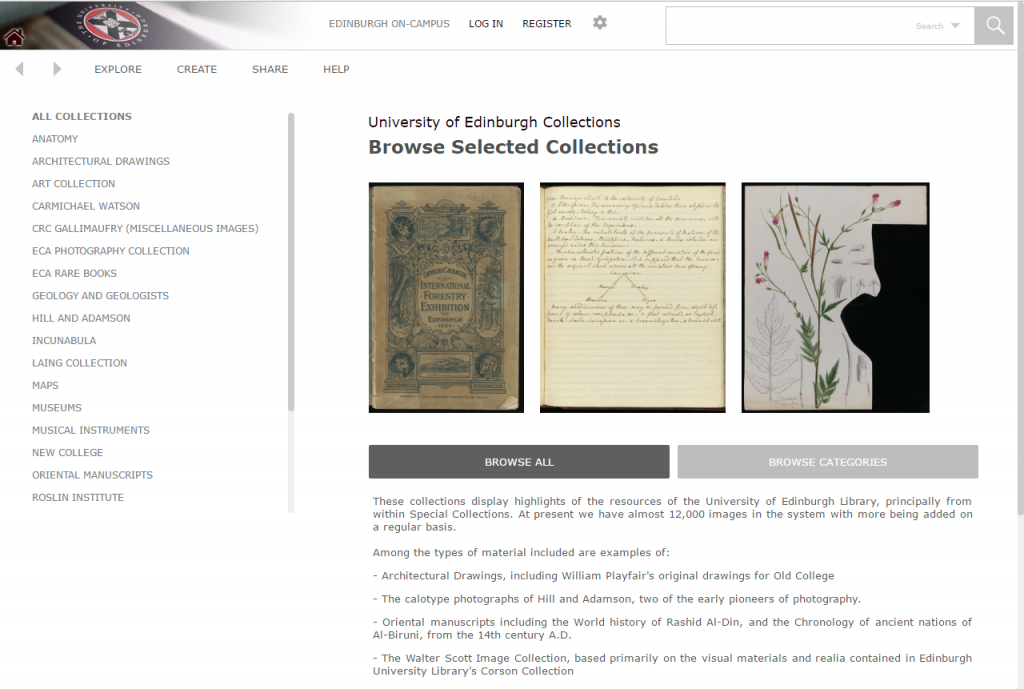
This week, and just scraping in before the end of the year, we upgraded the LUNA imaging platform to version 7.2. This is important to us for two reasons: the first is aesthetic, as the front-end interface has been completely overhauled and is much cleaner, more responsive and (basically) more modern; the second is that its implementation means we are now a IIIF-compliant institution. As always, the site can be found at http://images.is.ed.ac.uk.
What is IIIF?
There have been a few blogposts about IIIF this year, but they’ve been prospective and theoretical; now, we can talk about it as something we can genuinely offer. IIIF- the International Imaging Interoperability Framework- is a toolkit which allows open exchange with images, meaning that an image need only be hosted once for it to be disseminated anywhere. Yes, since the birth of the internet, we’ve been able to pull images into webpages using http links, but IIIF takes this to another level: its parameter driven URIs allow formatting to take place on the image without downloading it, taking it into (e.g) Photoshop and working on it there. A range of image viewers are IIIF-compliant, and these allow high-resolution zooming directly onto a webpage, or the performance of comparisons with other institutions’ content.
Since the Image API, which addresses the above, was written, new layers of IIIF have appeared:
- The Presentation API gives a shorthand which determines sequencing and display of selections of images, and lends itself well to comparisons. It includes Open Annotation extensions to allows users to, well, annotate images. The information that they add is stored in such a way that it can be discussed and rated by other users.
- The Authentication API gives users control over how items are accessed- not everything is able to be completely open.
- The Search API allows deeper search into the facets of the surfaced images.

How will we use it?
With LUNA as our IIIF server, we expect to be able to streamline a lot of our collections content. For example:
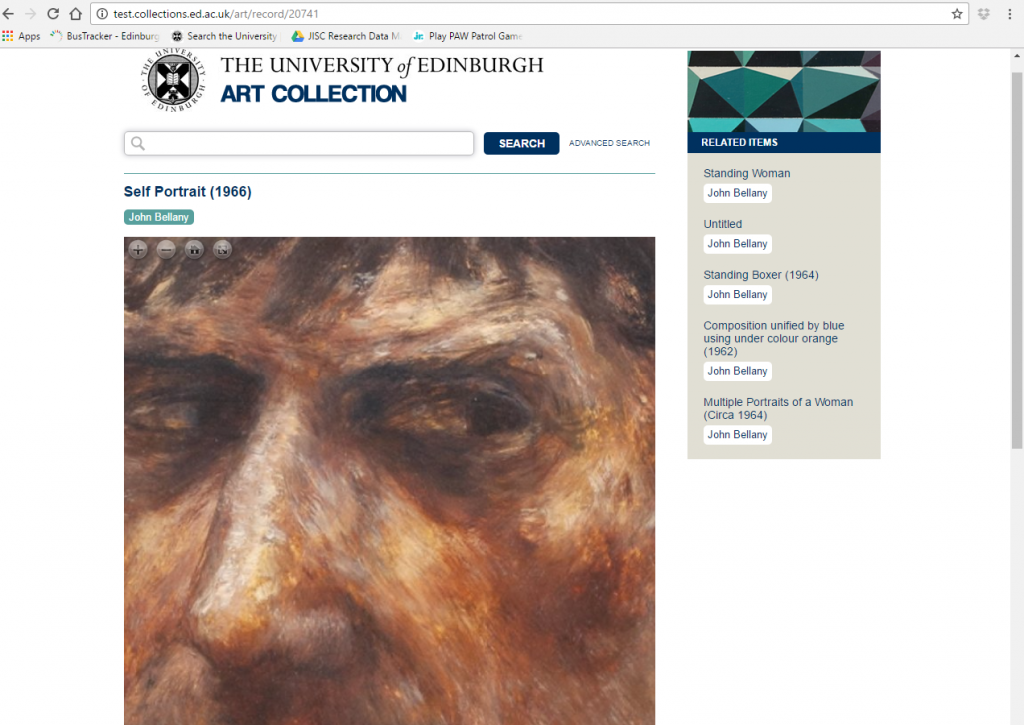
- collections.ed.ac.uk sites. Where we have a high-res image, we need an extra click to LUNA to see the full image. Using an embedded viewer such as OpenSeadragon or Leaflet, we will be able to zoom and pan the image directly on the page. This means we can effectively retire the LUNA front-end for these collections (and don’t need to worry about metadata getting out of sync!). This screenshot from the Art collection on test shows we’re working towards making this happen.
- Vernon/metadata games/anything that needs jpegs. These systems can reference URIs rather than storing images directly on the filesystem. This will save a lot of disk space and a lot of donkey work moving things around.
- Scottish Session Papers. This project is a collaboration among three institutions, and we intend to use the Mirador viewer as a front end to allow comparison across the content and to view the papers holistically.
- Polyanno. This amazing transcription and translation tool was developed in the summer by intern Erin Nolan, and will be available in the new year. It makes really good use of the Open Annotation extensions.
Try it!
This is a bit technical, but it’s verging on fun once you get your head round it.
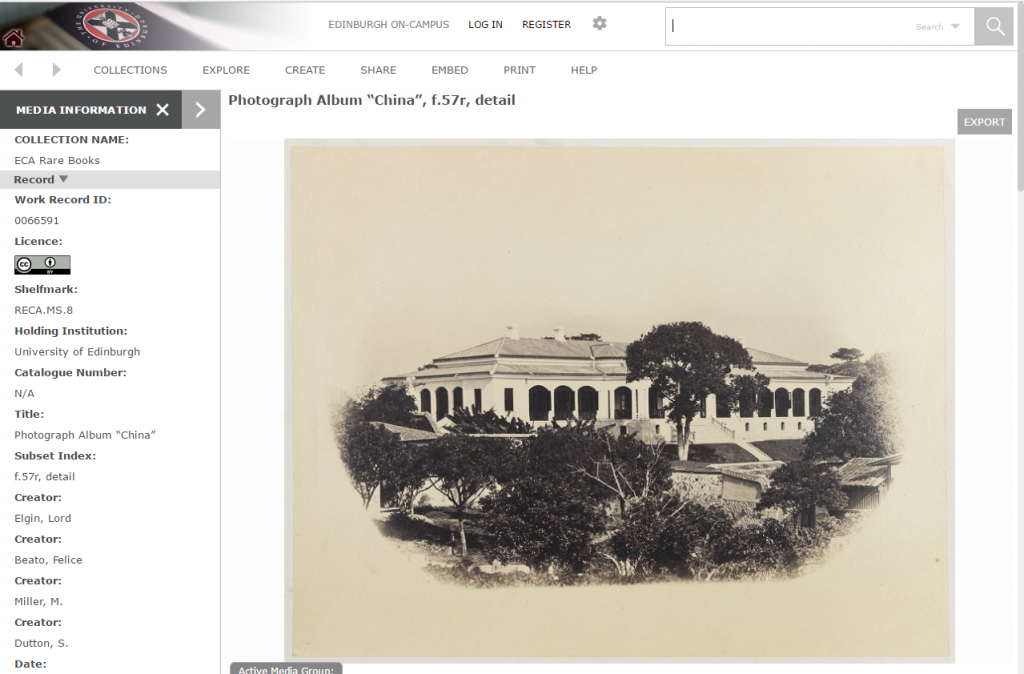
Pick an item in LUNA and copy the URL (obviously we do all of this programmatically!), for example:
http://images.is.ed.ac.uk/luna/servlet/detail/UoEwmm~3~3~61321~166317:Photograph-Album-%E2%80%9CChina%E2%80%9D,-f-57r,-de
…cut off the trailing text…
http://images.is.ed.ac.uk/luna/servlet/detail/UoEwmm~3~3~61321~166317
…replace ‘detail’ with ‘iiif’..
http://images.is.ed.ac.uk/luna/servlet/iiif/UoEwmm~3~3~61321~166317
…then add the parameter “path”, to get a working vanilla IIIF URL:
http://images.is.ed.ac.uk/luna/servlet/iiif/UoEwmm~3~3~61321~166317/full/full/0/default.jpg
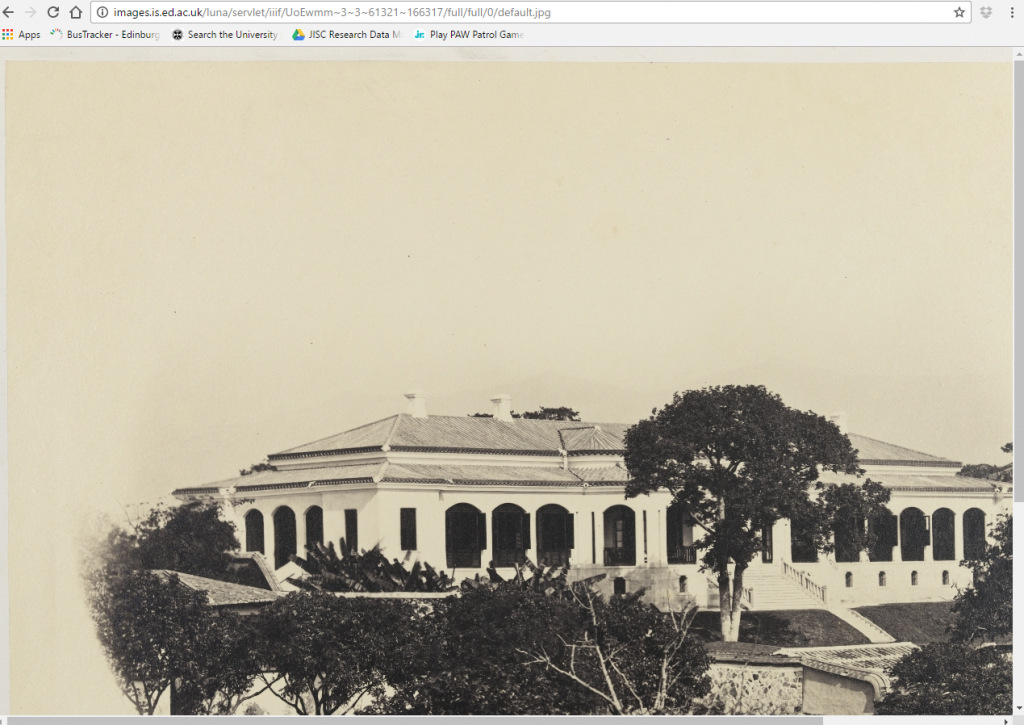
Now you can start formatting. Some of the things you can do follow, but you can see the full spec here.
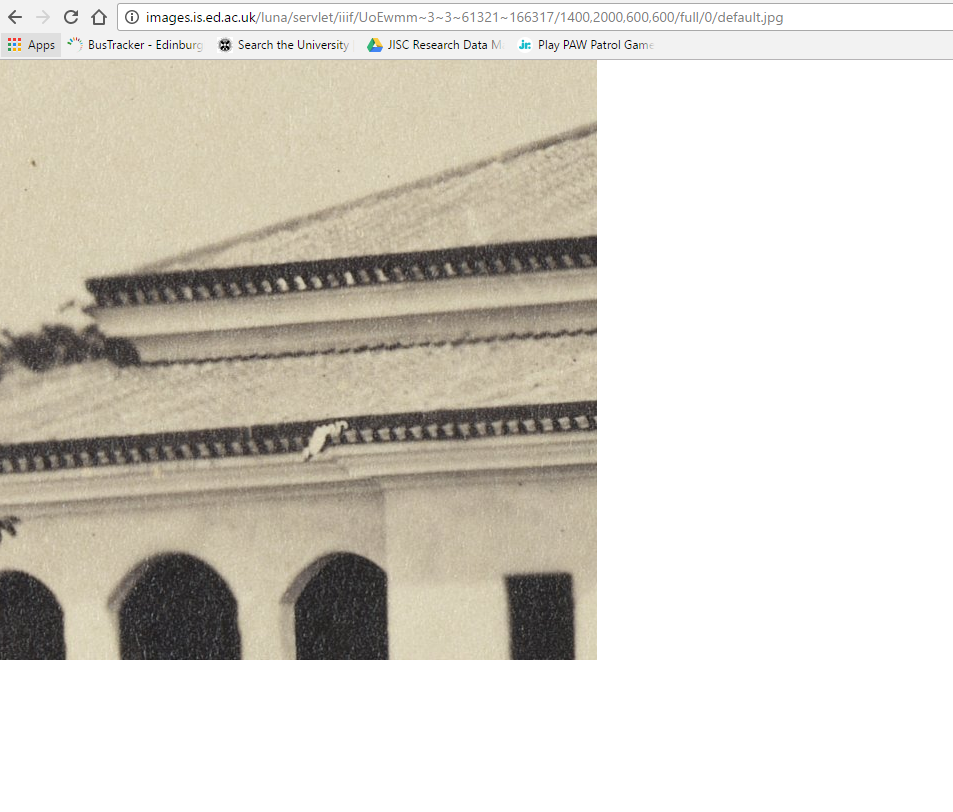
- Crop it (parameter 1):
http://images.is.ed.ac.uk/luna/servlet/iiif/UoEwmm~3~3~61321~166317/1400,2000,600,600/full/0/default.jpg
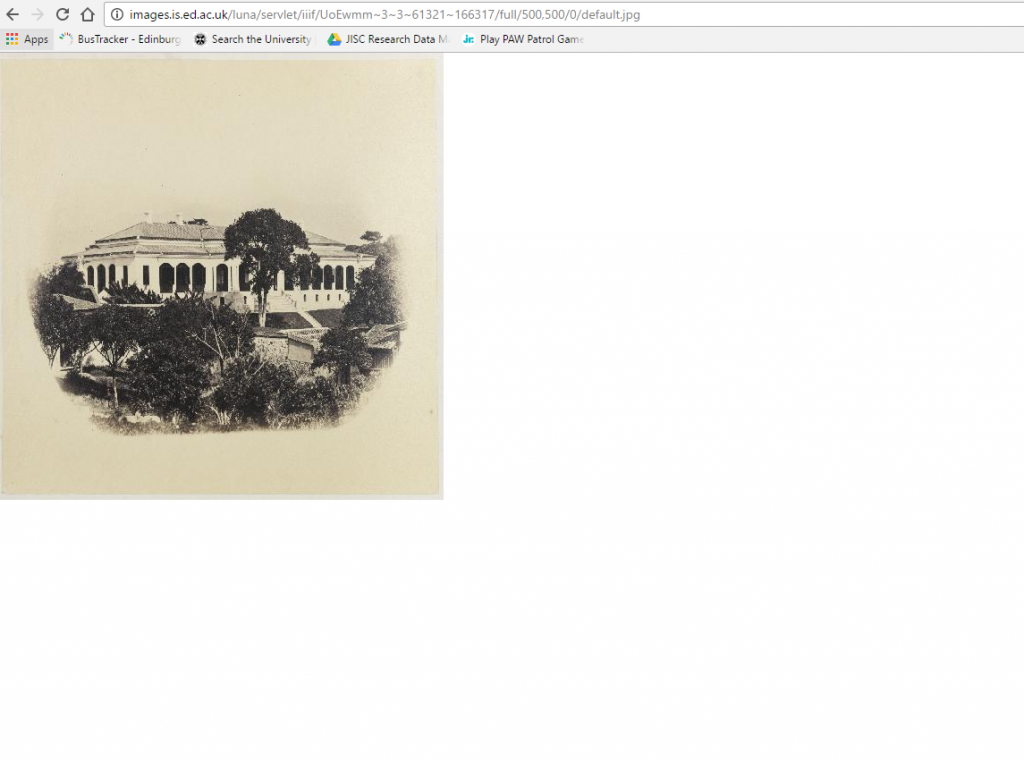
- Resize it (parameter 2):
http://images.is.ed.ac.uk/luna/servlet/iiif/UoEwmm~3~3~61321~166317/full/500,500/0/default.jpg
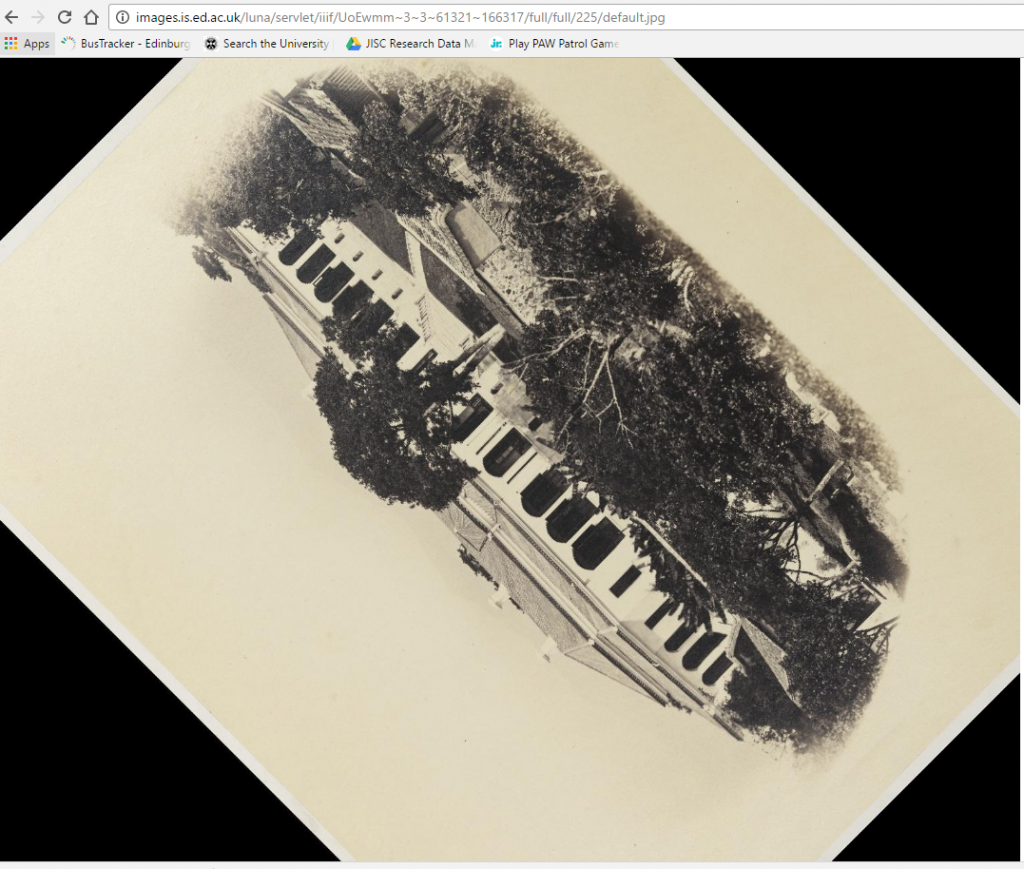
- Rotate it (parameter 3):
http://images.is.ed.ac.uk/luna/servlet/iiif/UoEwmm~3~3~61321~166317/full/full/225/default.jpg
I hope this sheds a bit of light on what we’re now able to do. We will try to keep everyone informed as IIIF developments happen over the coming year.
Scott Renton, Digital Development
Evaluation of Digital Cultural Resources in Glasgow

The revamped Kelvin Hall in Glasgow was the destination for the Scottish Digital Cultural Heritage Evaluation Network’s winter symposium, on December 12 and 13. Now the home of much of the University of Glasgow’s Hunterian Museum collection and the National Library’s Moving Image Archive, the Kelvin Hall is becoming the ultimate community space, continuing to host its leisure facilities amidst a burgeoning collection of museums objects. The juxtaposition, in fact, seemed particularly quirky to me, as I was sitting in a lecture theatre next to the 5-a-side courts I used to play on as a boy!
The thrust of the network, and thus the conference, was really about measuring the unmeasurable: how to find out the impact of digital discovery of museums objects beyond obvious KPIs such as analytics data and website hits. We are generally able to get this surface information quite easily, but it is much harder to quantify the social or legacy impacts and outcomes of putting cultural content online.
A number of institutions put forward papers highlighting their varied attempts to solve this problem. We became acquainted- thanks to Marco de Niet with the ENUMERATE framework which Europeana have integrated into their evaluations. It measures impact through a combination of quantifiable data, surveys and questionnaires. Laura Gottlieb at the imminently-opening Swedish Museum of Performing Arts, meanwhile, demonstrated the MIQS (Mixed Interactive Quality Study) toolkit, which used very useful approaches (again, largely survey-based) to this evaluation.
A much-photographed Europeana-run workshop put us in the shoes of museums decision-makers to think of different ways of looking at impact (they spoke of five lenses- utility, learning, legacy, existence, and community), to really consider how tools deliver outputs, outcomes, and ultimately impacts. I hadn’t really thought, before about the social cohesion, potentially leading to health benefits, that a digital collection could bring, but a strong case was made for it! Here’s the report.
It’s important for us to consider these questions, especially just now, with the re-opening of St Cecilia’s Hall upon us. The digital surfacing of the content is expected to be an integral component of the museum’s presence, so it’s important that we get it right. It’s also good to know that we can talk to the Hunterian- in the light of their recent major overhaul- about their experiences of a major change project.
Scott Renton, Digital Development
New books in the Library for History, Classics and Archaeology
Thanks to recommendations from members of staff and requests via RAB from students the Library is continually adding new books to its collections both online and in print. Here are just a (very) small number of the books that have been added to the Library’s collections in semester one, 2016/17 for the School of History, Classics and Archaeology and these demonstrate the wide range of subjects being taught, studied and researched within School.
–> Find these and more via DiscoverEd.
 From Constantinople to the Frontier edited by Nicholas S. M. Matheou, Theofili Kampianaki; Lorenzo M Bondioli (e-book)
Iron age hillfort defences and the tactics of sling warfare by Peter Robertson (shelfmark: GN780.22.G7 Rob.)
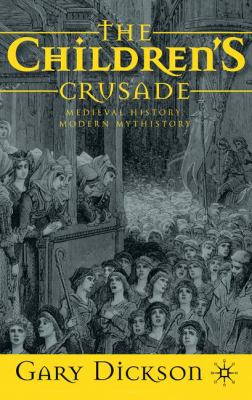
The Children’s Crusade: medieval history, modern mythistory by Gary Dickson (Shelfmark: D169 Dic. Also available as e-book).
Masculinity, class and same-sex desire in industrial England, 1895-1957 by Helen Smith (Shelfmark: HQ1090.7.G7 Smi.)
Classics renewed: reception and innovation in the Latin poetry of Late Antiquity edited by Scott McGill, Joseph Pucci (e-book). Read More
Oxford Handbooks Online – new e-books added

We have added the following Oxford Handbooks to DiscoverEd:
| The Oxford handbook of the Aztecs / edited by Deborah L. Nichols and Enrique Rodríguez-Alegría. |
| Oxford handbook of contemporary Buddhism / edited by Michael Jerryson. |
| The Oxford handbook of international climate change law / edited by Kevin R. Gray, Richard Tarasofsky, and Cinnamon Carlarne. |
| Late Victorian into modern / edited by Laura Marcus, Michèle Mendelssohn, and Kirsten E. Shepherd-Barr. |
| The Oxford handbook of British poetry, 1660-1800 / edited by Jack Lynch. |
| The Oxford handbook of the theory of international law / edited by Anne Orford and Florian Hoffmann. |
| The Oxford handbook of Islamic philosophy / edited by Khaled El-Rouayheb and Sabine Schmidtke. |
| The Oxford handbook of developmental linguistics / edited by Jeffrey L. Lidz, William Snyder, and Joe Pater. |
| The Oxford handbook of language and society / edited by Ofelia García, Nelson Flores, and Massimiliano Spotti. |
| The Oxford handbook of organizational identity / edited by Michael G. Pratt, Majken Schultz, Blake E. Ashforth and Davide Ravasi. |
| The Oxford handbook of Roman law and society / edited by Paul J. du Plessis, Clifford Ando, and Kaius Tuori. |
| The Oxford handbook of the economics of prostitution / edited by Scott Cunningham and Manisha Shah. |
| The Oxford handbook of Shakespearean tragedy / edited by Michael Neill and David Schalkwyk. |
| The Oxford handbook of the law and regulation of technology / edited by Roger Brownsword, Eloise Scotford, and Karen Yeung. |
Further Info.
The following Oxford Handbook subject collections are available to the University of Edinburgh – Archaeology, Business & Management, Classical Studies, Criminology and Criminal justice, Economics and Finance, History, Law, Linguistics, Literature, Music, Philosophy, Politics, Psychology, Religion up to the end of 2016 copyright year.
Winter Vacation at New College Library
 New College Library will close at 1pm on Friday 23 December 2016 and reopen again at 9am on Wednesday 4 January 2017. More details on opening hours for all University of Edinburgh Library sites over the holidays are available at : http://www.ed.ac.uk/is/library-opening. Read More
End of an Internship
Victoria Haddock, the second in a series of interns working on the Thomson-Walker collection, reviews her time spent at the CRC in this week’s blog post. If you’d like to find out more about this project, you can view Victoria’s end of internship Powerpoint presentation at the bottom of this article.
As I watch another beautiful sunset from the window of the CRC conservation studio, it seems a good moment to reflect back on the past 10 weeks of my internship here, which have absolutely flown by.
Although I did think on my first day that I was looking forward to 10 weeks of solid tape removal, the internship has been very busy, varied and with lots of opportunities beyond what I first expected.
New College Library books recommended by students
 Student recommendations are in at New College Library! The recently purchased Inherit the Holy Mountain: Religion and the Rise of American Environmentalism, edited by Mark Stoll, is available as an ebook via DiscoverEd.

Other student recommendations in the library include: Worship on the way : exploring Asian North American Christian experience by Russell Yee, at BR563.A82 Yee.
Read More
2nd C. Sculpture to Star Wars Props: 3D, a Force Awakens?
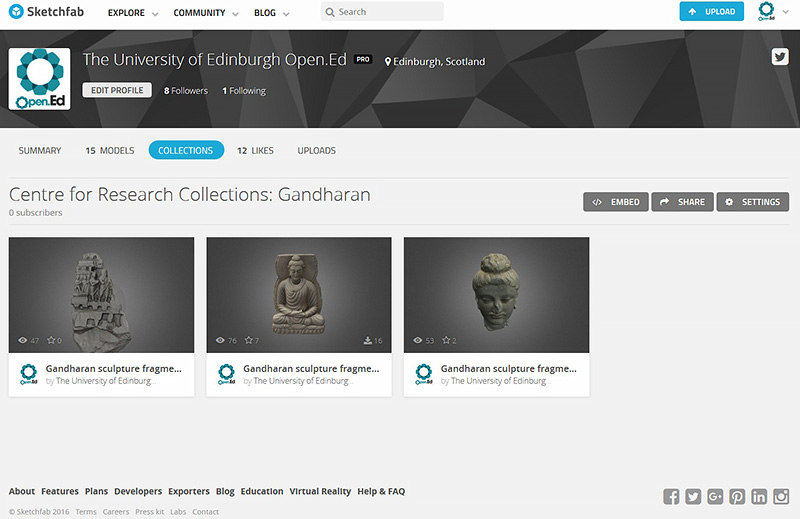
During a photogrammetry training session with Clara Molina Sanchez, we were recommended to choose objects with a matt surface, small to medium in size, and which didn’t have many holes or occlusions. We settled on a Gandharan Buddha from the Art Collection, a Paolozzi maquette from the Edinburgh College of Art collection and, just to test what would happen, a thigh bone trumpet wrapped in shiny metal filigree from the Musical Instruments collection.
The Statistical Accounts of Scotland Online – My statacc
This is the last in a series of blog posts about some of the functionality you may have come across (or may not have yet discovered!) in the new Statistical Accounts of Scotland Online. Here we concentrate on the new My statacc feature.
We have now introduced functionality to enable more personalisation when using the service. If you are a subscriber you can now save, annotate and tag individual pages, whole sections, illustrations and maps. You can use the star button to save. The label icon allows you tag items with one or two words of your choice, so that you can find them easily when you next visit (just type your words into the box), and the post-it note to write longer annotations which are stored alongside the item. If you are planning to coming back to a particular page, image or section, you can store information about why it is interesting, how it relates to your research or how you might want to use it.
These new features are designed to allow you to easily find and review content of particular interest to you. Tags and annotations are stored against your profile, and will remain there until you delete them. Just sign in and click on the My statacc red button on the top right of the page to find everything you have saved.

A page of the Statistical Accounts of Scotland showing personalisation features and the transcript. Screen-shot captured on Thursday 1st December 2016.
You can tag, annotate and save both sections and individual pages. Individual pages can be printed out and whole sections of the Statistical Accounts can now be downloaded as PDFs. You can even share what you have found on social media by clicking on the sharing icon and follow the links. Using these features is so easy – just click on the relevant icon and away you go!
We are particularly pleased to be able to offer such personalisation, which will help you to get the most out of your searching and browsing of the Statistical Accounts of Scotland Online. Please let us know what you think.
More information on all the features mentioned above, as well as others, can be found in the Statistical Accounts of Scotland Help Pages and the How to get the most out of the Statistical Accounts of Scotland online page. If you have any comments or queries please contact the EDINA Help Desk (edina@ed.ac.uk).
The Statistical Accounts of Scotland Online – Images and Words
This is the second in a series of blog posts about some of the functionality you may have come across (or may not have yet discovered!) in the new Statistical Accounts of Scotland Online. Here we concentrate on the images and maps, as well as the transcripts found on the website.
Images and maps
The new service contains a number of illustrations and maps published with the original accounts. Your search may result in a box containing the thumbnail views of related images or maps. As a subscriber you would be able click on these to view them (in a gallery view) in a much higher resolution than before. You are also able to zoom in and out, which is fantastic to be able to do! All other relevant images are on the left-hand side of the gallery view, making it easy to scroll and browse related illustrations and maps.
There are a number of interactive maps available in the service, which we are able to feature courtesy of the National Library of Scotland. One example is the map of Scotland on the homepage, where you can click on the map to open out a larger version, and as the mouse cursor moves over the map you will see the names of counties highlighted. There are also interactive maps available on the county pages, showing each of the parishes clearly within the county and allowing you to click through to more information on the parish.

The interactive map for the southern part of Northern Part of Ross and Cromarty Shires. Screen-shot taken from the Statistical Accounts of Scotland Online on Thursday 1st December 2016.
Transcriptions
Another greatly improved feature is that of the transcripts, which are available for most pages in the Statistical Accounts. The reading quality of the transcription has been improved through rendering the text in html, making it an even more useful to aid understanding when reading the Statistical Accounts.
We hope that these new features mean you get even more out of the wonderful wealth of information found in the Statistical Accounts of Scotland. More information on all the features mentioned above, as well as others, can be found in the Statistical Accounts of Scotland Help Pages and the How to get the most out of the Statistical Accounts of Scotland online page. If you have any comments or queries please contact the EDINA Help Desk (edina@ed.ac.uk).
Collections
 Hill and Adamson Collection: an insight into Edinburgh’s past
My name is Phoebe Kirkland, I am an MSc East Asian Studies student, and for...
Cataloguing the private papers of Archibald Hunter Campbell: A Journey Through Correspondence
My name is Pauline Vincent, I am a student in my last year of a...
Hill and Adamson Collection: an insight into Edinburgh’s past
My name is Phoebe Kirkland, I am an MSc East Asian Studies student, and for...
Cataloguing the private papers of Archibald Hunter Campbell: A Journey Through Correspondence
My name is Pauline Vincent, I am a student in my last year of a...
Projects
Cataloguing the private papers of Archibald Hunter Campbell: A Journey Through Correspondence
My name is Pauline Vincent, I am a student in my last year of a...
Archival Provenance Research Project: Lishan’s Experience
Presentation My name is Lishan Zou, I am a fourth year History and Politics student....