Home University of Edinburgh Library Essentials
May 10, 2026
Celebrating Success: Lyell’s Offprint Collection Fully Documented

Claire and Harriet proudly display the newly catalogued Lyell’s loose Offprint collection.
Hello, we are interns Claire and Harriet, who have now been working for 5 months on Charles Lyell’s Offprint collection held by Heritage Collections. In our first blog post, we covered how our work on these offprints was starting to reveal the extensive network of researchers and topics that Lyell was collecting and reading about. And we’re now finished!
Within this collection, we have worked through all sorts of sizes and types of Offprints, from larger folios (slightly bigger than A4), the smaller Offprints (roughly A5 size), as well as oversized, some miscellaneous items, as well as offprints of Lyell’s own published works. To date, we have now catalogued 1291 separate offprints and organised them into 32 boxes! Many have needed alphabetical reordering, where they have been previously misplaced or incorrectly labelled. It was especially satisfying to see this final re-shuffling and re-labelling of these boxes, now all under our new catalogued order.
But, we were not quite done! True to every other archive listing project (ever), we still had 22 bound volumes to tackle! Shelved along with other unaccessioned material, and originally part of the Geology Library, these volumes are embossed with the titles ‘Geological Tracts’ a somewhat vague title, that was assumed to point to various other organisations or societies. Some had titles, and numbers embossed on the outside, others were ‘unknown’, their place in the series unrecorded. In fact, these 22 volumes contain annotations by Lyell, and are a unique set, recording his reading.
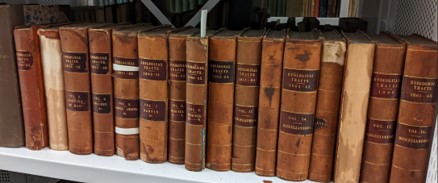
Lyell’s ‘Geological Tracts’
“Geological tracts Unknown Vol. 2”, “Vol. 5”, and ‘Vol. 7”, feature journal articles and book extracts discussing Charles Darwin’s Origin of Species, while volumes “Geological Tracts Vol. 3 Antiquity of Man”, “Vol. 5”, and “Vol. 11”, feature offprints on flint implements and geology in France. Each volume brings together as many as 33 different authors, all originating from different journals, with their own published volume numbers, page numbers – as well as Lyell’s own handwritten notes.
Papers about the Human species, their origin, their place within nature, and the different phases of human evolution within the geological/archaeological record, appear throughout, for example, Rolleston’s “Distinctive Character of brain of Man and of Anthropomorphic Apes” (Vol 2, 17) and Babbage’s (1859) “Chalk on human implements mixed with bones of extinct animals” (Vol 3, 16).
The bound volumes labelled “Miscellaneous” include assorted articles on geological formations, zoology, submergence, glaciation, plants, and the deep-sea from locations all over including: the Americas, India, Europe, Islands, with a higher proportion on England, Wales, and Scotland.
‘Tracts’ was a word that we had seen before – it had cropped up several times whilst cataloguing the other separate offprints, expressed in handwritten notes on their front covers. From this we have inferred that ‘Tracts’ refer to these bound volumes. We have also become familiar with the authors and contributors and their topics of interest, and recognised they were reappearing in these bound volumes, and that Lyell appears to collate the topics that he was most interested in. It has been incredibly rewarding to see the re-emerging connections, made possible from our work over the previous months, making more sense in these final bound volume offprints.
Finally, we have applied our deep understanding of Lyell’s Offprints, to his ‘Index Notebooks’.
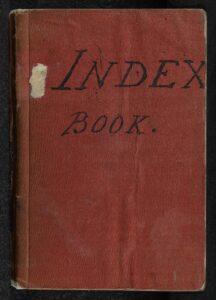 At the end of the series of Lyell’s Notebooks, there is a set of 16 index notebooks – but that title isn’t as clear as it seems. Our work has explored the relationship between these indexes, and Lyell’s reading, and it appears 13 of these notebooks are the key to unlocking the bound ‘Geological Tracts’. There are 2 General Indexes which relate to a series of 11 indexes, filled with Lyell’s reading, research, and correspondence notes. The second General Index (currently A5/12) lists alphabetically the names and papers of key researchers Lyell made notes on. This index lists where Lyell’s notes can be found inside both the Tracts and the series of 11 notebooks.
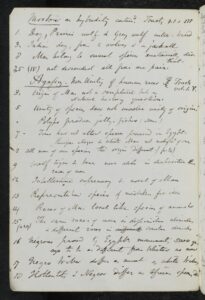 Aided by our comprehensive lists, we were able to put our theories as to how these records connect, to the test. For example, Lyell’s notes on Agassiz’s ‘Distribution of Animals’ is listed as Index 1.122 and Tracts 1.6. Therefore, these notes can be found in index book 1 (A5/15), page 122, and the paper itself can be found in Geological Tracts 1 entry 5 (Geological Society Vol. 1. 1850-1855). Because of this, we were able to correctly identify 2 volumes marked ‘unknown’, as ‘Geological Tracts‘ 6 and 12. We can piece together the whole set, and, recreate their original order – including some that are dated earlier, and may be their prototype!
Harriet and Claire’s internship has been funded by the Friends of the University Library – which is apt, given the relationship between Lyell’s archive, and, the Offprints, that technically form part of the book collections. The task of listing the voluminous Offprints must at times, felt never ending – and yet, the application of their knowledge, has meant we can now properly catalogue a crucial set of archival indexes, not to mention, extending Lyell’s network by several 100 people! Adding the detail of Lyell’s ‘reading’ to his other tools – of observation, collecting specimens, and correspondence- is a crucial part of the story of his contribution to how we understand the world today. Thank you both for your amazing efforts!
Preserving BITs – An Online Exhibition Featuring the Digital Preservation of a Central IT Bulletin at the University of Edinburgh
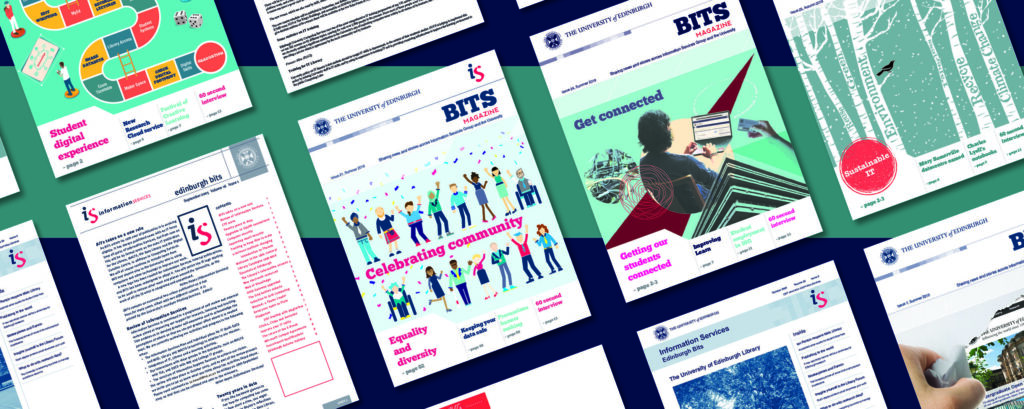 In 1990, Edinburgh University Computing Service (EUCS) launched the Bulletin of IT Services – or BITs for short. Produced by the staff in the EUCS team, BITs reported on the latest developments in communications and information technology at the University until Information Services was formed in the early 2000s. The newsletter charts the growth of technology in higher education, including staff email, the move to W3, virtual learning platforms, and new opportunities for distance and flexible learning. It provides insights into how the wider staff and student community responded to new technology services and the transformations enabled by growing infrastructure.
Neptune 1820 Convict Ship Voyage
Ash Mowat is a volunteer with the Civic Engagement team and in this blog explores the journals of James Mitchell from the 1820 convict ship voyage to New South Wales.
In this blog we shall delve into the journal of ship’s surgeon James Mitchell aboard the 1820 convict ship voyage from London to New South Wales, held in the University of Edinburgh Centre for Research Heritage Collections.
Biography of James Mitchell
Mitchell was born in Fife Scotland in 1792 and died in 1869.[1] He trained for and was appointed as a surgeon in 1813 and had a military career as a medic including service during the Battle of Waterloo. He travelled as the ship’s medic on two voyages to Australia before settling to live there in 1823. He later became a politician.
I viewed his journal,[2] which dates from March 1820 on board the Neptune[3] situated on the Thames before embarking on its journey to Australia and dating up until August 1820 when the ship made its return voyage back to London. Further information of the crew and organisation on board, including some details of the convicts can be found here.[4] The journal is only very rarely dated, unlike as in a diary, making it difficult to assess time lapses between entries.
The journal itself is slightly bigger than A5 in size and numbers in 151 pages. The handwriting is not always clear of legible, until to my eyes, so I was unable to read the notes in their entirety, although hope nevertheless that excerpts provided here provide a flavour of the author and of the voyage itself. In addition to Mitchell’s medical expertise and military background, he expresses throughout his profound Christian faith and a religious teaching is practiced and encouraged on board for all crew and indeed the convicts.
In an early entry he begins: “The Neptune sailed for Woolich on a sandbar, but from the stupidity of the pilot, who seems to be in his dotage.” It is interesting to here witness an early criticism of the navigation of the ship which we say echoed at the end of the journal on the return journey. He then records: “Next day we received the convicts in number 156 of them, 20 were boys! Amongst them was one Wharton, a lieutenant in the 48th regiment, the very regiment that is stationed in New South Wales. His crime was embezzlement, using a fictitious name in order to procure clothes, all arising from extravagance. This is a young fine-looking man, very tall about six foot two. He is of that family of Wharton’s….he is a nephew of Dr Wharton the poet laureate.[5] It is revealing here to learn how informed Mitchell is with regard to the crimes of those on board and their families, suggesting a good share of trust and rapport with them in his role as physician.
He goes on to detail a medical intervention on a convict, an old man of 70 years of age with various complications involving his hip. “The operation was performed and for some time even this promised very fair, but at last the discharge of matter was so great that he became hectic and he is now at death’s door.” No convicts reportedly perished on the voyage so it must be assumed that Mitchell’s surgery on this individual was ultimately successful.
Once the voyage is underway Mitchell cannot resist another opportunity to critique that navigation of the Neptune: “We have now sailed to Gravesend, but the stupid pilot being with us, we get aground again in the river, but providentially as the sand was soft, we sustained no injury”.
There follows another description of a convict and Mitchell’s account of them. “One of them, a very much fine-looking lad, and from his appearance you would be ready to suppose that being sent along with such wretches must have arisen from false evidence being given against him on some such cause. He has been for some time very much under my care. After he got better, he came up to me one day on deck and thanked me for all the trouble that I had taken with him. But alas, so much for his gratitude, smoot hypocritical countenance, he was discovered one night to have robbed his master of the whole of his tea which was found upon him….he begged forgiveness, yet with the crime being so flagrant…that I found it necessary for the use of discipline to make an example of him. Of course, I place no confidence in him afterwards.”
There a few striking issues arising from his comments above. The use of the word wretches to describe the convicts on general can be viewed as pejorative and one might hope that a professional physician would be less inclined to judgmental views, although we must take account of historic attitudes and of the fact that the Neptune was under hierarchical military jurisdiction. It is interesting also that in his initial appraisal of the convict he makes the dubious conflation between someone’s physical appearance and their moral character, a practice that was erroneously given valid medical consideration and later included into the pseudoscience of Eugenics. Perhaps Mitchell might have better benefited from the pitfalls of such assumptions as written by Shakespeare in Macbeth over 200 years previously, when early in the play King Duncan remarks that “there is no art to find the mind’s construction in the face.”
In a later note Mitchell relates another example of his medical interventions on board: “Shepherd was carried to the hospital on board the ship under my care, dangerously ill. However, by the mercy of God he survived under my care. I took him out of his irons as he had behaved since his arrival on board in a most exemplary manner. However afterwards I put them on again thinking this was a favorable opportunity when he had had the prospect of death so near his eyes.”
We learn, perhaps surprisingly, from Mitchell that there were women aboard, presumably wives of the crew: “What a wonderful providence that there should have been another woman on board giving birth. The first woman said to me as I had done everything so well that were I able to baptize the child. This I declined as it was out of my province, particularly as the child was healthy…..the Captain acquiesced when I asked him to do it.” Here Mitchell’s role as a physician on board extended to overseeing childbirth and displays his professionalism and modest in electing not to exceed his role in baptizing the child, but leaving this duty to the Captain.
In a later note Mitchell recounts a perilous episode of the coast of South Africa: In the shape of a sugar loaf and the crocodile rock, which from its name you may suppose is a very deceitful place being hardly visible above water. A most dangerous navigation which has hardly ever formerly been attempted. We are sailing at a great rate in the night, and have been hugging the coast too closely in endeavoring to round the cape. As a consequence, the ship experienced a close encounter, we would have been dashed on the rocks in the night, were it not for the actions of the Captain and crew.” The expertise of the Captain noted here, in contrast to the role of ship’s pilot who was previously criticized.
On arrival at Port Jackson Australia after 114 days travel Mitchell records: “One of the greatest views in my life, it has left an impression which will never be effaced. I could not help exclaim when I saw it from the beautiful countryside to be the place devoted as the abode of convicted felons”. Shortly after he makes the following troublesome observation:
“It is by far too noble, precious a country to be inhabited by such villains. No wonder that so many crimes are committed in England when they have it as the place of their banishment.” Again, the language here to describe the convicts seems jarring and unprofessional, and ignores the fact that they are being brought to Australia against their will to work.
After several months in Australia and situated at Batavia Mitchell records: “During the two months we have been here, I attended several ships in which almost the whole crew were suffering from this dreadful fever….providence favoured me to such that I neither lost an officer or man. But very different was the state of my own ship in spite of every exertion I could make both night and day. Large quantities of ardent spirits from which many were in a continual state of intoxication, such they might be much more liable to the deadly attack of the fever. Very few escaped from it (the fever), in the course of weeks we lost the 2nd Officer, who by the by was a drunkard and a notorious villain. We also lost 7 men by death. Some ships after this were more fortunate….14 Captains of different ships died in the space of 3 months.
Mitchell then goes on to make some observations on the policy of treatment of the convicts which are quite startling. “The only fault that I have to find with the Government, is that they are far too well treated, both in the way of accommodation, provisions, each convict being allowed two gallons of port wine on the voyage..more provisions than they could consume….many men give their surplus of porridge and soup to the pigs.” It is surprising to learn of alcohol being made readily available to the prisoners on board as one can imagine how that might make discipline aboard the voyage problematic, and it is easy to understand Mitchell’s concerns in this instance.
But then he continues “Is not this singular treatment to men who have been found unworthy to live in their native country and have been banished, some of them from their flagrant crimes had been justly sentenced to death by the laws of their country, but whose sentence has been commuted.” And he observes of an intervention he made saying “I got the Governor to put him to hard labour during his serving years, as a carrier of stones.”
The Neptune began its return voyage to England on 14th August, and on the 14th of November the ship docked at the Island of St Helena where Mitchell observed “I had an opportunity of seeing the cage that had contained one of the greatest men the world ever saw. It gave me more pleasure to see this island than it would have given me to see the coronation of George the 4th”. Given that Mitchell himself had served in the battle of Waterloo to defeat the enemy lead by Napoleon, is quite shocking to read these sentiments of his favour and respect for Napoleon seemingly taking ascendance over loyalty to the King, presumably sentiments that he reserved for this private journal.
In his final entry Mitchell recounts bad weather and a further concern with the ship’s pilot’s competence, placing his faith in God instead for their safe passage “having experienced a gale of wind in a dark night through a danger of navigation and with the bad pilot, we had to trust to the good pilot who alone can conduct us safely through the numerous dangers of this world.”
By today’s standards Mitchell’s use of disparaging and judgmental language comes across as jarring and contrary to the required skills of empathy and understanding that we’d expect from a doctor. However, such attitudes are representative of the time and given that this mission was under military jurisdiction with consequent hierarchies and levels of command. Furthermore, we have to recall that this is his private journal and he wasn’t therefore necessarily expressing these views to others or letting his opinions influence his professional duties as a doctor. Obviously, we only have Mitchell’s testimony of events to go by, but he appears to have been very committed to his work in as ships doctor to the prisoners and to have been respected by them for his expertise, efficacy and fair treatment of them. All of the prisoners survived the journey to Australia, unlike with the confusingly also named Neptune voyage of 1789, where almost one third of prisoners died on the voyage and the regime on board was far more brutal and cruel towards the prisoners.[6]
I should like to thank my supervisor Laura Beattie (Community Engagement Officer) at University of Edinburgh, and to all the staff at the Centre for Research Collections for their kindness and professionalism in enabling to view this historic notebook.
[1] James Mitchell (New South Wales politician) – Wikipedia
[2] Collection: Account of a voyage to New South Wales on the ‘Neptune’ by James Mitchell (1792- ), ship’s surgeon | University of Edinburgh Archive and Manuscript Collections
[3] Neptune (1780 ship) – Wikipedia
Music for Esther Inglis: August events
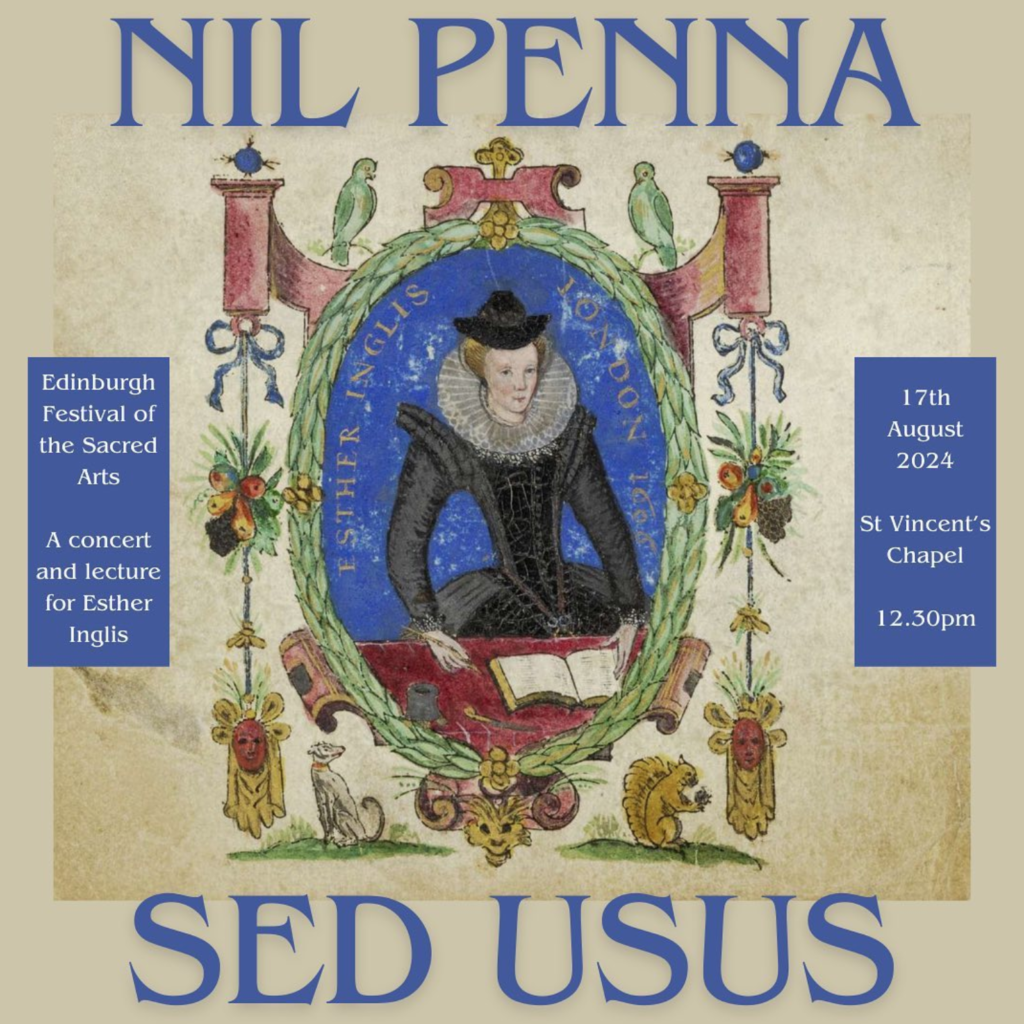
The Esther Inglis project has been gathering momentum behind the scenes, with plans now in place for an international colloquium, an online exhibition taking shape, many new digitisations of Esther Inglis’ manuscripts which can soon be shared, and several academic conference papers having brought Esther Inglis’ work to new networks and scholarly audiences.
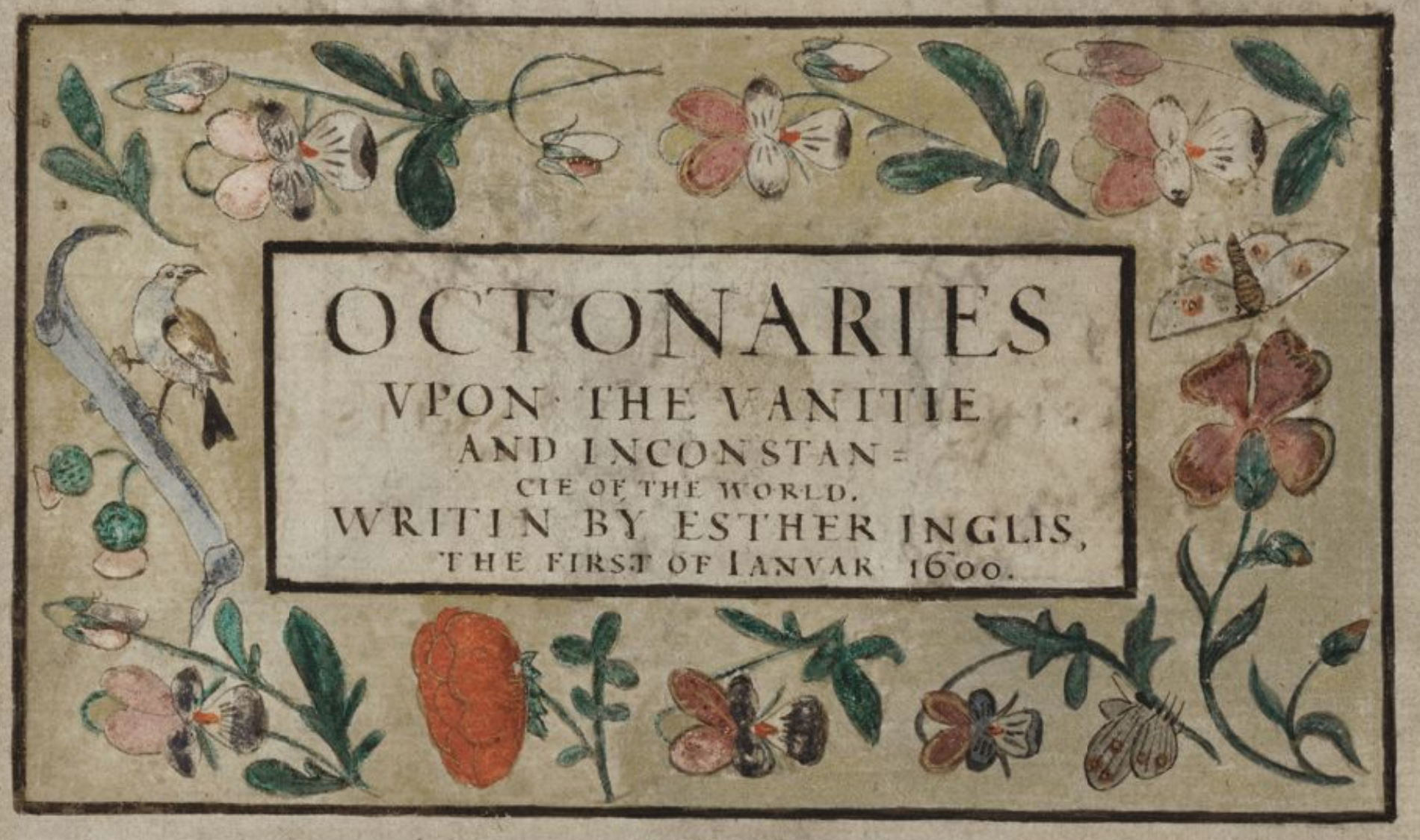
Title-page to Esther Inglis’ English Octonaries upon the Vanitie and Inconstancie of the World, translated from the French originals by Antoine de la Roche Chandieu. Folger Shakespeare Library, V.a.91
For those who are already in Edinburgh, there are two events relating to Esther Inglis and her manuscripts taking place in August, both with a focus on the music which surrounded Inglis in Jacobean Scotland, and the songs which shaped her calligraphic and artistic practices. Music was an important influence on Esther Inglis’ early construction of herself as a woman artist and writer; in her earliest self-portraits she depicts herself at her writing-desk together with a lute and an open book of music, following the 1567 portrait of the French Huguenot poet, Georgette de Montenay (1540-1581), from which Inglis works.
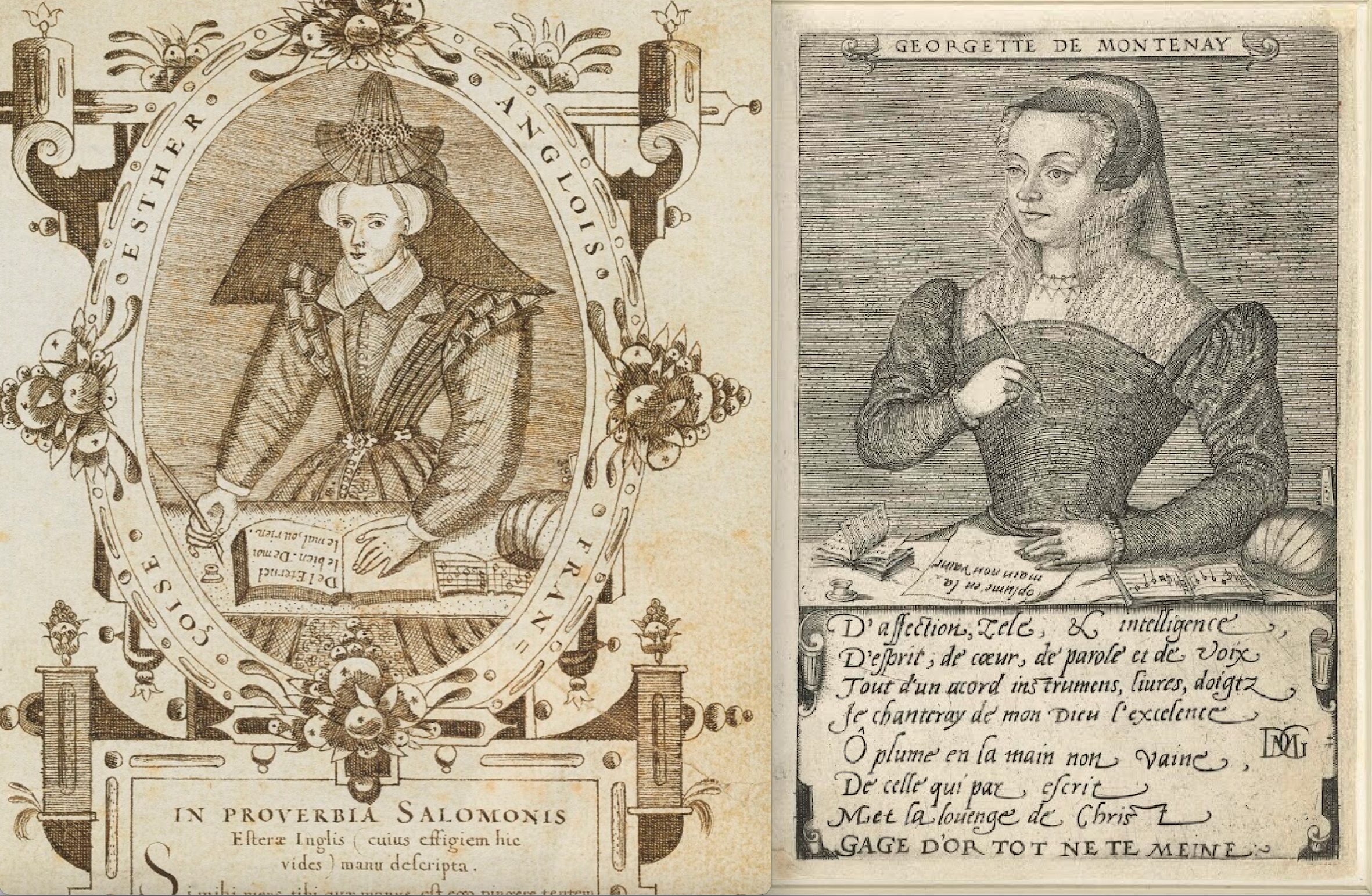
Self-portrait by Esther Inglis (1599), and engraved portrait of Georgette de Montenay (1567) by Pierre Woeiriot.
Bodleian Library, MS 990
On the 17th August, the beautiful Gothic space of St Vincent’s Chapel will host “Nil Penna Sed Usus: A Quartercentenary Event for Esther Inglis”. This immersive event will have two parts; the first will be a recital by the Sacred Arts Festival Singers, directed by Calum Robertson. The Festival Singers will perform selections from the works of Antoine de Chandieu and Guy du Faur. Chandieu’s Octonaires sur la vanité et inconstance du monde, and du Faur’s Quatrains are works of devotional poetry which Esther Inglis copied frequently into her own calligraphic manuscripts.
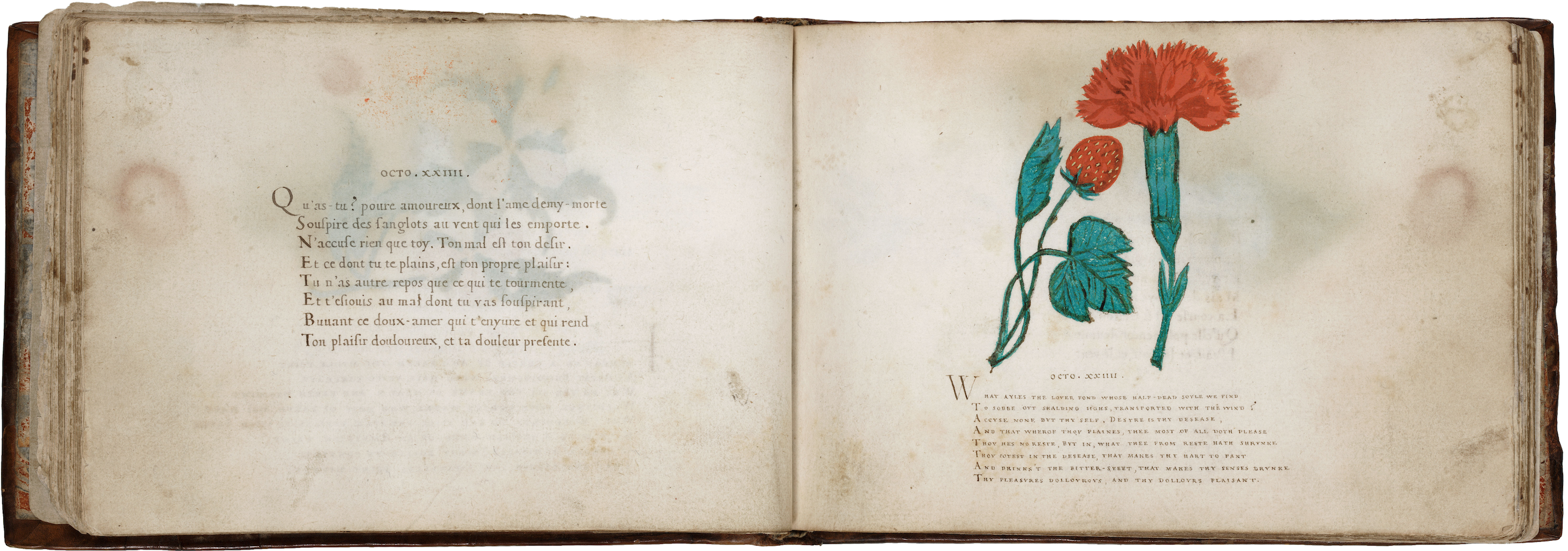
Octo XXIV from Antoine de la Roche Chandieu’s Octonaires sur la vanite et inconstance du monde, with facing English translation by Esther Inglis
Folger Shakespeare Library, V.a.91 (1600)
Of her 63 known books, 26 contain copies of these religious verses; either their French originals, or (in three cases) English translations of Chandieu’s Octonaires which Esther Inglis composed herself. Of these 26 mansucripts, 9 are made in Esther Inglis’ floral, illuminated style, embellished with painted botanical imagery and the verses copied in her characteristically wide range of calligraphic scripts. These devotional verses were set to music within Esther Inglis’ lifetime; settings of the Quatrains de Guy du Faur by Paschal de l’Estocart were published in 1582, for example, while Claude le Jeune (1530-1600) composed settings for Chandieu’s Octonaires.
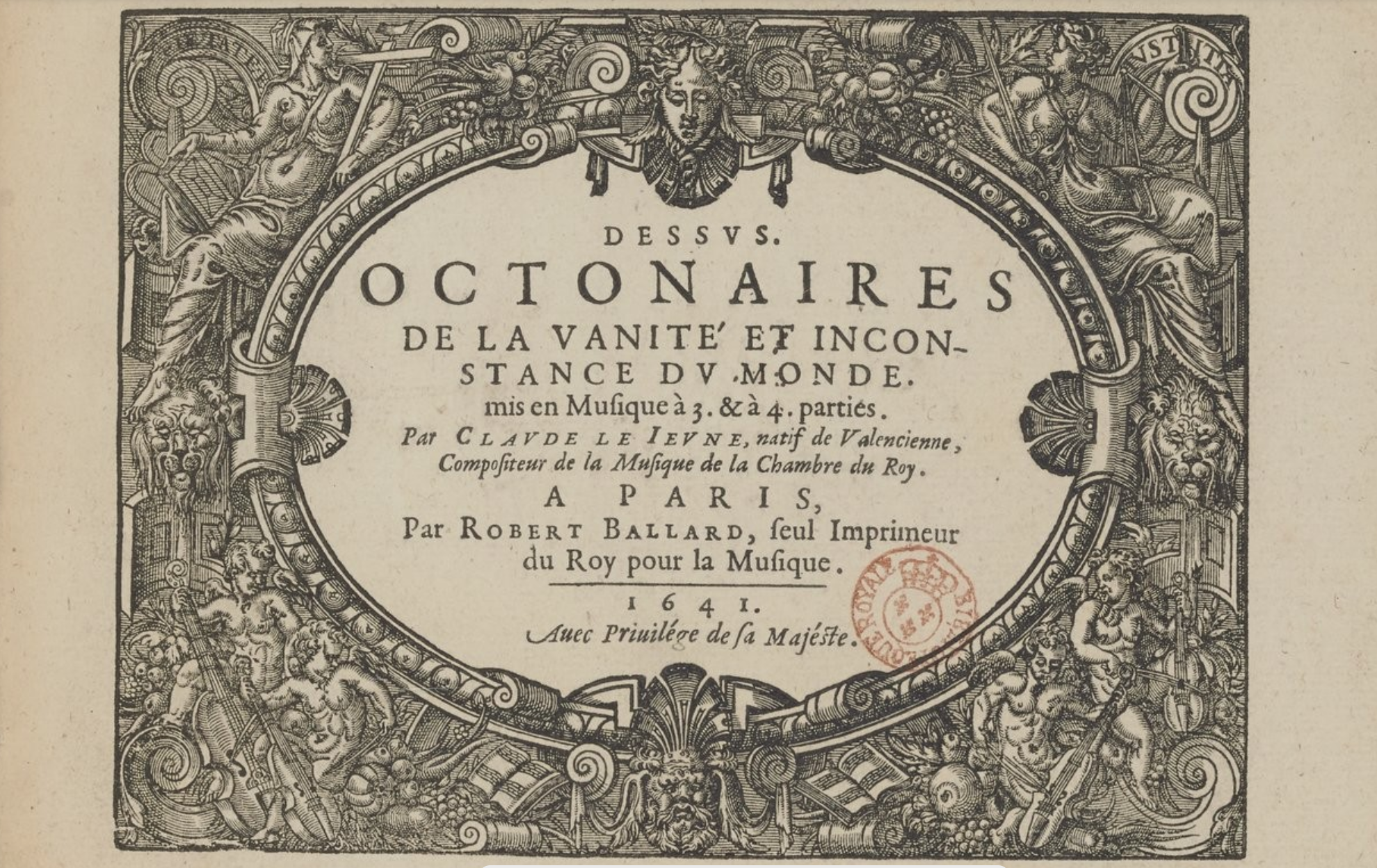
1641 publication of Claude le Jeune’s settings of the Octonaires sur la vanite et inconstance du monde, originally written by Antoine de la Roche Chandieu
Selections of these settings will be performed in St Vincent’s chapel, together with a series of metrical psalms and canticles which would have been sung in the services attended by Esther Inglis and her Scottish and French contemporaries. The second part of this event, taking place in the undercroft of the chapel, will be an introduction to the manuscripts of Esther Inglis, with particular focus on her copies of the verses which have been set to music. The result will be an immersive, multimedia event in which to understand the aural world which surrounds Esther Inglis’ work.

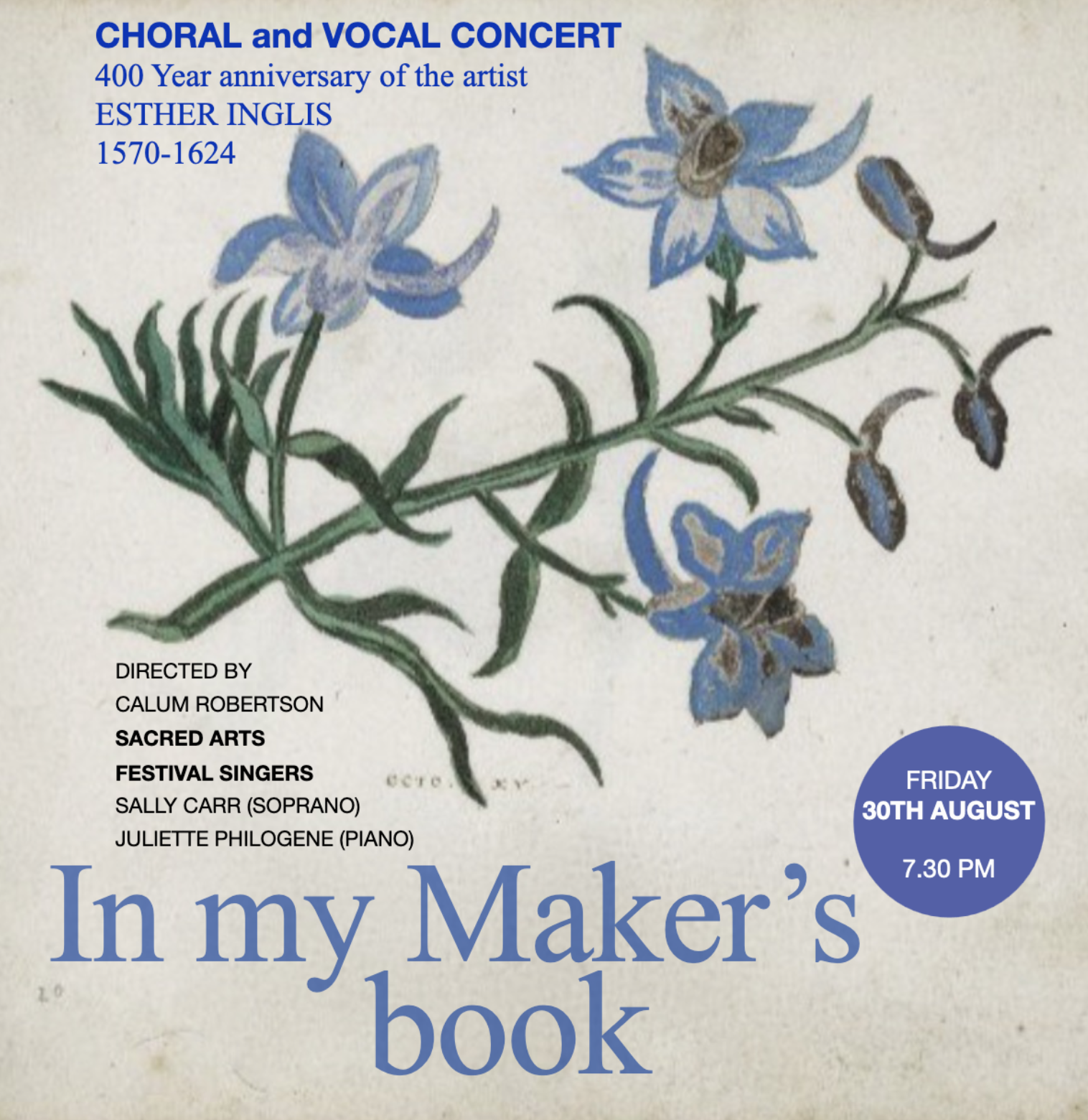
The second musical event, on the 30th August, will take place at South Leith Parish Church, a medieval church now 533 years old. This location must be close to where Esther Inglis herself lived; she died at Leith on the 30th August 2024. The event is entitled “In My Maker’s Book”, a line from the Nine Haiku for Esther Inglis written by Gerda Stevenson. These Nine Haiku have now been set to music by Sheena Phillips, and this event will offer the world-premiere performance of this newly-commissioned work, performed by Sally Carr (soprano), Juliette Philogene (piano) and Calum Robertson (clarinet and bass clarinet). Again directed by Calum Robertson, the Sacred Arts Festival Chorus will also perform musical pieces from Esther Inglis’ lifetime, including selections of the metrical Psalms, and further settings of the Octonaires sur la vanitie et inconstance du monde and the Quatrains de Guy du Faur.
For further details of this unique concert, please see the Eventbrite page.
Sir James Young Simpson
In light of the upcoming 300th anniversary of the University of Edinburgh’s School of Medicine in 2026, volunteer Ash Mowat looks to the archives to find out about Sir James Young Simpson.
In this blog we shall explore some items in the University of Edinburgh’s Heritage Collections, featuring the work of the pioneering medical figure of Sir James Young Simpson.
Simpson (1811-1870) was born in Bathgate (West Lothian, Scotland).[1] He became an undergraduate at the University of Edinburgh in 1825 (aged just 14), and after several years elected to study medicine as his specialism. By 1830 he had become an approved practitioner with the Royal College of Surgeons, and in 1832 achieved the MD (Doctor of Medicine Higher Degree). He began practices as a GP in Edinburgh, and at aged just 28 became the Professor of Medicine and Midwifery at the University of Edinburgh.[2]
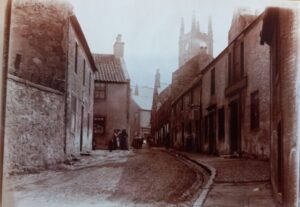
(Dr Simpson’s family home in Bathgate where he grew up, situated on the left).[3]
Despite his academic achievements, in his personal life Simpson suffered from episodes of depression but managed to recover and continue to expand his medical knowledge and expertise. Given his specialisms of Midwifery and surgery, an obvious area of his interest became the pursuit of a suitable anaesthesia to use. In 1847 he employed the use of Ether during a complex childbirth, but was not content with the efficacy of the treatment. He and several of his colleagues then began the hazardous tasks of experimenting on themselves with various, often toxic, substances. Later that year Simpson had acquired some Chloroform and after sampling this and witnessing its instantaneous inducement of unconsciousness, went on to promote his “Announcement of a New Anaesthetic Agent” that received widespread coverage in media and medical publications. It was soon adopted and widely used and acclaimed during surgical and complex midwifery cases, but was not routinely used during childbirth due to then unhelpful views on the “naturalness” of such pain during labour. Whilst Chloroform was by far the most effective and least risky anaesthetic then available, it was by no means entirely safe. However, it paved the way before safer alternatives could later be developed, and in the process greatly alleviated useless pain and suffering for so many.[4] In addition, in his services to to advancement of midwifery, Dr Simpson helped develop improved surgical instruments such as “Simpson’s forceps” and the Air Tractor, the first vacuum extractor to help with problematic childbirth.
As a result of his achievements in this filed, he was appointed Her Majesty’s Physician in 1947, and in 1866 became the first practising Doctor in Scotland to receive a Baronetcy. Simpson has a bust held at the Royal College of Physicians in Edinburgh, together with a sculpture of him located in Princes Street Gardens. Almost fifty years after his death, in 1916 the Simpson family bequeathed his former family home and former GP Surgery on Queen Street Edinburgh to the Church, and it is currently managed by the Charity Crossreach, to deliver free counselling and support for those affected by substance misuse issues.
Notes of Midwifery lectures given by Sir James Young Simpson taken down by George Dickson.[6]
I viewed this handwritten notebook of Dr Simpson’s lectures on midwifery and use of chloroform as notated by one of his students, located within the University of Edinburgh Library Heritage Collections. It offers a fascinating insight into the then available procedures, some of which were radical and advanced for the period, but also reveal the limitations of the technology during this time which have mercifully since been surpassed.
On a section on the gestation period for successful live human childbirth, the term abortion is used in place of what we now refer to as miscarriage or premature birth where the infant does not survive. Simpson observes that any child born at six months or earlier during this era was not viable and able to be saved, resulting in death, whereas nowadays 89% of children born at 27 weeks can be expected to survive, often without lasting disability or complications. In his lecture Dr Simpson helps dispel the myth that the size of the child at birth is any determinant of their general health and their life achievement prospects, citing that Sir Isaac Newton was small at birth, but became a pioneer and polymath in Physics, Mathematics, Astronomy and other fields, and lived until age 84.
Dr Simpson explains the vital need to carefully observe the patient during every childbirth to watch out for any emergence of problems and intervene swiftly and appropriately where they occur, cautioning that: “If you don’t and accident arise of complications, you get the blame for it. Therefore, set aside all engagements. In country may have to carry opium, in town nothing is required but a bottle of chloroform”.
Simpson goes on to challenge some assertions that have critiqued the efficacy and appropriateness of using chloroform as an anaesthetic. Under the charge that to do so is an unnatural medical intervention and that pain in childbirth is simply a matter for people (women only, obviously) to endure, he responds:” I mitigate suffering as well as prevent death”, hereby dismissing that charge and demonstrating the value of chloroform. Answering the accusation that using anaesthetic causes complications, Simpson responds “It stops convulsions. I cured a child of convulsions after 24 hours chloroform.” No anaesthetic including chloroform is every entirely safe, but this example of successful prolonged use of the drug is revealing as towards its comparative safety.
Another challenge that implies that using chloroform may precipitate bodily or mental diseases he simply rejects as “nonsense”. Interestingly he concedes under the Theories of how anaesthetics work to remark “can’t be explained”. Perhaps surprisingly this remains the case, with a full understanding on the exact mechanisms of general anaesthesia not yet established.[8]
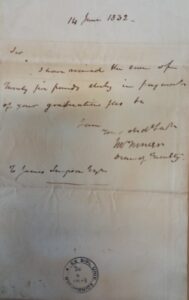
(The above receipt for Dr Simpson’s fees following graduation. Totalling £25.00 for seven years of university arts and medical training, this is equivalent to around £3500.00 today, which seems surprisingly affordable).
Extracts of letters of Margaret Buchanan Robertson relating to treatment by Professor James Young Simpson 1857-1959.
I viewed the above, held by the Lothian Health Services Archive within the University of Edinburgh Library.[9]
The letters were written by Margaret Buchanan Robertson to her mother in Australia. Her mother had immigrated to Australia in 1822 with Margaret born there, only to return to Edinburgh with her sibling in 1826 aged 24. The letters reveal much about her health issues and of the treatment received as a patient of Dr Simpson.
In a letter of 9/3/1857 she comments, “providence has been very kind and many blessings I enjoy which I strive to be thankful for, but from bad health I am often sadly depressed, languid and ill, but lately I am better, and the Doctor says he hopes to see me quite well and strong, but I am not as sanguine as he is. It is an internal complaint which causes a constitutional delicacy. I have been under the celebrated Dr Simpson’s care for three years and must say he has done me much good and without receiving a proper reward for all his kindness. Twice I have staid (sic) with his family home that he might watch the complaints, but it must run its course.”
In a further letter of 11/5/1857 she writes: “Mrs Hogg has been a kind friend to me and loves me as a sister. I must tell you how we became known to each other. We were both attending the great Dr Simpson and you must know you can only see him by the ticket. She had number 40 and I had number 7, which would admit me several hours before she would. She told me her sorrows and also that she had lost her little girl a few months before…She had been advised to consult the greatest man of the age, so she had come and hoped he might be able to restore her and if God thought fit, she might be blessed with an heir. I exchanged my ticket (with her) and it was with reluctance it was taken. She saw the Doctor and he cheered her telling her that if her general health was restored, she might have a family, but she must not be impatient. She remained a week under his care and in about a year she wrote asking me to come and visit her and just before leaving for home she told me that I might expect to hear of the arrival of a wee stranger, so this is the foundation of our friendship”.
Some years later in a letter of 16/2/1859 she observes: “My health I am thankful to say is much better since I had a very severe attack of nettle rash (Hives). The eruptions were all over my body, fortunately my face excepted for the marks are still on my hands, arms and body. My kind friend Dr Simpson said he thought my health would ultimately be better, but that I must be very careful of myself. He has been like a father and has refused to take renumeration from me saying “wait until you are cured dearie” It is most kind of him, he is most generous and many are the good deeds he does that will never be known in this world, but in the next he will receive his reward.”
The testimony in these letters brilliantly demonstrate the expertise, compassion and generosity of Dr Simpson and of the importance of his specialism upon the lives of many women under his care. In summary, Simpson devoted his professional career in the field of alleviating pain and suffering, and in saving lives that could otherwise be lost in childbirth or surgical procedures. I should like to thanks all staff at the University of Edinburgh Heritage and Lothian Health Services Archives for enabling access to these documents, and to Laura Beattie (Community Engagement Officer) for supervision and support.
[1] https://ourhistory.is.ed.ac.uk/index.php/Sir_James_Young_Simpson_(1811-1870)
[2] https://en.wikipedia.org/wiki/James_Young_Simpson
[3] Archives Space Public Interface | University of Edinburgh Archive and Manuscript Collections Seven photos relating to Sir James Young Simpson (Section DC.2.85s/DC.2.856
[4] https://www.rcpe.ac.uk/heritage/college-history/james-young-simpson
[5] https://www.crossreach.org.uk/our-locations/simpson-house-counselling-recovery-service
[6] Collection: Notes of midwifery lectures given by Sir James Young Simpson, taken down by George Dickson | University of Edinburgh Archive and Manuscript Collections
[7] Premature birth statistics | Tommy’s (tommys.org)
[8] General anaesthesia – Wikipedia
[9] Collection: Robertson, Margaret Buchanan | University of Edinburgh Archive and Manuscript Collections
RESPIRE Fellowship
This is a guest blog post from Tapas K Mohanty, Informatics & Data Science Liaison Officer for the RESPIRE project, who recently dropped by for a visit. Tapas, who is based at the KEM Hospital Research Centre in Pune, India, was here on a RESPIRE Fellowship to meet with his Edinburgh-based RESPIRE colleagues. Of course, he was mainly here to hang out with the cool kids: viz. Research Data Support.
If that wasn’t exciting enough, Tapas was also one the many very amazing presenters at this year’s Edinburgh Open Research Conference. Amid the whirligig of fun and excitement, he found time to jot down some thoughts on what was a Very Good Day. These are they:
Wednesday 29th May: a good start. Setting out for Pollock Halls, where the Open Research Conference was being held, I found Kitty Flynn, a RESPIRE colleague, on the same bus. Kitty was coming along to cheer me on during my presentation.
The conference opened with a thought-provoking Plenary Panel featuring Nick Wise, Rowena Lamb, Malcolm MacLeod, and Katie Nicoll Baines. Together, they explored the intersection of research culture change and Open Research. Key considerations included the delicate balance between policies and international collaboration. Notably, while discussing the legacy of racism in scholarly research institutions, the panel acknowledged its existence and advocated for a shift from blame-culture to accountability as the only way to effect real change.
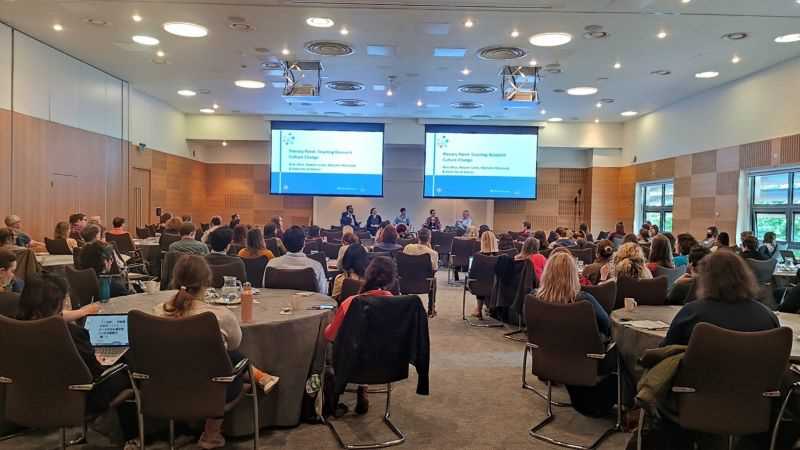
Plenary panel discussion – Photo credit: Tapas K Mohanty
Session One focused on Education, Skills, and Recognition. Lee Murphy opened the session with a technician’s viewpoint on the dominant academic perspective, which rarely credits technical support staff. Second was Haley Eckel, who described the introduction of Data Management Plan requirements for PhD students at the University of St Andrews. Third and last, Nik Tahirah Nik Hussin & Veronica Cano talked about the Contributor Roles Taxonomy (CRediT).
Next came the lightning talks, with me as the first presenter. Stepping up to the microphone, my heart raced and my throat felt dry. Brittany (another presenter) reassured me. Nervously, I wondered if I could finish within 5 minutes. My subject was an Open-Source Hardware initiative to enhance MRI accessibility in India’s low-resource areas. Ignited by last year’s Open Research Conference, the project will be hosted by Pune’s KEM Hospital Research Centre with support from PTB, Berlin, and GOSH (Gathering for Open Science Hardware). Utilising open-source designs, the initiative seeks to expedite the diagnosis of traumatic brain injuries in rural regions, ensuring essential medical technology is available wherever it’s needed.
The other speakers in this session were:
- Nicola Osborne, ‘Nurturing responsible data practices in creative industries R&D through applied ethics and open research practices.’
- Rachel Steeg, ‘Making iPSCs FFAIR.’
- Tom Morley, ‘From compliance to culture: How can we address the barriers that are preventing a culture of Open Research in relation to Open Monographs?’
- Dominic Hewett, ‘Humanities researchers’ perspectives towards scholarly communication practices’
- Brittany Blankenship (on behalf of Kasia Banas), ‘See one, do one, teach one: Teaching Open Research Skills for Data-Driven Innovation in Health and Social Care.’
Stuart King opened the final session on Next Generation Metrics and Recognition with a talk on preprints and reimagined of peer review. Lucy Woolhouse followed, returning us to the topic of credit and attribution. The legendary Marta Teperek came next, outlining the Netherlands’ strategic investment in Open Science, an investment that seeks to cultivate a research environment which prioritizes quality, equity, and inclusivity. Marisa De Andrade closed the session by challenging traditional research metrics through the lens of her new book on knowledge justice. She argued for methodologies that consider the lived experiences of marginalized communities and promote research that tackles inequalities.
The conference closed with a poster session in which presenters delivered one-minute, rapid-fire talks on their posters.
I can honestly say that this trip to attend the Open Research Conference will forever be in my memory. I will always remember the presentations and the people I was able to meet. It was an exciting day for new learning and it left the mark of an enriching experience.
Highlights from The Witness
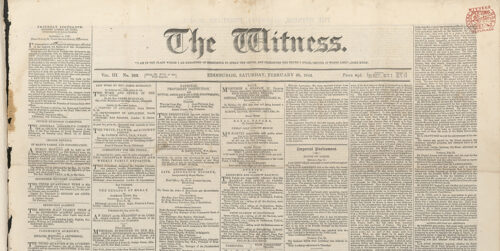
We’ve been working on digitising The Witness for quite some time now. Here’s a little background information from our previous post on the publication: ‘A twice weekly newspaper, The Witness was created by the Church of Scotland in 1840 and edited by Hugh Miller, an influential writer, geologist and stone mason. In 1843 The Church of Scotland was faced with 200 ministers walking out citing political interference, an event which came to be known as the Disruption and led to the Free Church being established. Presbyterianism is founded on the basis that the people make the decisions, not an elite hierarchy, and the only head of the church, is God. This makes The Witness newspaper a fantastic primary source covering a significant event in Scotland’s social and religious history, and as such, a prime candidate for digitisation.’
As the editions are bound into large format volumes, we decided to contract the digitisation to a company called Autodocs. Digitisation operators Miranda and Marian then took over the quality control and processing of the files and made some fun discoveries along the way – let’s hear from them!
AI vs the Imago Dei : views from US theological libraries

Computer17293866, CC BY-SA 4.0 , via Wikimedia Commons
On Tuesday 18 June, I flew half way around the world to attend the Atla conference in Long Beach, California. There were two questions that Atla delegates asked me that I had to pause and think about to answer. The first was ‘Why did you come such a long way to attend this conference?’ (the second was ‘Are you the library director? – well … no.). To answer the first, I was able to attend the Atla 2024 conference due to a generous travel grant from Atla itself, support from BETH (European Theological Libraries) and support from ABTAPL UK & Ireland. I was attending as a UK representative of BETH, but I also wanted to attend because of the unique theological library context, and because attending an international conference is a great learning experience. As at professional development events in the UK, AI dominated the agenda – here are some conference highlights.
Grand debut into Heritage: A Peek into my Collections Care Assistant Role
Isabela Tapia Hernandez
The Collections Care Assistant role was created for our students to explore the cultural heritage sector through employment and support their career aspirations post-graduation.
This is the second of three blog posts detailing their time with us!
Trial access to Japan Digital Archives Center online collections
The Library has trial access to four online collections from the Japan Digital Archives Center:
- Records of Cabinet Intelligence and Research Office (CIRO): Minro Shigaki Papers Online
- Prefectural Statistics Online
- Documents Related to Tokyo Trials and War Trials
- Collection of Magazines on Japanese Mass Entertainment and Sexual Customs Online (1950s – 70s)
For more information about these collections, and to access the trials, visit the E-resources trials page. Trials access for all four resources lasts until 15 August 2024. Please note that off-campus access is via VPN only.
Please remember to give us feedback to help us make a decision about subscribing using the E-resources Trial Feedback Form.
Collections
 Hill and Adamson Collection: an insight into Edinburgh’s past
My name is Phoebe Kirkland, I am an MSc East Asian Studies student, and for...
Cataloguing the private papers of Archibald Hunter Campbell: A Journey Through Correspondence
My name is Pauline Vincent, I am a student in my last year of a...
Hill and Adamson Collection: an insight into Edinburgh’s past
My name is Phoebe Kirkland, I am an MSc East Asian Studies student, and for...
Cataloguing the private papers of Archibald Hunter Campbell: A Journey Through Correspondence
My name is Pauline Vincent, I am a student in my last year of a...
Projects
Cataloguing the private papers of Archibald Hunter Campbell: A Journey Through Correspondence
My name is Pauline Vincent, I am a student in my last year of a...
Archival Provenance Research Project: Lishan’s Experience
Presentation My name is Lishan Zou, I am a fourth year History and Politics student....