On Wednesday 8th May 2019, The Church of Scotland is hosting a conference, organised by the Theological Forum. The conference, Westminster, Confessions and the Church, will run at New College, Edinburgh. Speakers from Scotland and elsewhere will explore different aspects of the theology and status of the Westminster Confession.

The Humble Advice of the Assembly of Divines… (New College Library, Special Collections MH. 319)
Background
The Westminster Confession of Faith is one part of the Westminster Standards drawn up between 1643-1649 by the Westminster Assembly which consisted of over 100 participants from theological and parliamentary backgrounds, brought together to restructure the Church of England. Several Scots attended the Assembly and the Church of Scotland adopted the Assembly’s recommendations, including the Westminster Confession which, together with the Larger and Shorter Catechisms, became the standards of doctrine for many Presbyterian churches around the world.

An Explication of the Article of the Confession of Faith (New College Library, Special Collections MSS WES 3.2) – temporarily unavailable for consultation due to conservation work.
From its inception, the Westminster Confession has attracted criticism, not least because, by its nature, it has to rely on man’s interpretation of the scripture and that will always be open to question. Nevertheless, its longevity bears witness to the exceptional effort made by, and the effectiveness of, those who gathered in Westminster in the mid-17th century to offer their very human advice regarding ‘a confession of faith: with the quotations and texts of scripture annexed’.

Confession of Faith 1690 with signatures (New College Library, Special Collections MSS WES 3.1)
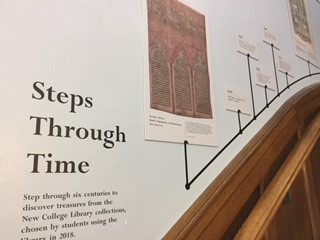
From 1st-31st May, an exhibition related to this conference will run in New College Library.
If you are interested in seeing specific copies of related Special Collection items which are not included in the displays, please contact staff at the Helpdesk.
Bibliography
https://en.wikipedia.org/wiki/Westminster_Assembly
https://en.wikipedia.org/wiki/Westminster_Confession_of_Faith
https://en.wikipedia.org/wiki/Westminster_Standards
An explication of the Article of the Confession of Faith of the Church of Scotland chapter 2 3 & 4th, namely that infidelity or difference in religion doth not make void the Magistrat’s just and legal authority &c. (New College Library, Special Collections MSS WES 3.2)
The Confession of Faith agreed upon by the Assembly of Divines at Westminster, with the assistance of Commissioners from the Church of Scotland – approved by the General Assembly 1647, and ratified by the Parliament of Scotland 1690. With the formula for the subscription of ruling elders. (New College Library, Special Collections MSS WES 3.1)
The Humble Advice of the Assembly of Divines, now by authority of Parliament Sitting at Westminster, concerning I. A Confession of Faith: II. A larger Chatechism. III. A shorter Chatechism. Presented by them lately to both Houses of Parliament. Westminster Assembly (1643-1652) Edinburgh : Printed at London and reprinted at Edenbrough ; MDCXLVIII [1648. (New College Library, Special Collections MH. 319)
Gina Headden, IS Helpdesk Assistant, New College Library





 Flavius Josephus Online is the first comprehensive literary-historical online commentary on the works of Flavius Josephus in English including the Greek text by Niese from the late 19th century. About 65% of the project is complete, consisting of Life, and Against Apion, book 2 of the Judean War, and books 1-11 and 15 of the Judean Antiquities.
 The Littman E-Library of Jewish Civilisation has over 30,000 pages of leading research in Jewish studies from Arthur Szyk: Artist, Jew, Pole to The Zohar: Reception and Impact. The LEJC includes international perspectives on Jewish civilization from scholars across the world, including the USA, Israel, Germany, Poland, and the UK.
 The Textual History of the Bible Online (THBO) is unique in providing, for the first time, a cross-searchable platform with all available information regarding the textual history, textual character, translation techniques, manuscripts, and the importance of each textual witness for each book of the Hebrew Bible, including its deutero-canonical scriptures. In addition, it includes articles on the history of research, the editorial histories of the Hebrew Bible, as well as other aspects of text-critical research and its auxiliary fields, such as papyrology, codicology, and linguistics.