“[Charles Lyell’s] cultivated mind and classical taste, his keen interest in the world of politics and in the social progress and education of his country, and the many opportunities he enjoyed of friendly intercourse with the most leading characters of his age, make the letters abound in lively anecdotes and pictures of society, constantly interspersed with his enthusiastic devotion to Natural History.” -Katherine Lyell, Life, Letters and Journals of Sir Charles Lyell, Bart, 1881
To mark 7 months working with the Lyell collection, I’d like to share some discoveries I’ve made while cataloguing these amazing notebooks, and researching Lyell’s published works. Lyell today is known for his great discoveries of the Earth, and the elevation and establishment of the science. Here, we see Lyell’s other interests.
Discoveries:
- Charles Lyell was deeply interested in the role of universities and education in society. He writes in his notebooks extensively about the religious requirements at Oxford and Cambridge, to which he objected. In Notebook 4 he makes this list:
![An image of a notebook page written in pencil or light pen in which Charles Lyell writes his thoughts on University education. Transcript: What is the portion of those who ought to have a Univ[ersit]y Ed[ucatio]n in England. Who really have one? 1. Learn number Att[ourn]ys & their cle-rks. Barristers not Oxf[or]d or any Univ[ersit]y men - Dissenter who an barrister, attournies, or spe-cial pleaders &c [etc] 2. Engineers, Architects, Surveyors 3. Physician dissenters how many Surgeon d[itt]o. Discipline was intended. ought not those below 16 to be required to go to church.](http://libraryblogs.is.ed.ac.uk/lyell/files/2020/09/0183475c.jpg)
Notebook No 4, p. 106, one instance of Lyell’s notes on Universities and education.
2. Dante’s Inferno was a constant reference in Lyell’s notebooks, though it’s not clear yet for what purpose, other than the geologist’s keen interest. In the midst of notes on other subjects, Lyell often makes brief abbreviated citations of the parts and lines of Dante. These must have been important to him, because he regularly references these citations in his table of contents. His father being a Dante scholar, this is intriguing for further research to understand how Dante’s poetry influenced Lyell’s understanding of the earth.
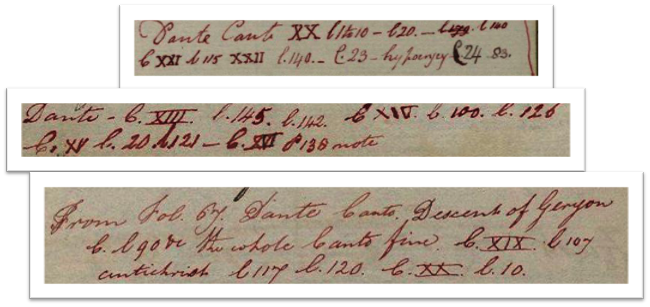
Excerpts from Notebook No. 4 (1827), where Lyell cites Dante.
3. Lyell wasn’t the only naturalist in his family, his sisters and father were keen on insect collecting and naming. In those days, much of the flora and fauna of Scotland had no official name, and therefore budding lepidopterists “discovered” and named the insects they caught. We hope to describe illuminating family letters like this in the newly acquired papers of Lyell.
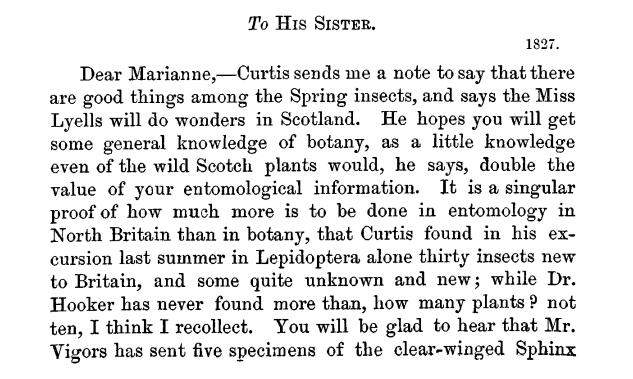
Letter to Marianne from Charles Lyell concerning the Lyell sisters’ prowess and interest in identifying insects
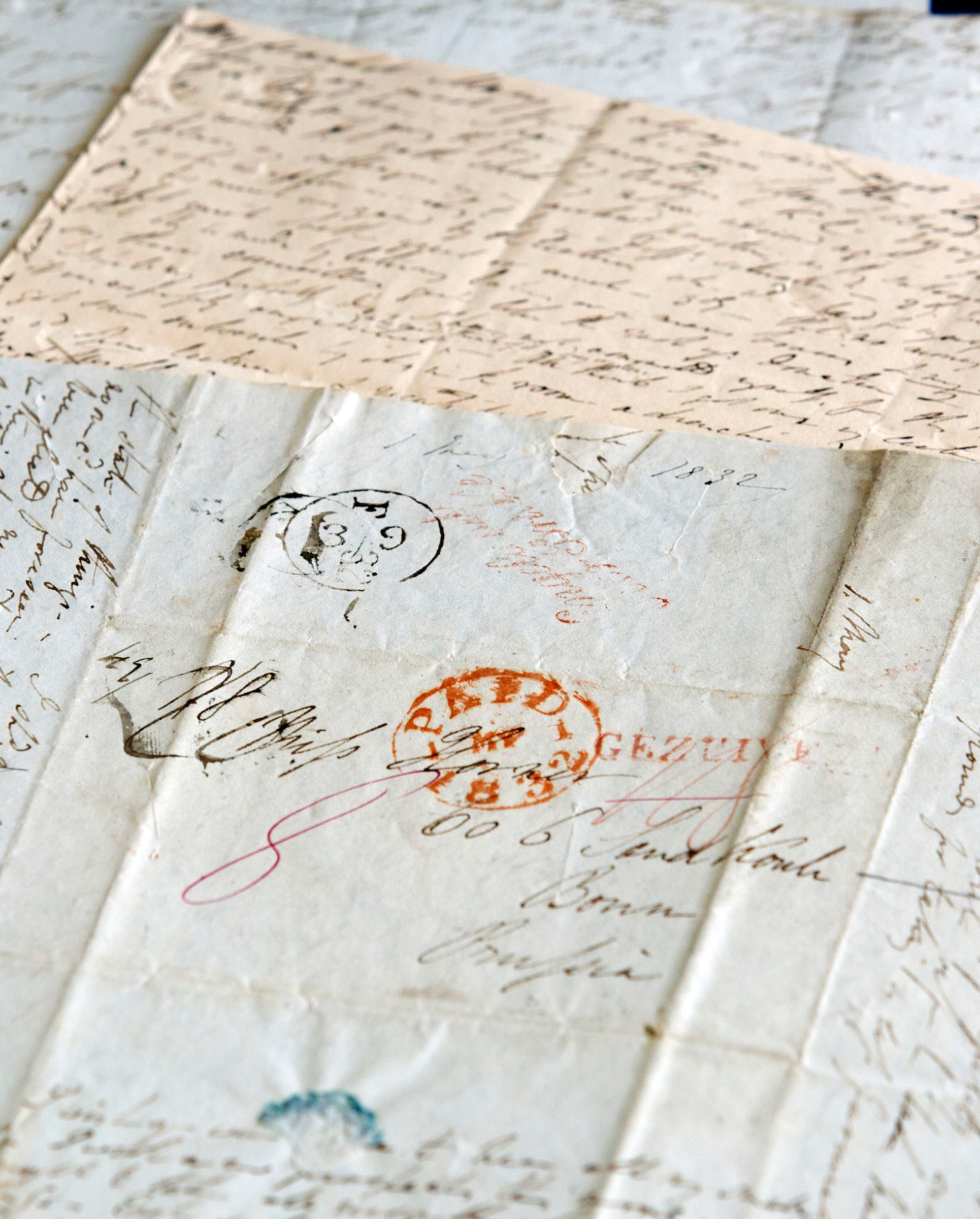
4. Lyell’s eyesight is known for being poor and limiting his abilities all his life, but the reason why is now contested. Most biographies cite that his eyesight worsened while studying the law by candlelight, but in a letter to Murchison in preparation for their Grand Tour to France and Italy, Lyell writes that his eye injury was caused by the long days in the Tuscan sun on holiday with his family. On that Grand Tour, to appease his father, Lyell brought with him a clerk named Hall to aid him in his work and treatment of his eyes – though no detail of the treatment has yet been found.

Excerpt from a letter to Murchison, April 29, 1828, explaining his father’s wishes for Lyell to bring his clerk with him, to make up for his troubles with his eyes.
References:
Lyell, C. (2010). Life, Letters and Journals of Sir Charles Lyell, Bart (Cambridge Library Collection – Earth Science) (K. Lyell, Ed.). Cambridge: Cambridge University Press. doi:10.1017/CBO9780511719691
Bailey, E., 1962. Charles Lyell, F.R.S., (1797-1875). Edinburgh: Thomas Nelson and Sons Ltd.
Charles Lyell Notebook No. 4, digitised here: https://images.is.ed.ac.uk/luna/servlet/s/cennww

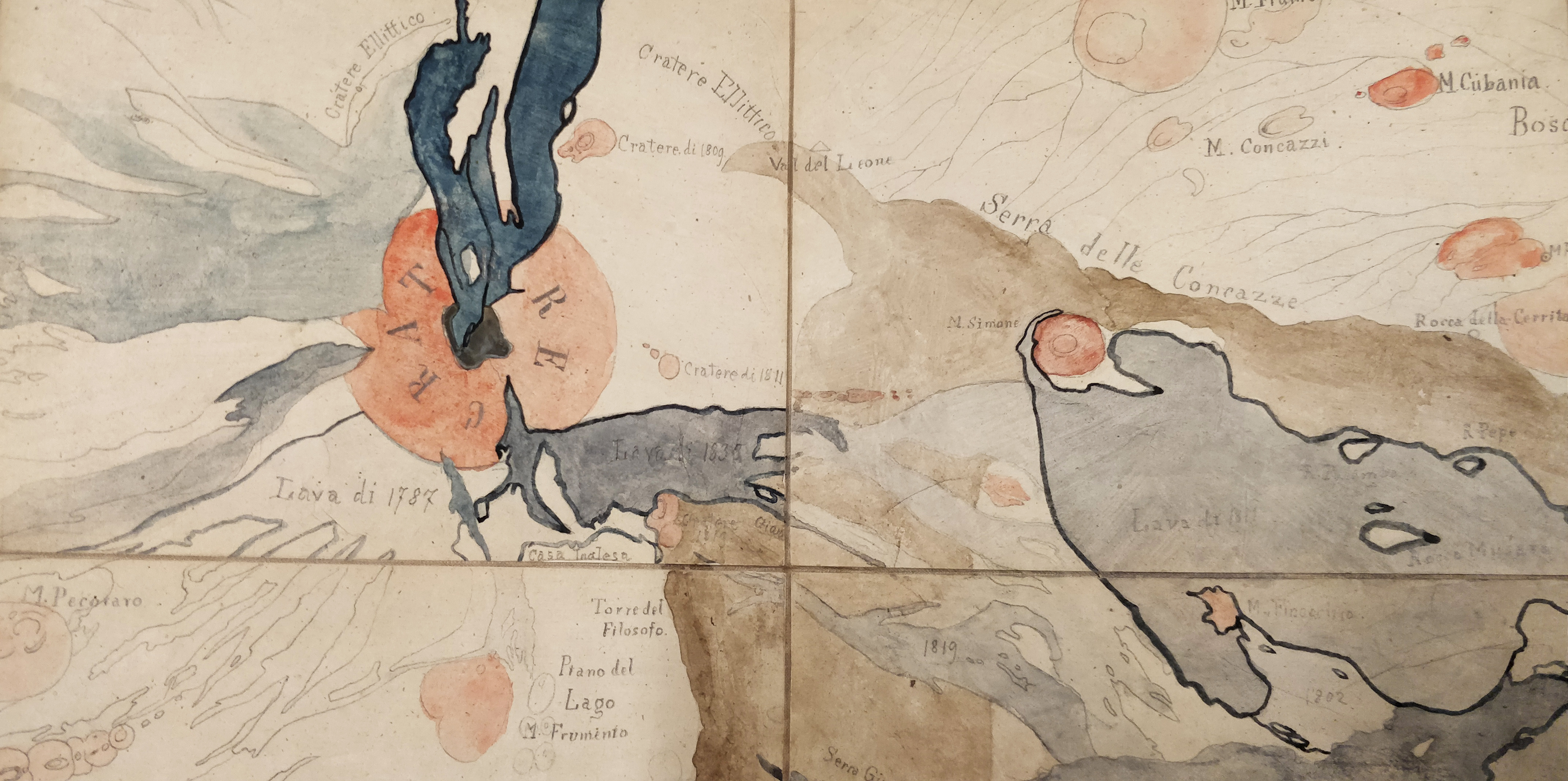
 During this lockdown, the Lyell Project has been able to continue enhancing metadata, despite having no access to the Lyell notebooks, thanks to some quick digitisation done by the amazing team at the DIU prior to lockdown. We’ve been working quite a bit with Notebook No. 4, from 1827, when Lyell was balancing his two callings; the law and geology. In 1825 his eyesight was no longer ailing him as it had been years previously, and following his father’s wishes, he was called to the bar and joined the Western Circuit for two years. But during this time, as we can see from the Notebook, he also maintained fervent correspondence with fellow geologists, read the works of George Poulett Scrope, and Lamarck, and thereby fostered a great curiosity for the volcanic Auvergne region in France. In 1825 he joined Scrope as a Secretary to the Geological Society, and contributed frequently to the Quarterly Review (published by John Murray, the archive of issues
  Another curious element in this notebook is the inclusion of citations to works by Dante, namely Dante’s Inferno. These appear often among entries on other subject, and without explanation. Clearly, this an excellent area of research, as we know Lyell’s father was a great scholar on Dante.
 Lockdown may seem frustrating and tiresome to some, but it has made space for a few spontaneous and unexpected collaborations!


 The Friends of Edinburgh University Library played a vital role in helping to acquire the Charles Lyell notebooks. They celebrate that acquisition in the new issue of