Tag Archives: archives

The Foundation of Anatomy: Class List of Alexander Monro (primus)

From time to time we ‘rediscover’ items in our collections.  It’s not that we didn’t know we had them; rather that they have not come to anyone’s specific attention within the many, many items we hold.

This is certainly the case with the earliest class list we hold for anatomy students.  It has a comprehensive name index, which is usually what people refer to, seldom asking to see the item itself.  However, when double checking some catalogue references, it was necessary to have a quick look at the original item.  It revealed itself to be far more significant than the index recorded.

It is a volume of principally students’ names and those they were studying under, beginning in 1720, when Alexander Monro primus began giving classes in anatomy in autumn 1720.  Monro had just been appointed Professor of Anatomy. Although the official establishment of the Faculty of Medicine was still six years away, many view the appointment of Monro as the clear starting point.
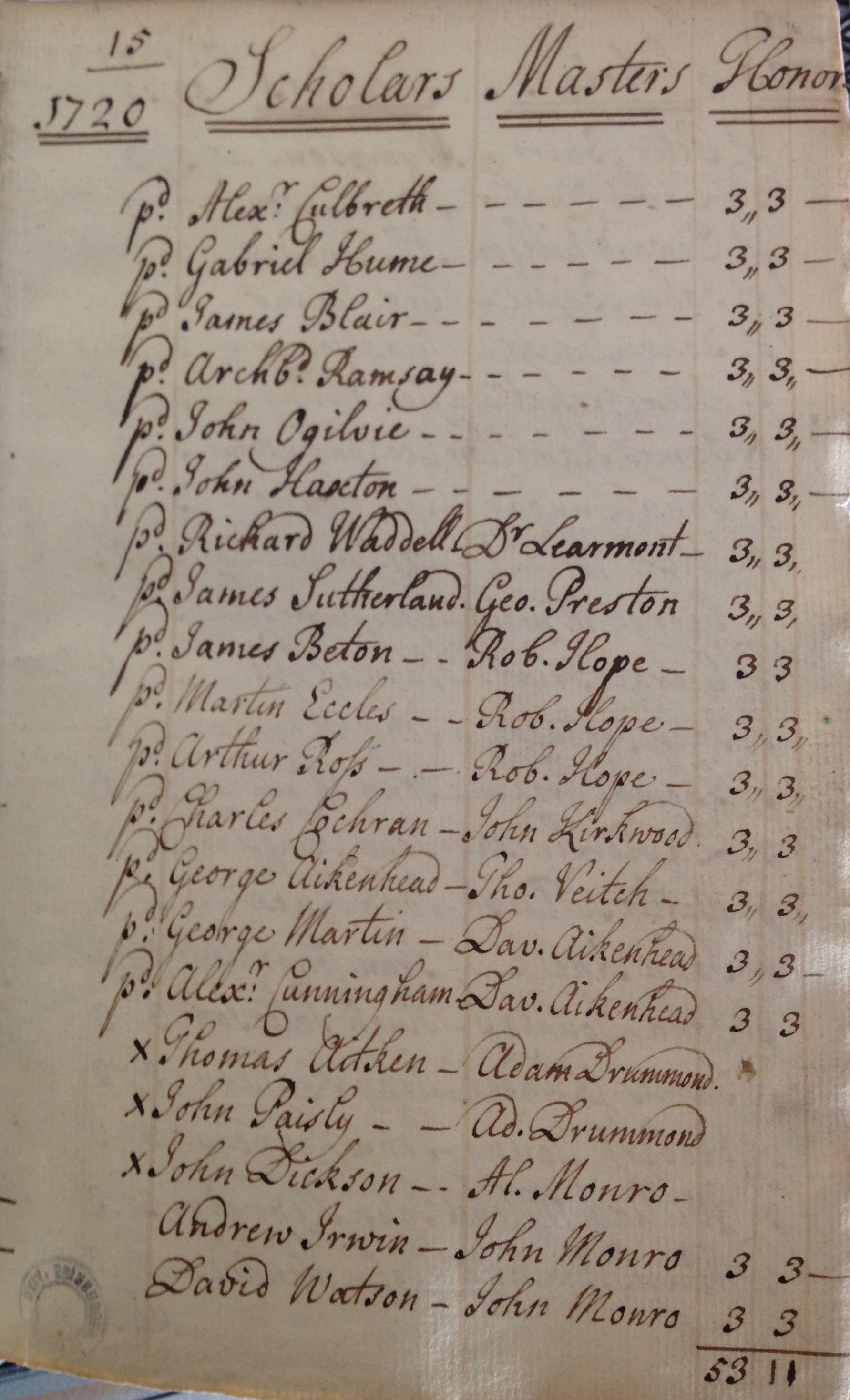
Page from 1820.  Includes the name of Martin Eccles. (Royal College of Physicians of Edinburgh. Died 1778.)

Page from 1820. Includes the name of Martin Eccles. (Royal College of Physicians of Edinburgh. Died 1778.)

Monro was educated at the Universities of Edinburgh and Leiden and learned anatomy under Frederik Ruysch in Amsterdam. He returned to Edinburgh in 1719 and passed the examinations for admission to the Incorporation of Surgeons.  The Professorship of Anatomy had been established by Edinburgh Town Council in 1705 but for Monro, unlike his predecessors, his appointment was clearly defined as a university chair.

Students were apprenticed to masters (surgeons), often boarding with them as well.  Teaching was conducted at Surgeons Hall and not within the precincts of the University until 1725, the move at least partly fuelled by public rioting over accusations of grave robbing.

A random check of names in the volume has as yet failed to yield a match with actual medical graduates, though names of identifiable surgeons and physicians are present, illustrating the fact that the formality of a degree was not mandatory to practice medicine.

The volume was donated to the University Library in 1924 by James Watt, LL.D., W.S., F.F.A., F.R.S.E (1863-1945).  He lived in Craiglockart House, which was built for Monro’s son, Alexander Monro secundus (1733-1817). The volume was found by Watt inn the cistern room of the house.  Fortunately, he was able to recognise its significance and pass it on to the then University Librarian, L. W. Sharp.

Copy of letter from James Watt to Lord Amulree, 1945, sent to Lauriston William Sharp, University Librarian.

Copy of letter from James Watt to Lord Amulree, 1945, sent to Lauriston William Sharp, University Librarian.

Sources:

  • Alexander Monro, class list (1720-1749), Special Collections, EUA GD60 (Dc.5.95)
  • Anita Guerrini, Oxford Dictionary of National Biography: Monro, Alexander, primus (1697–1767), surgeon and anatomist [accessed 30 Jan 2015]
  • Sir Alexander Grant, The story of the University of Edinburgh during its first three hundred years (1884)
The University benefits from Christmas

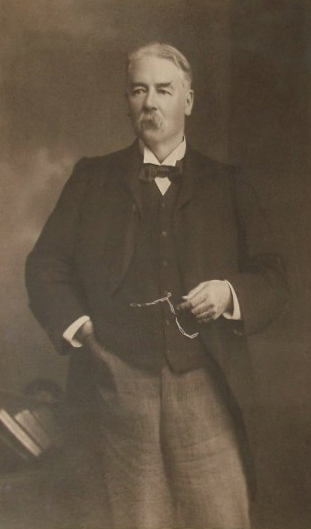
Robert Irvine (1839-1902) FRSE

Robert Irvine (1839-1902) FRSE. Endowed the Chair of Bacteriology.

A recent enquiry about a benefactor has thrown up an interesting set of connections within and beyond the University.

The son of Robert Irvine, manager of The Scotsman newspaper, Robert Irvine was born in Edinburgh in 1839.  By 1871 he was married to Margaret Sclater and living in a large house in Baltic Street, Leith, the manager of a chemical works.  By 1891 he was the owner of Caroline Park at Granton.  This included, the marine station, laboratories and warehouse as well as his own home.  He was now a Chemical Manufacturer. He was a friend of oceanographer, Sir John Murray (1841-1915), assistant on the Challenger Expedition and founder of the Marine Station at Granton, either on or adjacent to Irvine’s property (accounts differ).

Murray was also involved in establishing the Christmas Island Phosphate Company.  One of the investors was Irvine and it was part of the fortune realised by this lucrative venture that was bequeathed to the University of Edinburgh.  This established the Chair in Bacteriology and the first Professor was James Ritchie (1864-1923), MA, BSc, MD, FRCPE.

He was elected a Fellow of the Royal Society of Edinburgh in 1886, his proposers including Sir John Murray, and David Mather Masson, Professor of Rhetoric and Belles Lettres (English Literature).  The winner of the Neill Prize 1892-5, he also served as Councillor 1899-1902.

Irvine died in 1902 at his home at Granton, predeceased by his wife.  They had no children.

Irvine appears in our collections not only as a benefactor to the University but also in the records of the Granton Marine Station, which suggest his was role in it was quite hands-on.  The station closed shortly after Irvine’s death by which time most of the work had already moved to the west coast (for further information, see http://www.sams.ac.uk/about-us/our-history).

Grant Buttars, Deputy University Archivist

New acquisition: Further papers of Alexander Craig Aitken

aitken1The mathematician, statistician, writer, composer and musician, Alexander Craig Aitken, was born in Dunedin, New Zealand on 1 April 1895. He was of Scottish descent. He attended Otago Boys’ High School from 1908 to 1912. On winning a university scholarship in 1912 he went on to study at the University of Otago in 1913, enrolling in Mathematics, French and Latin. Studies were cut short by the 1914-1918 War however and he enlisted in 1915 serving with the Otago Infantry. Aitken saw action in Gallipoli and Egypt, and he was wounded during the Battle of the Somme. After his hospitalisation, he returned to New Zealand in 1917.

On the completion of his studies in 1920, Aitken became a school-teacher at Otago Boys’ High School and the same year he married Winifred Betts the first lecturer in Botany at the University of Otago where he also did some tutoring. Then, encouraged by a professor of mathematics at the University, he gained a postgraduate scholarship which brought him to Edinburgh University in 1923. His thesis on statistics gained him the degree of D.Sc. in 1925 when he also joined the University staff as a lecturer in Statistics and Mathematical Economics. In 1937 he was promoted to Reader, and in 1946 was appointed to the Chair of Mathematics.

Aitken’s publications include: jointly with H. W. Turnbull, The theory of canonical matrices (1932); with D. E. Rutherford, a series of Mathematical Texts; wartime experiences in Gallipoli to the Somme: Recollections of a New Zealand infantryman (1963); and, posthumously To catch the spirit. The memoir of A.C. Aitken with a biographical introduction by P.C. Fenton (1995). He made many important contributions to the many fields of his subject, particularly in the theory of Matrix Algebra and its application to various branches of mathematics. In his time, Professor Aitken was one of the fastest mathematical calculators in the world.

While at school, Aitken had learned to play the violin, and later on in life he played both the violin and viola and composed pieces for performance by university groups.  He died in Edinburgh on 3 November 1967.

Shortly before Christmas we acquired a further tranche of Aitken’s papers.  These include a number of original mathematical manuscripts, correspondence, legal documents, offprints, publications and photographs.  Amongst these is a review by Aitken of Sara Turning’s “Alan Turing”.

aitken

At the moment we still have to look through the collection, box it up and create a basic handlist.  Once this is done it will be available for consultation.