A question of scale

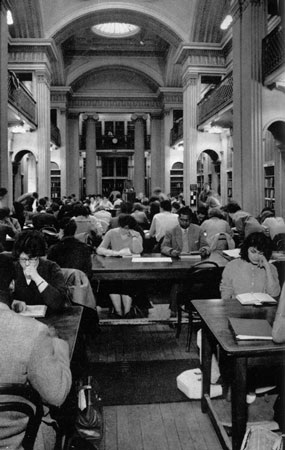
We just answered an internal enquiry for colleagues in or Law School who asked us about numbers of students and staff in the Law Faculty in the early 1950s. The answer stands in contrast to today’s student numbers:

Matriculated students (Law) 1952/53

Ordinary
Men 275
Women 37

Termly
Men 8
Women 0

Total 320 (out of 5850 total for the whole university)

Staff

Examiners 11
Assistants/Demonstrators 6
Lecturers 6
Professors 6
Other members of Faculty 6

Total 35

Answering this also highlighted the usefulness of the University Calendar for questions such as this. Produced annually from the late 1850s to the early 2000s, these record multiple aspects of University life, from staff details, bursaries and scholarships, curriculum and much more. Many have been digitised and are available at archive.org. [further details]

Geology Gems

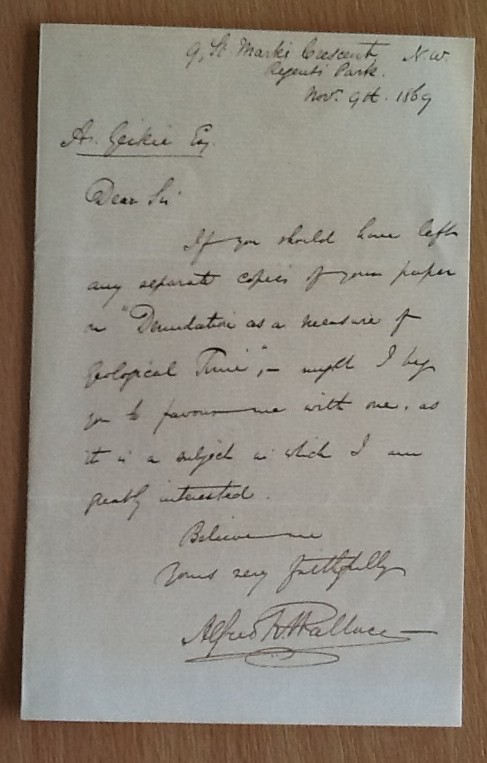
Letter from Alfred Russel Wallace to Archibald Geikie, 1869

Letter from Alfred Russel Wallace to Archibald Geikie, 1869

We recently acquired a number of interesting geology-related items via the Cockburn Geology Museum.

The Murchison Chair of Geology was instituted with the Faculty of Arts (there was then no Faculty of Science) in 1871. Archibald Geikie held the Chair until 1882 and was succeeded by his brother James, Archibald having been appointed as Director of the British Geological Survey. James went on to become Dean of the Faculty of Science (instituted in 1893) and retired in 1914.

Poster advertising lecture given by Sir Charles Lyell

Poster advertising lecture given by Sir Charles Lyell at the Athaeum, 1856

Archibald’s papers in particular contain a large portion of correspondence with many well-known scientists of the period. Amongst this recent addition there are further letters from individuals including Alfred Russel Wallace (shown), Thomas Henry Huxley and Joseph Dalton Hooker.

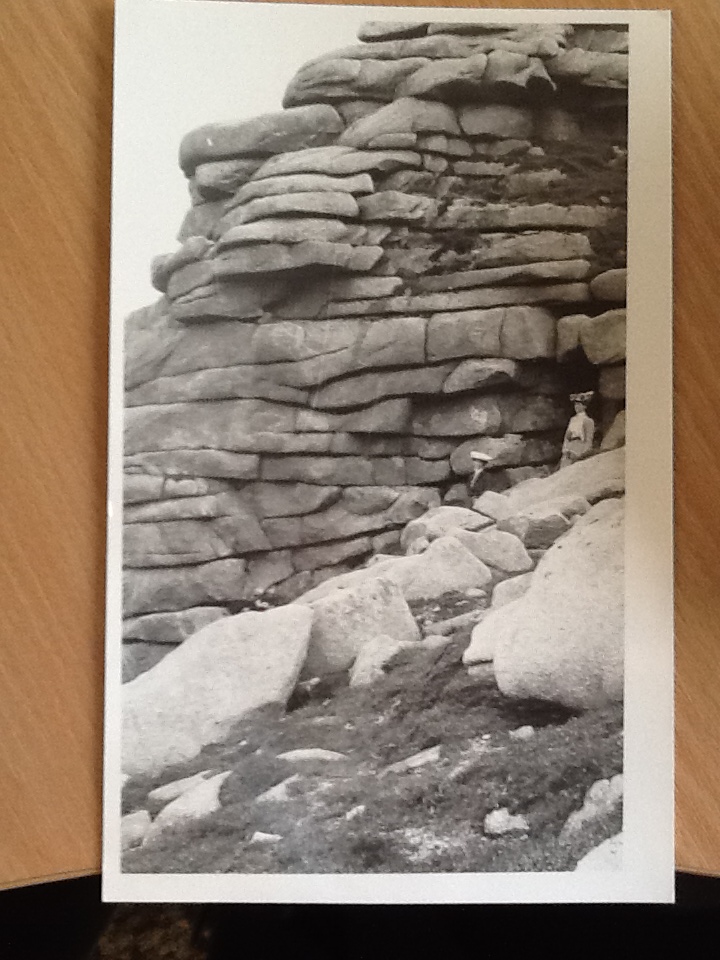
Photograph of two Victorian/Edwardian ladies in landscape

Photograph of two Victorian/Edwardian ladies in landscape

We also have further Sir Charles Lyell papers, including the poster shown here and numerous lecture texts from the 1840s.  We speculate that both the Geikie and Lyell material strayed from the main collections of their papers prior to these coming into our custody.  As such these recent additions are especially welcome.

Photographs of staff and students of the department also feature, some with names, others without.  This intriguing photo shows two ladies somewhat overshadowed by the landscape.  Given the period, we have speculated whether they may have been the wives of academics rather than students, although women were already making inroads into the University.

Understanding Student Records

We area about to begin a series of blog posts aimed at helping our users become aware of what information exists in different types of student records, how this changed over time and how the different records series relate to each other.

Understanding the records makes it easier to find all the relevant information and how to make best use of time when conducting research. The first post will relate to matriculation records and the three related records series which have recorded this over time.

Welcome to the new Blog

We are in the process of moving our blog in-house.  Although we’ve imported all the post titles, we still need to copy over the detail. Once we have finished the migration tasks, we will start blogging again.  In the meantime you can find the old blog at http://edinburghuniversityarchives.blogspot.co.uk/

Update, 4th July – blog content successfully migrated. New blog posts will appear here soon.

Edinburgh’s first women graduates honoured 50 year later

On 13 April 1893, eight women graduated MA, the first women students having been admitted the previous year following a lengthy battle to allow women admittance to the University.  The eight women had already completed most of their exams externally and were awarded their degree within a year of admittance.  The same year they graduated, a further 72 matriculated to study, with an additional 78 attending as non-matriculated students.
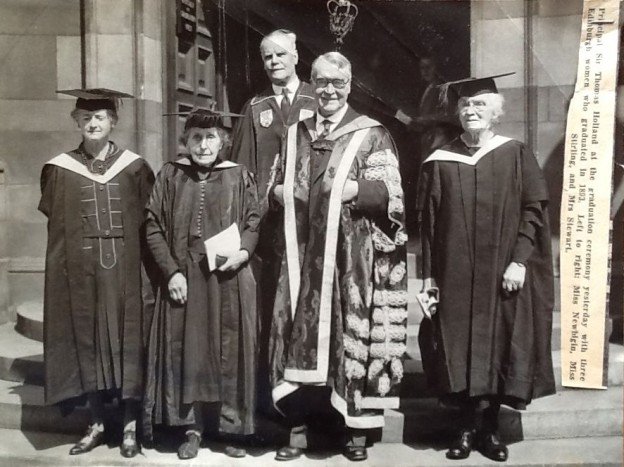
In July 1943, three of the eight joined Principal Sir Thomas Holland on the platform for the graduation ceremony in the McEwan Hall: Flora Stewart, nee Philip, Maude Elizabeth Newbigin and Amelia Hutchison Stirling. We blog this to mark 120 years since their graduation.

Henry Duncan Littlejohn notebook found

What connects Edinburgh, forensic medicine, public health and Sherlock Holmes? Many people would be tempted to say ‘Joseph Bell’, although they would probably wonder where public health fitted in. The answer is in fact ‘Henry Duncan Littlejohn’.

Born in 1826, the son of a prosperous merchant, Littlejohn was also credited by Conan Doyle as having been an influence. He graduated from the University of Edinburgh in 1847 and became a Fellow of the Royal College of Surgeons in 1854.  The same year saw him take up the position with Edinburgh Town Council as Police Surgeon. In 1862 he was appointed Edinburgh’s first Medical Officer of Health. The work he undertook had a significant impact on reducing the frequency of outbreaks of smallpox and typhus.

He was President of the Royal College of Surgeons of Edinburgh (1875-6), of the Medico-Chirurgical Society of Edinburgh (1883-5), and of the Institute of Public Health (1893). Awarded an honorary degree by the University of Edinburgh in 1893, he was knighted two years later.

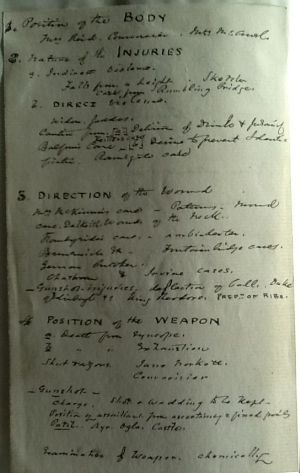
Littlejohn was appointed to the Chair of Medical Jurisprudence at the University of Edinburgh in 1897. In the context of that post, a series of his notebooks were kept by his successors within the departmental records of the Forensic Medicine department. However when these arrived in the University Archives volume “Wounds II” was noted as being absent. Thanks to the vigilance of a member of academic staff, this missing volume has now been found and transferred to us.

We are thrilled to be able to reunite this volume with the others. the series now runs to 6 volumes in total:

  1. Infanticide I
  2. Infanticide II
  3. Poisons III
  4. Poisons IV
  5. Wounds I
  6. Wounds II

Enclosed in the third volume are (1) Examination script and (2) Letter about ‘meat pies’ from a student of Henry Duncan Littlejohn. Enclosed in the fourth volume is booklet A Case of Strychnia Poisoning by J. Allan Gray, Medical Officer of Health, Leith.

The ‘new’ volume is of a similar format to the others with notes, news cuttings and loose enclosures.
Quatercentenary Collection

The Quatercentenary Collection came about as a result of an appeal that was made as the University of Edinburgh approached its 400th anniversary in 1983.  Former staff, students and others responded and sent in all types of university-related items, from student magazines to prize books, from lecture notes to memoirs, from photographs to degree certificates and much more. The scale of the response meant that it has taken until now to start getting a handle on much of it.

We have now begun a full survey of items in the collection was begun and to date nearly 850 items have been documented.  These will form the basis of new catalogue records.

Largely though not exclusively representing the ‘student experience, this collection is a real treasure trove and we are glad to being close to make it easily accessible for research.


Neil Armstrong

In memory of astronaut Neil Armstrong, we are displaying the award by the University of Edinburgh to him of Doctor Honoris Causa. The ceremony took place a the British Embasy in Washington on 13 June 2008.

We hold the certificate (shown here) in the University Archives.

University Mace stolen – reward offered!

On the night betwixt the 29th/30th October 1787 the door of the Library was broken open by thieves and the University Mace was stolen from the press where it was usually deposited. The Magistrates offered a reward of ten Guineas for the discovery of the Delinquents.

So reads the inset entered between the College minutes for 11th September and 3rd December 1787.

The University would appear to have been without a mace until 1789. William Creech presented the College with a new one at the meeting of 2nd October that year. At the same meeting it was reported that the University been granted Arms by the Lord Lyon and that a new seal was to be made, the use of one of the city’s seals being “inconvenient and unsuitable to the dignity of the University”.

Early Veterinary students

Although our registers of students who attended the Edinburgh / Royal Dick Veterinary College only begin in the 1860s, the college itself was established in 1823. Although, unlike the University, there is no easily-identifiable published list of early students, one does in fact exist. Included in William Dick’s ‘Occasional Papers’ (published 1869) is a list of all the graduates.

The list gives their name, year of graduation and place of residence. Cornell University have a digitised copy of the entire publication at http://archive.org/details/cu31924000347975