Category Archives: Collections

Hugh MacDiarmid introduces Lewis Grassic Gibbon (John Leslie Mitchell 1901-1935), author of ‘Sunset Song’, to publisher Stanley Nott

FROM LETTERS IN THE HUGH MACDIARMID (C. M. GRIEVE) COLLECTIONS HERE AT EDINBURGH

BandDuring this 80th anniversary of his early death, a new film adaptation of Sunset Song by Lewis Grassic Gibbon is to be released on 4 December 2015. Lewis Grassic Gibbon was the pseudonym of James Leslie Mitchell who was born in Auchterless in February 1901.

Band2Mitchell was raised in Arbuthnott, Kincardineshire, and in his teens he started work as a journalist with the Aberdeen Journal (which would later become the Press and Journal) and also for the Scottish Farmer.  In 1919 he joined the Royal Army Service Corps (RASC) and then in 1920 he joined the Royal Air Force (RAF). In 1925 he married and settled in Welwyn Garden City. He wrote a number of works under both his real name and his pseudonym before dying in his 30s of peritonitis brought on by a perforated ulcer – in February 1935.

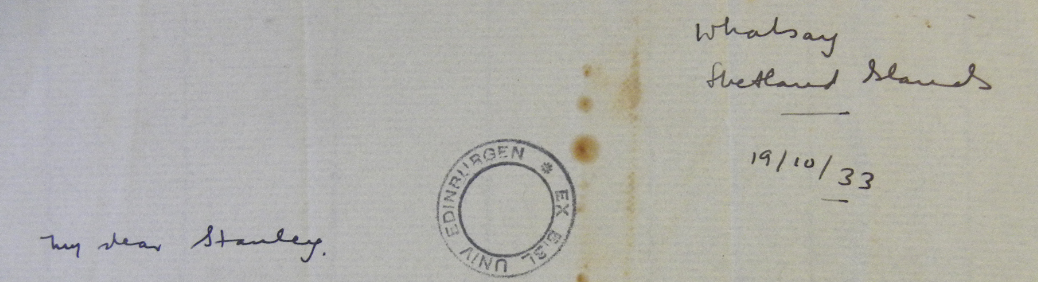
Letter from Grieve to Stanley Nott (Grieve Coll-18)

Letter from Grieve to Stanley Nott (Grieve Coll-18)

His earliest writing is described in a  letter from Christopher M. Grieve (Hugh MacDiarmid) to Charles Stanley Nott (1887-1978) author, publisher and translator, in what reads almost like a letter of introduction. The letter is dated 19 October 1933, and was written from Whalsay, Shetland.

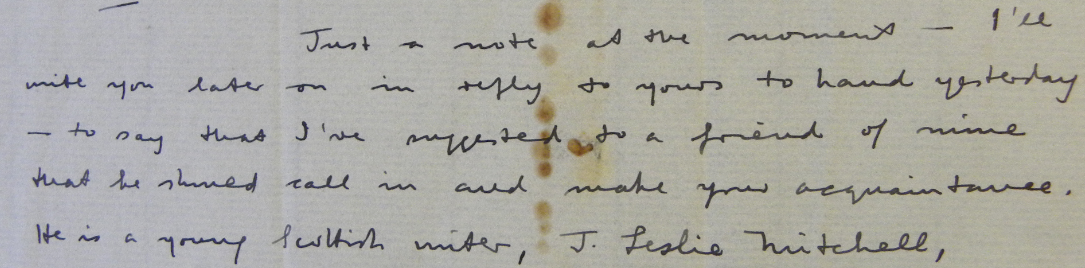
Letter from Grieve to Nott (Coll-18)

Letter from Grieve to Nott (Grieve, Coll-18)

Grieve writes to ‘My dear Stanley’:

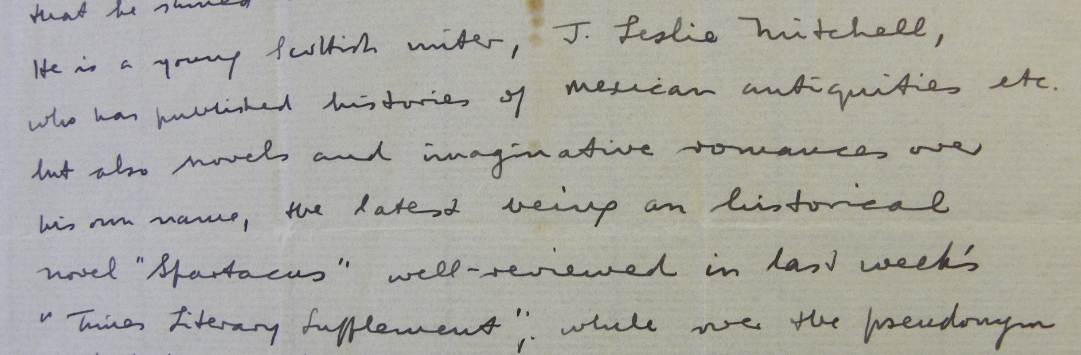
I’ve suggested to a friend of mine that he should call in and make your acquaintance. He is a young Scottish Writer, J. Leslie Mitchell, who has published histories of Mexican antiquities etc but also novels and imaginative romances over his own name, the latest being an historical novel…

Letter from Grieve to Nott (Coll-18)

Letter from Grieve to Nott (Grieve, Coll-18)

When referring to ‘histories of Mexican antiquities’, Grieve may have been pointing towards The Conquest of the Maya (1934). The historical novel mentioned was Spartacus which had been ‘well reviewed’ in the Times Literary Supplement, and which had been written under his own name, J. Leslie Mitchell.

Letter from Grieve to Nott (Coll-18)

Letter from Grieve to Nott (Grieve, Coll-18)

Grieve goes on:

…over the name Lewis Grassic Gibbon he has lately scored a great success with ‘Sunset Song’ and ‘Cloud Howe’, the first two volumes of a trilogy of novels…

Letter from Grieve to Nott (Coll-18)

Letter from Grieve to Nott (Grieve, Coll-18)

At the time of this correspondence to Nott – October 1933 – Grieve tells us that Mitchell’s publishers ‘are Jarrold’s, and Faber and Faber for a biography of the explorer, Mungo Park’, and that Mitchell and he ‘are collaborating in a miscellany on Scotland’. The Mungo Park work in question was Niger: The Life of Mungo Park (1934), and  the collaborative work by Grieve and Mitchell was Scottish scene (also 1934).

Letter from Grieve to Nott (Coll-18)

Letter from Grieve to Nott (Grieve, Coll-18)

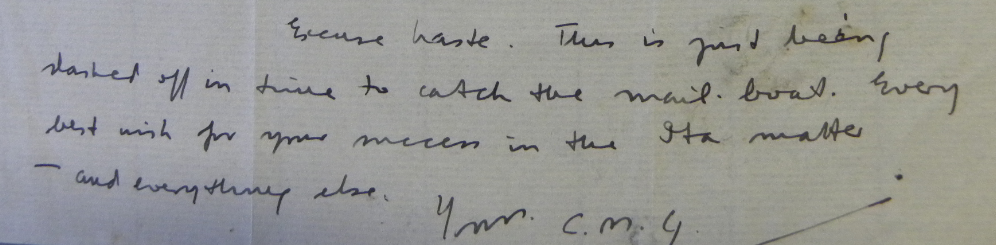
During these Whalsay years – island life in east Shetland – Grieve then writes:

Excuse haste. This is just being dashed off in time to catch the mail-boat […] Yours C.M.G.

Band2

Dr. Graeme D. Eddie, Assistant Librarian Archives and Manuscripts, Centre for Research Collections (Special Collections)


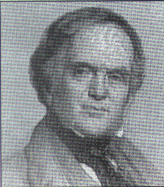
William Henry Playfair, architect

William Henry Playfair

William Henry Playfair

On 2 Nov 2015, the CRC hosted a seminar which looked at the figure of William Henry Playfair (1790-1857), discussing his life and work and looking in some detail at a range of architectural drawings which had been selected from our collection.

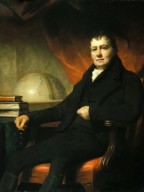
John Playfair

John Playfair

Playfair was born was born in Russell Square, London, July 1789. On the death of his father, architect James Playfair, he was sent to reside with his uncle in Edinburgh. Professor John Playfair, mathematician and geologist and a leading figure in the Edinburgh Enlightenment, took control of his nephew’s education. Following his father’s profession, the young Playfair studied under William Starke of Glasgow. Following Starke’s death in 1813, Playfair moved to London where he worked in the offices of James Wyatt and Robert Smirke, returning to Edinburgh in 1816.

He established himself professionally by winning the commission in 1817 to complete the unfinished University buildings (leaving the front as designed by Robert and James Adam). He also designed the city’s Royal Terrace and Regent Terrace on the Calton

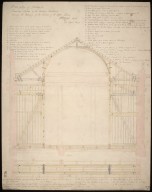
College of Edinburgh Transverse Section if the Southern Buildings

College of Edinburgh Transverse Section of the Southern Buildings

Hill estate; the unfinished National Monument on Calton Hill; and, the Royal Scottish Academy and the National Gallery on the Mound. While Playfair’s most important works in Edinburgh have been executed in the Greek revivalist or classical style – earning for Edinburgh the title of ‘Athens of the North’ – he was competent in other styles too. He designed New College for the ten newly established Free Church of Scotland, a jagged-lined rendering of the Gothic style. He also built country houses and mansions in the Italianate and Tudor styles.

The discussion in the seminar was not structured in any major way but flowed directly from looking at the drawings we had selected to view.  Alongside the physical drawings, we also looked at digitised ones, using the complement of both to do things which one or other could not do alone.

With over 5000 to choose from, electing the drawings was never going to be an easy task.  However we settled on one or more drawings relating to the following of Playfair’s projects:

  • College of Edinburgh
  • Royal Observatory
  • Dollar Academy
  • Blenheim Place
  • Elm Row
  • Royal Institution
  • Royal Institution Additions
  • National Monument
  • Royal College of Surgeons
  • Stewart Monument
  • Donaldson’s Hospital
  • New College Edinburgh

Links:

Talk given to Members of the South Georgia Association – on the Salvesen Archive

AT THE BUDONGO LECTURE THEATRE, EDINBURGH ZOO, SATURDAY 31 OCTOBER 2015

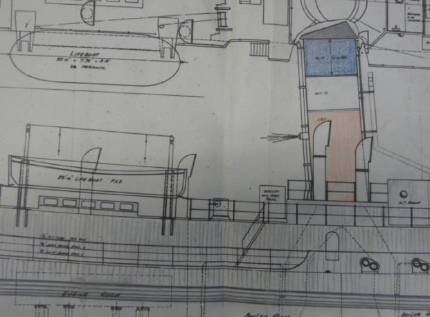
Plans for converting former naval vessels into whale-catchers.

Plans for converting former naval vessels into whale-catchers – an item in the Salvesen Archive.

This past weekend – Saturday 31 October – saw Dr. Graeme D. Eddie of the Centre for Research Collections (CRC) participate in the Penguin City Meeting of the South Georgia Association (SGA), held at the Budongo Lecture Theatre, Edinburgh Zoo. The SGA is a non-profit organisation formed to give voice to those who care for South Georgia, a remote mountainous island in the South Atlantic.

LogoThe SGA meeting had been organised and chaired by Dr. Bruce F. Mair, geologist. Also present among the geologists, glaciologists, botanists, ecologists, and former whalers, were Alexandra Shackleton, granddaughter of Sir Ernest Shackleton (1874-1922) and current President of the James Caird Society, descendants of Carl Anton Larsen (1860-1924) the Norwegian-British Antarctic explorer, and descendants of Sir James Mann Wordie (1889-1962) the Scottish Polar explorer and geologist.

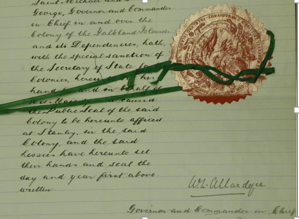
Signature of William Lamond Allardyce, Governor and Commander of the Falkland Islands, together with Seal, on the Lease agreed with the South Georgia Co., a firm raised by Christian Salvesen & Co.

Signature of William Lamond Allardyce, Governor and Commander in Chief of the Falkland Islands, together with Seal, on the Lease agreed with the South Georgia Co., a firm raised by Christian Salvesen & Co. in 1909… an item in the Salvesen Archive.

Presentations on the day covered ‘Accessible Archives and the Industrial Past’, ‘Science and Field Work’ and ‘South Georgia 2015 and Beyond’ and, represented as an accessible archive, the CRC presentation was given in the first section of the Meeting.

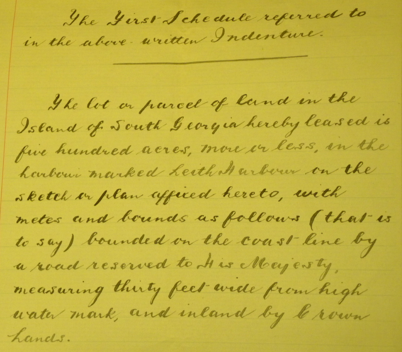
The Lease indicated that 'five hundred acres, more or less, in the harbour marked Leith Harbour', South Georgia.

The Lease indicated that ‘five hundred acres, more or less, in the harbour marked Leith Harbour’, South Georgia, was to be allocated to the firm. The Lease permitted the firm to operate two whale-catcher vessels in addition to two associated with a Lease over Allardyce Harbour. Four vessels in the region made the whaling operation viable.

Profiling the Salvesen Archive, it offered a brief history of the firm of Christian Salvesen & Co. Ltd., and a look at the transfer in three stages of the archive of the company’s whaling business to Edinburgh University Library starting in 1969.

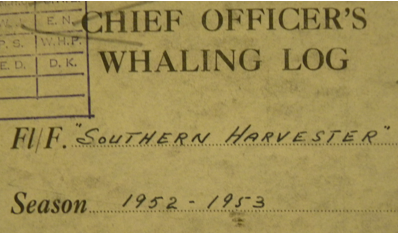
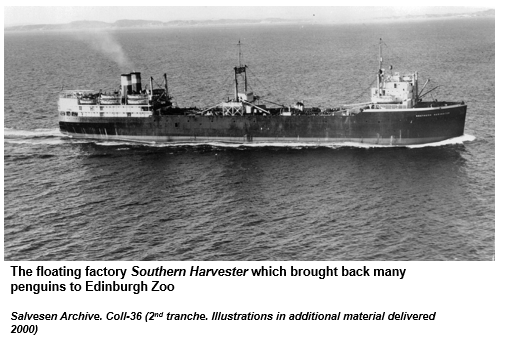
Cover of the 'Whaling Log' of the Salvesen & Co. whale factory-ship, 'Southern Harvester', season 1952-1953.

Cover of the ‘Whaling Log’ of the Salvesen & Co. whale factory-ship, ‘Southern Harvester’, season 1952-1953… an item in the Salvesen Archive.

The content of the Salvesen Archive was described with illustrations showing its variety. The talk looked at some of the conservation needs of the material, the use of the collection by researchers, and offered glimpses of the lives of personnel at the South Georgia stations.

While the 'Whaling log' has provided data of whales caught and processed to researchers of the past, it also provides climatological information to weather scientists and researchers today, giving information about ice, wind, and temperatures.

While the ‘Whaling log’ has provided data of whales caught and processed to researchers of the past, it also provides climatological information to weather scientists and researchers today, giving information about ice, wind, and temperatures.

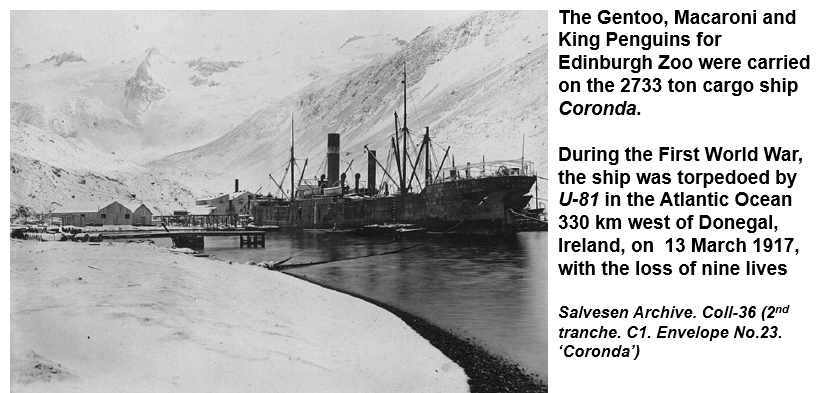
The transport of live penguins by the company to Europe – not least to Edinburgh Zoo – was also briefly explored through images from the Salvesen Archive.

A slide from the presentation at the SGA Meeting

A slide from the presentation at the SGA Meeting.

The SGA meeting also saw presentations from the National Library of Scotland with the title ‘South Georgia on the Shelf’ and looking at the Map and Wordie collections, and from the South Georgia Heritage Trust & the National Museums of Scotland about a project to highlight the location of South Georgia related objects around the world. John Alexander who had spent winter seasons in the whaling industry gave a talk on ‘Sailing in the Antarctic with Salvesen’.

A slide from the prsentation given at the SGA meeting.

A slide from the presentation given at the SGA Meeting.

There were also presentations on tussock grass on South Georgia, the geology of the island, sustainable South Georgia fisheries management, and the rat eradication programme. The day was concluded with a visit to the penguin enclosure at Edinburgh Zoo.

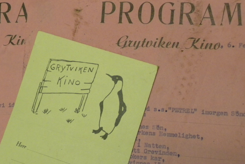
'Membership card' for the Grytviken Kino... the cinema at the Grytviken whaling station, South Georgia.

‘Membership card’ for the Grytviken Kino… the cinema at the Grytviken whaling station, South Georgia. At the time – up to the early 1960s – it was the most southerly cinema in the world after the cinema in Ushaia, Tierra del Fuego.

The host for SGA Meeting, Dr. Bruce F. Mair had been a geologist with the British Antarctic Survey and had carried out extensive mapping in an area of South Georgia around Brandt Cove, Larsen Harbour and Drygalski Fjord in the 1974-75 and 1976-77 field seasons. The region’s Mt. Mair is named after him!

Centre for Research Collections, Edinburgh University Library, 2 November 2015


Charles Oppenheimer (1875-1961), craftsman, artist

140th ANNIVERSARY OF HIS BIRTH

THE EVE OF SAINT AGNES – RECENT ACQUISITION AT CENTRE FOR RESEARCH COLLECTIONS, EDINBURGH UNIVERSITY LIBRARY

stripSaturday 10 October 2015 marks the 140th anniversary of the birth of Charles Oppenheimer, craftsman and artist. Oppenheimer was born in Chorlton-upon-Medlock, Manchester, on 10 October 1875. He was a prize-winning student at Manchester School of Art, and his first picture was exhibited at the Manchester Academy of Fine Arts in 1894. His studies also took him to Italy.

strip2After marriage in 1903, and after discovering – for him anyway – the acceptable light of Kirkcudbright he moved with his wife to Scotland in 1908 joining other artists in this community in south-western Scotland. By this time Oppenheimer had established himself, having exhibited his first picture at the Royal Academy, London, in 1906.

strip3Other works over six decades include: The Lion of St. Mark, Venice, exhibited 1898, and illuminated manuscript of the poem by John Keats The Eve of St. Agnes (c. 1901), Kircudbright Harbour (c. 1910), Kirkcudbright (c. 1913), Verona (1914), Morning mist – Lake of Lugano (c. 1925), Siena at dusk (c. 1929),  San Francesco, Assisi (1930s), and Blossom, Buckland Burn (c. 1940).

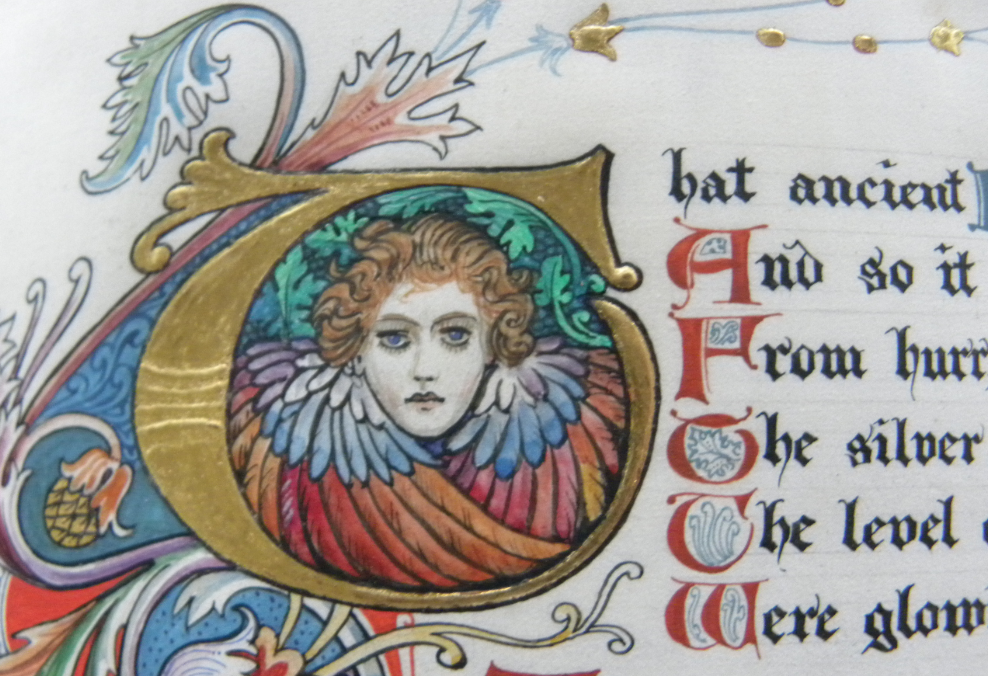
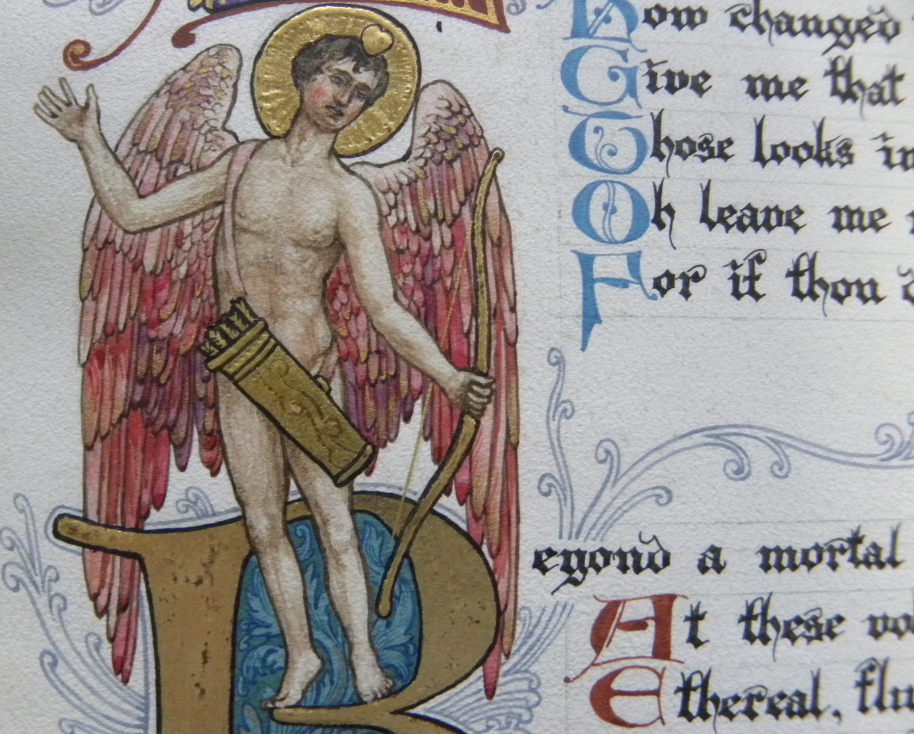
Recently, Edinburgh University Library acquired the illuminated handwritten manuscript crafted by Charles Oppenheimer of the poem The Eve of Saint Agnes, by John Keats. The bound volume is of thirteen pages of vellum – ‘a prodigious piece of work’ – and demonstrates Oppenheimer’s craftsmanship, skill and drawing. It is not known whether the item was a commission, an academic exercise or business sample.

Saint Agnes, from 'The Eve of Saint Agnes', Charles Oppenheimer, 1901

Saint Agnes, from ‘The Eve of Saint Agnes’, Charles Oppenheimer, 1901

Saint Agnes’ Eve – Ah, bitter chill it was! The owl, for all his feathers, was a-cold… stanza 1

The Eve of Saint Agnes was written by John Keats in 1819 and it was published in 1820, becoming one of his finest poems. Keats based his poem on the superstition that a girl could see her future husband in a dream if she performed certain rites on the eve of St. Agnes. In the 42-stanza poem we meet an old man of prayer (a beadsman), many an amarous cavalier, Madeline, old Angela, and Porphyro.

Carved angel, from 'The Eve of Saint Agnes', Charles Oppenheimer, 1901

Carved angel, from ‘The Eve of Saint Agnes’, Charles Oppenheimer, 1901

The carved angels, ever eager-eyed, stared, where upon their heads the cornice rests… stanza 4

Young Porphyro, from 'The Eve of Saint Agnes', Charles Oppenheimer, 1901

Young Porphyro, from ‘The Eve of Saint Agnes’, Charles Oppenheimer, 1901

Meantime, across the moors, had come young Porphyro, with heart on fire for Madeline… stanza 9

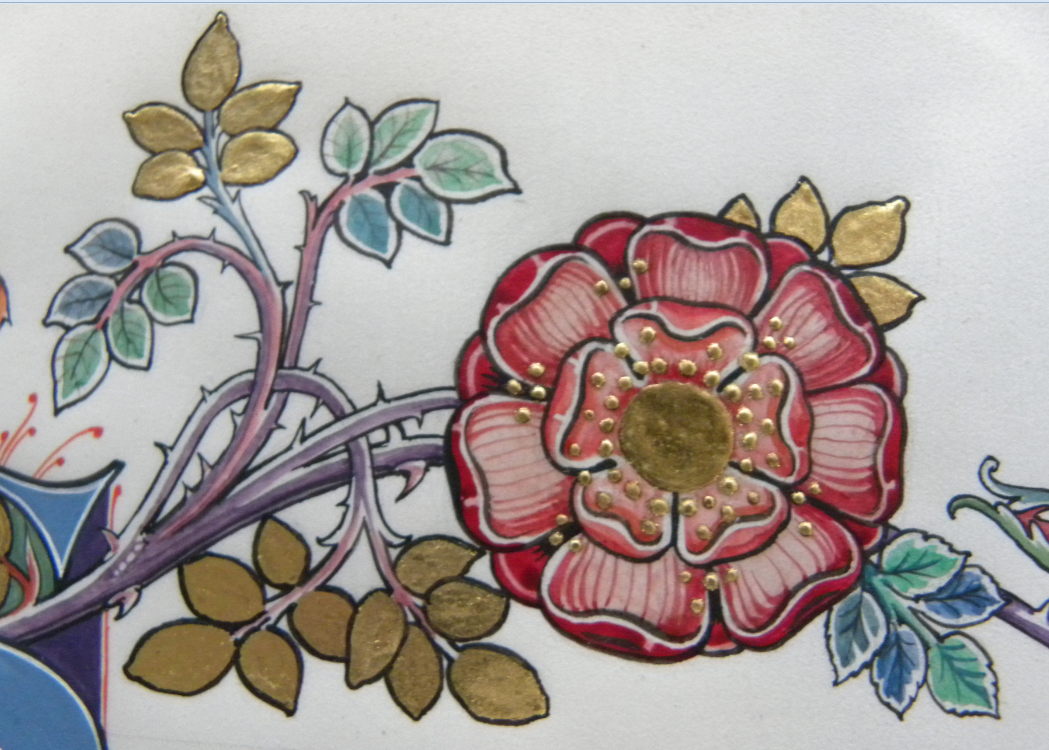
Full-blown rose, from 'The Eve of Saint Agnes', Charles Oppenheimer, 1901

Full-blown rose, from ‘The Eve of Saint Agnes’, Charles Oppenheimer, 1901

Sudden a thought came like a full-blown rose, flushing his brow, and in his pained heart made purple riot… stanza 16

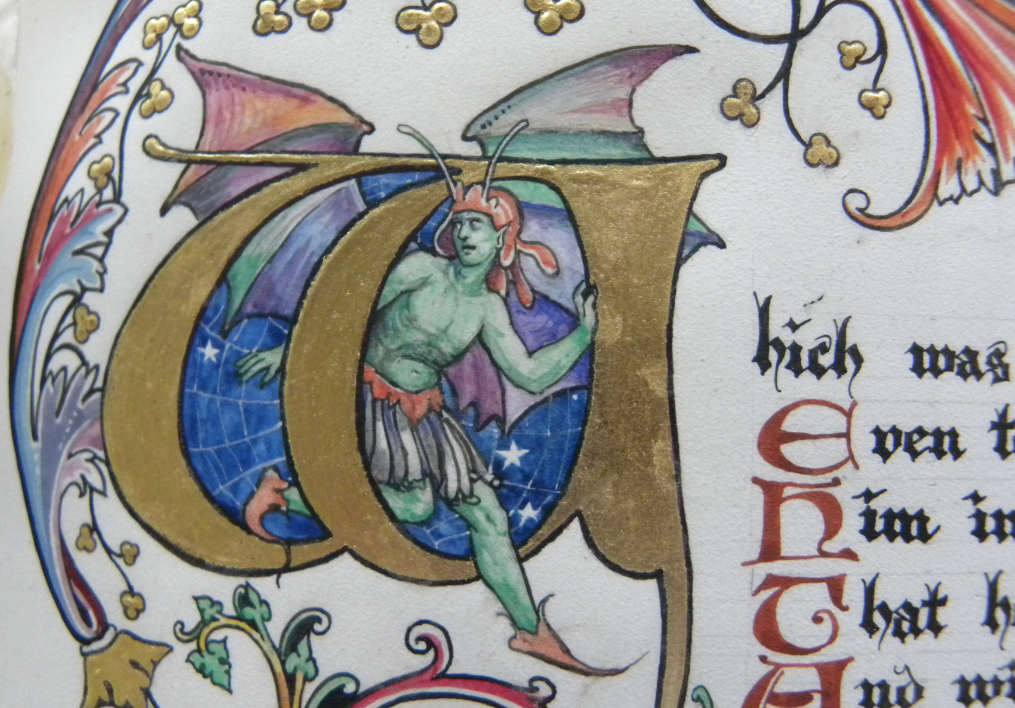
Legioned fairy, from 'The Eve of Saint Agnes', Charles Oppenheimer, 1901

Legioned fairy, from ‘The Eve of Saint Agnes’, Charles Oppenheimer, 1901

While legioned fairies paced the coverlet, and pale enchantment held her sleepy-eyed… stanza 19

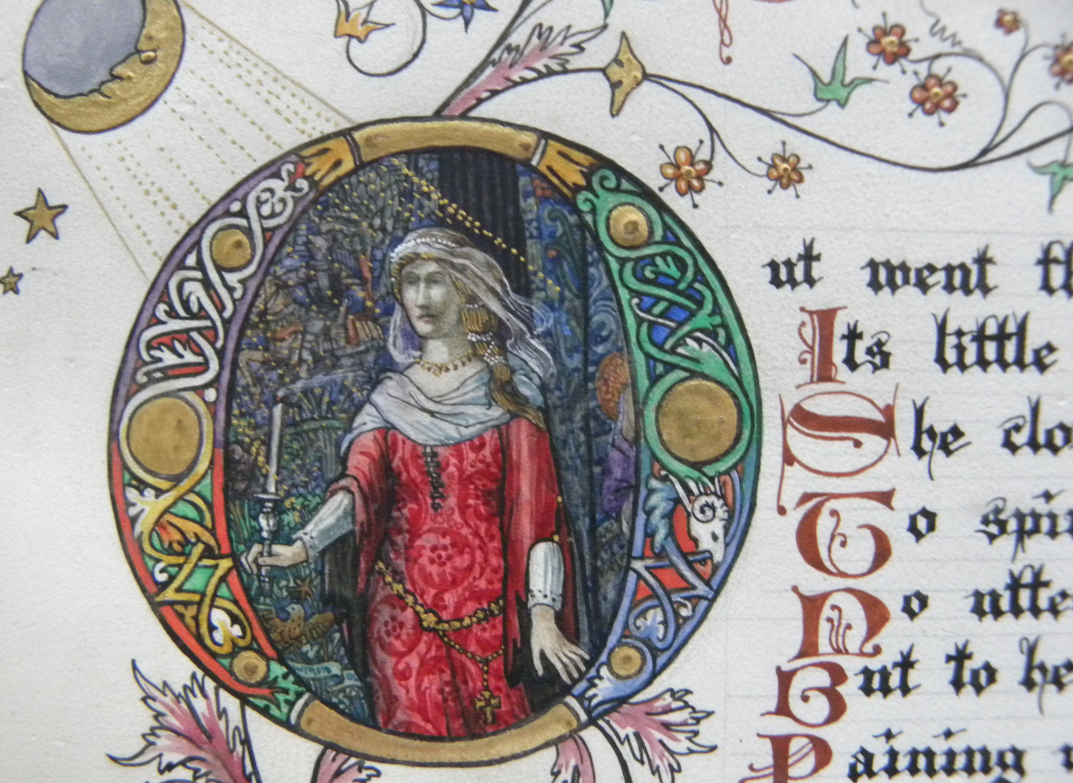
Out went the taper, from 'The Eve of Saint Agnes', Charles Oppenheimer, 1901

Out went the taper, from ‘The Eve of Saint Agnes’, Charles Oppenheimer, 1901

Out went the taper as she hurried in; its little smoke, in pallid moonshine died… stanza 23

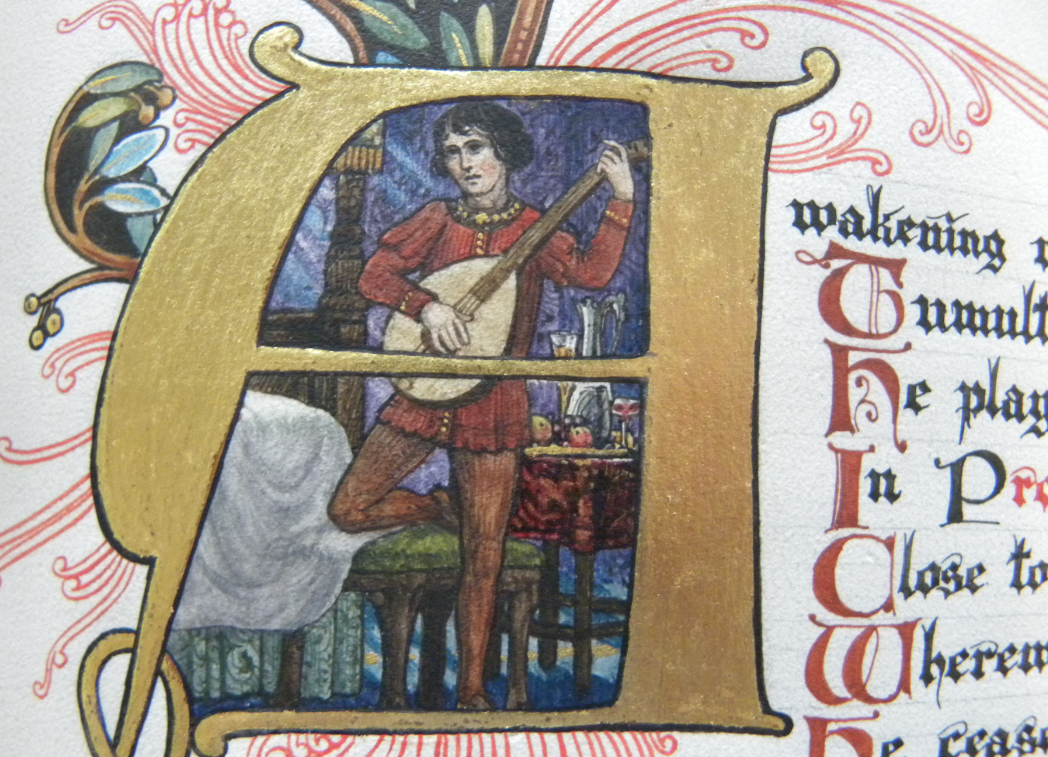
Hollow lute, from 'The Eve of Saint Agnes', Charles Oppenheimer, 1901

Hollow lute, from ‘The Eve of Saint Agnes’, Charles Oppenheimer, 1901

Awakening up, he took her hollow lute – tumultuous – and, in chords that tenderest be, he played an ancient ditty… stanza 33

My Porphyro...ethereal, from 'The Eve of Saint Agnes', Charles Oppenheimer, 1901

My Porphyro…ethereal, from ‘The Eve of Saint Agnes’, Charles Oppenheimer, 1901

At these voluptuous accents, he arose, ethereal, flushed, and like throbbing star… stanza 36

Down the dark stairs a darkling way they found, from 'The Eve of Saint Agnes', Charles Oppenheimer, 1901

Down the dark stairs a darkling way they found, from ‘The Eve of Saint Agnes’, Charles Oppenheimer, 1901

They glide, like phantoms, into the wide hall; like phantoms, to the iron porch, they glide… stanza 41

strip4Charles Oppenheimer exhibited at the Royal Academy in London, the Royal Scottish Academy, at the Royal Scottish Academy of Painters in Watercolours (RSW), at the Royal Glasgow Institute of Fine Arts, the Aberdeen Artists’ Society, and in Liverpool. He designed a number of posters for Britain’s railways, depicting local beauty spots, and he also designed the badge and motto ‘Sempere Vigilo’ of the Scottish Police Force (now Police Scotland).

Charles Oppenheimer died in Kirkcudbright on 16 April 1961.

10Hearts

Detail at stanza 42, from ‘The Eve of Saint Agnes’, Charles Oppenheimer, 1901

Dr. Graeme D. Eddie, Assistant Librarian Archives & Manuscripts, Centre for Research Collections, Edinburgh University Library

strip3The following work was referred to in the creation of this blog-post:

Charles Oppenheimer. From craftsman to artist, by Euan Robson. Edinburgh: Atelier Books, 2012.

The Music of Archives

For the past few years, we have had one of our volunteers, Fiona Donaldson, working with Deputy University Archivist, Grant Buttars, to develop a usable catalogue to our Tovey Collection, one of our larger collections of personal papers we hold.  We are now able to offer an unfinished but usable ‘pre-release’ to allow researchers and other users get a better handle on what’s in the collection while work continues.

Donald Francis Tovey

Donald Francis Tovey at work

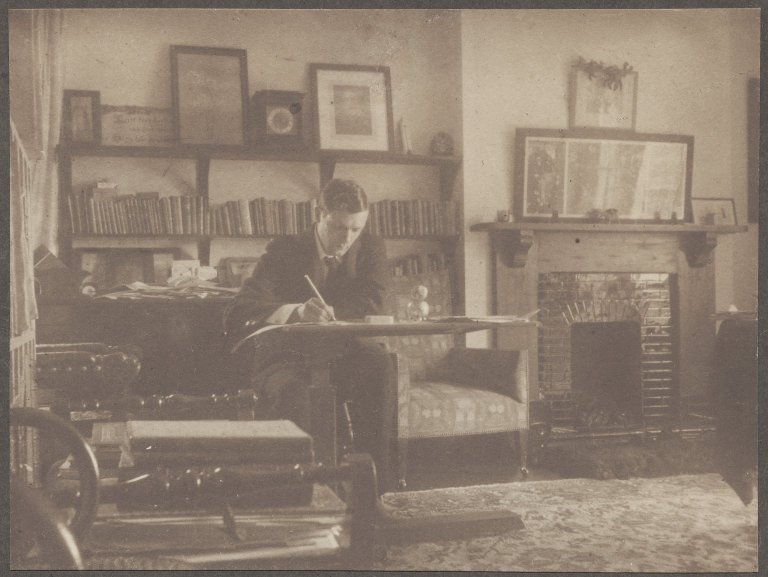
Donald Francis Tovey at work

Donald Francis Tovey was born at Eton on 17 July 1875. His father was an Assistant Master at Eton College. He was educated privately by the music and general teacher Miss Sophie Weisse (1851-1945) and later on studied under Sir Walter Parratt (1841-1924) and Sir C. H. Parry (1848-1918). Tovey then won a music scholarship to Balliol College, Oxford, graduating with a BA, Classical honours, in 1898. As a pianist, a series of chamber music concerts followed in London, Berlin and Vienna where he played with Halle, Joachim, Hausmann, Casals, and other artists. He also composed.

In 1914 he was appointed to the Reid Chair of Music at Edinburgh University in succession to Professor Niecks (1845-1924). As Professor he broadened the music curriculum by instituting classes in musical interpretation, orchestration, history and analysis, thorough-bass, score reading, and advanced counter-point and composition.

Tovey also established and conducted the Reid Orchestra and organised an annual series of concerts. His musical compositions were in many forms including chamber music, symphony, grand opera and concerto, and probably the most famous was his opera The bride of Dionysus produced in Edinburgh in 1929. His literary publications include the six volumes of Essays in musical analysis (1935-1939), and A musician talks (1941). Tovey was knighted in 1935. He died on 10 July 1940.

The Collection

Concert programme

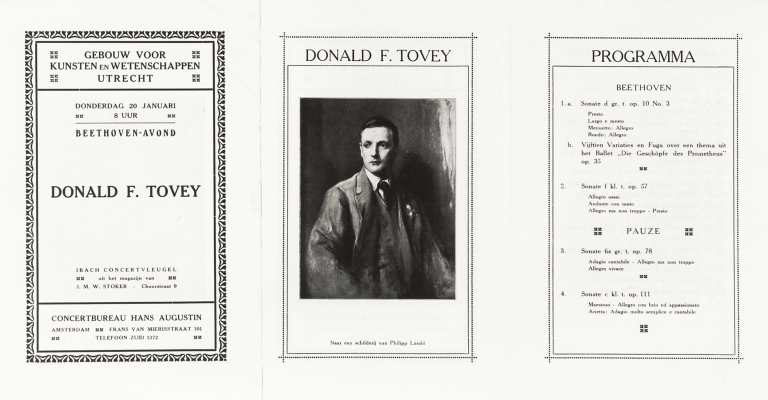
Concert programme

The largest part of the collection is the papers of Tovey himself.  Following his death, the collection appears to have remained in what became the Tovey Memorial Rooms at 18 Buccleuch Place, from where they were taken to Alison House sometime after the Faculty of Music took up occupancy there in 1964.  During its time in those locations it appears to have been augmented, with the addition of particularly correspondence and notes of Tovey’s biographer, Mary Gardner Grierson (1896-1964) and post-Tovey records relating to the Reid Orchestra and Choir.  Tovey’s teacher and mentor, Sophie Weisse (1851-1945), is also well-represented. Perhaps the clear boundaries between what simply began as adjacently shelved material became indistinguishable; by the time the collection was transferred here from the Reid Music Library in 2001, it was all seen as one overall collection and it has not proved possible to fully disentangle it.

The work

We have concentrated on sorting out obvious disorder but with a light-touch approach, creating a meaningful arrangement and, as far as possible identifying what is clearly Tovey’s papers from what is not. Basic repackaging has been undertaken where needed.

The catalogue benefits from earlier cataloguing work that was undertaken when the collection was still in the Reid Music Library.  It focussed on the correspondence (the largest single series within the collection) and the database created than has been converted and imported into the new catalogue.

Our volunteer Fiona is currently a PhD student but also a former administrator from within the former Faculty of Music.  Drawing on this and other related collections here, she has been creating a database to Reid Orchestras as part of her PhD research.

Find out more

View the Tovey Collection in our catalogue

View the Reid Concerts database

Papers of Dr. Jacobus L. Potter & Dr. Elizabeth M. Potter

THEIR BIRTHS IN NOVEMBER 1924 WERE ANNOUNCED IN THE SCOTSMAN ON THE SAME DAY… AFTER CAREERS IN THE USA, JACOBUS LOUW POTTER BECAME EXECUTIVE DEAN, FACULTY OF MEDICINE, EDINBURGH UNIVERSITY, 1981,

Recently added to our collections are the Papers of Dr. Jacobus L. Potter (1924-2015) and Dr. Elizabeth M. Potter (1924-1979), donated by the surviving family.

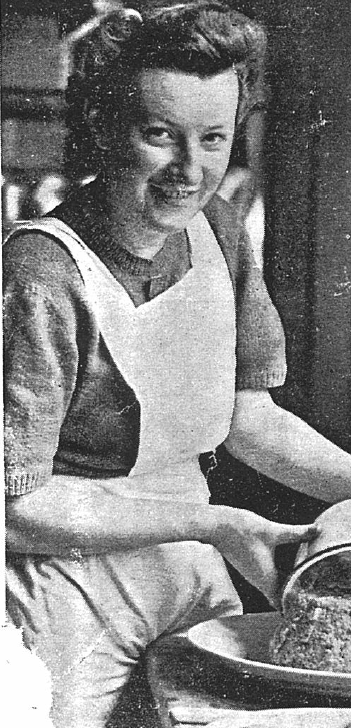
Elizabeth M. Ross at Tonley House, Alford, a hostel housing young women helping local farmers during the war. Elizabeth was a cook. An article about this was printed in the 'Bon-Accord & Northern Pictorial', 21 September 1944.

Elizabeth M. Ross at Tonley House, Alford, a hostel housing young women helping local farmers during the Second World War. Elizabeth was a cook at the hostel before going on to study medicine. An article about the women and their work was printed in the ‘Bon-Accord & Northern Pictorial’, 21 September 1944.

Elizabeth Mackay Ross and Jacobus Louw Potter grew up and went to school in different parts of Fife, Scotland, and met at Edinburgh University. Jacobus graduated in 1948 and Elizabeth in 1949, each with the degrees of M.B. Ch.B. They married in 1949.

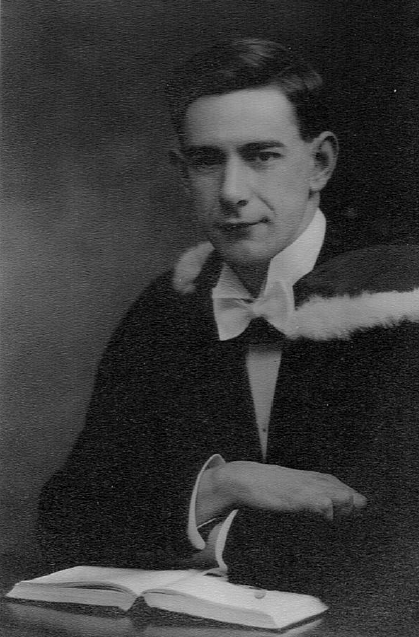
Jacobus Louw Potter, probably at graduation in 1948.

Jacobus Louw Potter, probably at graduation in 1948.

One of the first posts that Jacobus held was that of resident surgeon in the rheumatic diseases unit of the Northern General Hospital, Edinburgh. In 1952 however he joined the medical branch of the Royal Air Force becoming a squadron leader in charge of the medical division, RAF Hospital, Padgate, in Cheshire. In 1954 he returned to Edinburgh as a research fellow at the Northern General, and he went to the USA to research at the New York University School of Medicine’s pathology department.

The cover of the sketch-book filled by Jacobus L. Potter, 1944-1945.

The cover of the sketch-book filled by Jacobus L. Potter, 1944-1945.

In 1962, Potter returned to the USA, to White Plains, New York, and spent the next 20-years in the country. He had varied roles including: work with the Health Research Council of the City of New York; Associate Professor and Associate Dean of the New York University School of Medicine, 1958-1980; physician/consultant for the New York Veteran’s Administration Hospital; and, consultant at New York Infirmary.

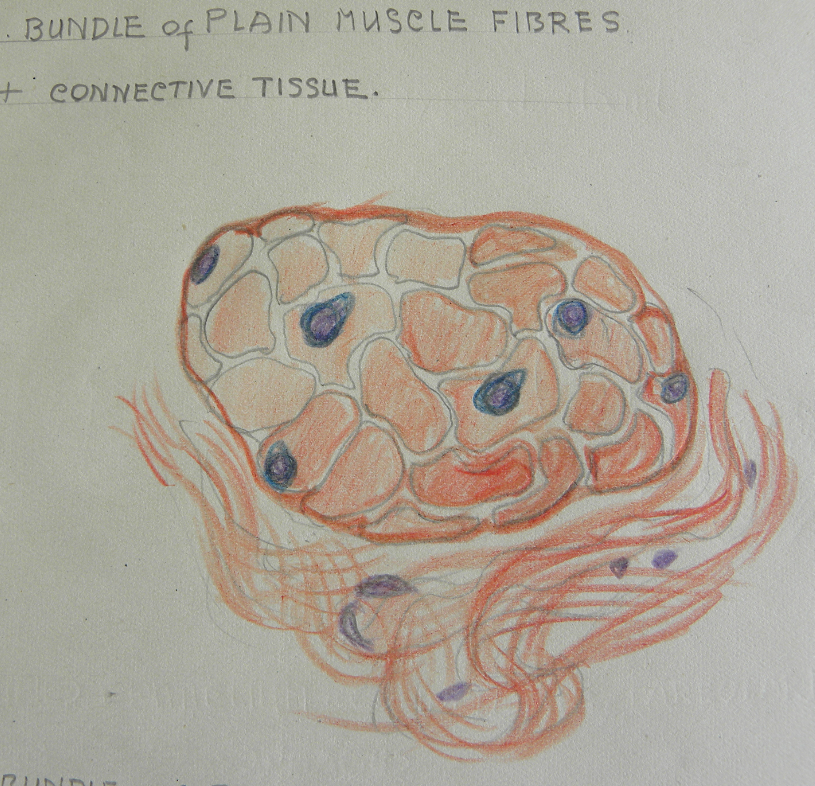
Sketch by Jacobus L. Potter showing a bundle of plain muscle fibres and connective tissue.

Sketch by Jacobus L. Potter, also a talented artist, showing a bundle of plain muscle fibres and connective tissue.

He also served on various bodies and committees, and he was elected as a Fellow of the American College of Physicians. He also became a Fellow of the Royal College of Physicians of Edinburgh.

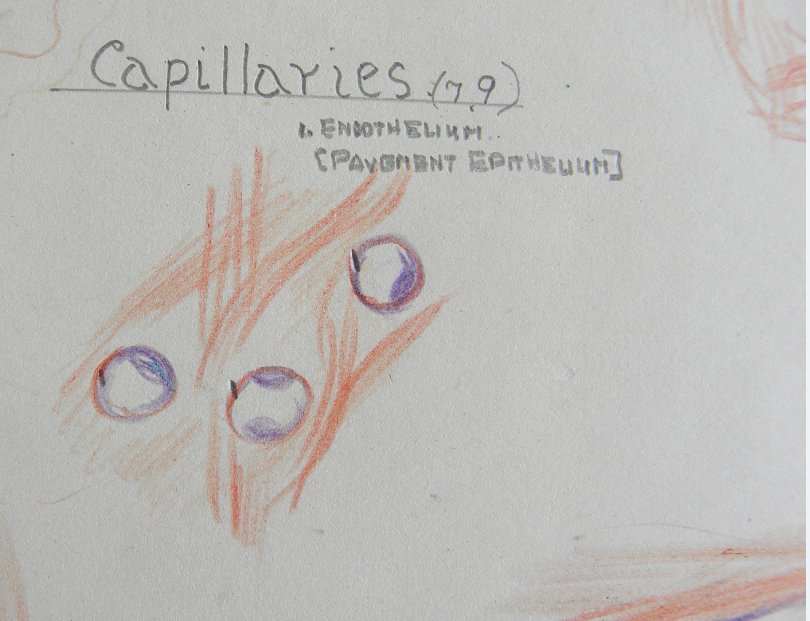
Part of a sketch of capillaries by Jacobus L. Potter.

Part of a sketch of capillaries by Jacobus L. Potter.

Meanwhile, after her graduation and marriage Elizabeth held posts at the Royal Hospital for Sick Children, the Northern General Hospital, and Bruntsfield Hospital, all in Edinburgh, and at Bangour Hospital outside the city.

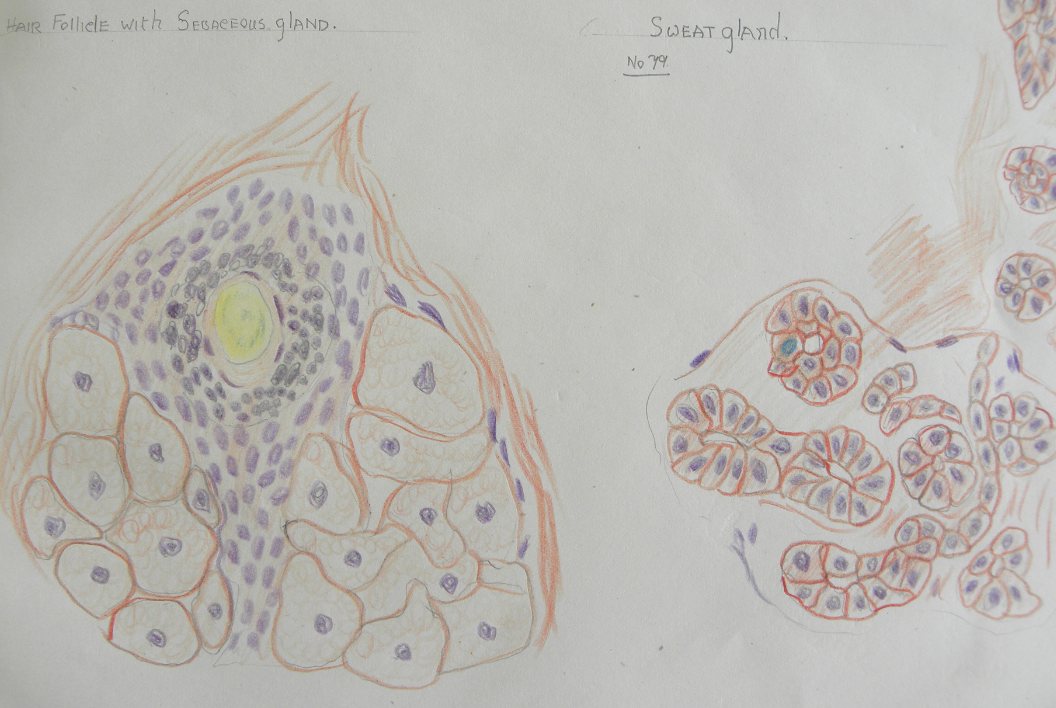
Sketches of hair follicle with sebaceous gland, and sweat gland.

Sketches of hair follicle with sebaceous gland, and sweat gland.

Joining Jacobus in the USA in 1963 she worked at the New York University School of Medicine, the New York University Medical Center, New York Infirmary, and St. Clare’s Hospital Center.

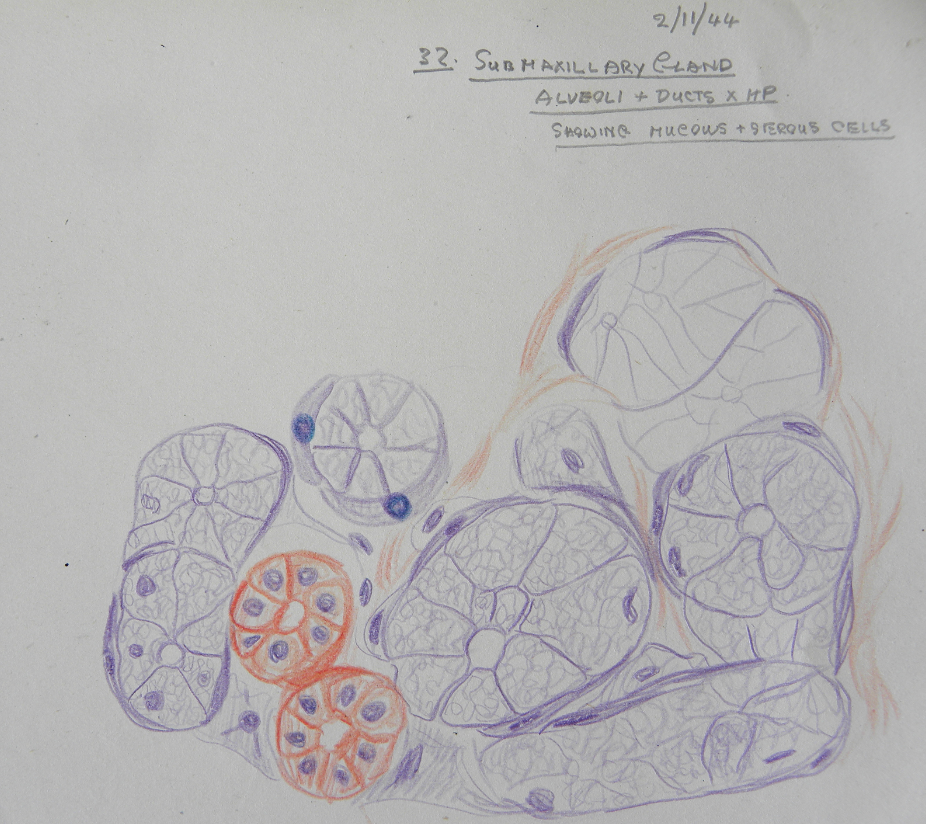
Sketch of submaxillary.

Sketch of submaxillary gland.

In 1981 Jacobus L. Potter was back in Scotland where he took up the post of Executive Dean of the Faculty of Medicine, Edinburgh University. This was noted in the University of Edinburgh Journal, Vol.30. No.1. June 1981. p.6. Sadly Dr. Elizabeth Mackay Potter had predeceased her husband on 26 July 1979, still only in her 50s.

Sketch of the thymus.

Sketch of the thymus.

Jacobus Louw Potter FRCP FACP died on 9 May 2015 in Edinburgh. His second wife, Rena (Catherine Matthews), had predeceased him a little earlier in 2015.

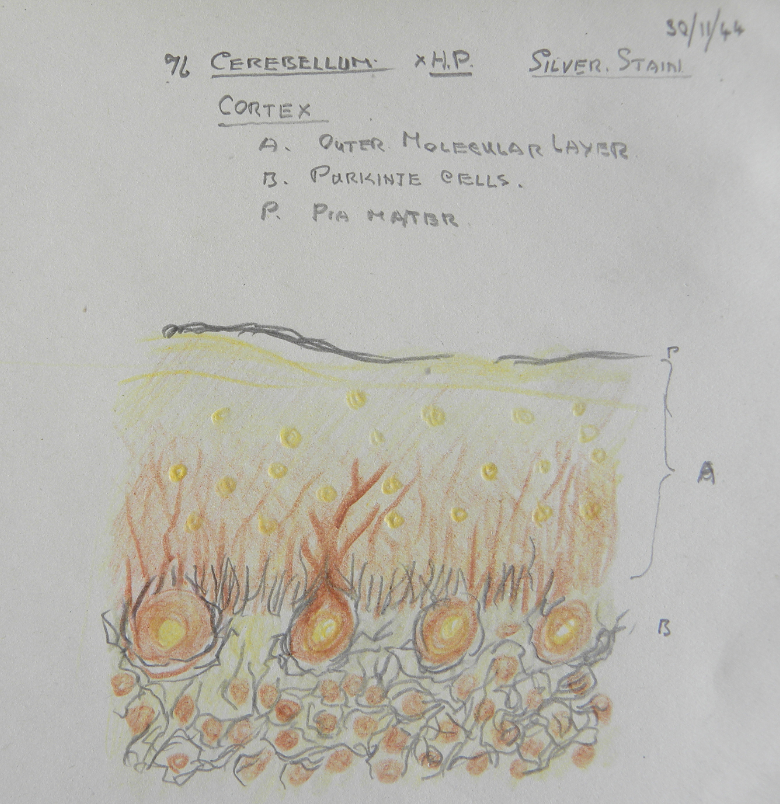
Sketch of the cerebellum.

Sketch of the cerebellum.

The donated collection which will now be prepared and boxed is composed of correspondence, class certificates and University study memorabilia, degrees and professional certificates of the couple. It is expected to be complemented with diaries and additional correspondence at a future date.

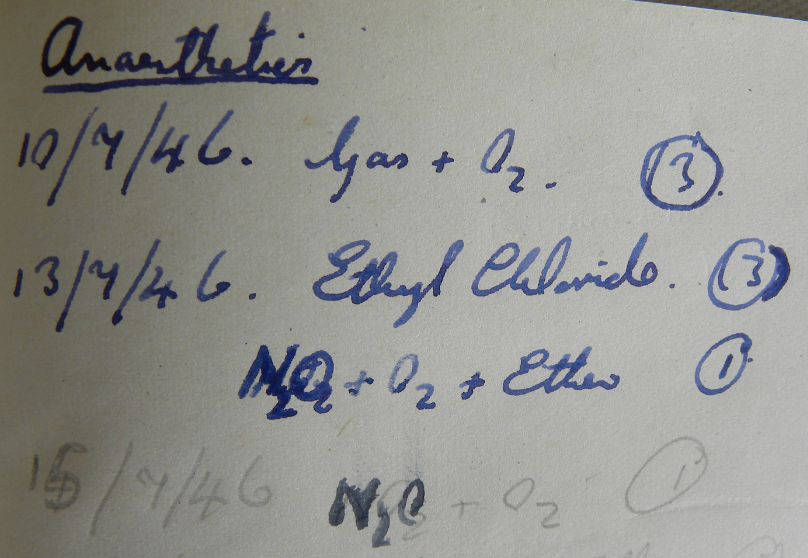
Notes of anaesthetics contained in the sketch-book kept by Jacobus L. Potter.

Notes of anaesthetics contained in the sketch-book kept by Jacobus L. Potter.

Dr. Graeme D. Eddie, Assistant Librarian Archives & Manuscripts, Centre for Research Collections

Note, also used in this post: ‘Obituary: Jacobus Louw Potter FRCP FACP, physician’, Alison Shaw, The Scotsman, 28 May 2015

MacDiarmid and ‘Nisbet: An interlude in post-war Glasgow’

II – IN THE HUGH MACDIARMID COLLECTION…: MS LETTER FROM THE PROJECT THEATRE, GLASGOW… NEW PLAYS ‘PROJECT’ NEW IDEAS

Letter-head from a letter to Christopher Grieve (Hugh MacDiarmid) from the Project Theatre, Glasgow, 1932

Letter-head from a letter to Christopher Grieve (Hugh MacDiarmid) from the Project Theatre, Glasgow, 1932

Among the many letters to Hugh MacDiarmid from producers and directors  of theatre companies across the UK and Europe,  and from editors of journals and reviews, is a couple of pieces of correspondence from the Director of the Project Theatre, Glasgow.

Project_Theatre_logo

Writing on 9 November 1932, the Director, Frederic Grant, mentions that the Theatre producer had found an old number of the Scottish Chapbook (August/September 1922) in the Mitchell Library. On looking through it he came across a one act play written by Grieve entitled Nisbet, He now had ‘the urge to produce’ the play the next month – December – ‘along with other one act plays’. Grant was ‘under the belief’ that they play had ‘not yet been produced’ and requested Grieve’s ‘permission to give it stage presentation’.

Body of the letter from Frederic Grant to Christopher Grieve, 9 November 1932, asking permission to put on 'Nisbet'.

Body of the letter from Frederic Grant to Christopher Grieve, 9 November 1932, asking permission to put on ‘Nisbet’.

The play in question was Nisbet, An Interlude in Post War Glasgow which had been published in 1922 in two issues of the Scottish Chapbook which had become an important outlet for his writing. The Nisbet in question was John Bogue Nisbet a young poet friend of Grieve who was killed at Loos during the First World War. The two used to go cycling and camping in Berwickshire and elsewhere.

Grant’s letter continues: ‘In accordance with our rules we do not pay authors for performing their plays when it is a case of first time on any stage. Our organisation has been founded for various reasons, one outstanding feature is our desire to help playwrights to have their work presented to the public’.

A second letter from the Project Theatre on 3 January 1933 announces that Nisbet had ‘jumped its first hurdle’. Grant continues: ‘I didn’t think for one moment you ever expected it to be played. Some of the passages came out very well indeed, but as you may agree there was a lack of theatre. Nevertheless the experiment was interesting’.

Project_Theatre_logo_part

Grant then describes how the Theatre workshop had created a back-cloth ‘in symbolic design, depicting piles of tenements and everything that is loathsome of Glasgow’. he also refers to the review in the Daily Record the morning after (probably 24 December 1932) in which the play was described as a ‘Cerebral Puzzle’.

Nevertheless, the Director of the Project Theatre was keen to know if Grieve had ‘any more to offer us?’ The Theatre was ‘intent upon doing new plays whenever possible. What a wealth of expression our present time affords’.

The Project Theatre liked to ‘be not too tame neither’ !

Dr. Graeme D. Eddie, Assistant Librarian Archives & Manuscripts, Centre for Research Collections

bannerThis piece was written using: (1) Correspondence within the MacDiarmid collection, Ms. 2966; (2) Lucky Poet. A self-study in literature and political ideas, p.83 London: Jonathan Cape, 1972. In Library general collections – PR 6013. R735 Macd; (3) ‘Hugh MacDiarmid, Author and Publisher’, J. T. D. Hall, in Studies in Scottish Literature, Vol. 21. Issue 1. January 1986


Dylan Thomas poem in ms: ‘In memory of Anne Jones’

I – IN THE HUGH MACDIARMID COLLECTION…: MS LETTER FROM DYLAN THOMAS AND MS POEM

Signature_DT_onlyFor several months work has been going on to bring order within the collections created over a number of decades around the great figures of the ‘Scottish Literary Renaissance’ of the 20th century. This work builds on the recommendations made by archivists in more recent years, and with the ambition of bringing greater clarity to the collections… significantly, in this instance anyway, those of George Mackay Brown, Helen B. Cruickshank, Norman MacCaig and Hugh MacDiarmid.

When working among the correspondence of a literary ‘great’ it is almost a given that interesting material lies waiting to be ‘rediscovered’. The collection of papers built up around Hugh MacDiarmid (Christopher Murray Grieve) has proved to be no exception… revealing an interesting letter from Dylan Thomas… along with a ms poem, In memory of Anne Jones.

Opening of the letter from Dylan Thomas to Hugh MacDiarmid [circa October 1938].

Opening of the letter from Dylan Thomas to Hugh MacDiarmid [circa October 1938].

The letter is written from Laugharne and the Sea View house that Dylan Thomas moved into in August 1938. He writes about regret for his ‘uppish letter’, but he ‘had just been talking to Keidrych Rhys and his arguments against the English’. He ‘can no more get money out of them than I can out of Wales’.

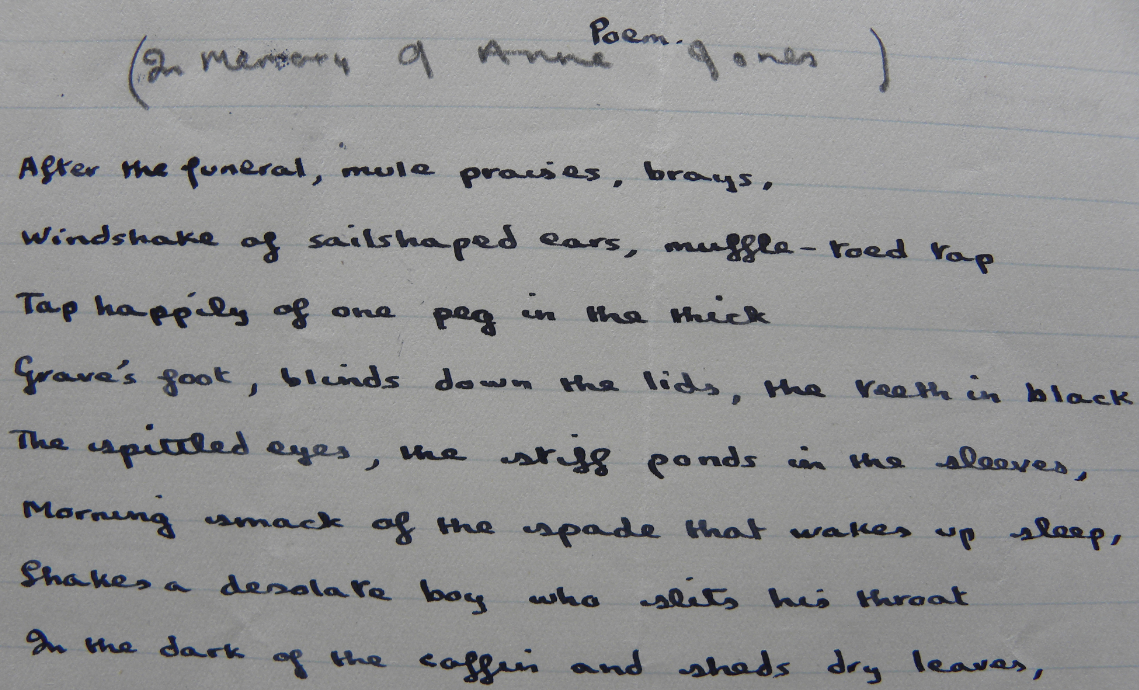
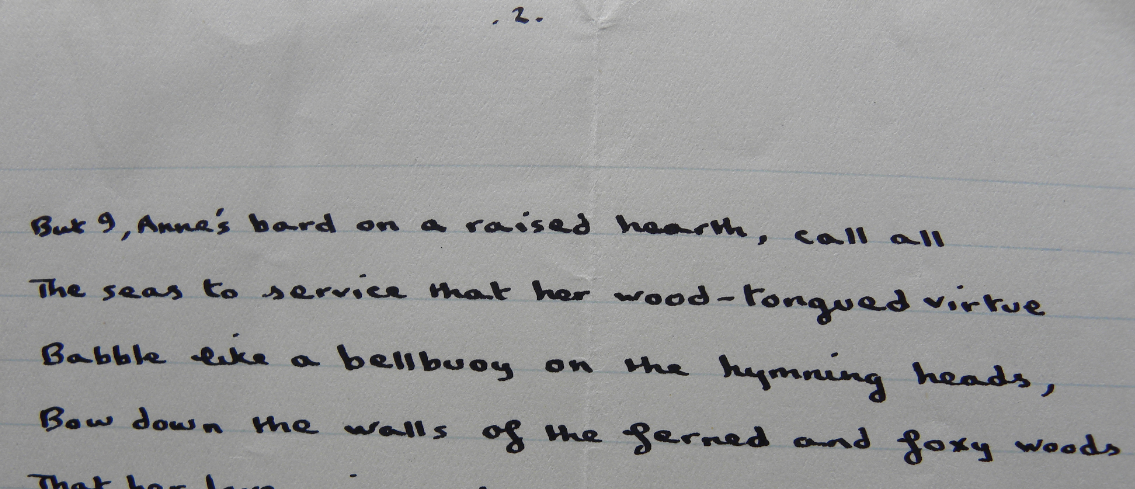
First lines of the poem 'In memory of Anne Jones', Dylan Thomas.

First lines of the poem ‘In memory of Anne Jones’, Dylan Thomas.

The letter mentions that he has sent MacDiarmid ‘a few short poems’ and that ‘if they don’t suit’ he’ll ‘post along some more’. He hopes ‘very much that one day we shall meet’. One of the poems appears to be a manuscript of In memory of Anne Jones.

Some lines from the poem 'In memory of Anne Jones', Dylan Thomas.

Some lines from the poem ‘In memory of Anne Jones’, Dylan Thomas.

The work is an elegy mourning the sad loss of a maternal aunt, Anne Jones, who died in 1933.

Signature of Dylan Thomas.

Signature of Dylan Thomas.

Dr. Graeme D. Eddie, Assistant Librarian Archives & Manuscripts, Centre for Research Collections

A Life Cut Short: Stephanie’s Story

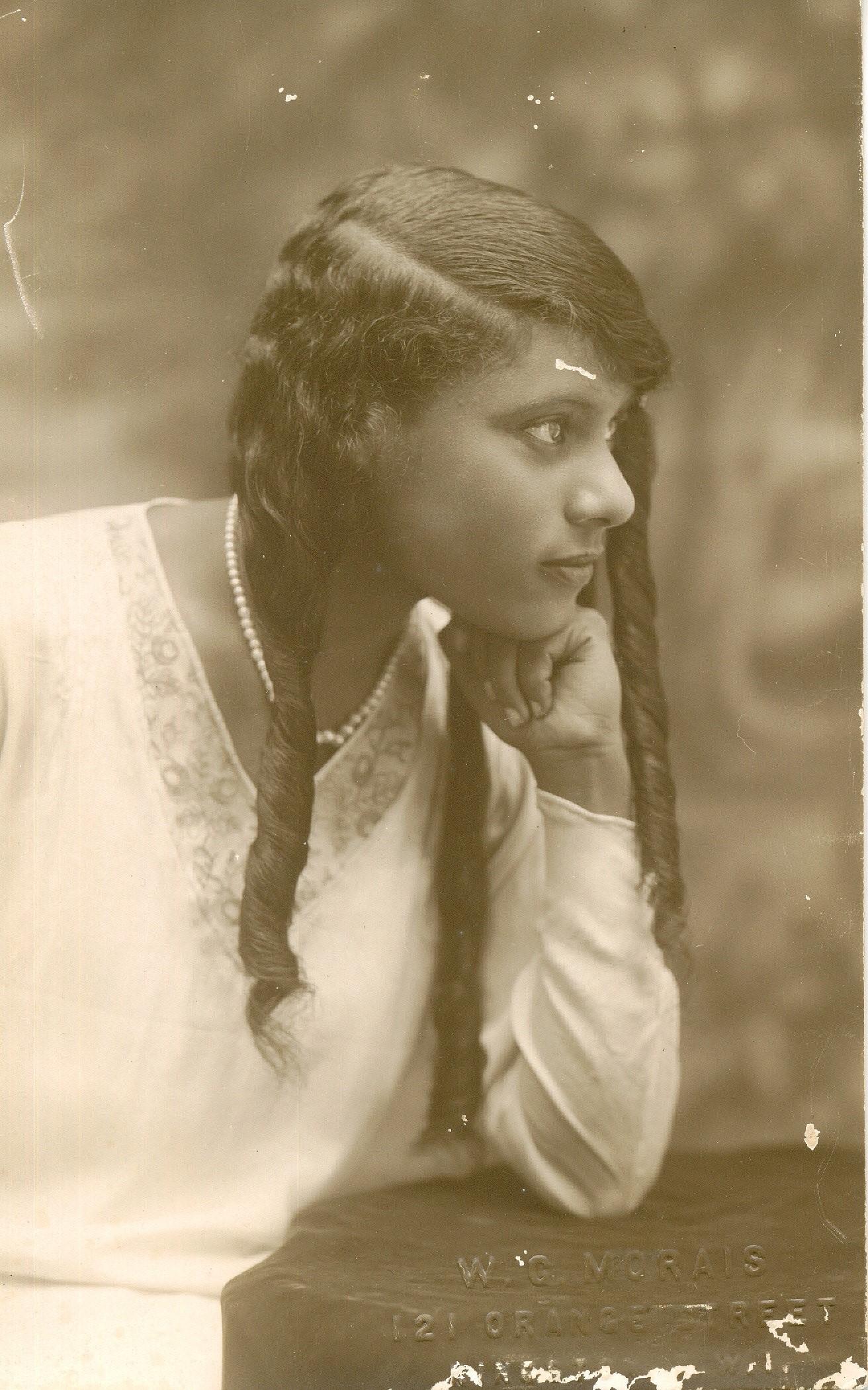
Stephanie (courtesy of Lauren McGregor)

In 1936, Julia Stephanie Evadne McGregor was in the final year of a five-year medical degree and showed all the signs of a highly motivated and conscientious student who would do well.  In January 1936, she was admitted to the Royal Infirmary of Edinburgh, again in May and then June.  She died on 4th July of rheumatic fever.  On the anniversary of her death this year, the University is awarding a posthumous degree, with her family in attendance.

Stephanie (as she was known) was born in Gayle St. Mary, Jamaica on 9th April 1911, the daughter of Peter James McGregor and his wife Julianna Drucilla Marsh. She attended Wolmer’s Girls High School in Kingston, Jamaica from 1923-1929 and matriculated at the University of Edinburgh to study medicine in April 1931, having obtained her matriculation certificate at the University of London the previous August. On 21 October 1931 she registered as a student member of the General Medical Council.

Her first year of study saw her study under (amongst others) Professors James Hartley Asworth (Zoology), George Barger (Chemistry) and William Wright Smith (Botany), passing her first professional exams in 1932. In her second year her Professors were Edward Sharpey-Schafer (Physiology) and James Couper Brash (Anatomy). She passed her second professional exams  in 1933.

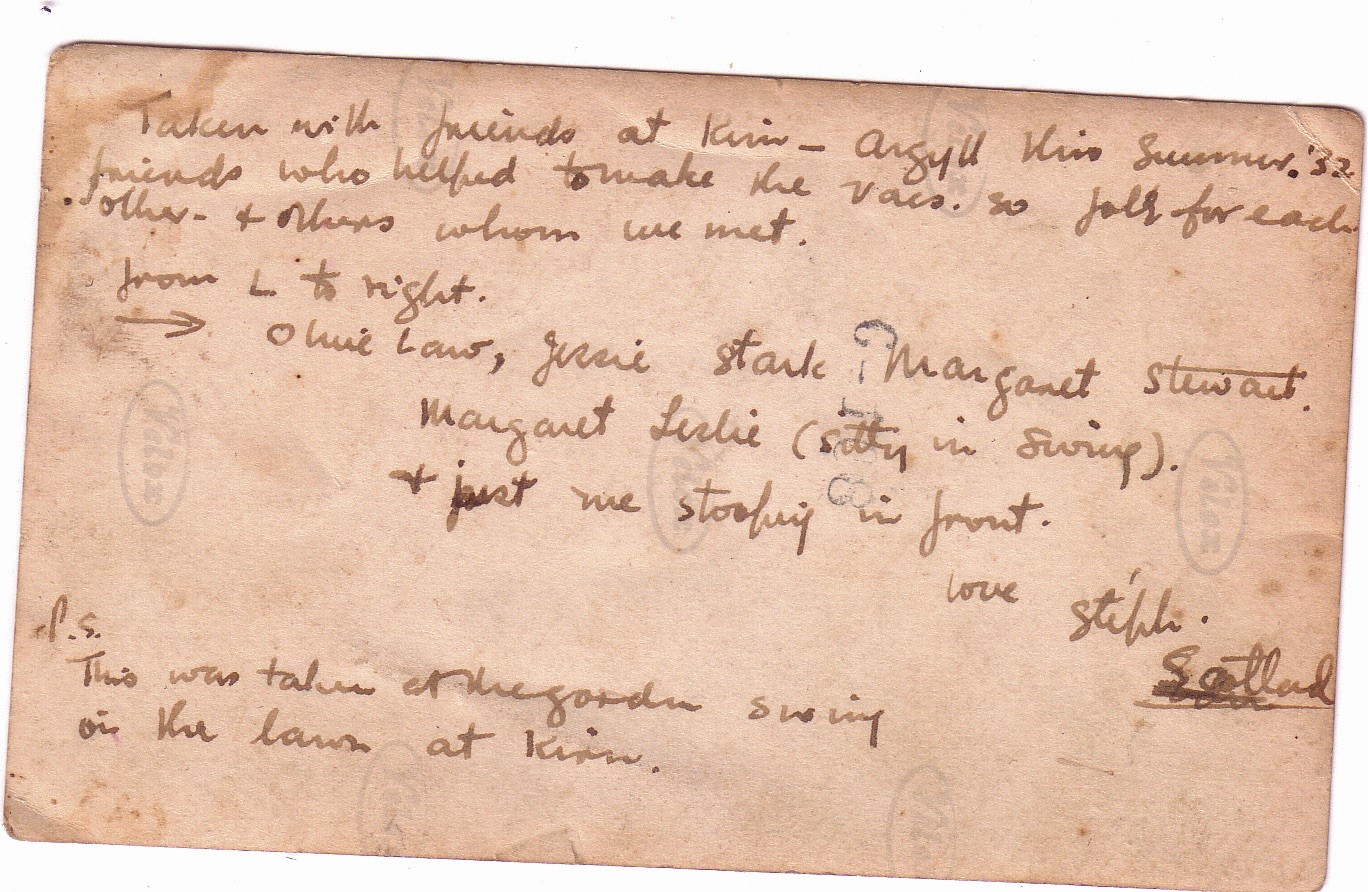
Holiday at Kirn, Argyll, 1932

On holiday at Kirn, Argyll, 1932 (courtesy of Lauren McGregor)julia2back

In October 1933, Marjorie Rackstraw in her capacity as Adviser of Women Students, wrote to Professor Sir Sidney Smith, Dean of the Faculty of Medicine, informing him that Stephanie was in financial difficulties, having received no allowance since the previous August, due to her family being in financial difficulties themselves. As a result, she was able to gain an award of £25 from the Medical Bursaries Fund. By the following February, this plus money Stephanie had managed to raise elsewhere was once again exhausted and Miss Rackstraw wrote again to Prof. Smith to explore other options, specifically a loan

She described Stephanie as capable and sensible, “one of the best of her class and has gained merit certificates in four of her subjects and one prize in Botany”. The letter also recorded that Stephanie was planning to apply for a Vans Dunlop Scholarship and, “if the  banana harvest is satisfactory she should be able to meet her expenditure during the next two years”. A further grant of £50 from the Medical Bursaries Fund was awarded.

Further troubles arose in late 1934. On 29th October Miss Rackstraw wrote again to Prof. Smith, explaining that Stephanie’s father had died a few weeks earlier, presenting more financial problems over and above dealing with the bereavement.  She was to receive further small pots of money.

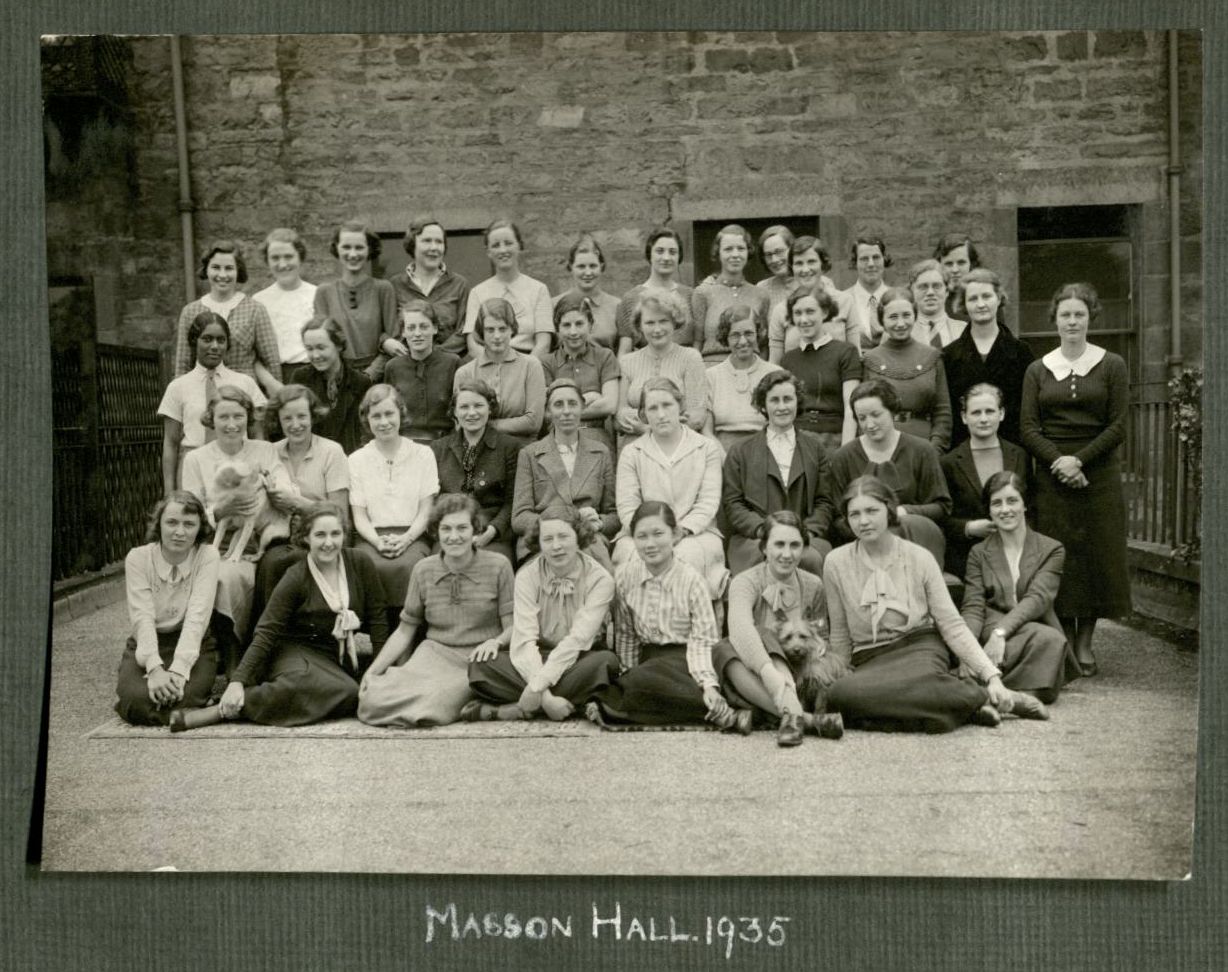
By 1935, Stephanie was living in Masson Hall of Residence, where Marjorie Rackstraw was warden.  The building no longer exists, having been demolished in the 1960s to make way for the Main Library building.  However there are extensive records, including photographs, and one that includes Stephanie survives.

Group photograph of residents and others at Masson Hall of Residence, 1935

Group photograph of residents and others at Masson Hall of Residence, 1935

1936 did not start well for Stephanie.  She fell ill on the 17th January and ended up in the Royal Infirmary but was let out after 15 days on the condition that she go away for convalescence.  She went to say with a Mrs Corrigall at “Stromness, Kirn, Argyll”, but the ordeal journey there resulted in a week in bed and further time away from study.  She wrote to Prof. Smith to explain her situation.

Mrs. Corrigall, with whom I am staying, called in her family Doctor and I have been under his care ….. I am still quite unfit to face classes and work ….. I am very troubled about my attendance and classes ….. This is the first time in the five years of my academic life, Sir, that I have for any reson or other been forced to miss my classes

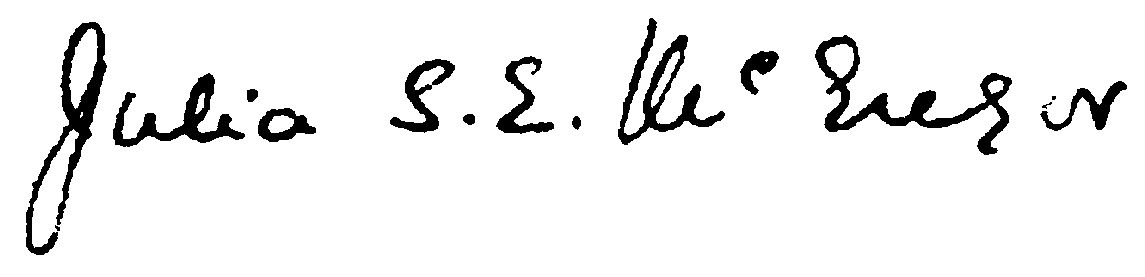
Steph's signature

Signature, from letter in her student file

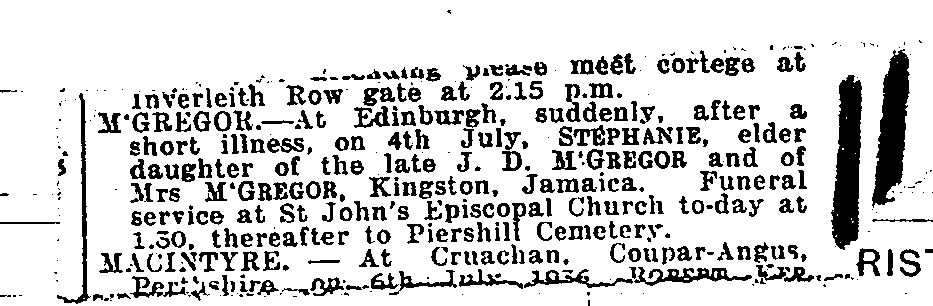
On 5 July 1936, Marjorie Rackstraw again wrote to Prof Smith but this time she was not looking for financial assistance.  Instead she had the task of informing him that Stephanie had died the day before, a victim of “rheumatic fever following tonsillitis which affected her heart”. Her funeral was held at St. John’s Episcopal, where she had been a member of the congregation, and she was buried at Piershill Cemetery.

Funeral notice (copy from her student file)

Funeral notice (copy from her student file)

Since the later 19th century, women students had been battling to gain parity with their male counterparts.  It was not until the 1890s that women were able to matriculate as students and it was only in 1915 that they gained an equal status to men within the Faculty of Medicine.  Even by the time Stephanie was studying, numbers of female students were very small compared to men, having only just edged over 10%.  Had Stephanie graduated, she would have made up one of only 19 women who were awarded a degree of MBChB that year.  Although she probably never saw herself as such, Stephanie can be seen as a contributor towards a major change within medical education, paving the way for those who followed.

At the graduation ceremony which takes place on 4th July 2015, coincidentally on the 79th anniversary of Stephanie’s death, the University of Edinburgh is awarding her a posthumous degree.

200th anniversary of the Battle of Waterloo – 18 June 2015

THE BATTLE OF WATERLOO REFLECTED IN OUR ARCHIVE COLLECTIONS

Decorative stripOn Sunday 18 June 1815, on the muddy fields of Waterloo just outside Brussels in today’s Belgium, Napoleon Bonaparte with his French Imperial Guard faced off the Duke of Wellington and the British and Allied army. The course of the Battle of Waterloo, notable officers and men, and the battle outcome can all be referred to elsewhere. Instead, on this 200th anniversary of Waterloo, we focus on some of the material curated by the Centre for Research Collections which reflect these hours of 18 June 1815 and the aftermath of battle.
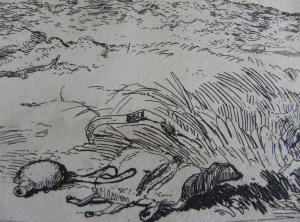
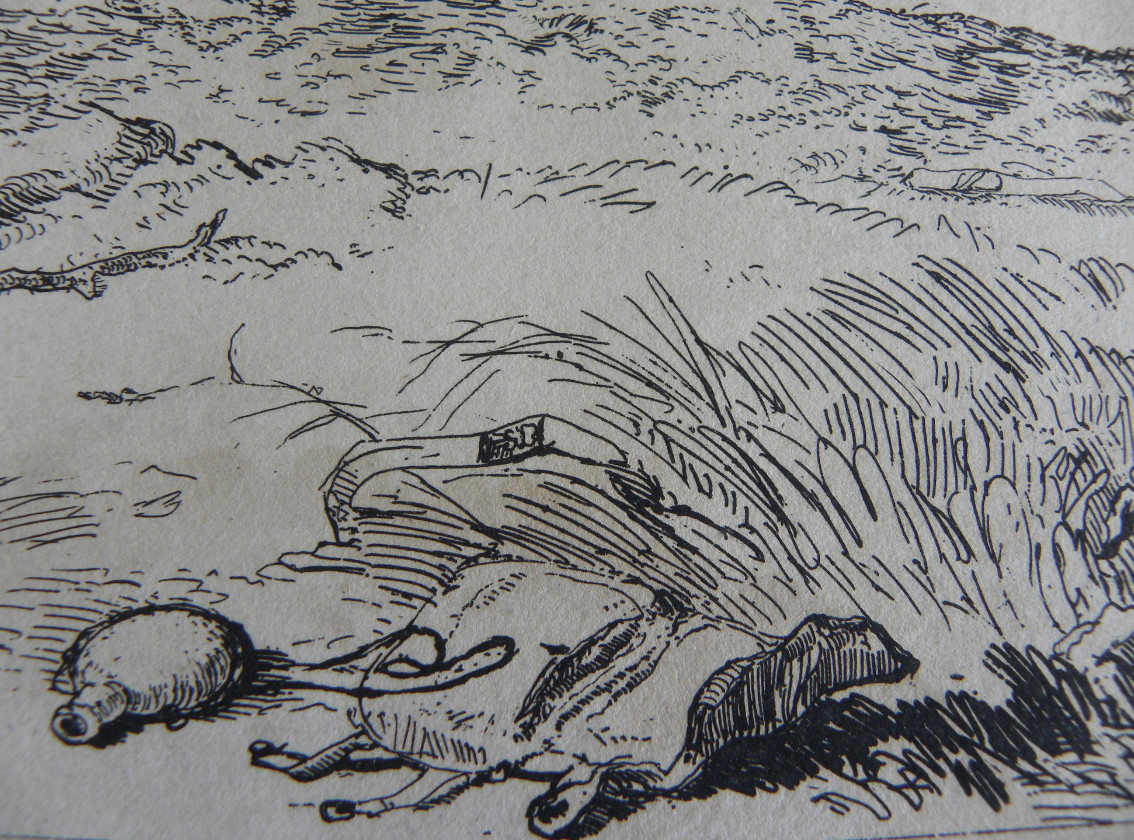
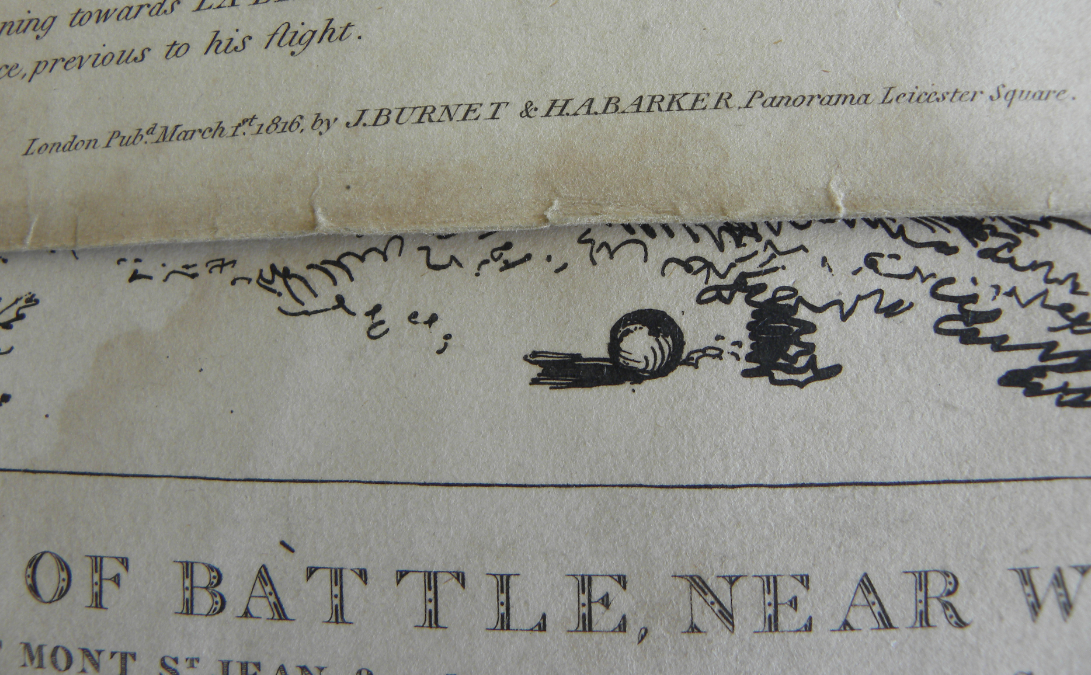
Drinking bottle on the field of battle in scene No.7 of the Barker Panorama of Waterloo (produced in 1816), shown at Leicester Square, London

Drinking bottle and personal effects on the field of battle in scene No.7 of the Barker Panorama of Waterloo (produced in 1816), shown at Leicester Square, London. (Coll-1101 – Barker Panorama of Waterloo, CRC)
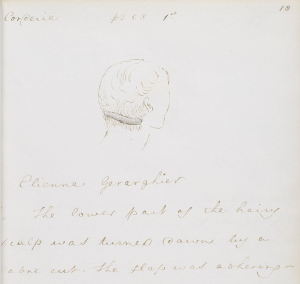
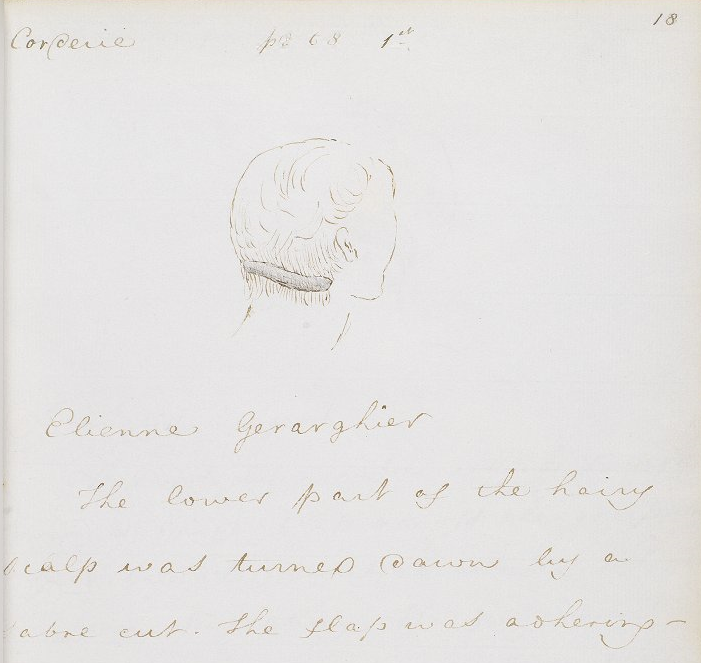
Wound sustained by Etiene G*** during the Battle of Waterloo and appearing in the case-notes of ***

Wound sustained by Etienne Gerarghier during the Battle of Waterloo and appearing in the case-notes of Dr. Thomson and Dr. Somerville. (On p. 18 of Gen.594, in Coll-530 – Collection of sketches and reports of wounded at the Battle of Waterloo, CRC)


The collections profiled are: scenes from the panorama of the field of battle at Waterloo drawn by Henry Aston Barker (Coll-1101); and, sketches and reports by Dr. John Thomson and Dr. William Somerville of the wounded at Waterloo (Coll-535).
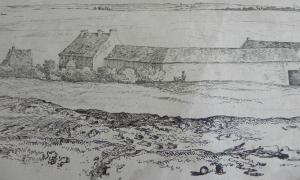
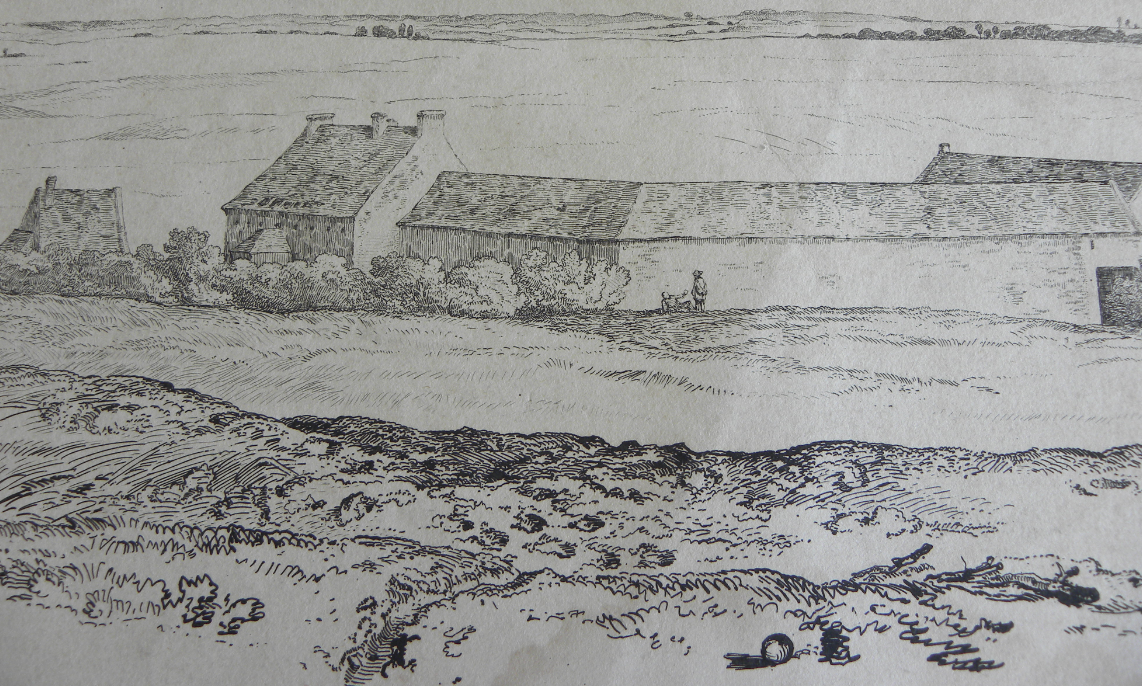
The farm of La Haye Sainte 'where the Life Guards *** the Cuirassiers' of the French Imperial Army. In part No.1

The farm of La Haye Sainte ‘where the Life Guards charged the Cuirassiers’ of the French Imperial Army (armour and firearm equipped cavalry). In part No.1 of the panorama. (Coll-1101 – Barker Panorama of Waterloo, CRC)

Firstly… scenes from the panorama of the field of battle at Waterloo (Coll-1101).

Henry Aston Barker (1774-1856) was the younger son of Robert Barker (1739-1806), the panorama painter. Aged 12, he was sent by his father to take outlines of Edinburgh from the city’s Calton Hill for the world’s first 360 degree exhibition panorama.

Barker panoramas were exhibited at an establishment in Castle Street, off Leicester Square, London, and the first was a view of London from the roof of the Albion Mills in 1791, the drawings for which were made by the young Henry.  Later on, from 1793, Barker panoramas moved to the first purpose-built panorama building in the world, in Leicester Square itself.
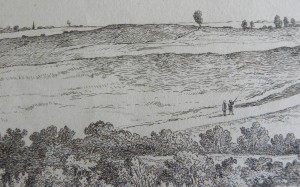
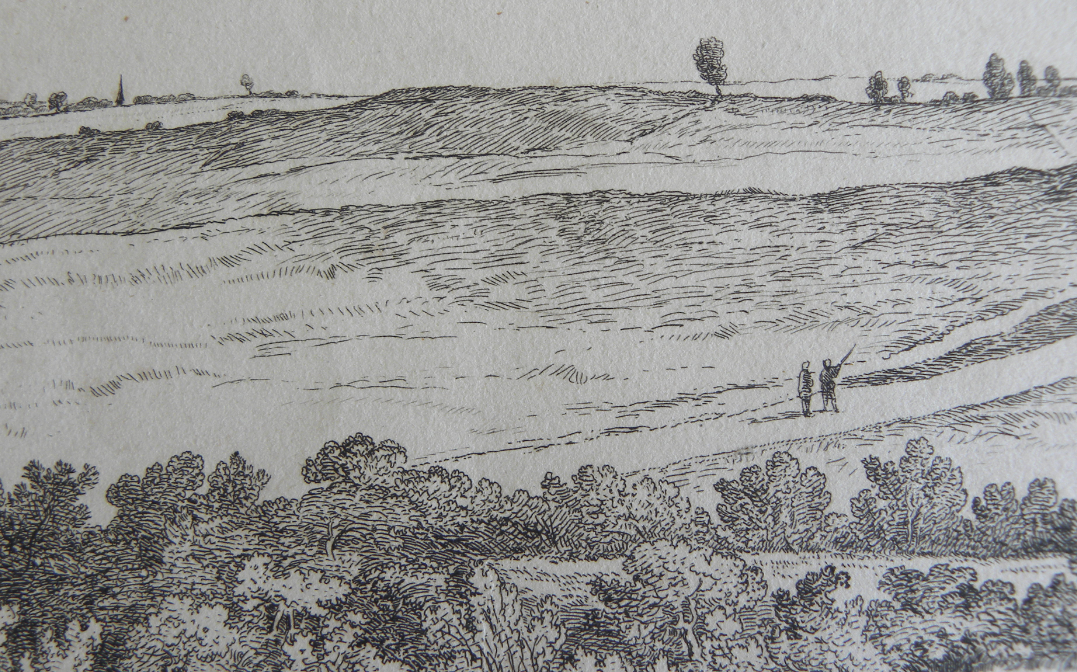
Scne showing the distant spire of Planchenoit 'where Bonaparte slept the night before the Action'.

Scene showing the distant spire of Planchenoit (top left) ‘where Bonaparte slept the night before the Action’. In part No.2 of the panorama. (Coll-1101 – Barker Panorama of Waterloo, CRC)

The scenes for the panorama of the field of battle at Waterloo were drawn by Barker on the  Plateau of Mont St. Jean, the escarpment which provided Napoleon’s name for the battle – La bataille de Mont-Saint-Jean.
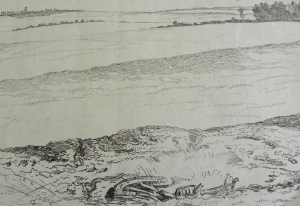
Scene showing distant platform or scaffold 'near which Bonaparte gave his orders in the early part of the Action'. From Coll-1101 Barker Panorama of Waterloo, CRC

Scene showing distant platform or scaffold (top left) ‘near which Bonaparte gave his orders in the early part of the Action’. In part No.3 of the panorama. (Coll-1101 – Barker Panorama of Waterloo, CRC)

Barker had also visited Paris to research the project and to interview officers who participated in the battle. The scenes were etched by J. Burnet, and they were produced in 1816 for sale to visitors to the panorama building at Leicester Square. The credit to both Burnet and Barker is printed on each of the eight components of the ‘souvenir’ panorama.
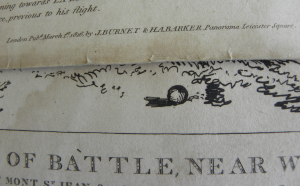
The drawings were initially done by Barker, and then etchings were made by J. Burnet

The drawings were initially done by Henry A. Barker, and then etchings were made by J. Burnet. (Coll-1101 – Barker Panorama of Waterloo, CRC)
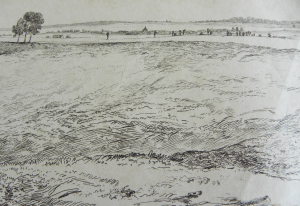
This scene showing the trees that approximately 'mark the Right of the edge of the British position'. In part No.4 of the panorama. From Coll-1101 Barker Panorama of Waterloo, CRC

This scene showing the trees and field that approximately ‘mark the Right of the edge of the British position’. In part No.4 of the panorama. (Coll-1101 – Barker Panorama of Waterloo, CRC)

It was intended that the eight parts of the panorama be joined together to form a complete circle. The viewer would then stand in the centre and have a panoramic view of the entire scene of Battle.
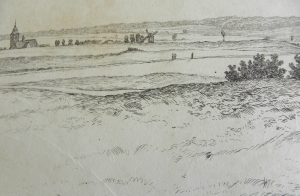
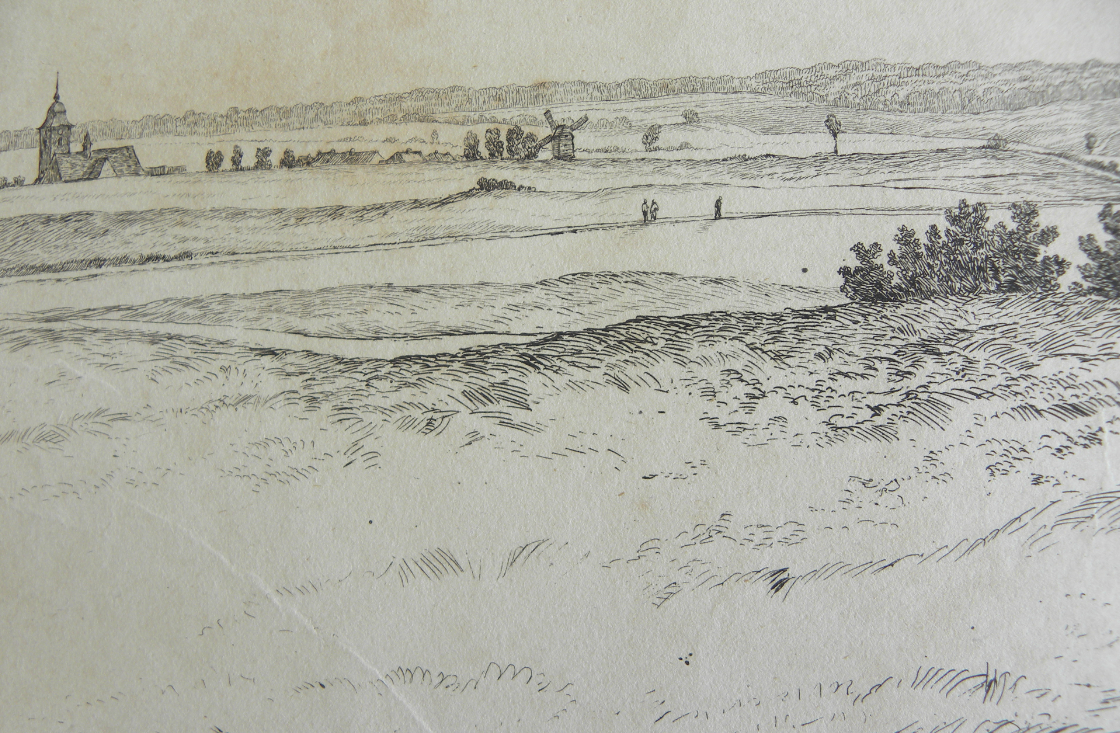
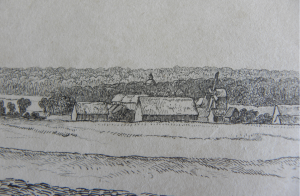
The church and windmill of the village of Braine La Leude on the battle site. In part No.5 of the panorama. From Coll-1101 Barker Panorama of Waterloo, CRC

The church and windmill of the village of Braine La Leude on the battle site. In part No.5 of the panorama. (Coll-1101 – Barker Panorama of Waterloo, CRC)

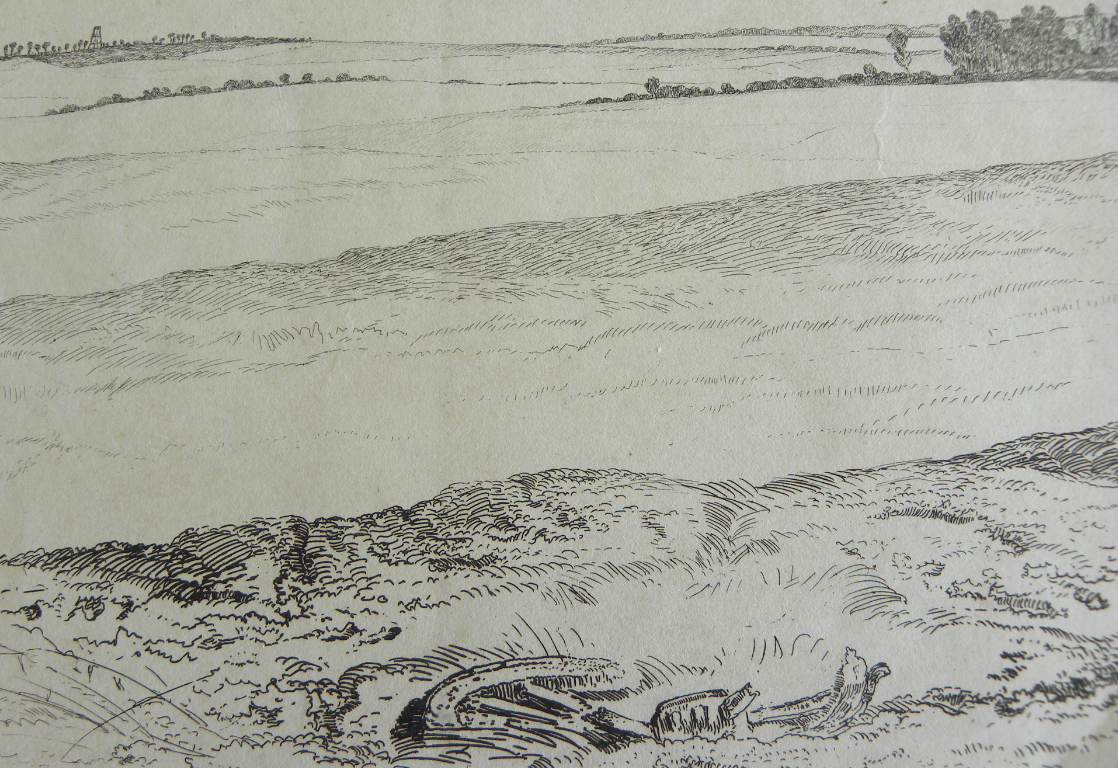
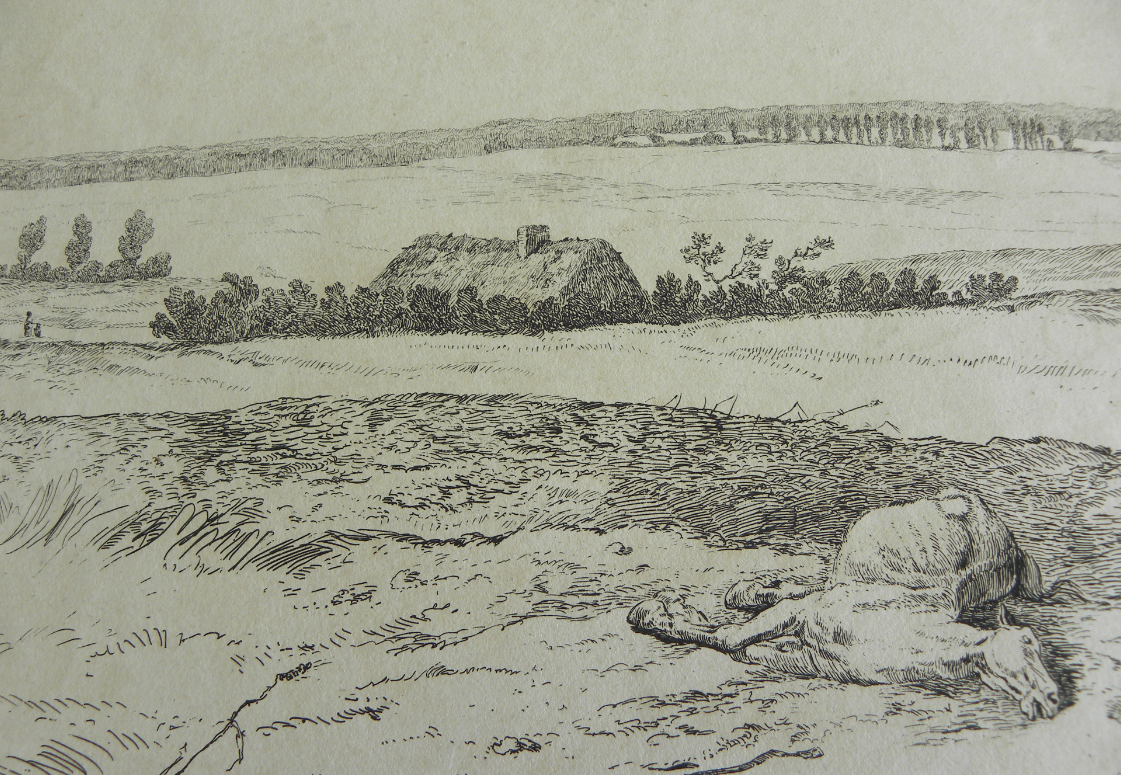
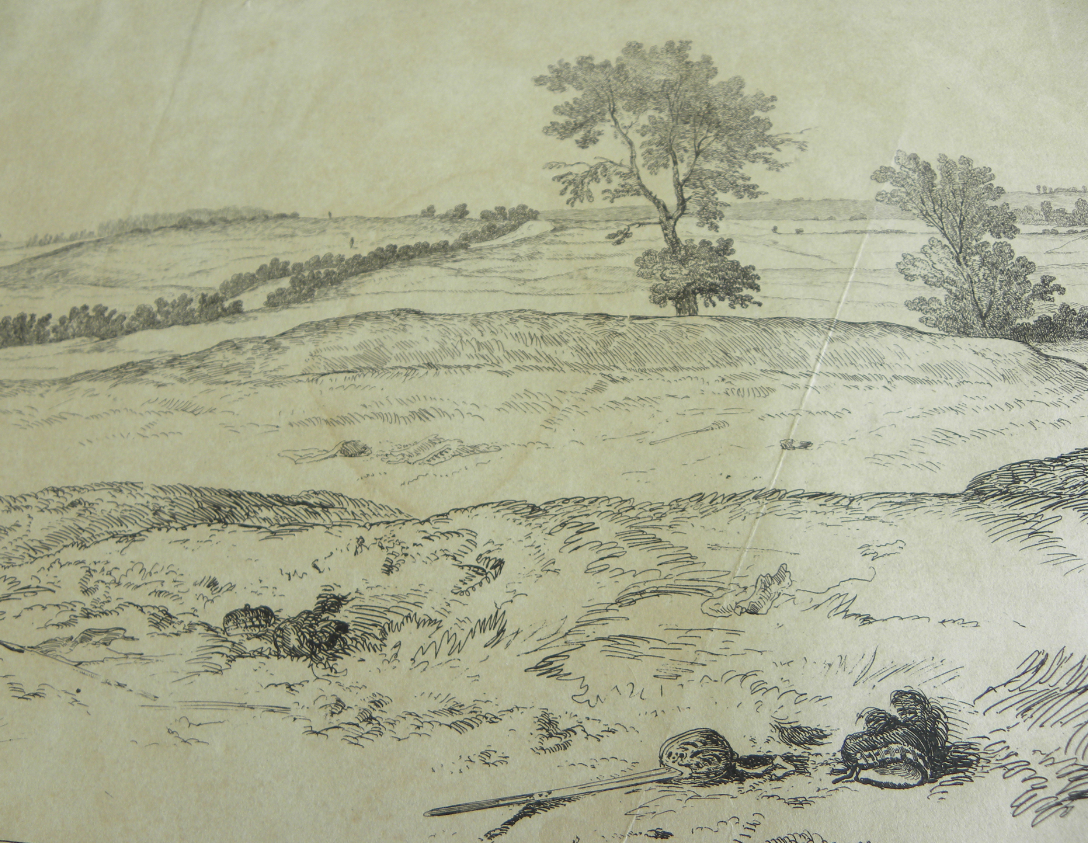
Each component is around 60cm x 29cm in size and together they show principally: 1 -The farm at La Haye Saint; 2 – Around the orchard of La Haye Sainte; 3 – Prominent part of the Plateau of Mont St. Jean; 4 – The crest of the hill on which the Imperial Guards were charged; 5 – The village of Braine La Leude; 6 – The village of Mont St. Jean; 7 – The Forest of Soigne; and, 8 – Road and hedge leading to Ter La Haye.
Distant Dome of the Church of Waterloo (Église Saint-Joseph de Waterloo) and the village of Mont St. Jean. In part No.6 of the panorama. From Coll-1101 Barker Panorama of Waterloo, CRC

Distant Dome of the Church of Waterloo in Brabant (Église Saint-Joseph de Waterloo) and the village of Mont St. Jean. In part No.6 of the panorama. (Coll-1101 – Barker Panorama of Waterloo, CRC)

At Waterloo, the French army of around 72,000 faced the outnumbering 113,000 allied British, Low Countries, German and Prussian forces. Napoleon lost around 25,000 men either killed or wounded, and 9,000 captured, while the allies lost around 23,000. Napoleon abdicated four days later.
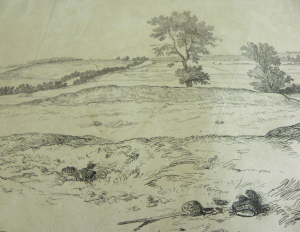
Part of the distant Forest of Soigne, on the site of battle. In part No.7. of the panorma. From Coll-1101 Barker Panorama of Waterloo, CRC

Part of the distant Forest of Soigne on the site of battle. In part No.7. of the panorama. (Coll-1101 – Barker Panorama of Waterloo, CRC)
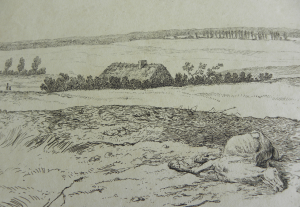
Scene showing personal effects on a part of the site 'where the Highlanders suffered so severely'. In part No.8 of the panorama. From Coll-1101 Barker Panorama of Waterloo

Scene showing personal effects on a part of the site ‘where the Highlanders suffered so severely’. In part No.8 of the panorama. (Coll-1101 – Barker Panorama of Waterloo)

So then… secondly… emphasising the human loss and injury… sketches and reports and case-notes of the wounded at Waterloo (Coll-535).

The wounds of French and Allied alike were described and reported on – as case-notes and sketches – by Dr John Thomson, Professor of Military Surgery at Edinburgh, and Dr William Somerville, the principal medical officer in Scotland. In the summer of 1814, Thomson had toured medical schools in France, Italy, Austria, Saxony, Prussia, Hanover and Holland, and in 1815 he was a staff-surgeon in Brabant and was at the Battle of Waterloo.
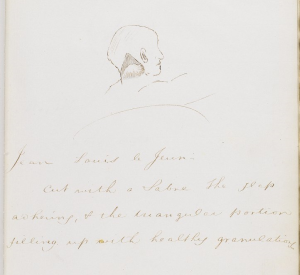
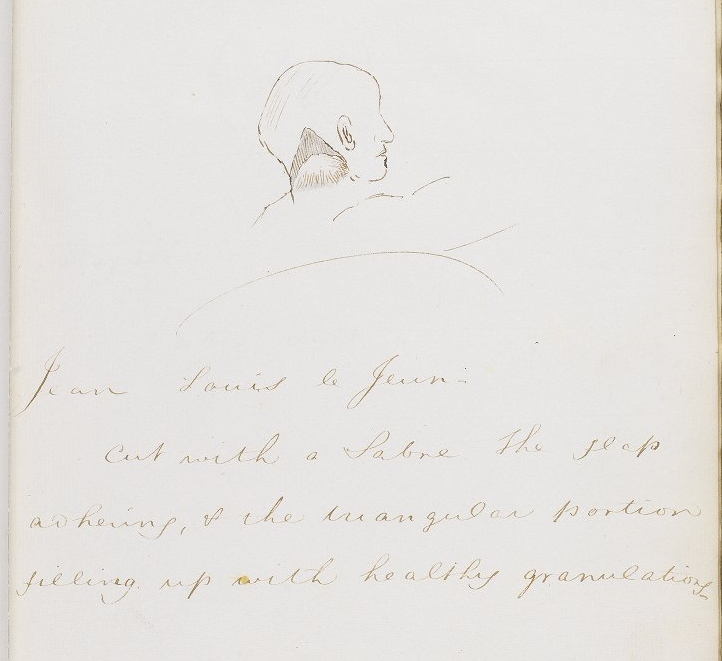
Wounds suffered by Jean Louis le Jeun who was cut with a sabre. From Coll-535

Wounds suffered by Jean Louis le Jeun who was cut with a sabre. (On p.21 of Gen.594, in Coll-535 – Collection of sketches and reports of wounded at the Battle of Waterloo, CRC)
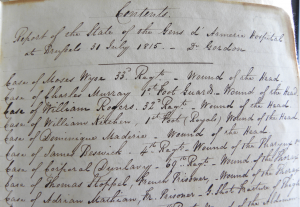
Contents (Coll-535)

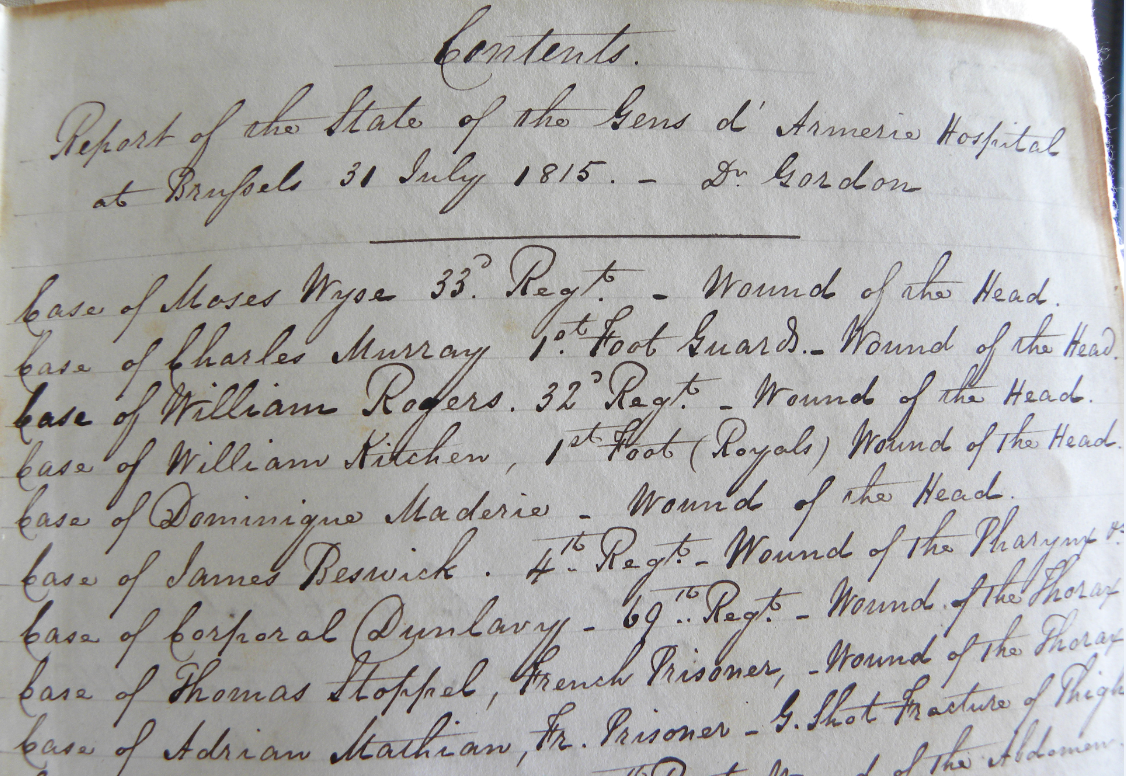
Contents pages at the beginning of the volume containing reports and cases at Gens d’Armerie Hospital in Brussels. (In the volume Gen.595, in Coll-535 – Collection of sketches and reports of wounded at the Battle of Waterloo, CRC)

The two-volume work profiled here was probably done in 1815. One also contains statistical tables of the wounded at the site – Reports cases and returns of the wounded at Waterloo (Gen. 595).
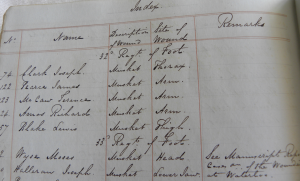
Index of the names of soldiers, description of wounds, and place of wounds, from the volume of reports, cases and returns. (Coll-

Index of the names of soldiers, description of wounds, and place of wounds, from the volume of sketches of the wounded. (In the volume Gen.594, in Coll-535 – Collection of sketches and reports of wounded at the Battle of Waterloo, CRC)

The other is illustrated with sketches of specific wounds of the soldiers, their names, their regiments, and details of their injuries – Sketches of the wounded at Waterloo. Drs. Thomson & Somerville (Gen. 594). Along with a number of other items both of the ‘Waterloo wounds’ volumes were transferred Edinburgh University Library from the Library of the Anatomical Museum, Edinburgh University, in June 1962.
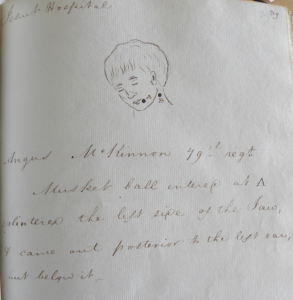
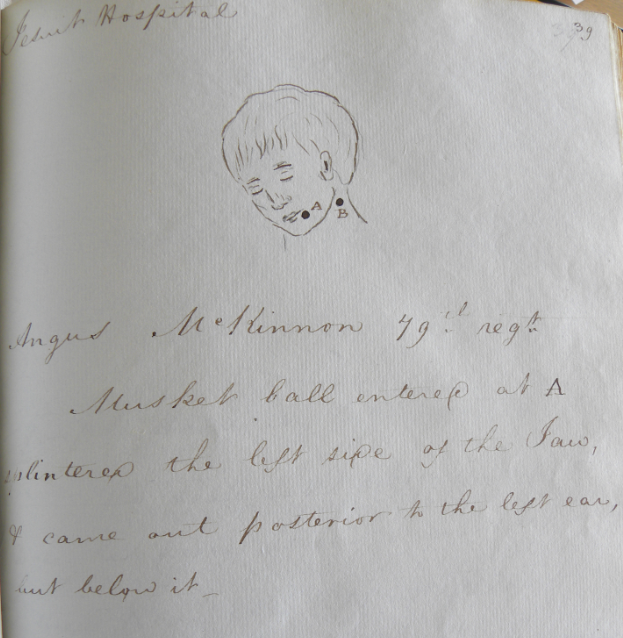
Description of the wounds suffered by Angus McKinnon

Description of the wounds suffered by Angus McKinnon (On p. 39 of Gen.594, in Coll-535 – Collection of sketches and reports of wounded at the Battle of Waterloo, CRC)
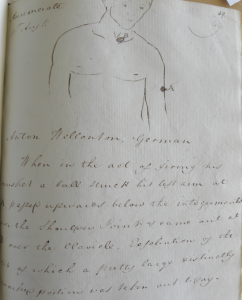
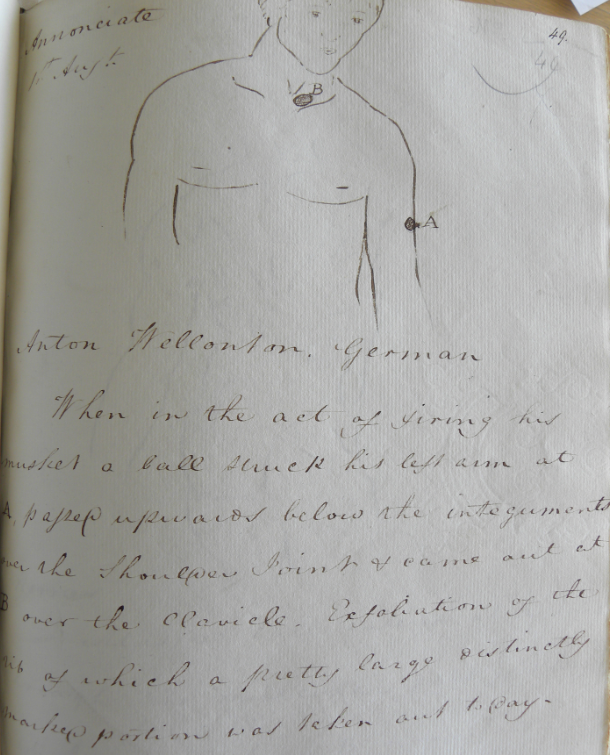
Description of the wounds suffered by Anton Wallenton

Description of the wounds suffered by Anton Wallenton (On p.49 of Gen.594, in Coll-535 – Collection of sketches and reports of wounded at the Battle of Waterloo, CRC)


The sketches show the kind of sabre wounds suffered by Etienne Gerarghier and Jean Louis le Jeun, and also wounds caused by firearms and cannon… e.g. the musket-ball wounds of Angus McKinnon, 79th Regiment, and the accidental wound of the German soldier Anton Wellonton. The sketches show the entry points at ‘A’ and the exit points at ‘B’.
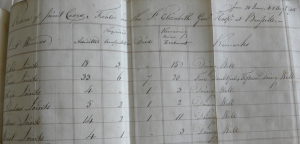
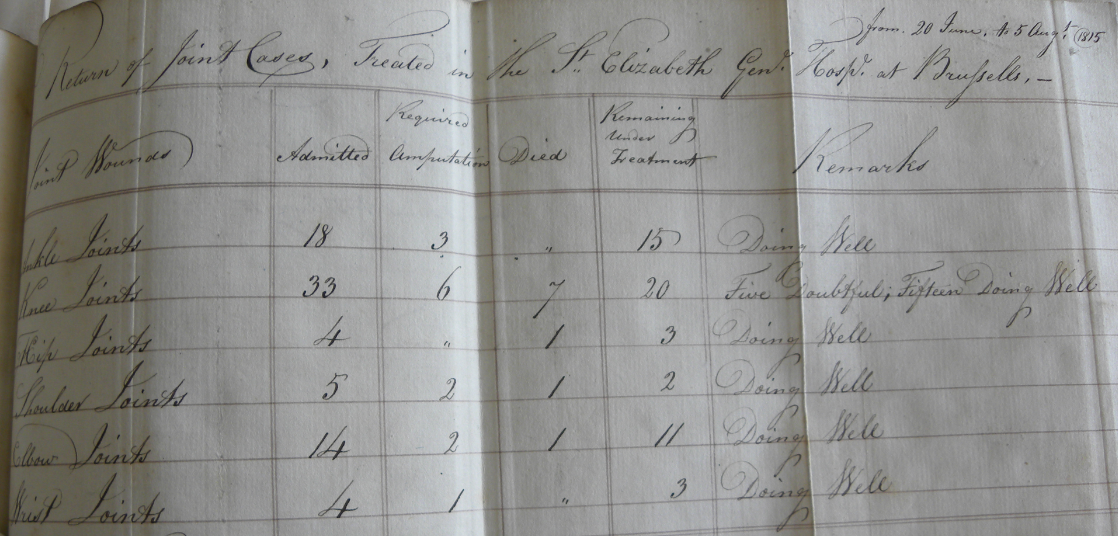
Return for join cases treated at the St. Elisabeth General Hospital, Brussels, from 20 June to 5 August 1815. (Coll-535)

Return for joint cases treated at the St. Elisabeth General Hospital, Brussels, from 20 June to 5 August 1815. (From volume known as Gen.595, in Coll-535 – Collection of sketches and reports of wounded at the Battle of Waterloo, CRC))

In addition to the work of Thomson and Somerville, reports in the volumes have also been written by: J. Gordon, Surgeon to the Forces in charge of Gens d’Armerie Hospital; Henry Home Blackadder; J. Cole, Surgeon to the Forces; W. Blick, Surgeon to the Forces; Roderick MacLeod, Hospital Assistant; Charles Collier, Surgeon to the Forces; and J. Roche, Surgeon to the Forces; and others. The sketches and reports are of cases in several of the hospitals accommodating the wounded around Brussels – these being the Jesuits’, the Annonciate, Gens d’Armerie, and St. Elisabeth – and in Antwerp, at the Corderie and the Facon.
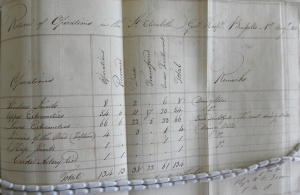
Return of operations (Coll-535 )

Return of operations performed at the St. Elisabeth General Hospital, Brussels, 1 August 1815. (From volume known as Gen.595, in Coll-535 – Collection of sketches and reports of wounded at the Battle of Waterloo, CRC)
Today in 2015, the battle site of Waterloo is a popular attraction for visitors to Brussels and to Belgium generally. The site is dominated by the artificial Butte du Lion created in the 1820s in the earliest days of Waterloo tourism and before the founding of modern Belgium. The Butte du Lion is an artificial earth-mound topped by a large giant sculpted lion commemorating the location where William II of the Netherlands, Prince of Orange, was knocked from his horse by a musket-ball to the shoulder during the battle. Decorative stripAdjacent to the Butte and to the new tourist facilities built for the 200th anniversary, stands a panorama building offering a large vista of the events of 18 June 1815. The Waterloo panorama building was designed by Franz Van Ophem in 1911 for the then forthcoming 100th anniversary of the Battle. It houses a 360° panoramic oil-on-canvas painting completed by the French artist Louis-Jules Dumoulin in 1912.
Decorative stripDr. Graeme D. Eddie, Assistant Librarian Archives & Manuscripts, Centre for Research Collections

Decorative stripThis blog post was compiled with the help of some information contained on pp.307-308 of The Edinburgh professoriate 1790-1826 and the University’s contribution to nineteenth century British society. Anand Chidamber Chitnis. Ph.D. 1968. Edinburgh… and also on pp.39-50 of ‘British Medical Arrangements during the Waterloo Campaign’, by Colonel H. A. L. Howell, in Proceedings of the Royal Society of Medicine. (Sect. Hist. Med.). 1924 (17).