Home University of Edinburgh Library Essentials
March 21, 2026
On trial: British and Irish Women’s Letters and Diaries
*The Library has access to British and Irish Women’s Letters and Diaries, 1500-1900 until 31st July 2024 as part of ProQuest Access 350.*
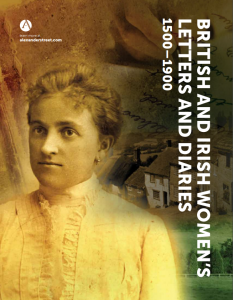
Thanks to a request from a 4th year dissertation student in HCA the Library now has trial access to Alexander Street’s digital collection British and Irish Women’s Letters and Diaries, 1500-1900. Spanning more than 400 years it brings together the personal writings of women from England, Scotland, Ireland and Wales.
You can access the database via the E-resources trials page.
Access is available on-campus. For off-campus access you must be connected to the VPN.
Trial access ends 16th November 2018.
Extending back to the 1500s, the collection lets you view history in the context
of women’s thoughts—their struggles, achievements, passions, pursuits, and desires. The collection shows the various shapes and formats of the diary as it evolved, including the travel diary, offering detailed accounts of journeys and descriptions of places; the daily personal diary, in which women reflected more broadly on aspects of their lives; letter diaries, wherein a daily dated letter to a recipient served simultaneously as a diary entry; and other forms. Read More
Get referencing right: some useful resources
Working on your assignment and unsure how to do references? Wondering what references, citations, endnotes, footnotes, etc., actually are? Don’t know your Harvard style from your Chicago style? We’ve got a few useful online resources that should help demystify the referencing process.
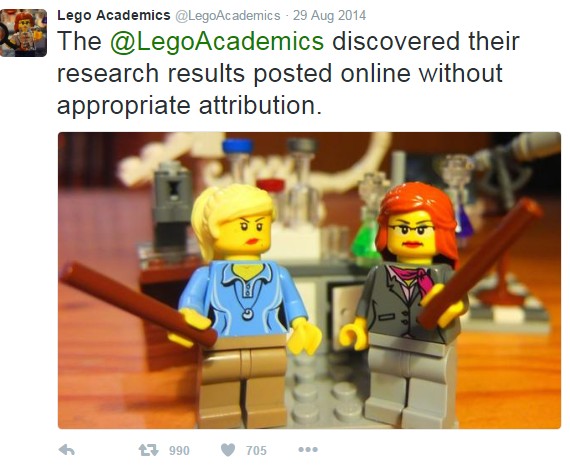
(Lego Academics, 2014)
What is referencing?
Referencing is the process of acknowledging other people’s work when you have used it in your assignment or research. It allows the reader to locate your source material as quickly and easily as possible so that they can read these sources themselves and verify the validity of your arguments. Referencing provides the link between what you write and the evidence on which it is based.
(Cite Them Right Online, no date)
New to the Library: Literary Print Culture
I’m pleased to let you know that the Library now has access to Literary Print Culture: The Stationers’ Company Archive, 1554-2007 from Adam Matthew. Sourced from the archive of The Worshipful Company of Stationers & Newspaper Makers, located at Stationers’ Hall in the City of London, this resource allows access to a vast and unique collection of primary source documents.

You can access Literary Print Culture: The Stationers’ Company Archive via the Databases A-Z list and Primary Source database list. You can also access it through DiscoverEd. Read More
On trial: Women’s Magazine Archive
*The Library has now purchased access to the ‘Women’s Magazine Archive, collection I and II’. See New to the Library: Women’s Magazine Archive.*
Thanks to request from a student in HCA the Library currently has trial access to ProQuest’s Women’s Magazine Archive, collection I and II. This unique database comprises archival runs of leading women’s consumer magazines of the twentieth century.

You can access the database via the E-resources trials page.
Access is available on-campus. For off-campus access you must be connected to the VPN.
Trial access ends 14th November 2018. Read More
Revealing and Expanding Diversity in our Library Collections: Black History Month 2018
It’s Black History Month, and to celebrate diversity in the University’s collections we now have a new book display in the Main Library foyer. This follows on from the success of our Black History Month ‘micro-exhibition’ with EUSA last year.
Our latest display is part of a project where the Library is working with EUSA to reveal, and further expand, the diverse collections which the Library holds. This month, we have a selection of texts on display, from works by Chinua Achebe to Zadie Smith, and a number of new purchases for the Library’s collections.
We also have a resource list, detailing many of the items on display:
Black History Month 2018 resource list
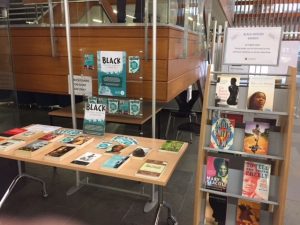
Head down to the Main Library from 8-19 October to browse and borrow!
New electronic resource trial: Artfilms-Digital
Artfilms-Digital is the video streaming service of Contemporary Arts Media and Artfilms and provides access to over 1660 videos in Arts & Humanities subject areas with strengths in performing arts, visual and digital art, architecture, design, new media, film, cinema, communication and culture. Includes masterclasses, documentaries, and interviews. Read More
Greater Expectations? Writing and supporting Data Management Plans
“A blueprint for what you’re going to do”
This series of videos was arranged before I joined the Research Data Service team, otherwise I’d no doubt have had plenty to say myself on a range of data-related topics! But the release today of this video – “How making a Data Management Plan can help you” – provides an opportunity to offer a few thoughts and reflections on the purpose and benefits of data management planning (DMP), along with the support that we offer here at Edinburgh.
“Win that funding”
We have started to hear anecdotal tales of projects being denied funding due – in part at least – to inadequate or inappropriate data management plans. While these stories remain relatively rare, the direction of travel is clear: we are moving towards greater expectations, more scrutiny, and ultimately into the risk of incurring sanctions for failure to manage and share data in line with funder policies and community standards: as Niamh Moore puts it, various stakeholders are paying “much more attention to data management”. From the researcher’s point of view this ‘new normal’ is a significant change, requiring a transition that we should not underestimate. The Research Data Service exists to support researchers in normalising research data management (RDM) and embedding it as a core scholarly norm and competency, developing skills and awareness and building broader comfort zones, helping them adjust to these new expectations.
“Put the time in…”
My colleague Robin Rice mentions the various types of data management planning support available to Edinburgh’s research community, citing the online self-directed MANTRA training module, our tailored version of the DCC’s DMPonline tool, and bespoke support from experienced staff. Each of these requires an investment of time. MANTRA requires the researcher to take time to work through it, and took the team a considerable amount of time to produce in order to provide the researcher with a concise and yet wide-ranging grounding in the major constituent strands of RDM. DMPonline took hundreds and probably thousands of hours of developer time and input from a broad range of stakeholders to reach its current levels of stability and maturity and esteem. This investment has resulted in a tool that makes the process of creating a data management plan much more straightforward for researchers. PhD student Lis is quick to note the direct support that she was able to draw upon from the Research Data Service staff at the University, citing quick response times, fluent communication, and ongoing support as the plan evolves and responds to change. Each of these are examples of spending time to save time, not quite Dusty Springfield’s “taking time to make time”, but not a million miles away.
There is a cost to all of this, of course, and we should be under no illusions that we are fortunate at the University of Edinburgh to be in a position to provide and make use of this level of tailored service, and we are working towards a goal of RDM related costs being stably funded to the greatest degree possible, through a combination of project funding and sustained core budget.
“You may not have thought of everything”
Plans are not set in stone. They can, and indeed should, be kept updated in order to reflect reality, and the Horizon 2020 guidelines state that DMPs should be updated “as the implementation of the project progresses and when significant changes occur”, e.g. new data; changes in consortium policies (e.g. new innovation potential, decision to file for a patent); changes in consortium composition and external factors (such as new consortium members joining or old members leaving).
Essentially, data management planning provides a framework for thinking things through (Niamh uses the term “a series of prompts”, and Lis “a structure”. As Robin says, you won’t necessarily think of everything beforehand – a plan is a living document which will change over time – but the important things is to document and explain the decisions that are taken in order for others (and your future self is among these others!) to understand your work. A good approach that I’ve seen first-hand while reviewing DMPs for the European Commission is to leave place markers to identify deferred decisions, so that these details are not forgotten about (This is also a good reason for using a template – a empty heading means an issue that has not yet been addressed, whereas it’s deceptively easy to read free text DMPs and get the sense that everything is in good shape, only to find on more rigorous inspection that important information is missing, or that some responses are ambiguous.)
“Cutting and pasting”
It has often been said that plans are less important than the process of planning, and I’ve been historically resistant to sharing plans for “benchmarking” which is often just another word for copying. However Robin is right to point out that there are some circumstances where copying and pasting boilerplate text makes sense, for example when referring to standard processes or services, where it makes no sense – and indeed can in some cases be unnecessarily risky – to duplicate effort or reinvent the wheel. That said, I would still generally urge researchers to resist the temptation to do too much benchmarking. By all means use standards and cite norms, but also think things through for yourself (and in conjunction with your colleagues, project partners, support staff and other stakeholders etc) – and take time to communicate with your contemporaries and the future via your data management plan… or record?
“The structure and everything”
Because data management plans are increasingly seen as part of the broader scholarly record, it’s worth concluding with some thoughts on how all of this hangs together. Just as Open Science depends on a variety of Open Things, including publications, data and code, the documentation that enables us to understand it also has multiple strands. Robin talks about the relationship between data management and consent, and as a reviewer it is certainly reassuring to see sample consent agreement forms when assessing data management plans, but other plans and records are also relevant, such as Data Protection Impact Assessments, Software Management Plans and other outputs management processes and products. Ultimately the ideal (and perhaps idealistic) picture is of an interlinked, robust, holistic and transparent record documenting and evidencing all aspects of the research process, explaining rights and supporting re-use, all in the overall service of long-lasting, demonstrably rigorous, highest-quality scholarship.
—
Martin Donnelly
Research Data Support Manager
Library and University Collections
University of Edinburgh
New! Royal Society of Chemistry E-Books 2018
 The Library has purchased the 2018 copyright year of Royal Society of Chemistry e-books. The first batch of titles have now been added to DiscoverEd. (50 titles).
A title list can be viewed at http://pubs.rsc.org/en/ebooks#!key=copyright-year&value=2018
‘Moving forwards towards perfection’: Dunfermline College of Physical Education

Dunfermline College, original building. Part of the Records of Dunfermline College of Physical Education (EUA IN16)
On this day (4th October) in 1905, the Carnegie Dunfermline Trust College of Hygiene and Physical Training (later renamed Dunfermline College of Physical Education) was founded. It was opened by the Marquis of Linlithgow (who was Secretary for Scotland) in the ‘palatial’ Carnegie Gymnasium in the presence of over 1,000 people. The ceremony was an important milestone in the history of the town of Dunfermline but also Scotland as a whole; this was the first college of physical education of its kind in the country.
Dunfermline had already been home to a number of health-focused amenities, thanks to funding from its native son, the Scottish-American industrialist and philanthropist Andrew Carnegie. There was ‘The Carnegie Gymnastics Club’ for young men and, later, a new gymnasium, swimming baths and Turkish Baths on Pilmuir Street.
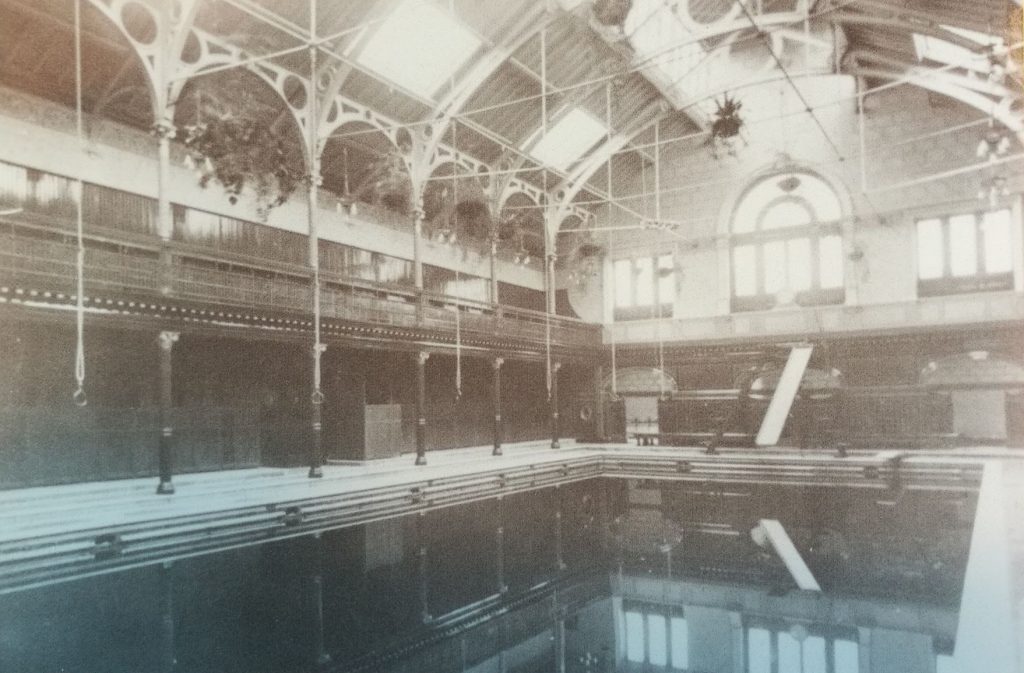
The Carnegie Baths. Part of Records of Dunfermline College of Physical Education (EUA IN16)

Turkish Baths, Dunfermline. Part of the Records of Dunfermline College of Physical Education (EUA IN16)
The idea of public health and fitness was a growing concern following the publication of the Report of the Royal Commission on Physical Training (Scotland) a year earlier. With widespread poverty and malnutrition, cramped, urban lifestyles and a lack of physical education in schools, the fitness of the general population was found to be severely lacking. The Report effectively recommended compulsory physical education in schools to help combat this.
A syllabus of physical exercises was published for use in public elementary schools and the Carnegie Dunfermline Trustees provided male and female teachers to visit schools weekly and instruct children. However, there was a shortage of teachers specially trained in physical instruction and it was decided that a training college should be formed.
Miss Flora Ogston (daughter of Sir Alexander Ogston, Regius Professor of Surgery, University of Aberdeen from 1882 to 1909) became the first Principal of the College, which accepted women students only. Teaching at the College focused on theoretical and practical aspects of physical education, and included human anatomy and physiology, Ling’s Swedish system of gymnastics, remedial massage and, perhaps surprisingly, singing and voice production. The first 11 students to complete the two-year diploma course did so in 1907.

College Hockey Team, 1905-1906. Part of the Records of Dunfermline College of Physical Education (EUA IN16)
Giving a toast to the College at a dinner following the opening ceremony, Alexander Ogston concluded with his vision of what it represented in terms of national achievement and improved human wellbeing:
Scotland does not stand where it did; where formerly it was covered with what were quaintly termed “foul moors,” it is now so altered that it presents in their stead scenes of charming beauty and fertility, or is filled with the evidence of man’s industry and genius. It is not too much to expect that the agencies now active in the amelioration of the physical condition of its people, among which we hope the Dunfermline College will play a great part, will result in a somewhat similar elevation of all its inhabitants, in the production of a higher, nobler, better race, moving forwards towards perfection.
The records of Dunfermline College of Physical Education are currently being catalogued and we look forward to sharing more stories from the archive soon!
Sources:
- Addresses delivered on the occasion of the inauguration of the Carnegie Dunfermline Trust College of Hygiene and Physical Training on the 4th October 1905 (Dunfermline: A. Romanes & Son, 1905)
- Dr I.C. MacLean, The History of Dunfermline College of Physical Education (Edinburgh: Dunfermline College of Physical Education, 1976)
- www.victorianturkishbath.org
Clare Button
Project Archivist
Battle of Cable Street: through our newspaper archives
On this day, 4th October, in 1936 large crowds of people gathered in London’s East End, an area of the city that had a large Jewish population, in an attempt to stop a march through the area by the British Union of Fascists (BUF). The protests turned into a riot with anti-fascist demonstrators clashing with Police, large numbers of demonstrators were arrested and even larger numbers of them (and Police) were injured. But they did manage to prevent the march from taking place.
In this week’s blog post I’m using some of the Library’s digital newspaper databases to find primary source material about the Battle of Cable Street (as the demonstrations became known).
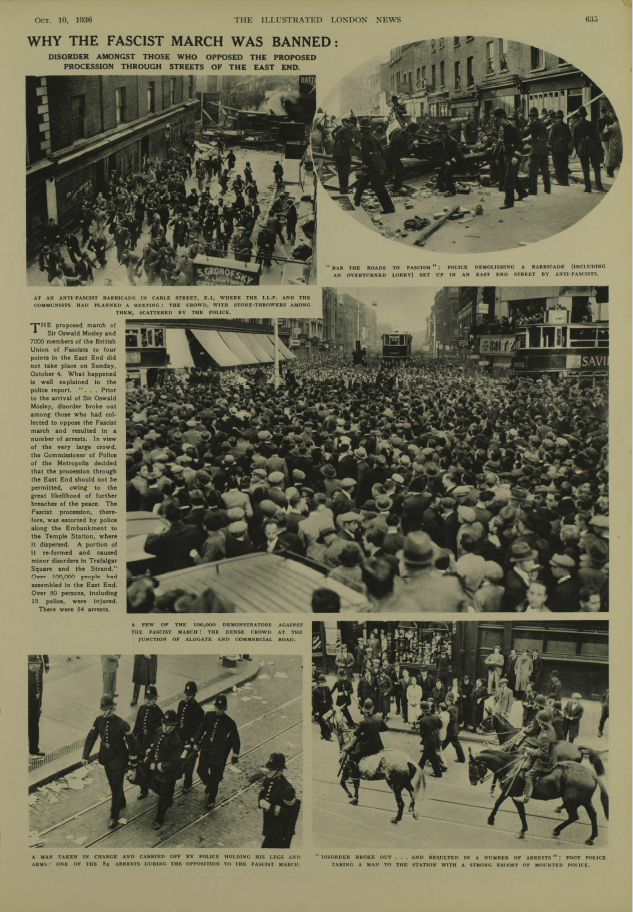
Screenshot from Illustrated London News, October 10, 1936, p. 635. From The Illustrated London News Historical Archive.
Collections
 Hill and Adamson Collection: an insight into Edinburgh’s past
My name is Phoebe Kirkland, I am an MSc East Asian Studies student, and for...
Cataloguing the private papers of Archibald Hunter Campbell: A Journey Through Correspondence
My name is Pauline Vincent, I am a student in my last year of a...
Hill and Adamson Collection: an insight into Edinburgh’s past
My name is Phoebe Kirkland, I am an MSc East Asian Studies student, and for...
Cataloguing the private papers of Archibald Hunter Campbell: A Journey Through Correspondence
My name is Pauline Vincent, I am a student in my last year of a...

Projects
Cataloguing the private papers of Archibald Hunter Campbell: A Journey Through Correspondence
My name is Pauline Vincent, I am a student in my last year of a...
Archival Provenance Research Project: Lishan’s Experience
Presentation My name is Lishan Zou, I am a fourth year History and Politics student....