Home University of Edinburgh Library Essentials
December 16, 2025
PubMed LinkOut for Pure users
Instructions for Pure users on how to find data to join PubMed LinkOut
PubMed LinkOut is a service where you can send data to NCBI which will allow them to link PubMed records directly to your institutional repository:
Whilst the benefits for repository owners are obvious – e.g. massively increasing the visibility of your open access content – not many repositories are actually doing this. At the time of writing, in the UK there are only 4 other repositories in the LinkOut programme: University of Strathclyde, Imperial College London, the White Rose consortium & the London School of Hygiene & Tropical Medicine. Currently there are no other institutions that use Pure so I thought I would investigate and create some instructions.
This blog post will help Pure administrators find URLs to full‐text open access items that have a PMID, but not a PMCID which can be used to send to NCBI.
Step 1: find Pure records that have a PMID, and also have open access full-text.
Note: Pure only holds PMIDs for records that have been imported from PubMed. Unfortunately, PMC IDs are not stored like other identifiers like ISBNs or DOIs. Set up a new report with the following filters:
- Organisation Unit – include all underlying subunits
- Source: select value is PubMed
- Electronic version(s) of this work: Accepted author manuscript/Submitted manuscript
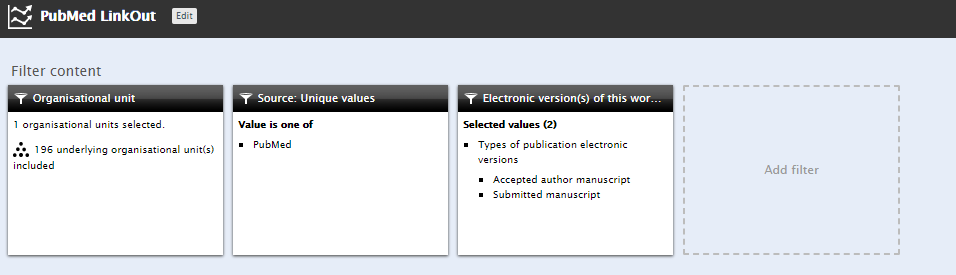
Recommended values for data table:
- Electronic versions(s) of this work > DOI
- System info > Source-ID
- System info > UUID
- System info > ID
- Add access version of this item > Open Access embargo date

This report will pull all records from Pure that have been imported from PubMed, and will show the Pure ID/DOI/PMID/UUID and OA embargo date. The UUID will be used to generate a stable URL to the item page in the portal. Export the report as an Excel spreadsheet.
Step 2: Find out which Pure records with PMIDs also have PMCIDs
If a paper has a PMC ID then it will have an open access version in PubMed Central and the LinkOut won’t be interested in including that record. You can use the online PMCID – PMID – Manuscript ID – DOI Converter to find out if the items in the Pure report have PMC IDs:
https://www.ncbi.nlm.nih.gov/pmc/pmctopmid/
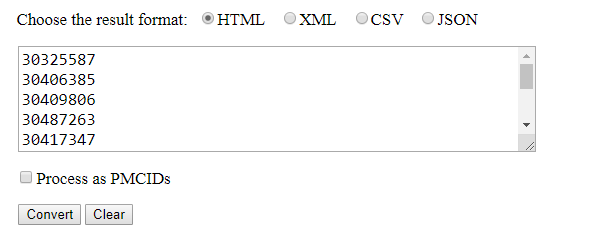
Cut/paste PMIDs into the box, select CSV result format and convert 100 records at a time. Any more will likely to produce an error.
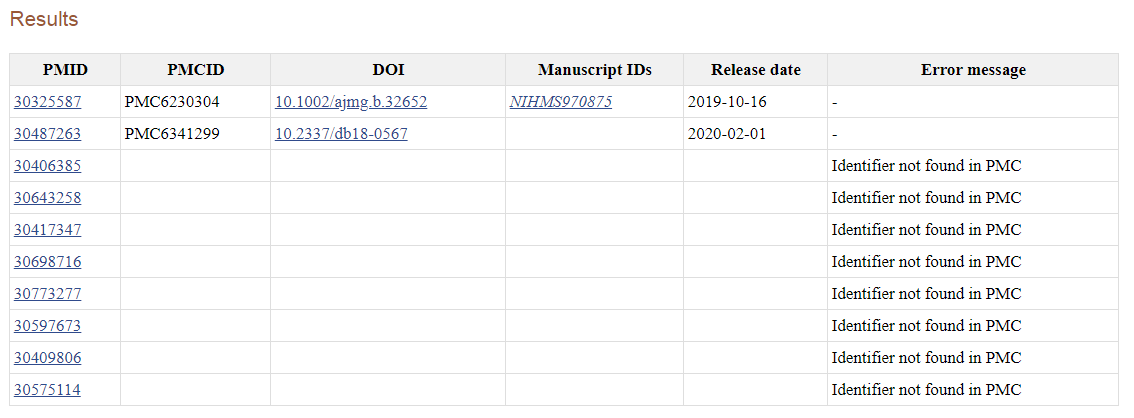
Ignoring the results with PMCIDs, cut/paste the remaining PMIDs (Identifier not found in PMC) into a new column in the Pure report spreadsheet.
Step 3: Identify the Pure records which can be included in PubMed LinkOut.
So far we have a list of records in Pure that have a PMID (which may or may not have PMCIDs), and a list of PMIDs that have been checked to make sure they don’t have PMC IDs. What we need to do now is merge the data. There are a number of different ways to do this in Excel, but I chose to use the conditional formatting function to highlight duplicate PMIDs in Pure that are on the ‘not in PMC list’ we created. Filtering by colour will then give you a list of records which can be included in the PubMed LinkOut programme. I chose to remove the items which are currently under an embargo which can be identified from the Open Access embargo date, and removed using a filter.

All that is remaining to do is to tidy up the records and add the stable URL. This can be done by taking the UUID-4 value from the Pure report and concatenating with the handle server ID for Pure, for example:
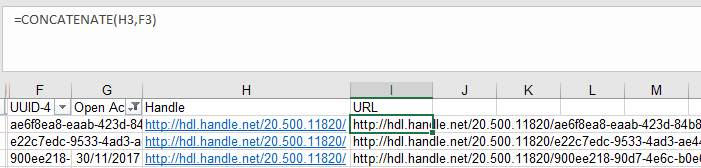
Handle + UUID-4 = URL , e.g:
http://hdl.handle.net/20.500.11820/e22c7edc-9533-4ad3-ae44-3f706dd7682c
Now you have a list of URLs of items in Pure that have PMIDs – but crucially not PMCIDs – which you can submit to the LinkOut Programme. You can download a printable PDF version of these instructions here:
Pure PubMed LinkOut instructions
Archives Internship Opportunity

We are delighted to be able to offer an 8-week, archive cataloguing project internship opportunity, working with the Wellcome Research Resource-funded archive project ‘Evergreen: Patrick Geddes and the Environment in Equilibrium’. This is a fantastic opportunity for a student or new archive career professional to develop and demonstrate core archival skills. The internship will involve contributing to the enhancement of online archive catalogue descriptions relating to the fascinating correspondence of Patrick Geddes, helping to enhance and promote access to the collections. Closing date: 29 March 2019. Interviews: 18 Arpil 2019. Start date: 13 May 2019.
https://www.ed.ac.uk/information-services/library-museum-gallery/crc/volunteers-interns-honorary-fellows/volunteers-interns
Database trial – Shakespeare’s Globe Archive: Theatres, Players & Performance
We have been offered a free trial of Shakespeare’s Globe Archive: Theatres, Players & Performance published by Adam Matthew Digital. Please click here to access the trial. EASE login is required. The trial runs until 8th April 2019.
This collection of documents offers insights into the performance practice in the particular space of the reconstructed Globe Theatre. It details the way in which the theatre was constructed as a place of radical experiment. It documents over 200 performances through prompt books, wardrobe notes & jottings, programmes, publicity material, annual reports, show reports, posters, photographs, music archive and architectural plans. Read More
Research Data Workshop Series 2019
Over the spring of 2019 the Research Data Service (RDS) is holding a series of workshops with the aim of gathering feedback and requirements from our researchers on a number of important Research Data topics.
Each workshop will consist of a small number of short presentations from researchers and research support staff who have experience of the topic. These will then be followed by guided discussions so that the RDS can gather your input on the tools we currently provide, the gaps in our services, and how you go about addressing the challenges and issues raised in the talks.
The workshops for 2019 are:
Electronic Notebooks 1
14th March at King’s Buildings (Fully Booked)
DataVault
1200-1400, 10th April at 6301 JCMB, King’s Buildings, Map
Booking Link – https://www.events.ed.ac.uk/index.cfm?event=book&scheduleID=34308
The DataVault was developed to offer UoE staff a long-term retention solution for research data collected by research projects that are at the completion stage. Each ‘Vault’ can contain multiple files associated with a research project that will be securely stored for an identified period, such as ten years. It is designed to fill in gaps left by existing research data services such as DataStore (active data storage platform) and DataShare (open access online data repository). The service enables you to comply with funder and University requirements to preserve research data for the long-term, and to confidently store your data for retrieval at a future date. This workshop is intended to gather the views of researchers and support staff in schools to explore the utility of the new service and discuss potential practicalities around its roll-out and long-term sustainability.
Sensitive Data Challenges and Solutions
1200-1430, 16th April in Seminar Room 2, Chancellors Building, Bioquarter, Map
Booking Link – https://www.events.ed.ac.uk/index.cfm?event=book&scheduleID=34321
Researchers face a number of technical, ethical and legal challenges in creating, analysing and managing research data, including pressure to increase transparency and conduct research openly. But for those who have collected or are re-using sensitive or confidential data, these challenges can be particularly taxing. Tools and services can help to alleviate some of the problems of using sensitive data in research. But cloud-based tools are not necessarily trustworthy, and services are not necessarily geared for highly sensitive data. Those that are may not be very user-friendly or efficient for researchers, and often restrict the types of analysis that can be done. Researchers attending this workshop will have the opportunity to hear from experienced researchers on related topics.
Electronic Notebooks 2
1200-1430, 9th May at Training & Skills Room, ECCI, Central Area, Map
Booking Link – https://www.events.ed.ac.uk/index.cfm?event=book&scheduleID=34287
Electronic Notebooks, both computational and lab-based, are gaining ground as productivity tools for researchers and their collaborators. Electronic notebooks can help facilitate reproducibility, longevity and controlled sharing of information. There are many different notebook options available, either commercially or free. Each application has different features and will have different advantages depending on researchers or lab’s requirements. Jupyter Notebook, RSpace, and Benchling are some of the platforms that are used at the University and all will be represented by researchers who use them on a daily basis.
Data, Software, Reproducibility and Open Research
Due to unforeseen circumstances this event has been postponed. We will update with the new event details as soon as they are confirmed.
In this workshop we will examine real-life use cases wherein datasets combine with software and/or notebooks to provide a richer, more reusable and long-lived record of Edinburgh’s research. We will also discuss user needs and wants, capturing requirements for future development of the University’s central research support infrastructure in line with (e.g.) the LERU Roadmap for Open Science, which the Library Research Support team has sought to map its existing and planned provision against, and domain-oriented Open Research strategies within the Colleges.
Kerry Miller
Research Data Support Officer
Library & University Collections
World Newspaper Archive collections: on trial
*The Library has now purchased access to African Newspapers, Series 1. See New! African Newspapers, Series 1 1800-1922*
Thanks to a request from the UncoverEd project team, I’m pleased to let you know that the Library currently has trial access to two digital newspaper collections, African Newspapers, Series 1 and South Asian Newspapers, from Readex. Both collections offer unique access to fully searchable collection of historical newspapers from Africa and South Asia.

You can access this digital resource via the E-resources trials page.
Access is available both on and off-campus.
Trial access ends 19th April 2019. Read More
Mathematical Sciences Publishers content via ProjectEuclid
 With the renewal of our Mathematical Sciences Publishers e-journal subscription, we now gain access to the following new titles:
- Innovations in incidence Geometry
- Moscow Journal of Combinatorics and Number Theory
- Pure and Applied Analysis
- Tunisian Journal of Mathematics
Access is via DiscoverEd and the e-journals AZ list.

Screenshot from Project Euclid website
Literature Online – problem update
Back on 31st January I communicated to LLC colleagues about the faulty full-text links to LION’s ABELL records in DiscoverEd and a separate issue of the loss of 1,492 Penguin Classics from the LION platform due to publisher rights. Here is the latest update on the status.
- ABELL indexing issue in DiscoverEd
All the ABELL bibliographical records in DiscoverEd have been removed. This has resolved the problem of faulty full-text indexing, but at the same time removed the ABELL records in DiscoverEd altogether. The LION publisher ProQuest will make the correct bibliographical records available again once LION collections are re-organised and reloaded, hopefully by the end of the first quarter according to ProQuest. This indexing problem only affects ABELL. Other collections in LION, such as full-text journals and books, are still indexed and discoverable at the publication title level in DiscoverEd. Examples:
American Poetry Review as journal title, but not at the article level, e.g. Williamson, Alan: “A Marriage Between Writers: Birthday Letters as Memoir and as Poetry”, in American Poetry Review (27:5) Sep/Oct 1998, 11-13.
Dutt, Toru. Ancient Ballads and Legends of Hindustan: By Toru Dutt … With an Introductory Memoir by Edmund Gosse. Kegan Paul, Trench &, 1885
In the meantime, the current LION platform in our Database list, Literature Online (LION), is functioning as normal. Please do use LION for ABELL searching. At the top of the current LION platform, you will see the following announcement: “Literature Online is now available on the enhanced ProQuest platform and cross-searchable with ProQuest journals, newspapers, dissertations and other relevant content. The new user experience is now available in parallel with the current version through mid-2019. …” Please try LION on the new ProQuest platform which will replace the current platform very soon anyway.
- Penguin Classics
There is no alternative provision of the e-texts of the lost Penguin Classics. Most titles also have the print copies in our Library collections. Please note: if you have provided links to LION Penguin books in your students’ reading lists including those in the Resource Lists, please do remove them and replace them with the permanent links to the possible alternative copies in DisocverEd. If no alternative copy is in stock, please use the Book Recommendation Form.
Thank you very much for your attention. We will update colleagues when the re-organising and reloading of the LION content by the publisher is completed.
Complete contents of LION can be viewed from here: https://literature-proquest-com.ezproxy.is.ed.ac.uk/createCompleteContents.do
DwD2018 – Videos now on Media Hopper
Dealing with Data 2018 was once again a great success in November last year with over 100 university staff and Post-Graduate students joining us to hear presentations on topics as diverse as sharing data in clinical trials and embedding sound files in linguistics research papers.
As promised the videos of each presentation have now been made publicly available on Media Hopper (https://media.ed.ac.uk/channel/Dealing%2BWith%2BData%2BConference/82256222), while the PDFs can be found on https://www.era.lib.ed.ac.uk/handle/1842/25859. You can also read Martin Donnelly’s reflections on the day https://libraryblogs.is.ed.ac.uk/2018/11/28/dealing-with-data-2018-summary-reflections/.
We hope that these will prove both useful and interesting to all of our colleagues who were unable to attend.
We look forward to seeing you at Dealing with Data 2019.
Open Access update
The University of Edinburgh is a strong supporter of open access (OA), and in 2018, researchers at Edinburgh published over 7,000 peer reviewed research outputs, of which over 5,181 (74%) are openly available from the University’s research portal (www.research.ed.ac.uk). As a large and diverse organisation there is naturally a large variation in the way in which we make our research openly available. From our total of 5,181 open access research outputs we find that 2,959 outputs (or 57%) are published as Gold OA – where the publisher makes the version-of-record open sometimes for a fee – and 2,222 (or 43%) are available as Green OA – where the author makes their accepted manuscript open from our Institutional or Subject Repositories for free.
Over the last 5 years the University has spent in the region of £5 million with publishers to make around 2,800 papers Gold OA. The majority of these papers were published as ‘hybrid OA’ in subscription journals where the publisher charges subscription fees to access the closed content, and also charges an open access fee to make individual papers open access. This practice of charging twice is called ‘double-dipping’ as large research intensive institutions have not seen their subscription costs lowered in proportion to their open access expenditure.
Over the last 5 years we have seen a period of significant consolidation of the open access publishing market with just three companies responsible for publishing 51% of Edinburgh’s journal articles, whilst receiving 57% of the money available for open access. The bulk of the University of Edinburgh’s RCUK block grants have been spent on ‘Hybrid OA’ journals as shown in the diagram below. Only 3 out of the 10 most popular publishers are purely Gold OA and don’t charge subscriptions :

Block chart showing the top 10 publishers who received funds from the RCUK open access block grant during 2013-2018. The number in the top left of each box is the total number of Gold OA papers published, the number in the middle of the box is the total expenditure and the name of the publisher is in the bottom left of the box.
Research funders like UKRI and the Wellcome Trust previously supported this ‘hybrid-OA’ model, but they no longer believe that it supports a transition to full OA which is their aim. To precipitate a change in the publisher’s behaviour and to increase the adoption of open access, a number of important European research funders, co-ordinated by Science Europe, developed Plan S.
Plan S update
Plan S requires that, from 2020, scientific publications that result from research funded by public money must be published in compliant Open Access journals, and specifically states that ‘hybrid OA’ journals won’t be supported. As it currently stands, Plan S will be hugely disruptive as researchers will potentially not be able to publish in their journal of choice.
In order to understand the impact of how Plan S will affect our research staff, departments and the broader academic community, Library & University Collections carried out a wide ranging consultation exercise. The Scholarly Communications Team held a series of eight open meetings, during the period 23rd – 30th January 2019, which were attended by over 260 staff. As far as we are aware this was the largest consultation held by a HE institution.
Based on feedback gathered at these meetings, the University has submitted a balance response to that is supportive of Plan S and the time frames set down, but also reflects the concerns raised about risks to international collaboration – specifically co-publishing work with collaborators in non-Plan S regions of the world. The response, and more general information about Plan S, can be read in full on our web pages:
https://www.ed.ac.uk/information-services/research-support/publish-research/open-access/plan-s
UKRI will decide how to apply the principles of Plan S once it has concluded an ongoing review of its own open-access policies, which is not likely to be completed until next autumn. The current Open Access policy is firmly in place until 31st March 2020 and it would be improbable for UKRI to change terms and conditions of grant awards midway through the year. We can therefore expect UKRI to adopt Plan S from 1 April 2020.
Taiwan Resource Centre for Chinese Studies
On 22 November 2018, Director of L&UC Jeremy Upton and Director-general Tseng Shu-hsien of the National Central Library of Taiwan (NCL) signed an agreement on establishing the Taiwan Resource Centre for Chinese Studies (TRCCS) in our Library. Over 25 academic colleagues from several Schools of CAHSS and several PhD students attended the ceremony.

Photo courtesy of Susan Pettigrew
Both Jeremy and Director-general Tseng delivered warm speeches in a very friendly, collaborative atmosphere. In his remarks, Jeremy highlighted the University’s long term connection with China, our Library commitment to supporting teaching, learning and research in Chinese Studies and China related topics across the University. The University’s Assistant Principal (China) Professor Natascha Gentz spoke in warm support of the project on behalf of the University. Director General Mr Jason Chien-Chen Lien of Taipei Representative Office in the U.K., Edinburgh Office, also attended the launch ceremony and made a speech. After the official signing of the agreement, the guests were shown by Dr Joseph Marshall a display of Special Collections items on China.
The worldwide TRCCS project was first launched in 2012 by the NCL of Taiwan to promote international exchange and library collaboration in Chinese studies. We are the 31st TRCCS partner institution in the world, the 3rd in the UK after SOAS and Oxford, and the 1st in Scotland.
Our TRCCS is located within the East Asian Studies Collection on the 3rd floor of the Main Library. Thanks to the hard work of colleagues in the Metadata Services and the Collections Management teams, the initial NCL donation of 748 titles of Chinese books and DVDs (948 items) on a wide range of subjects in arts, humanities and social science, recently published in Taiwan, have already been catalogued and made available for staff and students. There will be further donations of several hundred books each year from the second year onwards. In addition, the NCL will offer us access to about 8 digital resources from Taiwan. Under the project, the NCL and the University Library (together with the department of Asian Studies) will also co-host annual “Taiwan Lecturers on Chinese Studies”, delivered by internationally well-known scholars in the field.

TRCCS in East Asian Studies Collection, 3rd floor, Main Library. The entire TRCCS collection can be retrieved in DiscoverEd by shelfmark search for “TRCCS”.
We believe that the TRCCS project will enable us to fill in a gap in our Chinese print and e-resource collections by systematically acquiring scholarly publications produced in Taiwan. It will play an active role in our efforts to build our Chinese Collection into a national resource centre for Chinese Studies in Scotland.
Collections
 Hill and Adamson Collection: an insight into Edinburgh’s past
My name is Phoebe Kirkland, I am an MSc East Asian Studies student, and for...
Cataloguing the private papers of Archibald Hunter Campbell: A Journey Through Correspondence
My name is Pauline Vincent, I am a student in my last year of a...
Hill and Adamson Collection: an insight into Edinburgh’s past
My name is Phoebe Kirkland, I am an MSc East Asian Studies student, and for...
Cataloguing the private papers of Archibald Hunter Campbell: A Journey Through Correspondence
My name is Pauline Vincent, I am a student in my last year of a...

Projects
Cataloguing the private papers of Archibald Hunter Campbell: A Journey Through Correspondence
My name is Pauline Vincent, I am a student in my last year of a...
Archival Provenance Research Project: Lishan’s Experience
Presentation My name is Lishan Zou, I am a fourth year History and Politics student....