Home University of Edinburgh Library Essentials
March 21, 2026
Spotlight on: FBI Files
This is part of an occasional series highlighting some of the digital resources available at the Library that will be of interest to students and staff in History, Classics and Archaeology.

Federal Bureau of Investigation [Public domain]
The FBI have been involved in a large number of famous, not so famous and infamous cases dealing with organised crime, terrorism, civil rights, white collar crime, espionage, violent crime and more. And did you know that through the Library you have access to a range of digitised files from the FBI?
FBI Files in Archives Unbound

Through the Library’s subscription to Archives Unbound (an enormous digital primary source database) you have access to over 20 collections of digitised material direct from the FBI, covering over 70 years of American history. You’ll spot some famous cases and names within these but possibly also some less known. However, between them they provide a fascinating insight into the political, cultural and social climate of the United States in the 20th century.
FBI File: Julius and Ethel Rosenberg
Julius and Ethel Rosenberg were a nondescript couple accused in 1950 by the U.S. government of operating a Soviet spy network and giving the Soviet Union plans for the atomic bomb. The trial of the Rosenbergs, which began in March 6, 1951, became a political event of greater importance than any damage they may have done to the United States. It was one of the most controversial trials of the 20th century. Their guilt and the harshness of their sentences continue to be vigorously debated to this day. Read More
Crime and punishment in late 18th-early 19th century Scotland: Prisons
This is the last post in our series on crime and punishment in late 18th-early 19th century Scotland, this time focusing on prisons. In the Statistical Accounts there is a lot of fascinating, detailed information on prisons and bridewells (prisons for petty offenders). In some cases, there was simply a lock-up in a town-house, rather than a purpose-built building. Below, we will look at some specific prisons found throughout Scotland, first looking at the cities of Glasgow and Edinburgh and then towns. It is particularly interesting when we compare between the Old and New Statistical Accounts and see what changes there have been.
Prisons in Cities
Glasgow
By the 1780s, the population of Glasgow had greatly increased due to the expansion of manufacturing. It became clear that there was a “necessity of a bridewell, or workhouse, for the punishment and correction of lesser offences.” (OSA, Vol. V, 1793, p. 513) So, in 1789, existing buildings were converted from granaries into a bridewell. “These have been gradually increased to the number of 64, where the prisoners are kept separate from one another, and employed in such labour as they can perform, under the management of a keeper, and under the inspection of a committee of council, who enquire into the keeper’s management, etc.” (OSA, Vol. V, 1793, p. 514)
Even at this time it was felt very important that the prison was of an adequate standard. Town Councillors inspected the prison and reported their findings, including anything to be rectified or altered. The keeper also kept records of each prisoner, noting down the details of their sentence, the wages they received for their labour, and after expenses were subtracted, the surplus paid to the prisoner when they left the prison. For some, this amounted to L. 5 to L. 7. (OSA, Vol. V, 1793, p. 514)
However, by the time of this parish report written in 1793, it was noted that “the growing manufactures and population of the city requiring more extensive accommodations, than the present bridewell can afford, the Magistrates and Council propose to erect a new one, more properly calculated for the ends proposed, and on such a plan, that additions can be made to 1, from time to time, as the circumstances of the city may require.”(OSA, Vol. V, 1793, p. 514) Yet again, by the time of the New Statistical Accounts of Scotland, “the gaol at the cross had become deficient in almost every requisite.” (NSA, Vol. VI, 1845, p. 214) At that point, it was serving not just the city, but also occasionally the counties of Lanark, Renfrew, and Dumbarton. On the 13th February 1807, “the magistrates and council resolved to erect a new gaol and public offices in a healthy situation adjoining the river, at the bottom of the public green. This building, which cost L. 34,800, contains, exclusively of the public offices, 122 apartments for prisoners.” To discover more about the prison’s facilities (which may surprise you!) take a look at the parish report for Glasgow. (NSA, Vol. VI, 1845, p. 214)
On the 8th May 1798, a new bridewell was opened in Duke Street, Glasgow, which again quickly became ill-equipped for such a fast-expanding city. (Can you see a pattern emerging?!) It was, therefore, extended further and was opened on Christmas Day 1824. “It combines all the advantages of modern improvement, security. seclusion, complete classification, and healthful accommodation.” (NSA, Vol. VI, 1845, p. 215)
In the Statistical Accounts, there are several examples of tables giving the number of prisoners and associated costs. Below is an example for the Glasgow bridewell, covering the commitments in 1834.
| Males above 17 years of age, | 313 | ||||||||||||||||||
| Males below 17 years of age, | 222 | ||||||||||||||||||
| =1035 | |||||||||||||||||||
| Females above 17 years of age, | 864 | ||||||||||||||||||
| Females below 17 years of age, | 68 | ||||||||||||||||||
| = 932 | |||||||||||||||||||
| Total commitments, | 1967 | ||||||||||||||||||
| Remained on 2d of August 1833, | 356 | ||||||||||||||||||
| Prisoners in all, | 2323 | ||||||||||||||||||
| Liberated during the year, | 2030 | ||||||||||||||||||
| Remaining on 2d of August 1834, | 293 | ||||||||||||||||||
| The average number daily in the prison was 320; viz. males, 162; females, 158. | |||||||||||||||||||
| Abstract accounts for the year ended 2d of August 1834. | |||||||||||||||||||
|
Edinburgh
All the way back in 1560 the old prison or Tolbooth was founded and stood immediately west of St Giles’ church. However, this was pulled down in 1817, the same year a new prison was opened on Calton Hill. There is a very detailed description of the Calton Hill prison in the parish report of Edinburgh, written in 1842:
“It is a very ornamental castellated structure in the Saxon style; and is 194 feet long by 40 feet in width. The interior is divided into six classes of cells; four for males, and two for females; with an airing ground attached to each. There are two stories of cells, one above the other. To each of these divisions of cells on the ground floor there is a day room with a fire-place; and an airing ground common to fill the cells of the division. Each cell is for the reception of one prisoner; and is 8 feet by 6. A wooden bed is fixed into the wall, and there is a grated window and air holes in the wall for full and free ventilation. There are in all fifty-eight cells.” (NSA, Vol. I, 1845, p. 719)
_p.091_-_The_new_Bridewell,_Salisbury_Crags,_and_Arthur%27s_Seat_from_Calton_Hill_-_Thomas_Hosmer_Shepherd.jpg)
The new Bridewell, Salisbury Crags, and Arthur’s Seat from Calton Hill, Edinburgh, 1829. Thomas H. Shepherd [Public domain].
In the Appendix for Edinburgh, County of Edinburgh, a few key dates have been given. “In 1748-The first correction house for disorderly FEMALES was built, and it cost L. 198: 0: 4 1/2. N. B. This is the only one Edinburgh yet has. In 1791-Manners had been for some years so loose, and crimes so frequent, that the foundation of a large new house of Correction, or Bridewell, was laid on the 30th of November, which, on the lowest calculation, will cost L. 12,000; and this plan is on a reduced scale of what was at first thought absolutely necessary. In 1763-That is from June 1763 to June 1764, the expence of the Correction house amounted to L. 27: 16: 1 1/2. In 1791, and some years previous to it. The expence of the Correction house had risen to near L. 300,-ten times what it had been in the former period; and there is not room for containing the half of those that ought to be confined to hard labour.” (OSA, Vol. VI, 1793, p. 612)
Prisons in Towns
We have looked at the prison situation in the large cities. But, how about the situation in smaller towns? Below, we look at some examples throughout Scotland.
Kirkcaldy
As claimed in the parish report for Kirkcaldy, its jail is the best in Fife! “Under the New Prison Act, its management has been much improved. The prisoners are constantly employed, and great care is taken that proper attention be paid to their health, their diet, their education, and religious instruction. It is now a place more for the reformation than the punishment of prisoners.” (NSA, Vol. IX, 1845, p. 770)
Hawick
“The Jail, which forms a part of the town-house, and consists of a very small apartment, is neither properly secured, nor capable of being used without endangering the health of its inmates. For these reasons criminals are generally conveyed to the county town, a mode of procedure which is not only attended with considerable expense, but which, when taken in connection with a glaring deficiency of police, presents serious obstacles to the authorities in arresting the progress of crime and enforcing the authority of the laws. The number of convictions, inclusive of cases, brought not only before the magistrates and justices of peace, but before the Sheriff, and the circuit court at Jedburgh, amounted in 1838 to 58.” (NSA, Vol. III, 1845, p. 417)
Dumfries
“The Court-house is an elegant and commodious structure, wherein the circuit and sheriff-courts, the quarter session and the county meetings are held. Opposite to this stands a heavy-looking building, which was at first intended for a court-house, but is now converted into a Bridewell, the interior of which is arranged on the same plan with that of Edinburgh, but on so small a scale, that it is thought, from the facility with which the prisoners can hold intercourse with one another, to be very ill adapted for a place of confinement. Behind this, in a low damp yard, and surrounded by a high wall, is situated the county Jail, which, along with the Bridewell, was built in 1807. Previously to that period, the jail was in the centre of the town. A vaulted passage under the street, forms a communication between the prison-yard and the court-house. The debtors have the liberty of exercising themselves within the enclosed yard.” (NSA, Vol. IV, 1845, p. 14)
.jpg)
Inverness Steeple and Tolbooth, 2008. [Photo credit: Dave Conner from Inverness, Scotland [CC BY 2.0]].
As noted in the parish report for Aberdeen written in 1835, “the ancient jail of Inverness consisted only of a single damp dingy vault, in one of the arches of the stone bridge, and which (subsequently used as a mad-house) was only closed up about fifteen years ago. It was succeeded by another prison in Bridge Street, which, from the notices of it in the burgh’s records, must also have been a most unhealthy and disagreeable place of confinement. The present jail was erected in 1791, and cost L. 1800, the spire having cost about L.1600 more. ” (NSA, Vol. XIV, 1845, p. 34) (In fact, the spire is the only part of the building left standing, as can be seen in the picture on the right.)
“Besides prisoners for debt, all those charged with crimes from the northern counties are sent here previous to their trial before the circuit.courts of Jisticiary, which sit at Inverness twice a-year. Although a great improvement at the time of its erection, this prison is now found to be too small and very inconvenient, there being no proper classification of delinquents, while there is no open court or yard for them to walk in, nor can any manual employment be required of them at present.” (NSA, Vol. XIV, 1845, p. 34)
Porttree
In the parish of Porttree, County of Inverness, there was only one prison, where, in 1840, 16 offenders resided – “eleven for riotous conduct, four for housebreaking and theft, and one for forgery.” For some time in the past this prison was insecure, with instances of prisoners actually managing to escape! The bad conditions did not help matters. “Into the jail they are thrown without bed, without bedding, without fire, and with but a small allowance for their subsistence. “By the humanity, however, and charity of some benevolent persons in the neighbourhood, these privations have been partly alleviated, if not removed.” (NSA, Vol. XIV, 1845, p. 234)
Cupar
In the parish report of Cupar, County of Fife, in 1796, the Reverend George Campbell wrote that “the prison of Cupar, which is the public jail, for the very populous and wealthy county of Fife, yields perhaps to none, in point of the meanness, the filth, and wretchedness of its accommodations… Apartments in one end of a town-house acted as a place to secure and punish those who have fallen foul of the law. “The apartment destined for debtors is tolerably decent, and well lighted. Very different is the state of the prison under it, known by the name of “the Iron-house,” in which persons suspected of theft, etc. are confined. This is a dark, damp, vaulted dungeon, composed entirely of stone, without a fire-place, or any the most wretched accommodation. It is impossible, indeed, by language, to exaggerate the horrors which here present themselves” (OSA, Vol. XVII, 1796, p. 142)
In many parishes there was a concern that when a prison was built in a neighbouring or nearby county that it would cause the displacement of criminals into their area. This was certainly the case in Cupar, with the parish report stating that in such a wealthy county as Fife, there should be better prisons. “It is to be hoped, however, that the period is now happily arrived, when the landholders of Scotland, having more humane sentiments and enlarged views, than those who went before them, will attend to the wretched state of the different county jails” and would contribute to the building of more modern prisons. (OSA, Vol. XVII, 1796, p. 143) “A measure of this kind will appear every day of more pressing necessity, when the Bridewell now building at Edinburgh shall be finished. If Fife takes no step to defend itself against the influx of pickpockets, swindlers, etc. which may naturally be expected, it will become the general receptacle of sturdy beggars and vagrants; and the rising industry of the county must be exposed to the depredations of the desperate and the profligate, from every quarter*.” (OSA, Vol. XVII, 1796, p. 144)
In 1844, the number of prisoners committed to Cupar Prison was 37. “Of these, 15 were for debt, and 22 for stealing, assault, and such crimes as commonly occur in a populous country.” However, according to the parish report, the prison needed improvements. “The accommodation that it affords is uniformly condemned as most unworthy of the town and county. The lodging is bad, and reckoned unhealthy,-there is no room for the classification of criminals,-there is no chapel or place of worship attached; and consequently, any attempt to reclaim or improve those that are once committed to it, becomes absolutely hopeless.” (NSA, Vol. IX, 1845, p. 18)
Dundee
Dundee was another parish which felt the effects of prisons being built elsewhere. “Since Bridewells, or penitentiary houses, have been established in Edinburgh and Glasgow, Dundee has been much more pestered than formerly, with vagrants and persons of doubtful character, and swindling and petty thefts are more frequent. This will probably produce a Bridewell in Dundee. An establishment of this kind is certainly necessary, and the common prisons, and present inflictions of justice, are by no means sufficient to supply its place. With respect to our prisons, though among the best in Scotland, they are destitute of any court or area where the prisoners may enjoy the open air. This, however, is at present, the less necessary, as the laws of the country are supposed inhumanely, to exclude debtors from the privilege of breathing the same air with others; and, it is but very seldom, that felons suffer long confinement, in the prisons of places not visited by the Circuit Courts of Justiciary.” (OSA, Vol. VIII, 1793, p. 248)
Other Prisons
Here are some of the other prisons you can read about in the Statistical Accounts of Scotland: Linlithgow, County of Linlithgow; Montrose, County of Forfar; Falkirk, County of Stirling; Perth, County of Perth; Dingwall, County of Ross and Cromarty; Irvine, County of Ayrshire; Blairgowrie, County of Perth; Ayr, County of Ayrshire; Inverary, County of Argyle; Wick, County of Caithness; and Aberdeen, County of Aberdeen. This is by no means a definitive list!
Conclusion
The Statistical Accounts of Scotland provides a wealth of knowledge about prisons throughout Scotland, some very detailed and giving actual figures, for example Aberdeen, County of Aberdeen (NSA, Vol. XII, 1845, p. 83), Peebles (NSA, Vol. III, 1845, p. 182), Inverary, County of Argyle (NSA, Vol. VII, 1845, p. 42) and Wick, County of Caithness (NSA, Vol. XV, 1845, p. 175). You can discover when and where prisons and bridewells were built, descriptions of the buildings, living conditions, numbers of prisoners and crimes committed, work carried out by the prisoners and, for some of the larger prisons, even the costs of running them. Many parish ministers also wrote about the issues faced by the parishes and their prisons, especially the poor prison conditions and lack of cells. It may be a surprise to learn that many parish reports state how abominable prison conditions were, calling for more modern, larger prisons to be built to deal with the increased number of offenders.
Although this is the last post in our crime and punishment series, there are many other areas you could research, including crime statistics, policing, law courts and acts of law. This goes to show how comprehensive and enthralling a resource both the Old and New Statistical Accounts of Scotland are!
Resource Lists workshop for LLC course organisers
In response to LLC colleagues’ interest and requests, the Library Learning Services will provide a Resources Lists workshop specially for staff of the LLC School who are using or planning to use the Resource Lists for their course teaching.
- Time: 2.00 – 3.00pm Wednesday 17th April 2019
- Venue: Room 1.02 (Computer Lab), 50 George Square
Library staff will be on hand to answer any Resource Lists-related questions and to tell you about the help available to set up a Resource List for your course. To help us manage the session, if you’d like to attend, could you please follow the link below to make a booking:
https://www.events.ed.ac.uk/index.cfm?event=book&scheduleID=34349
The event is also visible to LLC staff in MyEd and is bookable there. We hope to see many of you at the workshop!
Background information
LLC has the largest number (208 as of Jan 2019) of published Resource Lists among all the Schools of the University, though it only represents 27% of our LLC courses.
What you will learn
By the end of this session you will be able to create and edit your own Resource Lists and understand how the Library is using Resource Lists to manage the purchase of books, provide access to copyright compliant scans and manage HUB/Reserve requests.
Why use Resource Lists?
- to improve the student experience
- to make it easier for course organisers to manage the provision of library materials for teaching
About Resource Lists
Resource Lists provide students with easy and consistent access to key course reading materials. The Library currently provides 1900 Resource Lists for courses across every school. Lists can be viewed via the service homepage: http://resourcelists.ed.ac.uk However, most students access their Resource Lists via a link in the left hand menu in the corresponding Learn course.
Resource Lists is the preferred route for Course Organisers to manage the provision of library materials. Once set up, lists are rolled over each June and can be reviewed and edited for the next academic year.
Any resource with a web address can be added to a list, including, books, e-books, book chapters, journal articles and videos. Course organisers assign priority to list items (Essential, Recommended or Further reading) and add notes for students indicating which chapters or pages should be read. The Library uses the priorities and student numbers to inform number of copies purchased and loan periods.
Resource Lists provide students with a number of features to help them manage their course reading. Students can create their own collection, make suggestions for new items to be added to lists and export their lists in their preferred citation style.
There is more information about Resource Lists on the IS website: http://edin.ac/resource-lists
For more information, please contact Library.Learning@ed.ac.uk
On trial: State Papers: Eighteenth Century (Parts I and IV)
Thanks to a request from a HCA student the Library currently has trial access to Parts I and IV of State Papers Online: Eighteenth Century, 1714-1782 from Gale. Part I covers State Papers Domestic, Military and Naval and the Registers of the Privy Council, while Part IV covers State Papers Scandinavia, Eastern Europe and Turkey.

You can access these two collections from here or via the E-resources trials page. Access is available on and off-campus.
Trial access ends 15th April 2019.
Part I: State Papers Domestic, Military and Naval and the Registers of the Privy Council

Screenshot of SP 35/71/1 f.5: Considerations on the nature of oaths, found at Lord North and Grey’s, Sept. 28 1722.
PubMed LinkOut for Pure users
Instructions for Pure users on how to find data to join PubMed LinkOut
PubMed LinkOut is a service where you can send data to NCBI which will allow them to link PubMed records directly to your institutional repository:
Whilst the benefits for repository owners are obvious – e.g. massively increasing the visibility of your open access content – not many repositories are actually doing this. At the time of writing, in the UK there are only 4 other repositories in the LinkOut programme: University of Strathclyde, Imperial College London, the White Rose consortium & the London School of Hygiene & Tropical Medicine. Currently there are no other institutions that use Pure so I thought I would investigate and create some instructions.
This blog post will help Pure administrators find URLs to full‐text open access items that have a PMID, but not a PMCID which can be used to send to NCBI.
Step 1: find Pure records that have a PMID, and also have open access full-text.
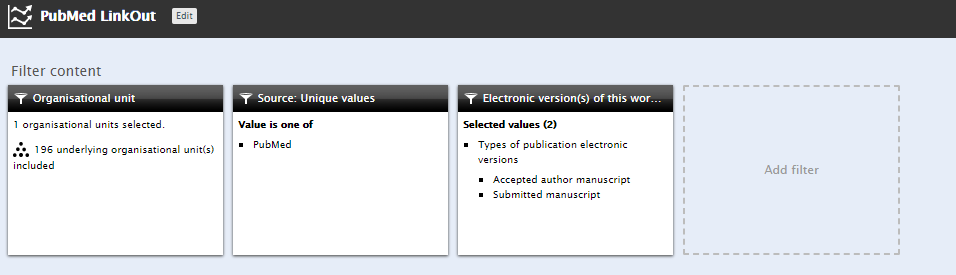
Note: Pure only holds PMIDs for records that have been imported from PubMed. Unfortunately, PMC IDs are not stored like other identifiers like ISBNs or DOIs. Set up a new report with the following filters:
- Organisation Unit – include all underlying subunits
- Source: select value is PubMed
- Electronic version(s) of this work: Accepted author manuscript/Submitted manuscript
Recommended values for data table:
- Electronic versions(s) of this work > DOI
- System info > Source-ID
- System info > UUID
- System info > ID
- Add access version of this item > Open Access embargo date

This report will pull all records from Pure that have been imported from PubMed, and will show the Pure ID/DOI/PMID/UUID and OA embargo date. The UUID will be used to generate a stable URL to the item page in the portal. Export the report as an Excel spreadsheet.
Step 2: Find out which Pure records with PMIDs also have PMCIDs
If a paper has a PMC ID then it will have an open access version in PubMed Central and the LinkOut won’t be interested in including that record. You can use the online PMCID – PMID – Manuscript ID – DOI Converter to find out if the items in the Pure report have PMC IDs:
https://www.ncbi.nlm.nih.gov/pmc/pmctopmid/
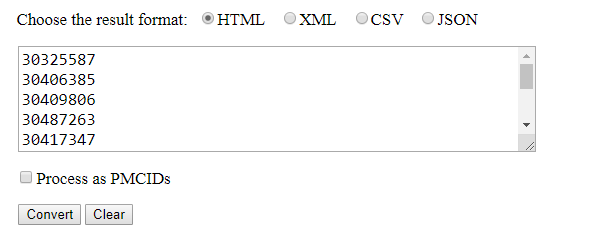
Cut/paste PMIDs into the box, select CSV result format and convert 100 records at a time. Any more will likely to produce an error.
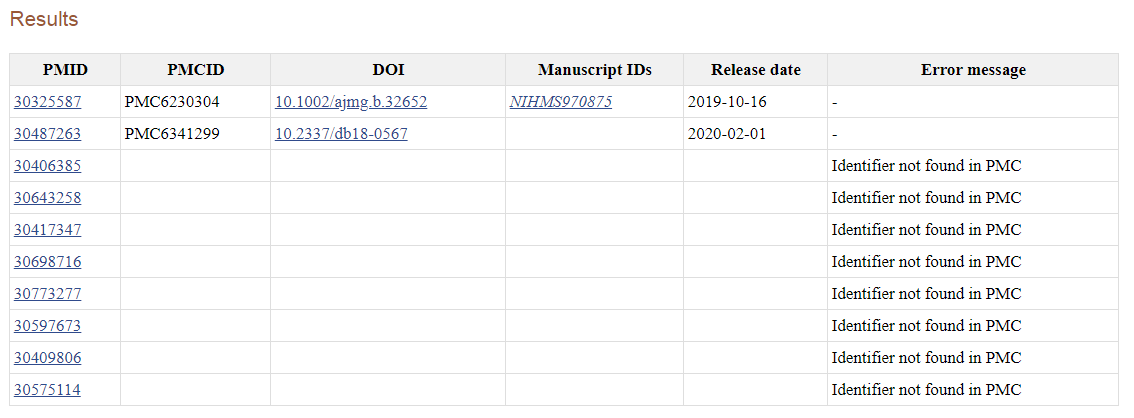
Ignoring the results with PMCIDs, cut/paste the remaining PMIDs (Identifier not found in PMC) into a new column in the Pure report spreadsheet.
Step 3: Identify the Pure records which can be included in PubMed LinkOut.
So far we have a list of records in Pure that have a PMID (which may or may not have PMCIDs), and a list of PMIDs that have been checked to make sure they don’t have PMC IDs. What we need to do now is merge the data. There are a number of different ways to do this in Excel, but I chose to use the conditional formatting function to highlight duplicate PMIDs in Pure that are on the ‘not in PMC list’ we created. Filtering by colour will then give you a list of records which can be included in the PubMed LinkOut programme. I chose to remove the items which are currently under an embargo which can be identified from the Open Access embargo date, and removed using a filter.

All that is remaining to do is to tidy up the records and add the stable URL. This can be done by taking the UUID-4 value from the Pure report and concatenating with the handle server ID for Pure, for example:
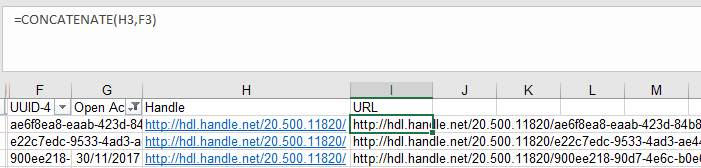
Handle + UUID-4 = URL , e.g:
http://hdl.handle.net/20.500.11820/e22c7edc-9533-4ad3-ae44-3f706dd7682c
Now you have a list of URLs of items in Pure that have PMIDs – but crucially not PMCIDs – which you can submit to the LinkOut Programme. You can download a printable PDF version of these instructions here:
Pure PubMed LinkOut instructions
Archives Internship Opportunity
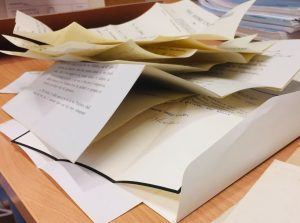
We are delighted to be able to offer an 8-week, archive cataloguing project internship opportunity, working with the Wellcome Research Resource-funded archive project ‘Evergreen: Patrick Geddes and the Environment in Equilibrium’. This is a fantastic opportunity for a student or new archive career professional to develop and demonstrate core archival skills. The internship will involve contributing to the enhancement of online archive catalogue descriptions relating to the fascinating correspondence of Patrick Geddes, helping to enhance and promote access to the collections. Closing date: 29 March 2019. Interviews: 18 Arpil 2019. Start date: 13 May 2019.
https://www.ed.ac.uk/information-services/library-museum-gallery/crc/volunteers-interns-honorary-fellows/volunteers-interns
Database trial – Shakespeare’s Globe Archive: Theatres, Players & Performance
We have been offered a free trial of Shakespeare’s Globe Archive: Theatres, Players & Performance published by Adam Matthew Digital. Please click here to access the trial. EASE login is required. The trial runs until 8th April 2019.
This collection of documents offers insights into the performance practice in the particular space of the reconstructed Globe Theatre. It details the way in which the theatre was constructed as a place of radical experiment. It documents over 200 performances through prompt books, wardrobe notes & jottings, programmes, publicity material, annual reports, show reports, posters, photographs, music archive and architectural plans. Read More
Research Data Workshop Series 2019
Over the spring of 2019 the Research Data Service (RDS) is holding a series of workshops with the aim of gathering feedback and requirements from our researchers on a number of important Research Data topics.
Each workshop will consist of a small number of short presentations from researchers and research support staff who have experience of the topic. These will then be followed by guided discussions so that the RDS can gather your input on the tools we currently provide, the gaps in our services, and how you go about addressing the challenges and issues raised in the talks.
The workshops for 2019 are:
Electronic Notebooks 1
14th March at King’s Buildings (Fully Booked)
DataVault
1200-1400, 10th April at 6301 JCMB, King’s Buildings, Map
Booking Link – https://www.events.ed.ac.uk/index.cfm?event=book&scheduleID=34308
The DataVault was developed to offer UoE staff a long-term retention solution for research data collected by research projects that are at the completion stage. Each ‘Vault’ can contain multiple files associated with a research project that will be securely stored for an identified period, such as ten years. It is designed to fill in gaps left by existing research data services such as DataStore (active data storage platform) and DataShare (open access online data repository). The service enables you to comply with funder and University requirements to preserve research data for the long-term, and to confidently store your data for retrieval at a future date. This workshop is intended to gather the views of researchers and support staff in schools to explore the utility of the new service and discuss potential practicalities around its roll-out and long-term sustainability.
Sensitive Data Challenges and Solutions
1200-1430, 16th April in Seminar Room 2, Chancellors Building, Bioquarter, Map
Booking Link – https://www.events.ed.ac.uk/index.cfm?event=book&scheduleID=34321
Researchers face a number of technical, ethical and legal challenges in creating, analysing and managing research data, including pressure to increase transparency and conduct research openly. But for those who have collected or are re-using sensitive or confidential data, these challenges can be particularly taxing. Tools and services can help to alleviate some of the problems of using sensitive data in research. But cloud-based tools are not necessarily trustworthy, and services are not necessarily geared for highly sensitive data. Those that are may not be very user-friendly or efficient for researchers, and often restrict the types of analysis that can be done. Researchers attending this workshop will have the opportunity to hear from experienced researchers on related topics.
Electronic Notebooks 2
1200-1430, 9th May at Training & Skills Room, ECCI, Central Area, Map
Booking Link – https://www.events.ed.ac.uk/index.cfm?event=book&scheduleID=34287
Electronic Notebooks, both computational and lab-based, are gaining ground as productivity tools for researchers and their collaborators. Electronic notebooks can help facilitate reproducibility, longevity and controlled sharing of information. There are many different notebook options available, either commercially or free. Each application has different features and will have different advantages depending on researchers or lab’s requirements. Jupyter Notebook, RSpace, and Benchling are some of the platforms that are used at the University and all will be represented by researchers who use them on a daily basis.
Data, Software, Reproducibility and Open Research
Due to unforeseen circumstances this event has been postponed. We will update with the new event details as soon as they are confirmed.
In this workshop we will examine real-life use cases wherein datasets combine with software and/or notebooks to provide a richer, more reusable and long-lived record of Edinburgh’s research. We will also discuss user needs and wants, capturing requirements for future development of the University’s central research support infrastructure in line with (e.g.) the LERU Roadmap for Open Science, which the Library Research Support team has sought to map its existing and planned provision against, and domain-oriented Open Research strategies within the Colleges.
Kerry Miller
Research Data Support Officer
Library & University Collections
World Newspaper Archive collections: on trial
*The Library has now purchased access to African Newspapers, Series 1. See New! African Newspapers, Series 1 1800-1922*
Thanks to a request from the UncoverEd project team, I’m pleased to let you know that the Library currently has trial access to two digital newspaper collections, African Newspapers, Series 1 and South Asian Newspapers, from Readex. Both collections offer unique access to fully searchable collection of historical newspapers from Africa and South Asia.

You can access this digital resource via the E-resources trials page.
Access is available both on and off-campus.
Trial access ends 19th April 2019. Read More
Mathematical Sciences Publishers content via ProjectEuclid
 With the renewal of our Mathematical Sciences Publishers e-journal subscription, we now gain access to the following new titles:
- Innovations in incidence Geometry
- Moscow Journal of Combinatorics and Number Theory
- Pure and Applied Analysis
- Tunisian Journal of Mathematics
Access is via DiscoverEd and the e-journals AZ list.

Screenshot from Project Euclid website
Collections
 Hill and Adamson Collection: an insight into Edinburgh’s past
My name is Phoebe Kirkland, I am an MSc East Asian Studies student, and for...
Cataloguing the private papers of Archibald Hunter Campbell: A Journey Through Correspondence
My name is Pauline Vincent, I am a student in my last year of a...
Hill and Adamson Collection: an insight into Edinburgh’s past
My name is Phoebe Kirkland, I am an MSc East Asian Studies student, and for...
Cataloguing the private papers of Archibald Hunter Campbell: A Journey Through Correspondence
My name is Pauline Vincent, I am a student in my last year of a...

Projects
Cataloguing the private papers of Archibald Hunter Campbell: A Journey Through Correspondence
My name is Pauline Vincent, I am a student in my last year of a...
Archival Provenance Research Project: Lishan’s Experience
Presentation My name is Lishan Zou, I am a fourth year History and Politics student....