Home University of Edinburgh Library Essentials
December 17, 2025
Anniversary of Andrew Lang
March 31 marks the 175th anniversary of the birth of one of Scotland’s most prolific and versatile writers, Andrew Lang (1844-1912). The author or co-author of 249 volumes, Lang worked in fields as varied as anthropology, folklore, classical scholarship, Scottish history, poetry, drama, and children’s writing. As a perennially in-demand journalist, he also penned articles and reviews on an almost daily basis.
At the Centre for Research Collections, we hold a suitably diverse collection of 35 letters (Coll-732) from Andrew Lang to a number of literary and professional colleagues. The publications mentioned in these letters convey the full breadth of Lang’s interests: controversially pro-Jacobite studies of Mary Queen of Scots and Charles Edward Stuart, translations from Homer, an epic poem on Helen of Troy, a history of Oxford University, a study of three French Romantic poets, and anthologies of ballads and folktales.
Although many of the letters are brief and business-like, they provide a vivid glimpse into the daily labour of a Late Victorian professional writer. There are letters asking magazine editors what they pay contributors; thanking his literary agent Hughes Massie for a cheque; requesting transcripts of historical manuscripts held by the British Museum; offering advice to young authors; submitting work on behalf of protégés; accepting or declining invitations to address clubs and societies; and turning down commissions when over-committed or short of inspiration.
Read More
Open Access Scotland Group meeting
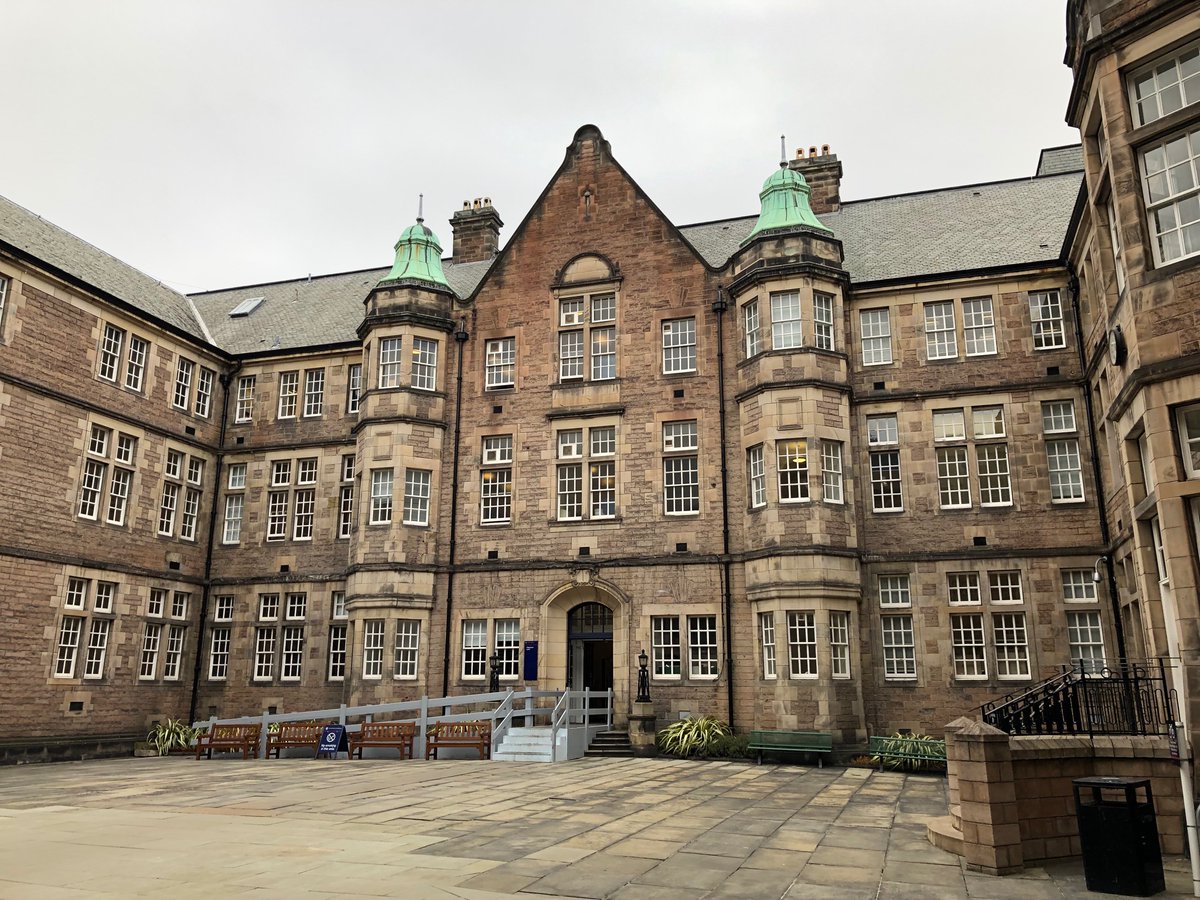
Photo by @hblanchett : https://twitter.com/hblanchett/status/1110843583320473600
On 27th March the Scholarly Communications Team at the University of Edinburgh were delighted to host the 6th regular meeting of the Open Access Scotland Group at the impressive Paterson’s Land building (pictured above).
The Group aims to provide a voice for open access in Scotland, allow the sharing of best practice, facilitate opportunities for networking between stakeholders, and lobby on behalf of Scottish organisations. It is an open group and comprises members from Scottish HE institutions and other allied organisations, like academic publishers, software vendors, local and national government agencies and research funders. The group also has honorary members from Iceland and Northern Ireland.
The event on 27th March was attended by 40 people representing over 20 organisations.

Photo by @hblanchett
The first speaker was Pauline Ward who gave a well received talk on Open Science Approaches – including the fantastic Research Data Service at the University of Edinburgh.
During the main session we had a facilitated discussion around issues such as the use of research notebooks, how to do open access for Practise-led Research, and updates on Plan S, UK-SCL and Jisc Support.
The draft notes from the event are available online here:
https://docs.google.com/document/d/19OZEX6QajIl-LNgUrGsY-Fdk7LSGUUhvfp0GM2Jubg4
If you are interested in Open Access and are based in Scotland then I would heartily recommend joining up to the Open Access Scotland Group. The next meeting is pencilled in for September and will probably be hosted by the University of the Highlands and Islands in Inverness. Hope to see you there!
What’s New in DiscoverEd – March 2019
DiscoverEd has some useful new features. Read on for full details…
1. Lockable Filters
It is now possible to lock a set of filters which you have applied to your search results, in order to make them active for the remainder of your DiscoverEd session. For example, you may wish to lock the Full Text Online Show Only filter and the Books Resource Type filter. This would result in subsequent searches being limited to electronic books.
To lock filters:
- Run an initial search in DiscoverEd and apply the filter(s) you wish to use.
- In the Active filters section, click on the opened padlock icon next to the filter you wish to lock – the icon will change to a closed padlock icon. Repeat this process for each of the filters you want to lock for the rest of the session.

These filters will remain locked for any subsequent searches that you carry out during the session. If you want to unlock the filters at any stage in your session, simply repeat the above process, this time changing the closed padlock icon back to the open padlock icon.
2. Personalised Search Results
It is now possible to alter the order of the results of a search, so that material that is more relevant to your preferred subject disciplines appears higher up the results list. To do this:
Run a search and then select the Personalise your results option:

You can now select up to 5 preferred disciplines from the available options. When you have finished making your selections, click on APPLY:

The order of your search results will now change, according to your preferences, and material which is more relevant will appear higher up the list of results. Your preferred disciplines are now shown to the left of your search results:

Please note that only the order of articles will change when you personalise your results, with the most relevant articles appearing nearer the top of your results list. The positioning of books from the University Library will not change in the list.
Your personalised preferences will remain in place for the remainder of your session, unless you switch them off by clicking on the red Personalised option:

You can also change your preferences at any time by selecting Edit Disciplines:

If you are signed in to DiscoverEd when you set your preferences then they will be retained and will be automatically applied to your search results in your next session, unless you change them or switch off the feature.
3. Citation Trails on Results List
DiscoverEd allows you to view journal articles which have cited, or were cited in, other journal articles. This “citation trails” feature was previously only available when viewing the full details of an article, but it is now available directly from the results list.
Articles which have cited or were cited in other articles can be easily identified by the citation trails icons which appear in the brief results display:

Click on the first icon (with the two upward arrows) to retrieve articles which have cited the article you are viewing. Click on the second icon (with the single downward arrow) to find articles that are cited in the article.
4. Renew Selected Items in My Account
It was previously only possible to renew borrowed items one at a time, or else to renew all the items you had on loan. It is now possible to select a group of items from your Loans list and renew only those selected items.
Click on the numbered boxes to select the items you wish to renew, then select the RENEW SELECTED option:

A New Profession
From 1 October 1928 The Edinburgh School of Social Study and Training, established in 1918, was to be incorporated into the University. Students at the school had been entitled to a university qualification since 1922 but they were now to become students in the newly created Department of Social Studies and Training with Miss Nora Milnes as director and also lecturer in Social Economics. Professor Kemp Smith at the University’s AGM said the move recognised that “a new profession was coming into existence”.
Who were the students who wanted to pursue this new profession? Where did they come from and what became of them? And how, in the first 20 years, did this new university course develop?
Some answers to these questions can be found in the collection of student admission files belonging to the department and covering the period from 1929-1956. As with any records containing personal information they are subject to Data Protection regulations, however the earlier files can provide a wonderful insight into the interests and progression of some of the department’s very first students.
Why social work?

On their application forms, each potential student was asked to explain why they had chosen this career path. It is quite remarkable how the answers to this question, although varying in detail, all allude to the overriding wish to work with people and not things, and not just to work with people, but to help them overcome whatever difficulties they may be facing. Being of use to the community and pursuing a worthwhile career also frequently appear as reasons. One student showed particular dedication by stating they wanted a career that “did not finish on leaving the office”.
The files include details of practical placements and serve to demonstrate some of the careers the students hoped to pursue – almoning, personnel management, child welfare to name a few:


Who were the students?
“I enjoyed my two years at Edinburgh and how much I value the broad lines of the course before plunging into a more specialised portion of social work”

Enrolment form for Jean Inglis, one of the last students to graduate from the School of Social Study and Training before it became incorporated into the University
Despite all sharing a goal to pursue a career in social work and welfare, the files show that the students were an interesting mix of young and old, British and overseas, male and female. Below are just a few examples of the diverse body of students who enrolled:

Marlene Kwok b.1932 d.2013
Marlene Kwok
Students came from India, Singapore, Australia, USA, Burma and all over Europe. Marlene Kwok hailed from British Guyana and attended Edinburgh University 1955-1956 graduating with a Certificate in Social Study. She returned home and wrote to Marjorie Brown in 1961 saying she was awaiting the general elections in August that year when the country’s new constitution would come into effect. Marlene wrote “Scenes from the History of Chinese in British Guyana”, a copy of which she presented to the University Library.
Cedric Mays

Cedric Mays b.1907
One of the department’s mature students, Cedric “Spike” Mays was 45 years old when he enrolled on the course in 1952. His application includes a letter of reference from Edwin Muir in his capacity as warden at Newbattle Abbey College where Mays was a contemporary of George Mackay Brown.
Originally from Essex, Cedric’s memoir “Reuben’s Corner: An English Country Boyhood” was first published in 1969 and subsequently re-issued as “The Only Way Was Essex” in 2013. He kept in touch with staff in the department and refers in one of his letters to his association with Lieutenant Colonel Alfred Wintle, subject of the book and biopic “The Last Englishman”, for whom he was organising a lecture tour of the USA following the Colonel’s six month imprisonment. The pair had met while convalescing in a military hospital.
Zbigniew Leszczynski (Les)
Les was one of a number of Polish students who enrolled on the course. Originally from Warsaw, Les arrived in Britain during the Second World War and graduated from the University with a Certificate in Social Study in 1948. A gifted artist he went on to study at Edinburgh College of Art and finally became an art teacher in the north of England. He also exhibited several works at the Royal Scottish Academy. He died in 2003 and his obituary can be read here.

Enrolment form for Marjorie Alice Brown who became Director of the School of Social Study in 1951
Students with Disabilities
It is also worth noting that at least four blind students studied at the department during this period. While attitudes of the staff varied as to the department’s capacity to cater for their needs, there was a general consensus that students with disabilities could be particularly suited to a career in social work. William Oliver, Professor of Organisation of Industry and Commerce, was especially enthusiastic, writing that he believed blind students “had a wonderful capacity for visualising the spoken word”.
Keeping it in the Family
The Ogilvy Wederburn sisters Janet, Katherine and Elspeth all gained their Certificates in the 1930s while Helen and Hilda Noble were both approaching 40 years old when they graduated with Diplomas in the same decade. In addition six other sets of sisters gained qualifications from the department during this period, including one set of twins, perhaps showing that a predisposition to follow a certain path can run in families!

Sylvia Perera came to study in the department from Singapore and graduated with a Certificate in 1957
Alumni
The students went on to have varied careers: teachers, managers, almoners, ministers of religion. The correspondence of those who kept in touch with staff are full of wonderful details of their journeys both within and outwith the field of social work. One former student who went into personnel management wrote about her position:
“It is a complete contrast in every way to the Glasgow factory – that one had about 2000 workers – this one considers itself very large with about 700 workers. Here they have as yet no trained nurse so I pull out splinters and plaster up burns etc. as well as interviewing, engaging, follow-ups, absentee, health and personnel records, supervising canteen……..I visit our girls who are out sick too and the only difference between slummy bits in Glasgow and here seems to me to be that here they are rather more cheerful, they drink more and there are infinitely more religious devices on all the walls”

Yolanda Vitolins b. 1930 d.2006. Originally from Latvia, Yolanda gained a Certificate in 1955 and went on to work at the Royal Edinburgh Hospital where she supervised students from the department on their placements.
Of those that stayed in the field of social work there are some notable alumni, a few of which are listed below:
Dr Alexina McWhinnie (1923-2017) graduated from the department in 1943 and was awarded a Carnegie Scholarship to do her PhD which was on the subject of adoption. Her first book, “Adopted Children, How They Grow Up” was published in 1967. As a Senior Research Fellow at Dundee University Dr McWhinnie conducted research into IVF and Donor Insemination families and also edited Who Am I? a collection of essays written by DI adults. She was an advocate for the rights of adopted people and the donor conceived and was awarded an MBE in 2010.
Kathleen Kufeldt (nee Galvin) would go on to have a very distinguished academic career, earning a PhD in child welfare, publishing many books and articles on the subject and teaching at the Universities of Newfoundland and New Brunswick.
Mary Neilson and Margaret Adams
Former students Mary Neilson (Certificate 1937) and Margaret Adams (Certificate 1951) co-authored the following publications which can both be found in the University Library:


Read about more alumni at http://www.socialwork.ed.ac.uk/centenary/people/alumni
These files are so much more than simple application forms; they can tell us so much about the beginnings and subsequent development of social work education at the University of Edinburgh and the personalities of those who taught and studied here.
They can also tell us about the progression of this “new profession” and as an added bonus can often give us first hand accounts of social history – the evacuation of school children to Brighton and the journey of WAAF members to Australia via Africa and Hong Kong being just two examples. As such they are a really invaluable and unique resource.
Referencing Tutorial
Cite Them Right online, which is in the Databases A-Z list, is a comprehensive guide to referencing almost anything you will come across in the course of your studies or research. It has just launched a Referencing Tutorial.

Direct access to the Tutorial is here. You will have the option to create an account to sign in as an authenticated user so that the Tutorial can remember your progress, or to explore freely without signing in and therefore without remembering your progress.
This tutorial is made-up of 11 short, self-contained topics, which you can explore and revisit at any time.
Content includes:
- What is referencing and why it matters
- What sources are appropriate to reference
- How to avoid plagiarism
- How to insert citations into your text
- Incorporating the work of others into your writing
- Documenting the full reference details
Open Science Conference 2019

This week, I attended the International Open Science Conference in Berlin. I attended this event last year, and found it so inspiring, I was keen to attend again this year. Open Science, or Open Research, as we tend to refer to it here in Edinburgh is an important development which will fundamentally change the way researchers and those who support them will work over the coming years.
We are in the process of adopting the LERU Roadmap on Open Science and are working with colleagues across the University with the aim of implementing as many of its 41 recommendations as possible.
The programme was comprehensive and there were far too many good ideas to summarise here, so instead I’d like to focus on a number of key take-home messages I came away with in no particular order:
- I need to get to grips with the European Open Science Cloud. It’s such a major intiative and I need to get to grips with what it is, how it works, and how it applies in the Edinburgh context (in an increasingly likely post-Brexit world).
- I’m very keen to work more closely with our Research Support Office to see what more we can do to ‘hack’ research proposals before they are submitted to make them more open right from the opurset. Thanks to Ivo Grigorov’s FOSTER Open Science CLINIQUE for the inspiration!
- Peter Kraker’s powerful presentation highlighted the risks we leave ourselves open to by allowing commercial monopolies to form within the research lifecycle. I’m increasingly worried that we are sleepwalking from a monopolistic market for library subscriptions to an even more dangerous situation with just one or two for-profit companies owning all the tools that are essential to the research endeavour. We need to do more to make open infrastructure sustainable. #dontleaveittogoogle
So, from my reams and reams of notes, those are my three key action points to take forward within the University of Edinburgh.
It was really great to hear Eva Mendez re-stress the importance of seeing the transition to open science as a process of manged, complex, cultural change. I think that is something I and my colleagues already understand very well, but it’s good to have this re-affirmed! It was also useful to think about how we need a complete picture of vision, skills, incentives, resources and action plans to avoid confusion, anxiety, resistance, frustration and false starts.

I’d highly recommend this conference and would encourage anyone with an interest in Open Research to attend again next year. #OSC2019
Dominic Tate
Brill E-Journals – renewal update

We have renewed our Brill e-journal deal and gain access to the following new titles.
| Subject | Title | ISSN Print | ISSN Online | 2019 Volume | No. of issues | Journal Web Page |
| African Studies | Studi Maghrebini/North African Studies – NEW at Brill | 0585-4954 | TBA | 17 | 2 | brill.com/mag |
| Art History | Paragone: Past and Present – NEW at Brill | 2476-115X | 2476-1168 | 2 | 2 | brill.com/para |
| Asian Studies | China and Asia – NEW | 2589-4641 | 2589-465X | 1 | 2 | brill.com/cahs |
| Book History and Cartography; History | Brill Research Perspectives in Map History – NEW | 2589-3955 | 2589-3963 | 1 | 2 | brill.com/rpmh |
| History | Journal of Applied History – NEW | 2589-5885 | 2589-5893 | 1 | 2 | brill.com/joah |
| History | Lithuanian Historical Studies – NEW at Brill | TBA | 1392-2343 | 21 | 1 | brill.com/lhs |
| History; International Relations | Diplomatica – NEW | 2589-1766 | 2589-1774 | 1 | 2 | brill.com/dipl |
| History; Social Sciences | Emotions: History, Culture, Society – NEW at Brill | 2206-7485 | 2208-522X | 3 | 2 | brill.com/ehcs |
| History; Theology and World Christianity | Brill Research Perspectives in Jesuit Studies – NEW | 2589-7446 | 2589-7454 | 1 | 4 | brill.com/rpjs |
| International Relations | Global Governance: A Review of Multilateralism and International Organizations – NEW at Brill | 1075-2846 | 1942-6720 | 25 | 4 | brill.com/gg |
| Language and Linguistics; Slavic and Eurasian Studies | International Journal of Eurasian Linguistics – NEW | 2589-8825 | 2589-8833 | 1 | 2 | brill.com/jeal |
| Literature and Cultural Studies | International Journal of Critical Media Literacy, The – NEW | TBA | TBA | 1 | 2 | brill.com/ijcm |
| Literature and Cultural Studies; Classical Studies | Brill Research Perspectives in Classical Poetry – NEW | 2589-2630 | 2589-2649 | 1 | 2 | brill.com/rpcp |
| Middle East and Islamic Studies | Al Abhath – NEW at Brill | 0002-3973 | 1811-5586 | 67 | 1 | brill.com/alab |
| Middle East and Islamic Studies | Berythus – NEW at Brill | 0067-6195 | TBA | 58 | 1 | brill.com/bery |
| Middle East and Islamic Studies | Mawlana Rumi Review – NEW at Brill | 2042-3357 | 2589-8566 | 10 | 2 | brill.com/mrr |
| Philosophy | International Journal of Jungian Studies – NEW at Brill | 1940-9052 | 1940-9060 | 11 | 2 | brill.com/ijjs |
| Philosophy | Simone de Beauvoir Studies – NEW at Brill | 1063-2042 | 2589-7616 | 30 | 2 | brill.com/sbs |
| Philosophy; Social Sciences | Journal of Applied Animal Ethics Research: Ethics for Animal Welfare, Veterinary Medicine, and Conservation – NEW | 2588-9559 | 2588-9567 | 1 | 2 | brill.com/jaae |
| Philosophy; Social Sciences | Secular Studies – NEW | 2589-2517 | 2589-2525 | 1 | 2 | brill.com/secu |
| Religious Studies | Brill Research Perspectives in Religion and Psychology – NEW | 2589-711X | 2589-7128 | 1 | 2 | brill.com/rpsy |
| Religious Studies | Religion and Gender – NEW at Brill | 2589-8051 | 1878-5417 | 9 | 2 | brill.com/rag |
| Religious Studies; Asian Studies | Journal of Chan Buddhism – NEW | 2589-7160 | 2589-7179 | 1 | 2 | brill.com/chbu |
| Religious Studies; Education | Brill Research Perspectives in Religion and Education – NEW | 2589-529X | 2589-5303 | 1 | 2 | brill.com/rpre |
| Religious Studies; Social Sciences | Brill Research Perspectives in Religion and Politics – NEW | 2589-5842 | 2589-5850 | 1 | 2 | brill.com/rprp |
| Social Sciences | Public Anthropologist – NEW | 2589-1707 | 2589-1715 | 1 | 2 | brill.com/puan |
| Social Sciences | Youth and Globalization – NEW | 2589-5737 | 2589-5745 | 1 | 2 | brill.com/yogo |
| Social Sciences; Media | Brill Research Perspectives in Popular Culture – NEW | 2589-4420 | 2589-4439 | 1 | 2 | brill.com/rppc |
| Theology and World Christianity | Brill Research Perspectives in Theological Traditions – NEW | 2589-8795 | 2589-8809 | 1 | 2 | brill.com/rptt |
| Theology and World Christianity | Journal of Religion and Demography – NEW | 2589-7411 | 2589-742X | 6 | 2 | brill.com/jrd |
| Theology and World Christianity; Philosophy | Journal for Continental Philosophy of Religion – NEW | 2588-9605 | 2588-9613 | 1 | 2 | brill.com/jcpr |
Further info.
The new titles are being added to DiscoverEd via an automated process as they become available on the Brill website.
For 2019 Brill publishes 310 journal titles in various subject fields. Nineteen of their titles are fully Open Access for 2019. Brill publications also include the imprints Brill | Nijhoff. Brill’s publications focus on the Humanities and Social Sciences, International Law and selected areas in the Sciences. Access is from 2000 onwards.
Brill Journal Archive Online, Parts 1 and 1a (Vol 1 to 1999) and Part 2 (2000-2009) have been purchased in perpetuity by Jisc Collections and are available free of charge to UK higher and further education institutions and Research Councils.
Spotlight on: FBI Files
This is part of an occasional series highlighting some of the digital resources available at the Library that will be of interest to students and staff in History, Classics and Archaeology.

Federal Bureau of Investigation [Public domain]
The FBI have been involved in a large number of famous, not so famous and infamous cases dealing with organised crime, terrorism, civil rights, white collar crime, espionage, violent crime and more. And did you know that through the Library you have access to a range of digitised files from the FBI?
FBI Files in Archives Unbound

Through the Library’s subscription to Archives Unbound (an enormous digital primary source database) you have access to over 20 collections of digitised material direct from the FBI, covering over 70 years of American history. You’ll spot some famous cases and names within these but possibly also some less known. However, between them they provide a fascinating insight into the political, cultural and social climate of the United States in the 20th century.
FBI File: Julius and Ethel Rosenberg
Julius and Ethel Rosenberg were a nondescript couple accused in 1950 by the U.S. government of operating a Soviet spy network and giving the Soviet Union plans for the atomic bomb. The trial of the Rosenbergs, which began in March 6, 1951, became a political event of greater importance than any damage they may have done to the United States. It was one of the most controversial trials of the 20th century. Their guilt and the harshness of their sentences continue to be vigorously debated to this day. Read More
Crime and punishment in late 18th-early 19th century Scotland: Prisons
This is the last post in our series on crime and punishment in late 18th-early 19th century Scotland, this time focusing on prisons. In the Statistical Accounts there is a lot of fascinating, detailed information on prisons and bridewells (prisons for petty offenders). In some cases, there was simply a lock-up in a town-house, rather than a purpose-built building. Below, we will look at some specific prisons found throughout Scotland, first looking at the cities of Glasgow and Edinburgh and then towns. It is particularly interesting when we compare between the Old and New Statistical Accounts and see what changes there have been.
Prisons in Cities
Glasgow
By the 1780s, the population of Glasgow had greatly increased due to the expansion of manufacturing. It became clear that there was a “necessity of a bridewell, or workhouse, for the punishment and correction of lesser offences.” (OSA, Vol. V, 1793, p. 513) So, in 1789, existing buildings were converted from granaries into a bridewell. “These have been gradually increased to the number of 64, where the prisoners are kept separate from one another, and employed in such labour as they can perform, under the management of a keeper, and under the inspection of a committee of council, who enquire into the keeper’s management, etc.” (OSA, Vol. V, 1793, p. 514)
Even at this time it was felt very important that the prison was of an adequate standard. Town Councillors inspected the prison and reported their findings, including anything to be rectified or altered. The keeper also kept records of each prisoner, noting down the details of their sentence, the wages they received for their labour, and after expenses were subtracted, the surplus paid to the prisoner when they left the prison. For some, this amounted to L. 5 to L. 7. (OSA, Vol. V, 1793, p. 514)
However, by the time of this parish report written in 1793, it was noted that “the growing manufactures and population of the city requiring more extensive accommodations, than the present bridewell can afford, the Magistrates and Council propose to erect a new one, more properly calculated for the ends proposed, and on such a plan, that additions can be made to 1, from time to time, as the circumstances of the city may require.”(OSA, Vol. V, 1793, p. 514) Yet again, by the time of the New Statistical Accounts of Scotland, “the gaol at the cross had become deficient in almost every requisite.” (NSA, Vol. VI, 1845, p. 214) At that point, it was serving not just the city, but also occasionally the counties of Lanark, Renfrew, and Dumbarton. On the 13th February 1807, “the magistrates and council resolved to erect a new gaol and public offices in a healthy situation adjoining the river, at the bottom of the public green. This building, which cost L. 34,800, contains, exclusively of the public offices, 122 apartments for prisoners.” To discover more about the prison’s facilities (which may surprise you!) take a look at the parish report for Glasgow. (NSA, Vol. VI, 1845, p. 214)
On the 8th May 1798, a new bridewell was opened in Duke Street, Glasgow, which again quickly became ill-equipped for such a fast-expanding city. (Can you see a pattern emerging?!) It was, therefore, extended further and was opened on Christmas Day 1824. “It combines all the advantages of modern improvement, security. seclusion, complete classification, and healthful accommodation.” (NSA, Vol. VI, 1845, p. 215)
In the Statistical Accounts, there are several examples of tables giving the number of prisoners and associated costs. Below is an example for the Glasgow bridewell, covering the commitments in 1834.
| Males above 17 years of age, | 313 | ||||||||||||||||||
| Males below 17 years of age, | 222 | ||||||||||||||||||
| =1035 | |||||||||||||||||||
| Females above 17 years of age, | 864 | ||||||||||||||||||
| Females below 17 years of age, | 68 | ||||||||||||||||||
| = 932 | |||||||||||||||||||
| Total commitments, | 1967 | ||||||||||||||||||
| Remained on 2d of August 1833, | 356 | ||||||||||||||||||
| Prisoners in all, | 2323 | ||||||||||||||||||
| Liberated during the year, | 2030 | ||||||||||||||||||
| Remaining on 2d of August 1834, | 293 | ||||||||||||||||||
| The average number daily in the prison was 320; viz. males, 162; females, 158. | |||||||||||||||||||
| Abstract accounts for the year ended 2d of August 1834. | |||||||||||||||||||
|
Edinburgh
All the way back in 1560 the old prison or Tolbooth was founded and stood immediately west of St Giles’ church. However, this was pulled down in 1817, the same year a new prison was opened on Calton Hill. There is a very detailed description of the Calton Hill prison in the parish report of Edinburgh, written in 1842:
“It is a very ornamental castellated structure in the Saxon style; and is 194 feet long by 40 feet in width. The interior is divided into six classes of cells; four for males, and two for females; with an airing ground attached to each. There are two stories of cells, one above the other. To each of these divisions of cells on the ground floor there is a day room with a fire-place; and an airing ground common to fill the cells of the division. Each cell is for the reception of one prisoner; and is 8 feet by 6. A wooden bed is fixed into the wall, and there is a grated window and air holes in the wall for full and free ventilation. There are in all fifty-eight cells.” (NSA, Vol. I, 1845, p. 719)
_p.091_-_The_new_Bridewell,_Salisbury_Crags,_and_Arthur%27s_Seat_from_Calton_Hill_-_Thomas_Hosmer_Shepherd.jpg)
The new Bridewell, Salisbury Crags, and Arthur’s Seat from Calton Hill, Edinburgh, 1829. Thomas H. Shepherd [Public domain].
In the Appendix for Edinburgh, County of Edinburgh, a few key dates have been given. “In 1748-The first correction house for disorderly FEMALES was built, and it cost L. 198: 0: 4 1/2. N. B. This is the only one Edinburgh yet has. In 1791-Manners had been for some years so loose, and crimes so frequent, that the foundation of a large new house of Correction, or Bridewell, was laid on the 30th of November, which, on the lowest calculation, will cost L. 12,000; and this plan is on a reduced scale of what was at first thought absolutely necessary. In 1763-That is from June 1763 to June 1764, the expence of the Correction house amounted to L. 27: 16: 1 1/2. In 1791, and some years previous to it. The expence of the Correction house had risen to near L. 300,-ten times what it had been in the former period; and there is not room for containing the half of those that ought to be confined to hard labour.” (OSA, Vol. VI, 1793, p. 612)
Prisons in Towns
We have looked at the prison situation in the large cities. But, how about the situation in smaller towns? Below, we look at some examples throughout Scotland.
Kirkcaldy
As claimed in the parish report for Kirkcaldy, its jail is the best in Fife! “Under the New Prison Act, its management has been much improved. The prisoners are constantly employed, and great care is taken that proper attention be paid to their health, their diet, their education, and religious instruction. It is now a place more for the reformation than the punishment of prisoners.” (NSA, Vol. IX, 1845, p. 770)
Hawick
“The Jail, which forms a part of the town-house, and consists of a very small apartment, is neither properly secured, nor capable of being used without endangering the health of its inmates. For these reasons criminals are generally conveyed to the county town, a mode of procedure which is not only attended with considerable expense, but which, when taken in connection with a glaring deficiency of police, presents serious obstacles to the authorities in arresting the progress of crime and enforcing the authority of the laws. The number of convictions, inclusive of cases, brought not only before the magistrates and justices of peace, but before the Sheriff, and the circuit court at Jedburgh, amounted in 1838 to 58.” (NSA, Vol. III, 1845, p. 417)
Dumfries
“The Court-house is an elegant and commodious structure, wherein the circuit and sheriff-courts, the quarter session and the county meetings are held. Opposite to this stands a heavy-looking building, which was at first intended for a court-house, but is now converted into a Bridewell, the interior of which is arranged on the same plan with that of Edinburgh, but on so small a scale, that it is thought, from the facility with which the prisoners can hold intercourse with one another, to be very ill adapted for a place of confinement. Behind this, in a low damp yard, and surrounded by a high wall, is situated the county Jail, which, along with the Bridewell, was built in 1807. Previously to that period, the jail was in the centre of the town. A vaulted passage under the street, forms a communication between the prison-yard and the court-house. The debtors have the liberty of exercising themselves within the enclosed yard.” (NSA, Vol. IV, 1845, p. 14)
.jpg)
Inverness Steeple and Tolbooth, 2008. [Photo credit: Dave Conner from Inverness, Scotland [CC BY 2.0]].
As noted in the parish report for Aberdeen written in 1835, “the ancient jail of Inverness consisted only of a single damp dingy vault, in one of the arches of the stone bridge, and which (subsequently used as a mad-house) was only closed up about fifteen years ago. It was succeeded by another prison in Bridge Street, which, from the notices of it in the burgh’s records, must also have been a most unhealthy and disagreeable place of confinement. The present jail was erected in 1791, and cost L. 1800, the spire having cost about L.1600 more. ” (NSA, Vol. XIV, 1845, p. 34) (In fact, the spire is the only part of the building left standing, as can be seen in the picture on the right.)
“Besides prisoners for debt, all those charged with crimes from the northern counties are sent here previous to their trial before the circuit.courts of Jisticiary, which sit at Inverness twice a-year. Although a great improvement at the time of its erection, this prison is now found to be too small and very inconvenient, there being no proper classification of delinquents, while there is no open court or yard for them to walk in, nor can any manual employment be required of them at present.” (NSA, Vol. XIV, 1845, p. 34)
Porttree
In the parish of Porttree, County of Inverness, there was only one prison, where, in 1840, 16 offenders resided – “eleven for riotous conduct, four for housebreaking and theft, and one for forgery.” For some time in the past this prison was insecure, with instances of prisoners actually managing to escape! The bad conditions did not help matters. “Into the jail they are thrown without bed, without bedding, without fire, and with but a small allowance for their subsistence. “By the humanity, however, and charity of some benevolent persons in the neighbourhood, these privations have been partly alleviated, if not removed.” (NSA, Vol. XIV, 1845, p. 234)
Cupar
In the parish report of Cupar, County of Fife, in 1796, the Reverend George Campbell wrote that “the prison of Cupar, which is the public jail, for the very populous and wealthy county of Fife, yields perhaps to none, in point of the meanness, the filth, and wretchedness of its accommodations… Apartments in one end of a town-house acted as a place to secure and punish those who have fallen foul of the law. “The apartment destined for debtors is tolerably decent, and well lighted. Very different is the state of the prison under it, known by the name of “the Iron-house,” in which persons suspected of theft, etc. are confined. This is a dark, damp, vaulted dungeon, composed entirely of stone, without a fire-place, or any the most wretched accommodation. It is impossible, indeed, by language, to exaggerate the horrors which here present themselves” (OSA, Vol. XVII, 1796, p. 142)
In many parishes there was a concern that when a prison was built in a neighbouring or nearby county that it would cause the displacement of criminals into their area. This was certainly the case in Cupar, with the parish report stating that in such a wealthy county as Fife, there should be better prisons. “It is to be hoped, however, that the period is now happily arrived, when the landholders of Scotland, having more humane sentiments and enlarged views, than those who went before them, will attend to the wretched state of the different county jails” and would contribute to the building of more modern prisons. (OSA, Vol. XVII, 1796, p. 143) “A measure of this kind will appear every day of more pressing necessity, when the Bridewell now building at Edinburgh shall be finished. If Fife takes no step to defend itself against the influx of pickpockets, swindlers, etc. which may naturally be expected, it will become the general receptacle of sturdy beggars and vagrants; and the rising industry of the county must be exposed to the depredations of the desperate and the profligate, from every quarter*.” (OSA, Vol. XVII, 1796, p. 144)
In 1844, the number of prisoners committed to Cupar Prison was 37. “Of these, 15 were for debt, and 22 for stealing, assault, and such crimes as commonly occur in a populous country.” However, according to the parish report, the prison needed improvements. “The accommodation that it affords is uniformly condemned as most unworthy of the town and county. The lodging is bad, and reckoned unhealthy,-there is no room for the classification of criminals,-there is no chapel or place of worship attached; and consequently, any attempt to reclaim or improve those that are once committed to it, becomes absolutely hopeless.” (NSA, Vol. IX, 1845, p. 18)
Dundee
Dundee was another parish which felt the effects of prisons being built elsewhere. “Since Bridewells, or penitentiary houses, have been established in Edinburgh and Glasgow, Dundee has been much more pestered than formerly, with vagrants and persons of doubtful character, and swindling and petty thefts are more frequent. This will probably produce a Bridewell in Dundee. An establishment of this kind is certainly necessary, and the common prisons, and present inflictions of justice, are by no means sufficient to supply its place. With respect to our prisons, though among the best in Scotland, they are destitute of any court or area where the prisoners may enjoy the open air. This, however, is at present, the less necessary, as the laws of the country are supposed inhumanely, to exclude debtors from the privilege of breathing the same air with others; and, it is but very seldom, that felons suffer long confinement, in the prisons of places not visited by the Circuit Courts of Justiciary.” (OSA, Vol. VIII, 1793, p. 248)
Other Prisons
Here are some of the other prisons you can read about in the Statistical Accounts of Scotland: Linlithgow, County of Linlithgow; Montrose, County of Forfar; Falkirk, County of Stirling; Perth, County of Perth; Dingwall, County of Ross and Cromarty; Irvine, County of Ayrshire; Blairgowrie, County of Perth; Ayr, County of Ayrshire; Inverary, County of Argyle; Wick, County of Caithness; and Aberdeen, County of Aberdeen. This is by no means a definitive list!
Conclusion
The Statistical Accounts of Scotland provides a wealth of knowledge about prisons throughout Scotland, some very detailed and giving actual figures, for example Aberdeen, County of Aberdeen (NSA, Vol. XII, 1845, p. 83), Peebles (NSA, Vol. III, 1845, p. 182), Inverary, County of Argyle (NSA, Vol. VII, 1845, p. 42) and Wick, County of Caithness (NSA, Vol. XV, 1845, p. 175). You can discover when and where prisons and bridewells were built, descriptions of the buildings, living conditions, numbers of prisoners and crimes committed, work carried out by the prisoners and, for some of the larger prisons, even the costs of running them. Many parish ministers also wrote about the issues faced by the parishes and their prisons, especially the poor prison conditions and lack of cells. It may be a surprise to learn that many parish reports state how abominable prison conditions were, calling for more modern, larger prisons to be built to deal with the increased number of offenders.
Although this is the last post in our crime and punishment series, there are many other areas you could research, including crime statistics, policing, law courts and acts of law. This goes to show how comprehensive and enthralling a resource both the Old and New Statistical Accounts of Scotland are!
Resource Lists workshop for LLC course organisers
In response to LLC colleagues’ interest and requests, the Library Learning Services will provide a Resources Lists workshop specially for staff of the LLC School who are using or planning to use the Resource Lists for their course teaching.
- Time: 2.00 – 3.00pm Wednesday 17th April 2019
- Venue: Room 1.02 (Computer Lab), 50 George Square
Library staff will be on hand to answer any Resource Lists-related questions and to tell you about the help available to set up a Resource List for your course. To help us manage the session, if you’d like to attend, could you please follow the link below to make a booking:
https://www.events.ed.ac.uk/index.cfm?event=book&scheduleID=34349
The event is also visible to LLC staff in MyEd and is bookable there. We hope to see many of you at the workshop!
Background information
LLC has the largest number (208 as of Jan 2019) of published Resource Lists among all the Schools of the University, though it only represents 27% of our LLC courses.
What you will learn
By the end of this session you will be able to create and edit your own Resource Lists and understand how the Library is using Resource Lists to manage the purchase of books, provide access to copyright compliant scans and manage HUB/Reserve requests.
Why use Resource Lists?
- to improve the student experience
- to make it easier for course organisers to manage the provision of library materials for teaching
About Resource Lists
Resource Lists provide students with easy and consistent access to key course reading materials. The Library currently provides 1900 Resource Lists for courses across every school. Lists can be viewed via the service homepage: http://resourcelists.ed.ac.uk However, most students access their Resource Lists via a link in the left hand menu in the corresponding Learn course.
Resource Lists is the preferred route for Course Organisers to manage the provision of library materials. Once set up, lists are rolled over each June and can be reviewed and edited for the next academic year.
Any resource with a web address can be added to a list, including, books, e-books, book chapters, journal articles and videos. Course organisers assign priority to list items (Essential, Recommended or Further reading) and add notes for students indicating which chapters or pages should be read. The Library uses the priorities and student numbers to inform number of copies purchased and loan periods.
Resource Lists provide students with a number of features to help them manage their course reading. Students can create their own collection, make suggestions for new items to be added to lists and export their lists in their preferred citation style.
There is more information about Resource Lists on the IS website: http://edin.ac/resource-lists
For more information, please contact Library.Learning@ed.ac.uk
Collections
 Hill and Adamson Collection: an insight into Edinburgh’s past
My name is Phoebe Kirkland, I am an MSc East Asian Studies student, and for...
Cataloguing the private papers of Archibald Hunter Campbell: A Journey Through Correspondence
My name is Pauline Vincent, I am a student in my last year of a...
Hill and Adamson Collection: an insight into Edinburgh’s past
My name is Phoebe Kirkland, I am an MSc East Asian Studies student, and for...
Cataloguing the private papers of Archibald Hunter Campbell: A Journey Through Correspondence
My name is Pauline Vincent, I am a student in my last year of a...

Projects
Cataloguing the private papers of Archibald Hunter Campbell: A Journey Through Correspondence
My name is Pauline Vincent, I am a student in my last year of a...
Archival Provenance Research Project: Lishan’s Experience
Presentation My name is Lishan Zou, I am a fourth year History and Politics student....