Home University of Edinburgh Library Essentials
March 21, 2026
New! African Studies – Oxford Bibliographies
I’m pleased to let you know that following a request from staff members in the Centre of African Studies (CAS) the Library now has access to Oxford Bibliographies: African Studies collection.

You can access Oxford Bibliographies: African Studies via DiscoverEd, the African Studies LibGuide or via the entry to Oxford Bibliographies on the Databases A-Z list.
Since the literature on African Studies is diverse, fast moving, controversial, and scattered among unfamiliar sources, Oxford Bibliographies have asked leading scholars to identify the most significant themes and areas of study in their fields, recommend the best sources for exploring them, and discuss these works conceptual and empirical significance to provide a series of guided studies through the diverse approaches to a wide array of complex subjects. Read More
On trial: Prosecuting the Holocaust: British investigations into Nazi war crimes
I’m happy to let you know that the Library currently has trial access to the brand new digital primary source collection, Prosecuting the Holocaust: British investigations into Nazi war crimes, 1944-1949, from British Online Archives. Drawn from the UK National Archives, this collection contains a wealth of information regarding the British government’s efforts to investigate and prosecute Nazi crimes.

You can access Prosecuting the Holocaust via the E-resources trials page.
Access is available both on and off-campus.
Trial access ends 30th April 2019. Read More
Board Games at Break
 Playful Engagement by Madeleine Leisk CC BY-NC
The UCF is always a fun place to work, but this past month, we have had the opportunity to add even more fun, excitement and teamwork to the UCF with the help of the Playful Engagement box. The box, a treasure trove of games, colouring books and creative materials, was created as part of the ISG commitment to Playful Engagement and the Innovation Fund project. We had the honour of being the first site location to receive the travelling box, while another box is located at Argyle House. These activities have been carefully curated so that they can be used during a short break, as part of a team building exercise, or as a way to relax individually. Some of our favourite objects in the box were: Hanabi, Perudo, One Night Werewolf, and an animal colouring book.
We dove right in with a game of One Night Werewolf, a quick game whereby players are randomly assigned characters and must discover which player is the werewolf. We were also able to practice our poker-faces with the dice game, Perudo, and made some goofy cartoons for our lunch room.
This month, we have also welcomed two new Library Assistants to the UCF and a game of Hanabi was a great introduction to the team. The game required teamwork to build the best fireworks display from a set of cards. It was simple enough to complete a game during our tea break but it was also challenging as it required players to rely on each other to provide clues to reach the communal goal of building a vibrant fireworks display.
These activities have been a great way to continue our development as a team and to add some more fun to our work. The individual activities, like the Animal Kingdom colouring book and the art supplies, have also been a good way to relax individually during our lunch breaks.
We will be sad to see the Playful Engagement box leave, but we hope that whatever team receives the box next enjoys it as much as we did (and does not mind the completed colouring pages). I would also recommend that you visit the Playful Engagement website, https://thinking.is.ed.ac.uk/playful-engagement/ and play some of the metadata games at https://librarylabs.ed.ac.uk/games/.
Madeleine Leisk, UCF Library Assistant
Anniversary of Andrew Lang
March 31 marks the 175th anniversary of the birth of one of Scotland’s most prolific and versatile writers, Andrew Lang (1844-1912). The author or co-author of 249 volumes, Lang worked in fields as varied as anthropology, folklore, classical scholarship, Scottish history, poetry, drama, and children’s writing. As a perennially in-demand journalist, he also penned articles and reviews on an almost daily basis.
At the Centre for Research Collections, we hold a suitably diverse collection of 35 letters (Coll-732) from Andrew Lang to a number of literary and professional colleagues. The publications mentioned in these letters convey the full breadth of Lang’s interests: controversially pro-Jacobite studies of Mary Queen of Scots and Charles Edward Stuart, translations from Homer, an epic poem on Helen of Troy, a history of Oxford University, a study of three French Romantic poets, and anthologies of ballads and folktales.
Although many of the letters are brief and business-like, they provide a vivid glimpse into the daily labour of a Late Victorian professional writer. There are letters asking magazine editors what they pay contributors; thanking his literary agent Hughes Massie for a cheque; requesting transcripts of historical manuscripts held by the British Museum; offering advice to young authors; submitting work on behalf of protégés; accepting or declining invitations to address clubs and societies; and turning down commissions when over-committed or short of inspiration.
Read More
Open Access Scotland Group meeting
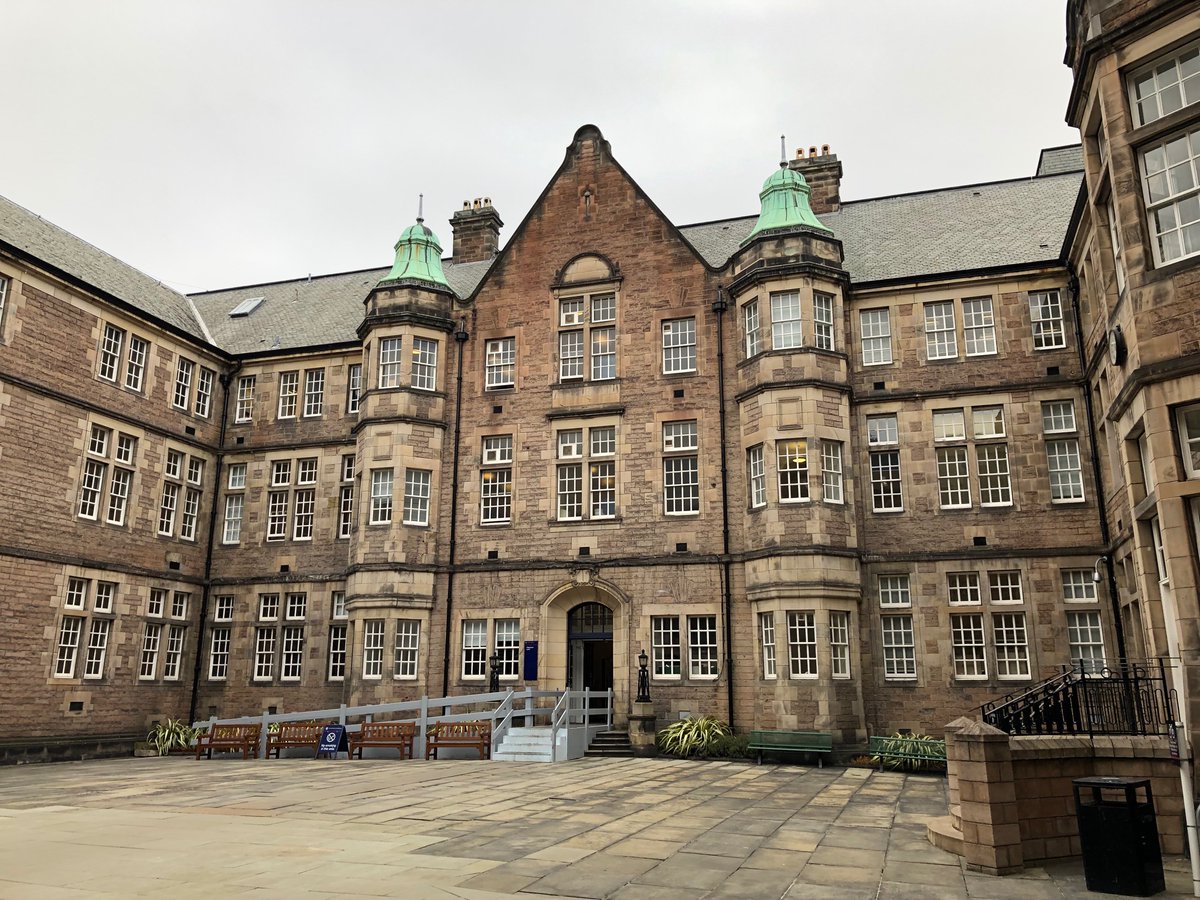
Photo by @hblanchett : https://twitter.com/hblanchett/status/1110843583320473600
On 27th March the Scholarly Communications Team at the University of Edinburgh were delighted to host the 6th regular meeting of the Open Access Scotland Group at the impressive Paterson’s Land building (pictured above).
The Group aims to provide a voice for open access in Scotland, allow the sharing of best practice, facilitate opportunities for networking between stakeholders, and lobby on behalf of Scottish organisations. It is an open group and comprises members from Scottish HE institutions and other allied organisations, like academic publishers, software vendors, local and national government agencies and research funders. The group also has honorary members from Iceland and Northern Ireland.
The event on 27th March was attended by 40 people representing over 20 organisations.

Photo by @hblanchett
The first speaker was Pauline Ward who gave a well received talk on Open Science Approaches – including the fantastic Research Data Service at the University of Edinburgh.
During the main session we had a facilitated discussion around issues such as the use of research notebooks, how to do open access for Practise-led Research, and updates on Plan S, UK-SCL and Jisc Support.
The draft notes from the event are available online here:
https://docs.google.com/document/d/19OZEX6QajIl-LNgUrGsY-Fdk7LSGUUhvfp0GM2Jubg4
If you are interested in Open Access and are based in Scotland then I would heartily recommend joining up to the Open Access Scotland Group. The next meeting is pencilled in for September and will probably be hosted by the University of the Highlands and Islands in Inverness. Hope to see you there!
What’s New in DiscoverEd – March 2019
DiscoverEd has some useful new features. Read on for full details…
1. Lockable Filters
It is now possible to lock a set of filters which you have applied to your search results, in order to make them active for the remainder of your DiscoverEd session. For example, you may wish to lock the Full Text Online Show Only filter and the Books Resource Type filter. This would result in subsequent searches being limited to electronic books.
To lock filters:
- Run an initial search in DiscoverEd and apply the filter(s) you wish to use.
- In the Active filters section, click on the opened padlock icon next to the filter you wish to lock – the icon will change to a closed padlock icon. Repeat this process for each of the filters you want to lock for the rest of the session.

These filters will remain locked for any subsequent searches that you carry out during the session. If you want to unlock the filters at any stage in your session, simply repeat the above process, this time changing the closed padlock icon back to the open padlock icon.
2. Personalised Search Results
It is now possible to alter the order of the results of a search, so that material that is more relevant to your preferred subject disciplines appears higher up the results list. To do this:
Run a search and then select the Personalise your results option:

You can now select up to 5 preferred disciplines from the available options. When you have finished making your selections, click on APPLY:

The order of your search results will now change, according to your preferences, and material which is more relevant will appear higher up the list of results. Your preferred disciplines are now shown to the left of your search results:

Please note that only the order of articles will change when you personalise your results, with the most relevant articles appearing nearer the top of your results list. The positioning of books from the University Library will not change in the list.
Your personalised preferences will remain in place for the remainder of your session, unless you switch them off by clicking on the red Personalised option:

You can also change your preferences at any time by selecting Edit Disciplines:

If you are signed in to DiscoverEd when you set your preferences then they will be retained and will be automatically applied to your search results in your next session, unless you change them or switch off the feature.
3. Citation Trails on Results List
DiscoverEd allows you to view journal articles which have cited, or were cited in, other journal articles. This “citation trails” feature was previously only available when viewing the full details of an article, but it is now available directly from the results list.
Articles which have cited or were cited in other articles can be easily identified by the citation trails icons which appear in the brief results display:

Click on the first icon (with the two upward arrows) to retrieve articles which have cited the article you are viewing. Click on the second icon (with the single downward arrow) to find articles that are cited in the article.
4. Renew Selected Items in My Account
It was previously only possible to renew borrowed items one at a time, or else to renew all the items you had on loan. It is now possible to select a group of items from your Loans list and renew only those selected items.
Click on the numbered boxes to select the items you wish to renew, then select the RENEW SELECTED option:

A New Profession
From 1 October 1928 The Edinburgh School of Social Study and Training, established in 1918, was to be incorporated into the University. Students at the school had been entitled to a university qualification since 1922 but they were now to become students in the newly created Department of Social Studies and Training with Miss Nora Milnes as director and also lecturer in Social Economics. Professor Kemp Smith at the University’s AGM said the move recognised that “a new profession was coming into existence”.
Who were the students who wanted to pursue this new profession? Where did they come from and what became of them? And how, in the first 20 years, did this new university course develop?
Some answers to these questions can be found in the collection of student admission files belonging to the department and covering the period from 1929-1956. As with any records containing personal information they are subject to Data Protection regulations, however the earlier files can provide a wonderful insight into the interests and progression of some of the department’s very first students.
Why social work?

On their application forms, each potential student was asked to explain why they had chosen this career path. It is quite remarkable how the answers to this question, although varying in detail, all allude to the overriding wish to work with people and not things, and not just to work with people, but to help them overcome whatever difficulties they may be facing. Being of use to the community and pursuing a worthwhile career also frequently appear as reasons. One student showed particular dedication by stating they wanted a career that “did not finish on leaving the office”.
The files include details of practical placements and serve to demonstrate some of the careers the students hoped to pursue – almoning, personnel management, child welfare to name a few:


Who were the students?
“I enjoyed my two years at Edinburgh and how much I value the broad lines of the course before plunging into a more specialised portion of social work”

Enrolment form for Jean Inglis, one of the last students to graduate from the School of Social Study and Training before it became incorporated into the University
Despite all sharing a goal to pursue a career in social work and welfare, the files show that the students were an interesting mix of young and old, British and overseas, male and female. Below are just a few examples of the diverse body of students who enrolled:

Marlene Kwok b.1932 d.2013
Marlene Kwok
Students came from India, Singapore, Australia, USA, Burma and all over Europe. Marlene Kwok hailed from British Guyana and attended Edinburgh University 1955-1956 graduating with a Certificate in Social Study. She returned home and wrote to Marjorie Brown in 1961 saying she was awaiting the general elections in August that year when the country’s new constitution would come into effect. Marlene wrote “Scenes from the History of Chinese in British Guyana”, a copy of which she presented to the University Library.
Cedric Mays

Cedric Mays b.1907
One of the department’s mature students, Cedric “Spike” Mays was 45 years old when he enrolled on the course in 1952. His application includes a letter of reference from Edwin Muir in his capacity as warden at Newbattle Abbey College where Mays was a contemporary of George Mackay Brown.
Originally from Essex, Cedric’s memoir “Reuben’s Corner: An English Country Boyhood” was first published in 1969 and subsequently re-issued as “The Only Way Was Essex” in 2013. He kept in touch with staff in the department and refers in one of his letters to his association with Lieutenant Colonel Alfred Wintle, subject of the book and biopic “The Last Englishman”, for whom he was organising a lecture tour of the USA following the Colonel’s six month imprisonment. The pair had met while convalescing in a military hospital.
Zbigniew Leszczynski (Les)
Les was one of a number of Polish students who enrolled on the course. Originally from Warsaw, Les arrived in Britain during the Second World War and graduated from the University with a Certificate in Social Study in 1948. A gifted artist he went on to study at Edinburgh College of Art and finally became an art teacher in the north of England. He also exhibited several works at the Royal Scottish Academy. He died in 2003 and his obituary can be read here.

Enrolment form for Marjorie Alice Brown who became Director of the School of Social Study in 1951
Students with Disabilities
It is also worth noting that at least four blind students studied at the department during this period. While attitudes of the staff varied as to the department’s capacity to cater for their needs, there was a general consensus that students with disabilities could be particularly suited to a career in social work. William Oliver, Professor of Organisation of Industry and Commerce, was especially enthusiastic, writing that he believed blind students “had a wonderful capacity for visualising the spoken word”.
Keeping it in the Family
The Ogilvy Wederburn sisters Janet, Katherine and Elspeth all gained their Certificates in the 1930s while Helen and Hilda Noble were both approaching 40 years old when they graduated with Diplomas in the same decade. In addition six other sets of sisters gained qualifications from the department during this period, including one set of twins, perhaps showing that a predisposition to follow a certain path can run in families!

Sylvia Perera came to study in the department from Singapore and graduated with a Certificate in 1957
Alumni
The students went on to have varied careers: teachers, managers, almoners, ministers of religion. The correspondence of those who kept in touch with staff are full of wonderful details of their journeys both within and outwith the field of social work. One former student who went into personnel management wrote about her position:
“It is a complete contrast in every way to the Glasgow factory – that one had about 2000 workers – this one considers itself very large with about 700 workers. Here they have as yet no trained nurse so I pull out splinters and plaster up burns etc. as well as interviewing, engaging, follow-ups, absentee, health and personnel records, supervising canteen……..I visit our girls who are out sick too and the only difference between slummy bits in Glasgow and here seems to me to be that here they are rather more cheerful, they drink more and there are infinitely more religious devices on all the walls”

Yolanda Vitolins b. 1930 d.2006. Originally from Latvia, Yolanda gained a Certificate in 1955 and went on to work at the Royal Edinburgh Hospital where she supervised students from the department on their placements.
Of those that stayed in the field of social work there are some notable alumni, a few of which are listed below:
Dr Alexina McWhinnie (1923-2017) graduated from the department in 1943 and was awarded a Carnegie Scholarship to do her PhD which was on the subject of adoption. Her first book, “Adopted Children, How They Grow Up” was published in 1967. As a Senior Research Fellow at Dundee University Dr McWhinnie conducted research into IVF and Donor Insemination families and also edited Who Am I? a collection of essays written by DI adults. She was an advocate for the rights of adopted people and the donor conceived and was awarded an MBE in 2010.
Kathleen Kufeldt (nee Galvin) would go on to have a very distinguished academic career, earning a PhD in child welfare, publishing many books and articles on the subject and teaching at the Universities of Newfoundland and New Brunswick.
Mary Neilson and Margaret Adams
Former students Mary Neilson (Certificate 1937) and Margaret Adams (Certificate 1951) co-authored the following publications which can both be found in the University Library:


Read about more alumni at http://www.socialwork.ed.ac.uk/centenary/people/alumni
These files are so much more than simple application forms; they can tell us so much about the beginnings and subsequent development of social work education at the University of Edinburgh and the personalities of those who taught and studied here.
They can also tell us about the progression of this “new profession” and as an added bonus can often give us first hand accounts of social history – the evacuation of school children to Brighton and the journey of WAAF members to Australia via Africa and Hong Kong being just two examples. As such they are a really invaluable and unique resource.
Referencing Tutorial
Cite Them Right online, which is in the Databases A-Z list, is a comprehensive guide to referencing almost anything you will come across in the course of your studies or research. It has just launched a Referencing Tutorial.

Direct access to the Tutorial is here. You will have the option to create an account to sign in as an authenticated user so that the Tutorial can remember your progress, or to explore freely without signing in and therefore without remembering your progress.
This tutorial is made-up of 11 short, self-contained topics, which you can explore and revisit at any time.
Content includes:
- What is referencing and why it matters
- What sources are appropriate to reference
- How to avoid plagiarism
- How to insert citations into your text
- Incorporating the work of others into your writing
- Documenting the full reference details
Open Science Conference 2019

This week, I attended the International Open Science Conference in Berlin. I attended this event last year, and found it so inspiring, I was keen to attend again this year. Open Science, or Open Research, as we tend to refer to it here in Edinburgh is an important development which will fundamentally change the way researchers and those who support them will work over the coming years.
We are in the process of adopting the LERU Roadmap on Open Science and are working with colleagues across the University with the aim of implementing as many of its 41 recommendations as possible.
The programme was comprehensive and there were far too many good ideas to summarise here, so instead I’d like to focus on a number of key take-home messages I came away with in no particular order:
- I need to get to grips with the European Open Science Cloud. It’s such a major intiative and I need to get to grips with what it is, how it works, and how it applies in the Edinburgh context (in an increasingly likely post-Brexit world).
- I’m very keen to work more closely with our Research Support Office to see what more we can do to ‘hack’ research proposals before they are submitted to make them more open right from the opurset. Thanks to Ivo Grigorov’s FOSTER Open Science CLINIQUE for the inspiration!
- Peter Kraker’s powerful presentation highlighted the risks we leave ourselves open to by allowing commercial monopolies to form within the research lifecycle. I’m increasingly worried that we are sleepwalking from a monopolistic market for library subscriptions to an even more dangerous situation with just one or two for-profit companies owning all the tools that are essential to the research endeavour. We need to do more to make open infrastructure sustainable. #dontleaveittogoogle
So, from my reams and reams of notes, those are my three key action points to take forward within the University of Edinburgh.
It was really great to hear Eva Mendez re-stress the importance of seeing the transition to open science as a process of manged, complex, cultural change. I think that is something I and my colleagues already understand very well, but it’s good to have this re-affirmed! It was also useful to think about how we need a complete picture of vision, skills, incentives, resources and action plans to avoid confusion, anxiety, resistance, frustration and false starts.

I’d highly recommend this conference and would encourage anyone with an interest in Open Research to attend again next year. #OSC2019
Dominic Tate
Brill E-Journals – renewal update

We have renewed our Brill e-journal deal and gain access to the following new titles.
| Subject | Title | ISSN Print | ISSN Online | 2019 Volume | No. of issues | Journal Web Page |
| African Studies | Studi Maghrebini/North African Studies – NEW at Brill | 0585-4954 | TBA | 17 | 2 | brill.com/mag |
| Art History | Paragone: Past and Present – NEW at Brill | 2476-115X | 2476-1168 | 2 | 2 | brill.com/para |
| Asian Studies | China and Asia – NEW | 2589-4641 | 2589-465X | 1 | 2 | brill.com/cahs |
| Book History and Cartography; History | Brill Research Perspectives in Map History – NEW | 2589-3955 | 2589-3963 | 1 | 2 | brill.com/rpmh |
| History | Journal of Applied History – NEW | 2589-5885 | 2589-5893 | 1 | 2 | brill.com/joah |
| History | Lithuanian Historical Studies – NEW at Brill | TBA | 1392-2343 | 21 | 1 | brill.com/lhs |
| History; International Relations | Diplomatica – NEW | 2589-1766 | 2589-1774 | 1 | 2 | brill.com/dipl |
| History; Social Sciences | Emotions: History, Culture, Society – NEW at Brill | 2206-7485 | 2208-522X | 3 | 2 | brill.com/ehcs |
| History; Theology and World Christianity | Brill Research Perspectives in Jesuit Studies – NEW | 2589-7446 | 2589-7454 | 1 | 4 | brill.com/rpjs |
| International Relations | Global Governance: A Review of Multilateralism and International Organizations – NEW at Brill | 1075-2846 | 1942-6720 | 25 | 4 | brill.com/gg |
| Language and Linguistics; Slavic and Eurasian Studies | International Journal of Eurasian Linguistics – NEW | 2589-8825 | 2589-8833 | 1 | 2 | brill.com/jeal |
| Literature and Cultural Studies | International Journal of Critical Media Literacy, The – NEW | TBA | TBA | 1 | 2 | brill.com/ijcm |
| Literature and Cultural Studies; Classical Studies | Brill Research Perspectives in Classical Poetry – NEW | 2589-2630 | 2589-2649 | 1 | 2 | brill.com/rpcp |
| Middle East and Islamic Studies | Al Abhath – NEW at Brill | 0002-3973 | 1811-5586 | 67 | 1 | brill.com/alab |
| Middle East and Islamic Studies | Berythus – NEW at Brill | 0067-6195 | TBA | 58 | 1 | brill.com/bery |
| Middle East and Islamic Studies | Mawlana Rumi Review – NEW at Brill | 2042-3357 | 2589-8566 | 10 | 2 | brill.com/mrr |
| Philosophy | International Journal of Jungian Studies – NEW at Brill | 1940-9052 | 1940-9060 | 11 | 2 | brill.com/ijjs |
| Philosophy | Simone de Beauvoir Studies – NEW at Brill | 1063-2042 | 2589-7616 | 30 | 2 | brill.com/sbs |
| Philosophy; Social Sciences | Journal of Applied Animal Ethics Research: Ethics for Animal Welfare, Veterinary Medicine, and Conservation – NEW | 2588-9559 | 2588-9567 | 1 | 2 | brill.com/jaae |
| Philosophy; Social Sciences | Secular Studies – NEW | 2589-2517 | 2589-2525 | 1 | 2 | brill.com/secu |
| Religious Studies | Brill Research Perspectives in Religion and Psychology – NEW | 2589-711X | 2589-7128 | 1 | 2 | brill.com/rpsy |
| Religious Studies | Religion and Gender – NEW at Brill | 2589-8051 | 1878-5417 | 9 | 2 | brill.com/rag |
| Religious Studies; Asian Studies | Journal of Chan Buddhism – NEW | 2589-7160 | 2589-7179 | 1 | 2 | brill.com/chbu |
| Religious Studies; Education | Brill Research Perspectives in Religion and Education – NEW | 2589-529X | 2589-5303 | 1 | 2 | brill.com/rpre |
| Religious Studies; Social Sciences | Brill Research Perspectives in Religion and Politics – NEW | 2589-5842 | 2589-5850 | 1 | 2 | brill.com/rprp |
| Social Sciences | Public Anthropologist – NEW | 2589-1707 | 2589-1715 | 1 | 2 | brill.com/puan |
| Social Sciences | Youth and Globalization – NEW | 2589-5737 | 2589-5745 | 1 | 2 | brill.com/yogo |
| Social Sciences; Media | Brill Research Perspectives in Popular Culture – NEW | 2589-4420 | 2589-4439 | 1 | 2 | brill.com/rppc |
| Theology and World Christianity | Brill Research Perspectives in Theological Traditions – NEW | 2589-8795 | 2589-8809 | 1 | 2 | brill.com/rptt |
| Theology and World Christianity | Journal of Religion and Demography – NEW | 2589-7411 | 2589-742X | 6 | 2 | brill.com/jrd |
| Theology and World Christianity; Philosophy | Journal for Continental Philosophy of Religion – NEW | 2588-9605 | 2588-9613 | 1 | 2 | brill.com/jcpr |
Further info.
The new titles are being added to DiscoverEd via an automated process as they become available on the Brill website.
For 2019 Brill publishes 310 journal titles in various subject fields. Nineteen of their titles are fully Open Access for 2019. Brill publications also include the imprints Brill | Nijhoff. Brill’s publications focus on the Humanities and Social Sciences, International Law and selected areas in the Sciences. Access is from 2000 onwards.
Brill Journal Archive Online, Parts 1 and 1a (Vol 1 to 1999) and Part 2 (2000-2009) have been purchased in perpetuity by Jisc Collections and are available free of charge to UK higher and further education institutions and Research Councils.
Collections
 Hill and Adamson Collection: an insight into Edinburgh’s past
My name is Phoebe Kirkland, I am an MSc East Asian Studies student, and for...
Cataloguing the private papers of Archibald Hunter Campbell: A Journey Through Correspondence
My name is Pauline Vincent, I am a student in my last year of a...
Hill and Adamson Collection: an insight into Edinburgh’s past
My name is Phoebe Kirkland, I am an MSc East Asian Studies student, and for...
Cataloguing the private papers of Archibald Hunter Campbell: A Journey Through Correspondence
My name is Pauline Vincent, I am a student in my last year of a...
Projects
Cataloguing the private papers of Archibald Hunter Campbell: A Journey Through Correspondence
My name is Pauline Vincent, I am a student in my last year of a...
Archival Provenance Research Project: Lishan’s Experience
Presentation My name is Lishan Zou, I am a fourth year History and Politics student....