Home University of Edinburgh Library Essentials
May 21, 2026
New to the Library: Women’s Magazine Archive
I’m happy to let you know that the Library now has access to the Women’s Magazine Archive, Collection I and II from ProQuest, a searchable archive of leading women’s interest magazines, dating from the 19th century through to the 21st.

You can access the Women’s Magazine Archive via the Databases A-Z list or the Newspapers, magazines and other news sources guide. You can also access the individual magazine titles via DiscoverEd.
Consumer magazines aimed at a female readership are recognised as critical primary sources through which to interpret multiple aspects of 19th and 20th-century history and culture. Archival issues, however, have previously been difficult to locate and navigate. Read More
‘Body Language’ exhibition launches to resounding gong!
Project archivist, Elaine MacGillivray, dances us through the magic of the ‘Body Language’ exhibition launch.
‘Body Language’ Exhibition opening times
A sudden booming and magical gong hushed invited guests. Its exotic timbre reverberated throughout the polished black granite, double-height, library foyer. Chatting paused…drinks suspended. All eyes turned to the small company of ‘MSc Dance Science and Education’ student dancers as they weaved their way through the standing audience to centre stage. Simple costumes of black leotards and tights were the perfect portal to an emotive and hypnotic choreography. The audience was transported, invited to come along on a wonderful journey of movement in space and time, as the dancers responded to the percussive gong. Finally, as the vibrations of the last gong strike gradually faded away, the audience applause occupied the vacancy. This is how to launch an exhibition.
Last Thursday (25 July 2019) students past and present, academics, professional support staff, volunteers, senior university staff and project partners came together to preview and celebrate the launch of the Wellcome Trust funded archive exhibition ‘Body Language’. Guests, from all over Scotland, were welcomed by Head of Special Collections and the Centre for Research Collections, Dr Joseph Marshall. This was followed by opening speeches from Wendy Timmons, Programme Director, MSc Dance Science and Education at the University of Edinburgh, and then from Professor John Ravenscroft, Chair of Childhood Visual Impairment at Moray House School of Education.
The exhibition was declared open and dancers continued to move throughout the exhibition space, responding to percussive instruments, as guests enjoyed their preview exploration of the exhibition. We were treated to a visual feast of contemporary dance inspired by learning from the (very) tangible past. The dance students choreographed their work as a creative response to the film ‘The Gong’. ‘The Gong’ film illustrates dance teaching at Dunfermline College of Physical Education in the 1960s (which included aesthetic and dramatic forms) and is featured in the exhibition.
University of Edinburgh Main Library Exhibition Gallery: ‘Body Language’ exhibition
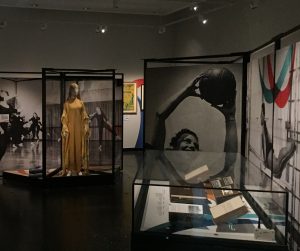
The ‘Body Language’ exhibition offers a unique insight into the work and life of Scottish female pioneers in movement, dance and physical education. We discover this through the archive collections of Dunfermline College of Physical Education (one of the first training colleges for female physical education teachers); Scottish Gymnastics (and its predecessors), and Margaret Morris (1891-1980). The exhibition features film, photographic images, textiles, printed works and manuscripts from across these three archive collections. The archive collections of Dunfermline College of Physical Education and Scottish Gymnastics are held at the Centre for Research Collections at the University of Edinburgh. The Margaret Morris collection is held by our project partner, Culture Perth and Kinross, at their Fergusson Gallery in Perth.
The University of Edinburgh’s Main Library Exhibition Gallery buzzed with the chatter of guests, as members of Dunfermline College of Physical Education Old Students’ Association mingled with archive cataloguing project volunteers, current students with professional and curatorial staff, and academics with dancers. Guests chuckled and nodded in agreement as Professor Ravenscroft compared a visit to the archives to that of a visit to Narnia. We agree that the archives are magical: a treasure chest, full to overflowing, with knowledge, ideas, learning and inspiration. The curation and staging of this exhibition is the culmination of months, if not years, of collaborative work involving archivists, curators, academics and project partners. But it is really only the beginning. The seed has now been planted, from which will grow a range public engagement activities with a variety of communities; academic research, and an enhanced student experience. It is a shining example of how archive collections can inform, inspire, encourage and facilitate inter-disciplinary working, research and creative engagement.
Disclaimer: whilst we agree with Professor Ravenscroft that like Narnia, archives are magical, we must make absolutely clear that they are not fictional, and you definitely cannot access them via the back of your wardrobe. We know, we checked. You can however, get yourself along to the University of Edinburgh’s Main Library Exhibition Gallery to experience for yourself the magic of the ‘Body Language’ exhibition. It’s free and you don’t even need a ticket!
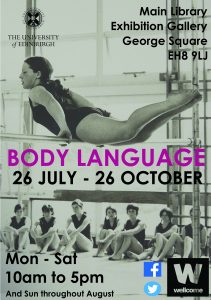
‘Body Language’ runs from 26 July – 26 October 2019 at the University of Edinburgh Main Library Exhibition Gallery, George Square, Edinburgh. The exhibition is open from Mon-Sat, 10am-5pm, with Sunday opening included in August. The exhibition forms part of the University of Edinburgh’s Exhibition programme as well as the Edinburgh Festival Fringe programme. You can view the student performance from the exhibition launch event here.
Elaine MacGillivray, project archivist.
New to the Library: The New Republic Archive
I’m pleased to let you know that through the Saunders endowment for North American history the Library has been able to purchase The New Republic Magazine Archive from EBSCOhost. This digital archive offers a searchable full-text backfile of all issues of The New Republic from 1914 onwards.

You can access The New Republic Magazine Archive via DiscoverEd. You will also soon be able to access it via the Databases A-Z list or the Newspapers, magazines and other news sources guide. Read More
New to the Library: Slavery: supporters and abolitionists, 1675-1865
I’m happy to let you know that the Library now has access to Slavery: supporters and abolitionists, 1675-1865 from British Online Archives. This database contains a wide range of documents concerning the African slave trade during the 17th, 18th and 19th centuries. The papers focus primarily on Jamaica and the West Indies but also cover the experience of other nations and regions.
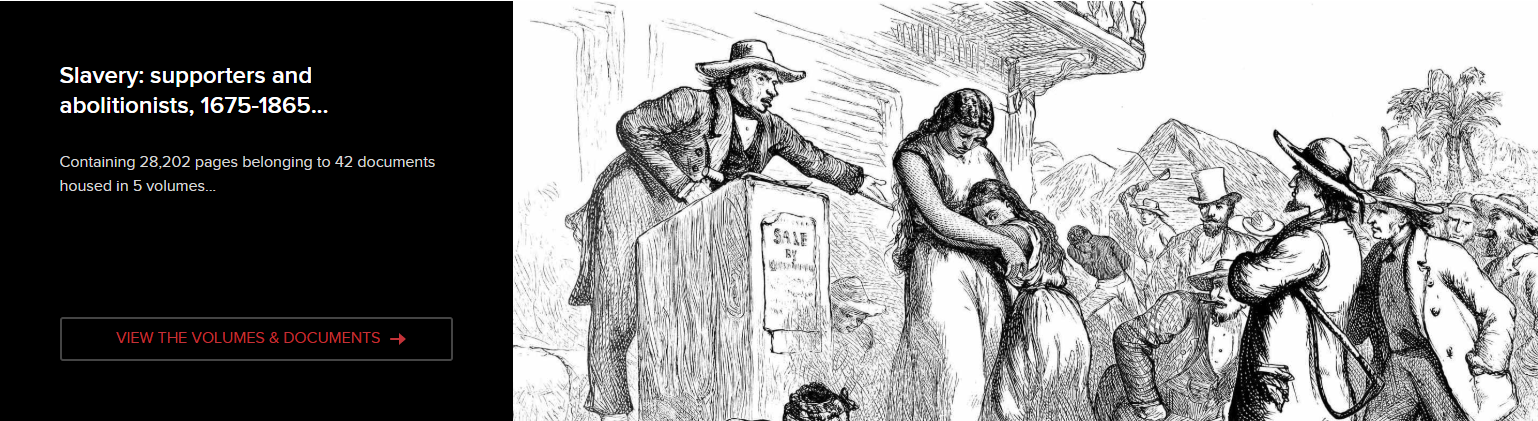
You can access Slavery: supporters and abolitionists, 1675-1865 via the Databases A-Z list and the Digital primary source and archive collections guide.You can also access it via DiscoverEd.
Through a combination of statistics, correspondence, pamphlets, and memoirs, Slavery: supporters and abolitionists offer insights into the commercial and colonial dimensions of slavery and the views of its advocates and opponents. Read More
New! Tanzania and Malawi in records from colonial missionaries, 1857-1965
I’m pleased to let you know that the Library now has access to Tanzania and Malawi in records from colonial missionaries, 1857-1965 from British Online Archives. This database gives you access to 54,550 digital pages from the Universities’ Mission to Central Africa (UMCA) archives including correspondence, journals, magazines, books, reports, etc.

You can access Tanzania and Malawi in records from colonial missionaries, 1857-1965 via the Databases A-Z list, the Digital primary source and archive collections guide or the African Studies databases list. You can also access it via DiscoverEd.
The UMCA was founded in the late 1850s, after the return of Dr David Livingstone from the region in 1857. This high church Anglican society drew its missionaries initially from the universities of Oxford, Cambridge, Durham and Dublin. Under its motto “A servant of servants”, from its main centres of Zanzibar and Nyasaland (now Malawi), the UMCA began from an early date opposing the slave trade and promoting the education of the indigenous people and the training and ordination of African priests. Read More
New to the Library: Picture Post Historical Archive
Did you know the Library now has access to the Picture Post Historical Archive? This database comprises the complete archive of the Picture Post from its first issue in 1938 to its last in 1957 – all digitised from originals in full colour.

You can access the Picture Post Historical Archive via the Databases A-Z list or the Newspapers, magazines and other news sources guide. Access via DiscoverEd will also soon be possible.
Picture Post was a photojournalistic magazine, often seen as the UK equivalent of Life, that was considered a groundbreaking example of photojournalism and was hugely successful from its first issue and throughout the 1940s. At its peak it is estimated its readership was 80% of the British population. In the era before television, it became the window on the world for ordinary people, bringing the major social and political issues of the day into popular consciousness. Read More
New to the Library: Stuart and Cumberland Papers
I’m really happy to let you know that the Library has recently been able to purchase the extensive Stuart and Cumberland Papers from the Royal Archives at Windsor Castle, digitised for the first time by Gale. This fascinating digital primary source database has been much requested by both students and staff in HCA, as well as ECA and LLC, and I hope it proves to be a useful and well-used resource for teaching, learning and research.

You can access the Stuart and Cumberland Papers via the Databases A-Z list or the Digital primary source and archive collections guide. Access via DiscoverEd will also soon be possible.
This primary source database contains two remarkable collections, The Stuart Papers and The Cumberland Papers, available online in their entirety. Read More
Edinburgh Research Explorer | ER-data: Jan. – June 2019

Edinburgh Research Explorer • www.research.ed.ac.uk • ERdata: Jan. – June 2019
The first six-months of 2019, as now seems inevitable, have proved to be the busiest six-months in Edinburgh Research Explorer’s brief history, with 543,152 downloads. This is not only the first time that the half-a-million milestone has been breached within such a short period, but represents a 35% increase on the previous best. As the chart below indicates, this rate of growth is unprecedented following a full 6-months:

This report aims to offer an overview of the last six-months of download activity on Edinburgh Research Explorer. The data generated through the IRUS-UK download statistics portal is somewhat limited, it won’t tell us much about the users, in terms of who is downloading what, but it will offer up a few broad clues. This report will investigate those clues under the following headings:
University of Edinburgh Data Safe Haven: a new facility for sensitive data
Information Services has implemented a remote-access “Safe Haven” environment to protect data confidentiality, satisfy concerns about data loss and reassure Data Controllers about the University’s secure management and processing of their data in compliance with Data Protection Legislation.
The Data Safe Haven (DSH) provides a secure storage space and a secure analytic environment that is appropriate for all research projects working with different kinds of sensitive data. It has its own firewall and is isolated from the University network. It is located in a secure facility with controlled access. All traffic between the DSH and the user’s computer is encrypted and no internet access is available. Access to the DSH is only for authorized users via an assigned ‘Yubikey’ and secure VMware Horizon Client, and will only be available from the managed desktops that are white listed for access to the DSH.
Provision of a range of analytic and supporting applications (e.g., SPSS, STATA, SAS, MATLAB, and R) is available. These are delivered dynamically and are assigned to the project. The applications that are available to the users will depend on the type of arrangement that has been made with the DSH technical team prior to the project registration and on the licensing arrangements with the software provider.
The DSH initial security review (penetration test) was carried out by a CREST accredited organisation in August 2018. The DSH exhibited an overall good security stance and demonstrated resilience against the various types of tests performed by the consultants. This was the initial review that formed part of our ongoing drive towards ISO 27001 certification. We expect to complete this phase of the project and obtain the certificate by November 2019.
We have successfully closed the pilot phase of the DSH with five projects in October 2018, and softly launched the service at our “Dealing with Data” conference in November 2018. At present, the DSH Technical team has been migrating Centre for Clinical Brain Sciences – National CJD Research and Surveillance project data from the walled garden into the DSH.
The DSH operates on a cost recovery basis and this cost should be included in grant applications. We welcome enquiries from researchers as early as possible in their project planning. Costing is based on bespoke project requirements (see DSH Overview for users at https://www.ed.ac.uk/is/data-safe-haven.
The DSH Operations team also provides:
- advice and input for funding and permissions applications;
- guidance on meeting Approved Researcher requirements;
- advice about meeting data sharing requirements and archiving of data.
We can set up a demo environment for researchers on request to explore the use of the DSH for their projects. If you need further information, please contact the RDS Team via data-support@ed.ac.uk.
Cuna Ekmekcioglu, Data Safe Haven Manager, Research Data Service
Edinburgh Research Archive Statistics: June 2019

Collections
 Hill and Adamson Collection: an insight into Edinburgh’s past
My name is Phoebe Kirkland, I am an MSc East Asian Studies student, and for...
Cataloguing the private papers of Archibald Hunter Campbell: A Journey Through Correspondence
My name is Pauline Vincent, I am a student in my last year of a...
Hill and Adamson Collection: an insight into Edinburgh’s past
My name is Phoebe Kirkland, I am an MSc East Asian Studies student, and for...
Cataloguing the private papers of Archibald Hunter Campbell: A Journey Through Correspondence
My name is Pauline Vincent, I am a student in my last year of a...
Projects
Cataloguing the private papers of Archibald Hunter Campbell: A Journey Through Correspondence
My name is Pauline Vincent, I am a student in my last year of a...
Archival Provenance Research Project: Lishan’s Experience
Presentation My name is Lishan Zou, I am a fourth year History and Politics student....