Home University of Edinburgh Library Essentials
May 21, 2026

Losing the Heid… or not
The Parthenon Frieze at Edinburgh College of Art
Running around the walls of the Sculpture Court of Edinburgh College Art is a cast of the Parthenon Frieze, which was first acquired by the college’s predecessor institution, the Trustees Academy in the 1830s. The sculpture court at ECA was built specifically to house and display this cast.
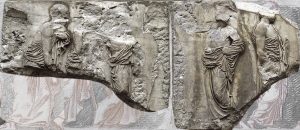
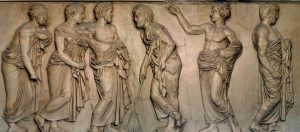
Earlier this year I began looking at the frieze with a view to creating possible projects around it but, as I compared it with images of both the original marbles (now housed in the Acropolis Museum in Athens, the British Museum and the Louvre) and other cast collections, differences began to emerge. Two sections immediately caught my eye – the casts of Sections VI and VII of the East Frieze.
This is a cast of Section VI, as displayed in the Acropolis Museum, taken from the original version displayed in the British Museum.
Compare that with the one at ECA – shown below
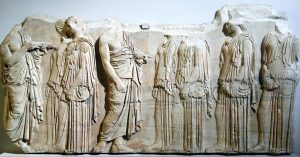
The differences in Section VII are also striking.
The original marble, on display in the Louvre, looks like this…
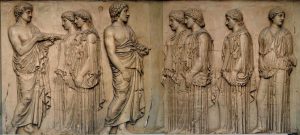
ECA’s cast, on the other hand looks like this!
So why the differences?
From the ECA records, it appears that Section VI was cast while the original was still on the Acropolis, made in 1787 by order of the French ambassador to the Sublime Porte in Constantinople, Count Choiseul-Gouffier. This version is also displayed at the Skulpturhalle in Basel, which has a complete set of casts from the Parthenon.
The original slab, taken from the Acropolis by Lord Elgin, is in the British Museum and on its website it displays the following text:
“These figures were sadly mutilated shortly before Lord Elgin’s men arrived on the Acropolis in 1801. They can be reconstructed with the help of casts from moulds taken by the French diplomat Le Comte de Choiseul–Gouffier.”
This would appear to verify that the cast of Section VI is original. The real mystery was Section VII, not least as yet more versions exist. One, copies of which are in Glasgow School of Art, the Met in New York and Cornell University collections (fig 1), shows the woman second from the right with more hair than the original, while another, from the Caproni Cast Collection in Boston (fig 2), shows a different head on the figure on the left to the one on the ECA version.
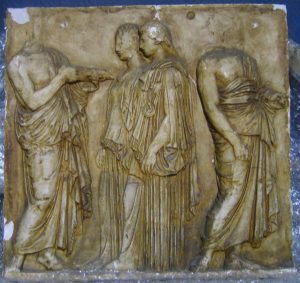
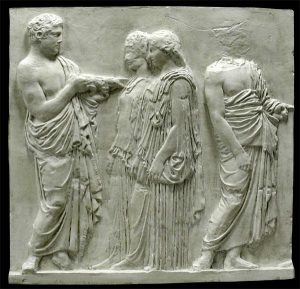
Fig 1 – Cornell Cast Fig 2 – Caproni Cast
The ECA records suggest that the cast had been restored. Both Sections VI and VII of the ECA originate in the Louvre, though we have no acquisition date. The original slab appears to have been found beneath Parthenon by L. S Fauvel in 1784, a few years later than Section VII, so the question was whether this cast is as it was originally discovered or a later, restored version. The only known drawing of these pieces showing them in place on the Parthenon was made by Jacques Carrey in 1674 (Fig 3). The drawings made by the architects Revett and Stuart in 1751 for their Antiquities of Athens books, appear to show that this section was already missing from the Parthenon, as there is a sizeable gap in their sketch of the East Frieze. Their drawings were made after the explosion in 1687, which destroyed much of the building. The accuracy of Carey’s drawings have been questioned but from them it is easy to see differences in the hairstyles of the figures in Section VII.
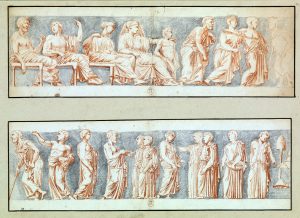
Fig 3 Drawing by Jacques Cary
The original slab, along with a number of casts, was transported from the Acropolis to Piraeus and then shipped to Marseilles in 1797, from where it was then moved to Paris. On arrival in Paris, however Fauvel was apparently angered to discover that the slab was missing its heads and insisted that they be found, implying that they had been lost in transit. However, in his personal papers, where he describes the find in January 2nd, 1789, Fauvel stated that the bas-relief only had two heads.
The slab was first displayed in what is now the Louvre in 1800 and the earliest drawing made in the museum was published in 1811 in A. L. Millin’s, Monuments antiques inédits ou nouvellement expliqués. No heads were shown. The earliest illustration with heads, didn’t appear until 1827 in Charles Clarac’s catalogue for the museum, Musée de Sculpture Antique at Moderne. A later edition of this catalogue, printed in 1841, contains the text, “all the heads of this bas-relief are due to a modern restoration.” This illustration is very similar to the cast held by ECA.
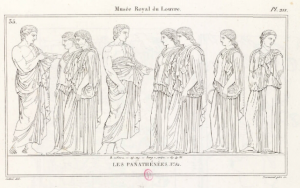
Fig 4. – Musée de sculpture antique et moderne Tome 2, première partie 1841 – Clarac
Half a century later, the 1896 catalogue for the Louvre contained a photograph of the slab with the heads once again absent (Fig 5).
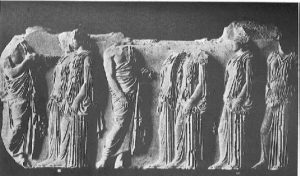
Fig 5 – Musée du Louvre – Catalogue Sommaire – 1896
It appears that some restoration work was carried out around 1820, probably by Bernard Lange, who was then in charge of the Louvre’s restoration workshop, but there no evidence to confirm this. In researching this piece it transpired that the missing heads have long been puzzled over by archaeologists and art historians and indeed were the subject of a presentation made at a conference on the Parthenon frieze held in Basel in 1988. The presenters, Jean Marcadé and Christiane Pinatel, both from Paris, concluded that at some stage plaster heads had been added to the marble slab and that casts had been made, so it seems likely that this is the source of the cast at the College of Art. Completing broken sculptures was fashionable in the early part of the 19th century but by the second half this trend was no longer acceptable so the additions would then have been removed. However, they also stated that “the modern parts that were removed at the end of the last century have not been found,” so does this make the ECA version unique? Certainly, having looked at numerous publications and online resources, there are no other images showing a cast with heads and when I contacted Tomas Lochman, the curator at the Basel Skulpturahalle, with an image of the ECA cast, he described it as “really astonishing.”
There is a slim possibility that this cast was made while the slab was still intact on the Acropolis but all the evidence would suggest not. Nevertheless, while it may not be original, the ECA cast may the only one of its kind and therefore, as evidence of 19th century restoration techniques, still has some value. Moreover, if we scan the section we may be able to verify this once and for all, as each cast has lines running through them, showing how the original mould was created If these run continuously though the figures then it is indeed an original. Time will tell!
Norman Rodger
Projects Development Manager
Library & University Collections
10 October 2019
On trial: Bloomsbury Medieval Studies
I’m happy to let you know that we currently have trial access to Bloomsbury Medieval Studies, a new interdisciplinary digital resource with a global perspective which opens up the medieval world for students and staff.

You can access Bloomsbury Medieval Studies from the E-resources trials page.
Access is available on and off-campus.
*Trial has been extended and access will now end on 24th November 2019*
Bloomsbury Medieval Studies brings together high-quality secondary content with visual primary sources, a brand new reference work and material culture images into one cross-searchable platform. Read More
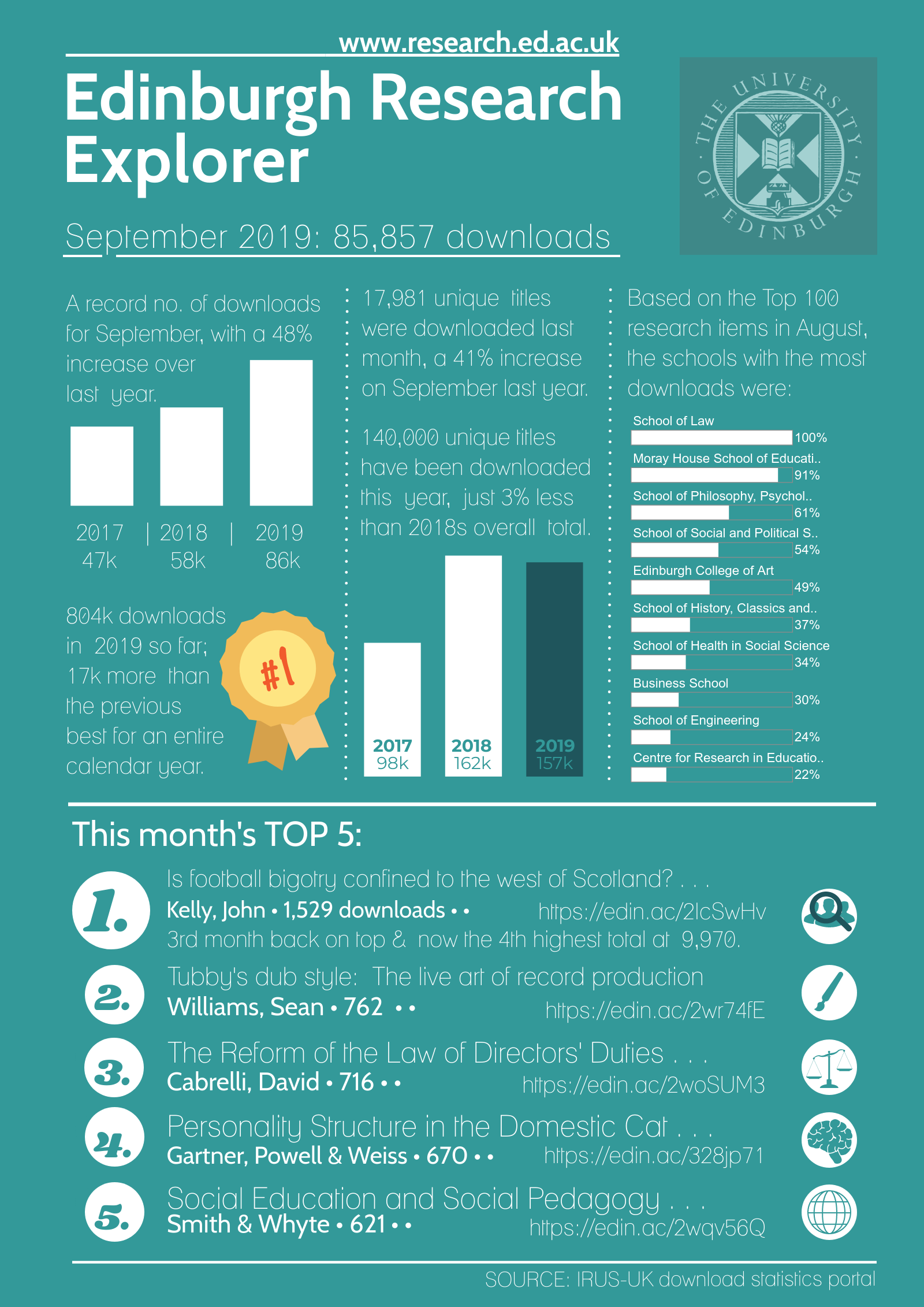
Edinburgh Research Explorer Statistics: September 2019
Research Data Training – Semester 1
*UPDATE* – We have just added two new and exciting courses to our training schedule:
- Assessing Disclosure Risk in Quantitative Data (RDS006)
- Assessing Data Quality in Quantitative Data (RDS007)
To find out more about these courses just visit our training page.
Each semester the Research Data Support team puts together a training programme for researchers and research support staff in all schools, and at all points in their career. Our programme this year introduces a number of new courses, including one designed especially for Undergraduates planning their final year dissertation. We have also reviewed and refreshed all of our existing courses to ensure that they are not only up-to-date but also more engaging and interactive.
Full Course list:
- Realising the Benefits of Good Research Data Management (RDS001)
- Writing a Data Management Plan for your Research (RDS002)
- Working with Personal and Sensitive Data (RDS003)
- Data Cleaning with OpenRefine (RDS004)
- Handling Data Using SPSS (RDS005)
- Assessing Disclosure Risk in Quantitative Data (RDS006)
- Assessing Data Quality in Quantitative Data (RDS007)
- Data Mindfulness: Making the Most of your Dissertation (RDS009)
- Introduction to Visualising Data in ArcGIS (RDS011)
- Introduction to Visualising Data in QGIS (RDS012)
Full details of all these courses, with direct booking links, can be found on our training webpage https://www.ed.ac.uk/information-services/research-support/research-data-service/training
Courses can also be found and booked via the MyEd Events page.
We are always happy to deliver tailored versions of these courses suitable for a specific school, institute or discipline. Just contact us at data-support@ed.ac.uk to let us know what you need!
—
Kerry Miller
Research Data Support Officer
Library and University Collections
XRF Internship at St Cecilia’s Hall
In this week’s blog, we hear from Despoina Papazoglou who was an intern at St Celilia’s Hall from April to June 2019. Her internship focused on the material analysis of a painted 17th-century harpsichord using XRF….
Hello! My name is Despoina and I decided to write this article to share my experience of an eight-week journey as an intern at St Cecilia’s Hall. This is the first time I have written something for a blog, so before I started I googled “how to write my first blog?”, and seriously, I couldn’t understand a thing…just for a moment, I believed that quantum physics was easier to understand!
Let’s start with when I found the vacancy for the internship. The title “Scientific Material Analysis of Musical Instruments Internship” sparked curiosity within me as my professional background is in the field of material science. After reading and re-reading the job description I knew I wanted to be part of the project, as I realised it would not only expand my knowledge but also expose me to new challenges that would help me achieve my future career goals. I was so excited about the job and wanted to be part of it so badly that I did extensive research and learnt all about the museum and the collections displayed within it. Long story short, I sent in my CV, attended the interview and was offered the internship. I was probably the happiest person on earth! One of my biggest desires came true, and I could finally work in a museum with people who share the same passion as me – the conservation and preservation of cultural heritage.
Announcing our new “Quick Guides” series
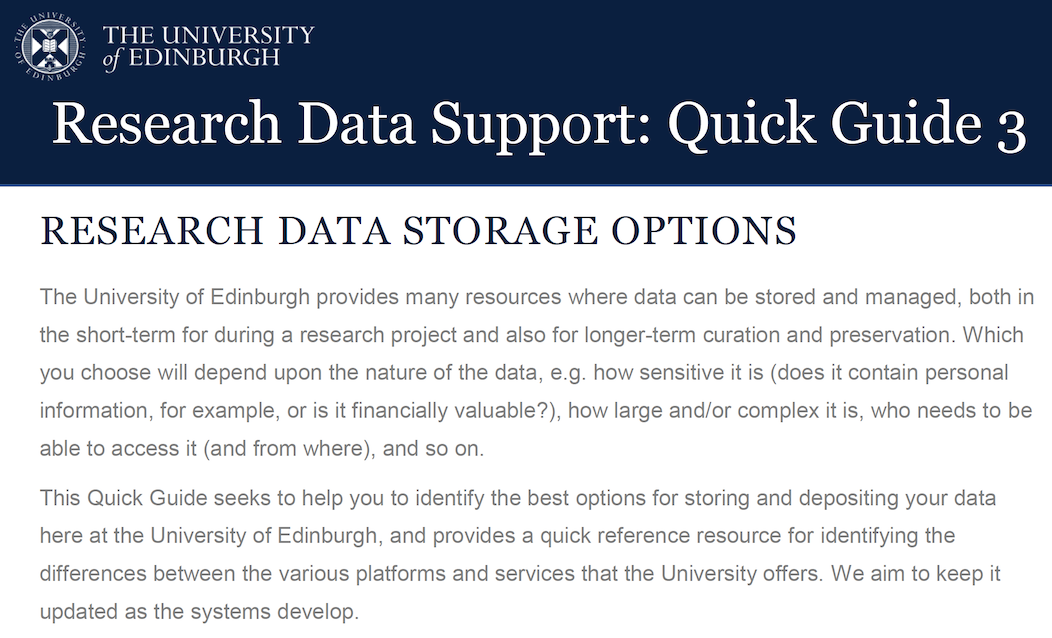
Earlier this week we bid farewell to our intern for the past four weeks, Dr Tamar Israeli from the Western Galilee College Library. Tamar spent her time with us carrying out a small-scale study on the collaborative tools that are available to researchers, which ones they use in their work, and what support they feel they need from the University. One of Tamar’s interviewees expressed a view that “[the University’s tools and services] all start with ‘Data-something’, and I need to close my eyes and think which is for what,” a remark which resonated with my own experience upon first starting this job.
When I joined the University’s Library and University Collections as Research Data Support Manager in Summer 2018, I was initially baffled by the seemingly vast range of different data storage and sharing options available to our researchers. By that point I had already worked at Edinburgh for more than a decade, and in my previous role I had little need or obligation to use institutionally-supported services. Consequently, since I rarely if ever dealt with personal or sensitive information, I tended to rely on freely-available commercial solutions: Dropbox, Google Docs, Evernote – that sort of thing. Finding myself now in a position where I and my colleagues were required to advise researchers on the most appropriate systems for safely storing and sharing their (often sensitive) research data, I set about producing a rough aide memoire for myself, briefly detailing the various options available and highlighting the key differences between them. The goal was to provide a quick means or identifying – or ruling out – particular systems for a given purpose. Researchers might ask questions like: is this system intended for live or archived data? Does it support collaboration (increasingly expected within an ever more interconnected and international research ecosystem)? Is it suitable for storing sensitive data in a way that assures research participants or commercial partners that prying eyes won’t be able to access their personal information without authorisation? (A word to the wise: cloud-based services like Dropbox may not be!)
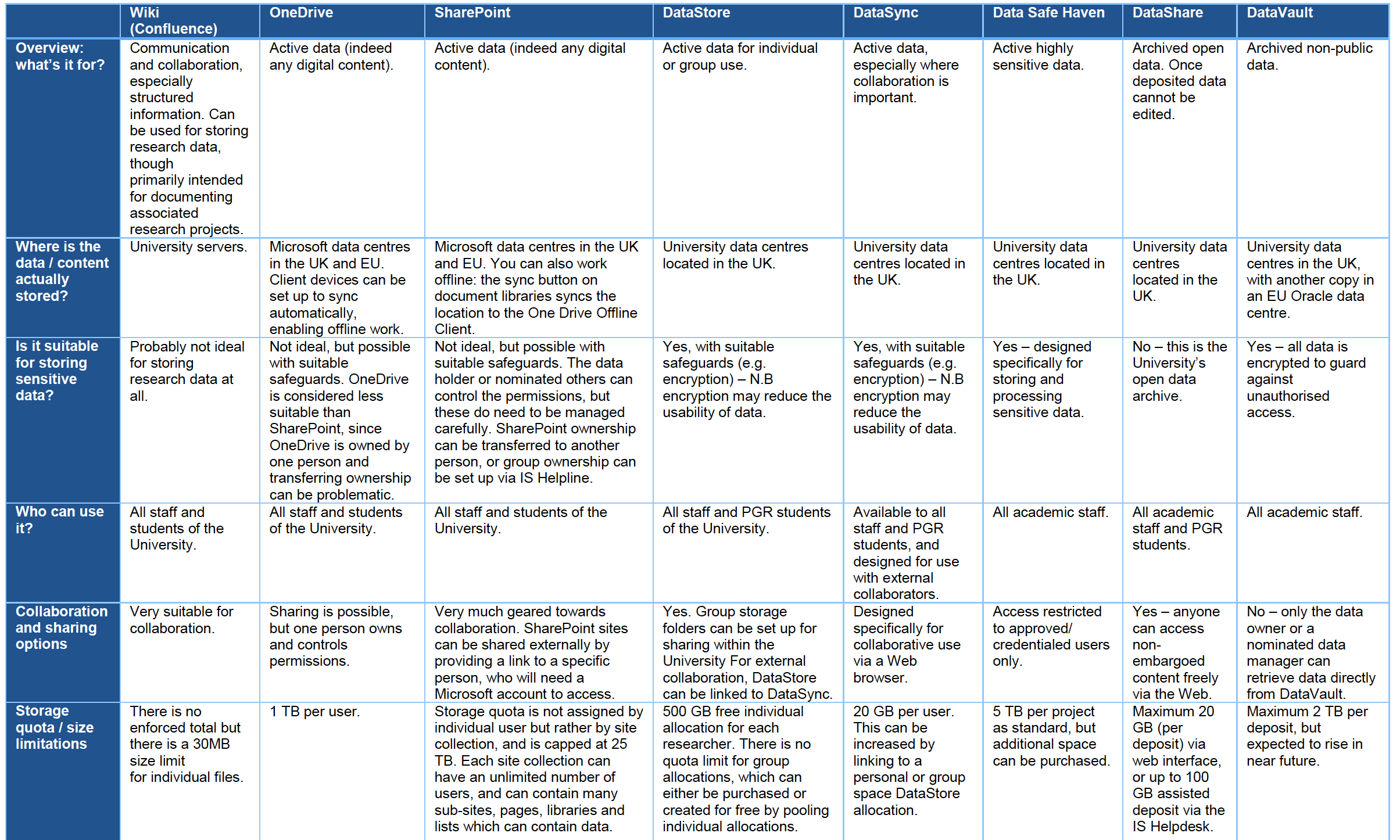
[click the image for higher resolution version]
Upon showing early versions to colleagues, I was pleasantly surprised that they often expressed an interest in getting a copy of the document, and thought that it might have a wider potential audience within the University. In the months since then, this document has gone through several iterations, and I’m grateful to colleagues with specific expertise in the systems that we in the Research Data Service don’t directly support (such as the Wiki and the Microsoft Office suite of applications) for helping me understand some of the finer details. The intention is for this to be a living document, and if there are any inaccuracies in this (or indeed subsequent) versions, or wording that could be made clearer, just let us know and we’ll update it. It’s probably not perfect (yet!), but my hope is that it will provide enough information for researchers, and those who support them, to narrow down potential options and explore these in greater depth than the single-page table format allows.
With Tamar’s internship finishing up this week, it feels like a timely moment to release the first of our series of “Quick Guides” into the world. Others will follow shortly, on topics including Research Data Protection, FAIR Data and Open Research, and we will create a dedicated Guidance page on the Research Data Service website to provide a more permanent home for these and other useful documents. We will continue to listen to our researchers’ needs and strive to keep our provision aligned with them, so that we are always lowering the barriers to uptake and serving our primary purpose: to enable Edinburgh’s research community to do the best possible job, to the highest possible standards, with the least amount of hassle.
And if there are other Guides that you think might be useful, let us know!
- Download the Quick Guide on Research Data Storage Options
- UPDATE: the new Guidance page is now live
—
Martin Donnelly
Research Data Support Manager
Library and University Collections
Database trial – CNKI English resources
The Library has arranged a free trial of three English resources from CNKI (China National Knowledge Infrastructure): China Data Insight, Academic Focus, and Journal Translation Project, covering all subject areas in humanities, social sciences, science and technology, and medicine.
The trial has been advertised on the Library E-resources Trials website. The trial is valid until 30th Nov. 2019. EASE login is required for access:
Just click on each database in Step 1 as indicated in the screenshot below to gain direct access:

China Data Insights provides access to more than 1,083 statistical yearbooks with 8,446 volumes and 1.49 million tables. There is a linked Chinese version with more data.
Academic Focus contains 262 English journals published in China, English content translated from top Chinese academic journals and over 2400 conference proceedings.
Journal Translation Project features the bilingual full-text content of 140 top academic journals in China with the English and Chinese versions displayed side-by-side.
CNKI is provider of our two important Chinese resources at the moment: China Academic Journals and China Doctoral and Masters Dissertations Full-text Database, both of which are in the Library’s Databases A-Z list and Databases by Subject for East Asian Studies.
Diamonds and Rust: Re-housing the Student Records
One of the largest components of the Department of Social Work’s archive is a collection of over 1000 student admission files from 1928, when the school was transferred to the university, to the mid-1950s.
This is a wonderful set of records. As well as telling us about the backgrounds, interests and careers of the students they are also a rich resource for social history. The files cover a period of social reform and change – World War 2, the introduction of the welfare state, immigration and changing population. They make it possible to build up a picture of the personalities involved in the profession at any given time and, through the inclusion of descriptions of jobs for which the students are applying, we can see the advancement of social work as a field during this period. Our previous blogpost “A New Profession” looks at the contents of these files in more detail.
This short post looks at the process of re-housing this material.

Archival boxes and folders
Paperclips and Pins
The first task was to remove all rusty paperclips, staples and pins. Not only do they pose an injury risk to those looking at the material, they also make it difficult to view the material without folding or tearing the pages and over time the rust will further stain the paper. Where necessary metal paperclips are replaced with archive friendly plastic ones.

Tool for removing staples


Folders and Boxes
In their original state, the admission files were housed in overcrowded file boxes. The boxes were dirty and too small resulting in the contents of the files being subjected to wear and tear over the many years of being removed and returned. Moreover the files were stored vertically meaning much of paper was becoming distorted.
Once all staples and pins had been removed each file was re-housed in an archival standard folder. The files consist of many different sizes of paper and so they have been re-housed in four-flap folders which will keep all the contents secure but also easily accessible.

Several files were housed in one overcrowded folder……

…..and multiple folders squashed into overcrowded boxes

Archival 4 flap folder

New folders in archival box
Where photographs were present they were placed in protective see-through pockets.

Photograph in protective sleeve (plastic paperclip for scale)
Similarly any pages that have been “repaired” with sellotape were placed in archival polyester sleeves so as to prevent the sellotape leaking onto other pages as it degrades. In the future these pieces of sellotape will hopefully be completely removed.

Research Assistant Sarah helping with the re-housing – thanks Sarah!
Rust removed, double click on the images here view just some of the diamonds uncovered during the process.
October Journal Club : “Unhiding” Special Collections

Geneva Bible, 1583 (University of Edinburgh, New College Library)
Our second meeting of the Journal Club in 2019/20 met on Wednesday 2 October to talk about improving access to Special Collections. Our discussion article was:
Marcella Tam (2017) Improving Access and “Unhiding” the Special Collections, The Serials Librarian, 73:2, 179-185, DOI: 10.1080/0361526X.2017.1329178
We began our discussion by talking about the image and perception of special collections, identified by the author as having a traditional image of being niche and aloof. We talked about the user experience of ‘library anxiety’ and how this might be heightened in the Special Collections context “if you don’t feel that you’re an insider and know the rules”. A user may question if their research interest is legitimate enough to be using Special Collections, and be very apologetic if, for example, they take a pen into the Special Collections reading room without thinking. But we also agreed about the value of Special Collections, both as a research experience and as ‘theatre’ – using Special Collections can be inspiring and memorable on a personal level as well as an academic one. A student experience of Special Collections can be the starting point of a lifetime’s academic journey into research. So how do we make Special Collections less scary? Read More
Planning for Humanity: Patrick Geddes in India, 1914-1924
This October we celebrate the 165th anniversary of Patrick Geddes’ birth (2 October 1854). We bring you news of a series of upcoming events which commemorate Patrick Geddes and his long-standing relationship with India.
We are popping up! We are offering a unique opportunity to view material from the Patrick Geddes Archives held by both the Universities of Edinburgh and Strathclyde. Two small complementary displays are available to view at the University of Edinburgh Main Library and the University of Strathlcyde Andersonian Library (levels 3 and 5). Planning for Humanity: Patrick Geddes in India, 1914-1924, celebrates Geddes’ unique contribution to urban planning in India.
Both displays will run throughout October 2019 and are available to view by staff, students and members of the public, between 9am-5pm, Monday to Friday. If you are a member of the public, simply let staff at the front desk of the library you are visiting know that you are interested in viewing the display and you will be issued with a temporary visitors pass. Please note that at the University of Edinburgh Library you will be required to provide photographic ID in order to gain access to the library and view the display.
 Congratulations to colleagues at Edinburgh Global who have compiled a fantastically full and varied programme as part of the University of Edinburgh’s South Asia Week 2019. Do not miss the Ahmedabad Walls exhibition! This is a unique opportunity see the history of Ahmedabad through the eyes of Mumbai based architect and aerial photographer Robert Stephens. Stephens’ aerial photography references Patrick Geddes’ 1915 observations of the historic walled city, and features excerpts from archive material from the Patrick Geddes archives and from Stephens’ own collections.
Robert Stephens first visited Scotland to research the Patrick Geddes archives in June 2018. During his visit, a chance conversation with our project archivist, Elaine MacGillivray, led to the two collaborating on two events in March 2019, in India. Thanks to funding from generous University of Edinburgh alumni, Elaine travelled in the footsteps of Geddes, highlighting the Patrick Geddes archives and sharing project news with passionate and enthused audiences in both Ahmedebad and Mumbai. You can view Elaine’s CEPT University talk on YouTube.
a selection of images from elaine and robert’s collaborative patrick geddes events with CEPT UNIVERSITY, Ahmedbad and artisan’s gallery, mumbai, which took place in March 2019. Images Courtesy of ROBERT STEPHENS AND Tina Nandi.
The University of Edinburgh’s South Asia Regional Director Amrita Sadarangani aided the success of Elaine’s visit to India enormously. One afternoon, in the beautiful Ministry of New offices in Mumbai, Amrita and Elaine sat together discussing potential “Geddes inspired” collaborations. Amrita suggested that we connect Stephens with our very own School of Architecture colleague, Dr Dorian Wiszniewski. Subsequently, and after a lot of hard work behind the scenes, we are thrilled that this October will see the opening of Ahmedebad Walls at the Matthew Architecture Gallery in Edinburgh. Thanks go to everyone who has helped to make it happen.

“Ahmedabad Walls” Exhibition Poster
Robert Stephens and Professor Bashabi Fraser (Edinburgh Napier University) will be in conversation with Dr Dorian Wiscniewski on the evening of 2 October 2019. Set to be a fascinating discussion, which covers Geddes,Tagore and Gandhi, this event immediately precedes the official launch of Stephens’ Ahmedebad Walls exhibition. This special opening event will start at 6pm at the Adam House Lecture Theatre, followed at 7pm by a visit to the Ahmedabad Walls exhibition at the Matthew Architecture Gallery. Ahmedabad Walls runs 2 – 25 October 2019 at the Matthew Architecture Gallery, Minto House, Chambers Street, Edinburgh.
There will be a futher opportunity to engage with Robert Stephens and Dorian Wiszniewski on Friday 4 October, when they host their ‘In Conversation’ event at the Ahmedabad Walls exhibition. You can find out about this event and all the other South Asia week events on the Edinburgh Global website.
 Last but by no means least – as part of the Patrick Geddes Centre’s autumn programme, Elaine and Robert reunite on 2 October 2019. Together with Dorian Wiszniewski, and the Patrick Geddes Centre’s education officer, Russell Clegg, they will lead a public study day which includes presentations on Geddes and India, followed by archive and exhibition visits. For more information and to book a place visit the Patrick Geddes Centre website or Eventbrite. It’s going to be a busy month – we hope you can join us in the celebrations!
If you would like to know a little more about Patrick Geddes in India, visit our February 2019 blog post To the City, In the City, For the City
Collections
 Hill and Adamson Collection: an insight into Edinburgh’s past
My name is Phoebe Kirkland, I am an MSc East Asian Studies student, and for...
Cataloguing the private papers of Archibald Hunter Campbell: A Journey Through Correspondence
My name is Pauline Vincent, I am a student in my last year of a...
Hill and Adamson Collection: an insight into Edinburgh’s past
My name is Phoebe Kirkland, I am an MSc East Asian Studies student, and for...
Cataloguing the private papers of Archibald Hunter Campbell: A Journey Through Correspondence
My name is Pauline Vincent, I am a student in my last year of a...

Projects
Cataloguing the private papers of Archibald Hunter Campbell: A Journey Through Correspondence
My name is Pauline Vincent, I am a student in my last year of a...
Archival Provenance Research Project: Lishan’s Experience
Presentation My name is Lishan Zou, I am a fourth year History and Politics student....