Home University of Edinburgh Library Essentials
March 19, 2026
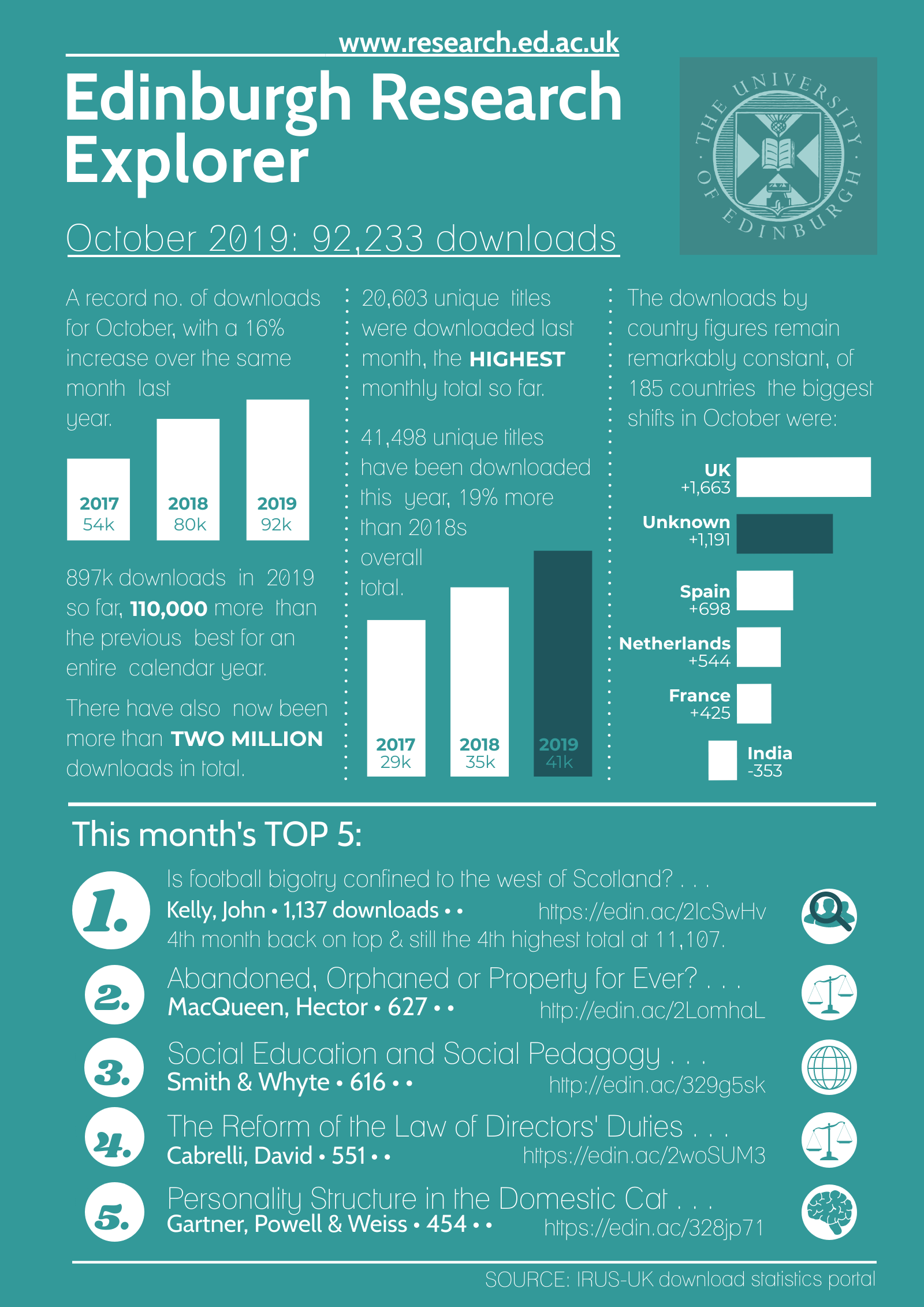
Edinburgh Research Explorer Statistics: October 2019
On trial: Translations of the Peking Gazette Online
Thanks to a request from HCA staff the Library currently has trial access to Translations of the Peking Gazette Online from Brill. This is a comprehensive database of approximately 8,500 pages of English-language renderings of official edicts and memorials from the Qing dynasty that cover China’s long nineteenth century from the Macartney Mission in 1793 to the abdication of the last emperor in 1912.
 You can access Translations of the Peking Gazette Online from the E-resources trials page.
Access is available on and off-campus.
Trial access ends 4th December 2019.
*Trial has been extended and access will now end on 14th December 2019*
The Peking Gazette was a unique publication that allows contemporary readers to explore the contours, boundaries, and geographies of modern Chinese history. Contained within its pages are the voices of Manchu emperors, Han officials, gentry leaders, and peasant spokesmen as they discussed and debated the most important political, social, and cultural movements, trends, and events of their day. As such, the Gazette helps us understand the policies and attitudes of the emperors, the ideas and perspectives of the officials, and the mentality and worldviews of several hundred million Han, Mongol, Manchu, Muslim, and Tibetan subjects of the Great Qing Empire. Read More
Trial access: The Guardian (ProQuest Recent Newspapers)
I’m pleased to let you know that the Library currently has trial access to ProQuest Recent Newspapers: The Guardian, a new resource that gives us full-text and full digitised images of The Guardian newspaper from 2010 – recent (3-month embargo).

You can access ProQuest Recent Newspapers: The Guardian from the E-resources trials page. Access is available on and off-campus.
Trial access ends 1st December 2019. Read More
Dissertation Fair 14th Nov
Dissertation Week starts next week (11-15th Nov). Today we focus on the Dissertation Fair on Thursday 14th Nov. The Fair highlights the range of resources and support available across the University, including the Institute for Academic Development, IS Digital Skills and more. Come along to find out more.
Attending:
Centre for Research Collections(*);
Library Academic Support; Institute for Academic Development; IS Digital Skills; Research Data Service
Adam Matthew(*); Gale(*); Proquest(*); SAGE Research Methods(*)
National Library of Scotland; National Museum Scotland Libraries
(*) Attending and presenting.
There are a number of presentations throughout the day.
Exploring ProQuest Primary and Secondary Resources to Improve your Dissertation – Ali Nazari-Nouri, Proquest
Join Ali Nazari-Nouri, Training and Consulting Partner at ProQuest, to learn about the wide variety of primary and secondary sources that are available at the University of Edinburgh and how you could utilise these resources to explore and collate the necessary information for your dissertation.
Time: 10:10 – 11:00
Register here
Using Primary Sources to Improve Your Dissertation – Dr Laura Blomvall, Adam Matthew
Critical engagement with primary sources is an essential component of a successful dissertation in arts and humanities. As a student at Edinburgh you have access to films, diaries, theatre records, historical newspapers and government files from archives around the world through Adam Matthew Digital primary source collections, covering periods from the Middle Ages to the 21st century.
Dr Laura Blomvall, Product Specialist in the Outreach team of Adam Matthew, will talk you through Edinburgh’s collections, from Shakespeare’s Globe Archive to Service Newspapers of World War Two, from Foreign Office Files for China to Literary Print Culture, from Mass Observation Online to Eighteenth-Century Journals. She will give you tips on how to navigate archival material online and how to use primary sources to enrich, enliven and expand your dissertation.
Time: 11:00 – 11:50
Register here
Dissertation Fair
Time: 13:30 – 16:30
Register here
We Have Great Stuff – Rachel Hosker, Deputy Head of Special Collections and Archives Manager at the University of Edinburgh
The University holds a vast range of rare/unique material including manuscripts and archives, rare books, photographs, printed and handwritten music, theses and microforms. Hear more about the University’s Collections and the interesting ways they have been used.
Time: 13:10 – 14:00
Register here
Fake News vs Real News: Discovering News Sources (Digital Skills)
In this half hour session you will learn:
How to spot fake news and check your facts.
How to find trusted news sources provided by the University of Edinburgh.
Time: 13:15 – 13:45
Register here
Sage Research Methods: What every researcher needs – Jordan Brooks, SAGE
SAGE Research Methods supports research at all levels by providing material to guide users through every step of the research process. Resources range from books and reference, to case studies, academic video, and exclusive research tools. Join Jordan Brooks from SAGE Publishing to find out more about how you can make the most of this resource for your own research activities!
Time: 14:10 – 15:00
Register here
Gale Primary Sources for your Dissertation: Archives and Platform – Martin McCall and Carolyn Beckford from Gale
The University of Edinburgh has access to a fantastic collection of primary source archives from Gale, covering centuries of content. Including, historical newspapers from the British Library, as well as The Times, The Economist and The Daily Mail, literature drama and plays from the 18th and 19th centuries and thematic collections such as the Archives of Sexuality and Gender.
As part of Dissertation Week at the Library, Martin McCall and Carolyn Beckford from Gale, will introduce a number of these archives as well the Gale Primary Sources platform, where these archives are cross-searchable. The Gale Primary Sources platform greatly enhances the research experience for students and researchers by broadening their discovery of primary source documents through the use of multiple search options and powerful research tools, such as:
Topic Finder – which allows users to explore the frequency of one or more search terms in the content over time, which can suggest the changing importance of particular concepts over time
Term Frequency – where users can discover related terms that commonly occur in relation to their own search term, which helps uncover hidden connections, or can be a helpful starting point in the early stages of research.
Time: 15:10 – 16:00
Register here
More information at https://edinburgh-uk.libguides.com/dissertation
Halloween Highland Superstitions

Image: Title page of a manuscript copy of The secret commonwealth by Robert Kirk, 1692. Held in The Laing Collection (La.III.551).
The day of Halloween is upon us and here at the UCF we’re marking the occasion the only way we know how…with some seriously spooky books! A quick click through the catalogue reveals some absolutely terrifying reading material. Titles such as Bats in roofs: a guide for surveyors (699.878), A bibliographical ghost revisits his old haunts (.01 Fra.), and Safe handling of corpses containing radioactive substances (WN650 Nat 1966) are lurking on our shelves. It’s enough to make even the most stoic librarian shudder!
Continuing to search for the magical and mystical amongst our collections, I came across a title by Robert Kirk; The secret commonwealth of elves, fauns & fairies: a study in folk-lore & psychical research (tOD 91 KIR). Kirk was a Gaelic scholar, folklorist, and alumnus of The University of Edinburgh. He collated this collection of folklore between 1691 and 1692 but died without seeing it published, which wasn’t until over a century later in 1815, by Sir Walter Scott. Several copies are held amongst the universities collections, whilst an 1893 edition, digitised by the HathiTrust, can be found here. Besides being a very significant work in its own right, it has recently served as the inspiration for the title of the second volume in Philip Pullman’s Book of Dust trilogy.
We only hold one item however, with the word Halloween actually in its title. This is Alexander Macgregor’s Highland superstitions; connected with the Druids, fairies, witchcraft, second-sight, Hallowe’en, sacred wells and lochs, with several curious instances of Highland customs and beliefs (SSSA.S.841). Published in Stirling in 1901 it lives amongst the School of Scottish Studies collection. A slim, unassuming volume, bound in forest-green, it details the events of All Hallows Eve as follows:
“Hallowe’en in Gaelic means “Samhuinn,” that is “Samhtheine,” the fire of peace. It is a Druidical festival, at which the fire of peace is regularly kindled. There is no night in the year which the popular imagination has stamped with a more peculiar character than Hallowe’en. It was the night, above all others, when supernatural influences prevailed. It was the night for the universal walking abroad of all sorts of spirits, fairies, and ghosts, all of whom had liberty on that night. It was customary in many parts of Scotland to have hundreds of torches prepared in each district for weeks before Hallowe’en, so that, after sunset on that evening, every youth able to carry a blazing torch, or “samhnag,” ran forth to surround the boundaries of their farms with these burning lights, and thereby protect all their possessions from the fairies. Having thus secured themselves by these fires of peace, all the households congregated to practice the various ceremonies and superstitious rites of that eventful evening. (p. 44)”
Some of the rites and ceremonies Macgregor describes we might recognise, such as ducking for apples or the reading of fortunes in teacups. Others, less so, “the wetting of the shirt sleeve, the sowing of hemp seed, pulling the stalks of corn, throwing the clue of blue yarn into the pit of the kiln, the white of eggs put into a glass of water” (p.46) do not feature in our modern autumnal festivities. An evocative account of the latter ceremony follows, in which a fresh egg is punctured with a pin and allowed to drip into a glass of pure water, to reveal one’s destiny:
“The glass is then held up to the candle, and some important event in the future of the life of the inquirer is found exhibited hieroglyphically in the glass, – the egg droppings assuming an endless variety of shapes, in which the skilful in these matters discover a resemblance to things, which, by association, clearly point out coming circumstances and events. All this was done by an old, weird Sybil, who had been invited for the special purpose of reading to the young folks the various signs and indications of this privileged right. (p.49)”
Perhaps you will take a leaf out of our book (and Macgregor’s) by adding this early 20th century rite into your revelries this evening. The Beltane Samhuinn Fire Festival is keeping the smahnag tradition alive with their yearly blazing display on Calton Hill. Happy Samhuinn!
Daisy Stafford, UCF Library Assistant
A narrative on the whaling industry: as told through a whale catch log-book and other items in the Salvesen Archive
WHALING AS TOLD THROUGH A CATCH LOG-BOOK – THE FANGST DAGBOK of SOUTHERN HARVESTER, SEASON 1948-49, A FLOATING FACTORY OPERATED BY THE SOUTH GEORGIA CO., A SUBSIDIARY OF CHRISTIAN SALVESEN OF LEITH

Catch log-book of the ‘Southern Harvester’ – a stern-slip whaling factory-ship – for season 1948-49. Many of the crew, particularly the officers, were Norwegians and a vessel’s catch log-book, or ‘fangst dagbok’ was bilingual in response to this
A vessel’s log-book provides a record of the most important daily events in its management and operation. Log-books have long been vital to navigation, and most national shipping authorities and admiralties require these to be maintained should radio, radar and global positioning systems (gps) fail. Log-books and their data can be of great importance in any legal case involving maritime accidents or disputes.
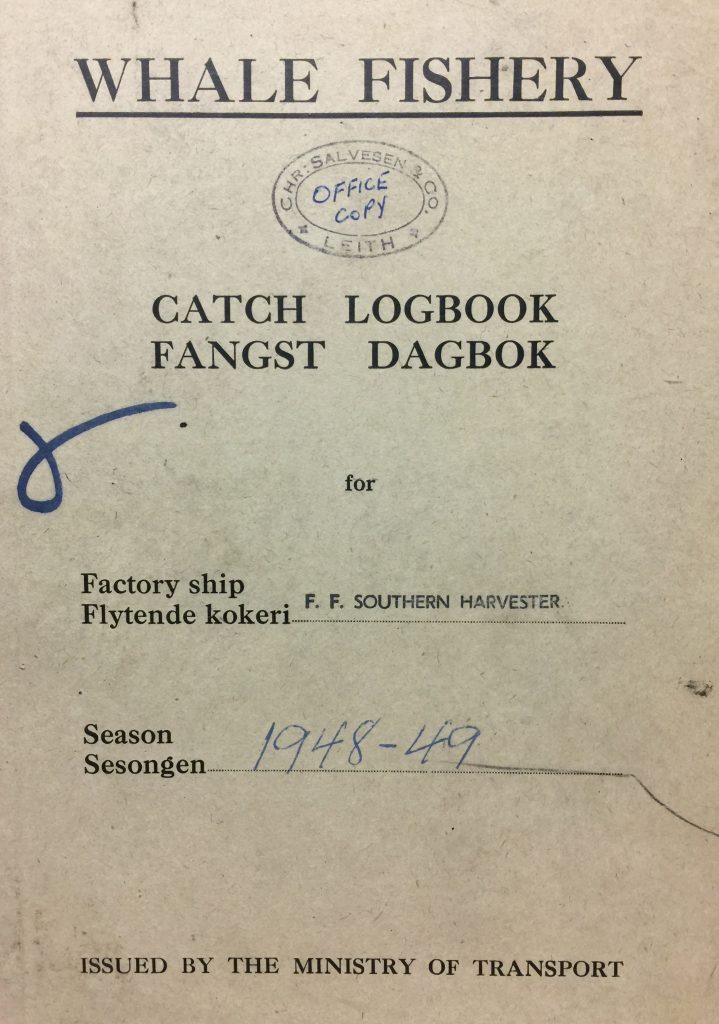
Cover of the ‘Southern Harvester’ catch log-book issued by the UK Ministry of Transport and relevant to whaling season 1948-49 [Salvesen Archive]
However, a log-book can tell us so much more than weather, navigational and catch data, as the whale catch log-book of the stern-slip factory-ship Southern Harvester illustrates.
The opening page of the 1948-49 catch log-book notes the basic statistics of the floating factory. At the start of the whaling season late-1948 it had a gross tonnage of just over 15,087 tons, and a net tonnage of over 8,092 tons (gross tonnage being the volume of all enclosed spaces of the ship, and net tonnage the volume of all cargo spaces of the ship). The tonnages might vary from season to season depending on whether or not maintenance of the vessel and any refitting or conversions had affected its configuration.

Basic statistics and technical data relating to the ‘Southern Harvester’ captained by Konrad Granøe, which included the information that the vessel was fitted out with 14 whale oil boilers and 2 Hartmann’s Apparatus [Title page of the ‘Southern Harvester’ log-book, 1948-49, Salvesen Archive]

The stern-slip whale factory ship ‘Southern Harvester’. The stern-slipway enabled whales to be hauled directly onto the flensing deck of the vessel where they could be cut down and then processed – ‘worked up’ – below decks in a battery of cookers and boilers [Photographic collection, Salvesen Archive]

Painting of the ‘Southern Venturer’ – sister ship of the ‘Southern Harvester’ – showing the stern-slipway for hauling whales up onto the flensing deck. The painting was the work of George McVey, 1956, and was featured on the cover of the book ‘Salvesen of Leith’, by Wray Vamplew, Scottish Academic Press, Edinburgh and London, 1975
The log-book shows that the 1948-49 season began on 20 November 1948, and ended on 26 March 1949, and that the floating factory Manager (its Captain) had been Konrad Granøe (1889-1961). Granøe was a Salvesen (South Georgia Co.) veteran, serving as Mate aboard the Saragossa during the seasons from 1924 to 1928, attending Masters’ training 1928-29, serving as Manager of Saragossa, New Sevilla, and Salvestria between 1929 and 1936, serving throughout the Second World War, and then serving as Manager of the Southern Harvester from catch season 1947 through to the end of the 1950 season.
The log-book had been written up by another Salvesen veteran, Sigurd Jørgen Bang-Olsen (born in 1902), who had served aboard both the Southern Harvester and Southern Venturer during various catch seasons from 1945 until 1963, and whose career with Salvesen began in Leith Harbour, South Georgia, in 1926. He experienced shore-station work at Leith harbour until 1930 and again during the 1940s (also at the offices of Tønsberg Hvalfangeri, South Georgia) and from 1950 until 1957.
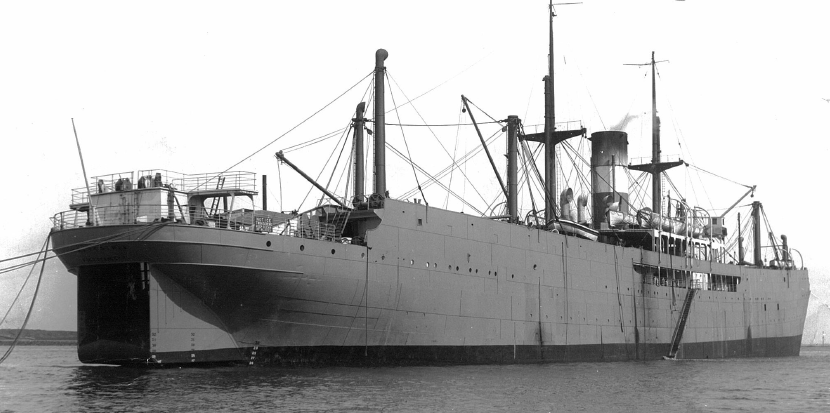
Completed in 1913, the Salvesen vessel ‘Salvestria’ had been captained by Konrad Granøe in the 1930s, and it was lost August 1940 after it struck a mine in the Forth estuary off Inchkeith during the last leg of a voyage from Aruba in the Caribbean to Grangemouth. Sigurd Jørgen Bang-Olsen had also served on ‘Salvestria’ [Photographic collection, Salvesen Archive]
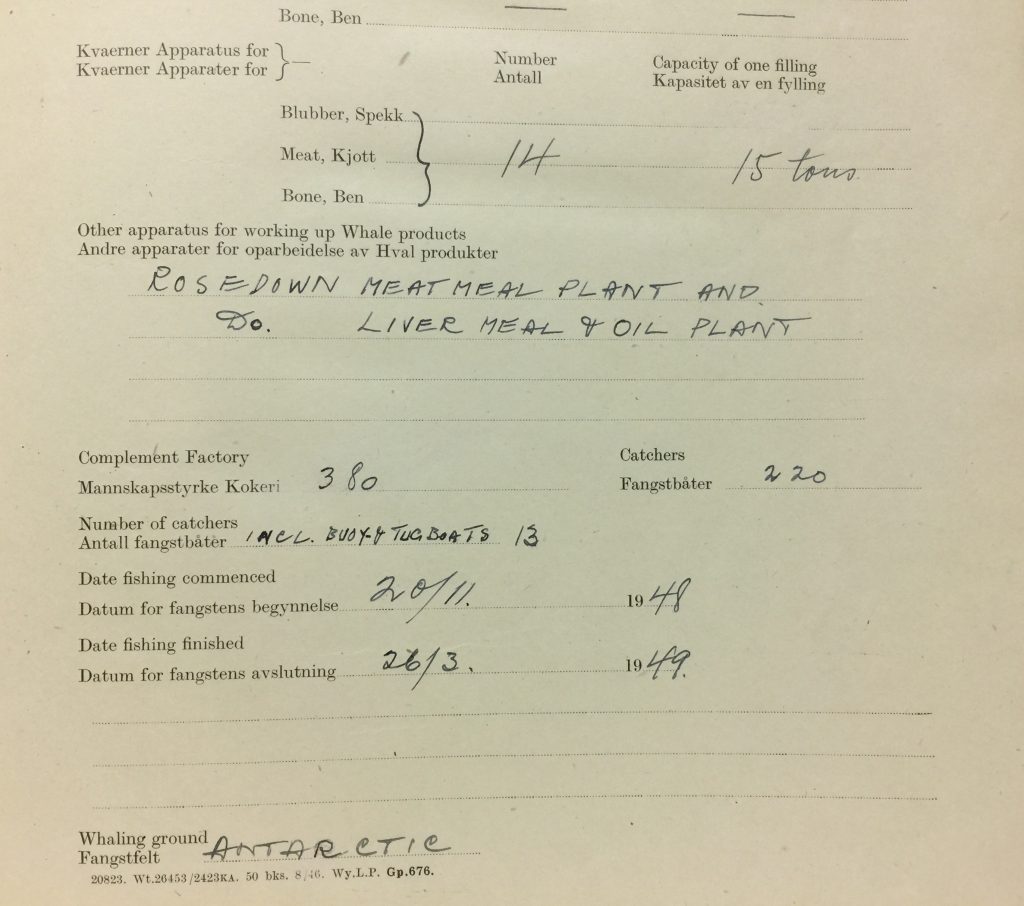
Technical data relating to the ‘Southern Harvester’ indicating that the vessel was kitted out with a Rosedown Meatmeal Plant and Liver Meal and Oil Plant [Title page of the ‘Southern Harvester’ log-book, 1948-49, Salvesen Archive]

Hartmann equipment for whale oil production shown in an advertisement stating that there were 4 such apparatus aboard the ‘Southern Venturer’, which was the sister ship of ‘Southern Harvester’ [From a copy of ‘Norsk Hvalfangst-Tidende’ / ‘Norwegian Whaling Gazette’, Salvesen Archive]

Kvaerner Apparatus on railway wagons leaving the Kvaerner Works in Oslo, Norway [Advertisement from a copy of ‘Norsk Hvalfangst-Tidende’ / ‘Norwegian Whaling Gazette’, Salvesen Archive]

Processing of whales – ‘working up whales’ – aboard an early floating factory. Processing was conducted below decks aboard the ‘modern’ vessels constructed during the 1940s [Photograph among material gifted by Sir Gerald Elliot in 2012, Salvesen Archive]
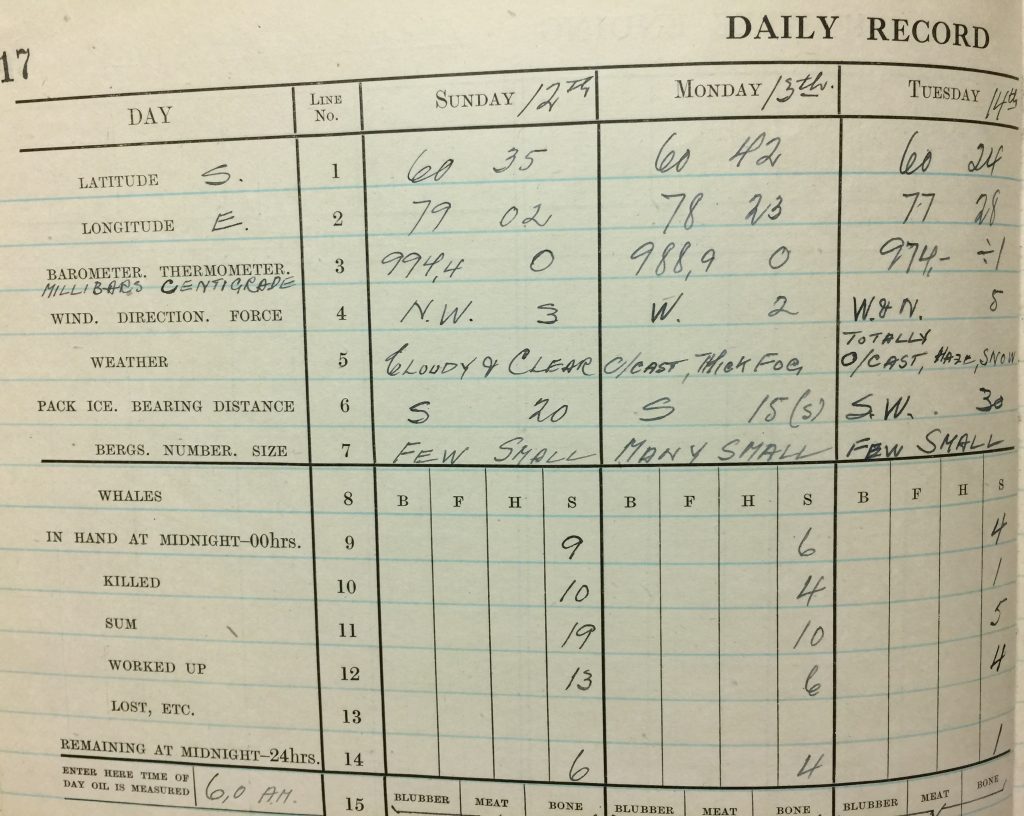
Page of the ‘Southern Harvester’ floating factory whaling log-book showing the vessel’s position on 12 December 1948. Latitude 60° 35′ South and longitude 79°02′ East was a location half-way between the Davis Station, Antarctica, and Heard Island and McDonald Islands (HIMI), in the Southern Indian Ocean [In the ‘Southern Harvester’ log-book, 1948-49, Salvesen Archive]
In addition to the 9 ‘in hand’ at the start of the period, another 10 Sperm Whales had been killed over the course of the day (making 19 in total), and over the day 13 Sperm Whales of the total had been processed.

The above page of the ‘Southern Harvester’ log-book informs us that ‘baleen whaling commenced 15 December 1948’. Sperm Whales (abbreviated as ‘S’ in the data) are of course toothed whales, Odontoceti. From 15 December, the log-book showed the catching of Blue Whales (‘B’) and Fin Whales (‘F’) which, together with Sei, Humpback, Bowhead, Gray, Minke, and others, are all baleen whales, Mysticeti [Page in the ‘Southern Harvester’ log-book, 1948-49, Salvesen Archive]
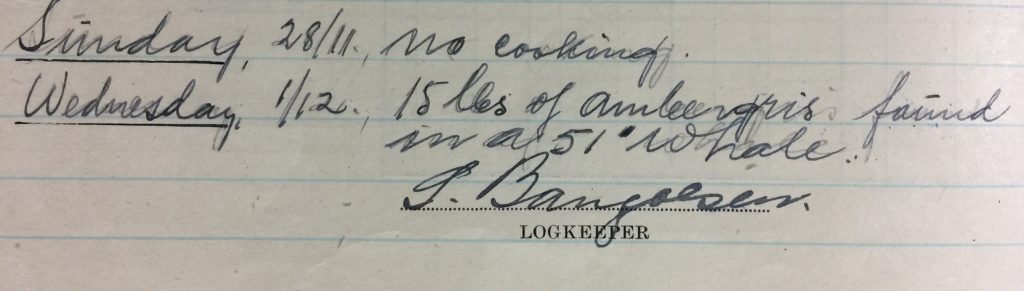
The catch log-book, kept up-to-date by the log-keeper, Sigurd Jørgen Bang-Olsen, has noted that on 12 December 1948 a 6.8 kilogram mass of ambergris had been found in a whale (the ambergris noted as being 15 pounds imperial weight). Ambergris is formed from a secretion of the bile duct in the intestines of the sperm whale, and would normally be passed in fecal matter. Ambergris acquires a sweet, earthy scent as it ages and so had been very highly valued by perfumers as a fixative allowing the scent to last much longer [Page in the ‘Southern Harvester’ log-book, 1948-49, Salvesen Archive]
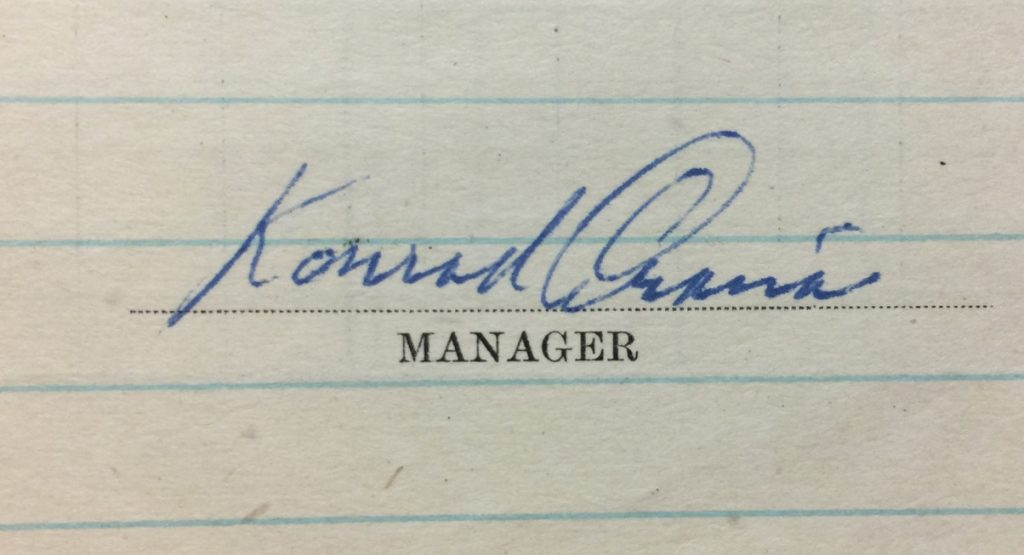
Signature of Konrad Granøe (1889-1961), Manager of the ‘Southern Harvester’ [Page in the ‘Southern Harvester’ log-book, 1948-49, Salvesen Archive]
Graeme D. Eddie, Honorary Fellow, CRC, engaging with the Salvesen Archive of maritime trading and whaling
References:
In the creation of this post the following resources were used: (1) Ogden, Lesley Evans. ‘New data from old treasures: Whaling logbooks’, BioScience, Vol.66, Issue 7, 1 July 20-16, p. 620; (2) Wilkinson, Clive. ‘Ice and Meteorological Data in the Christian Salvesen Archive, University of Edinburgh’, Climatic Research Unit, University of East Anglia Norwich UK & Faculty of Natural Resources, Catholic University of Valparaiso, Chile, 2013; (3) RECLAIM project, https://icoads.noaa.gov/reclaim/ [accessed 25 September 2019]; and (4) ‘The 19th-century whaling logbooks that could help scientists’, The Guardian, Thursday 17 December 2015.
If you have enjoyed reading this post, check out previous ones about the Salvesen Archive, or using Salvesen Archive content, which have been posted by units across CRC since 2014:
Salvesen Archive – 50 years at Edinburgh University Library – 1969-2019 May 2019
Cinema at the whaling stations, South Georgia August 2016
Exploring the explorer – Traces of Ernest Shackleton in our collections May 2016
Maritime difficulties during the First World War – Christian Salvesen & Co. October 2015
Talk on the Salvesen Archive to members of the South Georgia Association November 2015
‘Empire Kingsley’ – 70th anniversary of sinking on 23 March 1945 March 2015
Pipe bombs, hurt sternframes, peas, penguins, stoways and cookery books: the Salvesen Archive July 2014
Whale hunting: New documentary for broadcast on BBC Four June 2014
Penguins and social life May 2014
Three Decades @ the Crossroads of IP, ICT and Law conference

At the beginning of the month, the Centre for IT & IP Law (CiTiP), part of the Faculty of Law of the University of Leuven (KU Leuven) in Belgium, celebrated 30 years of existence. Although their newsletters are only occasionally in English, I have been following their activity for a few years now and I was impressed of their expertise in the areas of data privacy, information rights management and intellectual property rights.
One aspect that I really appreciate at all these conferences organised in Belgium (or nearby) is the wide range of participants: postgraduate students and academic researchers, lawyers from law firms, magistrates from national courts, representatives from industry (Microsoft, Google, Facebook etc), from organisations representing the rights of authors and publishers, from national governments and various EU bodies. These participants come from an area that is within a 2-3 hours train journey from Brussels – this means Benelux, western Germany and northern France. Personally, I find the diverse background of participants and the cultural differences fascinating.
The programme of the conference was really packed with three key-speakers (morning, lunchtime and late afternoon) intertwined with two parallel sessions of four panels each.
The most interesting presentation amongst the key speakers was that of Karen Yeung (Birmingham Law School) about Regulation and technological innovation: Myths, memes and the marginalisation of law. She encouraged the participants to abandon the romantic infatuation with 21st century technological innovation in favour of a more level-headed, clear-eyed view of public policy and regulation vis-à-vis technological innovation. She (successfully, in my opinion) argued against some of the current myths:
| Myth | Reality |
| All innovation is intrinsically ‘good’ | Not all innovation is good. Even beneficial innovation may have damaging side effects. |
| The tech entrepreneur is a moral hero | They (usually male and white) take risks with the rights and interests of others. |
| The equivalence of old v new technology | Comparisons must attend to ALL effects, not merely functional performance. |
| Regulation stifles innovation | Regulation also stimulate and accelerate innovation. |
| The law cannot keep up with the pace with technological innovation | Over-simplification – problems arise due to uncertainty in effects and identification of appropriate norms. |
| The governance of the tech innovation should be left to the markets | Markets are undemocratic. Reliance on post litigation is inadequate. |
|
Tech “ethics” will fix any problems |
Ethics cannot provide legitimate and effective social protection against impacts of tech innovation. |
Her conclusion was that “innovation is not only a technological process, but a profoundly human and socially embedded one” and therefore it is crucially important to bring the law into the heart of discussions about how to govern technological innovation responsibly as it cannot be left to the market. Even if it means swimming against the tide.
The morning parallel sessions were about a) Security, b) AI and GDPR, c) Content moderation and d) Personalised medicine. I choose to attend the one about ‘Content moderation’. The first part of the session was dedicated to ‘Content regulation & illegal and harmful content’ where an interesting debate developed between an in house counsel representing Facebook and everybody else in the room a representative of an NGO active in the fields of intermediary liability and surveillance policies including law enforcement access to data. In the second part of the session, the discussion was centred around ‘Content regulation & copyright’ with Google’s European IP manager, a Leuven IP academic, a representative from an artists’ management organisation and another person from a media company as panel members. The discussion floated around art. 17 (former art. 13) of the European Copyright Directive and its implications on the royalties paid by YouTube to artists and on YouTube copyright policy and so on. Already under pressure from the other speakers and the audience, Google IP manager tried to get some respite with a (misjudged) joke about lawyers which, considering the audience and (cultural) circumstances, just added more gas on his pyre and – surprisingly – I found myself agreeing with one of Disney lawyers, who was sitting next to me.
The afternoon sessions were a) Data markets, b) Smart cities, c) Food and sustainable development goals and d) From paper to bits – the legal development of electronic evidence. I decided to attend the Smart cities session as I presumed that they will talk about face recognition software, smart lampposts etc and I was not disappointed. The speakers talked about SPECTRE project (no relation with the evil organisation from Bond movie, it merely means Smart-city Privacy: Enhancing Collaborative Transparency in the Regulatory Ecosystem) and ‘Googlization of urban infrastructure’ and about Smart Public Spaces.
It was another hugely worthwhile conference, with a great variety of interesting topics relevant for my field but also for my colleagues. Congratulations to CiTiP researchers and collaborators for three decades of work at the forefront of IP, ICT and Law!

KU Leuven: Library (Bibliotheek)
Research Data Workshops: DataVault Summary
Having soft-launched the DataVault facility in early 2019, the Research Data Support team -with the support of the project board – held five workshops in different colleges and locations to find out what the user community thought about it. This post summarises what we learned from participants, who were made up roughly equally of researchers (mainly staff) and support professionals (mainly computing officers based in the Schools and Colleges).
Each workshop began with presentations and a demonstration by Research Data Service staff, explaining the rationale of the DataVault, what it should and should not be used for, how it works, how the University will handle long-term management of data assets deposited in the DataVault, and practicalities such as how to recover costs through grant proposals or get assistance to deposit.
After a networking lunch we held discussion groups, covering topics such as prioritisation of features and functionality, roles such as the university as data asset owner, and the nature of the costs (price).
The team was relieved to learn that the majority (albeit from a somewhat self-selecting sample) agreed that the service fulfilled a real need; some data does need to be kept securely for a named period to comply with research funders’ rules, and participants welcomed a centralised platform to do this. The levels of usability and functionality we have managed to reach so far were met with somewhat less approval: clearly the development team has more work to do, and we are glad to have won further funding from the Digital Research Services programme in 2019-2020 in order to do it.
Attitudes toward university ownership of data assets was also a mixed bag; some were sceptical and wondered if researchers would participate in such a scheme, but others found it a realistic option for dealing with staff turnover and the inevitability of data outlasting data owners. Attitudes toward cost were largely accepting (the DataVault provides a cheaper alternative than our baseline DataStore disk storage), but concerns about the safekeeping of legacy and unfunded research data were raised at each workshop.
A sample of points raised follows:
- Utility? “Everyone I know has everything on OneDrive.”
- Regarding prioritisation of features – security first; file integrity first; putting data from other sources than DataStore; facilitating larger deposit sizes; ease of use.
- Quickness of deposit and retrieval? Deposit was deemed more important to be quick than retrieval.
- University as data asset owner?
- Under GDPR the data are already university assets (because the Uni is the data controller).
- People who manage the data should be close to the research; IT people can manage users but shouldn’t be making decisions about data. Danger that because it’s related to IT it gets dumped on IT officers. The formal review process helps to ensure decisions will be made properly. Include flexibility into the review hierarchy to allow for variation in school infrastructure.
- When I heard that I was – not shocked – but concerned. If I move to another university how do I get access? This might be a problem. Researchers might prefer to retain three copies themselves.
- Is the cost recovery mechanism valid?
- Vault costs are legitimate costs.
- Ideally should come from grant overheads, until then need to charge.
- Possible to charge for small / medium/large project at start rather than per TB?
- Is the 100 GB threshold sufficient for unfunded research? How else could unfunded or legacy data be covered (who pays)?
- Alumni sponsor a dataset scheme?
- There will be people with a ‘whole bunch of data somewhere’ that would be more appropriately stored in DataVault.
The team is grateful to all of the workshop participants for their time and thoughts; the report will be considered further by the project board and the Research Data Service Steering Group members. The full set of workshop notes are colour-coded to show comments from different venues and are available to read on the RDM wiki, for anyone with a University log-in (EASE).
—
Robin Rice
Data Librarian and Head, Research Data Support
Library & University Collections
5 recommended Library resources for Africa Week 2019
Yesterday, 24th October, was the start of Africa Week 2019 at the University. A chance to celebrate Edinburgh’s connections to the region. There are a number of events taking place to mark Africa Week but I wanted to highlight just some of the library resources available to staff and students of the University that will allow you to study and research Africa and Africa related subjects further.
1. C.A.S. collection on 4th floor, Main Library
Have you ever been searching DiscoverEd for a book or journal related to Africa and come across shelfmarks starting C.A.S.? Read More
On trial: Black Newspaper Collection
*The Library has access to all titles from the Black Newspaper Collection until 31st July 2024 as part of ProQuest Access 350.*
Thanks to a request from staff in HCA, and to coincide with Black History Month, I’m pleased to let you know the Library currently has trial access to the full Black Newspaper Collection from ProQuest. This superb resource contains the archives of 9 individual newspaper titles (2 of which the Library already has access to) that provide cultural perspective and insight to the events that shaped the United States in the 20th Century.

You can access Black Newspaper Collection from the E-resources trials page.
On-campus access is direct. For off-campus access you will need to connect to VPN.
Trial access ends 20th November 2019.
Black Newspapers offers primary source material key to the study of American history and African-American culture, history, politics, and the arts. The 9 titles included in this resource are: Read More
Collections
 Hill and Adamson Collection: an insight into Edinburgh’s past
My name is Phoebe Kirkland, I am an MSc East Asian Studies student, and for...
Cataloguing the private papers of Archibald Hunter Campbell: A Journey Through Correspondence
My name is Pauline Vincent, I am a student in my last year of a...
Hill and Adamson Collection: an insight into Edinburgh’s past
My name is Phoebe Kirkland, I am an MSc East Asian Studies student, and for...
Cataloguing the private papers of Archibald Hunter Campbell: A Journey Through Correspondence
My name is Pauline Vincent, I am a student in my last year of a...
Projects
Cataloguing the private papers of Archibald Hunter Campbell: A Journey Through Correspondence
My name is Pauline Vincent, I am a student in my last year of a...
Archival Provenance Research Project: Lishan’s Experience
Presentation My name is Lishan Zou, I am a fourth year History and Politics student....