Home University of Edinburgh Library Essentials
April 4, 2026
Dear Library, I love you / I am breaking up with you because….
Happy February all!
With Valentine’s day fast approaching, the Law Library has decided to run again the very successful ‘Love Letters to the Library’.
The idea for these Love Letters is taken from Andy Priestner’s A Handbook of User Experience Research & Design in Libraries.
Library users are asked to write letters to the Library, and it can be about anything that they love or hate. It has been very successful as Priestner says “the method is universally understood and very willingly participated in”.

We are looking forward to reading your replies; and remember to address them to the Library.
Have fun!
New to the Library: Bibliography of the History and Archaeology of Eastern Europe in the Middle Ages
Following a successful trial the Library now has a subscription to Brill’s Bibliography of the History and Archaeology of Eastern Europe in the Middle Ages. A fundamental source of information for the study of the history and archaeology of medieval East Central and Eastern Europe, the bibliography aims to encourage further research, but also to provide guidance through an enormous amount of information available in a variety of languages and a great multitude of publications.

You can access this database through the Databases A-Z list or via the History or Archaeology subject guides. Access through DiscoverEd will also be available soon. Read More
Meet the RESP Fieldwork Interns
Written by: Katie Shepherd, RESP Fieldwork Intern
Hello world! I’m Katie, a Masters student at the University of Edinburgh studying Musicology. In collaboration with Ailsa, a final-year undergraduate student in Ethnology, we are Fieldwork Interns for the Regional Ethnology of Scotland Archive Project! Following in the footsteps of interns before us (see James’s and Rebekah’s posts), I’ve begun a diary-style record of our time working with the RESP.

Fieldwork Intern Katie

Fieldwork Intern Ailsa
While the rest of this blog and the RESP website (which you can find here) give a good description of the RESP Project as a whole, I’d like to first give you a little context about our internship specifically. RESP have previously worked in Dumfries and Galloway, and also with the John Gray Centre in Haddington, East Lothian. Ailsa and I will be continuing to work with a community group hosted at the John Gray Centre in Haddington, called the Active Memories Group. Some of the group had previously taken part in a project called Jumpers for Goalposts, which resulted in a physical publication of their sporting memories in the form of an A4 booklet. Dick Short, David Elder and John Peters have all completed earlier interviews with the RESP Project, and are available on the archive. All are amazing sources of oral and community history!
The group in Haddington were such a vibrant source of oral history that the RESP have decided they’d like to hear more! After an initial meeting with the group (over a Christmas cuppy and a very competitive quiz!) and a further discussion, the theme of working life arose. The group brought in some photographs and memorabilia to frame some of their working memories, and it seemed a rich topic to explore in individual and paired interviews.

John Gray Centre
So what’s next? Everyone in the group is keen to discuss memories of their careers, and while group discussions generate many insights, and a good deal of hilarity, recorded interviews offer an opportunity to share in-depth recollections and provide an accessible format to be uploaded to the RESP Archive Collections.
At the time of writing this post, Ailsa and I are set to begin recording interviews with group members in the next few weeks. The RESP project aims to facilitate the community in Haddington to create their own record of their life and society, and to do so by uploading audio recordings and photographs onto the archive website where they are available for everyone to view: the participants, their close friends and family, the public, the next generation…
There will be a number of outputs from this project, mainly an A4 booklet-style publication similar to Jumpers for Goalposts. The group at Haddington expressed a desire for a physical version of the interview recordings, along with some visual content to accompany excerpts. Ailsa and I will keep this blog updated during the process, will be posting on RESP social media accounts, and aim to release a few mini-podcasts and short videos. Watch this space!
Find us on Instagram: @resparchiveproject
DataShare spotlight: Human MotionLess Dataset (HuMoLs) and the creative potential of research data
For the second installment of the spotlight on DataShare blog posts, I would like to showcase a fascinating item containing videos of people not doing anything!
The dataset in question is titled “Human MotionLess Dataset (HuMoLs)” and was created by researchers Longfei Chan, Muhammad Ahmed Raza and Robert Fisher, who are based in the School of Informatics’ Institute of Perception Action and Behaviour. While on the face of it, people being still might not seem very dynamic, the research behind this dataset is trying to solve a difficult problem with a very useful outcome. Simply put, how do you tell when someone is lying still because they are doing something like sleeping, or if it is because they are unwell or have fallen? The videos in this dataset aim to try and train healthcare monitoring systems to help determine whether it is the former or the latter of these possibilities, with the priority being to uncover any critical medical conditions or to analyse chronic conditions.

What struck me while reviewing the videos for submission was that beyond the usefulness of these videos to the research project, there was the potential for them to be adapted creatively. The videos have a deliberately “uncanny valley” aspect, due to using AI to deepfake participant’s faces in order to preserve their anonymity. The amusingly odd character to the videos made me imagine them being used in an Adam Curtis documentary, or in an Aphex Twin music video. Possibly even in an Adam Curtis documentary with Aphex Twin music over the top of it.
This raises the fascinating idea that there are rich sources of research data stored in open access repositories that could have a life beyond being reproducible, but could also be reused, repurposed and remixed into creative new pieces, adding value to both the research itself, and to the repositories where the affiliated data is stored. To demonstrate this possibility, I have edited some of the videos together, see below, and set them to music. The piece of music, “Redolescence” by Other Lands, has a dreamlike quality to it which both complements and recontextualises the videos into something beyond their originally intended use.
What other audio and visual materials are there contained in research data repositories waiting to be repurposed in a creative manner? Time (and much more talented creators than me) will tell!
The full dataset can be found on DataShare: Human MotionLess Dataset (HuMoLs)
The paper which the dataset supports: OPPH: A Vision-Based Operator for Measuring Body Movements for Personal Healthcare
Permission to use the music featured in this video was kindly granted by Gavin Sutherland, performing here under his artist name of Other Lands. The album which contains this track can be purchased on Bandcamp: Other Lands – Riddle of the Mode
Knowledge Exchange with Japan
Two members of the Research Data Support team recently had an adventure visiting Japan in order to provide practical lessons to library students and librarians studying in a research data management (RDM) course.
When Professor Emi Ishita had visited the team in 2023, she was preparing a new syllabus for research data management for her library students at the Kyushu University iSchool. Struck by the strong engagement our team members had with researchers through training, supporting data management plans, and moderating data deposits, she returned in August, 2024 with a delegation of practicing librarians to learn from the Universities of Edinburgh, Leeds, and Oxford. The group spent a full day with various members of Library Research Support, going over a question list they had sent in advance, about Open Access (OA) and RDM support, and our approach to training researchers.
At the end of the session, Emi revealed that a grant was available to pay for two RDM practitioners from UoE to come to Kyushu University in Fukuoka to contribute to an October, 2024 public symposium and a two day-long in-person training sessions for her students. The students would include Masters students enrolled in the iSchool at Kyushu, as well as practicing librarians looking to reskill themselves following government policy directives embracing immediate open access and data sharing for research publications.
 The speakers for the hybrid symposium on OA and RDM in Japan were myself with Dr Simon Smith, along with long-time RDM service provider Jake Carlson from the University of Buffalo (New York), and the Library Director from Chiba University, and the Research Data Service Director at Kyushu University providing a Japanese context for OA and RDM. Dr Ishita introduced the symposium and chaired the panel session – her team also provided all the speakers with beautifully presented bento boxes tailored to each person’s diet for lunch.
While the symposium was exciting, with about 60 people in attendance and about 130 more watching and listening online, it was the practical training that myself and Simon found truly inspirational. The students overcame their customary reserve to answer Simon’s open-ended questions about supporting researchers with data management planning in a classroom setting. Later, they formed into small groups to try out depositing data in DataShare, and evaluate each other’s metadata for quality. The technology worked, the students were curious and engaged, and the Kyushu instructors were pleased with the outcome.

 During the week of the event, Simon and I visited prior and new contacts at Tokyo University, Chiba University, Kyoto University, Nagoya University and NII. In addition to the excellent company, we were pleased to be visiting such a beautiful country and eating the wonderful food.


Symbolae Scoticae
Today we are publishing an article by Ash Mowat, a volunteer in the Civic Engagement team, on the Symbolae Scoticae: a set of eight purpose-bound scrapbooks containing more than 2000 items relating to Scottish history, geography and culture.
In this blog I will explore the Symbolae Scoticae[1] (Scottish Contributions) volumes of scrapbooks containing images of Scotland as compiled by the 19th century Scottish naturalist Adam White, held at the University of Edinburgh’s Centre for Research Collections.
Adam White (1817 to 1878) was born in Edinburgh and developed a specialism in insects and crustaceans, practising as a zoological assistant at the British Museum in London.[2]
He was aged just 18 when he started this work having only been educated up to high school level, and developed expertise in the identification, naming and cataloguing of a wide variety of species of insects and crustaceans. He published many papers and reports of his findings and was very well regarded, having been praised by and commissioned work by Charles Darwin, amongst other esteemed colleagues. Despite his achievements and regard, he did not rise above the level of zoological assistant, potentially due to striven relationships with his supervisor. He further contributed by campaigning and petitioning for the creation of the National Museum of Scotland in his birthplace of Edinburgh.[3]
The Symbolae Scoticae collection consists of 8 large scrapbooks approximately 17×14 inches. I focused my inspection on the first two volumes which were dedicated to the Edinburgh and Lothians regions of Scotland. The books contain artworks in a variety of media dating from the 18th and early 19th century.

The image of 1838, an etching and engraving, shows a relatively unchanged view down from Edinburgh’s Hanover Street facing onto the building that is now the gallery and home of the Royal Society of Artists.

The above image from 1814 shows a dramatically different view from Edinburgh’s Princes Street, facing onto the towards the Old Town, attributed to the artist Dan Mcintosh. It depicts a very selective view of the times with the finery and wealth of the privileged classes on display, with the grime and sometimes squalid conditions of the Old Town in the background not featured.

In the etching and engraving above, the view is taken from the Greyfriars’s cemetery in Edinburgh, facing onto what was the Heriot’s Hospital but currently George Herriot’s School, with the dramatic backdrop of Edinburgh Castle. The rendering of details and capturing of varying lights, tones and textures are exquisitely crafted, more so than would be conveyed in the later development of photography.

The above image, selling fish, is by the renowned Scottish artist Walter Geikie (1795 to 1837) and dated to around 1830.[4] Born in Edinburgh, he overcame a disability that had left him deaf, learning how to speak and developing his natural talents as an artist to study and practice as a celebrated illustrator of the ordinary citizens of Edinburgh going about their wares, often featuring the Old Town of Edinburgh as their location. There is always much humanity, humour and affection in his works for his working-class subjects, at a time when many other artists would focus on creating images of the wealthy and powerful.


An illustration of Edinburgh’s South Bridge above left from the 19th century, alongside contrasting photograph of the location today.

Dated to 1832 by the artist G Barret and engraver E Finden, this spectacular composition shows a sunset over the ruins of St Anthony’s Chapel situated upon Holyrood Park in Edinburgh. The chiaroscuro lighting effects give the image a haunting quality.


Above left is an aquatint of the runs of Dunbar Castle in East Lothian outside Edinburgh, alongside a photograph of the location today.
The quality and diversity of the images held in this collection are incredible, I was only able to explore two of the 8 volumes held. I would urge anyone with their interest spiked to consider exploring these further, and staff have helpfully created a useful map to outline the locations and content covered.[5]
I should like to thank mu supervisor Laura Beattie (Community Engagement Officer) for support, and to the helpful staff at the centre for research Heritage Collections in enabling access to these materials.
[1] Collection: Symbolae Scoticae | University of Edinburgh Archive and Manuscript Collections
[2] Adam White (zoologist) – Wikipedia
[3] Adam white Archives – Innerpeffray Library
[4] Walter Geikie | National Galleries of Scotland
[5] https://symbolae.neocities.org/
Systematic review search strategies – training and resources
Are you developing a search strategy for a systematic review or other evidence synthesis? Here we have collated a list of useful training and guidance resources to help you.

Image by José Miguel from Pixabay
The Learn course LibSmart II: Advance Your Library Research has a whole module on Literature Searching for Systematic Reviews. LibSmart II can be found in Essentials in Learn. If you don’t see it there, contact your Academic Support Librarian and we’ll get you enrolled. You can work through LibSmart at your own pace, and return whenever you need.
For self-paced training on the whole process of conducting a systematic review, Cochrane Interactive Learning has modules created by methods experts so you build your knowledge one step at a time.
If you are a student conducting a systematic review, we can highly recommend the book Doing a Systematic Review (2023). With a friendly, accessible style, the book covers every step of the systematic review process, from planning to dissemination.
We also have several recorded presentations on systematic reviews on our Media Hopper channel, including Building complex searches for systematic reviews and How to test your systematic review searches for quality and relevance as well as introductions to databases like Medline and Web of Science.
For even more advice about systematic review searching, see the library’s subject guides on Systematic reviews
—–
What’s so different about a systematic review search strategy?
According to the Cochrane Collaboration, a leading group in the production of evidence synthesis and systematic reviews;
systematic reviews are large syntheses of evidence, which use rigorous and reproducible methods, with a view to minimise bias, to identify all known data on a specific research question.1
This is done by a large, complex literature search in databases and other sources, using multiple search terms and search techniques. This might include Boolean operators, truncation, phrase searches, and database subject headings. Find out more about these search techniques on the Library subject guide to Literature Searching.
Traditional literature reviews, such as the literature review chapter in a dissertation, don’t usually apply the same rigour in their methods because, unlike systematic reviews, they don’t aim to synthesise all known data on a topic. Literature reviews can provide context or background information for a new piece of research, or can stand alone as a general guide to what is already known about a particular topic2.
—–
You can contact your Academic Support Librarian for advice on literature searching, using databases, and managing the literature you find.
—–
References
- Higgins, J., et al., Cochrane Handbook for Systematic Reviews of Interventions version 6.4 (updated August 2023). 2023, Cochrane.
- Mellor, L. The difference between a systematic review and a literature review, Covidence. 2021. Available at: https://www.covidence.org/blog/the-difference-between-a-systematic-review-and-a-literature-review/. (Accessed: 20 March 2024).
Happy New Year and Welcome back
Happy new Year all and welcome back!
2025 has landed and the new semester is already underway. Teaching has resumed and the Law Librarians are busy delivering new information literacy classes to postgraduate students.
The Law Library is now open but still on reduced hours until this Sunday. Please check before planning your trip there to avoid any disappointment. Normal opening hours will resume on Monday 13 January. The Main Library has resumed its normal opening hours.

As always, we are here to help you with any enquiries you have about resources, referencing and literature searching. We offer one to one appointments most weeks; visit the MyEd Events Booking system and look for ‘literature search clinic’ and select the option relating to Law. And if you can’t see a bookable slot that suits you please email us on law.librarian@ed.ac.uk.
Association for Historical and Fine Art Photography Conference 2024
The Cultural Heritage Digitisation service team have attended the annual Association for Historical & Fine Art Photography conference for well over a decade and have contributed to presentations at the annual conference. Susan Pettigrew the studio manager was Chair of the AHFAP Libraries and Archives Special Interest Group until the end of 2023. AHFAP is an important conference for CHDS in that it’s our network connection to the UK wide community of Heritage photography and digitisation.
Warm Wishes from your Law Librarians
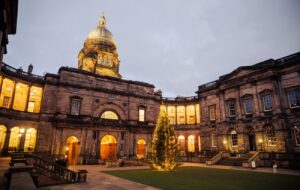
With the exam period almost finished, it is time for all of us to get a well deserved break from studies, assignments and work in general. The University will be closed across the 2024 festive period from 5pm on Monday 23rd December 2024 and reopening at 9am on Friday 3rd January 2025.
The Law Library will remain closed for the period mentioned above. If you are studying or conducting research over the winter break you will find our online resources remain accessible via the usual channels, but should you run into difficulties we will not be able to respond to any messages until we return in January. Your Law Librarians will be away from Friday 20th December 2024 and coming back on Monday 6th January 2025.
The Main Library will remain open for most of the duration of the holidays but with reduced staffing and opening hours.
We wish you a restful and pleasant winter break during your time away from the University. See you in 2025!
~ Anna & Rania
Collections
 Hill and Adamson Collection: an insight into Edinburgh’s past
My name is Phoebe Kirkland, I am an MSc East Asian Studies student, and for...
Cataloguing the private papers of Archibald Hunter Campbell: A Journey Through Correspondence
My name is Pauline Vincent, I am a student in my last year of a...
Hill and Adamson Collection: an insight into Edinburgh’s past
My name is Phoebe Kirkland, I am an MSc East Asian Studies student, and for...
Cataloguing the private papers of Archibald Hunter Campbell: A Journey Through Correspondence
My name is Pauline Vincent, I am a student in my last year of a...
Projects
Cataloguing the private papers of Archibald Hunter Campbell: A Journey Through Correspondence
My name is Pauline Vincent, I am a student in my last year of a...
Archival Provenance Research Project: Lishan’s Experience
Presentation My name is Lishan Zou, I am a fourth year History and Politics student....