Home University of Edinburgh Library Essentials
May 22, 2026
New College Library Project Update by the Library & Archive Assistants

New College Library Hall during the General Collection moves to DHT
Post by Jamie Sutherland, New College Library Project Assistant
New College Library moved to its temporary home in David Hume Tower in January 2020. This new space will allow continued access to books and journals from the General Collections while an Estates Project is carried out in our stunning Mound Place home. The General Collection moves have covered over 3.25km of books and, whilst the project team has been glad to see these securely in their new location, this has only been the first stage of the move project. New College Special Collections, one of the UK’s largest collections of theological rare books and archives, have also been prepared for safe relocation to other secure University sites and specialist off-site storage.
New College Library Hall during the General Collection moves to DHT

Pre-1900 Journals labelled and stabilised with cotton-tape ties ready for the move.
With the General Collections safely relocated to David Hume Tower, the past few months have focused on the even more daunting task of preparing our Special Collections materials. Here are some ongoing tasks which have formed part of this work:
Collections Care: New College Special Collections include a number of rare and wonderful materials which require their own special attention to move and store safely. These include rolled scrolls, glass plate negatives, photograph albums, books bound in animal hide, palm-leaf manuscripts, and even the academic gowns belonging to Thomas Chalmers, the first Principal of New College. Most of our work has focused on securely boxing or wrapping these items ready for the move. This has also given us the opportunity to consider their long-term storage requirements and what we might do to enhance their preservation once they return to their permanent home. As a team, we have been working on creating bespoke boxes and housing arrangements for some of the more unusual items as well as working on research projects to identify the best practices of collections care for particular types of material. Many items also had detached spines and covers which we were determined not to lose during transit. Our older journals were systematically checked for any damage or special care needs and either wrapped in acid-free tissue or ‘stabilised’ with cotton-tape ties to keep them together.
Archive ‘Mapping’: The collections include an extensive archive containing the papers of significant individuals or groups connected to New College, the University and the Church of Scotland. The project has focused on ensuring that these archive materials are fully listed, secured ready for the move, and suitably stored within the University. This began with the major task of identifying and measuring all the archive material. The final figure comes out at over 900 archive boxes and over 1,500 volumes! These figures help us to work out the optimal way of arranging shelving and storage arrangements, balancing collection storage needs with the ever-present concern of saving space. Having this information will also prove useful in the future in allowing us to identify potential rehousing projects such as the work of the Crowdsourcing Conservation Events.
Flat Folio Sequence: Many of the volumes in New College Special Collections are oversized. At the moment, these volumes are stored standing upright on the shelves alongside their smaller companions. Since these books have very heavy text-blocks, storing them upright exerts a lot of pressure on their spines which can cause damage to the book itself as well as risking damage to smaller items on the shelves which could become stuck or crushed between them. The project move has provided us with the opportunity to extract these larger items from the collection and bring them together into a dedicated ‘Flat Folio’ sequence (defined as any item over 42cm in height). These books can now be stored horizontally, which is a far better arrangement from the consideration of collections care. This project has required identifying, listing, and conducting basic collections care work on these items. Our inventory team have also been working on extracting these items ready for the move and updating their records with new temporary call numbers. The new flat folio sequence will contain over 900 volumes to be stored on much improved flat shelving.
Improving Shelf Space: Moving such a large collection poses the difficulty of finding enough shelf space to store it during the project. Whilst approximately two-thirds of the collection is moving to specialist off-site storage, we also have to retain a large portion on campus to facilitate collections care, cataloguing, and readers’ access to high-use material. As part of the project, we have been identifying ways to compact and re-pitch existing shelving in secure University stores to create additional space for the New College collections. Since January, we have successfully created an additional 39 linear metres of shelving which will provide space to store the New College archives and incunabula collection. Once the project has been completed, this space will be available to accommodate future projects or allow room for the acquisition of new Special Collections material.

Bound copies of ‘The Witness’ newspaper, forming part of the new Flat-Folio Sequence in NCL Special Collections
Over the next few weeks, we’ll be dedicating our blog posts to some of the particularly interesting items we have been working on in the New College Library collections. Keep an eye on this blog where we will be posting new case studies and insights into some of these remarkable items and the work which has been ongoing to keep them safe and accessible to future generations.
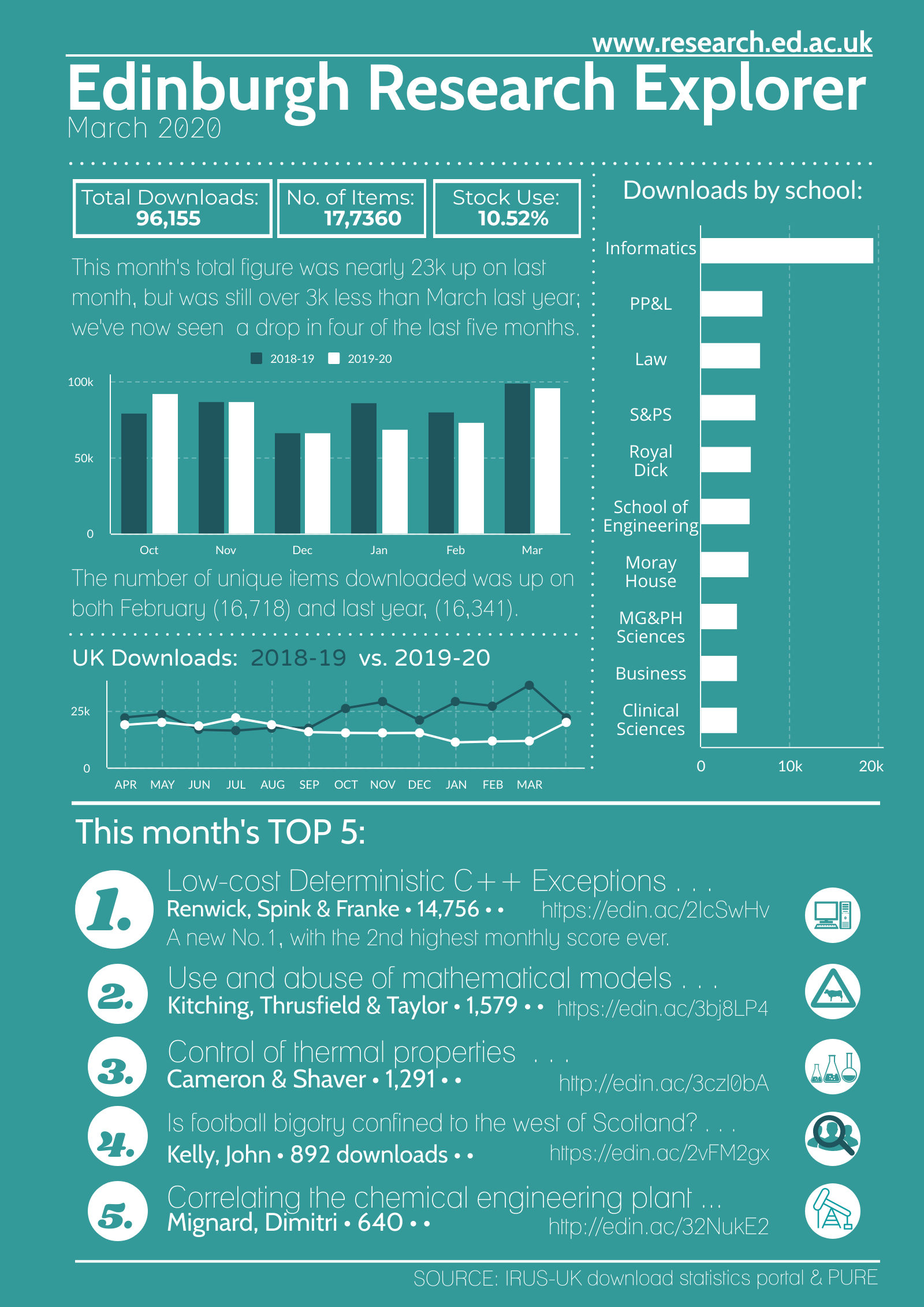
Edinburgh Research Explorer Statistics: March 2020
Research data management in a time of quarantine
Covid-19 has shaken up our world, and disrupted University life as we know it. But in terms of a silver lining, it has provided opportunities for open data / open research to prove their worth, in the search for a vaccine and other approaches to managing and treating the complications of the virus. SPARC Europe have collected a number of case studies on Open Science and the Coronavirus. If you’ve been working on Coronavirus research here at Edinburgh, we’d love to hear from you, especially if there is anything we might be able to do to help. So far we have engaged with researchers in all three Colleges studying, or hoping to study, an aspect of COVID-19; about handling sensitive data, archiving or sharing relevant data, or bidding for new research.
How has it affected us in Research Data Support?
- We are all working from home, although some of us have unavoidable childcare responsibilities which may slow down responses;
- In terms of answering Research Data Management (RDM) enquiries it’s business as usual. UniDesk has been a little quieter than usual, but we are receiving more complex queries as researchers adjust to the new reality;
- Data Management Plan (DMP) assistance is business as usual, and we are now set up on Teams for video consultations – let us know if you’d be interested in one of these;
- During the lockdown we will be refreshing our existing Research Data MANTRA training and directing research staff and students to this resource in place of our face-to-face training, which has been temporarily suspended. If you have a question or would like to discuss any aspect of RDM or Data Management Planning please contact the team using data-support@ed.ac.uk to setup an online consultation.
From the researcher’s point of view, in some cases collecting and processing or analysing new data may be more difficult than it usually is, and in many cases impossible without access to lab equipment or direct contact with research subjects. So why not turn your attention to other elements of RDM, such as preparing older data for deposit, and linking it with your published research papers to fortify the scholarly record?
What can you do?
- Use the time away from the lab or the field to tidy up data you’ve already collected or created (and don’t forget to attach metadata/contextual information!);
- Deposit completed data in DataShare (or a disciplinary repository, with metadata recorded in Pure);
- If you have deposited in DataShare before, check the usage stats and AltMetrics feed to see whether it has been used by others;
- Create an ORCID (unique, persistent global researcher’s ID), and link it with your Pure account to ensure you stay linked with your outputs throughout your career;
- Invite us to comment on your DMP, or get in touch about anything else RDM-related;
- Let us know if you’d like to arrange any bespoke training or awareness-raising sessions;
- Take some or all of the MANTRA course and let us know if you have any comments.
—
Martin Donnelly
Research Data Support Manager
Library and University Collections
Universal Database of Ukrainian Periodicals – on trial
Thanks to a request from a student in SPS the Library currently has trial access to the Universal Database of Ukrainian Periodicals (UDB-UKR) from EastView. The world’s first database of newspapers and magazines of Ukraine, it includes publications in Russian, Ukrainian and English.

You can access the Universal Database for Ukrainian Periodicals from the E-resources trials page.
Access is available on and off-campus.
Trial access ends 15th May 2020. Read More
On Trial – The Making of Modern Law: Foreign, Comparative, and International Law, 1600-1926
Thanks to a request from staff in HCA the Library current has extended trial access to The Making of Modern Law: Foreign, Comparative, and International Law, 1600-1926 from Gale. This resource provides you with instant, full-text access to primary source documents previously found only at the largest and oldest repositories.

You can access The Making of Modern Law: Foreign, Comparative, and International Law from the E-resources trials page.
Access is available on and off-campus.
Trial access ends 30th June 2020. Read More
Library Update for Divinity : Answering Your Questions

Image credit : Pixabay : free for non commercial use
Here are some of the questions Divinity staff and students have been asking me over the last few weeks, and some answers. As the Covid-19 situation can change quickly, the best place to go for the most recent updates is always our Library Covid-19 page.
Where can I find e-books to support my dissertation research?
The University of Edinburgh has access to 1.4 million e-books which are findable using DiscoverEd. Many e-books relevant to Divinity are also freely available, see my online guide as a starting point. Several publishers have made their digital content free for a temporary period during the Covid-19 crisis – see our temporary access web page. (These temporary access e-books are not listed on DiscoverEd). Participating publishers include:
- Manchester University Press
- JSTOR e-books
- Project Muse
Digital archives and primary sources for your dissertation
Not sure where to access digital archives and primary sources? Suddenly having to change the focus of your disseration and unsure what online resources may be available to you instead of physical archives? In this blog post I have pulled together some (hopefully) useful information and links for you to explore. Read through the whole thing or click on link below to read a particular section.
What digital archives and primary sources are already available to you?
Open access digital archives and primary sources
Trial access to digital primary source databases
Temporary access to resources in light of Covid-19 outbreak
What digital archives and primary sources are already available to you?
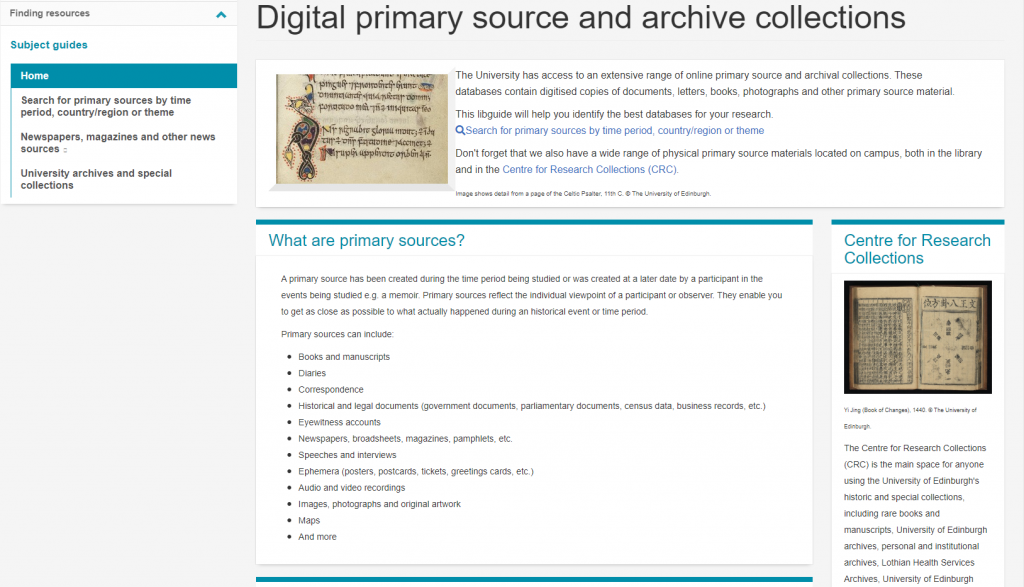
At the University Library we have access to, something like, over 400 digital primary source databases. Between them these databases cover 100s of years of history and contain a wide range of different document types e.g. newspapers, periodicals, official and legal documents, correspondence, diaries, books, pamphlets, sermons, audio and video recordings, images, objects, ephemera and much more. Read More
Manchester University Press – free e-book access until 30th June
I’m pleased to let you know that Manchester University Press (MUP) have opened up access to their 12 e-book collections until 30th June 2020 in light of the Covid-19 outbreak.

While the University Library already has access to a large number of e-books published by MUP, and already subscribes to 1 of the 12 collections, this extended access opens up a wide range of e-books that we’ve not had access to before for a limited period of time. Read More
Friends celebrate Lyell acquisition
 The Friends of Edinburgh University Library played a vital role in helping to acquire the Charles Lyell notebooks. They celebrate that acquisition in the new issue of The Piper
Joining the Friends is an excellent way to keep informed about Library activities and new collections: Friends Of Edinburgh University Library
Health in Motion: I move, therefore I am
As many of us face the challenge of managing our mental and physical well-being during the current Coronavirus (COVID-19) pandemic, we look to the doyenne of movement and pioneer of dance, Margaret Morris, for inspiration…
 In 2018, a YouGov online poll (based on a sample of 4619 participants) recorded that 74% of people have felt so stressed that they have been overwhelmed or unable to cope, 61% felt anxious and 37% lonely due to isolation. A further 36% of adults who reported stress in the previous year cited either their own or a friend/relative’s long-term health condition as a factor, rising to 40% in adults over 55. Housing worries were another key source of anxiety. In 2013, there were 8.2 million recorded cases of anxiety in the UK.
 In 2020, we can now add the stresses and strains of coronavirus (COVID-19) into the mental health mix. There is little doubt that current measures around social distancing and restrictions on movement – in place to protect ourselves and others from coronavirus – are exacerbating the collective strain on mental and physical well-being. Mental health organisation websites (such as the Mental Health Foundation, Mind, and the Scottish Association for Mental Health) are all leading with how to protect our mental well-being during the coronavirus pandemic. On 27 March 2020, the Scottish Government announced an additional £3.8 million investment to expand support for digital mental health services specifically in response to further demand as a result of the current crisis.
As our first-hand experience of social isolation informs our understanding of its impact, many of us are developing a new found empathy for those who had been living in social isolation pre-coronavirus. For those of us accustomed to leading active lives and moving around freely, we are now having to consider carefully the new risks associated with moving and exercising outwith our homes. For many of us, physical movement will be at the very bottom of our priority list as we juggle all of our other commitments. After all, just thinking about how to incorporate physical movement into our new daily routine (if we have managed to establish one) can be mentally exhausting given our work, family, child-care, pet-care, carer, domestic, social media, volunteering, and the new plethora of video group-chat catch-up commitments. That’s before we even register the anxiety around actually becoming infected with or transmitting coronavirus.
There are many studies which have shown that doing physical activity can improve mental health by aiding sleep, releasing feel-good hormones, distracting our brains from intrusive and racing thoughts, improving self-esteem, and reducing the risk of depression. All even more important in the current environment. How then, at this time of crisis, do we move physical and mental well-being up the priority list? For help, we decided to look to our archives and into the past. We look to the great doyenne of all things movement and pioneer of dance, Margaret Morris (1891-1980), for some inspiration and guidance.
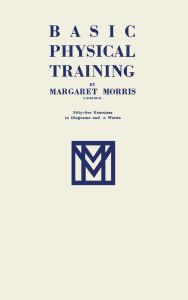
Front cover of Margaret Morris’ Basic Physical Training, 1937, courtesy of Culture Perth and Kinross
Ideas around the integration of mind and body are not new. In the 1920s, Margaret Morris, a dancer, choreographer and teacher, was part of a wider campaign that promoted health via ‘movement, wholefood, fresh air etc’. Morris developed her ‘Margaret Morris Movement’ method in which students studied form, line, colour, movement, music, rhythm, sound and composition. When she was interviewed in 1926 for Architecture: the magazine of architecture, the applied arts and crafts, Margaret Morris highlighted one of the primary problems in the area of physical movement which was, (and still is), ‘how can physical exercise be made interesting?’ Morris remarked in her 1937 publication Basic Physical Training, ‘corrective exercises have…excellent results when persisted in long enough – but they are terribly boring to do…’ Morris was convinced that interest could only be done by bringing the creative or artistic element; which she argued was not so difficult or far-fetched as it may at first appear. Underlying her approach was the inter-relation and harmony of all the arts. ‘All movements performed for the establishment of health…must combine the aesthetic as well as the medical values of movement.’
Morris developed and refined her method throughout her lifetime. By 1938, four divisions of Margaret Morris Movement had been established: normal, medical, athletic and aesthetic, all of which were interrelated. Morris propounded the remedial and health benefits of dance and her particular movement method as she witnessed improvements in her dancers’ posture and general health. Morris developed a dance system which, she argued, was more natural than classical ballet and allowed for all the possibilities of movement, including spring and balance, without artificialities or contortions – to allow a true freedom of expression. Many of us are currently experiencing high emotional states, but may be finding it difficult to express ourselves in words. Dance allows individuals to express powerful emotions through their physical bodies perhaps more instinctively and intuitively, and our bodies provide a physical medium through which pent up emotion may be released.
Central to the Margaret Morris Movement method is the science of breathing, and she advocated the teaching of correct breathing before anything else so that the breath is synchronised with movement. Many of the movements she devised are based on a ‘twist of the trunk, with counter-balancing arm and leg movements’. Writing in her book Roar (2016), about female physiology, health and fitness performance, Dr Stacy T. Sims tells us that ‘when our entire torso (collarbone to hip) is strong and solid, so are you.’ Unlike many other sports or physical activities, dance develops core strength as the foundation of every other move. Morris underlines the importance of the lungs, the abdomen and feet in Basic Physical Training claiming, ‘their efficient functioning is unquestionably of the first importance for success in any form of physical activity whatsoever.’
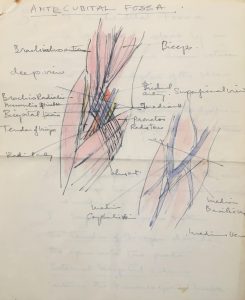
Margaret Morris Movement was informed by Morris’ deep understanding of human anatomy, illustrated here in one of her many anatomical drawings, underaken as part of her physiotherapy studies. Courtesy of Culture Perth and Kinross
From 1925 Morris began to demonstrate remedial qualities of her movement method to health professionals. In 1930 she qualified as a physiotherapist and by 1937 she was invited to join the National Council for Physical Education. By 1939 Margaret Morris had authored or co-authored a number of publications which described the Margaret Morris Movement method and explained its application to a range of physical activities including dancing, skiing, maternity and post-operative exercises, tennis and basic physical training. The continuing relevance of her ideas was recognised in 2013 in the New Zealand Journal of Physiotherapy in which her ‘maternity exercises’ from 1938, are considered to translate well to the present day, with more evidence to support their use in some instances. Margaret Morris Movement dance teachers continue to teach her technique and dances today to encourage the love of dance and movement for health benefits, satisfaction and performance. You can read more about Margaret Morris and the current work of Margaret Morris Movement International Ltd on their website.
While our freedom of movement may be geographically constrained, why not let Margaret Morris and her dancers inspire you to explore a physical freedom of movement and expression within your home? There is wonderful video footage of Margaret Morris demonstrations to be found online via British Pathé. Perhaps put on some music, breathe a little more deeply and rhythmically, give your trunk a little twist, counter-balance your limbs, think a little less, move a little more. Dance your way physically, through your body, to a better mental space. Alone or with your family, or dare I mention it, shared via video call. Test the assumption of intellectual superiority suggested by Descartes when he declared “I think, therefore I am” and try out our favoured alternative: “I move, therefore I am”.
We hope Margaret Morris will inspire you to add a little physical movement to your day. Stay safe, stay well, stay home – keep moving.
Elaine MacGillivray – Project Archivist
Acknowledgements
The Margaret Morris Archive was gifted by the International Association of Margaret Morris Movement to our project partner Culture Perth and Kinross in 2010. Images are courtesy of Culture Perth and Kinross and Margaret Morris Movement International Limited.
The Margaret Morris Archive is being catalogued as part of our Wellcome Research Resource-funded ‘Body Language’ project. The archive is held at the Fergusson Gallery in Perth. The Gallery is currently closed in line with Scottish Government guidance relating to the coronavirus pandemic. Updated information regarding re-opening will be published on the Culture Perth and Kinross Museums web-pages when available.
References
Morris, Margaret and Daniels, Fred, Margaret Morris Dancing, (Kegan Paul, 1926)
Morris, Margaret, The Notation of Movement, (Kegan Paul, 1928)
Morris, Margaret and Falkner, Hans, Skiing Exercises, (Heinemann, 1934)
Morris, Margaret and Randell, M., Maternity and Post-Operative Exercises, (Heineman, 1936)
Morris,Margaret, Basic Physical Training, (Heinemann, 1937)
Morris, Margaret, My Life in Movement (1969)
Power, Richenda, Healthy Motion: Images of ‘natural’ and ‘cultured’ movement in early twentieth-century Britain, in Women’s Studies International Forum, Vol 19, Issue 5, (Sept-Oct 1996)
Simpson, Betty and Whitfield, Frank, Notes on the theory of teaching Margaret Morris Movement (1936)
Sims, Stacy T., Roar, (Rodale, 2016)
Hay-Smith, E Jean C, Maternity Exercises 75 years on: what has changed and what does experimental evidence tell us? in New Zealand Journal of Physiotherapy, Vol 41, Number 1, (March 2013)
Miss Margaret Morris at Crosby Hall in The Academy, (25 May 1912), p.658
Architecture, a magazine of architecture and the applied arts and crafts, Vol 4, Issue 10, (London, February 1926).
Margaret Morris Movement International Ltd website
Mental Health Foundation website
Mind: the mental health charity website
The Scottish Association for Mental Health website
The Scottish Government website (news web-pages)
Collections
 Hill and Adamson Collection: an insight into Edinburgh’s past
My name is Phoebe Kirkland, I am an MSc East Asian Studies student, and for...
Cataloguing the private papers of Archibald Hunter Campbell: A Journey Through Correspondence
My name is Pauline Vincent, I am a student in my last year of a...
Hill and Adamson Collection: an insight into Edinburgh’s past
My name is Phoebe Kirkland, I am an MSc East Asian Studies student, and for...
Cataloguing the private papers of Archibald Hunter Campbell: A Journey Through Correspondence
My name is Pauline Vincent, I am a student in my last year of a...
Projects
Cataloguing the private papers of Archibald Hunter Campbell: A Journey Through Correspondence
My name is Pauline Vincent, I am a student in my last year of a...
Archival Provenance Research Project: Lishan’s Experience
Presentation My name is Lishan Zou, I am a fourth year History and Politics student....