Home University of Edinburgh Library Essentials
May 22, 2026
Reflecting on New College Library at DHT
A guest post from Gina Headden, New College Library Helpdesk Team
New College Library on the Mound is a grand and imposing building but like many historic locations it occasionally needs significant maintenance to allow its continued use as a venue fit for purpose in the 21st century.

New College Library @ DHT Helpdesk
Thus, in the early days of 2020, the general library stock moved from its historic location on the Mound to the ground floor of the 1960s David Hume Tower (DHT) in George Square so that essential repairs could be carried out ‘back at base’ over the next 18 months. Read More
Dealing with Data 2019 (January 2020): Collaboration Across the Nations
Picture the scene: A cold January day, the wind blowing the scarves of the passers-by through the large windows of the Informatics Forum meeting room. The group inside listens, takes notes, tweets, and asks questions of the speakers, representing a range of disciplines across the University…
Dealing with Data is an annual event hosted by the Research Data Service. Its aim is to engage the University community of researchers and support professionals around a theme, to share success stories and challenges in the myriad, everyday issues involved with data-driven research. The theme this year reflected the difficulty of managing research data in large, collaborative projects. Due to industrial action, the original November event was postponed to January. Around a hundred researchers – staff and students – participated, along with support staff who gave lightning talks about research-focused services. Full presentations and videos are now available.
So Benjamin Bach, our keynote speaker, inspired us with state of the art data visualisation software and techniques for both exploration and presentation. But he also illustrated the difficulties of portraying all of the data in all of its facets of a rich dataset, and the consequences of making necessary choices for its interpretation.
The first session began with Tamar Israeli’s study of researchers’ use of collaborative and institutional tools showed the challenges of making local infrastructure user friendly enough to attract new users familiar with slick cloud-based services. Then Mark Lawson demonstrated his ingenuous ‘ethical hacking’ to piece together a set of APIs to create a research workflow for samples and images for histology research. Minhong Wang conveyed a higher level view of data management focused not just on data-driven, but knowledge-driven phenotyping.
Next were the lively lightning talks, in which Mike Wallis of Research Services warned of a new Digital Dark Age, and David Creighton-Offord spoke of the dillemmas in Information Security user support where shiny doesn’t always equal safe. Lisa Otty spoke of innovative training and text mining projects bringing data science to the Humanities, and Rory MacNeil demonstrated how the RSpace electronic lab notebook can connect to a host of popular open science tools.
Following a lively lunch with chat between delegates and with hosts of the service exhibitions, Alex Hutchison showed a highly programmatic view of data management and ethics control from the UNICEF collaboration, in collecting and analysing real world data about children in need. Caileen Gallagher offered a case study of how food courier data could be used to empower workers. Sanja Badanjak shared her data integration problems of peace agreements around the world, conveying both innovative solutions and time-consuming workarounds.
In the final session Edward Wallace brought in the Edinburgh Carpentries to the rescue of poor data skills within Biological Sciences and the wider University – itself a great example of cross-community collaboration building a community of trainers. Gillian Raab showed us how any data problem however intractable can be solved by resourcefulness and determination, making use of DataShield for multi-party computation when datasets are too sensitive to be shared. Johnny Hay and Tomasz Zielinski demo’d their Plasmo ‘boutique repository’ for plant-systems biology modelling and Holly Tibble described tackling an international collaboration in linking administrative datasets via ‘ridiculously detailed’ statistical analysis plans. Representing the Research Data Service, I wrapped up proceedings with some of these very observations.
Both presentations and videos are available.
Welcome
- Jeremy Upton, Director of Library and University Collections. [Presentation]
Keynote
- Data Visualization for Exploration and Presentation, Prof. Benjamin Bach. Lecturer in Design Informatics and Visualization. [Presentation] [Slides]
Session 1 – Chair: Theo Andrew
- “Data Something”: Assessing Tools, Services and Barriers for Research Data Collaboration at the University of Edinburgh – a small-scale study carried out by Dr Tamar Israeli with support from the Research Data Support team. Robin Rice – Data Librarian & Head of Research Data Support Services. [Presentation] [Slides]
- Integrated secure web application to deliver centralised management of research samples, histology services and imaging data. Mark Lawson, Data & Project Manager, MRC Centre for Reproductive Health, QMRI. [Presentation] [Slides]
- Building the Knowledge Graph for UK Health Data Science Minhong Wang et. al, Deanery of Molecular, Genetic and Population Health Sciences. [Presentation] [Slides]
Session 2 – Chair: Kerry Miller
- The Data Opportunities & Challenges when Collaborating across Organisations
Alex Hutchison, Delivery Director – Data for Children Collaborative with UNICEF. [Presentation] [Slides] - Restoring Gig Workers to Power: Personal Data Portability, Supply of Digital Content and Free Flow of Data in the European Data Economy. Cailean Gallagher, Scottish Trades Union Congress, & St Andrews University Institute of Intellectual History. [Presentation] [Slides]
- Dealing with data in peace and conflict research. Sanja Badanjak, Postdoctoral Research Fellow, School of Law. [Presentation] [Slides]
Session 3 – Chair: Robin Rice
- Bringing researchers to data: computing skills training with Edinburgh Carpentries.
Edward Wallace, Sir Henry Dale Fellow, Institute of Cell Biology. [Presentation] [Slides] - Running an analysis of combined data when the individual records cannot be combined. Gillian M Raab and Chris Dibben, Scottish centre for Administrative Data Research. [Presentation] [Slides]
- The grant is dead, long live the data. Johnny Hay and Tomasz Zieliński, School of Biology, University of Edinburgh. [Presentation] [Slides]
- International collaborations using linked administrative data: Lessons from the MARIC study. Holly Tibble, Usher Institute, University of Edinburgh. [Presentation] [Slides]
—
Robin Rice
Data Librarian and Head, Research Data Support
Library & University Collections
Caring for the New College Library Torah Scroll
A guest post by Valentina Flex, New College Library & Archive Assistant.
In order to ensure the safe and successful decant of collections at New College Library, myself and my fellow Archive and Library Assistants have wrapped (with acid-free tissue paper or Tyvek) and cotton-taping tied particularly fragile objects within the archives in order to stabilise and reinforce them before they move. The preparation for this task involved surveying the collections and taking notes of items in need of special attention. Surveying the items in New College Library archives and assessing the best method of collections care for them made me think about the context of each object’s creation and use. Specifically, I wondered if there were any implications involving certain items in a religious setting that would affect the ways we treat and care for them.
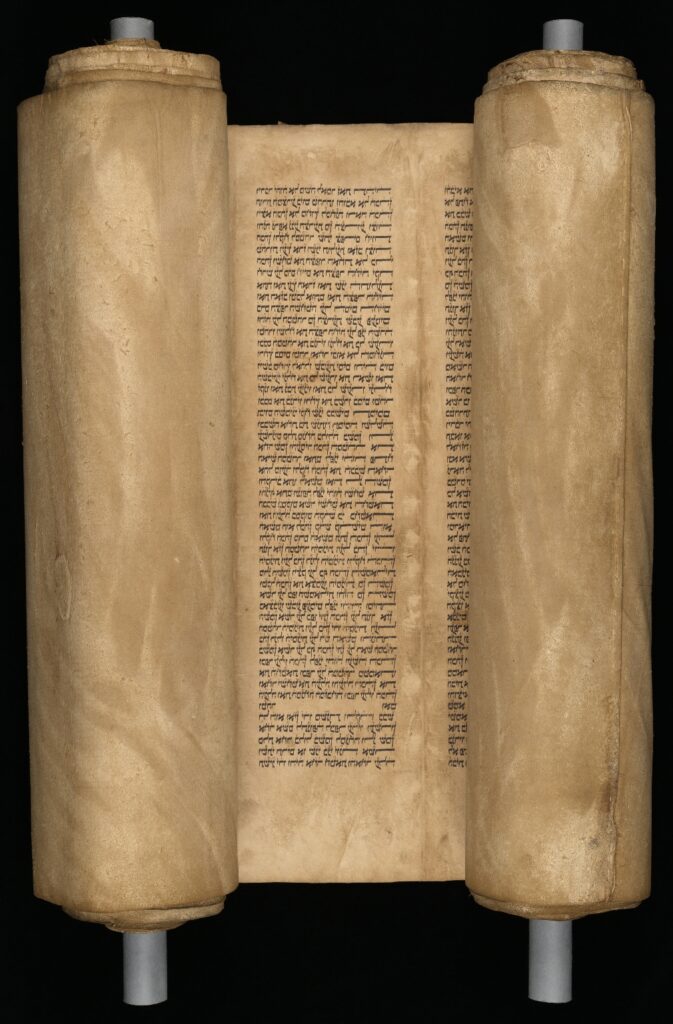
Torah Scroll, New College Library
On trial: State Papers Online Eighteenth Century
Thanks to a request from a PhD student in HCA the Library currently has extended trial access to State Papers Online: Eighteenth Century, 1714-1782 Parts I-IV from Gale. This covers the final section of the State Papers series from the National Archives in the UK before the series was closed and replaced by the Home Office and Foreign Office series in 1782.
You can access State Papers Online: Eighteenth Century via the E-resources trials page.
Access is available on and off-campus.
Trial access ends 30th June 2020.
State Papers Online: Eighteenth Century comes in 4 parts and we have access to all 4 during this trial. Read More
‘Protecting sensitive data’: new MANTRA unit now available
The Research Data Support team are pleased to announce a new update to MANTRA, the free and open online research data management training course.
The new ‘Protecting sensitive data’ module has been created from scratch, replacing the previous ‘Data protection, rights and access’ unit to provide an up-to-date guide for researchers working with sensitive and personal data.
MANTRA is designed to give post-graduate students, early career researchers, and information professionals the knowledge and skills needed to work effectively with research data.
The ‘Protecting sensitive data’ unit considers the ethical and legal contexts for conducting research with sensitive data, including information and guidance on:
- What makes data sensitive?
- What UK and European data protection laws mean for research
- Research ethics, informed consent and consent documentation
- Approvals processes and accessing restricted data
- Safeguarding sensitive data, including data retention limits, access controls and anonymisation
- Data protection training
MANTRA is designed to be approachable and informative, and incorporates text and video content plus quizzes, interactive exercises and a ‘further reading’ section.
We hope you find the new content interesting and useful, and we welcome comments on the new unit, as well as feedback on the other seven MANTRA modules.
Finally, the RDS team are currently working on a series of further updates to MANTRA which will be rolled out over the coming weeks, and information about these releases will be posted on this blog and the RDS Twitter account.
Bob Sanders
MANTRA, Lead Editor
Edinburgh Research Archive downloads: April 2020

Oxford Politics Trove – on trial
Thanks to a request from a member of staff from Politics & International Relations, the Library currently has extended trial access to Oxford Politics Trove, which enables you, for the first time, to search and interrogate the wealth of Oxford’s politics textbook list.

You can access Oxford Politics Trove via the E-resources trials page.
Access is available on and off-campus.
Trial access ends 30th June 2020. Read More
New to the Library: Trismegistos
I’m happy to let you know that further to a request from staff in HCA the Library now has a subscription to Trismegistos, an online resource that aims to surmount barriers of language and discipline in the study of texts from the ancient world, particularly late period Egypt and the Nile valley (roughly BC 800 – 800 AD).

You can access Trismegistos via the Databases A-Z list and Classics subject guide.
The core component of Trismegistos (TM) is Trismegistos Texts, currently counting 823212 entries. When the database was created in 2005, it focused on providing information (metadata) on published papyrological documents from Graeco-Roman Egypt. Since then the geographical scope has been widened to the entire ancient world, the time period covered was broadened to between BC 800 and AD 800, and the database was expanded to include epigraphic material as well. Read More
The Not-So-Lonely Lockdown of the Transcribing Geologists
 Lockdown may seem frustrating and tiresome to some, but it has made space for a few spontaneous and unexpected collaborations!
Over the last month with many “physical” tasks on hold, I have been able to peruse the sections of the Lyell notebooks which were digitised before the introduction of social distancing and the subsequent shut down of the University buildings. And far from being a lonely task – the notebooks have proven to be one of the most social activities I have ever worked on! As it turns out Twitter has a host of geologists, curators, PhD students, as well as academics in subjects ranging from the ideals of Victorian masculinity, to geomorphology… all just waiting to chip in their thoughts on what exactly Charles Lyell was thinking – and its more than likely they are all there because lockdown has disrupted their regular routines.
Now before we start, admittedly there have been some criticism of the notebooks. There is a much more standardised approach to how people “do” notebooks these days, especially in the field: Sketches must have an orientation, a scale bar and some annotation. So there have been a few comments that Sir Charles wouldn’t score very highly if he were an undergraduate summiting his work for assessment.
As a founder of modern geology, it’s important to note how the science has evolved since then, incorporating standards of which Lyell certainly would approve. A very generous statement on twitter from Professor Simon Mudd (@SimonMariusMudd), School of GeoSciences:
“I haven’t spent much time with these notebooks, but from what I have seen this (see sketch below) is the typical quality of the sketches. He was more of a ‘big ideas’ rather than ‘detailed sketches’ type of person.”
Lyell’s oversights in these areas, however, has not been too great an impediment for lively debate, especially when the diagram seems to be a bit of a mystery.
Last week I posted this sketch from notebook 4 on Twitter.

What is it?!? Is it rivers? Oxbow lakes? Waves crashing onto the shore of… Norfolk?
Cue a volley of guesses:
“A Sea-serpent?”
“You are all so wrong, it says “Loch Ness” and here, in the middle, you have Nessy…”
“Was he just bored and doodling??”
So it is true – nothing is sacred to the internet – not even one of the founding fathers of geology’s notebook!
But with the fun came a conclusion: this illustration in Notebook 4 is likely a map of sand banks off the Norfolk coast. Lo and behold, Andy Emery, the geomorphist, produced a map!
And YES – The sketch maybe isn’t as inaccurate as we had initially thought! But how did Lyell know what the submarine landscape off the coast of Norfolk look like in 1827?
There is a good chance that local fisher men would have known about these features, as they are shallower and depending on tides and currents, they might have been the best place to go fishing… or the worst place to run your boat aground.
Another of our online-super-sleuths, Jonny Scafidi (@jonafushi), messaged to say “On p.308 of Principles of Geology he mentions a Captain Hewett, R. N. who, according to p.56 of Memoirs of Hydrography, Volume 1 by Commander L.S. Dawson R.N. undertook a great survey of the N. Sea”. Most of Captain Hewett’s surveys where completed in the 1830’s but there is mention of a survey in 1822 – 5 years before Lyell sketched this diagram in his book. So it is possible Lyell had access to some surveys.
We will never know for certain where Lyell got the information that inspired this sketch. But what we can prove is that social media can be used to explore a whole array of different angles when investigating historical notebooks!
Stay tuned for more exciting installments of #TranscriptionTime over at @CockburnGeol and try your hand at deciphering the thoughts of historical scientists and collectors.
Thanks to the Science twitterati who helped with this mystery between 9.27am and 10.33am on 24th April:
Andy Emery (@AndyDoggerBank) – RA in Energy Transition, School of Earth & Environment, University of Leeds
Jonny Scafidi (@jonafushi) – PhD candidate, School of GeoSciences, University of Edinburgh
Simon Mudd (@SimonMariusMudd) – Professor of Geomorphology, School of GeoSciences, University of Edinburgh
John Faithfull (@FaithfullJohn) – Curator, Hunterian Museum & Art Gallery
Dan Hobley (@Siccar_Point) – Lecturer, School of Earth and Ocean Sciences, Cardiff Univeristy
Rich Taylor (@RockhoundRich) – Geoscience Applications Development at ZEISS Microscopy
Mikael Attal (@mickymicky06s) – Senior lecturer in Geomorphology, School of GeoSciences, University of Edinburgh
Dr. Gillian McCay
Curator, Cockburn Museum
@CockburnGeol
On trial: State Papers Online
Thanks to a request from the School of Literatures, Languages and Cultures (LLC) the Library currently has trial access to 3 further collections from the State Papers Online database from Gale. State Papers Online offers original historical materials across the widest range of government concerns, from high level international politics and diplomacy to the charges against a steward for poisoning a dozen or more people.

You can access the 3 collections on trial via the E-resources trials page.
Access is available on and off-campus.
Trial access ends 30th June 2020.
The 3 collections the Library has trial access to are: Read More
Collections
 Hill and Adamson Collection: an insight into Edinburgh’s past
My name is Phoebe Kirkland, I am an MSc East Asian Studies student, and for...
Cataloguing the private papers of Archibald Hunter Campbell: A Journey Through Correspondence
My name is Pauline Vincent, I am a student in my last year of a...
Hill and Adamson Collection: an insight into Edinburgh’s past
My name is Phoebe Kirkland, I am an MSc East Asian Studies student, and for...
Cataloguing the private papers of Archibald Hunter Campbell: A Journey Through Correspondence
My name is Pauline Vincent, I am a student in my last year of a...
Projects
Cataloguing the private papers of Archibald Hunter Campbell: A Journey Through Correspondence
My name is Pauline Vincent, I am a student in my last year of a...
Archival Provenance Research Project: Lishan’s Experience
Presentation My name is Lishan Zou, I am a fourth year History and Politics student....