Home University of Edinburgh Library Essentials
May 22, 2026
New! British Labour Party and Independent Labour Party Papers
I’m happy to let you know that the Library now has access to 3 British Online Archive digital collections of primary source documents relating to British political history in the 20th century:
- British Labour Party Papers, 1906-1968
- British Labour Party Papers, 1968-1994
- Independent Labour Party Records, 1893-1960.

You can access all 3 databases via the Digital Primary Source and Archive Collections guide, the Databases A-Z list and the Politics and International Relations subject guide. Read More
New to the Library: Scottish nationalist leaflets, 1844-1973
I’m happy to let you know that the Library now has access to the database Scottish nationalist leaflets, 1844-1973 from British Online Archives. This digital primary source database collects together pamphlets relating to Scottish nationalism printed by the Scottish National Party (SNP) and their predecessors.

You can access Scottish nationalist leaflets, 1844-1973 via the Digital Primary Source and Archive Collections guide and the Databases A-Z list. Read More
Digital Wall Student Experience Internships

Student browsing images of Library and University Collections on the Digital Wall
This past Winter 2019/20 the Digital Imaging Unit and Centre for Research Collections Museums teams hosted two student interns to support the development of the new Digital Wall, which opened in the University of Edinburgh’s main Library in September 2019. The students, Dario Lucarini (Napier University) and Tom Hutton (Edinburgh College of Art), were tasked with Read More
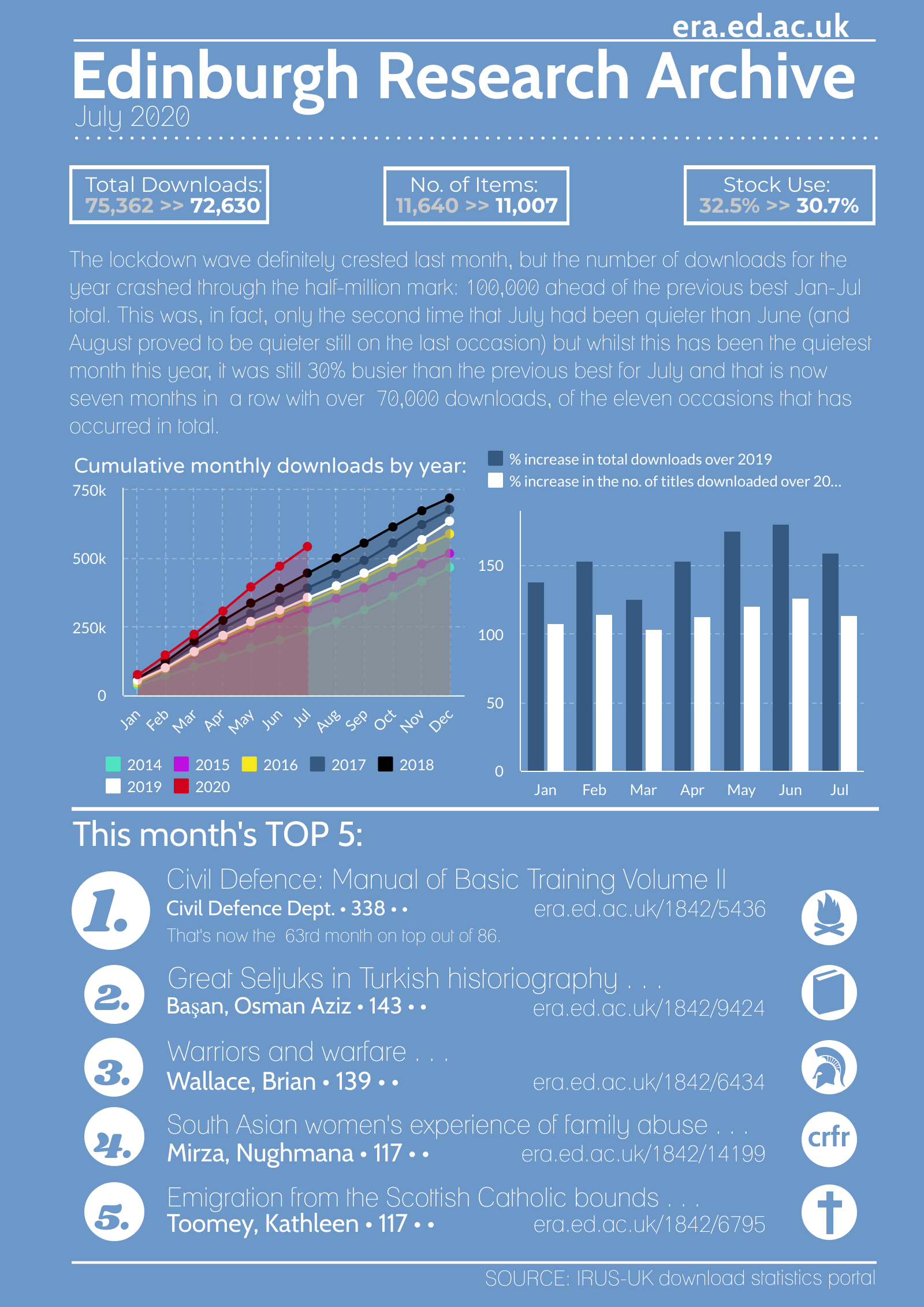
Edinburgh Research Archive downloads: July 2020
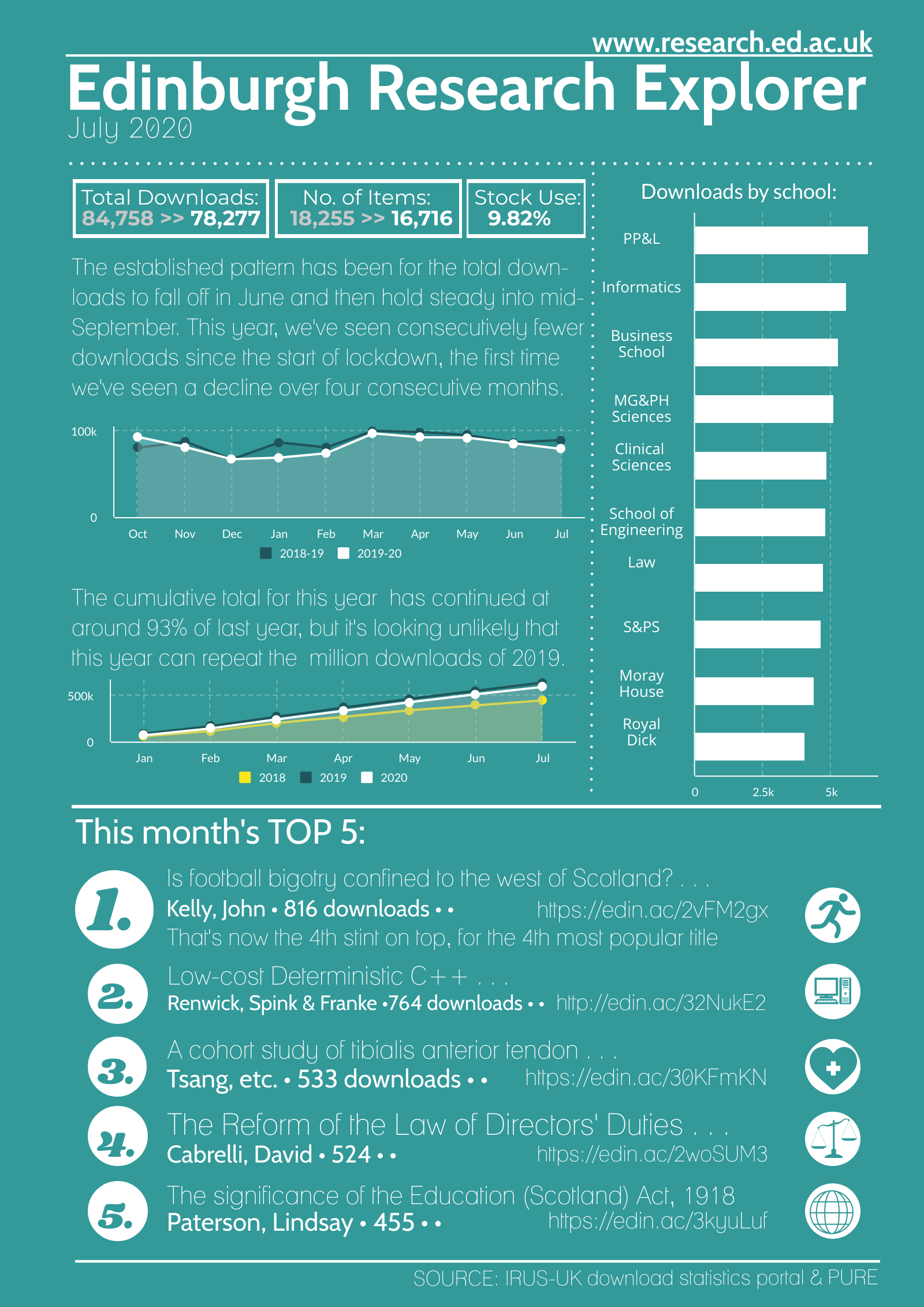
Edinburgh Research Explorer downloads: July 2020
The School of Scottish Studies Archives in Light Festival
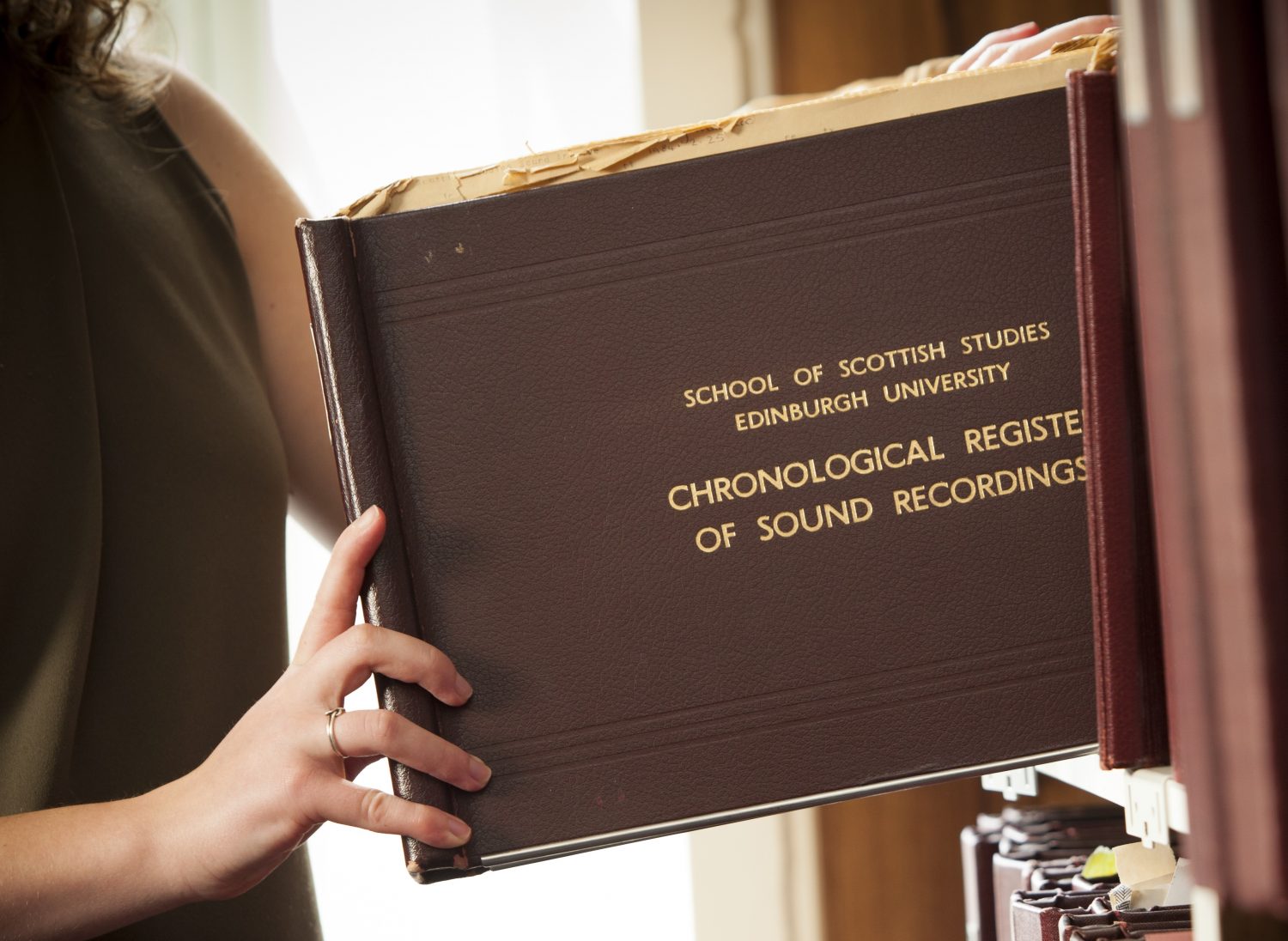
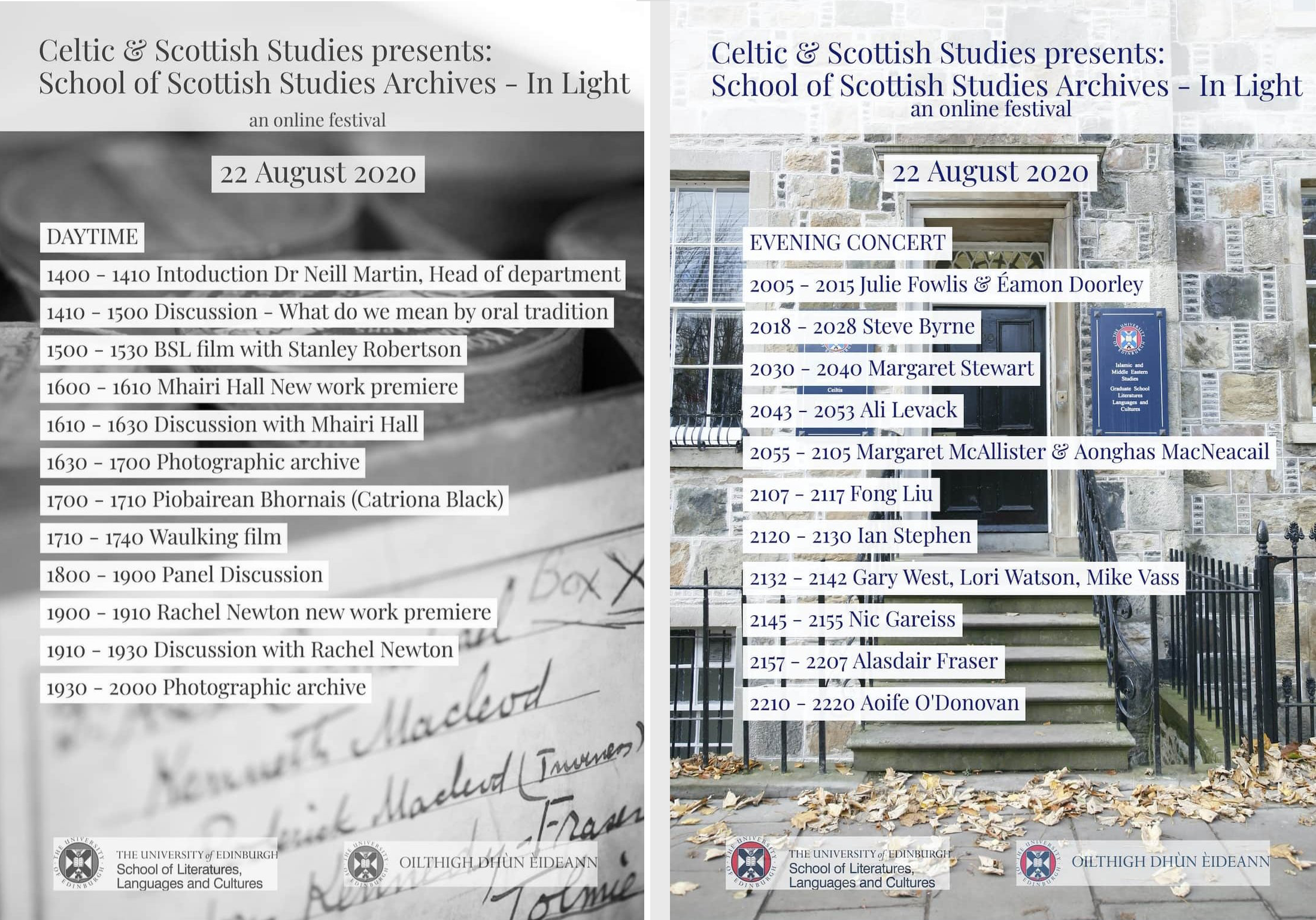
On Saturday, 22 August, the School of Scottish Studies Archives (SSSA) will be celebrated in a day-long online festival event hosted by the Celtic and Scottish Studies department.
Curated by Mike Vass, Traditional Artist in Residence, The School of Scottish Studies Archives In Light festival will focus on the sound, film and photographic collections of SSSA and will feature new work – inspired by archive recordings – by Scottish musicians Mhairi Hall and Rachel Newton. In addition to music and song, the programme features conversations and Archives Curator, Cathlin Macaulay, along with Ella Leith and Chris Wright, will be participating in the panel discussion ‘What do we mean by oral tradition?’ hosted by Professor Gary West.
Our photographic and film collections are also set to feature. There will be with a film of Storytelling with BSL translations of audio recordings from the late Stanley Robertson, Traveller, storyteller, balladeer and piper from Aberdeen. There is also an opportunity to see a fieldwork film made in South Uist in 1970 which shows the tradition of waulking the cloth (SA1970.01).
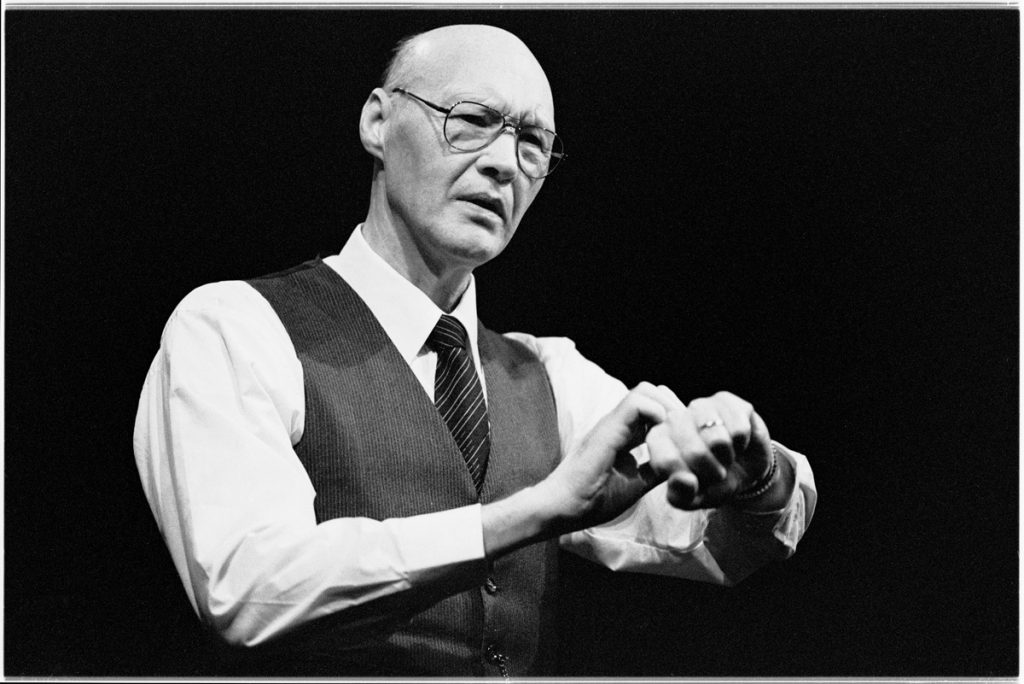
Stanley Robertson. Photographer: Ian Mackenzie (Reference: A163318) © SSSA
There will also be two visual displays from our Photographic Archive, featuring images from the collections of Werner Kissling (1895-1988) , Robert Atkinson (1915-1995) and SSSA photographer and curator Ian MacKenzie (1959-2009). The presentations will be accompanied by archive recordings from The Scottish Tradition Series which have been produced in collaboration with Greentrax Recording Limited.
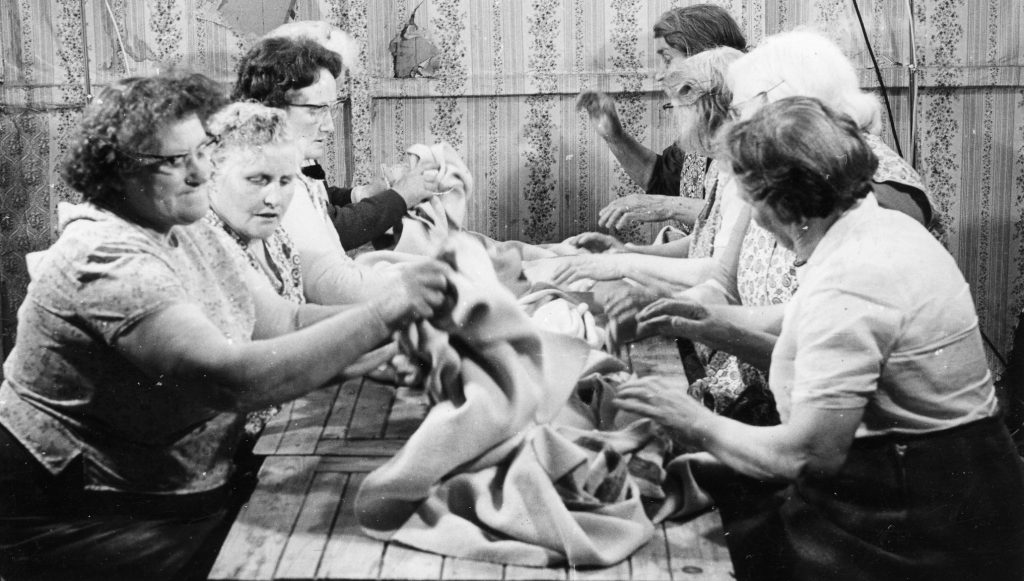
Waulking the Cloth (BVIII-3-7678) © SSSA
Finally, the festival will conclude with an evening concert of music, storytelling and dance from a stellar cast of performers from both sides of the Atlantic. The evening concert will be hosted by Professor Gary West, Chair in Scottish Ethnology, and features performances from musicians Julie Fowlis & Éamon Doorley; BBC Radio Scotland Young Traditional Musician of the Year Ali Levack; Steve Byrne, Margaret Stewart, Fulbright-Scotland Visiting Professor Margaret McAllister, acclaimed author and storyteller Ian Stephen. There will also be special transatlantic guests: singer-songwriter Aoife O’Donovan, fiddler Alasdair Fraser and dancer and musician Nic Gareiss as well as a performance from Glasgow-based Chinese singer and storyteller Fong Liu.
School of Scottish Studies Archives Traditional Artist in Residence Mike Vass said, “It has been a privilege curating this online event – many of the artists have a long association with the Archives and have drawn inspiration from it. Hosting this event online allows us to shine a light on the creativity that springs from this amazing resource, and on the wealth of material contained within it. We look forward to sharing this fantastic line-up, bringing together different audiences, and making connections through our shared cultural heritage.”
Dr Neill Martin, Head of Celtic & Scottish Studies said, “We conceived this event amid the bewildering early stages of lockdown, when it seemed that the music stopped and all around became still and eerily quiet. This is our response; an assertion of the power of music, song and the traditional arts of all kinds to create and sustain community in times of adversity. We hope you will join us.”
Daryl Green FSA, Head of Special Collections said, “The School of Scottish Studies Archive continues to amaze me, both in the content that was captured by pioneering ethnologists, but also in the empathy of those who were doing the collecting. Although new to the University, I’ve been exposed to pieces of the collection throughout lockdown which have moved me deeply: seeing the documentary evidence of traditional crafts long passed, hearing the conversation and stories, the multitude of music and accents and real connection to people and place all create this swell of emotion and sense of being. It is no surprise that this collection has inspired what will surely be a rich and powerful event.”
This special online event is a taster of what is to come in 2021 as we celebrate our Platinum Jubilee. Also coinciding with the 70th anniversary, the department of Celtic and Scottish Studies will launch a new Master’s programme for traditional artists and is the first of its kind aimed at musicians, dancers and storytellers.
The School of Scottish Studies Archives – In Light begins at 2pm, on Saturday 22 and will be streamed on the Celtic & Scottish Studies YouTube channel:
https://www.youtube.com/CeltScotVideos
and their Facebook page:
https://www.facebook.com/traditionalartsperformance
For more information about SSSA collections you can visit our website:
If you can’t make the online festivities you can still find material from SSSA on Tobar an Dualchais. There are almost 36,000 tracks from our collections which are available to listen to online:
Find out more about Celtic & Scottish Studies on their website:
: : : : : : : : : : : :
Update:
Some of the events of SSSA in Light will remain available for a short time to view on the CeltScotVideos channel on YouTube.
Preparing the Way
This week our project archivist gives us the inside view from our Body Language Archives project, bringing us on (the project management) board, with a review of project progress and highlights how archives cataloguing projects prepare the way new research.
The images above are a selection of some of the slides that we shared with our project board from our project progress report presentation at our virtual project management board meeting on Tuesday 11 August 2020.
At the end of our virtual meeting on Tuesday afternoon this week, our project board unanimously enthused over our project progress. We thought we would share some of the highlights.
- Scottish Gymnastics collections catalogue complete and online
- Dunfermline College of Physical Education Old Students’ Associaiton complete, online
- Dunfermline College of Physical Education 90% complete
- Dunfermline College of Physical Education, 447 student files rehoused and listed.
- Dunfermline College of Physical Education audiovisual / film – 180 new catalogue descriptions converted from legacy electronic data-set to online catalogue
- Margaret Morris Collection Photographs – expanded the existing data-set from 406 catalogue descriptions to 1738 descriptions, uploaded to ArchivesSpace (online catalogue)
- Margaret Morris Collection 2534 / 3596 catalogue descriptions completed on ArchivesSpace
- Technical infrastructure for test project website in place with draft content
All of this work means that these collections will become more accessible and open up new areas of potential research around health, well-being, movement, dance, the history of sporting apparel, the history of sport management and so much more. All of which afford us the opportunity to develop a greater understanding of these subject areas, their interrelationships, and the human experience as a whole.
We are helped greatly in our work by some fantastic volunteers. It is always a pleasure to report positive stories to our project board about the range of work we do to support new archive professionals. This was easy for me to do, as I had the pleasure of being supported by two up and coming professionals on the Body Language project. One of whom is just about to complete an MSc Information Management and Preservation and the second is now working as a fully qualified archivist with the Centre for Research Collections at the University of Edinburgh. Well done to both Emma and Elise, and a great big thank you to both of them for their wonderful work on the project.
Our project board is made up of a group of academics, and curatorial and archive professionals with research and collection care interests in movement, dance and physical education collections. Together they make sure that our project stays on track, and help us to think outside the day to day activities of the archive cataloguing work. I always enjoy meeting with our project board as they are so incredibly supportive of our work and inevitably bring something surprising and valuable to the table that we hadn’t thought of. It usually starts with “what about…..?” A huge thank you to Professor John Ravenscroft, Dr Wendy Timmons, Dr Matt McDowell, Dr Tiffany Boyle, Rhona Rodger, and Rachel Hosker for their continued support.
Elaine MacGillivray
Project Archivist
NEW Further Charles Lyell Papers
July was a busy month for the Sir Charles Lyell Collection, and the Centre for Research Collections.
After much planning and advice, the CRC passed inspection, and we opened again for University of Edinburgh researchers on 8 July with new ways of working, but offering access to our collections once again. This has also meant that we were able to welcome in new acquisitions whose delivery was paused during the nation’s lockdown. Which means, at long last, we are able to share the news of a very exciting addition of papers, correspondence, and rare manuscripts to the University’s Sir Charles Lyell Collection.

Rachel Hosker assists with off-loading the material in auction boxes, and moving them to be condition checked by Katherine Richardson.
This new collection includes over 900 letters to and from Sir Charles Lyell (including additional letters from Darwin, Joseph Dalton Hooker, John Murray, etc.); intimate correspondence between Lyell and his wife, Mary Horner Lyell, and his wider family; autograph manuscripts of a number of lectures delivered both in the United States and in the United Kingdom; a part of the autograph manuscript of Principles of Geology; maps commissioned for lectures and publications; and heavily annotated editions of Principles of Geology and other works marked up for later editions. This additional collection was allocated to the University of Edinburgh Library in 2020 by HM Government under the Acceptance in Lieu of Inheritance Scheme, from the estate of the 3rd Baron Lyell.
Daryl Green, Head of Special Collections, inspects a hand-drawn geological map of Kinnordy Estate and its district from the newly acquired Sir Charles Lyell archive. Photo © David Cheskin
Daryl Green, our Head of Special Collections and Deputy Director of the CRC, has had a chance to have an initial dive into this collection in order to check its inventory and gauge its quality. Here’s some initial reactions:
“Having arrived in March to my new post as Head of Special Collections, one of my first tasks was to oversee the transfer of this material from its holding location in London to the University. Lockdown prevented our best laid plans, however, and the Acceptance in Lieu material finally arrived on a warm and quiet day mid-July. Sifting through this material in an initial ‘getting to know you’ session, I was struck at how thorough the correspondence archive was. There are folder and folders of correspondence with Charles Bunbury, Joseph Dalton Hooker, John Murray and many others, but also transcripts of letters going out that were copied by one of Lyell’s sister-in-laws, Katherine Murray Lyell. Here, too, is a lifetime of correspondence between Charles and Mary Horner Lyell, from initial courting, to full blown intellectual romance, to letters later in life.
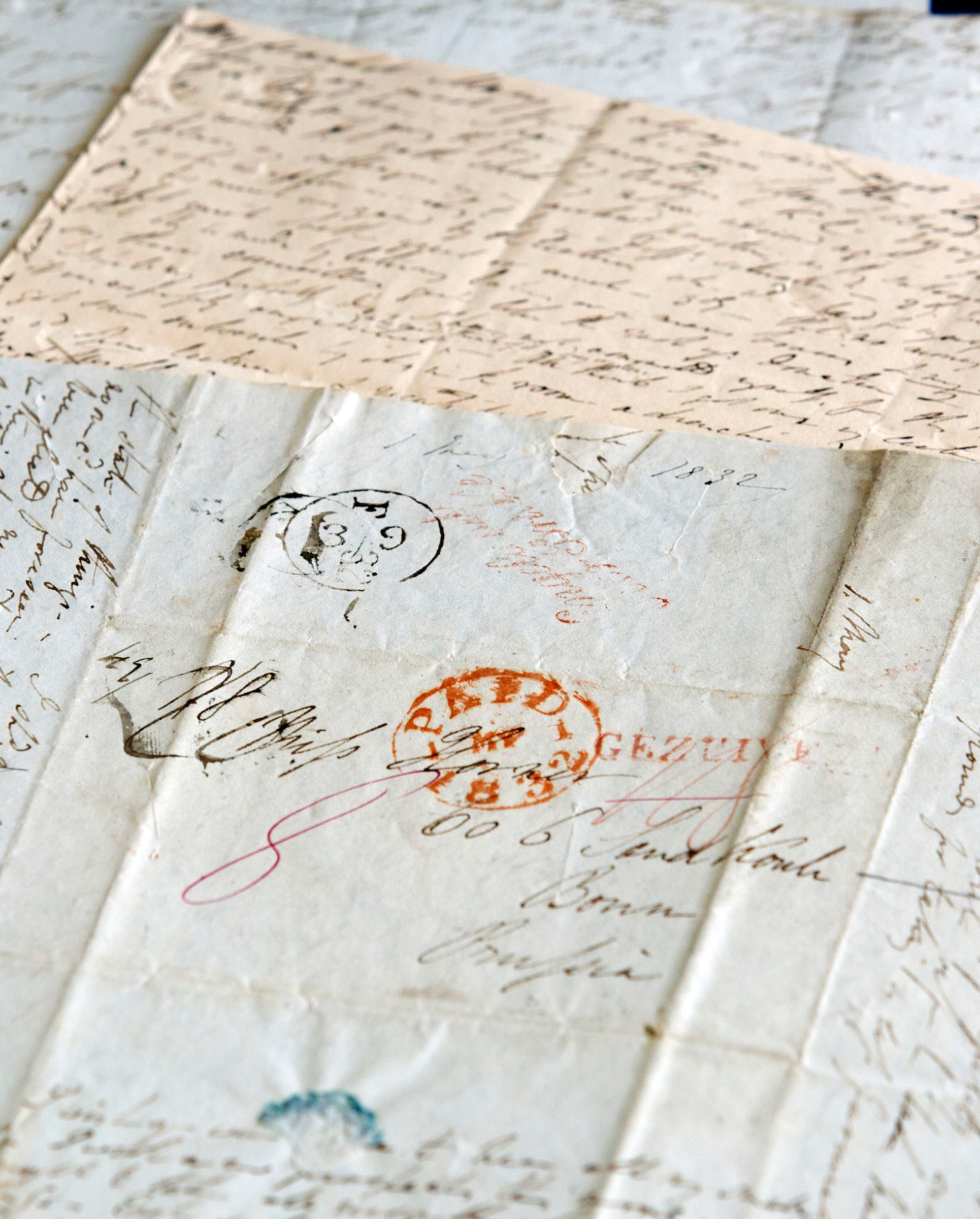
Letters from Sir Charles Lyell to his fiancée, Mary Horner, from the newly acquired Sir Charles Lyell archive. Photo © David Cheskin
As I sorted through folders I came across diagrams for how Lyell wanted his lecture theatre laid out for his tour of the States, I found hand-drawn maps and illustrations, both by Lyell and commissioned from others, including alluring diagrams, a gorgeous watercolour map of Etna, and a huge geological map of the Kinnordy Estate and its district.
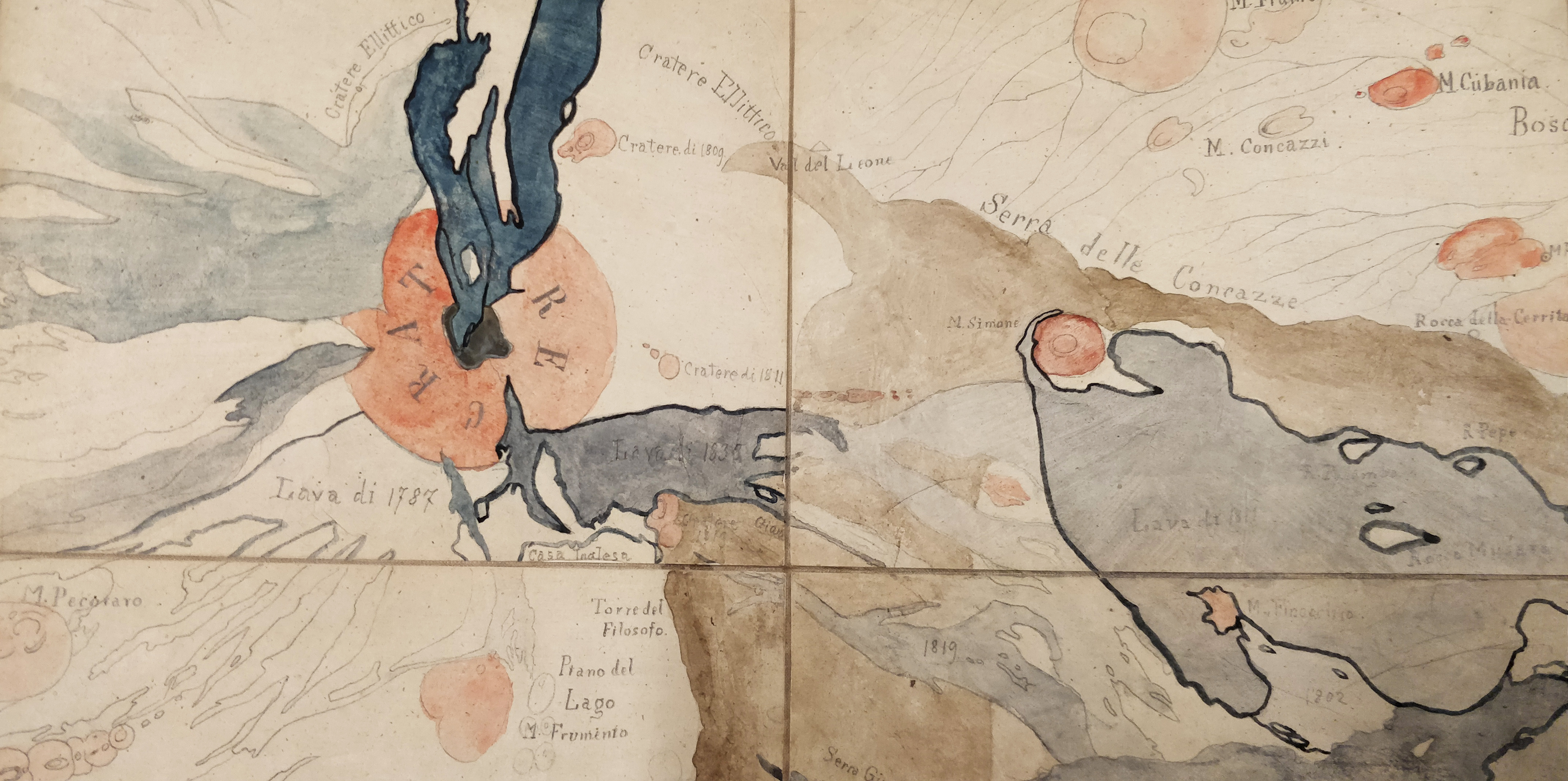
Detail of a hand-drawn map of Mount Etna from the newly acquired Sir Charles Lyell archive.
“This archive is by all accounts an amazing resource in its own regard.”
Letters upon letters between geologists, students, and admirers have all been beautifully preserved and organized by the Lyell family, and included in the archive was some of the work done by a member of the Lyell family in the 20thcentury to track down and copy correspondence, especially between Lyell and Charles Darwin, which had ended up in other collections. This archive is by all accounts an amazing resource in its own regard and, when paired with the notebooks, the further archive material, the publications and the geological samples, gives a more complete picture of how science was conducted in the 19th century than any other archive I am aware of.”
Conservation and archival description work is ongoing in order to provide public access to this collection. To support these activities and digitisation, read more here.
New Digital Imaging Unit Website
Guest post by Meg Dolan (MScR Collections and Curating Practices, 2020) and Keith Bossert (MSc History of the Book, 2020)
This summer we had the opportunity to intern with the Digital Imaging Unit, working under Photographer, Juliette Lichman, and DIU Manager, Carla Arton. Due to COVID-19 we worked remotely to expand and update the DIU’s web presence on the University’s Main Library page, a service development project related to their larger Digitisation as a Service Strategy.
The project was divided into 5 phases:
- Pre-Planning and User Experience Research & Analysis
- Planning and Training
- Design and Creation
- Usability Testing and Tweaking
- Publication

Phase 1: Pre-Planning and User Experience Research & Analysis
In Phase 1, we viewed the websites of similar digitisation departments across other academic and research institutions. This allowed us to Read More
DataVault – larger deposits and new review process notifications
New deposit size limit: 10TB
Great news for DataVault users: you can now deposit up to a whopping ten terabytes in a single deposit in the Edinburgh DataVault! That’s five times greater than the previous deposit limit, saving you time that might have been wasted splitting your data artificially and making multiple deposits.
It’s still a good idea to divide up your data into deposits that correspond well to whatever subsets of the dataset you and your colleagues are likely to want to retrieve at any one time. That’s because you can only retrieve a single deposit in its entirety; you cannot select individual files in the deposit to retrieve. Smaller deposits are quicker to retrieve. And remember you’ll need enough space for the retrieved data to arrive in.
We’ve made some performance improvements thanks to our brilliant technical team, so depositing now goes significantly faster. Nonetheless, please bear in mind that any deposit of multiple terabytes will probably take several days to complete (depending on how many deposits are queueing and some characteristics of the fileset), because the DataVault needs time to encrypt the data and store it on the tape archives and into the cloud. Remember not to delete your original copy from your working area on DataStore until you receive our email confirming that the deposit has completed!
And you can archive as many deposits as you like into a vault, as long as you have the resources to pay the bill when we send you the eIT!
A reminder on how to structure your data:
https://www.ed.ac.uk/information-services/research-support/research-data-service/after/datavault/prepare-datavault/structure
Ensuring good stewardship of your data through the review process
Another great feature that’s now up and running is the review process notification system, and the accompanying dashboard which allows the curators to implement decisions about retaining or deleting data.
Vault owners should receive an email when the chosen review date is six months away, seeking your involvement in the review process. The email will provide you with the information you need about when the funder’s minimum retention period (if there is one) expires, and how to access the vault. Don’t worry if you think you might have moved on by then; the system is designed to allow the University to implement good stewardship of all the data vaults, even when the Principal Investigator (PI) is no longer contactable. Our curators use a review dashboard to see all vaults whose review dates are approaching, and who the Nominated Data Managers (NDMs) are. In the absence of the Owner, the system notifies the NDMs instead. We will consult with the NDMs or the School about the vault, to ensure all deposits that should be deleted are deleted in good time, and all deposits that should be kept longer are kept safe and sound and still accessible to all authorised users.
DataVault Review Process:
https://www.ed.ac.uk/information-services/research-support/research-data-service/after/datavault/review-process
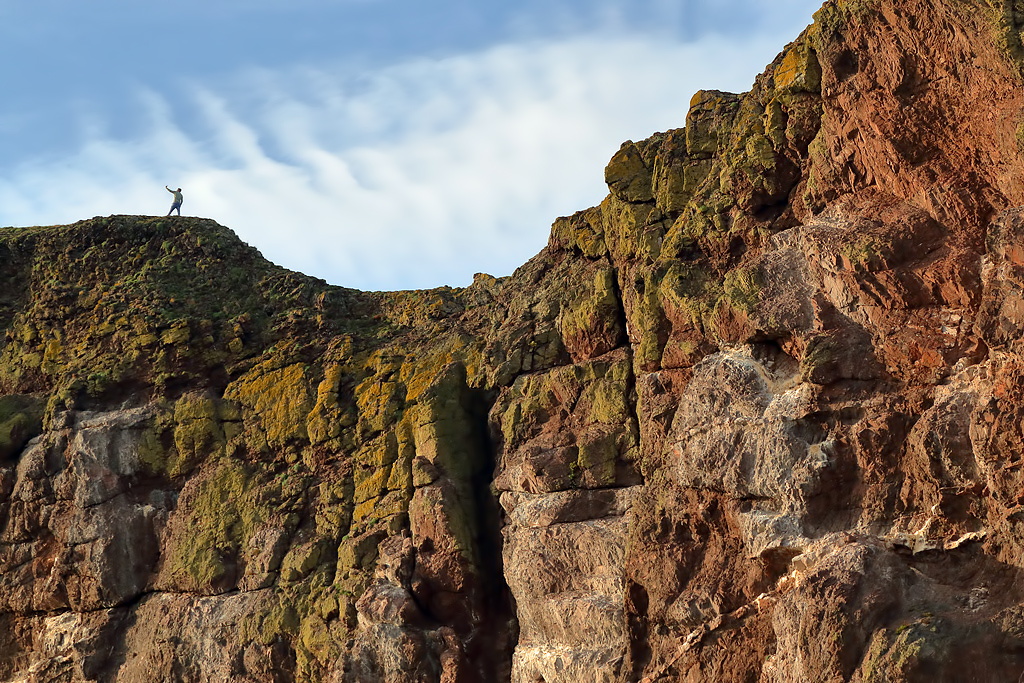
The new max. deposit size of 10 TB is equivalent to over five million images of around 2 MB each – that’s one selfie for every person in Scotland. Image: A selfie on the cliffs at Bell Hill, St Abbs
cc-by-sa/2.0 – © Walter Baxter – geograph.org.uk/p/5967905
—
Pauline Ward
Research Data Support Assistant
Library & University Collections
Collections
 Hill and Adamson Collection: an insight into Edinburgh’s past
My name is Phoebe Kirkland, I am an MSc East Asian Studies student, and for...
Cataloguing the private papers of Archibald Hunter Campbell: A Journey Through Correspondence
My name is Pauline Vincent, I am a student in my last year of a...
Hill and Adamson Collection: an insight into Edinburgh’s past
My name is Phoebe Kirkland, I am an MSc East Asian Studies student, and for...
Cataloguing the private papers of Archibald Hunter Campbell: A Journey Through Correspondence
My name is Pauline Vincent, I am a student in my last year of a...
Projects
Cataloguing the private papers of Archibald Hunter Campbell: A Journey Through Correspondence
My name is Pauline Vincent, I am a student in my last year of a...
Archival Provenance Research Project: Lishan’s Experience
Presentation My name is Lishan Zou, I am a fourth year History and Politics student....