Home University of Edinburgh Library Essentials
April 6, 2026
Visualising Civic Improvement
Explore Scotland’s capital through the mind of one of Scotland’s greatest social thinkers and join us as we take a closer look at Professor Sir Patrick Geddes’ (1854-1932) photographic survey of Edinburgh.
From Pompei to the present day, humankind has sought to effect its civic surroundings. From promoting security and avoiding danger to eradicating disease and poverty and the promotion of health and well-being, the motives may change over time but often co-exist and are deeply interconnected, and they reflect the civic values of each society’s citizenry.
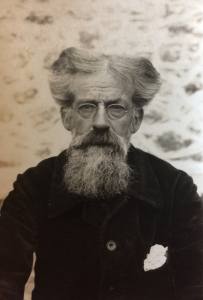
Patrick Geddes, aged 73, at Montpellier, c.1927 (Coll-1167)
Professor Sir Patrick Geddes (1854-1932) held a deep understanding of the complexities and inter-connectedness of civic change. Geddes made a unique and pioneering contribution to the fields of sociology and urban planning, not least through his tireless contributions, in the late nineteenth and early twentieth centuries, to regenerate the impoverished and dilapidated Old Town of Edinburgh.
Born in the Highlands of Scotland in 1854, Patrick Geddes studied biology and evolutionary theory in London, France and Mexico, before returning to Scotland in 1880 to teach biology at the University of Edinburgh. By the mid-1880s his interests had diverged to sociology, geography, ecology, education theory, cultural activism and urban planning. Geddes was a polymath and inter-disciplinarian.
Research conducted throughout his lifetime in Scotland, Europe, India, Palestine, the United States of America, and Mexico informed his conviction that the development of human communities was primarily biological in nature, consisting of interactions among people, their environment and their activities. Patrick Geddes died in Montpellier, France, in 1932.
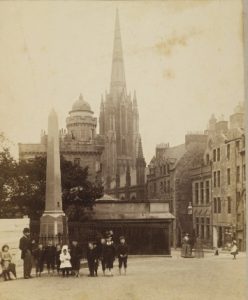
Patrick Geddes and a group of children in front of the Outlook Tower (Patrick Geddes Collection, Ref: Coll-1167/B/23/12)
Geddes believed that civic regeneration ought to be informed by a comprehensive sociological understanding of the city, its region and their inter-relationships. He argued that geology, geography, climate, economic life, and social institutions should all be considered. The basic analysis for his civic survey was derived from his Frederick Le Play inspired triad ‘place, work and folk’.
The survey of Edinburgh and its region was the fundamental purpose of Geddes’ Outlook Tower. Geddes forged and disseminated many of his ideas in this six-storey social laboratory, situated on Edinburgh’s Royal Mile, which he purchased and refurbished in 1892. Designed as a civic observatory, Geddes created a series of vertical exhibition spaces intended to help people understand the city in its wider context. He believed that the reconstruction of society would result from the co-operative efforts of informed individuals.
“The survey of our city and its region is of fundamental importance alike in the understanding of its past and present, and towards the preparation of the Greater Edinburgh of the near future.”
Patrick Geddes, 1919
Geddes amassed a vast collection of maps, views, plans, architectural drawings, photographs and other visual images at his Outlook Tower. The rooftop promontory offered the visitor a 360-degree view of the city of Edinburgh and its region. Together, these vivid and graphic representations illustrated the development of the city of Edinburgh over time, connecting its past to its present, and illuminating its relationship with the wider world. Geddes first exhibited a selection of visual material from his Outlook Tower collections at the Royal Institute of British Architects ‘Cities and Town Planning Exhibition’ in London in 1910. Exhibitions, were his favoured tool of civic education, where he set out and encouraged the adoption of his survey method.
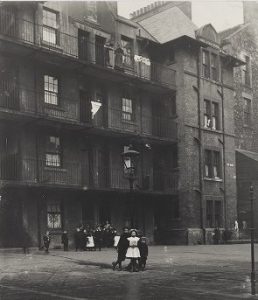
Tron Square, Edinburgh, (Patrick Geddes Collection, Ref: Coll-1167/B/27/4/5)
Photographs recording the built environment of Edinburgh and the way in which people lived and worked in it, were integral to Geddes’ Survey of Edinburgh. This type of photography was representative of a Scottish Visual Culture which was heavily influenced by Scottish Enlightenment philosophy. Great value was placed on empiricism and practicality, centred around values of improvement, virtue, and practical benefit for the individual and society as a whole. Geddes’ photographic survey forms part of a larger body of work of a network of late nineteenth century Scottish documentary photographers including Thomas Annan in Glasgow, William Donaldson Clark in Edinburgh, and John Thomson in London. Collectively, these photographs bore witness to the lives of the urban poor and were often used to inform social improvement programmes.
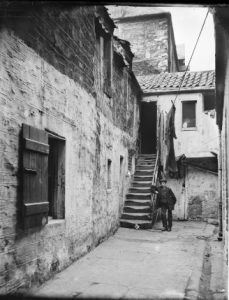
Brown’s Close, Canongate, Edinburgh, (Patrick Geddes Collection, Ref: Coll-1167/B/27/5/22)
The Photographic Society of Edinburgh established an Edinburgh Photographic Survey group in 1899, with the objective of creating a photographic record of Edinburgh. The Society subsequently staged an exhibition in 1904 which included 359 photographs. It is not clear whether the photographs used by Geddes in his Survey of Edinburgh were loaned to him from the Photographic Society of Edinburgh or in fact commissioned by him. It is thought that many may have been taken by photographers Francis Caird Inglis (fl.1880-1940) and Robert Dykes (fl. 1905-1906) and then a selection made and arranged for the survey by Geddes himself, assisted by Dykes, and two of his children, Norah Geddes (1887-1967) and Alastair Geddes (1891-1917), along with his God-daughter, Mabel Barker (1885-1961).
In the 1880s, Edinburgh’s historic Old Town was afflicted by degraded buildings and social deprivation. Whilst apt to meet the needs of the well-to-do, historically, planners had neglected the needs of all citizens. In failing to provide space for work-shops and industry, Geddes argued that this lack of foresight inevitably led to the unchecked filling up of any and every vacant space with any and every sort of irregular and utilitarian factory and workshop. Thus stately residential order and plan-less squalor could be found on opposite sides of the same street.
Geddes’ Survey of Edinburgh was a call for civic engagement and co-operation. Geddes asked:
“what can be done here and there meanwhile with moderate means and ordinary folk, with such labour and time as they can spare?” Patrick Geddes, 1915
Children’s Garden, Johnston Terrace, Edinburgh (Patrick Geddes Collection, Ref: Coll-1167/B/27/10/9)
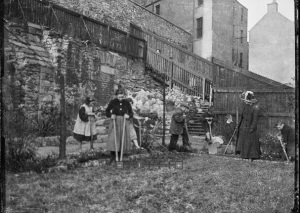
The Outlook Tower Open Spaces Committee surveyed every open space amid the slums of Edinburgh’s Old Town. They measured 75 pieces, totalling 10 acres. By 1911, over 10 of these had been reclaimed and turned into gardens and were accessible to local-residents, particularly women and children.
By encouraging local people to directly participate in the beautification, art, culture and education of their local community, Geddes provided citizens with the means to influence their local environment. He inspired regeneration from within the community.
Geddes believed that access to nature and natural conditions were essential to mental and physical health, and brought public beauty to areas of former squalor. He understood that private gardens, city parks and the surrounding countryside were often not within the reach of Edinburgh’s Old Town working class and poor. He recommended garden quadrangles replace wasted courts and drying greens so that family members, young and old, could employ themselves together in happy garden activities. This configuration of small proximal green spaces to Old Town residents would be far more accessible and useful to the daily use of childhood and family life.
“What better training in citizenship, as well as opportunity of health, can be offered any of us than in sharing in the upkeep of our parks and gardens?” Patrick Geddes, 1915
Many of the green spaces still to be found in Edinburgh’s Old Town today are due to the work of Geddes over a century ago. In 2020, Johnston Terrace Garden is the smallest of 123 wildlife reserves managed by the Scottish Wildlife Trust and is teaming with frogs, bees, butterfiles and birds.
Over 250 of the original, glass-plate negatives from Geddes’ Survey of Edinburgh survive within the Patrick Geddes Collections at the University of Edinburgh’s Centre for Research Collections. In September 2020, the University collaborated with Google Arts & Culture to make their collections more accessible to a wider audience. Among the collections featured are a series of photographs from the archives of Sir Patrick Geddes. View ‘Surveying Edinburgh: Civic Regeneration Under Patrick Geddes’ via Google Arts and Culture. Browse through a further 70 images from the collection online via the University of Edinburgh’s Image Collections website. It is also possible to view the original glass plate negatives and prints made from the negatives in person at the Centre for Research Collections. Please visit the Centre for Research Collections web-pages for up to date information and guidance on how you can access collections.
Welcome!
Welcome to the Law Librarians’ blog, where we will post helpful resources, training materials and news from the library.
Our names are Donna Watson and SarahLouise McDonald, and we are the Academic Support Librarians for the School of Law at the University of Edinburgh.
If there’s anything you’d like to see feature on our blog in future please contact us by leaving a comment, or emailing law.librarian@ed.ac.uk.

Law Library exterior, Old College
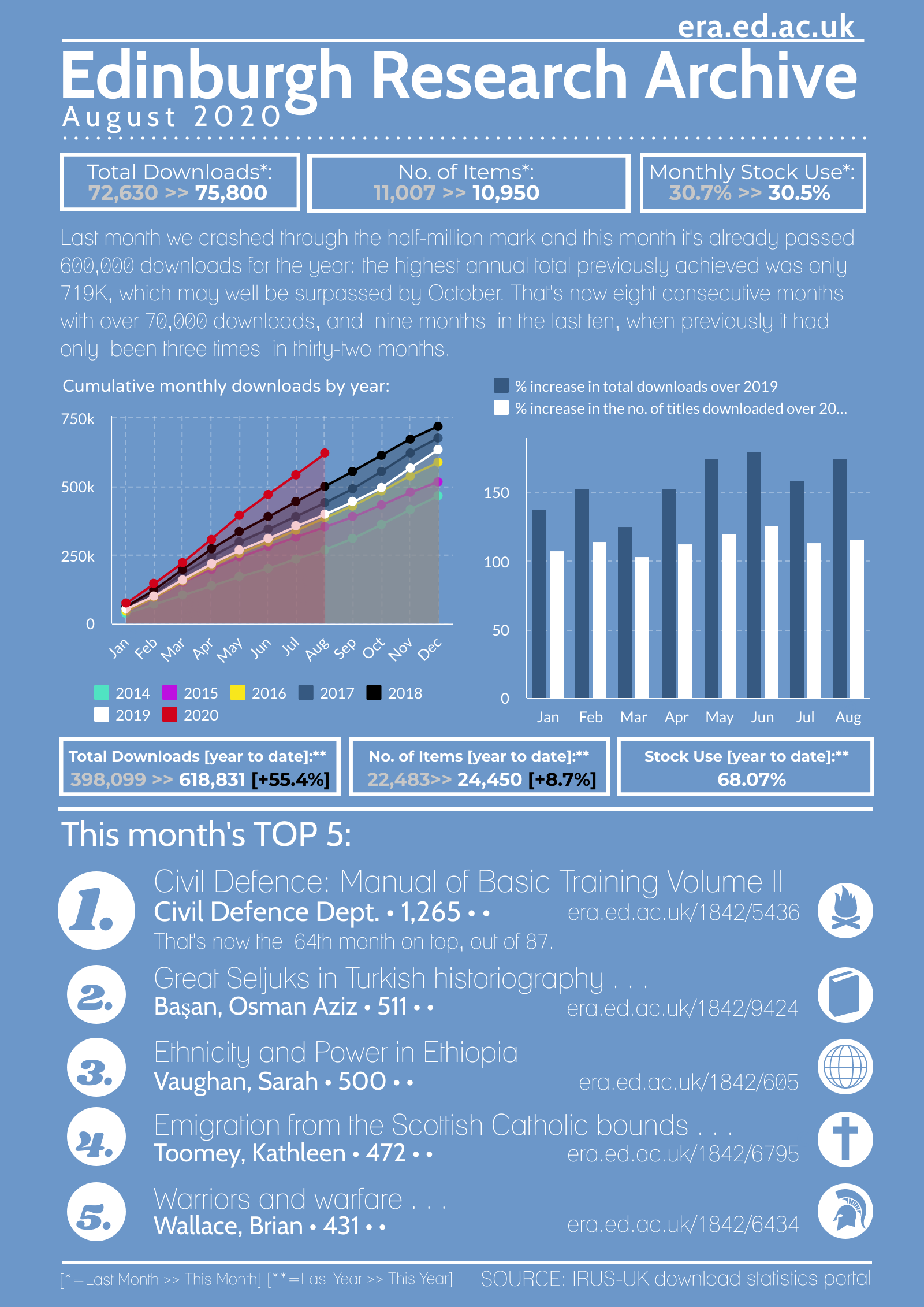
Edinburgh Research Archive downloads: August 2020
Discoveries in the Charles Lyell Collection
“[Charles Lyell’s] cultivated mind and classical taste, his keen interest in the world of politics and in the social progress and education of his country, and the many opportunities he enjoyed of friendly intercourse with the most leading characters of his age, make the letters abound in lively anecdotes and pictures of society, constantly interspersed with his enthusiastic devotion to Natural History.” -Katherine Lyell, Life, Letters and Journals of Sir Charles Lyell, Bart, 1881
To mark 7 months working with the Lyell collection, I’d like to share some discoveries I’ve made while cataloguing these amazing notebooks, and researching Lyell’s published works. Lyell today is known for his great discoveries of the Earth, and the elevation and establishment of the science. Here, we see Lyell’s other interests.
Discoveries:
- Charles Lyell was deeply interested in the role of universities and education in society. He writes in his notebooks extensively about the religious requirements at Oxford and Cambridge, to which he objected. In Notebook 4 he makes this list:
![An image of a notebook page written in pencil or light pen in which Charles Lyell writes his thoughts on University education. Transcript: What is the portion of those who ought to have a Univ[ersit]y Ed[ucatio]n in England. Who really have one? 1. Learn number Att[ourn]ys & their cle-rks. Barristers not Oxf[or]d or any Univ[ersit]y men - Dissenter who an barrister, attournies, or spe-cial pleaders &c [etc] 2. Engineers, Architects, Surveyors 3. Physician dissenters how many Surgeon d[itt]o. Discipline was intended. ought not those below 16 to be required to go to church.](https://libraryblogs.is.ed.ac.uk/lyell/files/2020/09/0183475c.jpg)
Notebook No 4, p. 106, one instance of Lyell’s notes on Universities and education.
2. Dante’s Inferno was a constant reference in Lyell’s notebooks, though it’s not clear yet for what purpose, other than the geologist’s keen interest. In the midst of notes on other subjects, Lyell often makes brief abbreviated citations of the parts and lines of Dante. These must have been important to him, because he regularly references these citations in his table of contents. His father being a Dante scholar, this is intriguing for further research to understand how Dante’s poetry influenced Lyell’s understanding of the earth.
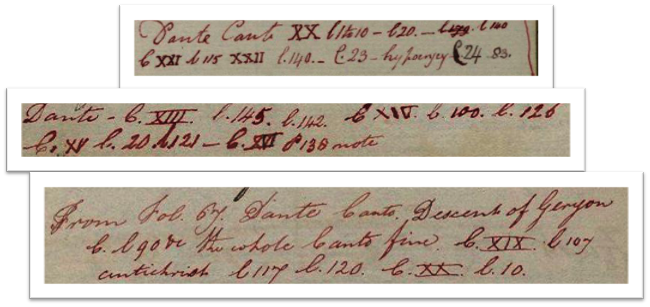
Excerpts from Notebook No. 4 (1827), where Lyell cites Dante.
3. Lyell wasn’t the only naturalist in his family, his sisters and father were keen on insect collecting and naming. In those days, much of the flora and fauna of Scotland had no official name, and therefore budding lepidopterists “discovered” and named the insects they caught. We hope to describe illuminating family letters like this in the newly acquired papers of Lyell.
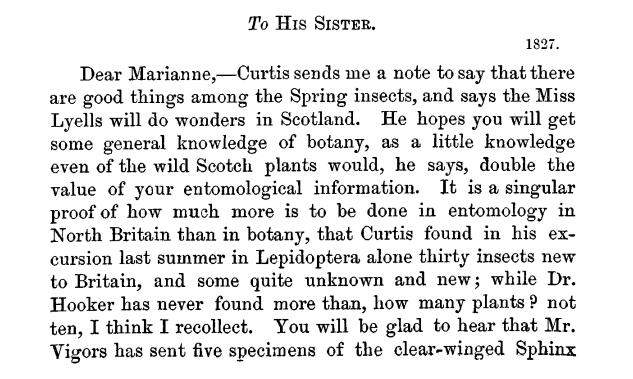
Letter to Marianne from Charles Lyell concerning the Lyell sisters’ prowess and interest in identifying insects
4. Lyell’s eyesight is known for being poor and limiting his abilities all his life, but the reason why is now contested. Most biographies cite that his eyesight worsened while studying the law by candlelight, but in a letter to Murchison in preparation for their Grand Tour to France and Italy, Lyell writes that his eye injury was caused by the long days in the Tuscan sun on holiday with his family. On that Grand Tour, to appease his father, Lyell brought with him a clerk named Hall to aid him in his work and treatment of his eyes – though no detail of the treatment has yet been found.

Excerpt from a letter to Murchison, April 29, 1828, explaining his father’s wishes for Lyell to bring his clerk with him, to make up for his troubles with his eyes.
References:
Lyell, C. (2010). Life, Letters and Journals of Sir Charles Lyell, Bart (Cambridge Library Collection – Earth Science) (K. Lyell, Ed.). Cambridge: Cambridge University Press. doi:10.1017/CBO9780511719691
Bailey, E., 1962. Charles Lyell, F.R.S., (1797-1875). Edinburgh: Thomas Nelson and Sons Ltd.
Charles Lyell Notebook No. 4, digitised here: https://images.is.ed.ac.uk/luna/servlet/s/cennww
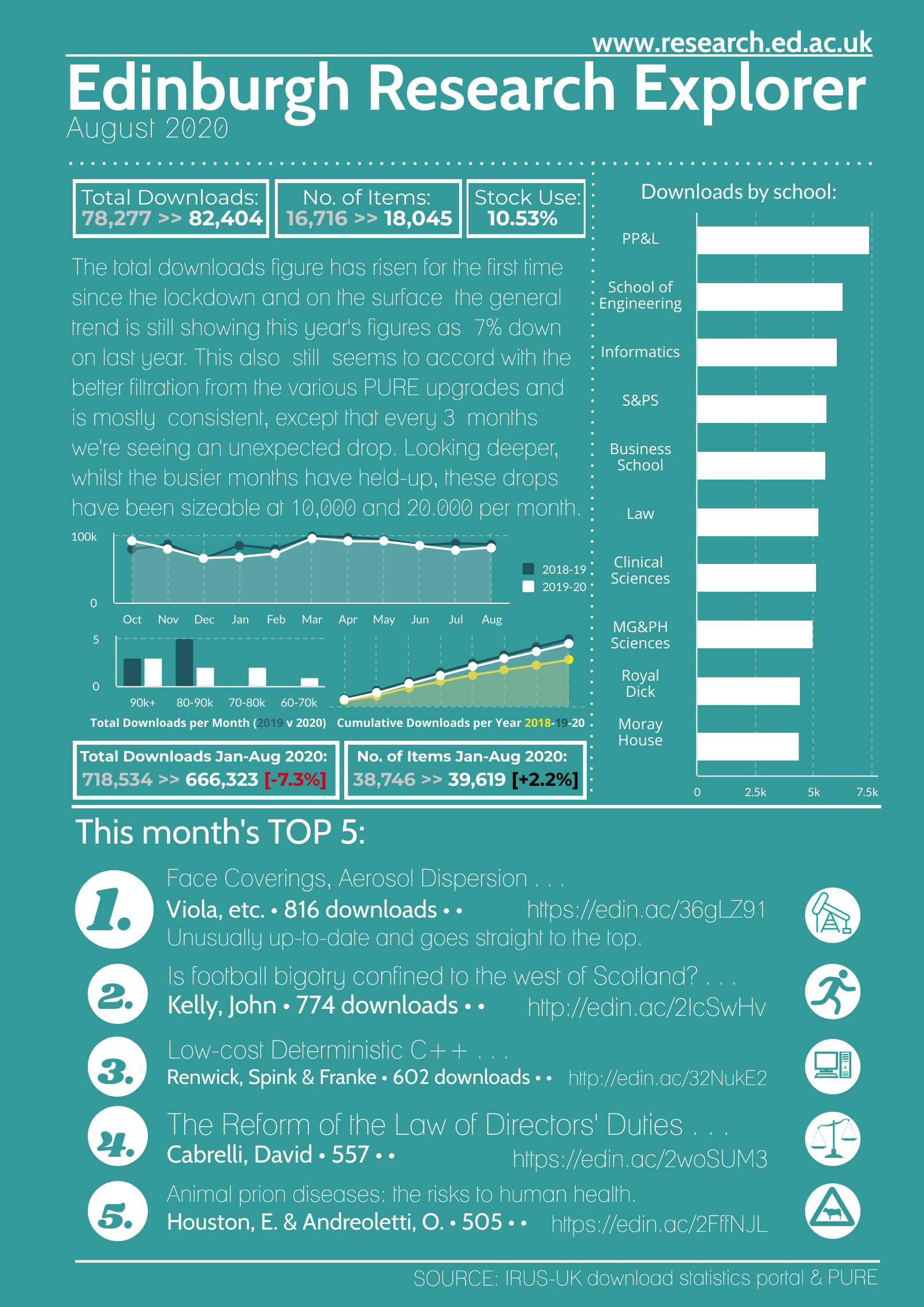
Edinburgh Research Explorer downloads: August 2020
Bicentenary of Sir Walter Scott’s ‘The Abbot’
This week marks the bicentenary of Sir Walter Scott’s twelfth novel The Abbot, published in Edinburgh on 2 September 1820 and in London two days later. Alone among the Waverley Novels, it was presented not as a stand-alone narrative but as the sequel to an earlier volume, The Monastery, which had appeared just six months earlier. Set in the early years of the Scottish Reformation, The Monastery had sold well but had disappointed many readers and reviewers. Criticism was directed, in particular, at the pivotal role played by the ghostly White Lady, guardian spirit of the House of Avenel. Contrary to widespread belief, Scott rarely resorts to the supernatural, and his use of the White Lady struck many as an incongruous Gothic throwback.

The White Lady appearing to Halbert Glendinning, engraved by Charles Heath after Richard Westall (Corson P.3000)
Genesis
Scott later hinted that the decision to set a second novel in the Reformation stemmed from frustration with the relative failure of The Monastery and a determination to show that the period provided fertile subject-matter. Accepted by most of his biographers, this account has been called into question by Christopher Johnson, editor of the recent Edinburgh Edition of The Abbot (2000). Johnson shows that the contract for a sequel was signed before the completion of The Monastery, and that Scott had simply found that he had enough narrative materials for two novels. The idea of depicting the imprisonment of Mary Queen of Scots at Loch Leven Castle—The Abbot’s central episode—had occurred to Scott as early as summer 1817.
Read More
Research Data Training: Semester 1 2020/21
A universal truth: things are a bit weird just now. So over the past few months we have been working hard to convert our popular face-to-face training workshops for online delivery. Below you will find a list of the courses we’ve scheduled to delivery during semester 1 using Collaborate virtual classroom. Come along and join us!
Full details about each course are on our training webpage https://www.ed.ac.uk/information-services/research-support/research-data-service/training
| Workshop | Audience | Date | Time | Booking Link |
| Writing A Data Management Plan for Your Research (RDS002) | Research Staff | 08 September 2020 | 09:30 – 11:30 | https://www.events.ed.ac.uk/index.cfm?event=book&scheduleID=42689 |
| Writing A Data Management Plan for Your Research (RDS002) | All Staff & PGR’s | 23 September 2020 | 10:00 – 12:00 | https://www.events.ed.ac.uk/index.cfm?event=book&scheduleID=42494 |
| Edinburgh DataVault: supporting users archiving their research data (RDS008) | Professional Service Staff | 25 September 2020 | 14:00 – 16:00 | https://www.events.ed.ac.uk/index.cfm?event=book&scheduleID=42495 |
| Realising the Benefits of Good Research Data Management (RDS001) | Research Staff | 29-30 September 2020 | 09:30 – 11:00 x 2 | https://www.events.ed.ac.uk/index.cfm?event=book&scheduleID=42690 |
| Realising the Benefits of Good Research Data Management (RDS001) | All Staff & PGR’s | 13-14 October 20 | 10:30 – 1200 x 2 | Part 1 – https://www.events.ed.ac.uk/index.cfm?event=book&scheduleID=42496,
Part 2 – https://www.events.ed.ac.uk/index.cfm?event=book&scheduleID=42637 |
| Working with Personal and Sensitive Data (RDS003) | Research Staff | 28 October 2020 | 09:30 – 11:30 | https://www.events.ed.ac.uk/index.cfm?event=book&scheduleID=42791 |
| Realising the Benefits of Good Research Data Management (RDS001) | Research Staff | 11-12 November 2020 | 13:30 – 15:00 x 2 | https://www.events.ed.ac.uk/index.cfm?event=book&scheduleID=42794 |
| Realising the Benefits of Good Research Data Management (RDS001) | PhD students | 01-02 December 2020 | 09:30 – 11:00 x 2 | https://www.events.ed.ac.uk/index.cfm?event=book&scheduleID=42795 |
| Working with Personal and Sensitive Data (RDS003) | All Staff & PGR’s | 07 December 2020 | 10:30 – 12:30 | https://www.events.ed.ac.uk/index.cfm?event=book&scheduleID=42498 |
The following courses will not run during semester 1, but we plan to relaunch them in 2021. In the meantime if you need any support just get in touch with us via data-support@ed.ac.uk and we’ll be happy to help.
- Data Cleaning with OpenRefine (RDS004)
- Handling Data Using SPSS (RDS005)
- Assessing Disclosure Risk in Quantitative Data (RDS006)
- Assessing Data Quality in Quantitative Data (RDS007)
- Data Mindfulness: Making the Most of your Dissertation (RDS009)
- Introduction to Visualising Data in ArcGIS (RDS011)
- Introduction to Visualising Data in QGIS (RDS012)
—
Kerry Miller
Research Data Support Officer
Library and University Collections
Qurʾan Gateway – database trial

The Library has arranged a database trial for Qur’an Gateway. The database can be accessed from https://web.qurangateway.org/auth/login.php on the University network or via VPN for off-campus access. The trial can also be accessed from the E-resources Trials website.
The trial is valid until 30 September 2020.
Qur’an Gateway is a digital tool for the critical study of the Qurʾanic text and its early manuscripts. Based on the latest academic research, the tool allows you to explore and analyse data from thousands of records. Features include the ability to examine linguistics and formulaic construction, track scribal changes from hundreds of original manuscripts, check meanings and references from the original Arabic and much more.
New! Kenya and Zimbabwe under colonial rule, in Government reports
I’m happy to let you know that the Library now has access to two digital primary source collections covering colonial rule in African countries in the 20th century. The two databases are Kenya under colonial rule, in Government reports, 1907-1964 and Zimbabwe under colonial rule, in Government reports, 1897-1980. Between them they contain 290 documents with over 158,000 pages of original primary source material.

You can access both of these databases via the Digital Primary Source and Archive Collections guide, the Databases A-Z list or the African Studies subject guide. Read More
New to the Library: African American Newspapers
I’m pleased to let you know that the Library now has access to African American Newspapers Series 1 and 2 from Readex. These fascinating databases provide online access to approximately 330 U.S. newspapers chronicling a century and a half of the African American experience.

You can access African American Newspapers Series 1 and 2 via the Newspapers, Magazines and Other News Sources guide, the Databases A-Z list or Black Studies databases list. Read More
Collections
 Hill and Adamson Collection: an insight into Edinburgh’s past
My name is Phoebe Kirkland, I am an MSc East Asian Studies student, and for...
Cataloguing the private papers of Archibald Hunter Campbell: A Journey Through Correspondence
My name is Pauline Vincent, I am a student in my last year of a...
Hill and Adamson Collection: an insight into Edinburgh’s past
My name is Phoebe Kirkland, I am an MSc East Asian Studies student, and for...
Cataloguing the private papers of Archibald Hunter Campbell: A Journey Through Correspondence
My name is Pauline Vincent, I am a student in my last year of a...
Projects
Cataloguing the private papers of Archibald Hunter Campbell: A Journey Through Correspondence
My name is Pauline Vincent, I am a student in my last year of a...
Archival Provenance Research Project: Lishan’s Experience
Presentation My name is Lishan Zou, I am a fourth year History and Politics student....