Home University of Edinburgh Library Essentials
April 5, 2026
Remembering Maurice Fleming
Staff, colleagues and friends of the School of Scottish Studies Archives were very sad to hear of the passing of Maurice Fleming in August last year.
David Fleming, Maurice’s son, has written a touching memorial to his father, which he has asked us to share.
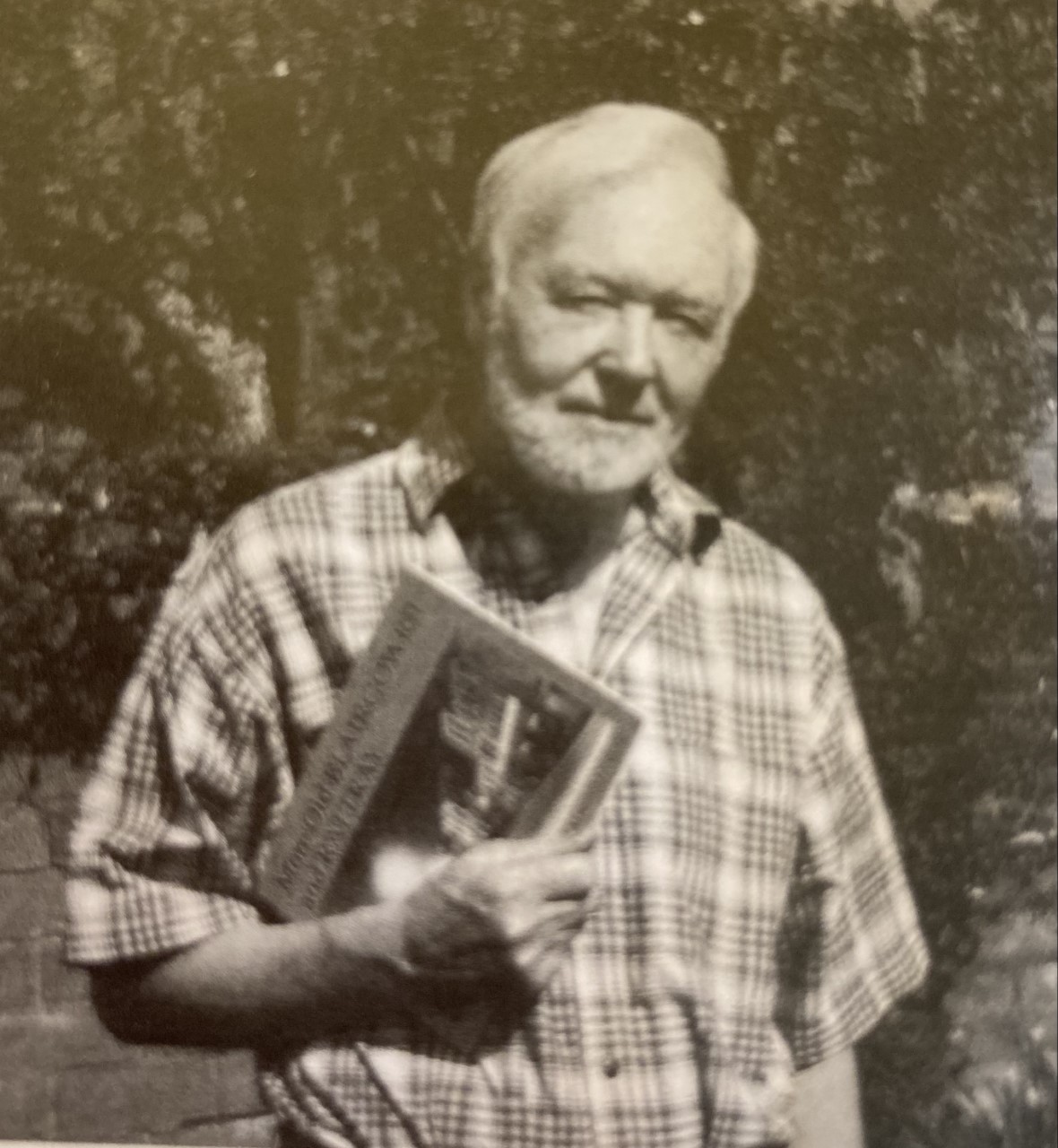
Maurice Fleming (1926-2020) Image: Scottish Traditions Series
Maurice Fleming, a song-collector from the early days of the School of Scottish Studies, passed away in August 2020.
Maurice was born in the Perthshire town of Blairgowrie in 1926. His father, James, owned a local draper’s shop and the family lived in comfortable circumstances in a house on the town’s Perth Road. Largely self-educated, James R. A. Fleming was an avid book collector with a particular interest in French and Russian literature. The family room at home, always known as the Library, was dominated by large glass-fronted bookcases full of works by the great writers of the day. Maurice’s parents both wrote in their spare time. His father composed reviews, travels sketches and a detective novel; his mother, Jessie, published volumes of poetry. In the 1920s, they collaborated on a successful radio play The Lost Piper which drew on folkloric material and concerned a ghostly musician roaming a warren of tunnels under the city of Edinburgh.
Maurice was educated in Blairgowrie. He left school without any formal qualifications but had developed a love of the written word. As a child, he roamed the fields and woods near his home and became very interested in wildlife, particularly birds. His first ambition was to become a nature writer, following in the footsteps of authors such as H. Mortimer Batten and F. Fraser Darling.
Called up for military service in 1944, Maurice joined the Cameronian Rifle Regiment and began training for service overseas in the Far Eastern Campaign. However, a misfiring Bofors gun shattered his eardrum, rendering him unfit for combat and leaving him with lifelong deafness in one ear. He saw out the war as a lance corporal, serving as a barman in the Officers’ Mess at Fort George and later at Dreghorn Barracks. These postings left him time to pursue his interest in bird-spotting and to enjoy solitary walks in the countryside.
After leaving the army, Maurice pursued a career in hotel management by taking on a number of jobs in hotel kitchens and working for a time in a busy Lyons Corner House off Piccadilly. It was while working at a country hotel in Glen Shee that a colleague suggested he could develop his literary interests by becoming a journalist. In November 1953 he joined the Dundee publishing company D.C. Thomson where he worked on women’s magazines before getting his “dream job” on the staff of The Scots Magazine. He took over as editor from Arthur Daw in 1975 and remained in the post until retirement in 1991.
Maurice’s involvement with the School of Scottish Studies began on the evening of the 26th July, 1954. His old school friend Archy Macpherson had invited him through to Edinburgh to attend a formal dinner in the Adam Rooms, George Street, and quite by chance the two men found themselves sharing a table with Hamish Henderson. Maurice was enthralled by Hamish’s account of the School’s work in seeking out and recording traditional singers and storytellers, and readily agreed to have a go when Hamish suggested he visit the berryfields around Blairgowrie where large numbers of travelling people, still bearers of a folk oral culture, would be at work picking the annual harvest of soft fruit and camping out in fields near his home.
Among the songs Hamish mentioned to look out for was The Berryfields of Blair and Maurice was to find this song and its original author not in a traveller’s camp, but in a small house in Rattray on the other side of the Ericht river from Blairgowrie. The house was occupied by a settled traveller family. Though singers, they were unknown outside the travelling community but they were soon to be internationally famous as the Stewarts of Blair. Maurice made frequent visits to their home, where he recorded Belle Stewart and her daughter Sheila. Belle introduced the young song-collector to many other local singers, and Hamish made trips through from Edinburgh as it became apparent what a wealth of traditional material had been uncovered.
In notes made concerning his memories of Hamish Henderson, Maurice has left us this impression of these exciting times:
“One day I told my mother I was going to a ceilidh that evening.
“Where is it to be held?” she asked, expecting it to be up at the Stewart’s home in Old Rattray or in one of the Blairgowrie hotels.
Instead I told her it was to be at the standing stones on the Essendy Road. This ancient circle is believed to be the only one in the country that has a road running through it. On one side was a raspberry field, and the travellers who had come to pick the fruit had pitched their tents on the grassy strip just over the fence from the road, next to the track leading to the Darroch, now popularly known as the Bluebell Wood. It was on the latter strip that the ceilidh was to take place.
Hamish and Belle Stewart had made the arrangements between them, telling all the pickers on the site and sending word to other singers and musicians camped round about. Hamish, of course, was to be making recordings of the event.
Although it was a warm evening, a few open fires had been lit and the smell of the woodsmoke hung in the air when I walked down the Essendy road. The ceilidh had already begun and I knew the voice of the singer. They had persuaded Jeannie Robertson to come down from her home in Aberdeen.
Hamish always regarded Jeannie as the greatest of his discoveries. A powerful ballad singer, her repertoire was astonishing. And here she was, come to join her friends the Stewarts and other travellers to make a night of it.
But Belle Stewart was on home ground and, surrounded by the crowd, she was at Hamish’s side, ready to point out to him this or that singer who could give what he wanted on his tape.
And, of course, Hamish was loving it all. Watching the two of them it seemed to me that this is how song-collecting should be, a joyous affair, not in some studio but out under the open sky and with the sights, sounds and smells of nature around us.
The ceilidh was still going strong when I rose, stiff, from the ground and bade everyone goodnight.”
Over the next few years, Maurice roamed Perthshire in search of more singers and songs. He often travelled by bike, carrying the heavy tape-machine with him, and made recordings of such distinguished traditional singers as Charlotte Higgins and Martha Reid. Among his most charming field recordings are those he made of the youthful Betty (Dolly) White who he came upon by chance camped out on a hill with her father above the waters of Clunie Loch one sunny day in 1956. (A selection of his Perthshire Field Recordings was released as a CD in 2011.)
During this time, he wrote a series of articles about traveller life and customs. Some of them appeared in the Edinburgh Evening News and The Countryman under the pen name Muiris MacEanruig.
In the late fifties, Maurice moved to Dundee to be nearer his work and was quickly involved in the folk scene there. In 1964, he recorded the singer and fearless political campaigner Mary Brooksbank who was by then a pensioner living quietly with her nephew in a city prefab. The two became friends and Maurice was able to do her a great service by retrieving a manuscript of her writings that had long been in the hands of another singer. This manuscript was to form the basis of Mary’s poetry collection Sidlaw Breezes.
During the 1960s, Maurice was involved in the organisation and hosting of concerts such as that held at the Dundee Art Galleries in July 1961. He also tried his hand at composition and wrote a couple of songs about the old Dundee to Newtyle railway. He was a founder member of Dundee Folk Club but had concerns about the commercialisation of the folk scene and feared that traditional singers were being squeezed out by popular entertainers. These concerns, shared by others at the time, led him to help form and work for the Traditional Music and Song Association of Scotland. With the renowned song-collector and singer Pete Shepheard as its guiding light, the TMSA aimed to give a platform to grassroots musicians and singers by running a number of locally based ceilidhs and other events. These included the now legendary Blairgowrie Festivals of Traditional Music and Song which were held each August between 1966–70. Maurice’s intimate knowledge of Blairgowrie performers and venues, along with his journalistic skills, help to ensure the success of these events. He also collaborated with Pete in collecting material for a Dundee Song Book. The fruits of this collaboration were to form part of Nigel Gatherer’s Songs and Ballads of Dundee.
Maurice had a great love of the theatre. He wrote plays for both the professional and amateur stage. His debut, The Runaway Lovers, which was produced at Dundee Rep in 1956, drew on his experiences in the hotel trade and was inspired by legends of Grainne and Diarmid which he found circulating within the oral tradition of Glen Shee.
His other plays included The Comic, set during the dying days of Variety Theatre; The Assembly Murder, a fast-moving Edinburgh thriller; and the highly popular Me and Morag, about a spirited young woman who shakes up a stuffy Edinburgh publishing house – produced at Perth Theatre in 1990. His last performed play, The Haunting O’ Middle Mause, (1992) was based on historical records of strange occurrences at a farm near Blairgowrie in the early eighteenth century and incorporated folksong material. Amongst his unperformed work was a one-man-play concerning the life of the Blairgowrie-born covenanter Donald Cargill. With the exception of a one-act play about Anne Frank, all Maurice’s plays were set in Scotland and celebrated the Scots language and people.
Maurice enjoyed a long and fruitful retirement after leaving The Scots Magazine. He wrote books on local folklore for the Mercat Press – The Ghost O’Mause and other Tales and Traditions of East Perthshire (1995) and The Sidlaws: Tales, Traditions and Ballads (2000) as well as a more general work, Not of This World: Creatures of the Supernatural in Scotland (2002). There was also a book for younger readers, The Real Macbeth and other Stories from Scottish History (1997), and a torrent of freelance journalism for a variety of newspapers and magazines.
A founding member of Blairgowrie, Rattray and District Civic Trust, he served as Chairperson for a number of years and was deeply involved in the successful campaign to establish the authenticity of the Essendy Road Standing Stone Circle and prevent its removal elsewhere to facilitate traffic. This took eight years and involved a good deal of patience dealing with various interested parties. Having gained the necessary permissions, an archaeologist was employed to survey the Stones and confirm their prehistoric credentials.
Maurice played a leading role in another local controversy in 2006 when an historic trophy, known as the Rattray Silver Arrow, was in danger of being sold at Southeby’s by its then custodian who considered himself its owner. The affair attracted national press attention and was the subject of a public debate chaired by John Swinney MSP during which Maurice successfully put the case for the Arrow being the rightful property of the People of Rattray.
A keen postcard collector, Maurice compiled two books of old Blairgowrie and Rattray Cards for Stenlake Publishing, and over the years assembled a comprehensive visual record of his home town and district. The collection now rests in the archive of the A.K. Bell Library in Perth.
Maurice married Nanette Dalgleish in 1958 and the couple were together for 59 years until Nanette passed away in 2017. They had three children: Gavin, David and Airlie.
His final years were darkened by the loss of Nanette and the onset of several health issues but he was able to continue living at his home in Blairgowrie until a few weeks before his death. He retained a love of folk music and always thought of his collecting days as some of the happiest and most exciting of his life.
Maurice was modest about his achievements, courteous in his dealings with others, and generous with his time in helping aspiring writers. In his own quiet way, as song collector, journalist, dramatist and folklorist, he carved a legacy for himself across several facets of Scottish cultural life.
David Fleming
You can find over 120 of Maurice’s recordings from The School of Scottish Studies online, via Tobar an Dualchais.
Open Library of Humanities Bronze Supporter
The University of Edinburgh has opted to support the Open Library of Humanities for another year- this time as a Bronze level supporter. This additional support will enable the OLH to continue its growth mission to convert subscription journals to a solid, ongoing, open-access model, with no author-facing charges.

Theo Andrew, Scholarly Communications Manager at the University of Edinburgh, said: “The OLH is such good value for money. Library budgets are always tight, but we feel that we should be doing more to support academic-led publishing. OLH puts a lot back into the academic community and we are pleased to help with its ongoing sustainability.”
Visiting our campus libraries… virtually!
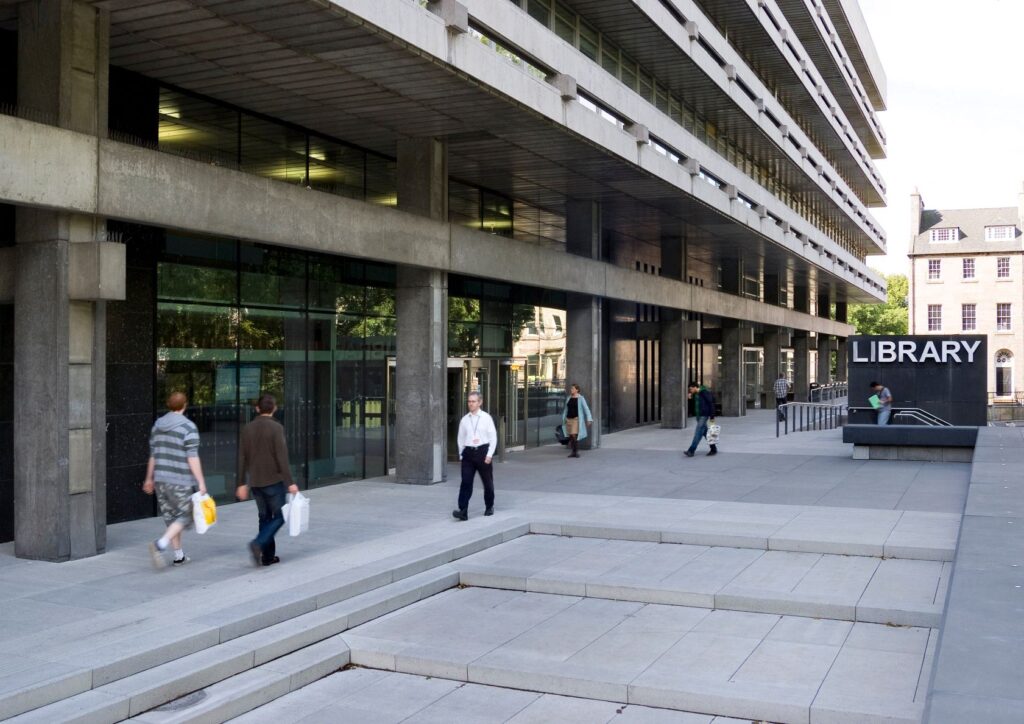
The Main Library entrance on George Square. [Taken by Paul Dodds, copyright of the University of Edinburgh]
However we know that after the past year some students may be anxious about coming on to campus, and may be worried about what to expect. In order to help with that we’ve prepared Library Orientation Guides for each of our sites so you can familiarise yourself with the building before your visit. It includes information on what’s in the collections, photos of the library, and links to other helpful resources you may want to use. You can find them here:
You’ll also find a guide to Using the Library Online, which we think will be helpful for our online or distance students, or those who are self-isolating or in quarantine.
Other preparations for visiting campus may include looking at maps. Did you know we’ve got an interactive campus map? If you visit the Maps page and use the key to select the Layers tab, and then click the eye icon to make Libraries and Study Spaces visible, you can see all our locations across the city!
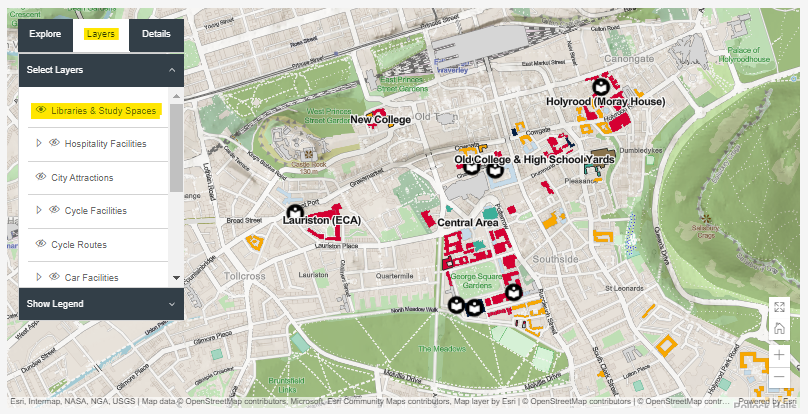
We look forward to seeing you on campus soon!
Note: The Microsoft Sway platform uses moving images in their templates, and each of the above Sways use one moving image at the top of the page. If you require the information in an alternative format please contact us by email: library-academic-support@mlist.is.ed.ac.uk.
Diverse climate change data in DataShare’s newest thematic collection
‘Code red for humanity’ was the galvanising message of the sixth report of the Intergovernmental Panel on Climate Change published on 9 August. The report draws on thousands of academic research projects. Research data is vital to understanding the nature and scale of the challenge of climate change, and the necessary deployment and application of solutions.
We decided to draw together the datasets relating to climate change to showcase them on a single Collection page on Edinburgh DataShare, our research data repository. In part this was prompted by a new deposit from Oliver Escobar in the School of Social and Political Science – data from citizens’ assemblies debating wind farms. Our DSpace repository allows us to ‘map’ an Item to Collections other than the one to which it belongs, resulting in the dataset being listed in more than one Collection. Edinburgh DataShare contains a wealth of research datasets from an extremely diverse array of academic disciplines, reflecting the strengths of the University of Edinburgh, and so it is with our climate change research:
We added many datasets from our School of Geosciences: one dataset from Ian Goddard and Professor Simon Tett demonstrated how urbanisation has affected temperatures in the UK, and includes a map showing heat islands around our major cities. Professor Tett said:
“To truly understand how climate change might impact society we need to bring together many datasets developed by many researchers so that other researchers can use them for their own studies. DataShare enables this.”
Goddard, Ian; Tett, Simon. (2018). “Software and data used in the study ‘How much has urbanisation affected temperatures in the United Kingdom'”, 1990-2017 [software]. University of Edinburgh. https://doi.org/10.7488/ds/2370.
Climatological data and toolkits for public engagement around climate and natural resources came from Professor Marc Metzger – including various kinds of maps, a board game and posters showing natural resources.
One dataset was a description of an artwork, a quilt representing global temperature measurements. Posters on the wall show the years, so as to provide a time axis for the temperature data represented in the colours of the patches in the quilt:
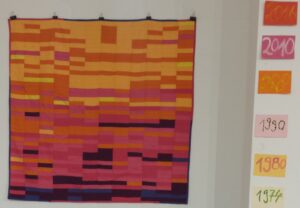
World temperature quilt on display at the Data-X exhibition
Zaenker, Julia; Vladis, Nathalie. (2017). Feel The Heat – A World Temperature Data Quilt, [image]. University of Edinburgh. EDINA. https://doi.org/10.7488/ds/1998.
Another theme was renewable energy – we included data from our School of Engineering on tidal turbines, and recent wave buoy experimental data:
The big 3-0-0-0: DataShare reaches three thousand datasets
All this raises the question – why bring these data together, what for? Do the datasets measuring and defining the problem really belong with the research working on technology to reduce greenhouse gas emissions? To answer this, I think the analogy of our other thematic collection on Covid-19 is apt. To develop and implement effective treatments and public health responses to Covid-19, we do need to understand a great deal about the cause, the pathogen and the pathology it creates. We should strive to break down barriers between domains of knowledge. So yes, to tackle climate change more effectively, we should all seek to better understand the underlying processes and the behavioural and technological solutions we must employ.
By bringing together research data from diverse teams in a single DataShare Collection, we empower the user to browse those datasets using the ‘facets’ feature in DataShare, or indeed a text search within the Collection. The user can filter by geography, by data creator’s name, by keyword, funder (see the screenshot below) or they can choose their own search term. When they reach an individual dataset, the breadcrumb trail at the top of the page can lead them into the original Collection where the dataset was first deposited, leading them to other work from the same research group, centre or School. This is one small way for the curation team to enhance the findability of the data. Scientists tell us there are challenges posed by the plethora of formats and programming languages used, even within disciplines. We hope that by making the connections and common themes between these different strands of research from different disciplines more visible, we make the data more findable, and perhaps hope to inspire new research questions or approaches.

DataShare’s facets
A word about DataShare’s structure: we find our depositors prefer to place their data in a Collection that reflects the organisational placement of their research group – typically the Collection represents the research group, and sits within a Community representing a research centre, sitting within a Community representing a School, sitting within a top-level Community representing a College:
DataShare structure
If you would like to suggest a theme for a new thematic Collection on DataShare, please contact the Research Data Support team:
Research Data Service | Contact
The RDS team, like all the University of Edinburgh’s teams, has a remit to address climate change as the university is committed to contributing to the UN’s Sustainable Development Goals, including no. 13 “Take urgent action to combat climate change and its impacts”:
Social Responsibility and Sustainability | The University of Edinburgh
We can all learn more about how we can take that urgent action effectively on the university’s amazing and inspiring “Climate Solutions” MOOC, available on edX:
Climate Solutions | edX
I recommend anyone to take this course – it is free of charge, it’s fun, it is easy to fit around other commitments. I’ve nearly completed the coursework and already passed thanks to my quiz scores, got my nice PDF certificate signed by Professor Dave Reay. The Climate Solutions MOOC inspired me to create the Climate Change thematic Collection and it has really opened my eyes to the scale and nature of the challenge, and many actions we all need to take to contribute to halting the rise in global temperatures. Everyone has their part to play.
Pauline Ward
Research Data Support Assistant
Library & University Collections
University of Edinburgh
SSSA in 70 Objects: Cassette of Annie Arnott Recordings
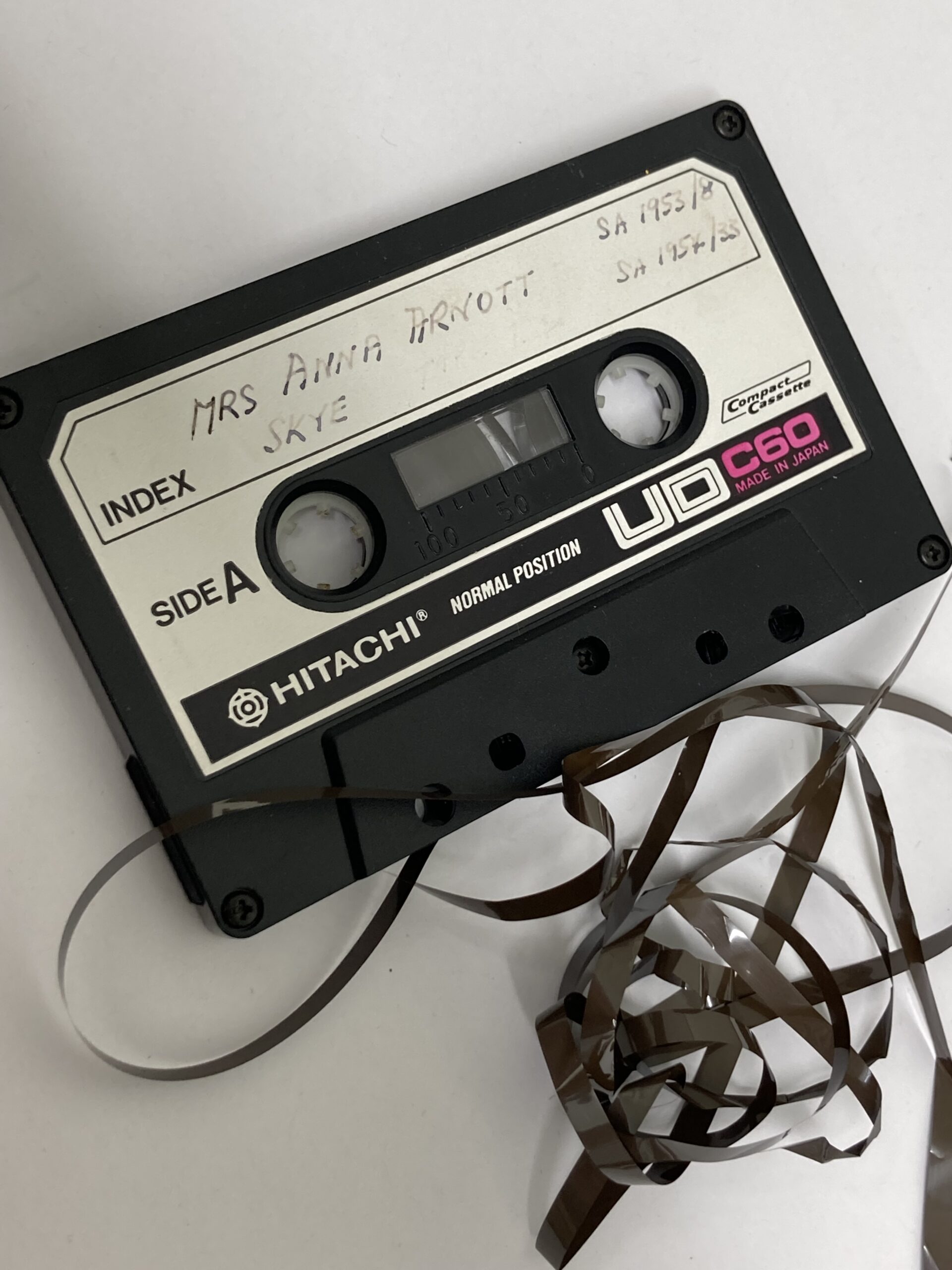
Recently this object was received back to SSSA.
The tape contains several recordings of Gaelic songs performed by Mrs Annie Arnott, of Skye. Born and raised in Linicro, in the Kilmuir district in Skye, Annie learned a large number of songs from her mother, who was descended from the Macdonald bards. Annie was regarded as a great tradition-bearer and she was recorded many times by fieldworkers from the School of Scottish Studies.
You can listen to over 150 recordings of Annie Arnott singing, from SSSA collection on Tobar an Dualchais .
The tape was made for Annie’s Grand-daughter, also named Annie; She sent us a letter to say she had listened to the tapes (this is one of a few she has) many times over the years and she hoped that we might be able to fix it for her.
After a lovely telephone call with Annie, we learned that she remembered well the fieldworkers from the School bringing their huge recording machines to Skye to record with her grandmother. We asked her if she wanted the recordings put on a CD, which she did, but she also was keen to see the tape fixed – if it was possible – as the cassettes are an important item to her.
Fix it we could! It took short work from Stuart, our AV technician, and here it is almost as good as new. This is winging its way back to Skye today.
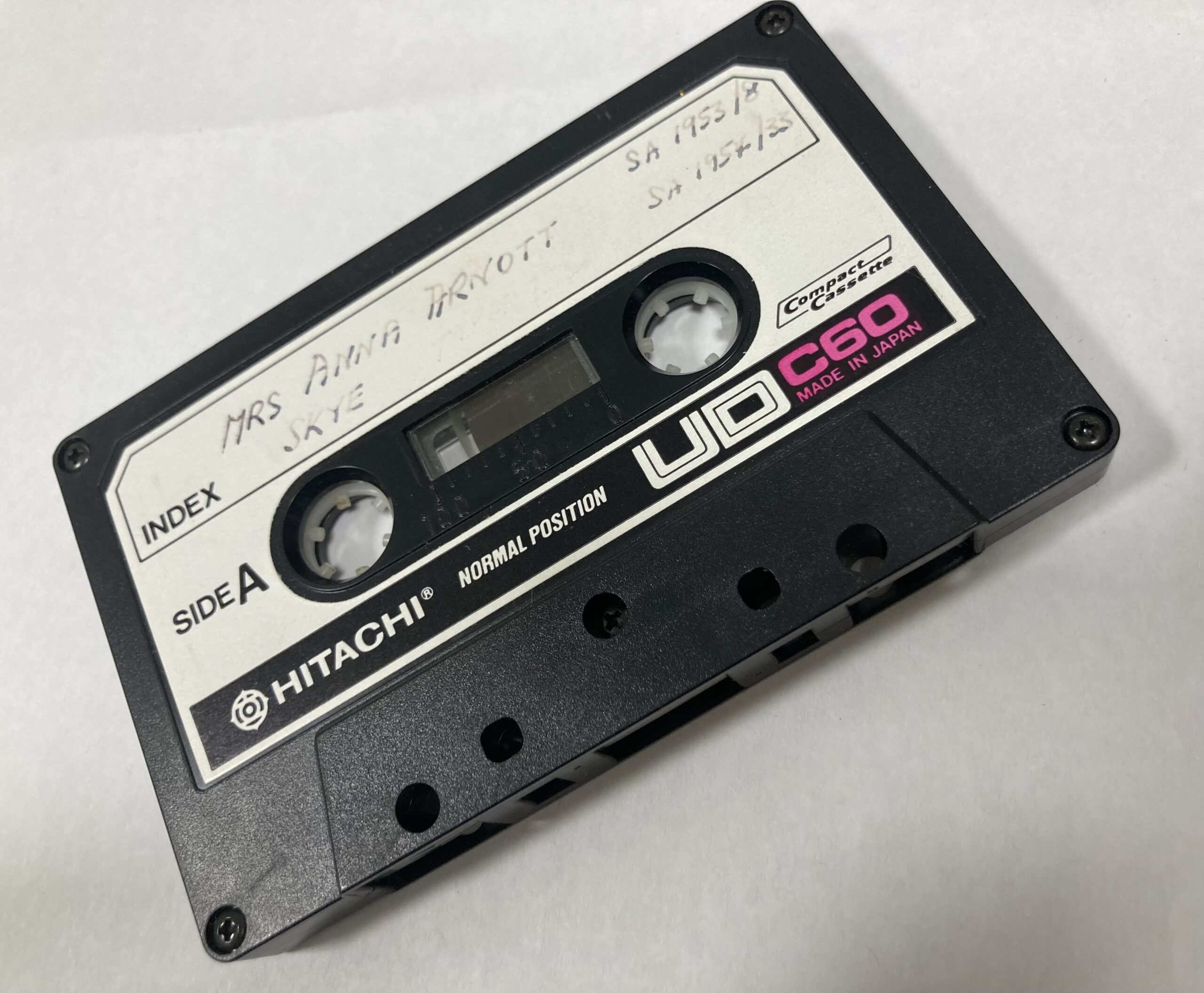
Stuart is going to do a little video for us on tape repairs like this, but in the meantime, here is one he made earlier on fixing a microcassette.
It is always special to hear from people who were recorded by the School, or who have memories connected to their family or local area and the recordings in the archive. Do you have any connections to The School of Scottish Studies or our archives? We would be delighted to hear from you. Drop us an email at scottish.studies.archives@ed.ac.uk or telephone (or leave a message) at 0131 650 3060.
Media Hopper, aka UoE YouTube!
If you’ve attended any of the induction sessions we’ve run in the past few weeks, you’ll have heard us mention Media Hopper (and specifically the Law Librarian Media Hopper Channel) many times as part of our introductory material.
Okay, but what is it?

‘Video stream’ image by febrianes86 via Pixabay
Media Hopper is like the University’s own version of Youtube. It’s an online storage repository and player for videos, and it means we can upload videos and recordings that you can watch to find out about more about library services, subscription databases, and many other resources. If you study online you may be used to watching videos or pre-recorded lectures that have been made for you on your course; the great thing about Media Hopper is that it’s not just for your coursework, it can be for other things too!
What does the Library use it for then?
Loads of things! We upload recordings of sessions, promotional videos for our online information skills course, and demonstrations of databases. We can also create playlists which link together useful videos on popular themes. For example, on the Law Librarian channel we have the following:
- Recordings of the introductory sessions we offer for UG, PG and PhD students
- Westlaw demonstration (with more databases demos to come)
- Using Legal Databases training
- Using news databases
- Simple search in DiscoverEd
- Referencing help, including demonstrations of the latest version of Endnote.
Sounds great! But do you have a video for….?
If there’s something you think we should make a video about, why not contact us to let us know. We take requests! Email us on law.librarian@ed.ac.uk with your suggestions. We want the resources we make to be as useful as possible, so all ideas are welcome.
Encyclopaedia Iranica Online
 The 15-volume set of Encyclopaedia Iranica, edited by Ehsan Yarshater (Routledge & Kegan Paul, 1982 – ) and available in the Main Library, is the most renowned reference work in the field of Iran studies. This important work has now been made available online for open access on the Brill Online platform:
Founded by the late Professor Ehsan Yarshater and edited at the Ehsan Yarshater Center for Iranian Studies at Columbia University, this monumental international project brings together the scholarship about Iran of thousands of authors around the world.
Things I wish I’d Known: Work, Rest, Play
In my last post I shared six things I wish I’d known sooner about the Library. But there’s more to university life than studying! Even though in the depths of essay season you might feel like you should be paying rent to the Library staff rather than your landlord, when you’re working hard it’s important to remember to rest and play too! So here are five tips for taking care of yourself and enjoying your time at Edinburgh…
1. Get out and about

An evening swim at Portobello…
Edinburgh is one of the most stunning cities in the UK (I’m not at all biased). It is also one of the greenest cities – with more green space than any of the UK’s other big cities. We literally have a 650-acre Highland-esque landscape ten minutes’ walk from central campus… visit Holyrood Park if you haven’t already!
If you’re lucky enough to be living in the city during your studies, make the most of it. Grab a few pals and plan a hike up Blackford Hill after a big essay deadline – or a meander through the Meadows after a library session. Maybe even take a cold plunge at Portobello Beach before your morning tutorial. I found getting away from screens and into nature one of the best ways to rest and escape throughout my studies. Read More
Miras Maktoob: Persian E-books Collection
 The Library has purchased the Miras Maktoob Persian e-book collection available via Brill Online.
The Collection consists of 249 volumes (189 works) originally published by the Written Heritage Research Institute (Miras Maktoob), a non-governmental organisation in Tehran. These e-books, which are exclusively available from Brill, include works in both Persian and Arabic on Islamic history and culture in the broadest sense. Detailed title information will be made available for the entire collection.
Features
– Languages: Persian and Arabic
– English title descriptions available
– 249 volumes (189 titles) on the Persianate and Islamic World
– High-level academic texts and resources
– All volumes appearing in digital format for the first time
How to access
You can access these e-books directly on the Brill Online platform with your UoE login:
All the individual titles can be retrieved in DiscoverEd by title or author searches in Persian script or transliteration. Title search by series title Miras Maktoob will retrieve all the titles at once, or simply click here.
SSSA in 70 Objects
“Too Principled, Too Honest”
Thomas Ferguson Rodger, Professor of Psychological Medicine
Response by: Dr Sarah Phelan
Recording: Interviews relating to Thomas Ferguson Rodger (1907-1978), interviewed by Sarah Phelan, Various dates (School of Scottish Studies Archives, University of Edinburgh)
Contributor: Dr Sarah Phelan

Professor Rodger giving his lecture ‘Some Observations on Mental Health Services in Scotland under the National Health Services Act’ to the Medical Institute of Kiev, 1955.
Image Credit: University of Glasgow Archives & Special Collections: MS Morgan H/1/2.
I have chosen to respond to my own contribution to the School of Scottish Studies Archive: a series of oral history interviews relating to the Glasgow-based psychiatrist, Thomas Ferguson Rodger (1907-1978). Thomas Ferguson Rodger was first Professor of Psychological Medicine at the University of Glasgow (1948-72) and a consultant psychiatrist at several Glasgow hospitals. I conducted these interviews with Rodger’s family and former colleagues as part of a PhD on Rodger’s contribution to twentieth-century psychiatry which was undertaken at the Medical Humanities Research Centre at the University of Glasgow and completed in 2018. Upon being awarded my PhD, I submitted the audio recordings and transcripts of these interviews to the School of Scottish Studies Sound Archive, grateful that my interviewees’ recollections would be carefully preserved and rendered accessible for researchers.
Rodger, known as Fergus to family and friends, was born in Glasgow on 4 November 1907[1] to Thomas and Ellen (nee Allan) Rodger.[2] Rodger had three brothers: William, James and Alan, and the family lived in Glasgow’s West End area.[3]
Upon being awarded a BSc in 1927 and an MB ChB in 1929 from the University of Glasgow,[4] Rodger worked as ‘assistant to Sir David Henderson, at Glasgow Royal Mental Hospital’.[5] Concurrently, he was awarded a Diploma of Psychological Medicine (D.P.M.) from the University of London in April 1931.[6] He then worked under the ‘most influential teacher of psychiatry, Professor Adolph Meyer at the Johns Hopkins University Baltimore’. Between 1933 and 1940, Rodger was again employed at Gartnavel, now as Deputy Superintendent, and also as an Assistant Lecturer in Psychiatry at the University of Glasgow.[7] Working as a military psychiatrist in the Second World War, Rodger was promoted to the ‘rank of Brigadier’ and made important contributions to personnel selection methods.
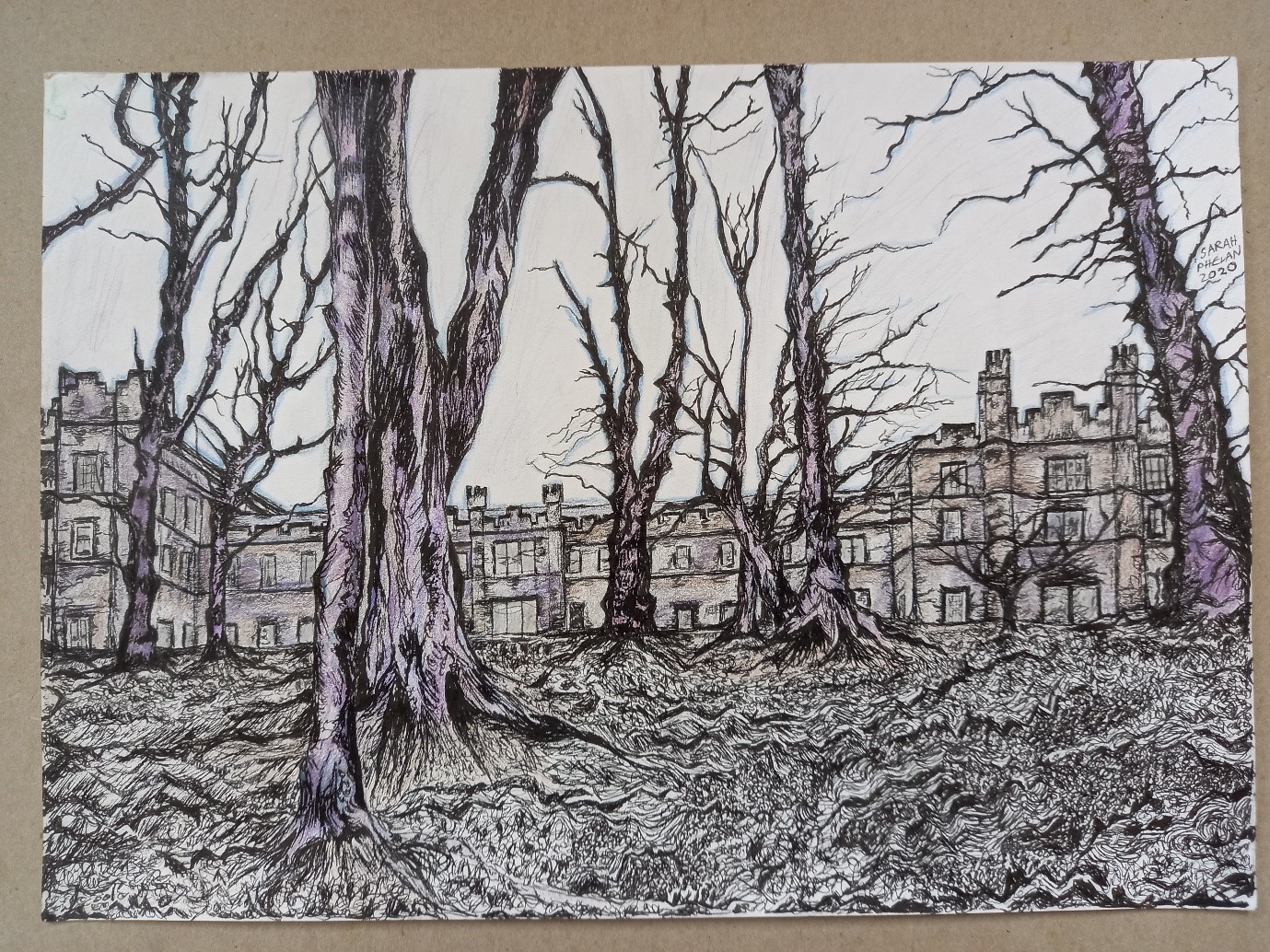
Sarah Phelan, Trees of Gartnavel, 2020.
Image Copyright: Sarah Phelan
After the war, Rodger took up a position as Senior Commissioner on the General Board of Control for Scotland until 1948, when he was offered the professorship in psychological medicine. He established his department at the Southern General Hospital. During this time, he also fulfilled many prominent positions in official bodies, both domestic and further afield. He received a CBE in 1967.[8]
In 1934, Rodger married Jean Chalmers.[9] They had three children: a daughter, Christine, who became a doctor, practising in cardiology and acute general medicine;[10] a younger son, Ian, who became a quantity surveyor; and an elder son who was Alan Ferguson Rodger, a prominent lawyer, Lord Rodger of Earlsferry and Justice of the Supreme Court of the United Kingdom.[11] Though Rodger possessed many connections to Scottish psychoanalytic circles, he enjoyed a particularly long friendship with John Derg (Jock) Sutherland (1905-1991),[12] who became Medical Director of the Tavistock Clinic in 1947 and, after his retirement, helped to establish the Scottish Institute of Human Relations in 1970.[13] Outside of work, Rodger was enthralled by computers and cybernetics, enjoyed ‘sketching’[14] and was a keen ‘bird-watcher’.[15] Rodger retired in 1972 due to illness in the final year of his professorship and suffered ill-health until his death on 1 June 1978.[16]
My PhD research focused primarily on Rodger’s personal papers held at the University of Glasgow Archives Services.[17] This collection retains a plethora of material from Rodger’s work life including copious typescript and manuscript draft lectures, talks to public and professional audiences, correspondence and intricate patient case records. Rodger’s career, as reconstructed from these papers, supplemented by other archival and published documents, can be viewed as an absorbing opening onto developments in twentieth-century psychiatry. Thus far, the published articles which have stemmed from my PhD have centred upon the interwar and post-war period. In an article for History of the Human Sciences, I explore how Rodger’s heretical psychoanalytic-psychotherapy unfolded within the so-called ‘dream books’, labyrinthian patient case histories recording the dream analysis of five male patients in the 1930s. In these books, Rodger’s contrasting therapeutic allegiances to Freudianism and a pragmatic ‘commonsense’ psychotherapy coalesce, allowing the patient’s shifting trust in and resistance to psychoanalysis to emerge.[18] In a co-authored paper for Cultural Geographies, Prof Chris Philo and I bring Rodger’s interwar psychoanalytic-psychotherapy into dialogue with the ‘new walking studies’, exploring a patient-authored account of a walk in Glasgow’s Botanic Gardens as a ‘psychiatric-psychoanalytic fragment’.[19] Finally, the first paper I published during my PhD contextualises Rodger’s post-war eclecticism, a combination of physical, psychological and social approaches, in relation to his psychiatric education as well as the deinstitutionalisation of psychiatry and the insufficiency of knowledge around certain treatments in the 1950s and 1960s.[20]
Although the archive offered up a rich and cogent portrait of Rodger’s career, oral history-type testimony summoned those more elusive and emotive elements of his life. Rodger’s daughter Christine and son Ian elaborated on Rodger’s youth, disposition and interests, while former colleagues elucidated how his psychiatric leadership manifested and how his personality affected the direction of his psychiatry. These interviews are qualitatively distinct from the archival material I examined, disclosing how Rodger was thought of or remembered by others. They offer a more impressionistic portrait of his standing in relation to his psychiatric contemporaries. In particular, they convey how Rodger was unique or atypical at least in fostering the collegial exchange of psychiatry and psychology. Kenneth Clarke, a psychologist who worked in Rodger’s department, stated that ‘one of the hallmarks’ of Rodger was his integration of psychoanalytically inclined staff with ‘quite hard […] biologically minded psychiatrists’.[21] The psychologist Professor Gordon Claridge evoked the genial, egalitarian atmosphere of Rodger’s department which facilitated this eclectic collaboration. Claridge explained how the department,
was just an unusually relaxed place, both personally and from a professional point of view […] there was nowhere else in the country, I don’t think, where psychologists and psychiatrists could get on so well, were almost treated as an equal really in the face of, you know, a certain amount of tension between psychiatry and psychology and, you know, it was a very rewarding period of my life I have to say (LAUGHS) and, you know, very enjoyable as a place to work […] It was just Glasgow and somehow the department fitted into that, you know, a sort of rather warm inviting place really.[22]
It is difficult to see how something as subjective and evanescent as the sense of easy community recalled by Professor Claridge, and indeed also by his colleagues could be conjured as vividly, if at all, from the written texts in Rodger’s archive.
Rodger was memorably characterised by a psychiatric colleague, Dr Reginald Herrington as ‘too principled, too honest’ and a person who ‘could see a problem from every angle’ (Herrington Interview 10).[23] Researching developments in twentieth-century psychiatry through the biography of a self-effacing and self-critical figure such as Rodger has likely benefited my research, making visible some of the difficulties and instabilities of psychiatric practice during that period, potentially hidden by a more self-satisfied practitioner.
Acknowledgements
Thank you to Louise Scollay for assistance and advice during the preparation of this blogpost. I would also like to thank the individuals I interviewed for my PhD. I am grateful to the University of Glasgow Archives and Special Collections for permission to reproduce an image of Thomas Ferguson Rodger in this blogpost and to NHS Greater Glasgow and Clyde Archives for permission to reference archival material. Thanks also to Dr Gavin Miller and Prof Chris Philo for discussing this research with me during my PhD.
This blogpost draws on PhD research which was funded by a Lord Kelvin Adam Smith PhD Scholarship from the University of Glasgow.
[1] ‘Biography of Thomas Ferguson Rodger’, (26 February 2013). University of Glasgow Story. http://www.universitystory.gla.ac.uk/.
[2] Christine Rodger: Personal Communication.
[3] Christine Rodger, Interviewed by Sarah Phelan, 2 December 2014, School of Scottish Studies Archives, University of Edinburgh, 13.
[4] ‘Biography of Thomas Ferguson Rodger’, (26 February 2013). University of Glasgow Story. http://www.universitystory.gla.ac.uk/.
[5] A.M.S. (1978) ‘Obituary: T. Ferguson Rodger’, British Medical Journal 1(6128): 1704.
[6] Christine Rodger: Personal Communication; Letter of application, 26 April 1937, Dr Thomas Ferguson Rodger (c.1933-1963), Staff Records of the Physician Superintendent, Records of Glasgow Royal Mental Hospital, NHS Greater Glasgow and Clyde Archives, Mitchell Library, Glasgow, HB13/20/179, 2.
[7] A.M.S. (1978) ‘Obituary: Professor T. Ferguson Rodger’, The College Courant 30(61): 39; Letter of application, 26 April 1937, pp. 2–3.
[8] A.M.S. (1978) ‘Obituary: Professor T. Ferguson Rodger’, The College Courant 30(61): 39; A.M.S. (1978) ‘Obituary: T. Ferguson Rodger’, British Medical Journal 1(6128): 1704; ‘Biography of Thomas Ferguson Rodger’, (26 February 2013). University of Glasgow Story. http://www.universitystory.gla.ac.uk/; Timbury, G. ‘Obituary: Thomas Ferguson Rodger.’ Psychiatric Bulletin, 2(10): 169.
[9] Christine Rodger: Personal Communication.
[10] Christine Rodger, Interviewed by Sarah Phelan, 2 December 2014, School of Scottish Studies Archives, University of Edinburgh, 1.
[11] Administrative/Biographical History for Papers of Thomas Ferguson Rodger, 1907– 1978, Professor of Psychological Medicine, University of Glasgow, Scotland (Archives and Special Collections, University of Glasgow, May 2012); accessed (16 August 2021) at: https://archiveshub.jisc.ac.uk/search/archives/89c87074-8f6c-33e7-8811-b9960fa6c1b0.
[12] Christine Rodger, Interviewed by Sarah Phelan, 2 December 2014, School of Scottish Studies Archives, University of Edinburgh, 6.
[13] Haldane, D., and Trist, E. ‘Obituary: Jock Sutherland.’ British Journal of Medical Psychology, 65, (1): 3.
[14] Christine Rodger, Interviewed by Sarah Phelan, 2 December 2014, School of Scottish Studies Archives, University of Edinburgh, 11, 12.
[15] Ian Rodger, Interviewed by Sarah Phelan, 26 January 2015, School of Scottish Studies Archives, University of Edinburgh, 12.
[16] Timbury, G. ‘Obituary: Thomas Ferguson Rodger.’ Psychiatric Bulletin, 2(10): 169-170.
[17] Thomas Ferguson Rodger Papers, 1907-1978, University of Glasgow Archives and Special Collections, GB 248 DC 081, Catalogue can be viewed at: https://archiveshub.jisc.ac.uk/search/archives/89c87074-8f6c-33e7-8811-b9960fa6c1b0.
[18] Phelan, S. (2021) ‘A “Commonsense” Psychoanalysis: Listening to the Psychosocial Dreamer in Interwar Glasgow Psychiatry’, History of the Human Sciences (34)3-4: 142-168.
[19] Phelan, S. and Philo, C. (2021) ‘“A Walk 21/1/35”: a psychiatric-psychoanalytic fragment meets the new walking studies’, Cultural Geographies (28)1: 157-175.
[20] Phelan, S. (2017) ‘Reconstructing the Eclectic Psychiatry of Thomas Ferguson Rodger’, History of Psychiatry 28(1): 87-100.
[21] Kenneth Clarke, Interviewed by Sarah Phelan, 31st January 2015, School of Scottish Studies Archives, University of Edinburgh, 3.
[22] Gordon Claridge, Interviewed by Sarah Phelan, 30th January 2015, School of Scottish Studies Archives, University of Edinburgh, 10.
[23] Reginald Herrington, Interviewed by Sarah Phelan, 8th December 2014, School of Scottish Studies Archives, University of Edinburgh, 10.
Dr Sarah Phelan is an Affiliate in School of Geographical and Earth Sciences, University of Glasgow. She was awarded a PhD in Medical Humanities from the University of Glasgow in 2018. Prior to this, she undertook an MSc in the History and Theory of Psychology from the University of Edinburgh. She has published peer-reviewed articles in the journals History of Psychiatry, Cultural Geographies and History of the Human Sciences. Her research interests include the history of psychiatry, the history of psychoanalysis, and the history of dreaming.
Images are copyright to those attributed in the captions and used with kind permission
Collections
 Hill and Adamson Collection: an insight into Edinburgh’s past
My name is Phoebe Kirkland, I am an MSc East Asian Studies student, and for...
Cataloguing the private papers of Archibald Hunter Campbell: A Journey Through Correspondence
My name is Pauline Vincent, I am a student in my last year of a...
Hill and Adamson Collection: an insight into Edinburgh’s past
My name is Phoebe Kirkland, I am an MSc East Asian Studies student, and for...
Cataloguing the private papers of Archibald Hunter Campbell: A Journey Through Correspondence
My name is Pauline Vincent, I am a student in my last year of a...
Projects
Cataloguing the private papers of Archibald Hunter Campbell: A Journey Through Correspondence
My name is Pauline Vincent, I am a student in my last year of a...
Archival Provenance Research Project: Lishan’s Experience
Presentation My name is Lishan Zou, I am a fourth year History and Politics student....