Home University of Edinburgh Library Essentials
April 6, 2026
LibSmart: Popular modules
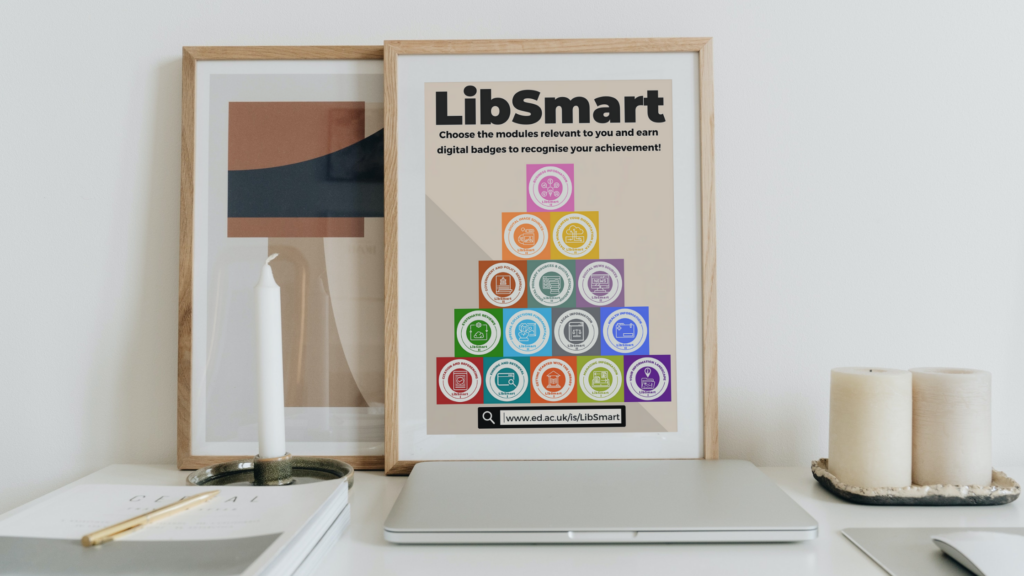
By now we hope the name LibSmart is familiar to you. Whether you’ve seen a slide in a presentation from an Academic Support Librarian, a page on the display screens in the library, or you’re just an avid reader of this blog, we hope you know that our online information literacy course is up and running, ready for any staff or students at the University of Edinburgh to self-enrol via Learn.
You may also know that for every module you complete in LibSmart you receive a Digital Badge, issued to you by the ASL team via Badgr. We’ve been keeping an eye on the number of students enrolled and also the number of badges we’ve issued for each module, and we’re starting to see some trends emerge even though it’s still early in the academic year.
LibSmart badges
For LibSmart I, we’ve definitely seen the most badges issued for the first module Getting Started With The Library. This isn’t a great surprise as it is the first module and therefore a logical place for people to start. We’re also seeing great numbers in our Your Information Landscape module which helps students orientate themselves with the resources that are helpful for their subject area. We’ve also seen the most growth month-to-month in our Referencing and Plagiarism module, perhaps because we’re getting close to assessment time now and people are making sure they’re familiar with how to reference correctly for their assignments.
When it comes to LibSmart II, we’ve had a nice even spread of badges being awarded across all modules. The most popular so far has been Data mindfulness: finding and managing data for your dissertation, which shows a real appetite for assistance with dissertation and thesis work. This is great news as this is exactly what we hoped LibSmart II would do – help those at an advanced stage of study complete the big pieces of work! We’ve also got a three-way tie in second place for the Health Literature, Digital Images and Special Collections Fundamentals modules all having the same number of badges awarded. Because we assume these would appeal to students of quite different disciplines, it’s great to see the word is getting out to different schools!
Have you had a look to see what LibSmart can offer yet? Check the website for more information, or watch our self-enrol demonstration video to help you get started.

Law Library: Changes to opening times
As the end of semester approaches, you may be concerned about the hours the library will be open in the run up to exams. We’ve increased weekend hours as we get closer to the exam period by opening later on Sundays in December:
Monday 29th November 2021 to Monday 20th December 2021
| Monday – Thursday | 9am – 9:50pm |
| Friday | 9am – 6:50pm |
| Saturday | 9am – 4:50pm |
| Sunday | 12 noon – 6:50pm |
There will also be changes to the opening hours over the winter break, as follows:
Tuesday 21 December 2021 to Sunday 16 January 2022
| Tuesday 21 – Thursday 23 December 2021 | 9am – 4:50pm |
| Friday 24 December 2021 – Tuesday 4 January 2022 | Closed |
| Wednesday 5 – Friday 7 January 2022 | 9am – 4:50pm |
| Saturday 8 & Sunday 9 January 2022 | Closed |
| Monday 10 – Friday 14 January 2022 | 9am – 4:50pm |
| Saturday 15 & Sunday 16 January 2022 | Closed |
Normal semester opening hours will resume on Monday 17th January 2022.
If you find the times above don’t suit your schedule for study, you may want to look at the Main Library opening hours, or for a complete list of library opening information please check the Library website.
Finding Resources: Subject Guides

Where to start?
Following on from my general tips for finding resources and navigating the online library, this blog post will cover why you should check out Subject Guides, and highlights some resources, old and new, that you may not already know about for studies.
When you are looking for resources, remember not everything in the Library collection is on DiscoverEd, so it’s best to check out your Subject Guide.
Subject Guides bring together all the most relevant library resources for a subject or topic. These guides, put together by Academic Support Librarians (ASLs), are always a good place to start when you’re looking for resources. Read More
Mixed Methods Reviews
Most researchers have heard of and understand the needs of a systematic review (SR), however the concept of a mixed methods review (MMR) can be confusing. The types of questions students and researchers ask can include:
- Can I do this type of research?
- How do I combine the data?
- My quantitative and qualitative data are different – how do I make sense of this?
MMRs differ from the traditional model of SR as they aim to answer complex interventions and social policy type questions. They go beyond what works and look to highlight the complexity of what is happening, to explain why things make an impact and what may influence how an intervention works, offering context to interventions.
To answer such questions MMRs need to draw from both quantitative and qualitative material (Pearson et al, 2015), but this does not mean they cannot be systematic!
To be systematic they should demonstrate the same transparent and explicit approach that established SR methods require – so have a protocol, as well as detailed reporting of methods. There would need to be appraisal and analysis of the included literature. They would need to show a rigorous research process (Gough et al, 2017).
There are different review approaches included in this type of research, but it is important that the research question uses both qualitative and quantative data. If the research question does not then it may be better to use another type of review method. An overview of review types can be found in an article by Sutton et al (2019).
How the types of data are combined depends on the research objectives of the review.
The resource SAGE Research Methods (which is available to all staff and students at the University via our Library Databases pages) has lots of information and advice on the ways that the differing data can be analysed and combined, as well as an overview of this family of research methodology.


Donna Watson
Academic Support Librarian
SSSA in 70 Objects: Linguistic Survey of Scotland: Gaelic grammar materials
By Dr Teàrlach Wilson
The first time I ever visited the SSSA, I was being given a tour by my supervisor to-be. I hadn’t officially submitted an application to do a PhD at the University of Edinburgh yet, but I had come up to Edinburgh from London to meet with my supervisor to-be, Dr Will Lamb, and to have an introductory tour of the University and the resources I hoped to work with. The SSSA was one of the reasons that attracted to me to Edinburgh. It was especially the moment that Will was showing me the Linguistic Survey of Scotland materials (collected between 1951 and 1963), and my eye was caught by a folder on which was written ‘St Kilda’. Anybody with an interest in Scottish history, culture, and identity will be fascinated by St Kilda, and there is often a nostalgia for what once was. As a linguist with a particular interest in geographical variation (‘dialects’), I was immediately excited and saddened by a very simple fact represented by the words ‘St Kilda’ on a document containing linguistic material: when a community ceases to exist, its special variety of speech also ceases to exist. The loss of the St Kilda dialect is not just a loss of localised language and cultural knowledge, it is also a reduction of the Scottish Gaelic language more generally. We have to be eternally grateful to the organisers and fieldworkers of the Linguistic Survey, or else this dialect – and others – could have been lost forever. We may never regain these dialects, but at least we have some idea of the linguistic patterns that existed within them. A great frustration for those studying linguistic variation is the lack of data available from previous periods of history, and it would be a great shame to have failed to collect this data in the 20th century when recording methods and technologies were available.
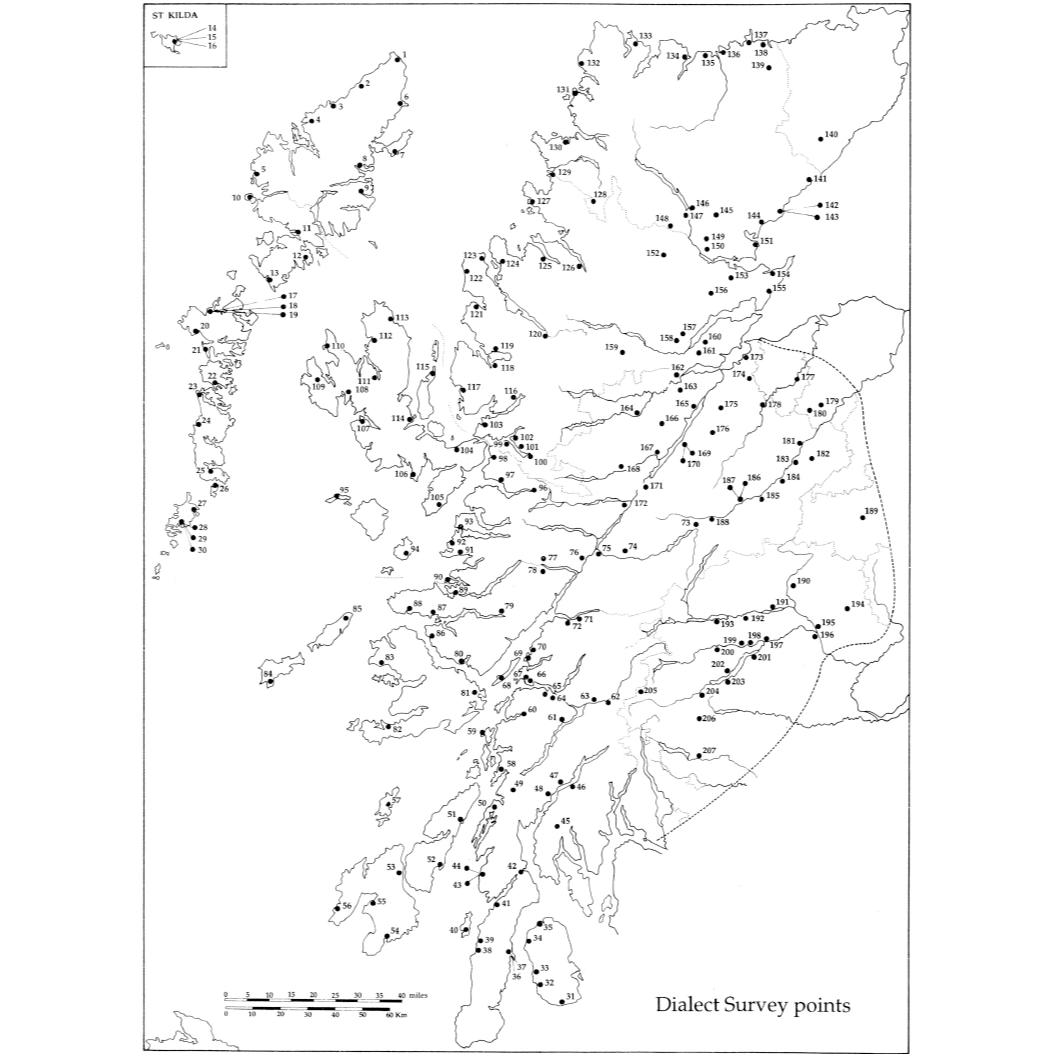
St Kilda isn’t, of course, the only ‘lost’ dialect to have been captured for posterity in the Linguistic Survey of Scotland. Another painful fact for those interested in Gaelic – be they linguists or from other disciplines – academic or not – is the generally northwesterly withdrawal of Gaelic across Scotland, so that the majority of mainland dialects are now obsolete and the Outer Hebrides are the last stronghold of the language. If you open the Linguistic Survey materials, or the only publication to come of the Linguistic Survey – ‘The Gaelic Dialects of Scotland’ (Ó Dochartaigh (ed.) 1997) – you will find this map of Scotland that represents the location of speakers who contributed their speech to the archive material:
click on image for larger size
Look at the geographic extent of the fieldwork activity! From as far north as Srathaidh (Strathy) in Sutherland to Sean-achaidh (Shannochie) at the most southerly tip of the Isle of Arran – and from as far west as Hiort (St Kilda) to Bràigh Mhàrr (Braemar) in Aberdeenshire – the entire Gàidheatachd (‘Gaelic-speaking region’) seems to be represented (except Loch Lomond, the Cowal peninsula, the Isle of Bute, and the south end of the Kintyre peninsula). By looking at this map and not looking at census data, you’d be forgiven for thinking that Gaelic was in a strong position – having so many speakers across the Scottish territory. However, the Linguistic Survey fieldworkers were also quite thorough in their note-taking and hints at the impending shift can be found in the notes that they took. On a number of occasions, fieldworkers talk about struggling to find speakers or note that the speakers have few, if any, fellow Gaelic speakers within their local social networks. Take into consideration that the majority of the contributors to the Survey were elderly (most being born in the 1880s), and you realise that the fieldworkers arrived at the cusp of a tipping point where traditional local Gaelic dialects go from ‘just holding on’ to ‘no longer existing’. Some fieldworkers even suggest that ‘linguistic decay’ (a term I absolutely loathe) is observable in the speech of those Gaelic speakers who represent the last speakers of their areas and who have perhaps not spoken Gaelic for years, even decades. The implication of this is that some of the material in the Survey don’t not, in fact, represent the traditional local dialects of some areas (Another term used is ‘linguistic attrition’, but I describe it as ‘contact-influenced change’ in my work to show that linguistic changes are natural and that ‘contact’ with the dominant language – English in our case – are driving some of those changes).
When I commenced my fieldwork – with the intention of comparing dialects of the Linguistic Survey with the dialects of speakers of a similarly elderly age today (who represent the grandchildren – or at least the grandchildren generation – of the contributors to the Survey), I found that the geographical extent of my fieldwork was going to be far more restricted than the range had by the fieldworkers who collected the Survey data around 60 to 70 years ago. Imagine the excitement of seeing historical linguistic forms mixed with an overwhelming sadness that they are lost. The emotions were, and still are, sometimes debilitating. I’d be looking at materials in the SSSA, with people around me in silence also looking at materials, and the rollercoaster of emotions would go from wanting to scream, “WOW!” to wanting to cry. I’m sure I wasn’t alone. There is sometimes a melancholy in the SSSA (which should never put you off going there) because visitors and researchers are all feeling the pain of loss – a loss that was so unnecessary. Sometimes you did not speak to fellow visitors or researchers, and so you had no idea what they were looking at or that they were feeling loss. Yet you still sometimes knew. As though a united purpose of capturing loss and criticising the unnecessary causes of loss was reverberating around the building. As I said: don’t let the melancholy put you off – it is a form of human bonding and communication. And that silent bonding is sometimes the most powerful.
It should go without saying that it’s not always melancholy. As I said, there are some moments of almost extreme excitement. One of the things that I enjoyed most about my research was finding contributors to my fieldwork who remembered or were related to contributors to the Linguistic Survey in the 1950s and 1960s. Reading fieldworkers’ notes about people – probably based on short experiences with the people and making assumptions sometimes driven by the fieldworkers’ own assumptions – and hearing stories about the same people from their neighbours and descendants made my cheeks hurt from smiling so much. Seeing a name written in the Survey and then asking a contributor, “did you know X?”, which then led to information not recorded in the Survey was like finding a precious treasure trove – the dialectological equivalent of finding Tutankhamun’s tomb. The similarities or differences between the accounts of people’s personalities and type of Gaelic was always amusing. I remember in particular one fieldworker noting how a female contributor had been quite conservative – almost archaic – in her use of Gaelic grammar, and then a neighbour of this woman (who must have died some half a century ago) recounting how forced her Gaelic sometimes seemed, how pious she was, and how miserable she was! She’d apparently often come to the door as she saw people passing her bothy on her croft just to lament at the state of the world! Something not noted in the fieldworker’s accounts, but you could certainly sense that it was the same woman! Maybe the fieldworker hadn’t been around long enough to witness her lamentations, or maybe she was on her best behaviour with the fieldworker, or the fieldworker wasn’t a member of her close social network. Nonetheless, the fieldworker’s comments about her Gaelic being old-fashioned made me think as I heard stories about her, “yes, it makes sense that someone like that would have some very old-fashioned speech!”
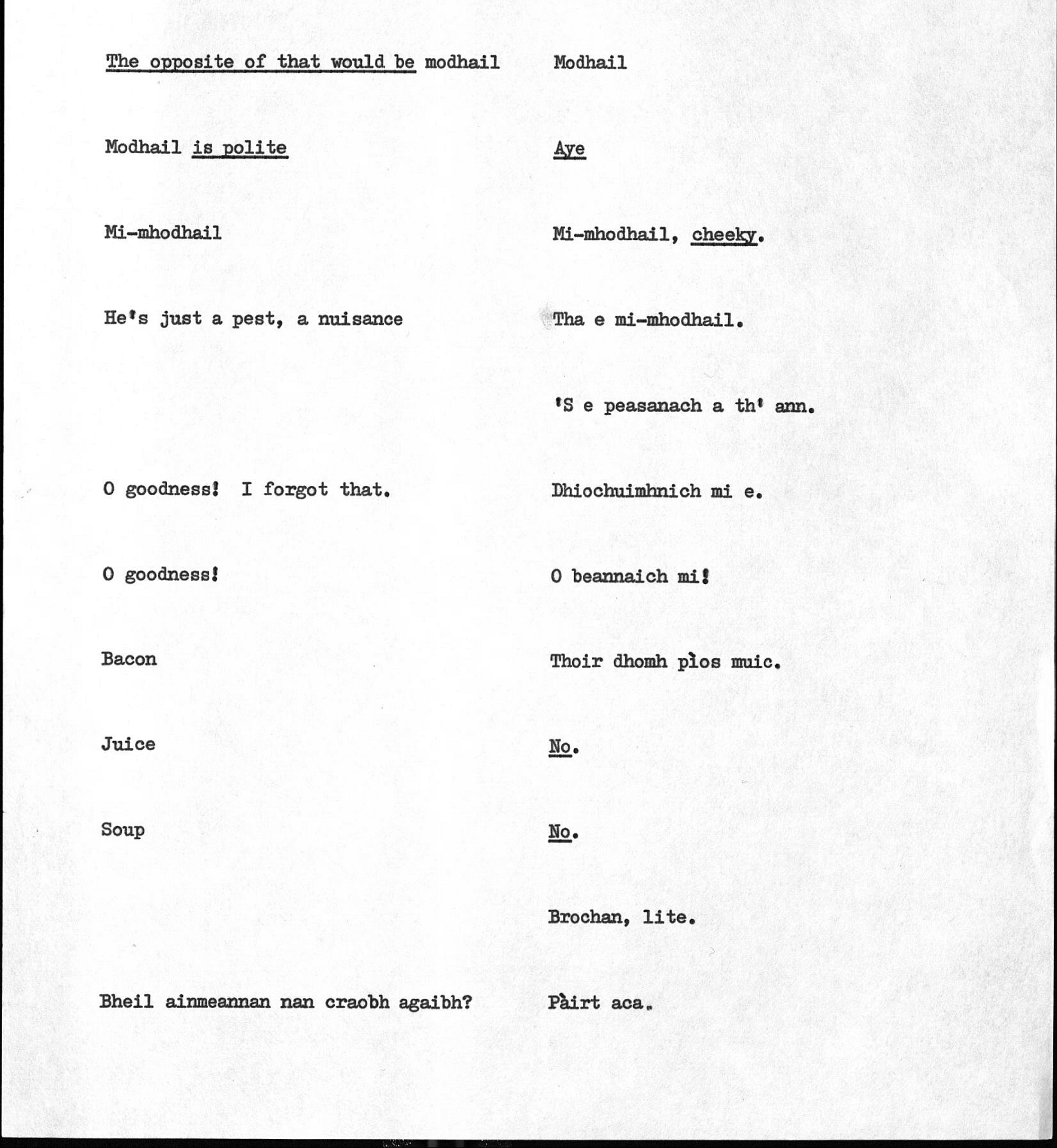
An example from Gaelic Linguistic Survey Transcriptions from speaker from St Kilda (GLS0987)
My fieldwork ended up being restricted to the Hebrides – both Inner and Outer. I went to the most northerly inhabited point of the Hebrides (Nis, Leòdhas, or Ness, Lewis in English) and to one of the most southerly (Port na h-Abhainne, Ìle, or Portnahaven, Islay). It was not easy to find contributors and my fieldwork is not as exhaustive as the Linguistic Survey. But combining Archive research with fieldwork in rural island communities has certainly been one of the most enriching experiences of my life, that has really informed who I am today and helped me develop my views and feelings about rural island communities, minority languages, and the importance of cultural – tangible and intangible – in a post-colonial, urban-centric, and land-facing society. I didn’t look at these people’s contributions to Lowland life, but make no mistake about it: rural island communities know how to survive when most Lowland urbanites only know how to go to a supermarket. Island communities are at the forefront of action against climate change because they know how to work their land sustainably while they will be the first to see the consequences of the climate crisis, as big cities invest in infrastructure to protect themselves from rising sea levels. All the while, the members of these communities are the guardians of our cultural and agricultural heritage, who provide us with food and energy. It’s not just their speech that needs to be protected. Their speech is just one facet of their entire way of life that needs to be protected. You may not see that when you look in the St Kilda folder and see that the typical Hebridean pronunciation of bàta ‘boat’ (sounds a bit like paaaaahhhhtuh) was not a feature of St Kilda dialect, even though St Kilda is a considered a Hebridean island (they said something more like baaaatuh). But all these issues are interlinked and the voices calling for respect and understanding of our world ring out through the records of their speech. This is worth thinking about while COP26 is going on in Scotland’s biggest city, i.e. how linguistic minorities protect the planet and what those (mainly male) world leaders need to do to protect them. Linguistic diversity is a part of our planet’s biodiversity, and so the loss of a dialect is like the extinction of a species and the SSSA like the Natural History Museum in those terms.
Dr Teàrlach Wilson is a former University of Edinburgh student, who completed his PhD in Celtic and Scottish Studies in 2021, looking at the links between Gaelic grammar, dialects, and geography. He now lectures Scottish Gaelic at Queen’s University Belfast and is the founding director of An Taigh Cèilidh, a nonprofit Gaelic community hub in Stornoway, Outer Hebrides.
Meet your LexisNexis Student Associate for 2021/22!
We’d like to introduce you to Noah Norbash, one of your fellow students who is a specialist in working with LexisNexis and all their resources – such as the invaluable LexisLibrary and Lexis PSL databases! We recently met with Noah to discuss what he has planned for the year, and he’s answered the following questions so you can get to know him too.
Tell us a little bit about yourself! Who are you and what do you study at Edinburgh?

Noah outside the magnificent buildings of Old College
I’m Noah – currently a student in the Graduate LLB programme. I grew up in the United States just outside of Boston, but I have spent many a year studying and living in St Andrews, the Veneto region of Italy, London, and finally here in Edinburgh!
Why did you apply to be the student representative for LexisNexis?
I applied to be the LexisNexis Student Associate on campus to not only enhance my own understanding of legal databases, but also to convey my knowledge to my fellow students. As an added extroverted bonus, I also get to have a bit of a chat here and there with interesting people! LexisLibrary has been of extraordinary help to me in my degree programme so far, and no doubt LexisPSL will be of equal significance when I begin the diploma and a traineeship. As a simultaneous LawPALS leader and a LexisNexis Student Associate, I looked forward to giving members of the university community the tools to succeed and achieve whatever they put their minds to.
What do you think is the best feature that Lexis offers for students in the Law School?
The #1 top-notch feature that can be accessed on LexisLibrary is without a doubt the Stair Memorial Encyclopaedia – it is a resource exclusive to LexisNexis, and it contains a wealth of information on every imaginable topic in Scots law with links to any relevant case law and legislation. In a nutshell, it serves as a textbook on the entirety of the laws of Scotland, and its usefulness cannot be overstated! When it came to preparing for moots or even getting a birds-eye view of material in advance of tutorials, the Encyclopaedia can quickly steer you in the right direction for where you need to go.
If you could name one top tip that everyone should know about your platform, what would it be?
A top tip everyone should know about the platform is that you can easily narrow searches of case law to only a particular firm: this is especially useful to those seeking a traineeship to be able to discuss specifically what issues their firm of choice may be facing in today’s legal climate. There is no better way to stand out from the crowd in an interview setting – being able to express niche insider-quality knowledge about the firm that is totally available to applicants is a spectacular way to impress. By reading a firms’ submissions and the judge’s opinion on LexisLibrary, you as an applicant can see the fruits of the firm’s labour and gain a clearer understanding of what the firm seeks to achieve in the courtroom.
When students book a training session with you, what can they expect to get from the meeting?
When students book a training with me, they can expect to gain insight into how to use LexisNexis software in an approachable and friendly setting. Over the course of the year, I will be running training sessions for Foundation- and Advanced-level LexisLibrary Certifications, LexisPSL certification, and Commercial Awareness more generally. Otherwise, students can get in contact with me for any Lexis-themed questions and I will be happy to help! Although I’m not an expert on par with the full-time Lexis Customer Success Managers, I will do all I can to imbue you with the knowledge I have been given and to give you a solid base of LexisNexis database-searching skills that will prove indispensable for the legal journey of your lifetime. Don’t be a stranger!
You can find Noah in his new and fabulous Teams group: tinyurl.com/LexisCorner
Alternatively youcan reach him by email at n.norbash@sms.ed.ac.uk.
Finding Resources: Navigating the Online Library
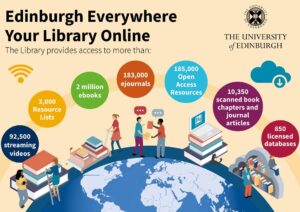
The Online Library is a vast resource. Whatever you study, you will find what you need in the Library collections. For all that it is wide and wonderful, however, I know (from personal experience) navigating the Online Library can be overwhelming. Read on for tips on where to look for resources and how to get the best out of the Online Library…
Subject Guides
Subject Guides are a great place to start your search for resources. If you haven’t already, head over to the Subject Guides list and find all the most relevant library resources for your subject and more…
Check out our blog dedicated to Subject Guides for more information, coming soon...
Read More
Making library data work for us

Image by 200 Degrees from Pixabay
On 2-4 November I attended the LibPMC Conference (International Conference on Performance Measurement in Libraries). The conference content was really varied, including a focus on the needs of stakeholders and communities and actively using qualitative and quantitative data to improve services and the user experience. Here are some highlights.
- But can it last? How the pandemic transformed our relationship with data. Dr Frankie Wilson, Bodleian Library
- Knowledge is PowerBI: How data visualisation helped inform services during the pandemic. Elaine Sykes, Liverpool John Moore’s University
- Using return on investment to tell the story of library value and library values. Prof Scott HW Young, Prof Hannah McKelvey – Montana State University
- Assembling a Virtual Student Library Advisory Board during COVID-19. Prof Chantelle Swaren, Prof Theresa Liedtka – University of Tennessee at Chattanooga
- Charting the Change: Analysing How Online Delivery Made A Difference to Who Is Accessing Academic Skills Programmes. Louise Makin, Academic Engagement Manager, Liverpool John Moores University.
Visit to University of Dundee Library
The past eighteen months have been quite isolating for staff as well as students at academic institutions, and this has meant that opportunities for networking and visiting colleagues from other universities have been in short supply. Recently I was invited to visit the University of Dundee’s Main Library thanks to Kayleigh McGarry, Digital Literacy and Service Development Librarian.
Friday's actually my day off from work and childcare. What did I choose to do with my time to myself? Go on a field trip to another law library, obvs. pic.twitter.com/zed2JYiHUB
— SL McDonald (@brawbukes) October 15, 2021
Although Kayleigh works across all subject areas in Dundee, she and I both have a specialist interest in Law as we previously worked in the Scottish Courts and Tribunals Service Library Service together. The Law collection at Dundee is housed in the Main Library and I was delighted to see a familiar face during my visit!
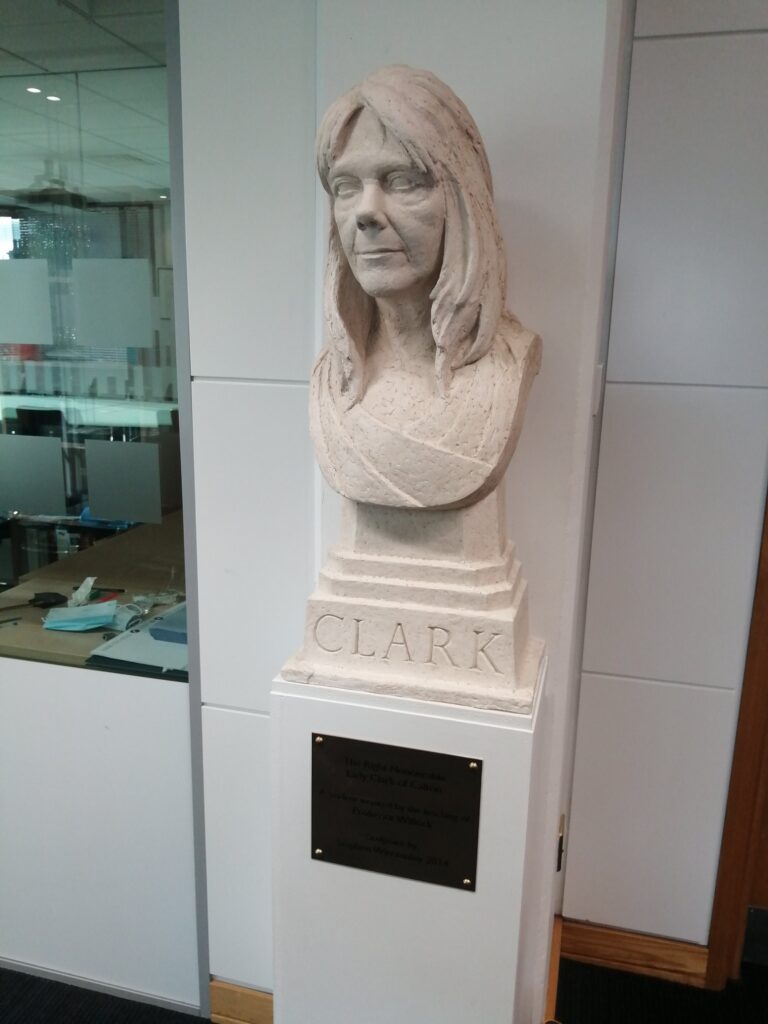
Bust of Lady Clark of Calton, Senator of the College of Justice and formerly Chairman of the Scottish Law Commission.
While I was interested to view the Law collection, it was also helpful to see how another institution have dealt with the challenges of the pandemic with regards their study spaces, group study rooms, and moving around the library. Most of the actions that have been taken in Dundee are very similar to our own service adjustments in the past year. Students are now able to use most study spaces on a drop in basis just like in our own libraries, and masks are worn throughout the building. The usual hand sanitising procedures and one-way systems are in place, and overall staff reported great cooperation from students during this tricky time. It was a real pleasure to see students back on campus and making the most of the available facilities. I have to confess that I’m quite jealous of the library’s podcast and recording studio, and seeing their makerspace reminded me of the brilliant facilities we have in the uCreate Studios on the first floor of our own Main Library.
Overall I found the visit to be both reassuring – the challenges we’ve faced as staff and students at Edinburgh are not unique, and knowing that other university library services have made similar choices to our own suggests that we’re all doing the best we can under the circumstances – and inspiring, because Kayleigh and I have a plan in the works to further encourage networking amongst our colleagues across HE institutions in Scotland. Hopefully this will be the first of many renewed opportunities for visiting libraries and sharing experiences to come.
SarahLouise McDonald
Academic Support Librarian to the School of Law
Database Trials

After a break in arranging database trials these have now restarted. Two current trials that may be of interest to staff and students alike are:
Policy Commons database:
The Library has taken out a one-year trial subscription to the Policy Commons database, a unique database providing access to nearly 3 million curated, high quality policy reports, briefs, analyses, working papers, books, case studies, media and datasets from thousands of policy organizations and think-tanks world-wide. This talk will cover content and search of the database, including searching for tables and graphs, as well as the facility to upload documents. Access to Policy Commons can be found at policycommons.net.
Off-campus access requires the use of the University’s VPN, or to register for a Policy Commons account using a University of Edinburgh email address.
A demonstration of the database will be held for University of Edinburgh users on Thursday 9th December, 10:00 – 11:00. Book a place at this online event at : events.ed.ac.uk/index.cfm?event=book&scheduleID=51607
Europresse:
The library has access to Europresse for a ten-day trial, until Friday 12th November.
This databases provides access to over 6,200 international publications including journals, newspapers, blogs and magazines. Coverage is international with many of the publications included available in their original language and layout, which differs from many of the news databases we currently subscribe to. The range of available sources includes numerous European national newspapers such as Le Monde, Libération and Le Figaro, along with regional newspapers. English language titles such as The Guardian and The New York Times are also available. Full details are on the databases trials page.
If you try out either of these databases (or any of the databases linked on the trials webpage) we’d be really grateful if you would complete the feedback form to tell us what you think. This helps us get a feel for what has been useful to you and whether we should subscribe. Alternatively you can send us feedback or any ideas for future resources we should trial by email on law.librarian@ed.ac.uk.
Collections
 Hill and Adamson Collection: an insight into Edinburgh’s past
My name is Phoebe Kirkland, I am an MSc East Asian Studies student, and for...
Cataloguing the private papers of Archibald Hunter Campbell: A Journey Through Correspondence
My name is Pauline Vincent, I am a student in my last year of a...
Hill and Adamson Collection: an insight into Edinburgh’s past
My name is Phoebe Kirkland, I am an MSc East Asian Studies student, and for...
Cataloguing the private papers of Archibald Hunter Campbell: A Journey Through Correspondence
My name is Pauline Vincent, I am a student in my last year of a...

Projects
Cataloguing the private papers of Archibald Hunter Campbell: A Journey Through Correspondence
My name is Pauline Vincent, I am a student in my last year of a...
Archival Provenance Research Project: Lishan’s Experience
Presentation My name is Lishan Zou, I am a fourth year History and Politics student....