Home University of Edinburgh Library Essentials
December 19, 2025
Considering labels
The Cockburn Geological Museum at the Grant Institute holds an extensive collection of over 130,000 geological specimens that reflect the whole spectrum of earth science materials, including minerals, rocks and fossils. Most of these specimens have labels – some have multiple labels, some of these labels are loose paper in the bottom of specimen boxes, while others are glued directly on to the rock or mineral. Some information is written on with red or blue paint. Some specimens have all of the above – some don’t have any labels at all.
There are several specimens at the Cockburn that are clearly marked ‘Sir C Lyell’ – in what looks to be his own handwriting – a good indication that they were originally part of his own collection.
Now that the University of Edinburgh has acquired Lyell’s 294 Notebooks, for the first time, in a long time, both the specimens and the documentary records, can be brought together to share the same space. The notebooks offer the chance to enrich our knowledge of the specimens, adding valuable context and insight into when and where they were collected, and what they were potentially used for.
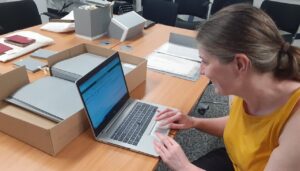
Using our now well-developed Lyell ‘next level’ palaeography skills, we feel ready to explore the links between specimens and the written information – but to get us started, we brought in the label expert!
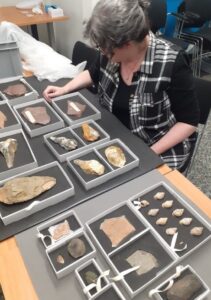
Postgraduate researcher Kate Bowell is exploring the stories the National Museum of Scotland has told in their collection of 20,000 exhibition labels and how these stories have changed over time (See Kate’s blog here https://blog.nms.ac.uk/2021/12/14/a-history-of-exhibition-labels-and-the-stories-they-tell/ ). Her experience in studying the stories behind labels means she is the perfect person to help us start formulating a plan.
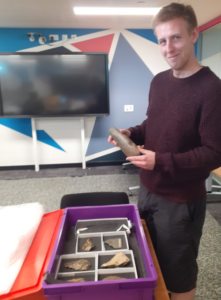
We were also pleased to have undergraduate student Will Adams join us. Currently in 4th year Archaeology at the University of Edinburgh, Will’s interested in archives and how they relate to archaeological collections – he is also on the quest to find a dissertation topic.
Could we join forces to help each other out? What followed was a joyous 3 hour discussion – exploring the history of labels, the history of collections, why people collect, how people use labels, personal collection administration, split and movement of collections, the rise and purpose of museums – and how museums subsequently label items, both for use and for public enjoyment.
Lyell’s administration throughout his collection – his page numbering, indexing and the labelling of his specimens – show that he actively used them as a resource for his work. No actual catalogue exists – and so we have to start slowly working out how he kept his collection in order, and how he used specimens to aid his understanding. Now that the collections are together, it should be possible to start to see how it all linked up – and there is huge potential to learn much more about the specimens.
For example, one of the Cockburn’s specimens, and part of Lyell’s original collection is this amazing Agate, labelled in Lyell’s own handwriting:
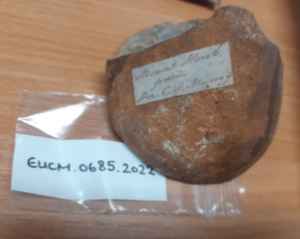
We recognise Lyell’s distinctive ‘e’ – and the place name Mount Horne points us to British Columbia[1]. The specimen’s original owner is noted by Lyell as the Honourable C.A. Murray. In many ways similar to Lyell, Charles Augustus Murray was an author and diplomat,. He attended Oxford University, and spent several years travelling across Europe and America from 1835 and 1838, describing his experiences in popular books on his return [2].
We know Lyell visited British Columbia several times; the collection includes both Charles and Mary’s certificates recording their passing behind Niagara Falls to Termination Rock dated the 7th June 1842; and a card representing Columbia College dated 1853. As we are able to identify critical information – names of people, places, mineral types – on the labels – these can be cross-referenced to text in the notebooks, allowing us to focus in on the history of the specimens. Creating this framework of knowledge allows us to develop our hypothesis about how travel, collaboration, and collecting (or trading) specimens fed into the larger ideas of the time relating to “how the earth systems worked”.
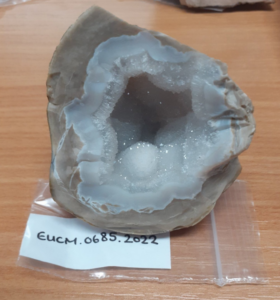
Will’s presence also helped us see how he can add archaeological detail to the specimens. Lyell’s interests where wide ranging, and his exploration of the history of man resulted in him collecting neolithic objects ranging from tools to beads. Of course, we cannot be experts in everything, and with the collection of specimens being held by the Grant Institute, they have been categorised very much as geological specimens. Will’s contribution proved how collaboration with people who can view the objects with an “archaeological eye” adds significant detail to the objects. Our meeting provided him with the perfect opportunity to dive in and begin to think about a project combining his interest in archives and collections. Inspired, Will has booked into the CRC Reading Room to start looking at the collection in more detail, and is talking to his dissertation advisor to firm up a plan.
The benefits in bringing both the collections and experts together are tangible. Collaborative work will really enhance the Lyell collection – indeed, our afternoon spent considering label gave us a practical insight into how he himself worked and used the collection.
Witchcraft, Waulking & Will-o’-the-Wisps – Exploring the Maclagan Manuscripts
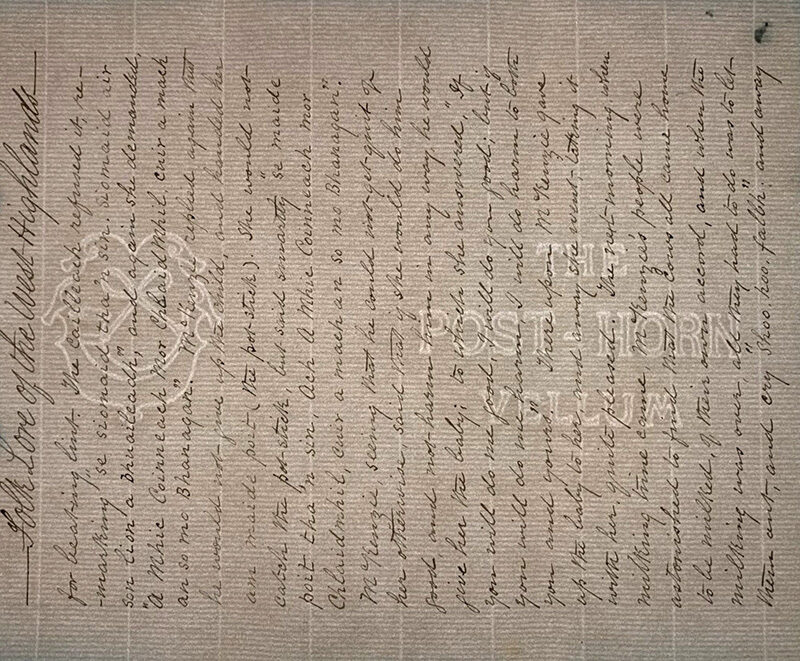
Have you ever been stuck for a good nursery rhyme to tell your kids? Or needed a cure for a headache that just will not go away? Or perhaps you’ve found yourself wondering – what is the best way to protect my butter from being cursed by witches? If the answer to any of these questions is yes (or possibly “why would a witch curse my butter?”) then let me introduce you to the collection recently digitised by our Cultural Heritage Digitisation Service team that can answer all these questions and more – the Maclagan Manuscripts.
Welcome and welcome back!
Hello, and if this is your first time visiting the Law Librarian Blog, we’re glad you made it! This is where we post updates about training, resources, library access and anything else we think you might need to know. We hope you’ll find the blog a useful place throughout the year.

Image by analogicus on Pixabay
So welcome week has come and gone already and we’re straight into Week One of teaching. We’ve been busy running induction sessions for student at all levels but don’t worry if you missed out, recordings of all online sessions have been uploaded to our Media Hopper channel:
- UG Using the Library and Using Legal Databases
- PG Using the Library and Using Legal Databases
- PhD Sources, Materials and Bibliographies
There’s information about what’s available in the library and what we have online access to listed in DiscoverEd, which you can find here:
- DiscoverEd.ac.uk
- Video on a simple search on DiscoverEd (6 mins)
- Microsoft Sway guide to using DiscoverEd
And finally, some other resources that can help you get started with legal research:
- Our new information skills resource to help students work through the basics of finding legal information.
- The Law Subject Guide has a lot of useful information for all levels:
- Take a virtual look around the Law Library before you visit! Find our Library Orientation Guide here.
We completely understand the first few weeks of a new academic year are swamped with information, and it’s probable that you’ll have too much to take in for now. However if you bookmark this page or these resources we hope they’ll be useful when you need them. If you have questions please feel free to get in touch at any time by leaving a comment or emailing us directly: law.librarian@ed.ac.uk.
On trial: HNP Louisville Defender
Thanks to a request from staff in HCA the Library currently has trial access to the Louisville Defender part of ProQuest’s Historical Newspaper collections. An excellent source for coverage on issues affecting African Americans, the newspaper played an integral role in the fight for integration in the 1960s.

You can access HNP Louisville Defender via the E-resources trials page.
Access is available on and off-campus.
Trial access ends 20th October 2022. Read More
Minimum Preservation for Maximum Results? It’s a good idea if it works!
 In less than a week, iPres22 will kick off in Glasgow, right on our doorstep! If you’re not already acquainted with iPres, welcome! There’s something for everyone! iPres is the world’s largest digital preservation conference where practitioners from all sorts of backgrounds and industries gather to share challenges and strategies.
At this year’s iPres, among other things, I’m running a workshop with Caylin Smith (Head of Digital Preservation at Cambridge University Library) and Patricia Falcao (Time-based Media Conservator at Tate) on Preserving Complex Digital Objects – Revisited. We ran a similar workshop at iPres 2019 in Amsterdam, breaking into groups to undertake different aspects of the preservation process with one complex digital object (‘Breathe’ by Kate Pullinger).
This year, each of the speakers will bring a digital object from their own collections that they consider to be complex. We will break participants into small groups to try an experiment:
Can a Minimum Viable Preservation (MVP) approach be applied to complex digital objects? Read more to learn about what MVP digital preservation looks like and what to expect from the workshop! If you’re planning to attend iPres, come join us!
Student Interns Capture ‘The Student’
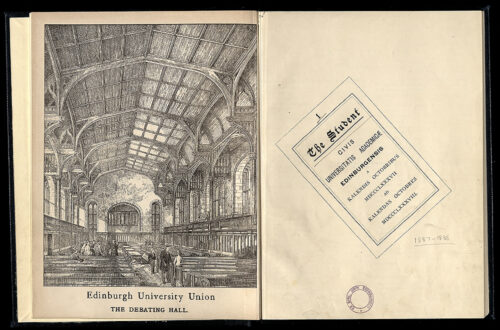
In February 2022, PhD students Vesna Curlic and Ash Charlton began their digitisation internships in partnership with the University of Edinburgh’s Library and University Collections and the Centre for Data, Culture, and Society. Together, they reflect on the joys and challenges of digitisation.
We were tasked with an internship project that has two main parts – half our time is spent in the Cultural Heritage Digitisation Service’s Digital Imaging Unit (DIU) in the University’s Main Library scanning early volumes of The Student, University of Edinburgh’s student newspaper. The other half of the time, we work to develop a training pathway for the Centre for Data, Culture and Society which will direct people towards resources for undertaking their own digitising projects. This post is part one of two, reflecting on our experiences digitising The Student.
Data Mindfulness – learning the basics of good research data management
When planning a research project, whether this involves carrying out interviews for a first dissertation project or analysing secondary data for a PhD, it is important to ensure that you are handling your research data safely and effectively. Taking time to think about where and how you will store and organise your files, how your data can be backed up to protect against accidentally losing your work, and what to consider if working with sensitive information, will help make the research process simpler and help you become a better researcher.
The Research Data Service provide a range of training materials to help both new and experienced researchers to work with their research data more effectively. For students planning a dissertation project we have developed the online Data Mindfulness: Making the most of your dissertation data course (available as part of the Library’s LibSmart II course). This short introductory course is designed to be accessible and engaging, and incorporates videos, quizzes and reading materials to provide helpful tips and guidance for those preparing to undertake their first dissertation project.
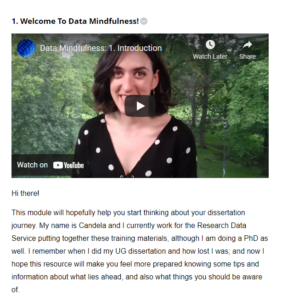
Data Mindfulness is available online as part of the library’s LibSmart II research skills course
We are happy to share some of the positive feedback we have received from students who recently completed the Data Mindfulness course:
“It was clear and easily accessible, especially for someone who is an online student”
“A lot of information that I had no idea about but feel better having received it”
“It provides useful tips about organizing and storing data and files”
“Every SSPS student should be aware that they have access to this course before starting their dissertation”
For post-graduate students and those with previous experience working with research data we recommend checking out MANTRA, our well-established online training course which provides more in-depth training on key research data management topics.
Dr Bob Sanders
L&UC Research Data Support
iPres Delegate Visit to the University of Edinburgh
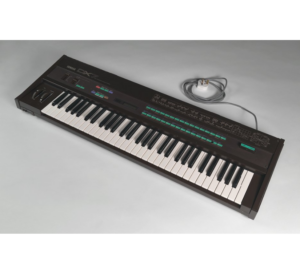
As part of iPres 2022 hosted in Glasgow on 12-16 September, the University of Edinburgh will welcome a cohort of conference delegates to tour the Main Library and St. Cecilia’s Hall.
As part of the tour, specialist curators will provide an overview of materials from across collections that reflect many examples of Technology Heritage in the care of the University. Items will include manuscripts like Makhrūṭāṭ Iblawniyūs (Apollonius’ Cones), an early 18th century copy of a Codex Arabic Script and Godfrey Thomson’s mechanical calculator from the 1930s. Read More
Under Construction

Image: Digital Preservation Business Case Toolkit http://wiki.dpconline.org/
Nothing to see here! Check back soon for updates about digital preservation at the University of Edinburgh!
Edinburgh Open Research Conference Proceedings
 One of the ambitions for the EOR conference held in March, 2022, when we first started planning it was to make it as open and accessible as possible. To achieve this we made the whole event hybrid so that plenary talks, posters, and workshops were all accessible on the day to both in person and remote attendees. While this generally worked very well for both remote and in-person attendees, we also wanted to make it available to people who couldn’t attend on the day – so we recorded everything, and the recordings of the talks and posters can now be openly accessed through our Edinburgh Open Research journal at http://journals.ed.ac.uk/eor.
Kerry Miller
Research Data Support Officer & Open Research Co-Ordinator
Library Research Support
Collections
 Hill and Adamson Collection: an insight into Edinburgh’s past
My name is Phoebe Kirkland, I am an MSc East Asian Studies student, and for...
Cataloguing the private papers of Archibald Hunter Campbell: A Journey Through Correspondence
My name is Pauline Vincent, I am a student in my last year of a...
Hill and Adamson Collection: an insight into Edinburgh’s past
My name is Phoebe Kirkland, I am an MSc East Asian Studies student, and for...
Cataloguing the private papers of Archibald Hunter Campbell: A Journey Through Correspondence
My name is Pauline Vincent, I am a student in my last year of a...
Projects
Cataloguing the private papers of Archibald Hunter Campbell: A Journey Through Correspondence
My name is Pauline Vincent, I am a student in my last year of a...
Archival Provenance Research Project: Lishan’s Experience
Presentation My name is Lishan Zou, I am a fourth year History and Politics student....