Home University of Edinburgh Library Essentials
April 10, 2026
Acta Sanctorum now available online to University of Edinburgh
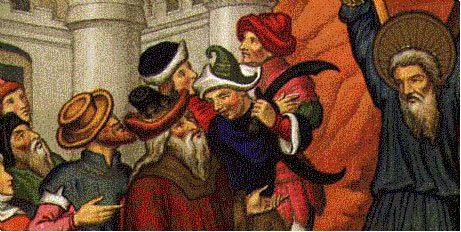 The online Acta Sanctorum, published by ProQuest Databases, is now available to University of Edinburgh users. It is an electronic version of the complete printed text of Acta Sanctorum,which examines the lives of saints, organised according to each saint’s feast day, and runs from the two January volumes published in 1643 to the Propylaeum to December published in 1940. The original printed volumes are held in New College Library’s Special Collections.
University of Edinburgh registered users can access the database via the link on the Library’s A-Z Databases page.
Studying away from Edinburgh over the summer?
If you’re a School of Divinity student moving away from Edinburgh over the summer but continuing to work on your thesis, you’ll be thinking about how to obtain the library materials you need.
All of the University of Edinburgh’s online services remain open to you, of course. Just log in remotely using your EASE user name and password.
As long as you remain a University of Edinburgh student, the Library can continue to process inter-library loan requests for you, and photocopies of journal articles and book chapters can be posted to you (We can’t supply physical loans of books or microfilms by post). If an electronic copy has been supplied, we will email it to you. You’ll need to register for the ILLiad system first, if you haven’t already done so, and then submit your requests online. 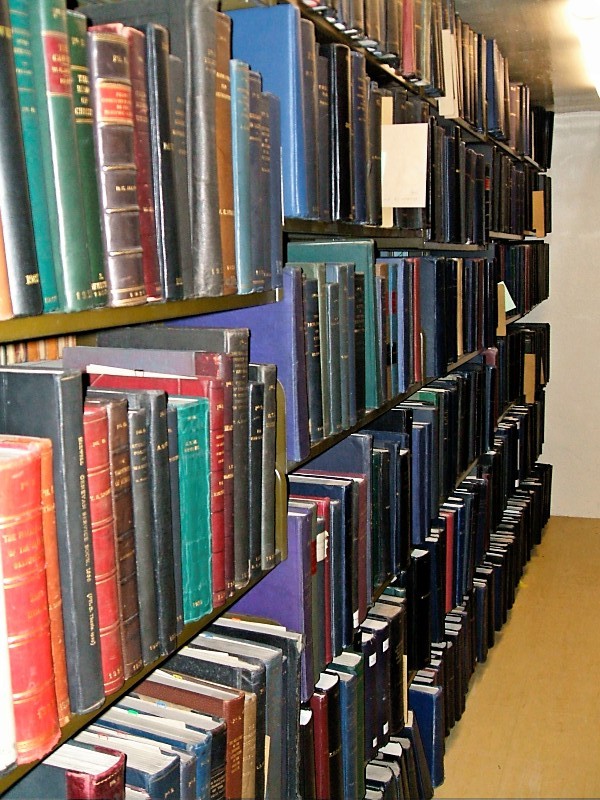
In the UK, you can usually request inter-library loans using the services available at your local public library. This will depend on the services offered locally, and there may be a charge. Always allow a minimum of two weeks, and more if possible, for an inter-library loan item to be delivered.
If you live within easy travelling distance of a University library, it’s probably worth joining the SCONUL access scheme. This allows University of Edinburgh staff and students to have access to 170+ Higher Education Libraries in the UK. You might find visiting one of these libraries quicker than waiting for inter-library loans. You need to register with Edinburgh University as your home library first – so do it before you leave Edinburgh. Use the COPAC Union library catalogue http://copac.ac.uk/ to help you see which academic libraries have the materials you want.
A plea from us to all of you going away over the summer – please keep checking your e-mail notices for library books that have been recalled. We need you to return these books for the benefit of other library users. Thank you!
New books at New College Library – June
New College Library has a regular display of new books at the far end of the Library Hall, close to the door to the stacks.
 Currently in the display is The origin of the Roman Catholic Church in Korea : an examination of popular and governmental responses to Catholic missions in the late Chosôn dynasty by Jai-Keun Choi. This was a recommendation from a postgraduate student.
Also new is Petri Cantoris Parisiensis Verbum adbreviatum, part of the Corpus Christianorum series that the Library subscribes to.
You can see an regularly updated list of new books for New College Library on the Library Catalogue – choose the New Books Search and limit your search to New College Library. Here’s a quick link to new books arriving in the last few weeks. A word of caution – some of the books listed here may still be in transit between the Main Library (where they are catalogued) and New College Library, so not on the shelf just yet.
Researching the motherhood of God
The School of Divinity at New College hosts a colloquium on June 7, 1:00 – 4:30 on Women, Language, and Worship in the Church of Scotland – see the blog or facebook page for more details.
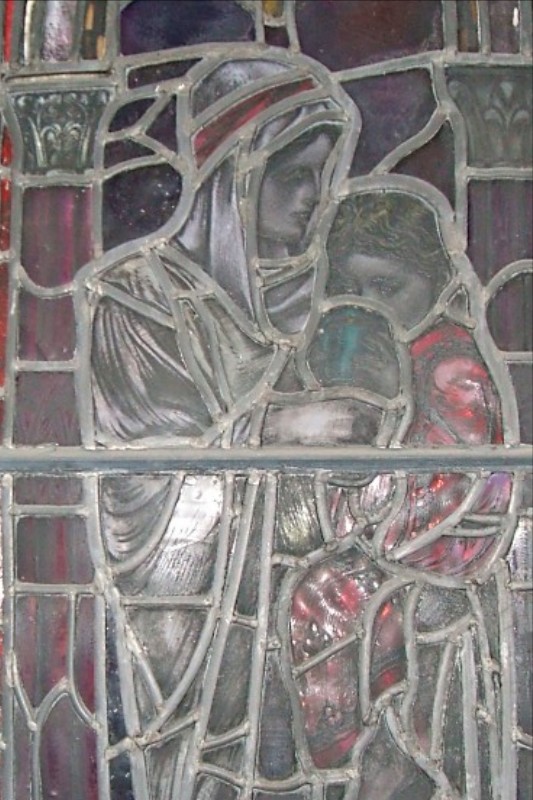 In 1984, a report was submitted to the General Assembly by Anne Hepburn, president of the Women’s Guild, which explored how God might be referred to as a Mother figure as well as a Father in the New Testament, and the implications for gender inclusive language within the Church. New College Library holds this report in the Reports of the General Assembly (at sLX 50 B) and it was also reprinted separately as a volume in its own right (at pRQ 20 MOT, New College Library). The report received a hostile reception, which was widely reported in the Scottish and National Press.
New College Library holds substantial collections of order of service books and hymnbooks, which researchers can access to see if the 1984 report did have an impact on Church practice. These include the Hymnology Collections as well as the fourth edition of the Church Hymnary (2005), on the shelf at New College Library at Ref. BV431 Chu.
New College Library Stack 1 Closure from 14 June
 Stack I is due to be redecorated this summer, and an early warning system for flooding is also being installed in all three Stack floors. To enable these works Stack I will be closed to public access for approximately 4 weeks, starting on the 14th of June. Library staff will operate a book collection service where access allows.
Stack I is the floor immediately below the Library Hall, which contains general lending stock – Library of Congress sequence BS-Z, and the older books classified using the Union Theological Seminary scheme. These sequences are the only books which will be affected. The Library of Congress books in the Library Hall, the periodicals and Special Collections are all unaffected.
To avoid problems, you could try to visit the Library before 14 June to borrow Stack I books. Postgraduate students and staff can borrow up to 40 books. Please contact the Library helpdesk if you have any queries about this closure period.
Finding New College theses on the online catalogue
In response to your questions, here’s some tips for finding New College theses on the University of Edinburgh Library catalogue.
Personally, I find using the Aquabrowser version of the catalogue quite useful for a quick (if dirty) search of what’s available. Type in theses + another search term – e.g. christianity, New Testament etc – into the search box. I searched for eschatology theses. Once you’ve got your list of results make sure that you select ‘New College Library’ from the list of library locations and you should get New College Library results only. One health warning here : you will also get books with the word ‘theses’ in the title and you may get theses from other universities if we have them in the library.
For more precision, you can use the ‘classic’ library catalogue interface. Go straight to the advanced search. Type theses into the search box . Add any additional keywords into the remaining search boxes. Make sure you choose a year of publication option – click one of the radio buttons. For instance you can click the first radio button and choose to search the last 50 years. Now go down to the Library location box and choose New College Library only.
Another tip – when you click the search button at the bottom of the form, choose the search button next to where it says ’10 records per page’. Don’t click the word ‘Search’ which is on the tab at the bottom of the page next to Saved Searches. If you do – as I’ve found to my frustration – it thinks you want to start a new search and you end up having to start over again.
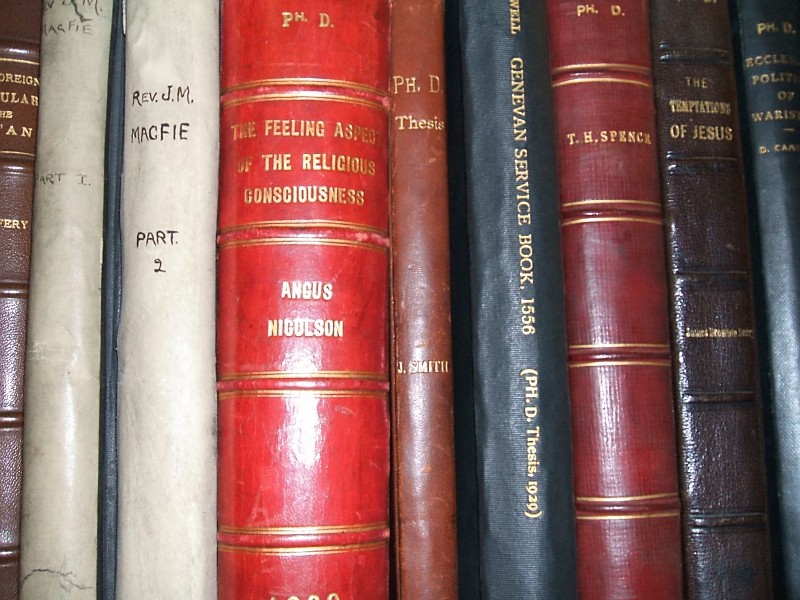
New College Theses collection now fully catalogued online
Over 700 New College theses covering the period 1920-1985 have now been catalogued online as part of the Funk Cataloguing Projects. Some of these theses have second copies at the main Library, but many others are unique copies only held in New College Library. The completion of this project means that all of New College Library’s theses are now listed on the University of Edinburgh Library’s online catalogue.

The Theses collection demonstrates the richness and diversity of Divinity research in the twentieth century, with topics ranging from the Buddhist conception of Man in relation to the Christian conception, to the Church in Shetland during the sixteenth and seventeenth centuries – to pick just a few. Current Divinity PhD students now have improved access to the range of previous research done at New College, and New College alumni with PhDs will now be able to find the fruits of their efforts on the online catalogue.
Now that these theses are included in the University of Edinburgh online catalogue, the details of this research will be shared worldwide, not only by researchers looking for University of Edinburgh material but also by researchers using tools such as COPAC, the union catalogue of the UK’s major research libraries.
Summer days at New College Library … and Hymnology collections
Summer has arrived! The weather forecast says 12 degrees today – but it feels much warmer. The School of Divinity’s exams are over, and the bustle of last week’s General Assembly has faded. Inside the library, only a few dedicated researchers are at work – and the library staff, of course. Here’s a summer themed item from New College Library’s Special Collections.

The child’s book of song and praise, including 34 pieces of music … [1870]. Hymnology Collection, E15/g 6.
The child’s book of song and praise [1870] is an item from the Hymnology Collections. The core of these collections was the gift in the 1880s of two thousand hymnbooks from James Thin, the founder of the famous Edinburgh bookshop. This collection has been added to by gift, purchase and the re-organisation of other library books of a similar nature to form the collection of over 5000 items we have today.
Primarily 18th & 19th century printed volumes (some with very nice pictorial publishers bindings), there are also some older books, a few scores and some LPs and cassettes. The collection covers sacred songs and poetry as well as hymns, including many items intended for children, both for Sunday School and home use. This verse from The child’s book of song and praise is just one example:
“Peace be around thee, wherever thou rov’st’ / May life be for thee one summer’s day …”
A project to catalogue the Hymnology Collections online has just begun – just one of the Funk Cataloguing Projects which are opening up the Special Collections here at New College Library.
Medieval manuscript on display at New College Library …
Now on display at New College Library : the Athanasii Opuscula.
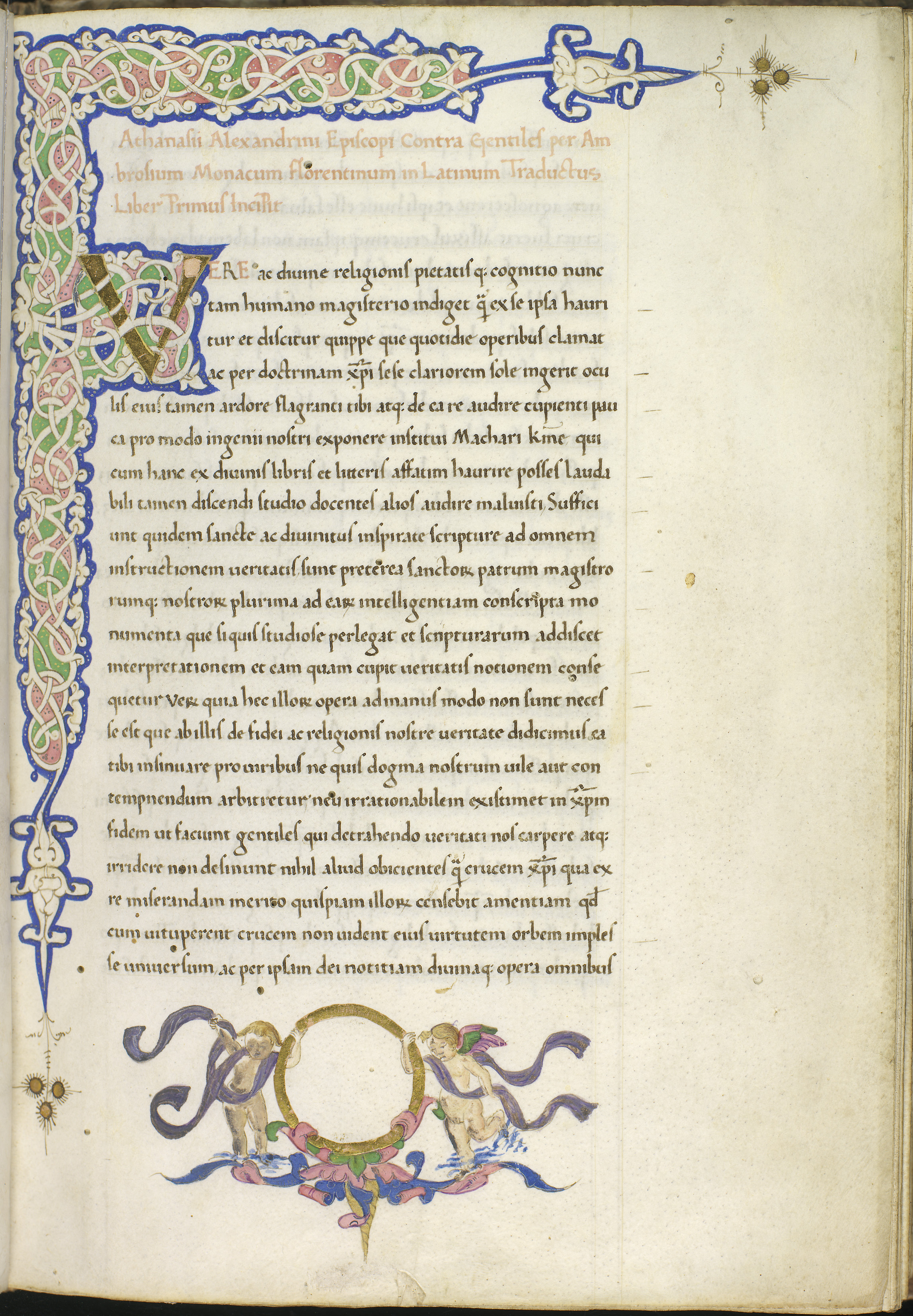
This fifteenth century Italian medieval manuscript has a beautiful painted and gold tooled frontispiece and a neat humanistic script. In the lower margins cupids hold a gold hoop. (Details taken from Medieval Manuscripts in British Libraries, N.R. Ker, Oxford: Clarendon 1977, p. 532)
New College Library possesses five medieval manuscripts in its manuscripts and archives collection. This item was given to the Library by F. Sargent, probably before 12 Nov 1844.
Treasures of New College Library : the Pamphlets Collection
“… but that religious pamphlets, especially if they had a shade of allegory in them, were the very rage of the day.”[1]
In the days before radio, television and instant news pamphlets allowed theological debate and comment to be carried on in cheap, portable and accessible print. New College Library has an exceptional Pamphlets Collection with over 30,000 items. Spanning the development of the Scottish Church from the time of the Reformation to the present century, the sermons, theological debates and reports of Church government and discipline which are contained in this collection are a reflection of the parallel development of Scottish history, and of the establishment and disestablishment of a national Scottish Church.
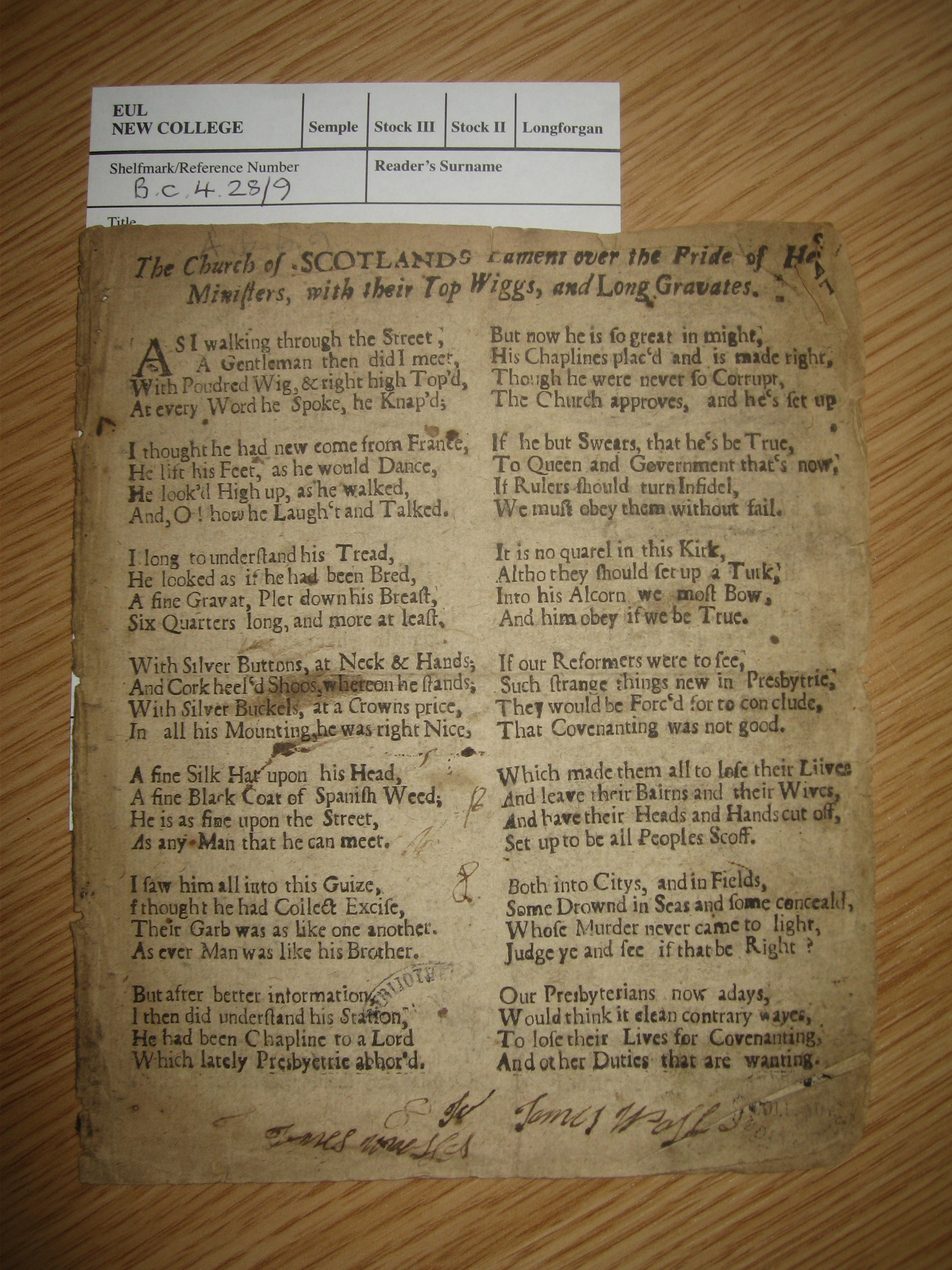
The Church of Scotland’s lament. Pamphlets Collection, New College Library B.c.4.28/9
“The Church of Scotland’s lament over the Pride of Her Ministers, with their Top Wiggs, and Long Gravates …” is just one example of the Pamphlets in this collection. Dating from the 1700s, it is a humorous poke at a well to do Church of Scotland minister, with the writer contrasting the minister’s comfortable existence with the struggles of the Covenanters in times past.
As I write the 2012 General Assembly is in full swing, and many Church of Scotland ministers are coming and going – but I haven’t spotted any wigs or ‘Gravates’ (cravats, I think). Nevertheless comment, discussion and criticism of the Church’s activities will be just as much in the news as when this pamphlet was written.
This pamphlet is newly catalogued online as part of the Funk Cataloguing Projects at New College Library, which has enabled the cataloguing of over 12,000 pamphlets.
[1] Hogg, James The private memoirs and confessions of a justified sinner (London: A.M. Philpot Ltd., 1824)
Collections
 Hill and Adamson Collection: an insight into Edinburgh’s past
My name is Phoebe Kirkland, I am an MSc East Asian Studies student, and for...
Cataloguing the private papers of Archibald Hunter Campbell: A Journey Through Correspondence
My name is Pauline Vincent, I am a student in my last year of a...
Hill and Adamson Collection: an insight into Edinburgh’s past
My name is Phoebe Kirkland, I am an MSc East Asian Studies student, and for...
Cataloguing the private papers of Archibald Hunter Campbell: A Journey Through Correspondence
My name is Pauline Vincent, I am a student in my last year of a...
Projects
Cataloguing the private papers of Archibald Hunter Campbell: A Journey Through Correspondence
My name is Pauline Vincent, I am a student in my last year of a...
Archival Provenance Research Project: Lishan’s Experience
Presentation My name is Lishan Zou, I am a fourth year History and Politics student....