Home University of Edinburgh Library Essentials
December 14, 2025
*The Library has now purchased access to Mass Observation Project. See New! Mass Observation Project, 1981-2009 *
I’m happy to let you know that the Library currently has trial access to Mass Observation Project, 1981-2009 from AM Digital, which allows you to explore the history of Britain through three turbulent decades, written by those living through it.
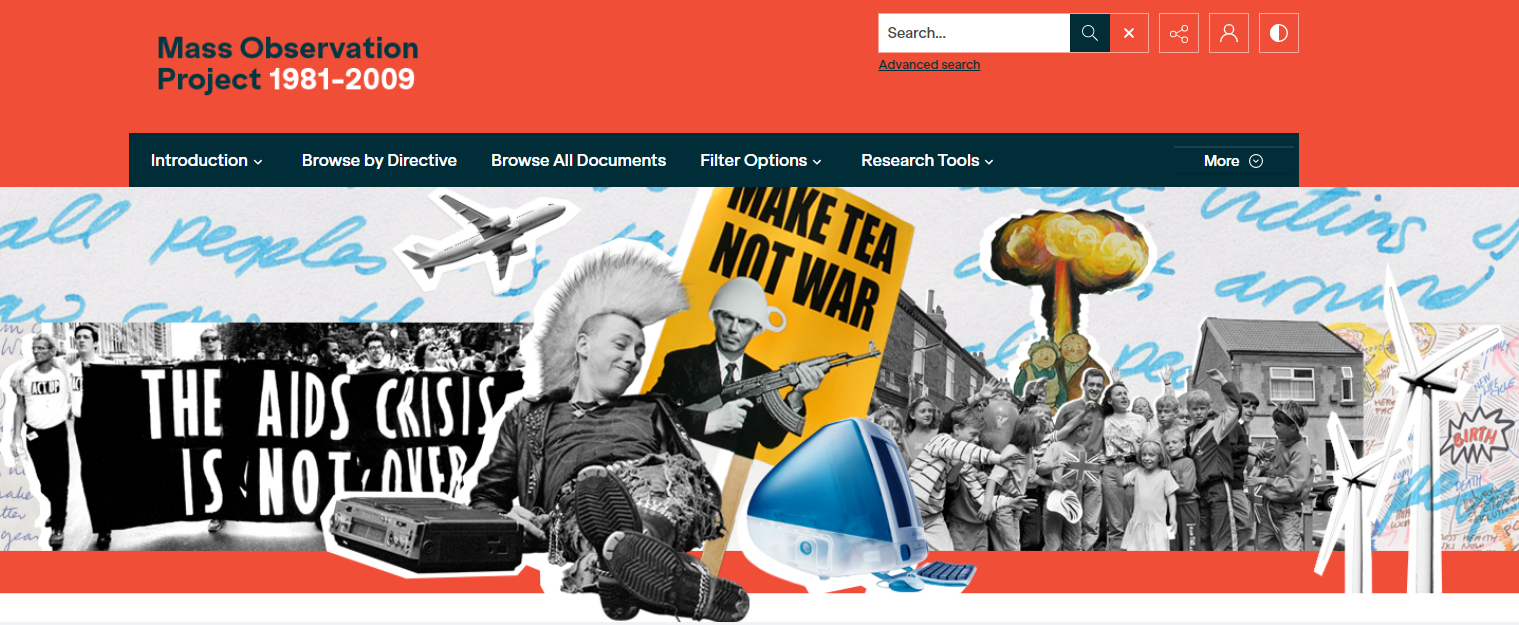
Access Mass Observation Project via the E-resources trials page.
Access is available on and off-campus.
Trial access ends 24 June 2023.
Mass Observation Project, 1981-2009 provides digital access to a unique life-writing archive, capturing the everyday experiences, thoughts and opinions of people living through the turbulent final decades of the 20th century and the advent of the 21st century. Read More
The Library currently has trial access to Foreign Office Files for Japan, 1919-1952 from AM Digital. This resource allows you to discover Japan’s rise to modernity and its relations with global superpowers through British Government documents from the National Archives, UK.
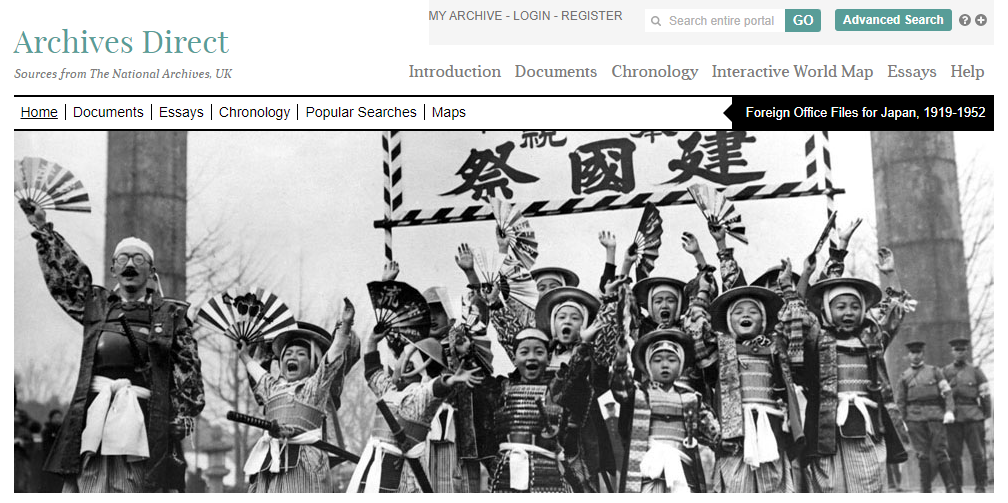
For more information, see the On trial: Foreign Office Files for Japan blog post by the Academic Support Librarian for History, Classics and Archaeology.
The Library currently has trial access to Latin American Newspaers: Series 1 from Readex, which allows you to explore Latin American history and culture during the 19th and 20th centuries.
For more information, see the On trial: Latin American Newspapers, Series 1 blog post by the Academic Support Librarian for History, Classics and Archaeology.
Thanks to a request from a HCA postgraduate student the Library currently has trial access to Foreign Office Files for Japan, 1919-1952 from AM Digital. This resource allows you to discover Japan’s rise to modernity and its relations with global superpowers through British Government documents from the National Archives, UK.

You can access the Foreign Office Files for Japan, 1919-1952 via the E-resources trials page.
Trial access ends 24th June 2023.
Published in three parts, this collection makes available extensive coverage of British Foreign Office files dealing with Japan between 1919 and 1952. Read More
Thanks to a request from staff in the School of Social and Political Science the Library currently has trial access to the new resource BBC Monitoring: Summary of World Broadcasts, 1939-2001 from Readex. Created in partnership with the BBC and digitised from the physical archives this fascinating resource captures more than 60 years of turbulent 20th century global history, as it unfolded.
Access BBC Monitoring via the E-resources trials page.
Access is available on and off-campus.
Trial access ends 12 June 2023. Read More
In this blog, Veronica Wilson discusses her project working with musical instruments in storage. Veronica started this project as a Thompson-Dunlop Intern and then joined the Conservation & Collections Management team as a Library Assistant (funded by Thompson-Dunlop endowment and the Nagler bequest).

Wolfson gallery at St Cecilia’s Hall
The University of Edinburgh holds a rare and unique collection of musical instruments. Many stand proudly on display in St Cecilia’s Hall, the music museum of the University, visible to the public and played by musicians from around the world. The rest are in storage, available only by request for research, study, or viewing. The collection at the University Collections Facility (UCF) consists of instruments too large to be stored in any of the other locations. Though the time since they were last played can span lifetimes, the collection is anything but silent.
Today’s blog comes from Collections Registrar Morven Rodger, reflecting on the 2023 ICOM UK Conference in Glasgow, addressing legacies of colonialism nationally and internationally.
In August 2018, while on a courier trip in Washington DC, I paid a visit to the National Museum of African American History and Culture1. In one of the very first galleries I entered, a label mentioning the Earl of Dunmore caught my eye…
‘In November 1775 Royal Governor of Virginia John Murray, the Earl of Dunmore, issued a proclamation that offered freedom to “all [indentured] servants, Negroes, or others… that are able and willing to bear arms” for the crown. But this promise was not fulfilled.’
I recognised the name immediately. John Murray, the 4th Earl of Dunmore, built the Pineapple, an architectural folly a stone’s throw from my hometown. I knew about the building, and the symbolic significance of the fruit, yet here I was, thousands of miles across the Atlantic, being offered a new perspective on this familiar figure. I remember being struck that I’d had to travel all this way to hear the other side of his story.
Do you think UKRI’s’ open access policy for journal articles has made a significant impact on the scholarly publishing landscape in the past year? How has the policy changed things and impacted the shift to open access?
From our point of view we have seen that the UKRI policy and the associated Open Access Block Grants funding has been one of the more significant driving factors in shifting the academic publishing landscape in the UK towards open access as the standard approach for many academics when publishing their research outputs. To illustrate this, in 2022 there were 32,478 articles published by lead authors from the UK with a Creative Commons licence which represents around 45.7% of the total UK output. In 2021 this figure was 34.1% and slightly lower at 25.2% in 2020 (OA figures provided by the Hybrid Open Access Dashboard: https://subugoe.github.io/hoaddash).
This significant rise in openly licenced material is a direct consequence of publishers offering the UK academic sector Transitional Agreements (TAs), sometimes known as ‘Read & Publish’ deals. Transitional agreements are contracts between a university and publisher which gradually shift the basis of payments from subscription-based reading to open access publishing services in a controlled manner. (https://www.jisc.ac.uk/full-guide/working-with-transitional-agreements). Research intensive universities have struggled to meet the additional costs of open access on top of journal subscription expenditure and the UKRI Open Access Block Grants have enabled this transition to start to take place. Without this critical investment by UKRI in the publishing landscape this transformation would not be possible.
Do you think UKRI’s open access policy is sufficient? Should UKRI do anything else to facilitate the shift to open access?
To date the focus of the UKRI policy has been on the final published journal article, with a sidenote that encourages authors to use preprints – particularly researchers funded by the MRC and BBSRC who have separate policies for preprints. During the COVID-19 pandemic we saw great use of preprints to rapidly disseminate research findings. One University of Edinburgh preprint reporting on the Omicron variant of concern was downloaded 21, 005 times in 10 days (See this blog post for a case study: https://libraryblogs.is.ed.ac.uk/openscholarship/2022/01/07/the-power-of-preprints-an-omicron-case-study/).
Other subject disciplines that have longer publication times would benefit greatly from rapid communication and we would like to see UKRI investing more in open infrastructure which will help enable this. Research England has invested significantly to support initiatives like Octopus – a new platform for the scientific community – but this focus on lab-based disciplines risks leaving innovation in the Arts, Humanities and Social Sciences trailing behind the traditional science subjects.
Another open question that UKRI could help answer is how can the value of preprints be more widely recognised and rewarded? This issue is closely related to the strong incentives for researchers to publish in glamour journals and the obsession with Journal Impact Factors. UKRI is already doing some great work to reform research assessment – for example by promoting narrative CVs – and we would like to see this continue in more subject disciplines.
What else needs to be done by others (not UKRI) for a full shift to open access?
The purview of UKRI is limited by national boundaries, which is why the Plan S initiative is extremely important. Co-ordination between national research funders is required to ensure that progress towards open access is a controlled and managed so that it works for everyone involved in the process – authors, publishers, institutions and research funders. The core of the access problem is that academia has outsourced the publishing component to commercial companies who are extracting maximum revenue – as is their wont and right to do so. Libraries don’t currently have comprehensive answers, but we are engaging with publishers to let them know how they can help the academic community. Our favoured approach is to support smaller society publishers to adopt the “Subscribe to Open” (S2O) model which a pragmatic approach for converting subscription journals to open access. Using S2O, a publisher offers a journal’s current subscribers continued access. If all current subscribers participate in the S2O offer – simply by not opting out – the publisher opens the content covered by that year’s subscription. There is little risk to the publisher and there are no barriers or fees for authors to publish.
Have you or researchers at Edinburgh encountered any problems linked to UKRI’s open access policy for journal articles?
The shift to requiring immediate open access upon publication with a CC BY licence is hugely welcome, however it does create significant complexities for researchers who are trying to navigate their way through the various complex options offered by journal publishers. Some examples of current live issues that we routinely help authors with are:
The changes in the publishing landscape have provided libraries with new opportunities to support and engage with the academic community. The skills and knowledge of librarians are well suited to help manage this change.
The English writer Walter de la Mare was born 150 years ago this week on 25 April 1873. To mark his anniversary, we are publishing a blog by Ash Mowat, a volunteer in the Civic Engagement Team, which also marks the centenary of Come Hither, de la Mare’s much loved anthology of verse for ‘the young of all ages’. The blog also contains details of Edinburgh University Library’s extensive collection of de la Mare correspondence. Read More
Ash Mowat is one of our volunteers in the Civic Engagement Team. Ash has been looking into the relationship between pseudoscience and unexplained phenomena.
Introducing Ash: I was born and have lived in Edinburgh most of my life. I attended University of Glasgow in the late 1980s where I hoped to complete an honours degree in English literature, but unfortunately due to ill health I was only able to obtain a degree at ordinary level. I have diverse interests in literature, the visual arts and science and history. I also worked for almost 25 years in social housing and have a passion for social justice, and equalities.
This wee blog intends to delve into and explore some of the flawed attempts to adhere to correct science, or indeed abandon it altogether to engage with a faulty reality, driven either by ideology, attempts to exploit and gain financially from others, and things in-between.
We’ll encounter some well-intentioned but incorrect science and/or research, some skewed biases and consequent errors, and the ludicrous and paranoid labyrinths we can encounter, made more so with the unhinged impact of sometimes exploitative, unproven, hate driven, and monetising voices on the Internet. We’re in for a sometimes-bumpy ride
What is science?
If we’re going to pick apart the wrongs of pseudoscience we should at first try to establish how true science is established, defined and proven. [1]
Scientific terms are also often loosely and carelessly used incorrectly, not always with ill intent. For example, we often use the term theory to suggest a notional idea, when scientifically a theory has to be an established, and proven concept that is both accepted and replicated by others peers in the specialized field.
Scientific discoveries are, of course, an ongoing force of learning. Some science previously proven and established is later replaced with new research, findings and laws.

Mary Jackson, taken from https://www.cnet.com/culture/internet/meet-katie-bouman-the-woman-who-transformed-our-view-of-black-holes-forever/

Katie Bouman, taken from https://www.cnet.com/culture/internet/meet-katie-bouman-the-woman-who-transformed-our-view-of-black-holes-forever/
Pseudoscience
Pseudoscience is defined as an attempt to establish a science based on incorrect data. For example wrong or flawed research and evidence, bias, since disproven science. It can be driven by ideological unsound motives such as human race and superiority notions, but equally be an outcome of well-meaning but ultimately incorrect scientific applications. [2]
Examples of Pseudoscience 2: Phrenology
Phrenology emerged in the late 18th century via Franz Josef Gall and his fellow German assistant Johann Gaspar. It was based on wholly untested and unproven assertions that various bumps on the head corresponded to any individual’s character, intelligence, behaviours etc. There was no evidence for these claims and knowledge of brain function at the time was very limited. We know now that certain brain areas influence certain behaviours, but these are complex and not detectable on the surface of the head.

Image from https://exhibitions.ed.ac.uk/exhibitions/mind-shift
Like eugenics to follow, phrenology wrongly claimed that all moral and intellectual abilities were biologically inherited and determined from birth. Phrenology was also supportive of the hateful and erroneous notions of the superiority of white people, and consequently was used as a “science” to condone slavery and racial injustice.
Phrenology was widely criticised for its lack of any valid scientific evidence, and largely dismissed as a pseudoscience by the mid-1800s. In 1844 French physiologist Francois Magendie said “phrenology, a pseudoscience of the present day like astrology….pretends to localise in the brain the different kinds of memory. But its efforts are mere assertions, which will not bear examination for an instant (An elementary treatise on human physiology by Francois Magendie 1844). [3]
Visit to the University of Edinburgh Archives on Phrenology
Systems of Phrenology by George Combe (Edinburgh 1836, third edition). George Combe was born in Edinburgh and became a student at the University. He became a devoted believer in phrenology when he attended lectures that its two founders Franz Joseph Gall and Johann Gaspar gave in Edinburgh in 1815, where they had come in response to criticism levelled against the scientific merits of their practices. [4]
It was fascinating to view this rare edition, as a hand written manuscript. On that note, however, any student wishing (unlike here) to make a complete reading and thorough study of this text, would be advised to also access an online typewritten version. The handwriting here is very small, and even with the library staff’s kind provision of a magnifying glass, it’s hard to decipher.
In the book, Combe makes reference to the twin hemisphere structure of the brain, and names regions of the brain. These were named and classified before phrenology (he doesn’t try to state otherwise). Phrenology then, in a great leap without logic or evidence, to declare that an array of human characteristics and behaviours (propensities) are wholly biological and exist as separate “organs” located in different locations in the brain. These are determined and fixed from birth, so that if born with a notable acquisitiveness propensity, one is destined to engage in theft and similar behaviours. These so-called organs vary in size and hence influence. Most bizarrely, although these features are located in the brain itself, they can nevertheless be detected as bumps on the surface of the head.
The sheer scale of listing and categorising personality characteristics is staggering, everything from amativeness (propensities for sex and love), to secretiveness, perception of time, perceptions of location, appetite for food, and numerous others. Some are loaded in line with factors such as gender, with cautiousness deemed a more feminine trait. I couldn’t help but feel a bit sorry for Mr Combe, though. The efforts, enthusiasm and time investment required to write this elaborately constructed yet scientifically invalid text must have been considerable. I can’t help but wonder if he hadn’t attended a certain phrenology lecture in 1815, he might have pursued more meaningful and productive subjects. By the time of his death in 1858 phrenology had been widely discredited as a pseudoscience.
From the text itself “one individual is strongly adhesive to constructiveness, another to cruelty, another to benevolence, another to pride, another to family, these dispositions are natural, uniform and permanent. They have never believed that a man can totally change his nature”.
Thus, like eugenics to follow, phrenology was ignoring social and environmental factors (nurture) and instead determining that all human potential was instilled from birth. Given phrenologist claims that all our individual abilities and characteristics are biological organs in the brain, there is an alarming, indeed a total, absence of any physical identification of these organs and how they function.
Examples of Pseudoscience 1: Eugenics
The term Eugenics was coined by Francis Galton in 1883.[5] Eugenics became an established movement and was widely embraced across the globe. It has proven to be scientifically incorrect, in that it exaggerated the extent to which human health, intelligence and behaviours are biologically fixed and inherited, whilst choosing to diminish the impact of social and environmental factors on human development. It created a hierarchy of human types using racial superiority models and other biases against people with disabilities and exposed to poverty and deprived of access to high levels of education that people born into wealth could expect as an entitlement.

Francis Galton, taken from https://en.wikipedia.org/wiki/Francis_Galton
The notion of superior and inferior people was fervently embraced by Nazi Germany, who coined the term “people unworthy of life”. Some 400,000 such adults were forcibly sterilized, and over 75,000 adults and children with disabilities were killed. This ideological abuse of the notion of true science culminated in the holocaust, where millions were murdered, predominantly Jews, but also gypsies, political dissidents, etc. [6]
The Eugenics Society: University of Edinburgh Archives
It was surprising and revealing to view these chiefly meeting minutes, grant funding requests, and policy documents, dating from 1959 to 1968[7]. Some of the language and views expressed are shocking to read now and given how relatively recent these beliefs are, and with the knowledge of the racist and disability atrocities carried out in Nazi Germany.
The society was founded in London in 1907 by Sybil Gotto and presided over by Francis Galton (a little more of him later) but by the time of this archive had been presided over by Sir Julian Huxley, brother of the author Aldous Huxley. In 1989 the society changed their name to the Galton Institute, and since 2021 they’re now established as the Adelphi Genetics Forum, finally removing the tainted titles related to eugenics
Viewing the archive, I was first struck by racist and biologically dubious language in a grant request for funding (Eugenics Society meetings minutes 27/7/1959) “aspect of the genetics of biological fitness of negro European hybrids”. “Whether non-behavioural reproductive barriers to outbreeding exist”.
In an undated but chronologically inserted document of 1959, the society is conceding reduced membership and acknowledges public opinion resistance to the field “owing to the unfortunate combination of circumstances it may well be what public opinion imagines to be eugenic ideas appeal less at the present time than they did twenty years ago”. This paper was part of a proposal to conduct a public opinion survey on Eugenics. It further reported memberships of the society had been in decline since 1933, an interesting year given the then formation of the Nazi government.
There’s a reference to “the herrenvolk cult” (German for the master race), the myth of Nazi Aryan race theory, in the same document, as suggested influencer of decline in support for Eugenics.
Family and social class dynamics and biases are also revealed. In a document the Eugenics Society of 16/10/1959 entitled discussions and conclusions, we hear “the deliberate determination of family size is now an aspect of freedom and responsibility exercised in some degree by all but some of the feckless and dull”. Note the pejorative use of language in feckless and dull.
It further proposes, “Children born into promising families would be above average abilities”. What constitutes a promising family and how children born into poverty are enabled to escalate from this via access to education and more seemingly dismissed.
Later it states “promising parents need support and some degree of economic help before they are able to have as many children as they would have liked”.
And again, appallingly, “from the eugenic viewpoint, it is important that such measures should be selective in their effect, increasing the size of promising families, but permitting the fall in the number of unplanned and unwanted children born into problem families to continue”.
Noted in the Eugenics Society meeting of 8/6/1960, was a proposal to fund a study of the comparison between the IQ of children of Jamaican ancestors born in this (the UK) country, and their contemporaries born in Jamaica. Later, in a letter from the Eugenics Society to Professor Waddington at King’s Buildings University of Edinburgh of 16/6/1960, it’s remarked that “the extent to which the Jamaicans coming to this country, many already may be self -selected for, shall we say, vigour if not intelligence”.
In 1962 the society employed polling agency Gallup to undertake views on Eugenics from those not employed in the field but deemed worthy of an opinion. Unsurprisingly, the society targeted 1000 members of the elitist “who’s who” database, to send a questionnaire to, rather than target any relevant scientific peers with opposing views on Eugenics.
Some findings were that 60% agreed “more should be done to deter certain people from having children “. Quite how “certain people” are defined is worrisome given eugenics history of bias on class, ethnicity and disability issues, and lack of understanding of the nature of genetics.
The questionnaire findings also reported that it was the view of 58% of respondents that intelligence was most affected by heredity, 30% by equally heredity and environment, and just 8% by environment only. These findings are again incorrectly inflating the biological role in shaping our abilities and potential, and dismissing the influence of environment, e.g. exposure to poverty and denied rights of access to education.
As early as 1962 the society had entertained changing their name, as they eventually did, to the Galston Institute in 1986. In a paper outlining the pros and cons of this name change in 1963, comments included “eugenics is now, some argue, an evil word associated with Nazi doctrines”. Contrastingly, “Galton’s name is now in the ascendant; soon his fame will be parallel with Darwin, and then the public will understand the significance of his eugenic interests.” , concerns on the Society founding President Galton’s skewed legacy as a fervent and scientifically blinded Eugenics Supporter, University College London students campaigned in 2021? To have renamed his lecture theatre.
Dr Adam Rutherford on Eugenics
Which brings us neatly to geneticist Dr Adam Rutherford, author of the recent and much lauded critique on eugenics entitled control. [8]

Image of Dr Adam Rutherford from amazon.co.uk
Dr Rutherford lectures at University College London where the Galton lecture room is located. In his book, he brilliantly exposed how badly Eugenics got their science wrong. Their notions of how heredity works were totally unproven. Eugenics was founded in the nineteenth century, but the structure of DNA not discovered until the 1950’s. He exposes that whilst some proponents of Eugenics were not ideologically driven by racist beliefs many were, and the whole field was blinded and seduced by its scientific failures and biases on notions of race, class, disability etc. “Bigotry disguised as biology” is how he summarises eugenics. Race as a term applied to people, Dr Rutherford clarifies, is unhelpful and erroneous in itself, as regardless of skin colour, we are all members of one human race.
He records in his book control and BBC sounds podcast bad blood[9], eugenics was primarily concerned with determining which people should be encouraged to have children, and those that should be discouraged or even prevented from having children. Involuntary sterilisation was not brought into law in the UK, but was done so elsewhere and not just under Nazi Germany. In the USA 60,000 recorded cases of enforced sterilisation were carried out, although the figure is believed to be much higher as these were not always retained on documents. People exposed to poverty, disability and people of colour were disproportionately affected, and some USA states only revoked these practices and laws as recently as the 1980s.
Dr Rutherford further reveals that is only in very recent years with progress in mapping the human genetic code that we are recognising how complex inheritance is. He establishes the fact that very few diseases or conditions are a simple single gene that determines an outcome, such as with Huntington’s disease. There have been some genetic traits that can increase an individual’s chances of developing certain mental illness disorders or alcohol dependence, but these are limited in impact and do not dictate a set outcome. He also clarifies that many genetic factors that may increase a negative health outcome, may have a dual or multiple roles in influencing other potentially beneficial health outcomes.
Enjoyed this post? Watch out for Part 2, coming soon!
[1] https://sciencecouncil.org/about-science/our-definition-of-science/ (accessed 6/1/2023)
[2] https://www.newscientist.com/definition/pseudoscience/ (accessed 6.1.2023)
[3] https://www.verywellmind.com/what-is-phrenology-2795251 (accessed 6.1.2023)
[4] https://archives.collections.ed.ac.uk/repositories/2/resources/461 (accessed 4.1.2023)
[5] https://www.genome.gov/about-genomics/fact-sheets/Eugenics-and-Scientific-Racism (accessed 6.1.2023)
[6] https://www.genome.gov/about-genomics/educational-resources/timelines/eugenics (accessed 6.1.2023)
[7] https://archives.collections.ed.ac.uk/repositories/2/archival_objects/15238(accessed 5.1.23)
[8] https://www.adamrutherford.com/eugenics (accessed 3.1.2023)
Hill and Adamson Collection: an insight into Edinburgh’s past
My name is Phoebe Kirkland, I am an MSc East Asian Studies student, and for...
Cataloguing the private papers of Archibald Hunter Campbell: A Journey Through Correspondence
My name is Pauline Vincent, I am a student in my last year of a...

Cataloguing the private papers of Archibald Hunter Campbell: A Journey Through Correspondence
My name is Pauline Vincent, I am a student in my last year of a...
Archival Provenance Research Project: Lishan’s Experience
Presentation My name is Lishan Zou, I am a fourth year History and Politics student....