Home University of Edinburgh Library Essentials
April 7, 2026
Copyright Insights and Collaborative Exploration: A Visit to Leiden University and KU Leuven Libraries
Last month, I had the incredible opportunity to go on an Erasmus+ visit to Leiden University Library and KU Leuven University Library to meet with colleagues and discuss about copyright, the second publishing right as existent in the Netherlands & Belgium, Open Access and Plan S issues and, generally, about research support services that our libraries are offering academics.
Leiden University is one of the oldest and largest universities in the world. It was founded in 1575 and its library has a collection of over 7 million items, including books, journals, manuscripts, maps, and photographs.
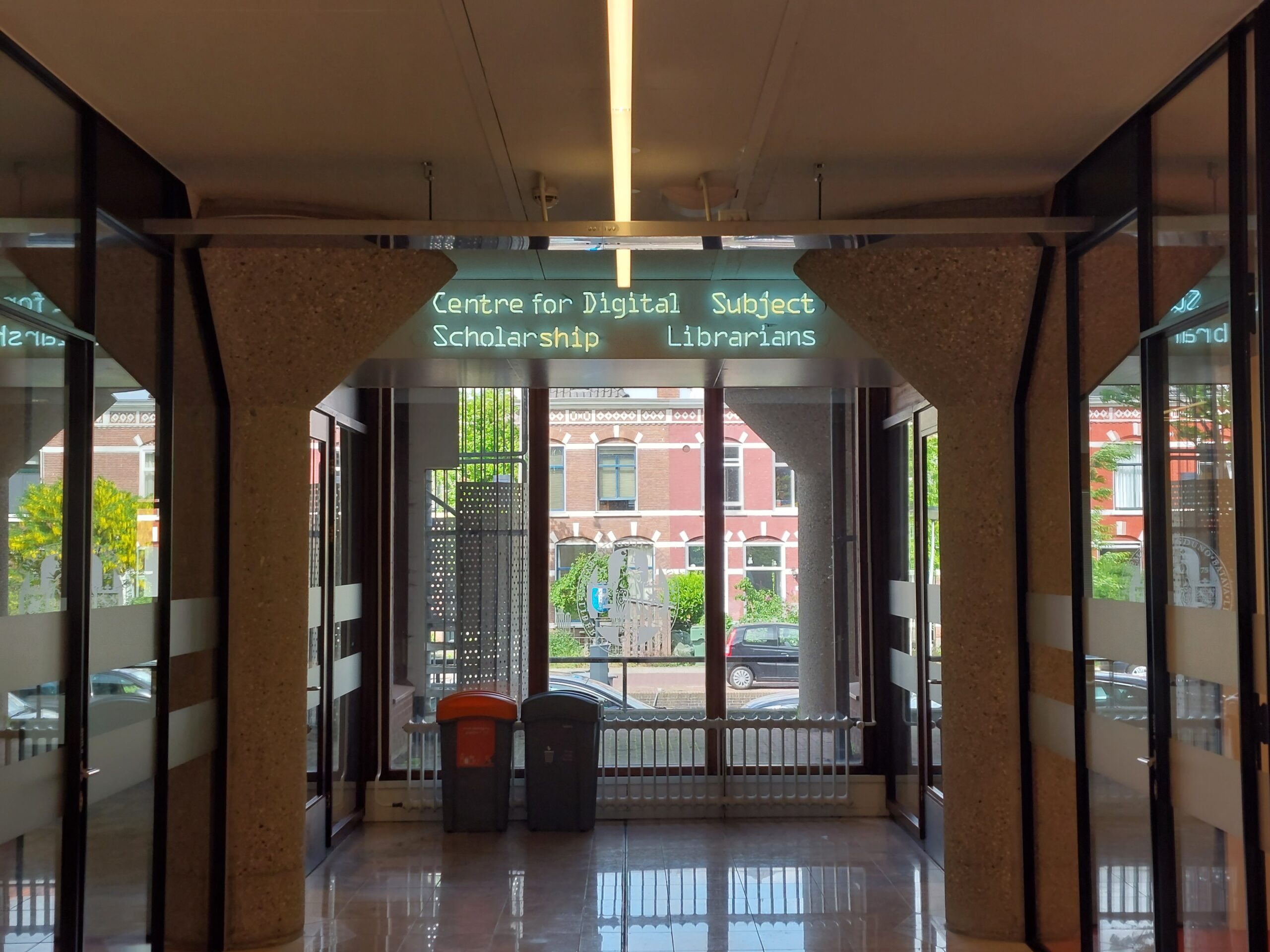
“Leiden University Library, Centre for Digital Scholarship” by Eugen Stoica, The University of Edinburgh is licensed under CC BY 4.0
During my visit, I had the pleasure of engaging with colleagues from Centre for Digital Scholarship, especially with Erna Sattler (copyright librarian), and had very fruitful discussions about copyright research funding issues and requirements. I talked about Edinburgh’s Research Publication and Copyright policy and I learned how the Taverne amendment helped them make many of their publications available Open Access. I also had many interesting discussions with colleagues from CDS regarding the Library research support services that we offer to academics. These services cover research data management, research software, institutional repository, open access and scholarly communication, copyright, licensing and so on.
I was surprised to learn that at Leiden, library’s budget is formed from schools’ contributions and consequently when the library management are requesting an increase of their budget, they must justify it. The library will present (green) OA to schools as an alternative to traditional (expensive) academic publishing and as an option to reduce publishing costs, trying to motivate schools & researchers to adopt (green) OA. On the other hand, Edinburgh Library (which is funded from university central accounts) is the principal driver for pushing schools & researchers towards OA and being compliant with their research funders’ requirements.
KU Leuven will celebrate its 600th anniversary in 2025, making it one of Europe’s oldest universities. It has a very large and important academic library, with a collection of over 10 million items.
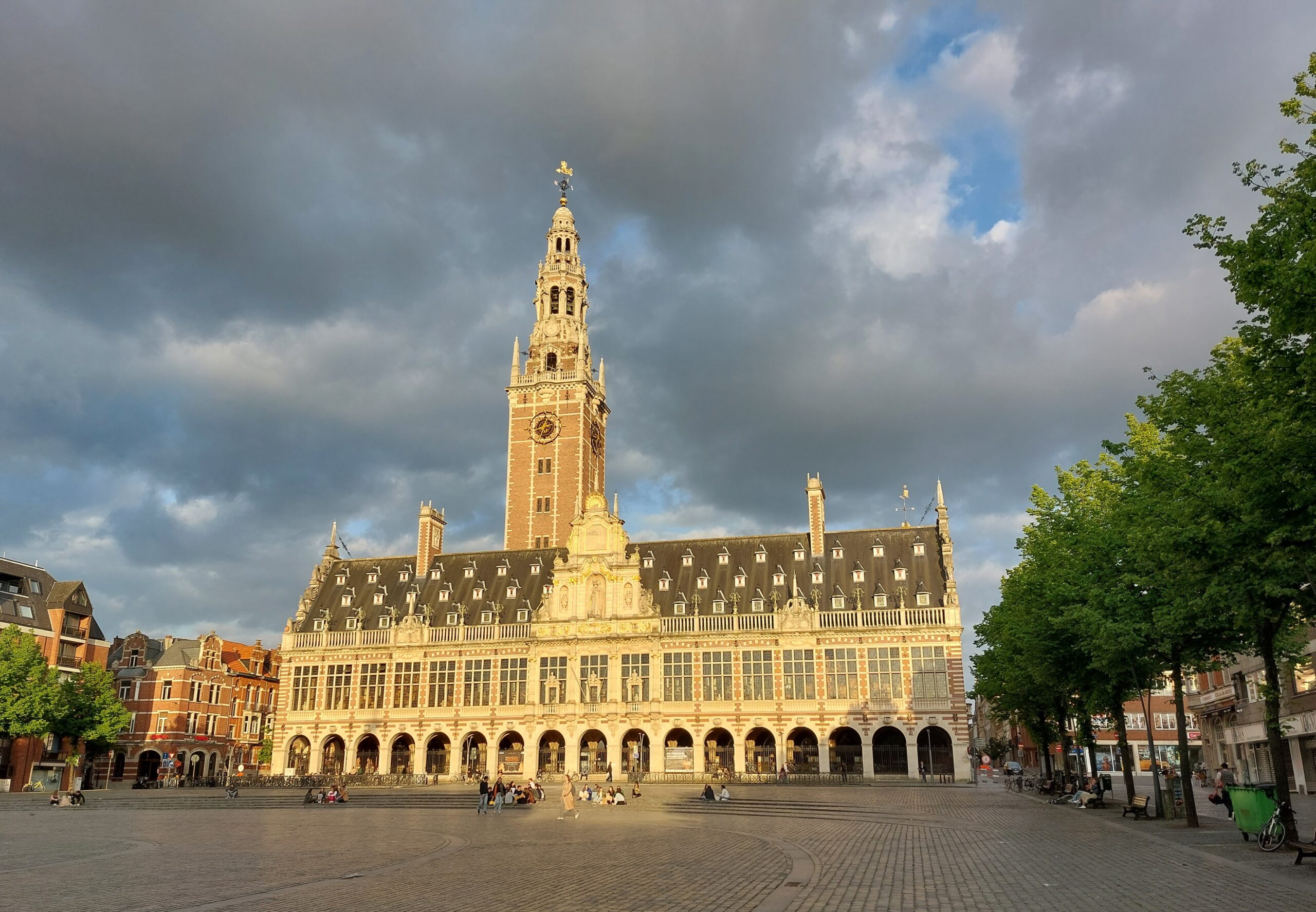
“KU Leuven University Library” by Eugen Stoica, The University of Edinburgh is licensed under CC BY 4.0
At Leuven, I had meetings with Hanne Heirman, Head of Policy Implementation, Library Central Services and Sara Decoster, Open Science Officer. The discussions were centred around the same topics – copyright research funding issues and requirements. Just like the Netherlands (and other five European countries), Belgium had a similar amendment introduced in the copyright legislation in 2018.
While these amendments to the copyright legislation are incredibly useful, allowing them to make public all research outputs publicly financed, in my view there are also a few disadvantages. Firstly, there is an embargo – 6 or 12 months from publication. Secondly, the benefits granted by the amendments come into force after publication, forcing libraries to concentrate all their attention and resources to dealing with works that were already published. Thirdly, researchers are not really motivated to make their research available OA, knowing that the library will do it anyway, based on the copyright amendments.
In the UK, REF2015 regulations required research outputs to be made available OA in order to be eligible for REF; this forced libraries, and indirectly researchers, to focus their attention towards the future, to make sure that they will publish their outputs in such a way that they will be eligible for REF. Also, research funders are requiring that all research they are supporting to be made available OA, usually under a CC BY license.
I was very impressed with the work that is being done at both Leiden University Library and KU Leuven University Library. I am grateful for the opportunity to have met with my colleagues and to have discussed these important issues.
I believe that the work that we do as copyright librarians is essential to the advancement of research. We help to ensure that authors are able to protect their intellectual property rights and that researchers have access to the scholarly literature that they need to do their work. I am delighted to see that we are all committed to continuing to work to promote Open Access and to ensure that research is available to everyone.
New feature: Sharing DataVault data with an external user
By popular demand, the Research Data Service is pleased to announce the arrival of a brand new feature: the DataVault Outward Staging Area (DOSA), a free-of-charge benefit to DataVault depositors.
What is a staging area? Somewhere your data can be held temporarily, on the way to somewhere else. Just like a traditional staging post for stagecoaches, as shown in this engraving.
Imagine: your multi-terabyte dataset is safe-and-sound in your vault, you’ve cited it in a paper you’ve just published, and an external researcher has asked you for a copy. What will you do?
Simple: send a request to IS Helpline (or data-support@ed.ac.uk) asking us to create a DOSA folder for your data.
We’ll then use DOSA to give temporary (two months) external access to a copy of your deposit, using a Globus FTP endpoint. We’ll retrieve a copy of your data to the folder. And we’ll provide you with the Globus endpoint, which you send to the researcher. They may need to install some software to get the data. Alternatively, for datasets under 500 GB, we suggest a DataSync link will be more suitable. We set that up and provide it to you in the same way as the Globus endpoint. The difference for the end user is they can use the DataSync link (+ password) from their browser. Let us know if you have a preference for a Globus endpoint or a DataSync link (otherwise we’ll decide automatically based on the size).
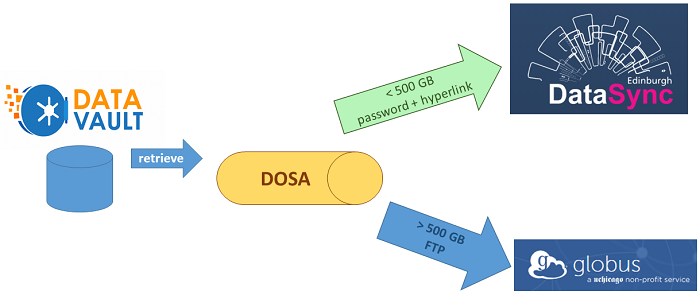
Workflow: We retrieve your deposit to your DOSA folder. We provide you with either a Globus endpoint or a DataSync link, to provide to your external person who made the request.
The DOSA is part of our networked active data storage, DataStore, but separate from the other staging area we provide for users making a new deposit (‘the DataVault staging area’), for the inward route.
Since 2016 researchers have been archiving data in Edinburgh DataVault. The DOSA is available for any DataVault deposit, old or new.
DataVault Outward Staging Area (DOSA): Sharing data with an external user
Not sure you’ll remember the name of the service? Worry not! I have a mnemonic device for you: just remember that a ‘dosa’ is an Indian savoury pancake. What’s not to like?

Pauline Ward
Data Repository Operations Officer
University of Edinburgh
From Plagues to Progress: Looking at A Century of Edinburgh’s Public Health
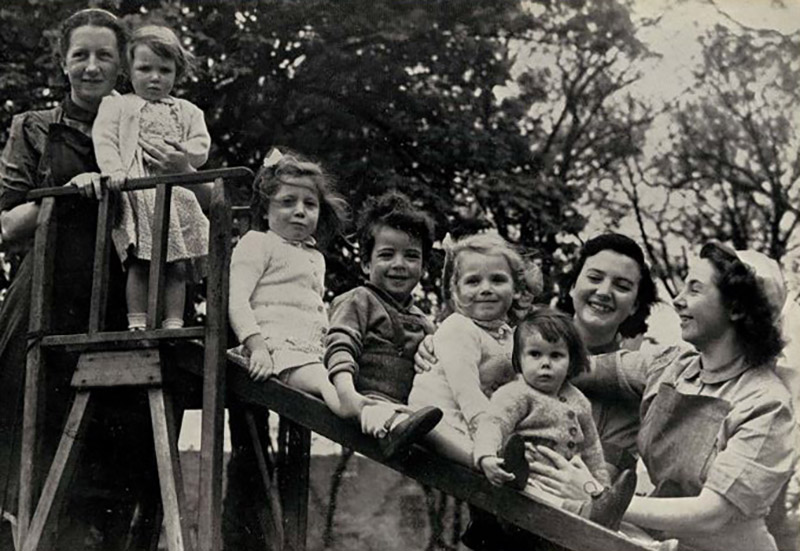
Over the last few months, our team has been working on digitising the Lothian Health Service Archive’s collection of Annual Public Health Reports for the City of Edinburgh. Comprising of 74 bound volumes of reports recording the public health of Edinburgh’s residents from 1865 to 1973, these documents are an absolute goldmine of information just waiting to be utilised by academics and researchers, covering everything from birth, death and disease rates to specific aspects of public health that were overseen by the City authorities, like infectious diseases or sanitation. Read More
New trial to Oxford Historical Treaties
Oxford Historical Treaties (OHT) is the premier resource for historical treaty research and home to the full text of The Consolidated Treaty Series, the only comprehensive collection of treaties of all nations concluded from 1648 through 1919. Available via the Oxford Public International Law platform, OHT is cross-searchable with Oxford’s leading public international law resources and benefits from a modern, intuitive interface and sophisticated functionality.
Access Oxford Historical Treaties
The trial runs until 16 June 2023. Please provide any feedback on this trial via our feedback form:
Hello from your new (part-time) Law Librarian
Hi! My name is Anna and I am a new Academic Support Librarian supporting Law. SarahLouise and I are job-sharing – I take the start of the week and SarahLouise the latter but you don’t need to remember that. Just email us at law.librarian@ed.ac.uk if you have any questions.
I am a third-generation librarian (!) and I moved here from De Montfort University in Leicester. Professionally, I am interested in the critical aspects of information literacy, particularly issues of bias and source reliability. I am also interested in how AI will impact all aspects of information literacy. Personally, I love walking and photography and can’t wait to explore all the beautiful Scottish landscapes.
I look forward to working with you all in the coming months.
5 things to remember if using the Library this summer
The summer vacation period officially started this week! And while many of you are probably thinking the last thing you want to do is use the Library over the summer break, there will be a large number of students who will need to (or just want to) use the Library during the summer vacation period to continue with their studies or research.
So if you are one of the many who is planning on using Library facilities or services over the summer then read on. And for those of you who are not planning on doing this, we’d recommend you read on anyway (particularly if you have not returned books you have borrowed from the Library).
1) The Main Library and all our site libraries remain open throughout the summer vacation period.
 Opening hours and staffed hours will be reduced in many libraries so check the opening hours website before you visit and follow the Library on social media for any updates – Instagram, Twitter, Facebook. Read More
Mass Observiation Project – on trial
*The Library has now purchased access to Mass Observation Project. See New! Mass Observation Project, 1981-2009 *
I’m happy to let you know that the Library currently has trial access to Mass Observation Project, 1981-2009 from AM Digital, which allows you to explore the history of Britain through three turbulent decades, written by those living through it.
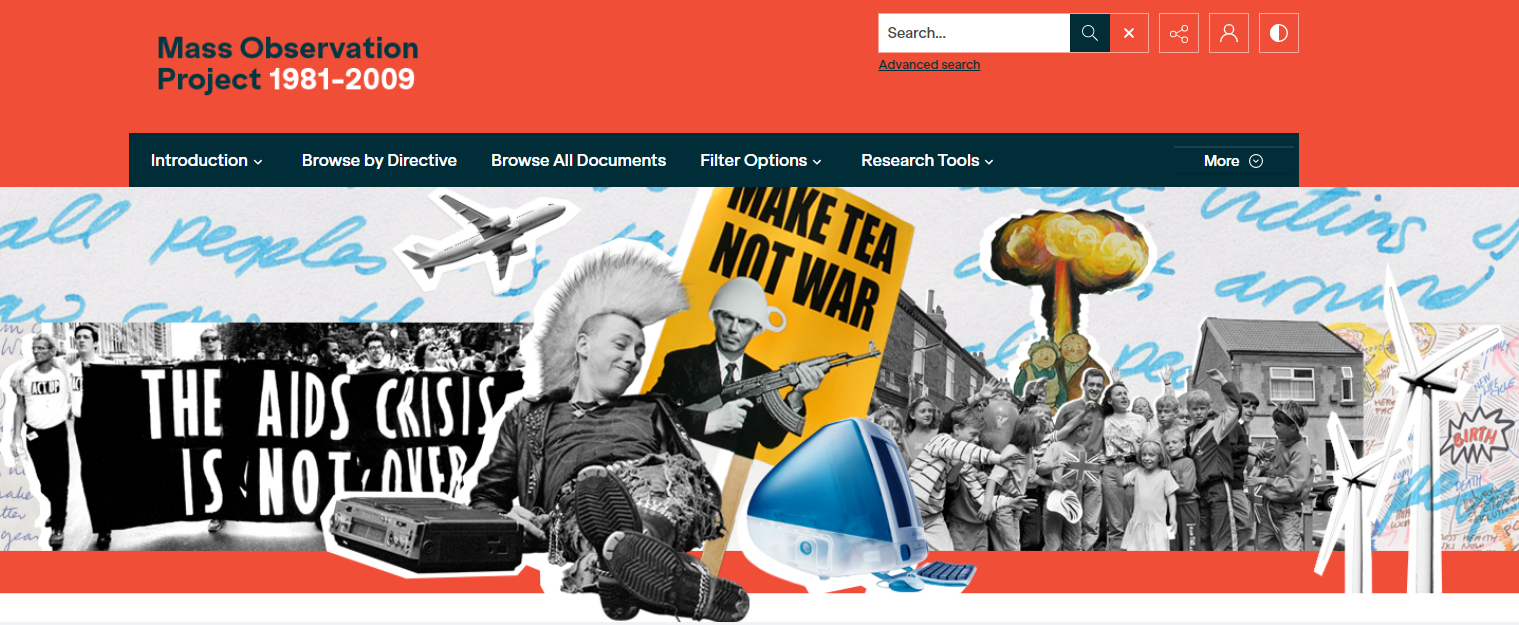
Access Mass Observation Project via the E-resources trials page.
Access is available on and off-campus.
Trial access ends 24 June 2023.
Mass Observation Project, 1981-2009 provides digital access to a unique life-writing archive, capturing the everyday experiences, thoughts and opinions of people living through the turbulent final decades of the 20th century and the advent of the 21st century. Read More
On trial: Foreign Office Files for Japan
The Library currently has trial access to Foreign Office Files for Japan, 1919-1952 from AM Digital. This resource allows you to discover Japan’s rise to modernity and its relations with global superpowers through British Government documents from the National Archives, UK.
For more information, see the On trial: Foreign Office Files for Japan blog post by the Academic Support Librarian for History, Classics and Archaeology.
On trial: Latin American Newspapers, Series 1
The Library currently has trial access to Latin American Newspaers: Series 1 from Readex, which allows you to explore Latin American history and culture during the 19th and 20th centuries.
For more information, see the On trial: Latin American Newspapers, Series 1 blog post by the Academic Support Librarian for History, Classics and Archaeology.
On trial: Foreign Office Files for Japan
Thanks to a request from a HCA postgraduate student the Library currently has trial access to Foreign Office Files for Japan, 1919-1952 from AM Digital. This resource allows you to discover Japan’s rise to modernity and its relations with global superpowers through British Government documents from the National Archives, UK.
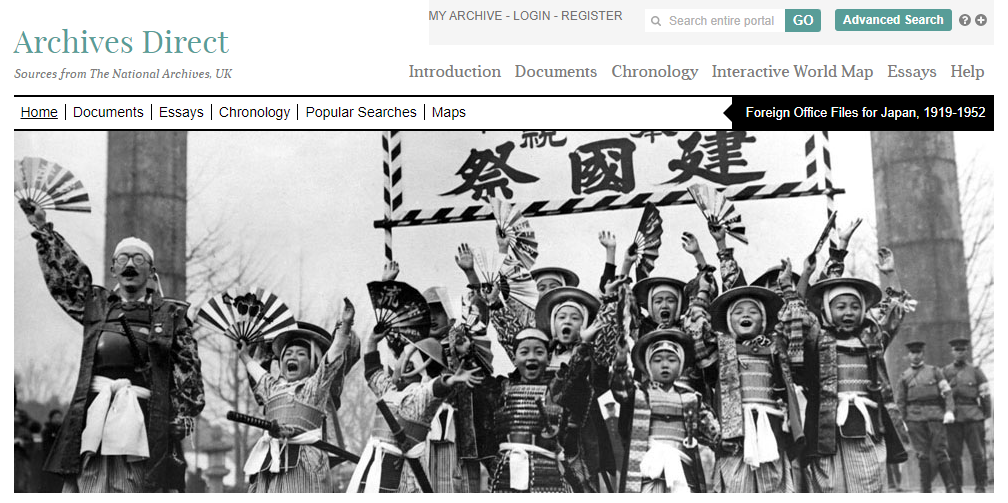
You can access the Foreign Office Files for Japan, 1919-1952 via the E-resources trials page.
Trial access ends 24th June 2023.
Published in three parts, this collection makes available extensive coverage of British Foreign Office files dealing with Japan between 1919 and 1952. Read More
Collections
 Hill and Adamson Collection: an insight into Edinburgh’s past
My name is Phoebe Kirkland, I am an MSc East Asian Studies student, and for...
Cataloguing the private papers of Archibald Hunter Campbell: A Journey Through Correspondence
My name is Pauline Vincent, I am a student in my last year of a...
Hill and Adamson Collection: an insight into Edinburgh’s past
My name is Phoebe Kirkland, I am an MSc East Asian Studies student, and for...
Cataloguing the private papers of Archibald Hunter Campbell: A Journey Through Correspondence
My name is Pauline Vincent, I am a student in my last year of a...

Projects
Cataloguing the private papers of Archibald Hunter Campbell: A Journey Through Correspondence
My name is Pauline Vincent, I am a student in my last year of a...
Archival Provenance Research Project: Lishan’s Experience
Presentation My name is Lishan Zou, I am a fourth year History and Politics student....