Home University of Edinburgh Library Essentials
April 4, 2026
A letter from Pip
Some of the most interesting letters in Thomson’s collection were sent to his widow following his death in 1955. The following, from psychiatrist and secretary of the Eugenics society Carlos Paton Blacker (1895–1975), gives a good indication of the friendship between himself and Thomson:


 It is not clear when Thomson and Blacker first became acquainted, but their research interests certainly overlapped. Thomson was the key figure in the two Scottish Mental Surveys, which tested the intelligence of almost every school child in Scotland born in 1921 and 1936 in 1932 and 1947 respectively. These were of direct interest to Blacker, who had helped establish the Royal Commission on Population.
The word ‘Eugenics’ is one which the 21st century audience is rather uncomfortable with. Unsurprisingly, following the holocaust and devastation of World War II, mid 20th century Britain wasn’t comfortable with the concept either. At best Eugenics was considered a mere pseudo-science (as it is to this day, despite Blacker’s efforts, widely acknowledged to be). But the eugenics of Blacker were more moderate than that of those preceding him. As Soloway argues in his Oxford DNB entry:
Under Blacker the Eugenics Society was transformed from an unfocused, amateur propaganda agency dabbling uncertainly in the newly emerging areas of birth control and genetics, into a quasi-professional research foundation committed to family planning and the serious study of population problems.
Blacker had experienced first hand the effects of a lack of access to, and information about, birth control throughout his time as a medical student at Guy’s hospital, where he encountered large numbers of deeply distressed female patients undergoing unwanted pregnancies they were powerless to avoid. However, it is undeniable that alongside this very human desire to help the women he encountered, Blacker viewed contraception as a tool to ensure what eugenicists saw as the least desirable echelons of society were not ‘out-breeding’ the more desirable.

From the Wellcome Trust archives, Blacker being awarded the Galton medal, 1957 (ref: PP/CPB/B.20). Image Wellcome Trust
This was a concern that pervaded the first half of the 20th century – namely that of the perceived ‘differential birth rate’, the idea that the more educated (therefore the most desirable) sections of society were producing less offspring than the ill-educated working classes. Indeed, the second Scottish Mental Survey was undertaken in order to establish whether Scotland’s intelligence was declining (in fact, the results indicated a slight increase).
Thomson fought for a fair education for all that catered to each individual’s abilities regardless of their background, often in the face of eugenic principles which argued that such an approach would encourage the supposed ‘differential birth rate’. Similarly, Blacker faced criticism from fellow members of the Eugenics Society who believed availability of contraceptives to all would lower the birth rate of educated professionals even further. Both were men of strong beliefs, and the development of their friendship can be seen in records of the Eugenics Society held by the Wellcome Trust Library and available online.
The changes in how they address one another in the course of their correspondence are particularly telling. The surviving correspondence in the records of the Eugenics Society dates from 1946-1950 (though we know from Thomson’s papers that he and Blacker were in touch until Thomson’s death). At the onset, Thomson addresses Blacker ‘Dr Blacker’, then ‘Blacker’, then ‘My dear Blacker’. Eventually, in his letter of November 1948, Thomson begins:
(I would like to feel privileged to use the name you once told me was yours among your friends, but I can’t for the life of me remember it – Punch or Plug or something like that I think. Do tell me).
From SA/EUG/C.329, ‘Professor Sir Godfrey H Thomson’, Wellcome Trust Library
Blacker evidently signed his reply (of which only the typed copy survives) by this name, which was of course ‘Pip’. From then on, Thomson addresses Blacker as ‘Pip’, while Blacker moves from ‘My dear Thomson’ to ‘My dear Godfrey’. Their correspondence shows the value each placed on the other’s professional opinion, as well as the interest they took in one another’s lives and the enjoyment they derived from one other’s company.
When Blacker was awarded the Galton medal two years after Thomson’s death, Lady Thomson wrote to him (her letter can be found in Blacker’s personal papers, held by the Wellcome Trust Library and available online) in her typically touching fashion:
I can only say how delighted I am, and you know how proud of you Godfrey would have been.
I hope he knows about it in some way or other.
From PP/CPB/B.20, ‘Award of Galton Medal to Carlos Paton Blacker’, Wellcome Trust Library
Blacker’s career was varied, taking him from an heroic performance in World War I (where he was awarded the Military Cross), to a medical graduate (then psychologist) working in Guy’s hospital. Blacker went on to work as a psychiatrist in Maudsley Hospital, where he stayed to the end of his career, broken up only by his time as a field Doctor during World War II (where he was awarded the George Medal for gallantry), and a secondment to the Ministry of Health, where he was investigating the need for psychiatric care following World War II.
Blacker was certainly an interesting character. His views, moderate in their time, are open to criticism in ours. But then everyone is a product of the time from which they emerge. Blacker’s work, whether it be establishing the needs of soldiers during and after warfare, or working towards making contraception both available and socially acceptable, was both far reaching and forward facing, and the traces he has left behind are a fascinating glimpse of the turbulent and changeful 20th century from some of its most interesting and complex characters.
Wellcome Trust University Award Research Fellow Dr Edmund Ramsden will be speaking about Eugenics and intelligence testing in the 20th century at a seminar titled ‘Gathering Intelligence: the work of Professor Sir Godfrey Thomson’, which will be held at Edinburgh University Library on the 16th May, 9-3.30 (with an optional tour of Moray House in the afternoon). Dr Ramsden will be one of 6 speakers, each looking at Thomson’s work from a different perspective. The seminar is free to attend, however booking is required. Bursaries for travel and accommodation may be available. If you are interested in attending, please contact me at Emma.Anthony@ed.ac.uk for further information.
Training subject librarians in RDM
I have just completed running the MANTRA course for librarians http://datalib.edina.ac.uk/mantra/libtraining.html with my team of 8 subject librarians at Stirling University. A member of the Research Office attended one session and the team manager for Library Content Manager also attended some of the sessions.
 We started the librarians training kit on 29 May 2013 and our last session was in December, so the course has actually changed (and improved) whilst we were undertaking it.
I think we found it beneficial to set time aside as a team to look at this issue and take our time over it! We enjoyed lots of lively discussions. I am Chair of Stirling’s RDM Task Force and knew that we, as librarians, would be expected to have the skills to help researchers manage their research data. It was great to know that there was already a training package in existence for librarians.
Everybody really liked the panda film in the last section. They suggested using that style more often. Some of my staff thought the videos were too long or too slow.
As the facilitator I found that the instructions were sometimes not clear but by the end I figured out that I just needed to look at the manual. I think it was really useful at the beginning to have real researchers talking about the issues.
I feel more confident that my team are no longer fearful of RDM enquiries.
Thank you for a fantastic resource and I will continue recommending it to researchers.
Lisa Haddow
Team Manager: Library Liaison and Development
University of Stirling
Library and University Collections sign up to ArchivesSpace
At the end of 2013, the University of Edinburgh’s Library and University Collections (L&UC) became the first institution in the UK and Europe to become members of ArchivesSpace. Built for archives by archivists, ArchivesSpace is an open source archives information management application for managing and providing web access to archives, manuscripts and digital objects.
The application was developed by a partnership of universities in the United States: New York University Libraries, the University of California, San Diego Library, and the University of Illinois at Urbana-Champaign Library and had generous support from The Andrew W. Mellon Foundation.

As the application is open source, it has been possible to test ArchivesSpace before becoming a member. The positive response of archivists and information systems developers within L&UC has led to the purchase of full membership with the aim of having catalogues online using the application towards the end of the year.
We are very pleased to be involved with ArchivesSpace and to be keeping company with many illustrious institutions in American and Australia: http://www.archivesspace.org/sites/default/files/ASpace%20Charter%20Members.pdf. Above all, we hope that the application will provide improved access to our Special Collections and Archives for staff, students and members of the public.
Next week we’ll be holding a workshop for archivists, librarians and developers in L&UC to get to grips with the system, culminating in a web-chat with the ArchivesSpace Program Co-ordinator in Atlanta.
Exhibition Archive: The Model (22/11/13 – 9/12/13) Edinburgh College of Art
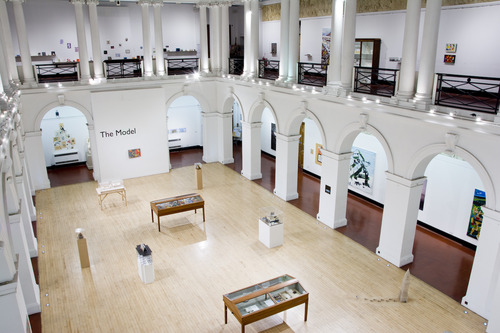
The Model, curated by Gordon Brennan (Head of Painting) and Neil Lebeter (Art Collections Curator), brought together models from across University Collections; ranging from Geology, Veterinary Science Anatomy, Music and Architecture. These teaching models were displayed alongside work by invited artists and students from Edinburgh College of Art and Gray’s School of Art, Aberdeen. Students were asked to consider the theme of the Model as:
• Miniature.
• Proposition.
• Ideal.
• Explanation
• Maquette.
• Replica.
• Prototype.
The exhibition was held in the Sculpture Court of ECA and provided an excellent opportunity to highlight to students and the general public the breadth of University Collections and a contemporary reflection on an idea that has fascinated artists for many years.
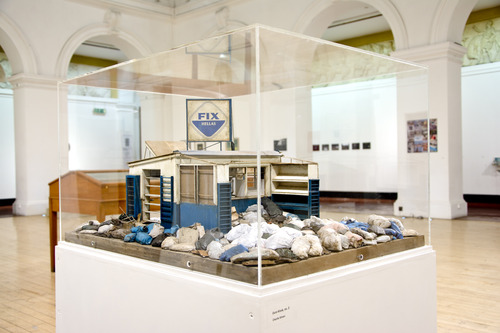
Charlie Stiven, Euro Kiosk no.3
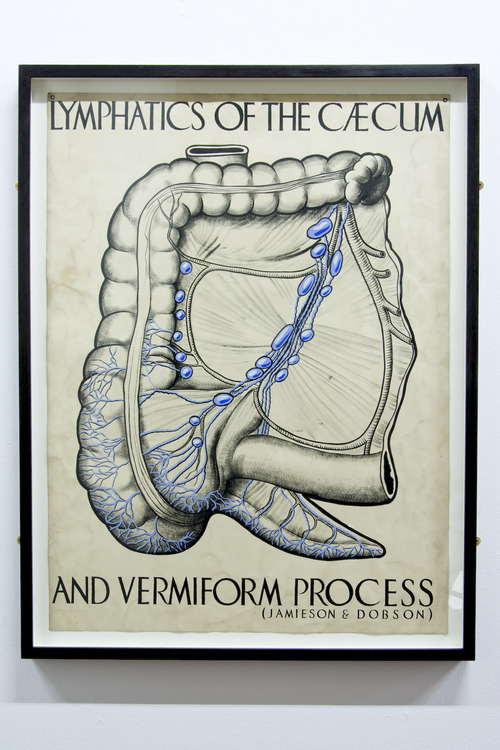
Jamieson & Dobson, Lymphatic System
University of Edinburgh Anatomy Collection
Repairs without the tears
It’s a fact. Certain activities within a library are, by necessity, dull. While some may think that book repair falls into that category they would definitely be mistaken. At the busiest times of year the intrepid library assistant (myself) is greeted with shelves groaning with ‘poorly’ books – each with its own ailment.
Reserve and HUB books are dealt with first as a priority. Sections of a book that have come away cleanly from the spine can be dealt with rapidly – glue being the saviour here. Other pages that have come adrift may have tears in them. Lightweight, acid-free tape is the hero in these cases making the page and book serviceable once again. Sometimes an unscrupulous reader has torn out a section of the book. If the library holds multiple copies of that title then another copy is tracked down, relevant pages photocopied (adhering to copyright rules), pages trimmed and finally tipped (glued)-in. However, if the book is a sole copy, then I apply for an Interlibrary loan. Once the book loan has been received, the above process is carried out.
If a hardback book is falling apart and beyond my capabilities as an in-house repairer, then checks are made on Voyager to see if it is either heavily-used or a sole copy. If the book meets either of these criteria then it is sent to the external bindery to be re-bound. If a book is littered with pencil markings, then these have to be erased – quite a laborious process! Sometimes a new title has to be made to go on the spine for one which has faded and become illegible, or tape needs to be affixed to either the endpapers of the outer spine of a paperback. Occasionally pockets at the rear of a book have to be re-attached or a new pocket made for loose papers. Very occasionally a book comes to me which has suffered water damage. Usually a spillage of liquid making the pages go wavy. If the book has not been dried correctly, then pages will stick to each other rendering the book unreadable. In this scenario the only thing that can be done is to wave goodbye to the book. So, as you can see, there is a myriad of ailments which a book can suffer. It is very satisfying, though, knowing that you have made a book ‘better’ again, ready to boldly go once more into the book world of academia.
Now, what will be waiting for me today?
My First MOOC!
The University of Edinburgh has been an early adopter of MOOCs (Massive Open Online Courses) and offers courses through both the Coursera and FutureLearn platforms. Library services need to constantly respond to changes in the provision of research and learning activities of their institutions. MOOCs are one such area where libraries are currently exploring their role.
In my role as Head of Research and Learning Services within the Library & University Collections division of Information Services I get to think about these challenges daily. However, as with many aspects of life, there is no better way to learn about something new than to roll up your sleeves and have a go! As such, at the end of 2013 I enrolled on my first MOOC!
MOOC name: An Introduction to Operations Management
Institution: The Wharton School of the University of Pennsylvania
Instructor: Christian Terwiesch
I chose this particular course as it isn’t directly relevant to my role in the library, however it addresses issues such as identifying bottlenecks, optimising workflows, calculating waiting times, and generally improving the operations of a business. All of these are applicable to one area or another of the library. It was also nice to study something a little different and in a domain that I knew nothing about.
The introduction video for the course gives a good overview of what it covered:
Below is a list of thoughts about the course:
- There were some introductory videos to the course. These were good, as they provided familiarisation to the Coursera system and video player before the course really started. They also provided a personal introduction to the instructor, his office (where the lectures were filmed) and his interests. This personal aspect could easily be missed in a MOOC.
- The Coursera video player allows videos to be played at different speeds, such as 0.75 (a bit slower), 1.0 (normal speed), and 1.25 / 1.5 / 1.75 / 2.0 (faster). These worked well, with the audio being adjusted somehow so that the instructor didn’t sound like a chipmunk!
- I found it hard to make time during the week to study, so ended up cramming in all the learning at the weekends. Saturday evenings were used for watching the lectures, while Sundays were used for exam revision and taking the exams. It probably took about four to five hours per week.
- The weekly exams allowed multiple attempts, and were tricky enough, so often required a couple of attempts to get them all correct. There was a practice exam and answers available for each week.
- The course had two tracks: Academic (exams) and Practitioner (weekly assignments for a project). I took the academic track.
- Other than the course videos, there were a few optional readings, however these tended to be newspaper articles that talked about subjects related to the course (such as queuing systems at Disney resorts).
- The course was about 25% of the equivalent course at Wharton, which has a dedicated text book. The instructor and the publisher (McGraw-Hill/Irwin) worked together to create a cut-down version of the book that contains the relevant chapters, as an ebook. This was only a fraction of the cost of the full book. However I completed the course without having to buy the book, although if I had more time it would have been interested to read more deeply around the subject.
- The final exam was a little bit stricter, with only two attempts allowed, although Coursera says which answers were right and which were wrong, allowing you to retry some questions.
- The course was 8 weeks long, which was about right. I was glad to have a rest at the weekends once it was finished.
- The only negative in the course was that after that final module went live, the site was never updated with messages from the instructor. It would have been nice to see a final post or two, and perhaps a concluding video.
The course also had a ‘Signature Track’ option. This requires a payment of about £30, and requires you to upload a photo of yourself holding your passport photo page (to prove it is you), and to take a typing pattern recognition test. After each exam, you had your photo taken by webcam, and had to re-take the typing test. These were to prove that it was actually you who took the exam. This is not infallible, of course, but a good basic level of verification.
In return for being on the Signature Track, you also get a shareable course record that can be used to show you completed the course. Mine can be seen at: https://www.coursera.org/records/FxQQn8nWmW9eeNkc
Overall the course was good fun, I felt I learned a lot, and the process of learning via a MOOC worked well. I didn’t really interact with anyone else on the course forums, and don’t know how many other students were on the course, or completed the course.
You’ll have noticed that the title of the blog is ‘My First MOOC’. I really enjoyed the experience, learning something quite different, and I’m sure I’ll be signing up for another sometime later this year!
Christmas in the David Laing manuscripts
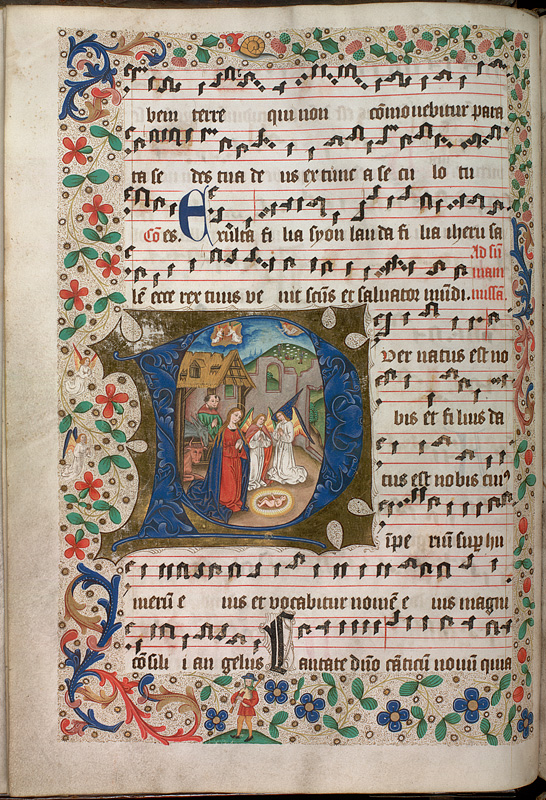
This is a leaf from MS.33, a 15th century Gradual received by the Library as part of the David Laing bequest in 1878. We have recently been awarded a substantial grant from the National Manuscripts Conservation Trust to preserve the Laing manuscript books, which are among our greatest treasures. Happy Christmas to all our blog readers and we look forward to sharing more tales from the collections in 2014.
Christmas is nearly here!
In celebration of the next week’s big event, we thought we’d bring you a sample of some of the festive bits and pieces in our archive collections.
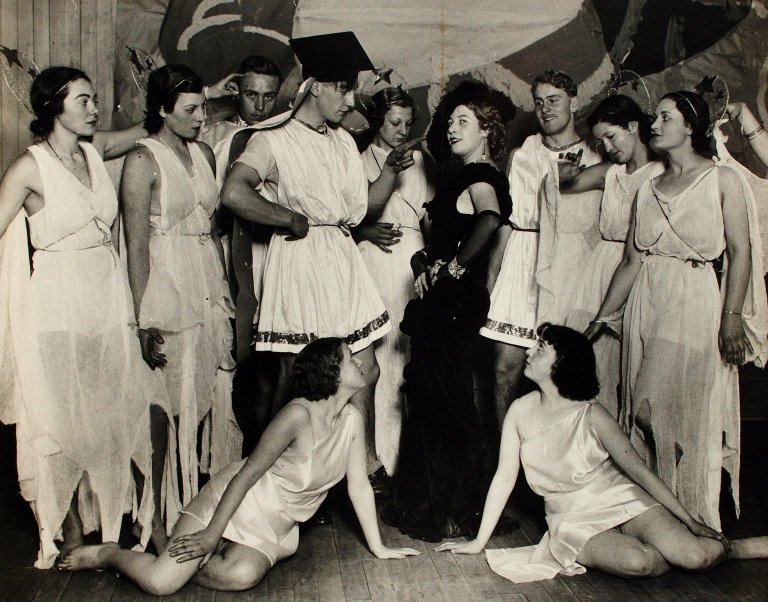
As always, the ECA Christmas Revel provides some wonderful outfit inspiration for all your office parties – above we have a scene from the 1934 skit Picard Goes West, with Miss Nessie Sutherland playing Mae West. Below is a group of dancers in miscellaneous costumes, obviously all blinded by the camera’s flash!

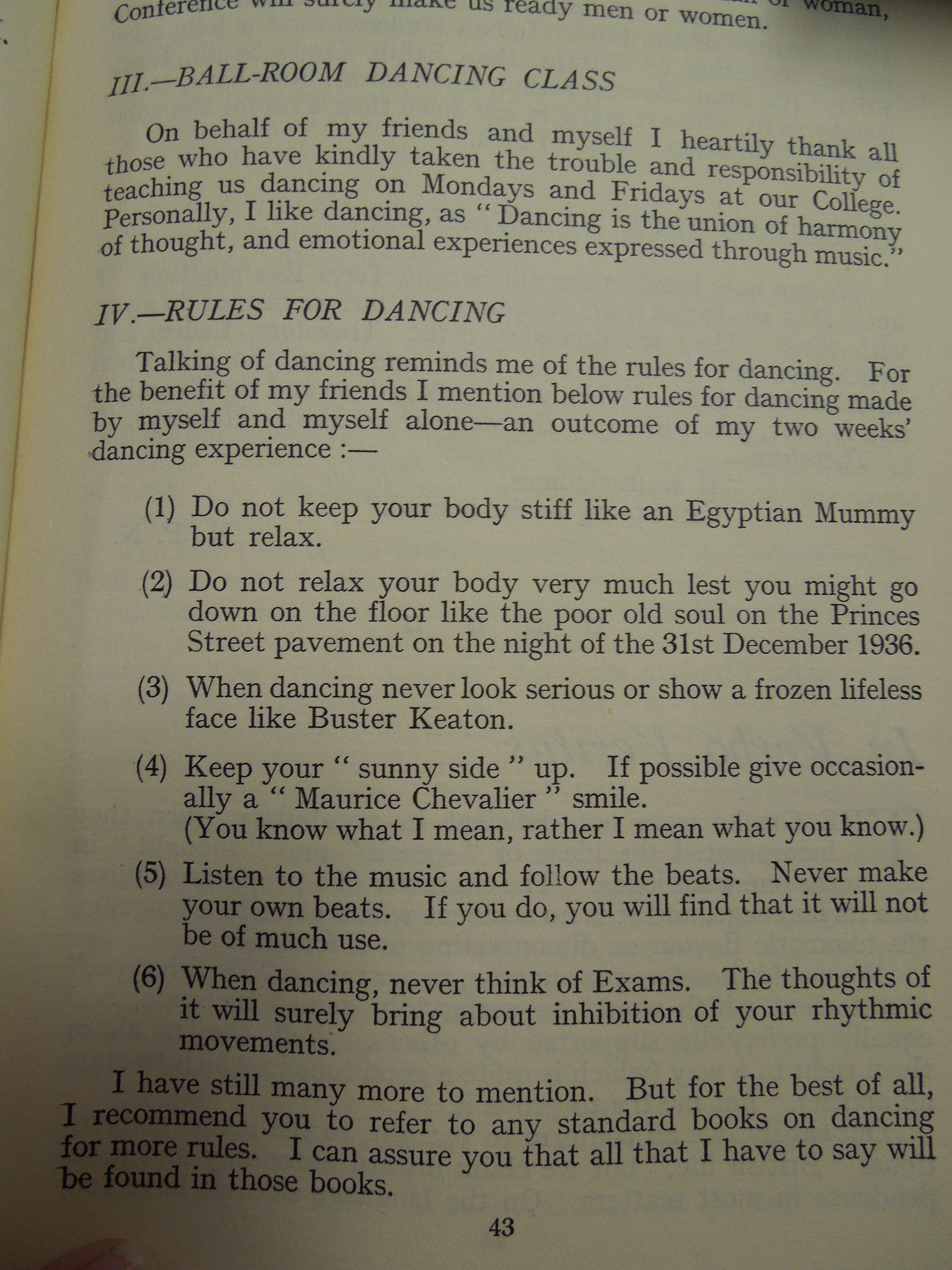 Now, this is what I’ve always needed for Christmas – rules to help me look good on the dancefloor. The Moray House magazine for 1937 offers precisely that, although I think a room full of people all practising their Maurice Chevalier smiles would be quite terrifying…
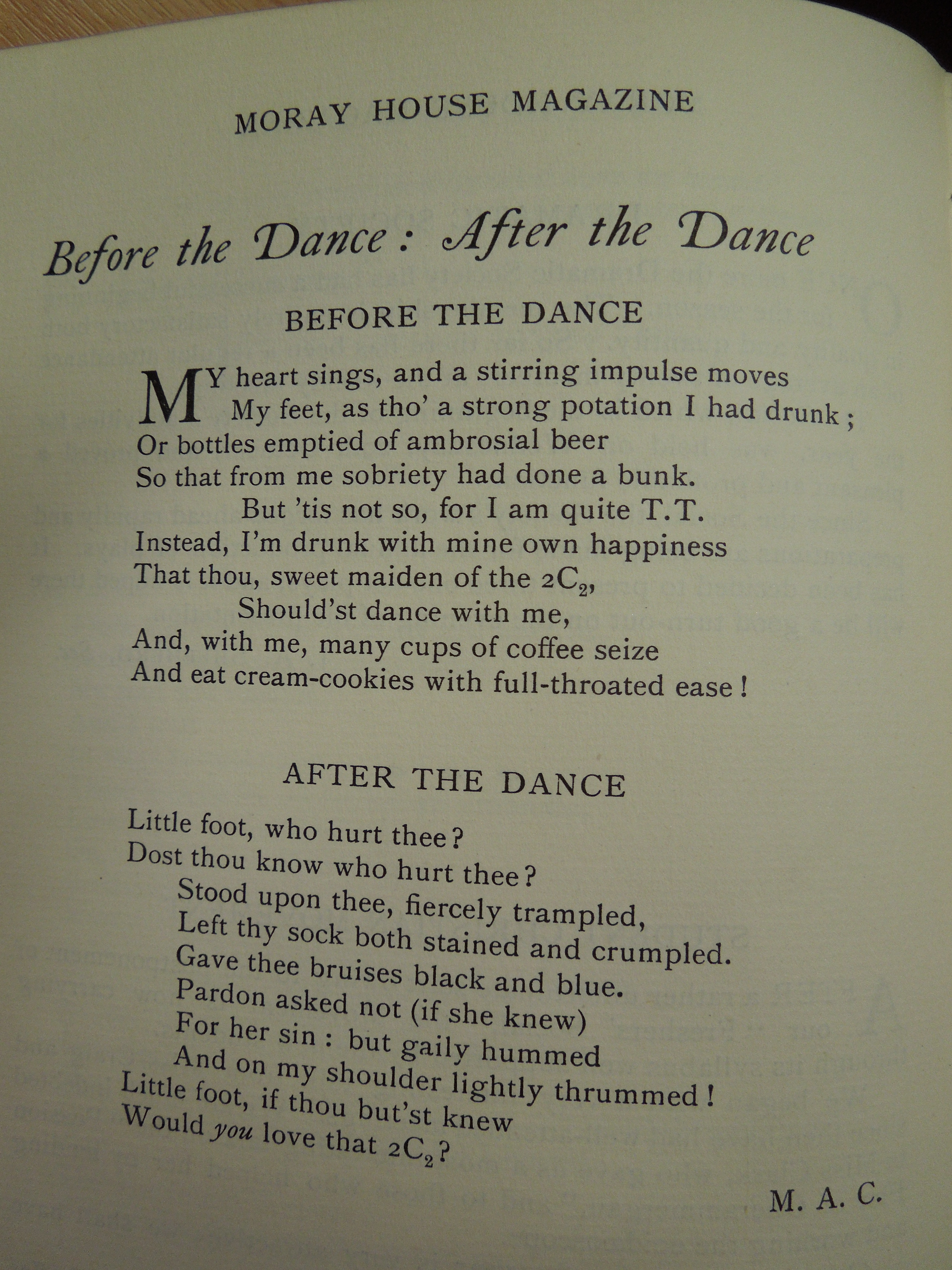
The 1930’s edition of the magazine describes the dangers of dancing with the ‘sweet maiden’ you’ve had your eye on all night.
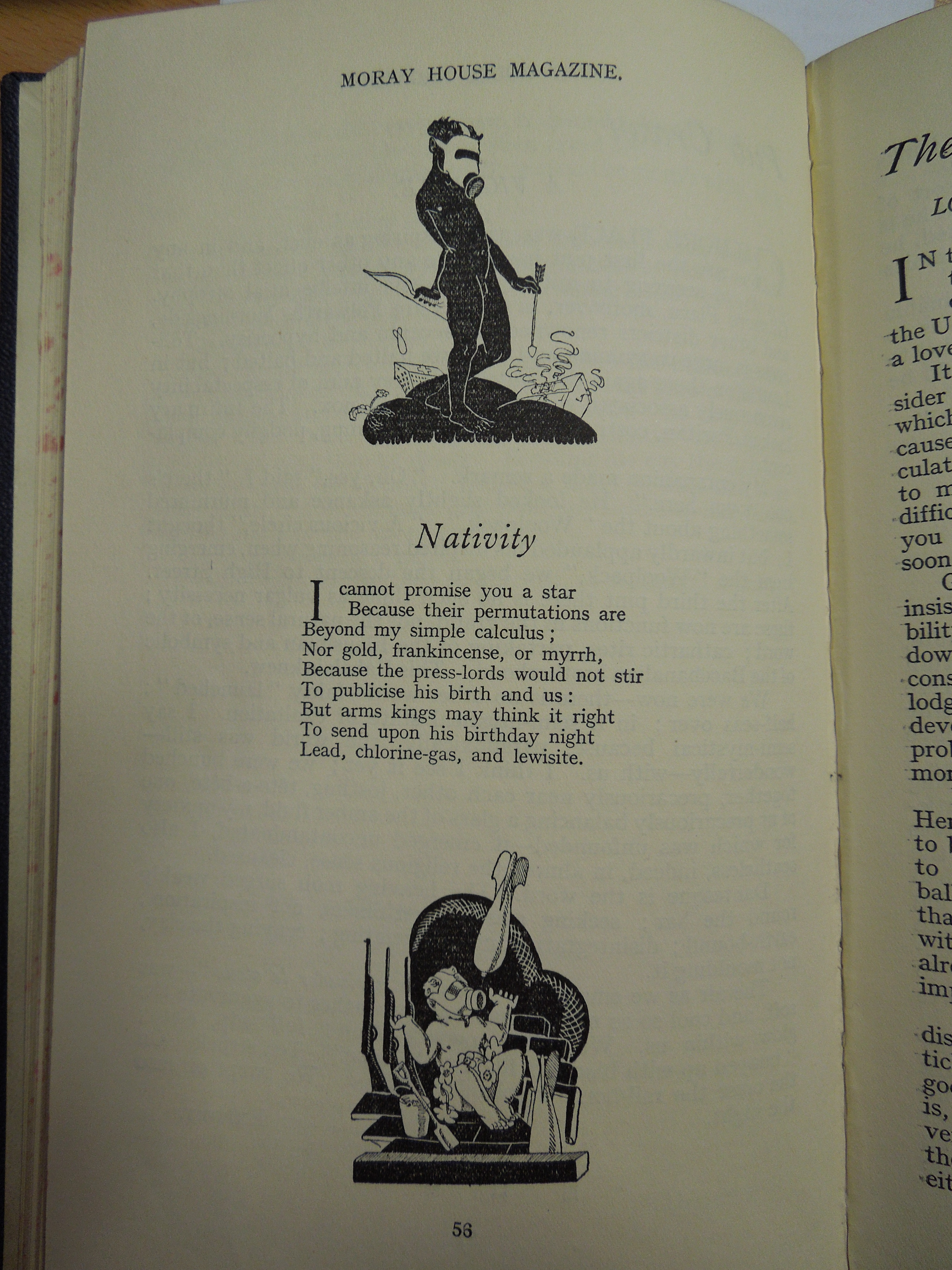
And we end on an even darker note – a horrifying poem entitled Nativity from 1938.
Merry Christmas!
Thinking about a Data Vault
[Reposted from https://libraryblogs.is.ed.ac.uk/blog/2013/12/20/thinking-about-a-data-vault/]
In a recent blog post, we looked at the four quadrants of research data curation systems. This categorised systems that manage or describe research data assets by whether their primary role is to store metadata or data, and whether the information is for private or public use. Four systems were then put into these quadrants. We then started to investigate further the requirements of a Data Asset Register in another blog post.
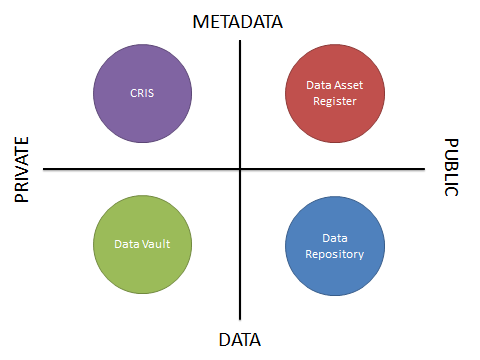
This blog post will look at the requirements and characteristics of a Data Vault, and how this component fits into the data curation system landscape.
What?
The first aspect to consider is what exactly is a Data Vault? For the purposes of this blog post, we’ll simply consider it is a safe, private, store of data that is only accessible by the data creator or their representative. For simplicity, it could be considered very similar to a safety deposit box within a bank vault. However other than the concept, this analogy starts to break down quite quickly, as we’ll discuss later.
Why?
There are different use cases where a Data Vault would be useful. A few are described here:
- A paper has been published, and according to the research funder’s rules, the data underlying the paper must be made available upon request. It is therefore important to store a date-stamped golden-copy of the data associated with the paper. Even if the author’s own copy of the data is subsequently modified, the data at the point of publication is still available.
- Data containing personal information, perhaps medical records, needs to be stored securely, however the data is ‘complete’ and unlikely to change, yet hasn’t reached the point where it should be deleted.
- Data analysis of a data set has been completed, and the research finished. The data may need to be accessed again, but is unlikely to change, so needn’t be stored in the researcher’s active data store. An example might be a set of completed crystallography analyses, which whilst still useful, will not need to be re-analysed.
- Data is subject to retention rules and must be kept securely for a given period of time.
How?
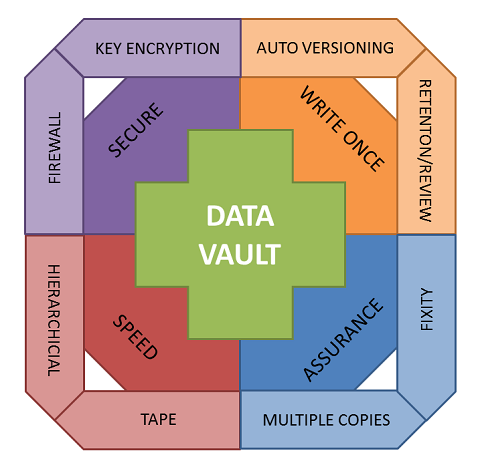
Clearly the storage characteristics for a Data Vault are different to an open data repository or active data filestore for working data. The following is a list of some of the characteristics a Data Vault will need, or could use:
- Write-once file system: The file system should only allow each file to be written once. Deleting a file should require extra effort so that it is hard to remove files.
- Versioning: If the same file needs to be stored again, then rather than overwriting the existing file, it should be stored alongside the file as a new version. This should be an automatic function.
- File security: Only the data owner or their delegate can access the data.
- Storage security: The Data Vault should only be accessible through the local university network, not the wider Internet. This reduces the vectors of attack, which is important given the potential sensitivity of the data contained within the Data Vault.
- Additional security: Encrypt the data, either via key management by the depositors, or within the storage system itself?
- Upload and access: Options include via a web interface (issues with very large files), special shared folders, dedicated upload facilities (e.g. GridFTP), or an API for integration with automated workflows.
- Integration: How would the Data Vault integrate with the Data Asset Register? Could the register be the main user interface for accessing the Data Vault?
- Description: What level of description, or metadata, is required for data sets stored in the Data Vault, to ensure that they can be found and understood in the future?
- Assurance: Facilities to ensure that the file uploaded by the researcher is intact and correct when it reaches the vault, and periodic checks to ensure that the file has not become corrupted. What about more active preservation functions, including file format migration to keep files up to date (e.g. convert Word 95 documents to Word 2013 format)?
- Speed: Can the file system be much slower, perhaps a Hierarchical Storage Management (HSM) system that stores frequently accessed data on disk, but relegates older or less frequently accessed data to slower storage mechanisms such as tape? Access might then be slow (it takes a few minutes for the data to be automatically retrieved from the tape) but the cost of the service is much lower.
- Allocation: How much allocation should each person be given, or should it be unrestricted so as to encourage use? What about costing for additional space? Costings may be hard, because if the data is to be kept for perpetuity, then whole-life costing will be needed. If allocation is free, how to stop it being used for routine backups of data rather than golden-copy data?
- Who: Who is allowed access to the Data Vault to store data?
- Review periods: How to remind data owners what data they have in the Data Vault so that they can review their holdings, and remove unneeded data?
Feedback on these issues and discussion points are very welcome! We will keep this blog updated with further updates as these services develop.
Image available from http://dx.doi.org/10.6084/m9.figshare.873617
Tony Weir, Head of Unix Section, IT Infrastructure
Stuart Lewis, Head of Research and Learning Services, Library & University Collections.
Thinking about a Data Vault
In a recent blog post, we looked at the four quadrants of research data curation systems. This categorised systems that manage or describe research data assets by whether their primary role is store metadata or data, and whether the information is for private or public use. Four systems were then put into these quadrants. We then started to investigate further the requirements of a Data Asset Register in another blog post.
This blog post will look at the requirements and characteristics of a Data Vault, and how this component fits into the data curation system landscape.
What?
The first aspect to consider is what exactly is a Data Vault? For the purposes of this blog post, we’ll simply consider it is a safe, private, store of data that is only accessible by the data creator or their representative. For simplicity, it could be considered very similar to a safety deposit box within a bank vault. However other than the concept, this analogy starts to break down quite quickly, as we’ll discuss later.
Why?
There are different use cases where a Data Vault would be useful. A few are described here:
- A paper has been published, and according to the research funder’s rules, the data underlying the paper must be made available upon request. It is therefore important to store a date-stamped golden-copy of the data associated with the paper. Even if the author’s own copy of the data is subsequently modified, the data at the point of publication is still available.
- Data containing personal information, perhaps medical records, needs to be stored securely, however the data is ‘complete’ and unlikely to change, yet hasn’t reached the point where it should be deleted.
- Data analysis of a data set has been completed, and the research finished. The data may need to be accessed again, but is unlikely to change, so needn’t be stored in the researcher’s active data store. An example might be a set of completed crystallography analyses, which whilst still useful, will not need to be re-analysed.
- Data is subject to retention rules and must be kept securely for a given period of time.
How?
Clearly the storage characteristics for a Data Vault are different to an open data repository or active data filestore for working data. The following is a list of some of the characteristics a Data Vault will need, or could use:
- Write-once file system: The file system should only allow each file to be written once. Deleting a file should require extra effort so that it is hard to remove files.
- Versioning: If the same file needs to be stored again, then rather than overwriting the existing file, it should be stored alongside the file as a new version. This should be an automatic function.
- File security: Only the data owner or their delegate can access the data.
- Storage security: The Data Vault should only be accessible through the local university network, not the wider Internet. This reduces the vectors of attack, which is important given the potential sensitivity of the data contained within the Data Vault.
- Additional security: Do we encrypt the data, either via key management by the depositors, or within the storage system itself.
- Upload and access: Options include via a web interface (issues with very large files), special shared folders, dedicated upload facilities (e.g. GridFTP), or an API for integration with automated workflows.
- Integration: How would the Data Vault integrate with the Data Asset Register? Could the register be the main user interface for accessing the Data Vault?
- Description: What level of description, or metadata, is required for data sets stored in the Data Vault, to ensure that they can be found and understood in the future?
- Assurance: Facilities to ensure that the file uploaded by the researcher is intact and correct when it reaches the vault, and periodic checks to ensure that the file has not become corrupted. What about more active preservation functions, including file format migration to keep files up to date (e.g. convert Word 95 documents to Word 2013 format)
- Speed: Can the file system be much slower, perhaps a Hierarchical Storage Management (HSM) system that stores frequently access data on disk, but relegates older or less frequently access data to slower storage mechanisms such as tape. Access might then be slow (it takes a few minutes for the data to be automatically retrieved from the tape) but the cost of the service is much lower.
- Allocation: How much allocation should each person be given, or should it be unrestricted so as to encourage use? What about costing for additional space? Costings may be hard, because if the data is to be kept for perpetuity, then whole-life costing will be needed. If allocation is free, how to stop it being used for routine backups of data rather than golden-copy data?
- Who: Who is allowed access to the Data Vault to store data?
- Review periods: How to remind data owners what data they have in the Data Vault so that they can review their holdings, and remove unneeded data.
Feedback on these issues and discussion points are very welcome! We will keep this blog updated with further updates as these services develop.
Image available from http://dx.doi.org/10.6084/m9.figshare.873617
Tony Weir, Head of Unix Section, IT Infrastructure
Stuart Lewis, Head of Research and Learning Services, Library & University Collections.
Collections
 Hill and Adamson Collection: an insight into Edinburgh’s past
My name is Phoebe Kirkland, I am an MSc East Asian Studies student, and for...
Cataloguing the private papers of Archibald Hunter Campbell: A Journey Through Correspondence
My name is Pauline Vincent, I am a student in my last year of a...
Hill and Adamson Collection: an insight into Edinburgh’s past
My name is Phoebe Kirkland, I am an MSc East Asian Studies student, and for...
Cataloguing the private papers of Archibald Hunter Campbell: A Journey Through Correspondence
My name is Pauline Vincent, I am a student in my last year of a...

Projects
Cataloguing the private papers of Archibald Hunter Campbell: A Journey Through Correspondence
My name is Pauline Vincent, I am a student in my last year of a...
Archival Provenance Research Project: Lishan’s Experience
Presentation My name is Lishan Zou, I am a fourth year History and Politics student....