Home University of Edinburgh Library Essentials
April 6, 2026
William Soutar’s Caricatures of Hugh MacDiarmid
A few days ago I gave a talk to the Friends of William Soutar in Perth on the friendship between Soutar and his fellow Scots poet Hugh MacDiarmid, as illustrated by letters in Edinburgh University Library’s C. M. Grieve Archive (MS 2960.18).
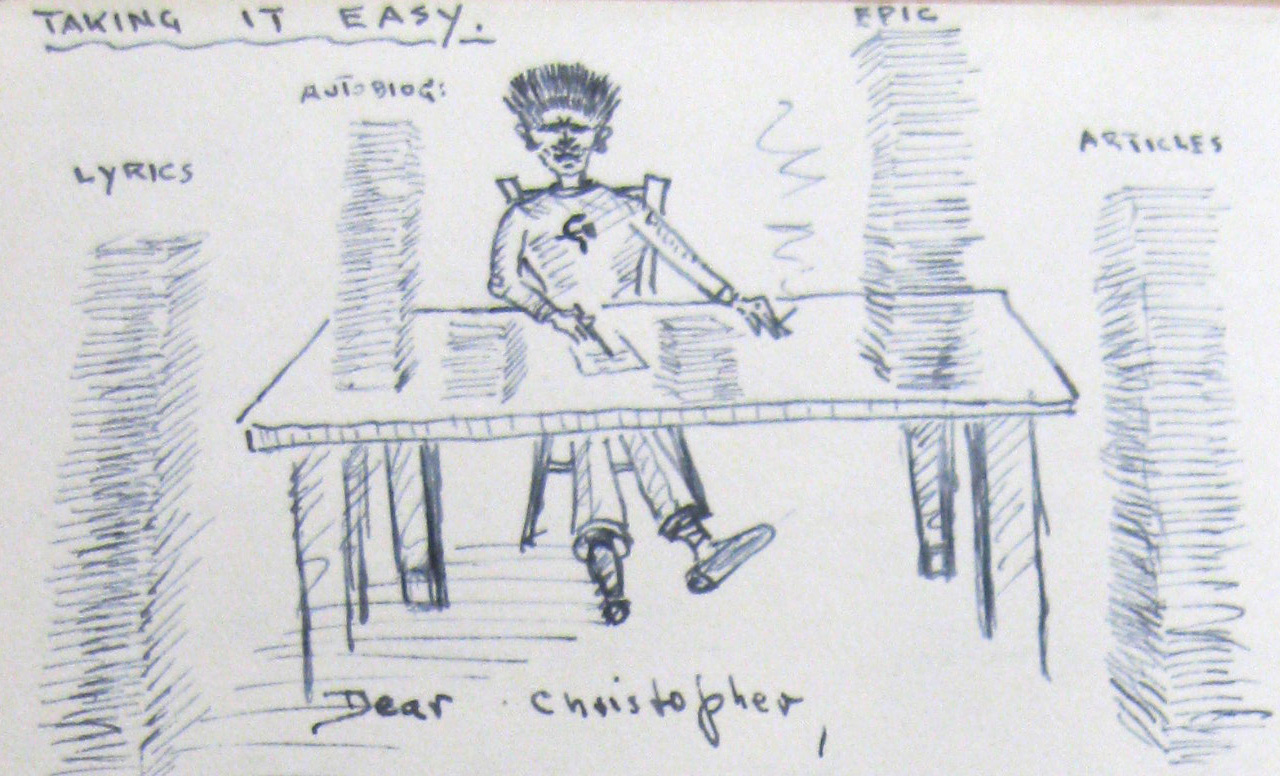
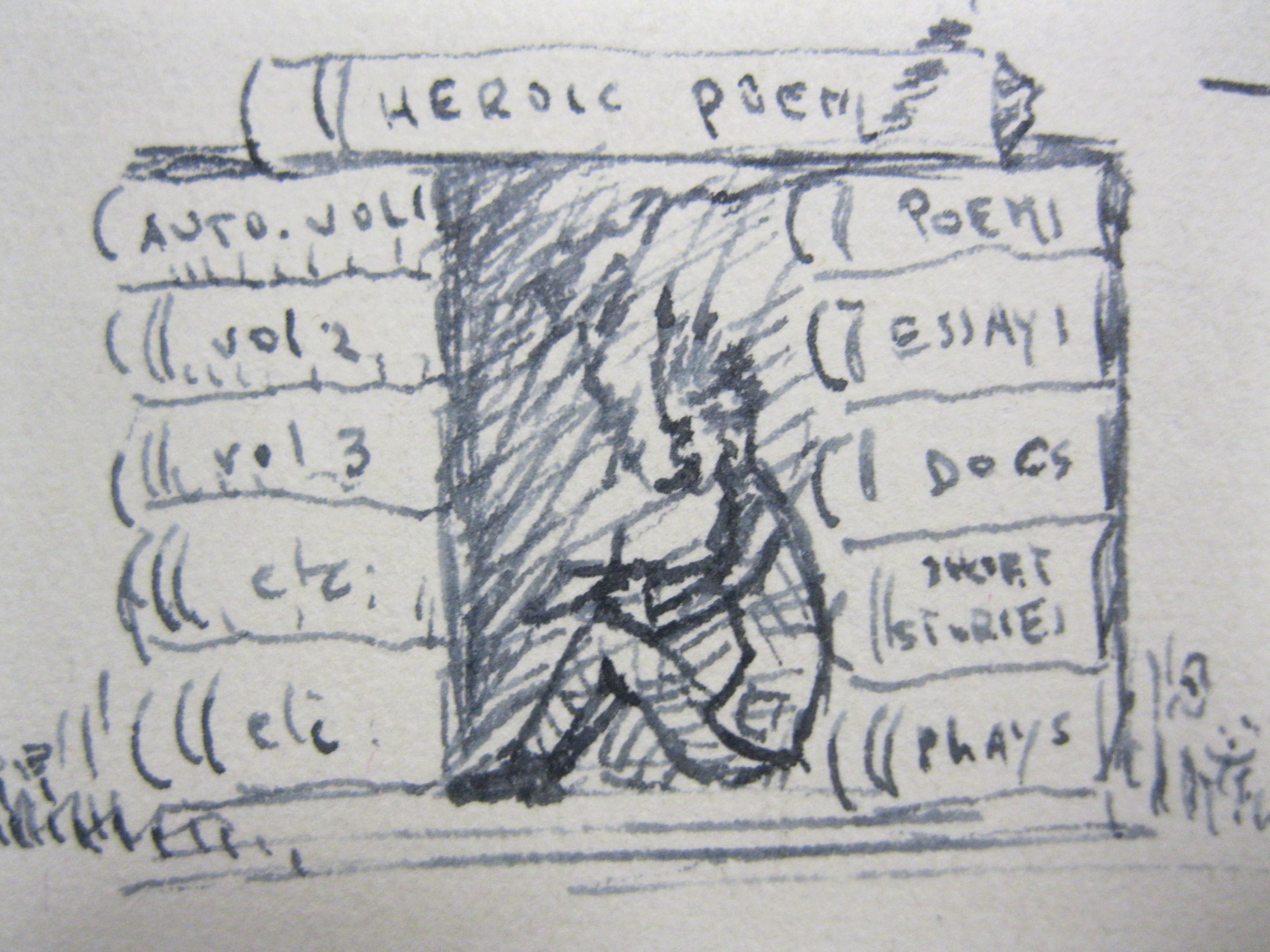
Soutar, confined to bed with a debilitating disease for the last 13 years of his life, adorned some of his letters with affectionate pen-and-ink caricatures of MacDiarmid (whom Soutar always addressed by his real forename ‘Christopher’). On 9 January 1937, he pokes gentle fun at the workaholic MacDiarmid’s idea of ‘taking it easy’, portraying him as a Marxist superman surrounded by piles of manuscripts headed ‘Lyrics’, ‘Autobiog.’, ‘Epic’, and ‘Articles’. When war breaks out, he suggests (19 December 1940) that the drafts of MacDiarmid’s works in progress will make a more than adequate bomb shelter.
Soutar was an Edinburgh University student, matriculating in 1919, after serving in the Royal Navy during the First World War (an experience that turned him into a pacifist). He began a medical degree, but soon switched to English Literature, where he proved a notoriously difficult student. He refused to study both Anglo-Saxon and novels in general as he considered both irrelevant to his future career as a poet. He did, however, publish early verses in The Student, many of which reappeared in his first published volume Gleanings by an Undergraduate (1923).
For information on our holdings of William Soutar manuscripts and correspondence, see Scottish Literary Papers.
Paul Barnaby, Centre for Research Collections
New Strides, Old Stripes: Zebras and the tsetse fly

Glass slide, which probably once belonged to James Cossar Ewart, showing the tsetse fly (Coll-1434/3139)
It was announced last week that scientists have deciphered the genetic code of the tsetse fly, which offers hope of eradicating one of Africa’s most deadly diseases. The fly, which is only found in Africa, carries parasitic micro-organisms which cause sleeping sickness (trypanosomiasis) in humans by attacking their circadian rhythms (biological clock) and can be fatal if left untreated. As well as the threat to people, the tsetse can have equally devastating effects on animals, particularly livestock, causing infertility, weight loss and decrease in milk production. By also rendering animals too weak to plough, the consequences for farmers can be catastrophic. Since the parasite can evade mammals’ immune systems, vaccines are useless, and control of the tsetse is currently only achievable through radiation, pesticides or trapping.
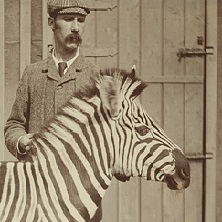
James Cossar Ewart with one of his zebras in Penicuik, outside Edinburgh, c.1900 (Coll-14/4/6)
Concerns about the tsetse fly in Africa date from far before such advances in genetics could hope to help. There are several letters in James Cossar Ewart’s archives which give an insight into how the problem was being dealt with over a century ago. As you may remember from other posts, Ewart, Professor of Natural History at the University of Edinburgh from 1882 to 1927, famously conducted cross-breeding experiments with zebras and horses on his home farm in Penicuik. It is perhaps not too surprising then, that zebras featured in Ewart’s thoughts about the tsetse fly…
Ewart’s letters show that between 1903 and 1909 he was corresponding with various individuals involved in the administration of East Africa (which was then a protectorate of the British Empire), where the tsetse fly was a great problem, particularly where animals such as horses – which were invaluable for transport – were being infected. Ewart believed his zebras could be the solution, if it could be shown that they were immune to the disease the fly carried. (Ewart had already been researching the potential of zebras and zebra hybrids as alternative pack and transportation animals in military, mining and agricultural contexts around the world). However, in June 1903, a letter from Ewart’s regular correspondent, the German animal dealer and trainer Carl Hagenbeck, regretfully informed Ewart that three zebras had died in Berlin after being infected. However, hope was not lost; a month later, Alice Balfour (sister of the 1st Earl of Balfour) wrote to Ewart wondering whether cross-breeding infected zebras with healthy horses might lead to an immune hybrid strain being created. As a matter of fact, zebras are indeed immune to the bite of the tsetse, with some theories holding that zebras have evolved stripes to confuse the flies and deter attack. In 1909, the author, soldier and hunter Lieutenant-Colonel John Henry Patterson wrote to Ewart stating that it was a shame zebras were not easily domesticated, as East Africa sorely needed animal transport immune from ‘the fly’.

Glass slide, which probably once belonged to James Cossar Ewart, showing the distribution of the tsetse fly across Africa (Coll-1434/2058)
We don’t know from Ewart’s correspondence whether zebras did end up being used in East Africa, although they have remained useful to the present day – in 2010, for instance, it was announced that cattle in East Africa were being scented with zebra odour in order to deter the tsetse!
These letters offer an insight into ways of tackling the tsetse problem through species selection and cross-breeding before scientific advancement enabled the full sequencing of the tsetse genome.
Read more about the sequencing of the tsetse here:
http://www.theguardian.com/global-development/2014/apr/25/scientists-crack-genetic-code-tsetse-fly-africa-sleeping-sickness
See the catalogue of James Cossar Ewart’s paper here:
http://www.archives.lib.ed.ac.uk/towardsdolly/cs/viewcat.pl?id=GB-237-Coll-14&view=basic
Clare Button
Project Archivist
William Drummond book returns home
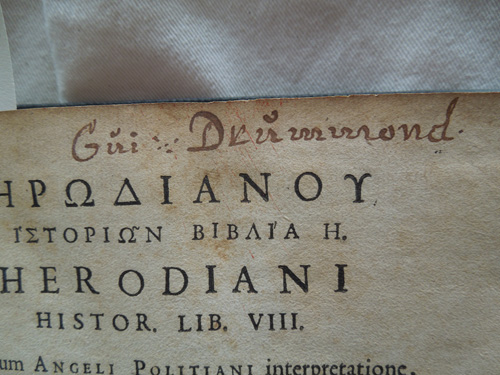
Rare Books and Manuscripts has purchased a book once in the library of William Drummond, the Scottish poet who gave us most of his books in 1626. This particular book never came to the University of Edinburgh and has spent much of its life in libraries in North America. It is a copy of the works of the historian Herodian, printed in 1581. Shown here is an image of part of the title-page, with Drummond’s inscription. It is great to be able to finally re-unite this book with the rest of Drummond’s library – several centuries later.
Journal of Lithic Studies: First issue published on journal hosting service
The first complete issue of the Journal of Lithic Studies (JLS) has been published supported by the Library’s Journal Hosting Service.
The first issue focuses specifically on presentations from the 2013 International Symposium on Chert and Other Knappable Materials held in Iași, Romania. The articles cover a relatively wide range of topics in lithics studies such as use-wear analysis, raw material characterisation and research into trade patterns. This issue also showcases examples of research being conducted around the world, including North America, Europe, the Near East and East Asia.
The first issue of The Journal of Lithic Studies can be viewed on the journal’s website – http://journals.ed.ac.uk/lithicstudies/issue/view/66 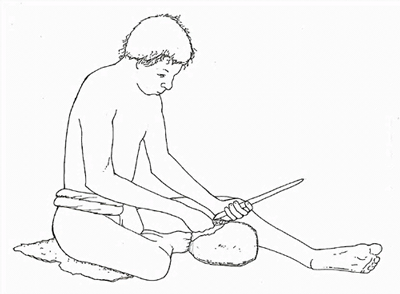
The journal is currently accepting submissions for the next issue (Volume 1, Number 2) which will be published in September 2014. JLS publishes articles on archaeological research into the manufacture and use of stone tools, as well as the origin and properties of the raw materials used in their production. Research from all geographic regions and time periods will be considered.
Although whole issues are published in March and September, the individual articles which make up the issues will each be published online within a few days of final acceptance. In the spirit of open scholarship, JLS is freely available to the general public. There are no fees to download articles, nor are there any fees to submit, review or publish articles.
To receive future updates from JLS, please register on the journal’s website at http://journals.ed.ac.uk/lithicstudies/
Angela Laurins, Library Learning Services
8000th full text item added to the Edinburgh Research Archive
To round off the week we’re delighted to have just archived our 8000th full text item in the Edinburgh Research Archive. The item to receive this prestigious accolade is a dissertation from the Moray House School of Education called:
Writing in the Junior Secondary Phase “Standard V”.
This dissertation was digitised from microfilm and uploaded to ERA by Stephanie Anderson who we have had the pleasure of working with us for the last month. Stephanie has been working in our Scholarly Communications Team as an intern as part of her studies for a Library and Information Studies Masters degree from Robert Gordon University.
We have really enjoyed having Stephanie join our team for the short time she was here, and we wish her all the best for her future endeavours!
Scotland’s Religious Past : Unique Special Collections at New College Library, Edinburgh
Here at New College Library we’re rediscovering unique Special Collections items which tell the story of Scotland’s radical religious past.
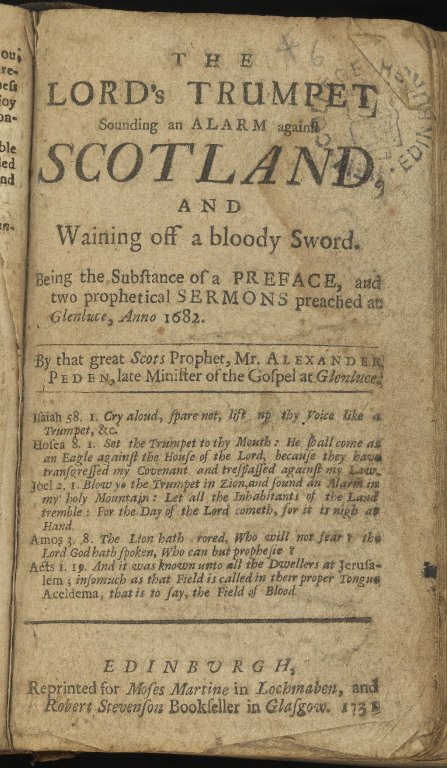
The Lord’s Trumpet Sounding an Alarm Against Scotland. Edinburgh, 1731, New College Library S.b.32
This item, The Lord’s trumpet sounding an alarm against Scotland, and waining off a bloody sword, reprints sermons originally preached in 1682 by Alexander Peden, one of the leading figures of the Covenanter movement in Scotland. Part of the New College Library Pamphlets Collection, it was identified when catalogued as unique on ESTC, or the English Short Title Catalogue, meaning that this imprint had never previously been identified.
The story of Scotland’s religious history is also evident in this eighteenth century pamphlet by Ralph Erskine, brother of Ebenezer Erskine, leader of the Secession Church which broke away from the Church of Scotland in the eighteenth century. Samuel VII and covenant theology. Faith’s Plea Upon God’s Word and Covenant is another example of a New College Library Pamphlet that has been identified as unique in the world.

Faith’s plea upon God’s word and covenant : a sermon preached on a preparation-day before dispensing the sacrament of the Lord’s Supper, at Burnt-island ..
New College Library, H.d.288
Both these items were catalogued as part of the Funk Cataloguing Projects at New College Library, University of Edinburgh, where over 700 items unique on ESTC have been discovered.
Christine Love-Rodgers, Academic Support Librarian – Divinity
University of Edinburgh Open Access update: April 2014
Green Open Access
As of 30th April there are approximately 78,340 records in our Current Research Information System (PURE), of which 18,321 have open access documents available to the general public (23% open access).
Looking specifically at just journal articles and conference proceedings:
| OA full text/Record only (all time) | Open access % | OA full text/Record only (2013+) | Open access % | |
| Medicine & Veterinary Medicine | 6,712/19,998 | 34 | 1,023/2,212 | 46 |
| Humanities & Social Science | 3,459/13,571 | 26 | 577/1,119 | 51 |
| Science & Engineering | 5,915 /26,009 | 23 | 841/2,049 | 41 |
Gold Open Access
Monthly application figures to the Gold Open Access funds:
| Month | Applications to RCUK | Applications to Wellcome |
| January 2014 | 32 | 13 |
| February 2014 | 24 | 13 |
| March 2014 | 23 | 14 |
| April 2014 | 35 | 5 |
Status of the Wellcome fund – since the start of the new reporting period (November 2013) the cumulative open access spend has been £152,826
Status of the RCUK fund – current cumulative spend for the current reporting period (since April 2013) is £393,480 with an additional £65,500 committed on articles submitted for publication.
New Guide to Scottish Literary Papers
A new online guide to some of our major collections of Scottish literary papers is now available on the Centre for Research Collections website. It provides an overview of fourteen of our most significant twentieth-century collections, covering the literary manuscripts and correspondence of poets George Mackay Brown, Norman MacCaig, Hugh MacDiarmid, Edwin Muir, Sydney Goodsir Smith, Helen Cruickshank, Tom Scott, Andrew Young, Maurice Lindsay, and Duncan Glen, of short-story writer Fred Urquhart, and of historian and biographer Marion Lochhead. There are also pages on novelist John Buchan’s correspondence as literary adviser to Thomas Nelson & Sons Ltd (in our Nelson Archive).


The guide not only lists the most significant literary manuscripts for each writer, but highlights links between the collections, charting correspondence between the featured writers, and mutually inspired creative and critical writings. For each writer, there is also a list of manuscript materials of relevance in other Edinburgh University Library collections. There are further links to online hand-lists and to relevant entries in the Archives and Manuscripts Catalogue.
The literary papers cover a great variety of materials:
- Manuscript and typescript drafts of literary works, such as Norman MacCaig‘s version of the Brecht/Weil song Mack the Knife (above right)
- Correspondence, including George Mackay Brown‘s application for a summer job at Edinburgh University Library (below left)!
- Photographs, such as W. R. Aitken‘s portrait of Hugh MacDiarmid and family on Whalsay, Shetland (above left)
- Other visual materials, such as Sydney Goodsir Smith‘s sketches for staging one of his plays (below right)


In due course, the pages will be expanded to cover smaller Scottish collections and pre-20th-century manuscripts, and to detail our holdings of writers (like Sorley Maclean or Edwin Morgan) for whom we have no discrete named collection. We hope that the guide will provide an invaluable gateway to our collections for anyone interested in researching 20th-century Scottish writing. To explore the site, go to:
Paul Barnaby
The Piper Magazine Photography
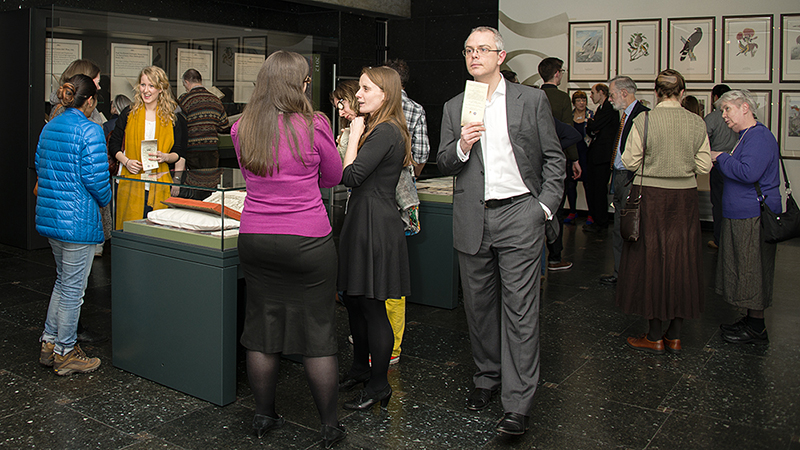
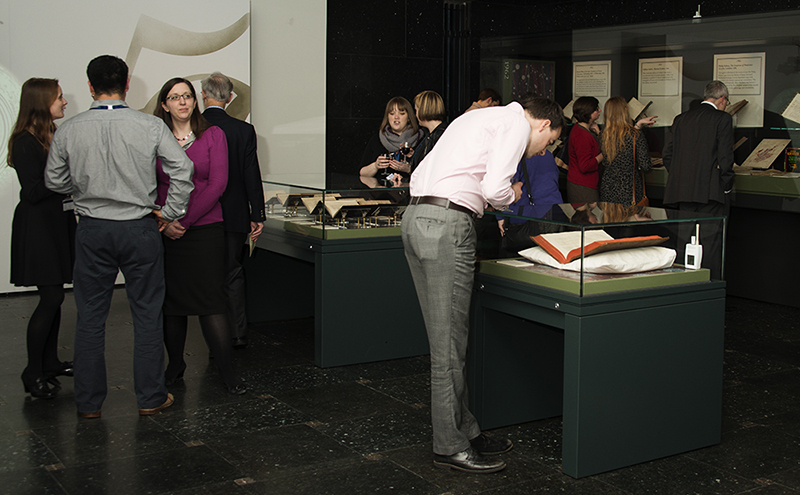
For many years the Digital Imaging Unit have been the primary photographers for The Piper Magazine. The Piper is The Friends of Edinburgh University Library twice-yearly illustrated newsletter. The DIU enjoy the challenge of photographing a diverse range of fascinating material that comes our way for the magazine. This has included the friends purchase of Holinshed’s Chronicles on one occasion and this new edition demonstrates particularly good marriage between the layout design of Mark Blackadder and the photography of DIU photographer Susan Pettigrew.


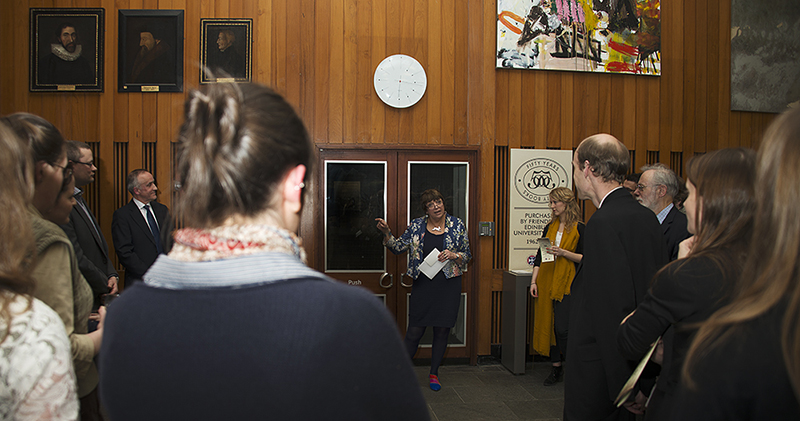
It would be a terrific resource to have the previous issues of The Piper made available as pdf downloads from The Friends website. The current exhibition in the Main Library celebrates Fifty Years, Fifty Books: purchases by the Friends of Edinburgh University Library, 1962-2012 Exhibition Gallery, Main Library, George Square 28 March to 14 June 2014. The exhibition is well worth a look and illuminating as usual. The DIU also photograph all exhibition openings in the Library. Below are some images from the 50/50 opening night.
Malcolm Brown, Deputy Photographer.
The simple art of reference writing
As I am now coming to the end of my time in Edinburgh cataloguing the papers of Professor Sir Godfrey Thomson, references aren’t terribly far from my mind! But I had some pause for thought after a conversation with my eighty-one year old Grandmother. While most of my Grandmother’s contemporaries now shop, talk, and bank online, she remains resolutely uninterested. When I explained I would never see my references – they would be e-mailed, uploaded, etc, my Grandmother was particularly disdainful.
For once, I found myself rather agreeing with her. References were often treasured by the subject, years after they no longer had use for them. They were a courtesy, a kindness. While their primary function was to allow the receiver to gain further employment, they were also an acknowledgement of their hard work, and usually written by someone the receiver respected and admired. References are still, undoubtedly, all of these things – but now, of course, the subject rarely has a copy, and employees rarely keep them for any length of time.
Thomson’s collection contains two – one from the Nobel Prize winning physicist, Karl Ferdinand Braun, and one from educator and historian of music, Sir William Henry Hadow:
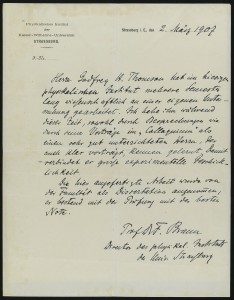
- Reference from Professor Ferdinand Braun


Reference from Sir William Henry Hadow
Both are highly complimentary. Hadow describes Thomson as ‘one of my most distinguished students…a man of very pleasant manners and address…extremely popular in college’, and praises his ‘remarkable power of influencing others for good’.
Hadow was Professor of Education at Armstrong College while Thomson was in turn a student then lecturer. Both had in common a love of music – Hadow frequently wrote on the topic, while Thomson was a skilled pianist. We know that both Thomson and Hadow were interested in the role that music could play in a liberal education, and Thomson’s lectures on teaching music survive in his collection. The notes written on the reverse of the reference are in Lady Thomson’s hand, and comment on Thomson and Hadow’s harmonious friendship and working relationship.
Braun was Professor of Physics at Strasbourg while Thomson was undertaking his DSc, supervised by Braun. He was an inventor, and experimented widely with wireless telegraphy. No doubt he would have been an exiting person for the young Thomson to work with, and it would appear the feeling was mutual – he describes him as well informed, and showing great ‘experimental ingenuity’.
Part of the reason these references meant to much to Thomson is because they were unique, and written in the hand of men whom he had a great deal of respect for. While archivists are widely encouraged to see the beauty in bit code as much as they can illuminated letters (a gross exaggeration on my part!) I’m not quite sure how this will translate in our current day record creation. Laying the ever evolving issues of digital preservation aside, references simply aren’t prescribed with long term value. Which is a shame, because however biased they may be (which they are supposed to be – they are, after all, the opinion of the writer!) they certainly tell us a good deal about the subject.
With thanks to Simone Müller and Christina Schmitz for their translations, and to Serena Frederick for pestering them for said translations!
Collections
 Hill and Adamson Collection: an insight into Edinburgh’s past
My name is Phoebe Kirkland, I am an MSc East Asian Studies student, and for...
Cataloguing the private papers of Archibald Hunter Campbell: A Journey Through Correspondence
My name is Pauline Vincent, I am a student in my last year of a...
Hill and Adamson Collection: an insight into Edinburgh’s past
My name is Phoebe Kirkland, I am an MSc East Asian Studies student, and for...
Cataloguing the private papers of Archibald Hunter Campbell: A Journey Through Correspondence
My name is Pauline Vincent, I am a student in my last year of a...
Projects
Cataloguing the private papers of Archibald Hunter Campbell: A Journey Through Correspondence
My name is Pauline Vincent, I am a student in my last year of a...
Archival Provenance Research Project: Lishan’s Experience
Presentation My name is Lishan Zou, I am a fourth year History and Politics student....