Home University of Edinburgh Library Essentials
May 9, 2026
Picture puzzles from the Paterson Bible Collection at New College Library
I’m delighted to be able to report that all 278 items in the Paterson Bible Collection at New College Library are now catalogued online. This collection turned up a number of surprises for us along the way, not least the number of items that are not Bibles. In a previous blog post about this collection, I mentioned how it represents the life and work of its collector, John Paterson (1776–1855) a Glasgow trained missionary for
the Congregational Church, who served throughout northern Europe.
 We were intrigued by this 1727 Book of Common Prayer (PAT 215) because of its fine binding with a fish and crown design. We haven’t discovered the significance of this design and would be interested if anyone could tell us?


We loved the beautiful illustrations in this book (PAT 216) in Danish and Latin on the Sami and Finnmark fylke (1767). Perhaps Paterson acquired this book in the early years of the nineteenth century, when he worked with the Swedish and Finnish Bible Societies translating the Bible into Finnish, Icelandic, Sami, Samogitian, and Swedish.
 We were surprised by the graphic woodcut illustrations in De sanctorum martyrum cruciatibus by Antonio Galliano, (1660, PAT 224). This is a manual of methods of torture, persecution and martyrdom faced by the early Christian marytrs.
The cataloguing of this collection was made possible by the generous donation of the Rev. Dr Robert Funk.
Christine Love-Rodgers, Academic Support Librarian – Divinity & Janice Gailani, Funk Projects Cataloguer
Welcome!
Welcome to the new University of Edinburgh’s conservation blog. This post will be the first of many, keeping you up-to-date with all the interesting and exciting aspects of the conservation work going on throughout the University’s rare and unique collections. Our next blog will come courtesy of Erika Freyr, who (without revealing too many spoilers) is coming to the end of the her 10-week internship in our conservation department working on the University’s historically important Laing Collection.
Fitba’ crazy, fitba’ mad? A football inspired reading list
The World Cup kicks off tomorrow in Brazil and we’ve pulled together just a small number of the e-books currently available to staff and students of the University in the Library’s collections that look at different aspects of the beautiful (or not so beautiful) game.
 The Global Football League: Transnational Networks, Social Movements and Sport in the New Media Age by Peter Millward addresses the themes that have come to define the global flow of images, capital and people that exist in contemporary football today, including case studies on Liverpool, Manchester United and Manchester City football clubs.
Foreign Players and Football Supporters: The Old Firm, Arsenal, Paris Saint-Germain by David Ranc looks at supporters’ reactions to the increase in the number of foreign players in the clubs they support. It concentrates on three case studies on Glasgow (Celtic and Rangers), Paris Saint-Germain and Arsenal in London and the book charts the evolution of the link between supporters and club between 1995 and today.
Organisation and Governance of Top Football Across Europe : An Institutional Perspective aims to provide an extensive overview of how football is organised and managed on a European level and in individual European countries, and to account for the evolution of the national, international and transnational management of football over the last decades.
 Football’s Dark Side: Corruption, Homophobia, Violence and Racism in the Beautiful Game by Ellis Cashmore and Jamie Cleland aims to express the views of thousands of football fans on the game they love, but which they know has an unpleasant underside demonstrating that beyond football’s assumed social value, the glamour and the spectacle an array of serious problems and exclusions endure.
An ethnography of English football fans: Cans, cops and carnivals by Geoff Pearson is based upon sixteen years observation of English football fans who travel home and away with their team – Manchester United, Blackpool and the England national team. The book challenges a number of the myths about hooliganism and crowd control and describes the interpretations, motivations and behaviour of these groups of fans both at home and abroad.
Caroline Stirling – Academic Support Librarian for Social and Political Science
Further funding success
Fundraising continues to go from strength to strength for the St Cecilia’s Hall Project. Following the recent successful Heritage Lottery Fund award in March, the Binks Trust have pledged a further gift in support of the Project.
As one of the projects first supporters, the Binks Trust have been instrumental in helping us to realise our vision for St Cecilia’s to become the centre for the display, study performance and enjoyment of historical musical instruments in the UK. The Trust’s continued support for the Project is a great example to other potential supporters and we hope that this further award will encourage additional funders to support the Project.
As well as the recent fundraising successes, the team at MIMEd are looking forward to a summer of festivities at St Cecilia’s over the coming months, prior to the doors closing for the restoration and refurbishment in September. There will also be a full programme during the Edinburgh Festival in August, with concerts on historical instruments as well as a variety of other events. Check out the programme here.
We will, of course, keep the Reid Concert Hall open during the period of closure at St Cecilia’s Hall, so be sure to watch out for the exciting programme of events we have planned while St Cecilia’s undergoes its transformation!
Godfrey and Hector Thomson

(Coll-1310/1/2/2 Family Photographs)
With father’s day coming up this weekend, I thought it would be interesting to blog about the father/son relationship between Godfrey and Hector Thomson. When Hector was born in 1917, it was clear that Godfrey had a new test-subject in his infant son!

Immediately after Hector was born, Thomson began to keep a journal recording his son’s development from his birth until the age of ten (ref: Coll-1310/1/7), a copy of which is among the records of the Godfrey Thomson collection. This journal is fascinating in its level of observation and detail about young Hector, and shows the depth of Godfrey’s commitment to understanding childrens development and intelligence. Who knows what Hector thought about the in-depth analysis of his behaviour and speech throughout his childhood, but the entries give a great insight into what it must have been like in the Thomson household.

 (Coll-1310/1/7 Papers Regarding Hectors Development)
The many photographs in the Thomson family albums illuminate the family further, and contain several charming pictures of Hector and Godfrey together.
The first entry records Hectors appearance as a new-born on the 18th of February 1917. Godfrey notes that he “has blue eyes, brown hair, long thin limbs and a large triangle head”! Less than a month later, it is recorded that “he looks at bright objects and turns his head about when a noise is made. Finds bright objects better than he finds noises however. Smiled twice today. His eyes are much darker than when he was born and perhaps they are changing from blue to brown.”
Frequent diary entries contain details about Hector’s early years, including his thumb-sucking, his ability to see his mother in the mirror, picking up items, first words, illnesses and learning to walk. As the years went by, quotes from the rather amusing Hector were also recorded in the journal, as well as stories he made up, dreams he recounted for his parents and several drawings. Despite early attempts by his parents to make him write with his right hand, his natural tendency to left handedness won out in the end! Interestingly he had a propensity to write in mirror image, which is shown in some of his drawings.
Godfrey was obviously very interested in Hector’s intellectual development and the scientific conclusions he could draw from his observations; but this file is also a testament of the affection, pride and amusement he felt while watching his son growing up.


Earlier blog entries have told about Hector as an adult, his wide ranging travels and his marriage to Andromache. Rather touchingly, even as an adult he always referred to Godfrey as “Daddy”. He followed in his father’s footsteps into the field of education to become a popular and well respected teacher in Nicosia and later at the University of Aberdeen.

Neasa Roughan, Godfrey Thomson Project Intern
A secret agent exposed…
As I am told by every taxi driver who ever gives me a lift home, Edinburgh’s Fountainbridge area is famous for being the childhood home of Sean Connery. But, you may not know that he was employed by Edinburgh College of Art as an artist’s model from February to May 1952 – we’ve even got his contract in the ECA Archive, signed when he was still known as Thomas Connery.
Richard Demarco, who remembers painting him as a student, described the future Bond as “too beautiful for words, a virtual Adonis.”
Unfortunately only one painting exists in the Art Collection from Big Tam’s brief stint as a model, painted by jazz musician Al Fairweather when he was a student. Feast your eyes on this:
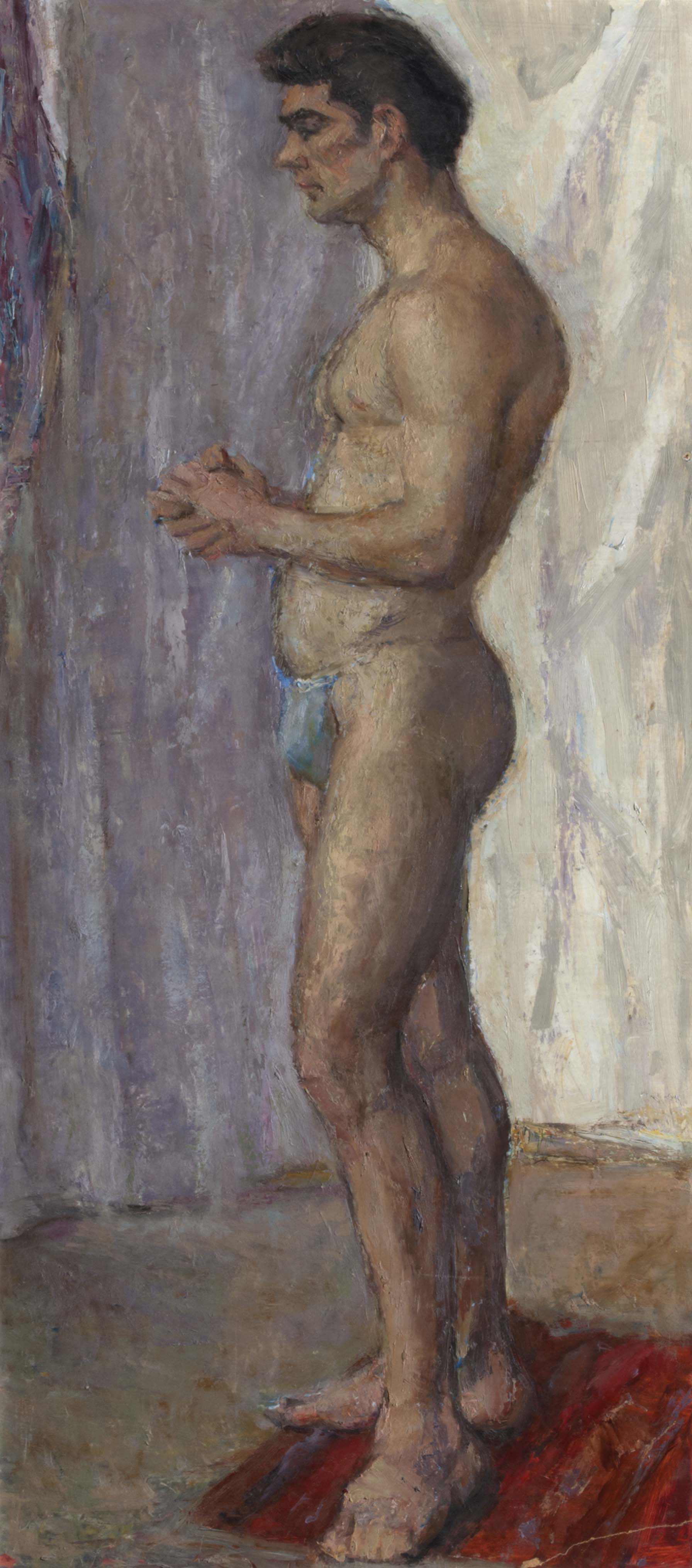
The hair! The pouch! That elegant and alluring pose. No wonder he was cast as James Bond just a few years later.
Anna Hawkins
The Blue Blanket
Each week the Centre for Research Collections receives two deliveries of Special Collection items from the library annexe. Usually these items go back to the annexe when the reader is finished with them, but occasionally we choose to keep the item in the main library, especially if its contents are closely related to other items in the collections. This happened recently with a journal requested by Fiona Donaldson who is researching the history of the University of Edinburgh Reid Concerts.
The item is called The Blue Blanket, An Edinburgh Civic Review. Four issues of the journal were published during 1912 and its contents relate to a number of special collection items.
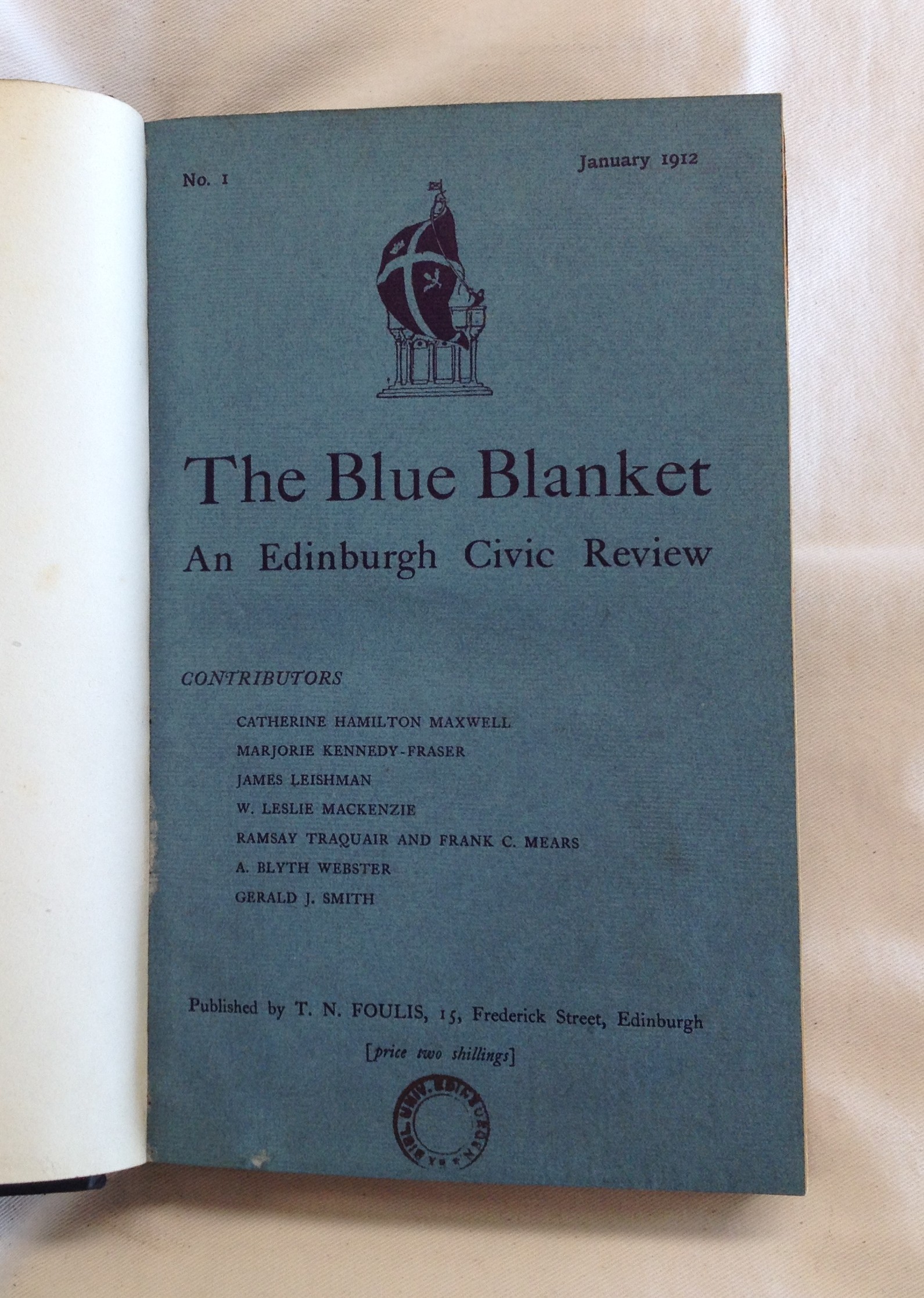
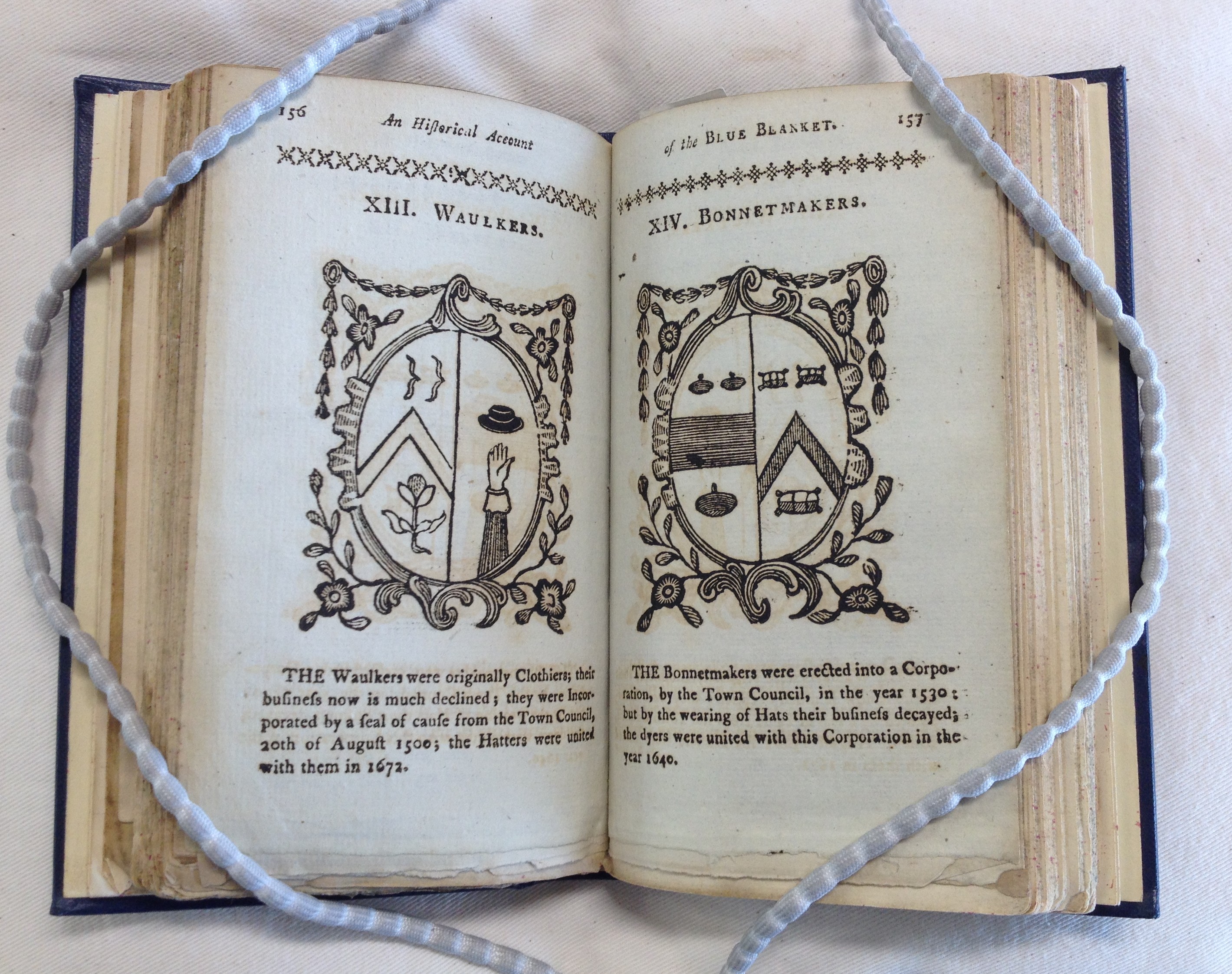
The title of the journal is inspired by banner of Edinburgh Craftsmen. Our rare book collections include a 1780 pamphlet about the Blue Blanket and the craftsmen of Edinburgh:
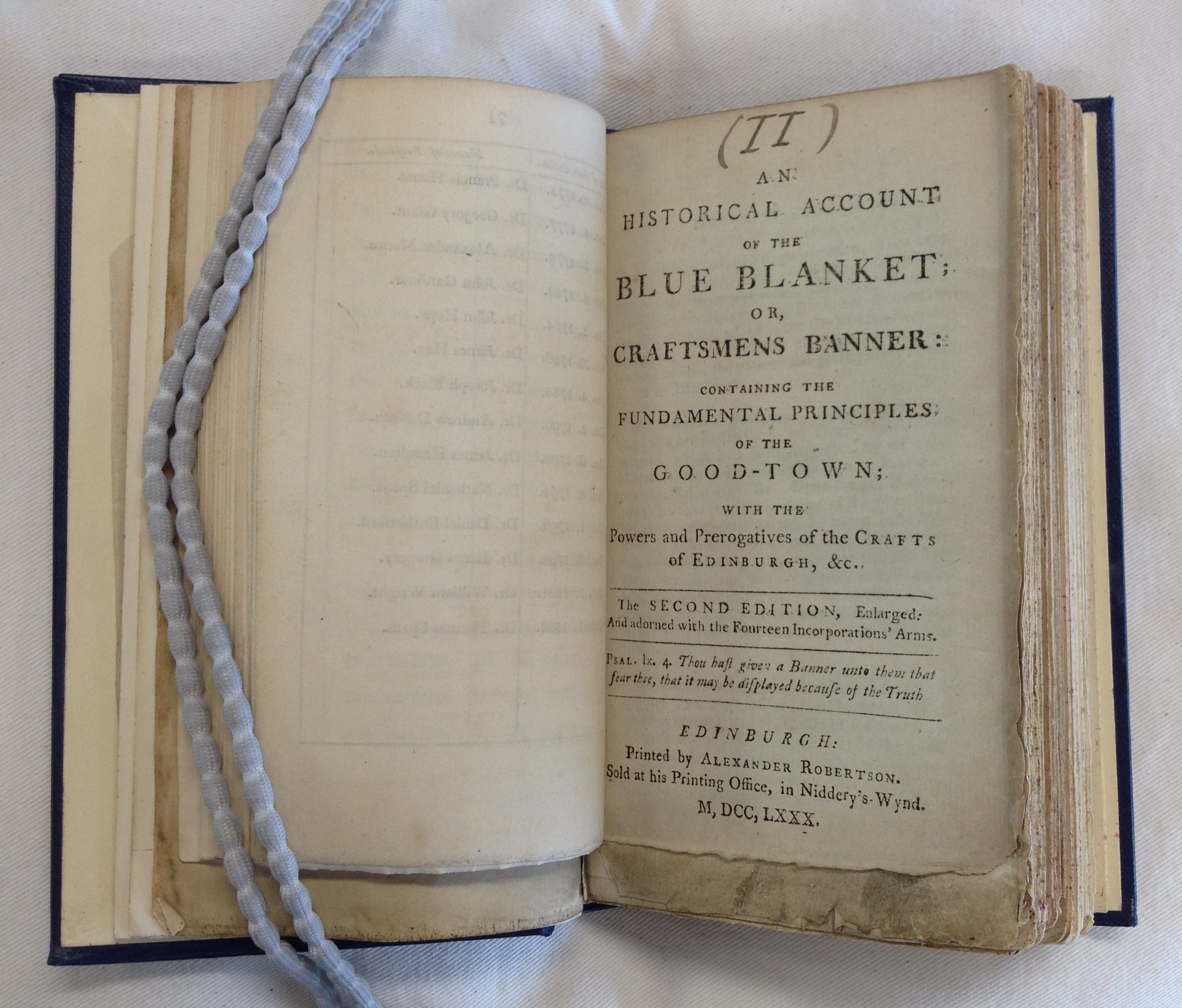
The Historical Account of the Blue Blanket includes illustrations of the emblems of different crafts and guilds, such as the Waulkers and Bonnet Makers:
The journal includes a number of articles by Marjory Kennedy-Fraser (1857-1930), singer, pianist, folk song collector and arranger. The Centre for Research Collections holds her archives, including personal correspondence, manuscripts and musical fragments. Further information can be found on the Archives and Manuscripts Catalogue: http://www.archives.lib.ed.ac.uk/
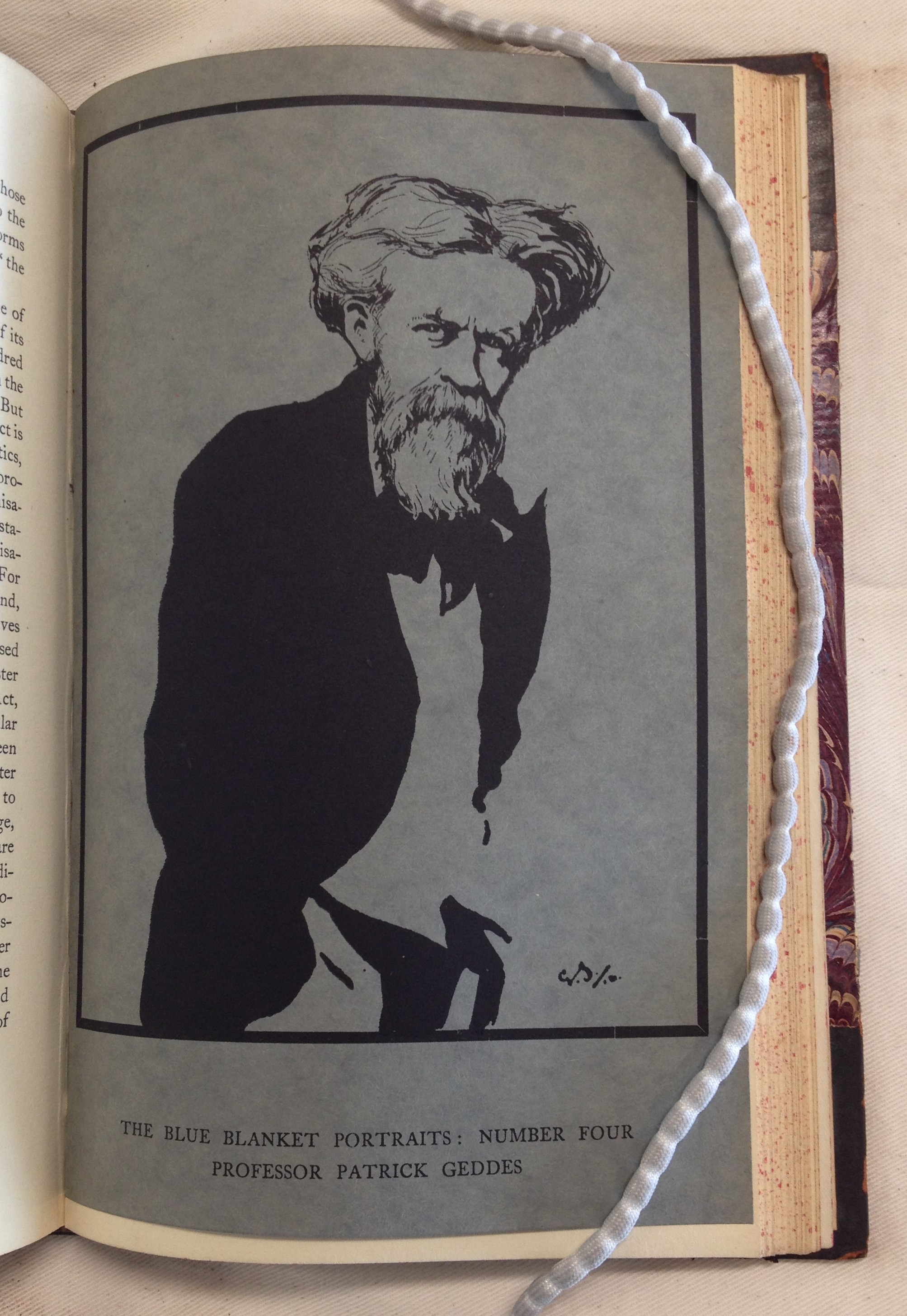
Each issue of The Blue Blanket included a portrait of a notable individual. The portrait for October 1912 was of Professor Patrick Geddes (1854-1932). Geddes was a biologist, sociologist, geographer and town planner. Our collections hold a number of items relating to Geddes, including correspondence to Sir Donald Francis Tovey (1884-1932) and papers relating to the Outlook Tower (some of the photographs from this collection can be seen on the online image collection).
The Blue Blanket can be consulted at the Centre for Research Collections: www.ed.ac.uk/is/crc
Fran Baseby, Service Delivery Curator
My first week as an intern and how it led to the destruction of a city
Jamie started as an intern at the Centre for Research Collections last week, here he tells us about his first few days.
I have just finished my first of eight weeks as a Marketing and Outreach Intern with the CRC, and what a week it has been. After a quick induction the first week has been filled with a mixture of meeting all of the fascinating people working in the department as well as gathering and researching ideas for some of the projects I am going to be working on.
Since I have started, my mind has been blown at least once a day by the interesting things that everyone is working on, and the more this happens the more eager I have been to make my internship successful so we can share some of the stories I have heard with everyone else!
On that subject, here is a little bit more about what I’m doing. As a marketing and outreach intern I’m looking over some of the existing strategies as well as researching, and possibly creating, new ones. Basically I’m looking at ways in which to reach out to more people and let them know about the department and give them a better understanding about what everyone does. I am finding it quite exciting because I get to meet and discuss with everyone all about their roles so I can have a better idea of how to promote everything. By this point you are probably wondering how this led to the destruction of a city.  [Just one of many scenes of devastation included in the photo album of Caen]
Well, it started with all the news surrounding the D-Day Anniversary, I started asking around to see if anyone had information about a collection relating to this that we could post to our Facebook and Twitter pages. I was directed to a photo album in the collection showing pictures and postcards of the city of Caen in Normandy. The city of Caen was first attacked on D-Day by the allies, but initial assaults were unsuccessful and the battle for Caen ended up waging on for most of June and July. During this battle Caen suffered from heavy bombing and destruction of a lot of its buildings. The photo album I looked through was mostly before and after pictures and it was sad to see many beautiful buildings on postcards and then next to it a photo of the same spot but with nothing more than a pile of rubble. The album had been presented by a Professor John Orr, who was a professor of French here. In the catalogue book there was another entry that was a collection of telegrams and newspaper clippings from John Orr, so I decided look for more information behind the Professor’s link with Caen. Going through this collection I found out that Professor Orr was the Chairman of the Edinburgh-Caen Fellowship, and worked hard on getting the people of Edinburgh to donate food, money and emergency items to Caen following the destruction of their homes.


[Two images showing before and after the assaults]
I could go into a lot more detail on what I found out about the Professor and Caen but I think that I’ve given enough for a taster. If you want to find out more you could pop to the Centre for Research Collections’ Reading Room in the Main Library and take out the album yourself and read all about these important events in our history.
I am sorry to disappoint those of you looking to find out how I caused the destruction of a city! If you haven’t realised, it was about how my internship led on to finding out about Caen. I am a little clumsy but have never done anything like destroying an entire city… yet. I hope you’ve enjoyed my first blog – hopefully they’ll let me do another one…
Thank you for reading, and thank you to DIU for supplying the images.
Jamie
Employ.Ed Hidden Collections Intern – Week 1
The Library Annexe will be joined for the next 8 weeks by Nik Slavov, who is working for the University as part of the Employ.Ed on Campus summer internship programme, in collaboration with the Careers Service. Nik is our Hidden Collections Intern, who is tasked with understanding and prioritising print books stored in the Library Annexe, that are not on the Library’s online catalogue. The eventual goal is to make unique material available for the user community.
Here Nik reflects on his first week at the Library Annexe.
Carl Jones, Library Annexe Supervisor
—
My first week at the Library Annexe now behind me, it would appear it is now time for me to look back and see how that went.
It feels like I haven’t seen anything yet. On the other hand, considering how much I’ve learned about the House of Lords, the native population of Oceania, reclaiming land for ironsand processing, Australasian literature in the 70’s, Antarctica, dairy farming, soil erosion and pollution (it is actually quite scary), New Zealand’s defence program and a number of other topics that I had never thought to occupy my brain with, all of that being just a side effect of organising a few shelves at Annexe 1…
Well, considering all that, I still haven’t even scratched the surface of what’s there. If my math’s any good, I’ve seen less than 0.05 % of what is held in that room only. At this point, Pratchett’s theory of L-space seems very plausible (http://en.wikipedia.org/wiki/L-Space#L-space). The sheer mass of books distorts the space-time continuum, which is why the Library Annexe is way bigger on the inside.
The team is lovely. In all fairness, given the randomness and rareness of my encounters with other human beings within the Annexe, and the alleged hallucinogenic effect of the fungus that develops in old books, I am not entirely certain they actually exist, but in case I didn’t make you guys up – it’s lovely working with you. Or at least, you know, in the same building, or the one next door. Having lunch together. Occasionally. And sometimes overhearing conversations on the radio…
At least it clearly says in the office that this is a Vashta Nerada free workspace, which is a relief. And apparently there have been no Velociraptor-related work accidents in a bit less than a year (is that really good? I should look into that. There ought to be a book with statistics on the topic in the Annexe somewhere. I can’t find one on the catalogue, but I couldn’t find the New Zealand Agriculture and Fisheries Department report from 1968 on the catalogue either, yet I am certain I had it in my hands yesterday.
Unless, you know… fungus.*
Nik Slavov, Hidden Collections intern.
(*For pedantry’s sake, I’d like to point out that there is no active mould in any of the Library Annexe Collections! -ed.)
Search for Vashta Nerada and other resources using Searcher
The Conservation Studio (fungus experts)
Data journals – an open data story
Here at the Data Library we have been thinking about how we can encourage our researchers who deposit their research data in DataShare to also submit these for peer review.
Why? We hope the impact of the research can be enhanced with the recognised added-value of peer review. Regardless whether there is a full-blown article to accompany the data.
We therefore decided recently to provide our depositors with a list of websites or organisations where they could do this.
I pulled a table together, from colleagues’ suggestions, from the PREPARDE project and the latest RDM textbook. And, very much in the Open Data spirit, I then threw the question open on Twitter:
“[..]does anyone have an up-to-date list of journals providin peer review of datasets (without articles), other than PREPARDE? #opendata”
…and published the draft list for others to check or make comments on. This turned out to be a good move. The response from the Research Data Management community on Twitter was very heartening, and colleagues from across the globe provided some excellent enhancements for the list.
That process has given us confidence to remove the word ‘Draft’ from the title – the list, this crowd-sourced resource, will need to be updated from time-to-time, but we are confident that we’ve achieved reasonable coverage of the things we were looking for.
Another result of this search was the realisation that what we had gathered was in fact quite clearly a list of Data Journals. My colleague Robin Rice has now added a definition of that term to the list, and we will be providing all our depositors with a link to it:
https://www.wiki.ed.ac.uk/display/datashare/Sources+of+dataset+peer+review
Collections
 Hill and Adamson Collection: an insight into Edinburgh’s past
My name is Phoebe Kirkland, I am an MSc East Asian Studies student, and for...
Cataloguing the private papers of Archibald Hunter Campbell: A Journey Through Correspondence
My name is Pauline Vincent, I am a student in my last year of a...
Hill and Adamson Collection: an insight into Edinburgh’s past
My name is Phoebe Kirkland, I am an MSc East Asian Studies student, and for...
Cataloguing the private papers of Archibald Hunter Campbell: A Journey Through Correspondence
My name is Pauline Vincent, I am a student in my last year of a...
Projects
Cataloguing the private papers of Archibald Hunter Campbell: A Journey Through Correspondence
My name is Pauline Vincent, I am a student in my last year of a...
Archival Provenance Research Project: Lishan’s Experience
Presentation My name is Lishan Zou, I am a fourth year History and Politics student....