Home University of Edinburgh Library Essentials
April 6, 2026
New resource: Decolonisation and Legal Knowledge
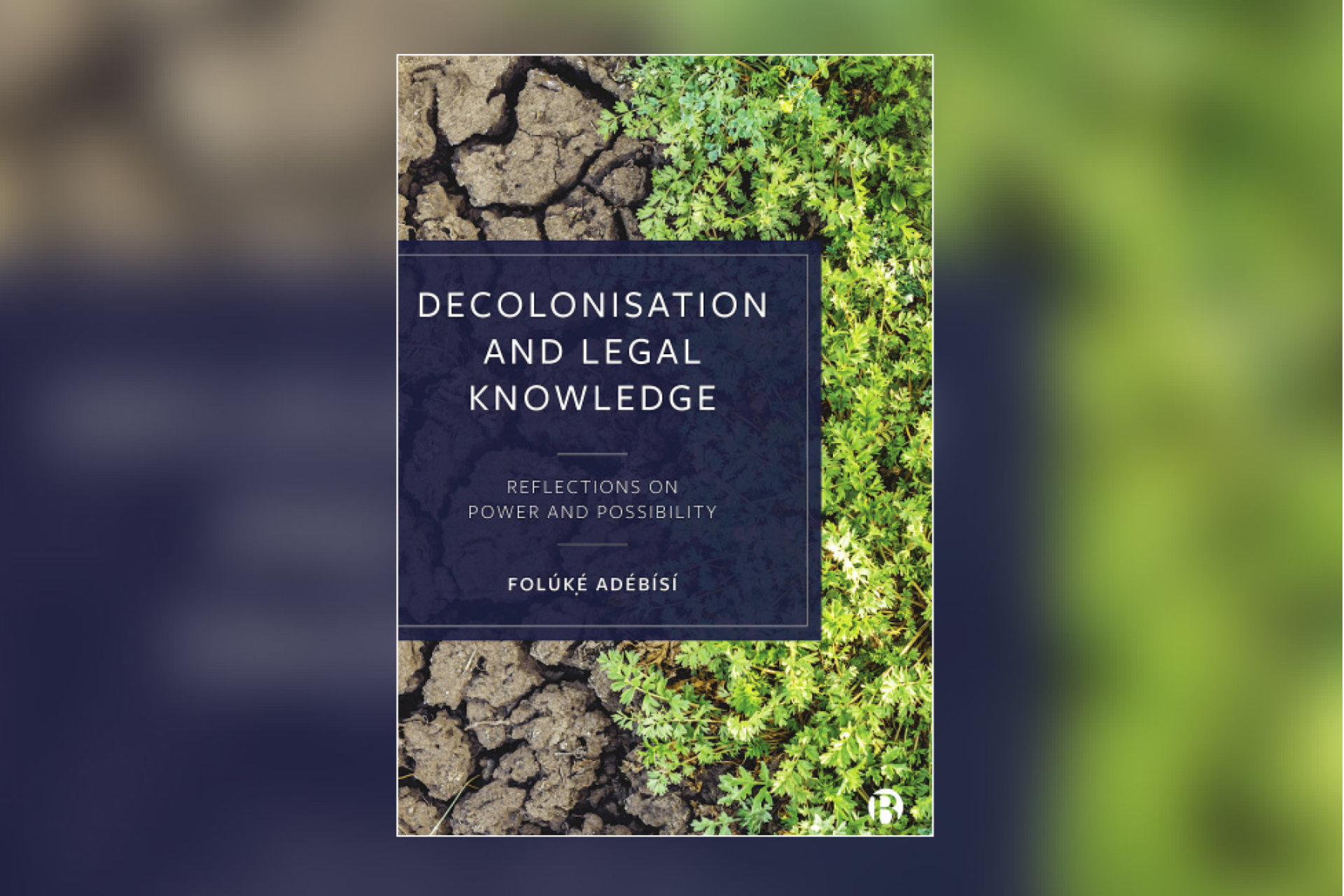
In January the School of Law was fortunate to host the book launch event for Professor Folúkẹ́ Adébísí’s Decolonisation and Legal Knowledge: Reflections on Power and Possibility.
From the publisher:
The law is heavily implicated in creating, maintaining, and reproducing racialised hierarchies which bring about and preserve acute global disparities and injustices. This essential book provides an examination of the meanings of decolonisation and explores how this examination can inform teaching, researching, and practising of law.
It explores the ways in which the foundations of law are entangled in colonial thought and in its [re]production of ideas of commodification of bodies and space-time. Thus, it is an exploration of the ways in which we can use theories and praxes of decolonisation to produce legal knowledge for flourishing futures.
This text is now available via DiscoverEd: Decolonisation and Legal Knowledge: Reflections on Power and Possibility.
If you’re interested in requesting material like this that you think would be a valuable addition to the Law Library, you can complete the Request A Book (RAB) form. Alternatively if you’re interested in the library securing access to subscriptions or expensive items that you think would benefit teaching or research, contact us by email (law.librarian@ed.ac.uk) to discuss your idea!
CHDS DAMS Internship Experience

Over the past 6 months, I have had the pleasure of working with the Cultural Heritage Digitisation Service team as a DAMS (Digital Asset Management System: software used to manage digital heritage collections) Assistant, working to build the foundations for the migration of these collections from the current DAMS (LUNA) to the new Digital Collections Platform (Archipelago). Read More
Stories To Tell: South Asian Heritage Month
From 18 July to 17 August it is South Asian Heritage Month, a chance to celebrate and raise the profile of British South Asian history, arts, culture and heritage. This year’s theme is #StoriesToTell, celebrating the stories that make up the diverse and vibrant South Asian community.
Sometimes, to understand your own story or those of others, you have to look back and in this blog post we are highlighting just a small number of digital archives you can access through the Library that allow you to learn more about South Asian history and the stories that have shaped our present and future.
South Asia Commons (formerly South Asia Archive)

CRC: A Space Odyssey – Day in the Life of a Collections Management Technician
My name is Jasmine, and I’ve been working here at the University for five and a bit months as the Collections Management Technician. I’m the other half to Robyn Rogers’ role as Collections Care Technician, whose fantastic blog post about her recent work you can read here, and I work directly with the Appraisal Archivist and Archives Collection Manager, Abigail Hartley, whose equally wonderful blog post was featured last month.
Abigail did a great job of defining appraisal and the challenges to the archivist when it comes to choosing what material to preserve. The archivist is often put in the position of assessing the ‘value’ of the record, a thorny process which comes with a number of ethical challenges. Thinking through these problems, it might seem easier to suggest that we simply keep everything we receive. If we get to keep everything, we don’t have to think through complicated questions, like what is the purpose of the record? And what is the purpose of the archivist? After all, if something has found its way into the archive, isn’t that an implicit statement of its value? Why appraise at all?
New! Mass Observation Project, 1981-2009
I am happy to let you know that following a successful trial, that ended last month, the Library has now purchased Mass Observation Project, 1981-2009 from AM Digital, which allows you to explore the history of Britain through three turbulent decades, written by those living through it.
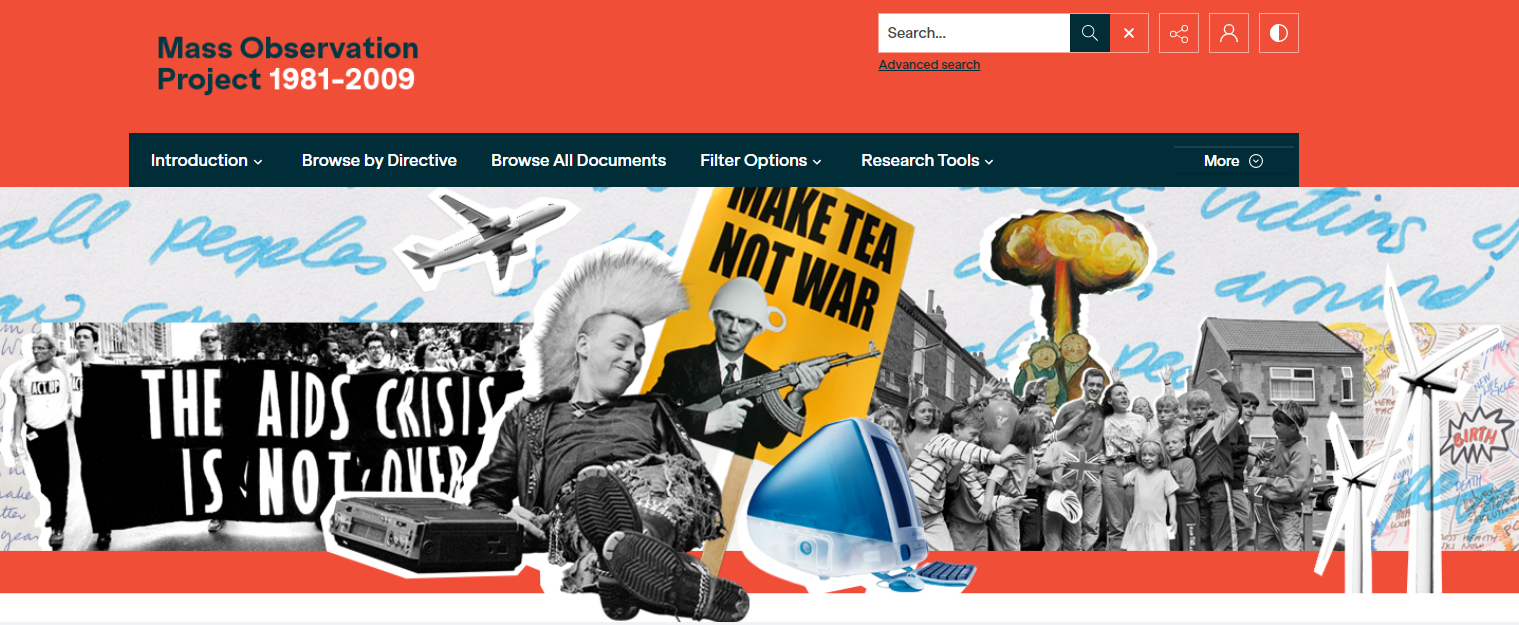
You can access Mass Observation Project via the Digital Primary Source and Archive Collection guide or the Databases A-Z list. You will also soon be able to access it via DiscoverEd.
Mass Observation Project, 1981-2009 provides digital access to a unique life-writing archive, capturing the everyday experiences, thoughts and opinions of people living through the turbulent final decades of the 20th century and the advent of the 21st century. Read More
New Data Visualisation Intern
It’s often said that the best way to achieve your goals is to visualise success. But what if visualisation is your goal? Then get someone clever to do it for you. That’s what we did: hired a new Data Visualisation Intern.

Henry Sun has joined Research Data Support for the summer to work on our Data Dashboard project. Henry is about to start his 4th year as an undergraduate, studying electronics and computer science. That’s right, he’s doing 2 degrees: our very own Henry Beauclerc. Henry also came to us with previous experience of laboratory research. Impressed? Us too, very.
Just how Henry manages to find time for anything else is a little baffling. But find it he does and with it, among other things, he watches superhero movies – Marvel for preference, obviously. And he cooks: Henry tells us that he already has special skills in Asian, especially Chinese cuisine, and now he’s learning how to bake. You can imagine how popular he’s going to be when his colleagues find out.
This internship is Henry’s first time in a professional services role and that role is to develop a dashboard that will enable us to monitor and to understand all the Open Research activity that goes on at the University of Edinburgh. Primarily, that means tracking down a range of internal and external data sources and figuring out a way to tie them all together and visualise them. And if that’s not enough, we’re hoping that Henry will be able to predict the future, or at least come up with some ideas for ongoing development of the dashboard. Exciting stuff, right? Right.
And what do we plan to do with this shiny new box of numbers? Management teams will want have a look, of course. We in Research Data Support are expecting to get a clearer and more detailed picture of the data management situation across the University: good practice, bad practice, and no practice at all. Knowing all that, especially the last two, will enable us to focus on the areas where we’re needed most. It will also be useful for our three Colleges – Arts, Humanities & Social Sciences, Science & Engineering, and Medicine & Veterinary Medicine – to see what kind of Open Research their researchers are producing. And speaking of Open Research, we’re aiming to make at least some of this data – headline numbers, etc. – available to the public via our website. It will be nice to show off all the hard work that’s going on in Open Research at Edinburgh as well as all the hard work Henry is doing for us.
Simon Smith
Research Data Support Officer
Library & University Collections
New College Library Library is moving August / September 2023

Inside New College Library, Mound Place
In January 2020 the majority of New College Library General Collections were relocated to 40 George Square to provide a Library service for the duration of a major Estates project. This Estates Project has now come to an end. New College Library at 40 George Square will close at 4.50pm on 9th August 2023.
Between 10 August and 10 September access to the New College Library General Collections will be unavailable as they move location. While access to collections is paused the Library will support Library users to identify alternative ways to access required Library resources.
New College Library plans to re-open at Mound Place with full access to General Collections, study spaces and Library services on 11th September 2023.
Further information about the Library is provided on the New College Library website New College Library | The University of Edinburgh
On trial: Brepolis online databases
*The Library now subscribes to both Monumenta Germaniae Historica and Archive of Celtic-Latin Literature. Find out more at New to the Library: Archive of Celtic-Latin Literature and Monumenta Germaniae Historica.”
Thanks to a request from staff in History the Library is currently trialing access to 3 Brepolis databases: Monumenta Germaniae Historica, Archive of Celtic-Latin Literature and Aristoteles Latinus. As well as trialling access to their Cross Database Searchtool which allows you to cross search all 3 of these databases, in addition to their Library of Latin Texts, which the Library already has a subscription to.

You can access all 3 databases plus the cross search database tool via the E-resources trials page.
Trial access ends 5th August 2023.
Monumenta Germaniae Historica (eMGH)
The Monumenta Germaniae Historica was founded in 1819 by the Gesellschaft für Deutschlands ältere Geschichtskunde. It is one of the most prestigious editorial undertakings for the critical publication of medieval historical texts. In more than 300 volumes, covering the widest possible range of historical documents, divided into five major Series (Scriptores, Leges, Diplomata, Epistolae and Antiquitates) and into 33 Subseries, the Monumenta not only continues its editorial programme but it has established for all Western scholarship a standard for critical editions. Read More
Library summer opening and changes to service
Although this blog mainly focuses on the work of the ASL team (who are library focused but often work remotely) we realise that many readers may associate this blog with the physical library spaces, so we wanted to highlight a few things happening over the summer in our library buildings.
Summer opening hours: Main Library
The Main Library is now operating on Summer opening hours. This means the following hours of operation apply:
| Day | Building | EdHelp Service Desk |
|---|---|---|
| Monday – Thursday | 24 hour opening | 9am – 7:50pm |
| Friday | 24 hour opening | 9am – 4:50pm |
| Saturday | 24 hour opening | 12 midday – 4:50pm |
| Sunday | 24 hour opening | 12 midday – 4:50pm |
Please note that this week new gates will be fitted to the Main Library entrance and exit, Café exit gates and the High Use Books exit gates. The works will be carried out between Tuesday 4th July-Thursday 7th, 9:00-5:00pm. You can still access the Main Library, alternate entrances and exits will be clearly marked. You can find out more about this (as well as opening hours for the Centre for Research Collections, Main Library Cafe and links to other information) on the Main Library Opening Hours page.
Summer opening hours: Site libraries
The majority of our site libraries open for reduced hours during the summer. Information can be found on the individual sites listed on the Library Opening Hours page.
The vast majority of our libraries operate from 9am to 4.50pm, Monday to Friday during the summer and are closed at weekends. Exceptions this summer are the Art & Architecture Library and New College Library, which we have detailed below.
Art & Architecture Library
Due to building works in Minto House there is currently an alternative entrance to the Art & Architecture Library. Entering Minto House either via the main reception area or the Maltings entrance, follow the signs downstairs to the temporary library entrance door in the lower ground floor (basement) corridor.
UPDATE: Due to disruption as a result of essential building works within Minto House, it will be necessary to close the Art & Architecture Library between Monday 10th July and Sunday 3rd September. Please email us at library.account@ed.ac.uk for any enquiries or if you urgently require any print resources during this time and we will endeavour to make them available within 2 working days from the Law Library in Old College. Please consult the Art & Architecture Opening Hours page for more information.
New College Library
Due to essential maintenance works all New College Library’s current services except for Special Collections were transferred to the temporary library at 40 George Square in 2020. A schedule for the move of New College Library services and collections back to New College Library, Mound Place in 2023 has now been agreed. The main expected dates are :
- 9 August 2023 : New College Library, 40 George Square closes for General Collections moves.
- 11 September 2023 : New College Library, Mound Place opens for access to services and collections.
Until 9 August 2023, NCL General Collections and Library services will remain fully available for students in the library at 40 George Square. For more information please see the New College Library page.
We hope this is useful for anyone wishing to visit our lovely libraries over the summer. The ASL team will be available throughout July and August, so please contact us if you have any queries, either by email or by leaving a comment on this post.
Launch of a New Open Access Journals Toolkit
by Rebecca Wojturska, Open Access Publishing Officer, The University of Edinburgh
On Tuesday 27th June, the OASPA (Open Access Scholarly Publishing Association) and DOAJ (Directory of Open Access Journals) announced the release of a new Open Access Journals Toolkit. I was fortunate enough to be asked to join the editorial board in my capacity as Open Access Publishing Officer within Edinburgh University Library, and would love to share my experience of helping to write the guide!
The aim of the toolkit was to “promote transparency, accessibility, and inclusivity in scholarly publishing.” As these values align with Edinburgh Diamond (the library’s journal and book hosting service), I very quickly said yes at the opportunity to get involved.
Firstly, I was very pleased to see the board was extensive and included a range of subject experts in Open Access and journal publishing. Having so many board members helped split the workload and meant there were many eyes on each section. The fact that board members are from all around the world ensured that the toolkit wasn’t just from a Global North point of view, and would be useful for anyone, no matter where they are based. It was also great to meet so many of my peers!
The journal toolkit has many topics and provides an overview of the subject, as well as references and further reading for more detailed information. Each board member was each assigned three topics to lead, involving conducting research in this area and writing a section containing everything a reader might need to know about the topic. We were under instruction not to bulk it out too much as the guide was meant to be easy to digest and not too overwhelming for a beginner. The sections then went into peer review, where another board member would look over your contributions and provide as much feedback as they could, giving you scope to revise and strengthen them. Then, a third member would give it a final look-over to catch any last minute errors or omissions. Finally, Research Consulting, who were the consultants pulling it all together, tidied up everything and ensured the toolkit read consistently throughout. Overall, the toolkit was really well-crafted and extensively peer-reviewed.
Library publishing is a growing area, and most if not all of the services and presses within libraries focus on Open Access. However, there isn’t as much guidance or resources available that are tailored specifically to Open Access, especially for under-resourced journals and initiatives, who are the core target users for the toolkit. This is extra important when you consider most teams in this area are new to it and consist of a very small amount of staff. Knowing how to even get started is incredibly daunting, and the toolkit means all those starting steps are laid out for users to follow, making the process more manageable and smooth. Also, having an easy-to-access toolkit means that everyone with an internet connection can find out all the basics they need to consider, and at no cost to them. Even better, most of the content in the toolkit is openly licensed under a Creative Commons Attribution 4.0 International License!
Our Edinburgh Diamond service will be using the toolkit for when we have a new editor looking to launch a journal or flip to Open Access. I’ll also be recommending it to our shared service partners, many of whom run their own Open Access initiatives, as the toolkit is a great way to ensure journals hit the ground running, are of a high standard, and are an attractive option for authors. For us, it helps strengthen the reputation and prestige of our service, helping cement the sustainability and viability of Diamond Open Access in the library.
The toolkit has a very sleek and user-friendly interface, so why not check it out and find out how it could be useful for you too?
Collections
 Hill and Adamson Collection: an insight into Edinburgh’s past
My name is Phoebe Kirkland, I am an MSc East Asian Studies student, and for...
Cataloguing the private papers of Archibald Hunter Campbell: A Journey Through Correspondence
My name is Pauline Vincent, I am a student in my last year of a...
Hill and Adamson Collection: an insight into Edinburgh’s past
My name is Phoebe Kirkland, I am an MSc East Asian Studies student, and for...
Cataloguing the private papers of Archibald Hunter Campbell: A Journey Through Correspondence
My name is Pauline Vincent, I am a student in my last year of a...
Projects
Cataloguing the private papers of Archibald Hunter Campbell: A Journey Through Correspondence
My name is Pauline Vincent, I am a student in my last year of a...
Archival Provenance Research Project: Lishan’s Experience
Presentation My name is Lishan Zou, I am a fourth year History and Politics student....