Home University of Edinburgh Library Essentials
April 6, 2026
Welcome to the new Research Data Management Service Coordinator: Stuart Macdonald
We welcome Stuart Macdonald to the position of Research Data Management Service Coordinator, as a 1-year secondment for the current post-holder. Stuart will continue the work of developing the research data services provided by Information Services at the University of Edinburgh. Stuart will be working for three quarters of his time on the programme, and the remaining quarter in his current role as Associate Data Librarian for EDINA and the Data Library.

Stuart has recently returned from a six month secondment at Cornell Institute for Social and Economic Research as Data Services Librarian where he co-ordinated the successful Data Seal of Approval trusted repository application for CISER Data Archive as well as modernized archival process and practice.
When not working as service coordinator, Stuart will be working towards gaining the Data Seal of Approval for DataShare, the University’s open data repository.
On the role of service coordinator, Stuart says “This is a marvellous opportunity to be at the heart of research data management activities here at the University and to continue the great work that has already been put in place”
University Press Scholarship Online

We have extended our e-book deal with University Press Scholarship Online to provide access to over 14,000 key titles across over 25 subject areas in the humanities, social sciences, sciences, medicine, and law.
These can be browsed at the link above by choosing a subject area and then selecting the show full text option. Newly published titles will also continue to be added to the library catalogue through regular updates.
Congratulations to our Divinity Graduates and Dr Rowan Williams
New College Library staff would like to congratulate all the Divinity students who will be graduating today, Friday 4 July, and wish them well for the future.
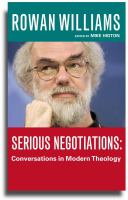 Celebrating with them will be Dr Rowan Williams, formerly Archbishop of Canterbury, who will be awarded an honorary Doctor of Divinity Degree on Friday 4 July. We have a selection of Dr Williams’ publications on display in the entrance to New College Library. To see more of Dr William’s extensive publications, have a look at the resource list we have created using the Talis Aspire Resource list system.
Christine Love-Rodgers, Academic Support Librarian – Divinity
Discovering the Orient

Detail of portrait showing a group of women washing clothes in a river. This miniature comes from a collection of portraits (Tasawir), which originate from India and date to the mid-19th century. Although many of the images in the oriental manuscripts collection tend to relate to religion or mythology, this portrait is interesting as it provides a fascinating insight into the life of ordinary people, during the rule of the British Raj.
On the 2nd June, I was lucky enough to begin employment as the Employ.ed Digital Collections intern for the CRC. Although I begin with a little trepidation – like most people when they start a new job, I spent the night before worrying that I’d be really bad at it or that no one would like me – I am now in my fifth week and enjoying it immensely: I don’t really want to leave! Read More
A Famous Economist and His Library Collection
Jamie, our Marketing and Outreach Intern, gives an update on his progress.
I have passed the halfway point of my internship here at CRC; I feel like time is flying by too quickly but at the same time feel like I have been here and part of the team much longer than four weeks. I’ve started to get really stuck into my work as the Marketing and Outreach Intern preparing presentations, writing reports, doing research amongst other things. Although busy the majority of time with those things I still enjoy the pleasure of dipping my toes into some of the collections and discovering some very interesting pieces on my way. As part of my university degree I study Economics (yes students do actually study sometimes), and I am sure many of you are aware of Adam Smith; for those of you who are not there’s no need to worry as I’ll give you a little background information.
Adam Smith (1723-1790) is often referred to as ‘the father of modern economics’. He was the author of ‘The Wealth of Nations’ which is one of his most well-known works and is one of the first books regarding modern economics. He studied at the University of Glasgow and Balliol College, Oxford before giving lectures at the University of Edinburgh. Read More
Top five Canadian library resources for Canada Day

It’s Canada Day! We thought we’d give you a taster of Canadian library resources here at the University of Edinburgh. The University of Edinburgh Library has one of the largest Canadian collections in the UK.
1. Have you seen the America: History and Life database? This bibliographic database for US and Canadian history covers the history of the United States and Canada comprises almost 400,000 bibliographic entries and covers over 2,000 journals.

2. The letter F … is where you’ll find books on Canadian history in the University of Edinburgh Main Library. That’s on Floor 2, folks. Canada starts at F1001, up to F1200 where we’re into Latin America.

3. Find e-journals like the Journal of Canadian Studies by searching the online library catalogue or e-journals web pages.

4. You can read all about it in Canadian daily newspapers The Globe and Mail and National Post – available online via newspaper database Factiva.

5. You’ll find e-books for Canadian Studies on the library catalogue – like this one, the Oxford Companion to Canadian Literature.

Need more? Have a look at the Subject Guide to Canadian Studies – our very own one-stop shop for Canadian Studies library resources at the University of Edinburgh.
Christine Love-Rodgers – Academic Support Librarian – Social & Political Science
50 Years of Sociology at Edinburgh: Professor Tom Burns
In 1964 the Sociology department at University of Edinburgh was founded by Tom Burns. A prominent sociologist and one of the first sociologists to be elected to a Fellowship of the British Academy, Professor Burns worked at the University until his retirement in 1981.
The Centre for Research Collections at the University Library holds Professor Burns papers. Although these are currently uncatalogued and require some extensive conservation work, I was allowed a sneak peak at a box of offprints that is part of his collection of papers (Tom Burns offprints: Accession no. E2002.6).

The City as Looking Glass by Tom Burns in Prospect (1960)
Happy Graduation Day!
Today we have lots of celebrations as a number of alumni, colleagues and friends celebrate graduations.
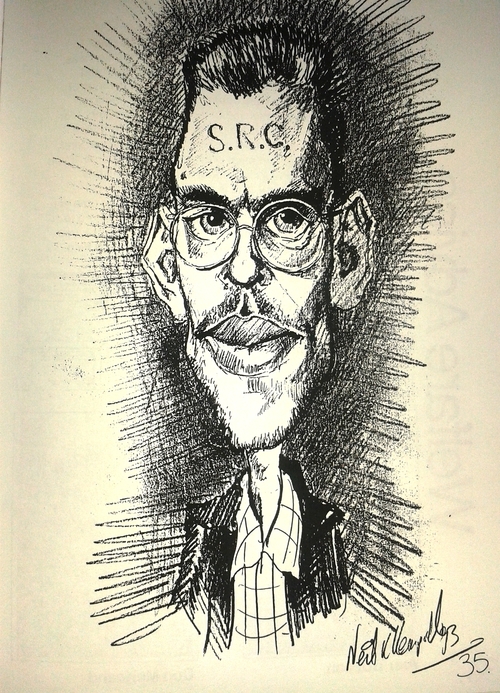
Among them are Graham Dey who was Welfare Officer and music guru at Edinburgh College of Art (ECA) for over 20 years and helped many students. Graham is a great supporter of the ECA archive and provided much advice on events and people at ECA during from the 1980s to the 2000s. Here is a caricature of him from the ECA Student Handbook 1993! (With thanks to the artist, Neil Kempsell).
I also met jeweller Sheila Fleet O.B.E. and her family. Sheila is receiving an honorary degree today and we had a great chat over items in the archive, including photographs where we spotted her and members of the family when at the College. Within the group eight of the family had graduated from the College. Here is Sheila and her sisters Connie, Dorothy and Leila, who studied at ECA, on the staircase in the main building.

Sheila also brought along her College scarf. I had never seen one, so was very excited when she brought it out of her bag!
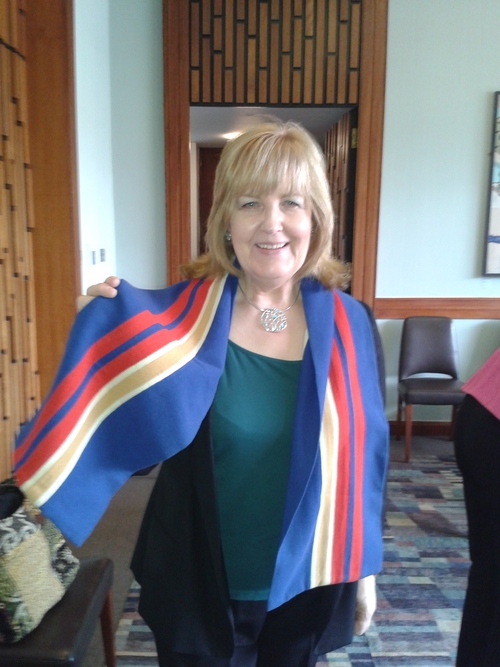
And last but not least our own Emma Smith, who works as Exhibitions Assistant within the Centre For Research Collections. She graduated today with First Class Honours. We’re so proud!!

Congratulations to all! We hope you’ve had a fantastic day!
Rachel Hosker, ECA Archivist
Presentation skills

Lecture notes by Geoffrey Beale illustrating crossing over in Neurospora, 1940s (Coll-1255)
Giving lectures is a prominent aspect of working life for many academics, as the animal genetics archives here at Edinburgh University Library Special Collections show. Most of the collections of scientists’ personal papers contain information relating to academic and public lectures given, and frequently also include copies of the lectures themselves, some dating back as far as the 1940s. This material gives a fascinating insight into how genetics teaching has changed and evolved over the decades, but we don’t always hear about the experience of lecturing from the point of view of the listening students. Anecdotes occasionally survive about teachers who were particularly memorable (for both good and bad reasons!). James Cossar Ewart, Professor of Natural History at the University from 1882-1927, was instrumental in establishing genetics as an academic subject at the University of Edinburgh in the early twentieth century, but his reputation as a lecturer is not quite as gilded. One of his students, Maurice Yonge, remembered that Ewart’s lectures were ‘conducted amid scenes of riot and general pandemonium, Ewart…being unable to control the class. Indeed, at times…so chaotic were the proceedings, that only the movement of Ewart’s large walrus moustache indicated he was still lecturing.’ On the other hand, the first director of the Institute of Animal Genetics, F.A.E. Crew, was a charismatic and inspiring teacher, as his friend and colleague Lancelot Hogben recalled: Read More
A Case for Sensorship
Preventive conservation, and environmental monitoring in particular, is an important part of my job as Conservation Officer at the University. It was for this reason, therefore, that I found myself heading into our storage and exhibition spaces within the Centre for Research Collections, and beyond, to collect up our Hanwell environmental monitoring sensors (all 37 of them) and prepare them for their annual calibration. Although small, these sensors are invaluable in helping us to monitor temperature and relative humidity conditions, and their calibration ensures that the readings are as accurate as possible.
It is impossible to halt the aging process of a material completely. However, environmental conditions during storage and display can greatly affect the rate of aging and the extent of damage, and, therefore, a well-controlled environment can dramatically improve the condition of a collection, and reduce the need for more interventive treatment in the future. Our Hanwell environmental monitoring system provides regular readings, and helps to ensure that the conditions stay within the recommended limits as set out by the British Standard Institution’s document PD 5454:2012 (Guide for the storage and exhibition of archival material) – namely 13°C-20°C and 35%-60% relativity humidity with emphasis placed on stability within these parameters.
Having successfully undergone their yearly check-up, it was just left to place them all back again….

Hanwell Environmental Monitoring Sensors
Collections
 Hill and Adamson Collection: an insight into Edinburgh’s past
My name is Phoebe Kirkland, I am an MSc East Asian Studies student, and for...
Cataloguing the private papers of Archibald Hunter Campbell: A Journey Through Correspondence
My name is Pauline Vincent, I am a student in my last year of a...
Hill and Adamson Collection: an insight into Edinburgh’s past
My name is Phoebe Kirkland, I am an MSc East Asian Studies student, and for...
Cataloguing the private papers of Archibald Hunter Campbell: A Journey Through Correspondence
My name is Pauline Vincent, I am a student in my last year of a...
Projects
Cataloguing the private papers of Archibald Hunter Campbell: A Journey Through Correspondence
My name is Pauline Vincent, I am a student in my last year of a...
Archival Provenance Research Project: Lishan’s Experience
Presentation My name is Lishan Zou, I am a fourth year History and Politics student....