Home University of Edinburgh Library Essentials
April 23, 2026
Oxford Bibliographies – new modules purchased

Our existing Oxford Bibliographies collection has been expanded so we now have access to modules in Buddhism, Chinese Studies, Cinema & Media Studies, Classics, Islamic Studies, Latin American Studies, Medieval Studies, Philosophy, Victorian Literature.
Further information about our databases is available from http://www.ed.ac.uk/schools-departments/information-services/library-museum-gallery/finding-resources/library-databases.
Making the Most of the Intern(et)
Our wonderful Intern Gemma is leaving us today, but she has managed to squeeze in one more post before she goes. Gemma has done some really amazing work for us, after completing her cataloguing project of Oriental Manuscripts (her work can be seen here http://images.is.ed.ac.uk/luna/servlet/UoEsha~4~4 ) in record time, she has helped out with Flickr, Walter Scott and a new project about not yet officially started too. I’d like to say a very big thank you to Gemma for all her hard work- we’re going to miss her! Over to Gemma…

Since I finished my project with the Oriental Manuscripts Collection a few weeks ago (see my blog below for more info https://libraryblogs.is.ed.ac.uk/diu/2014/07/02/discovering-the-orient/#more-931 ), I’ve been working on a few other projects to make the most of my remaining time here at the CRC. Of these, one of my main tasks has been to update the department’s Flickr account (https://www.flickr.com/photos/crcedinburgh/).
Service interruption for ScienceDirect – July 26

The ScienceDirect platform will be unavailable for 30 minutes of scheduled maintenance on Saturday, July 26 from 12:00 BST until 12:30 BST. It is also possible that you may experience service disruptions such as slower response times and unexpected outages throughout the day. Elsevier apologise in advance for any inconvenience.
Festival Concerts
We are looking forward to the last Festival before we close for redevelopment, and the fantastic series of concerts being organised by the Friends of St Cecilia’s Hall. We have five 3 o’clock concerts lined up:
John Kitchen plays the 1678 Garracino virginal (shown above) on 13 August
‘De La Guitarra’: Stephen Morrison and Gordon Ferries play guitar music by Carulli, Beethoven and others on 16 August
The woodwind and keyboard ensemble ‘Arborea Musica’ celebrate Italians in London using the 1764 Hass harpsichord in its 250th year on 20 August
Ksenia Semenova, winner of the 2013 Volkonsky International Harpsichord Competition, plays Bach, Handel and D Scarlatti on 23 August
The Gilbert Elliott Duo explore repertoire for flute and harpsichord from 18th-century Scotland on 27 August
You can also enjoy the Edinburgh Renaissance Band’s Viol Rackett Show.
For more information about the collection and the instruments featured, see http://collections.ed.ac.uk/mimed
For tickets, visit the Edinburgh Festival Fringe website https://www.edfringe.com/
Fairytales & Chivalry at the Centre for Research Collections
When I think of our rare book collections, I tend to think or row upon row of brown, leather bound volumes. This is true for a large part of the collections, but there are also many whose bindings are as bright and vibrant as their contents. This is particularly the case for some turn of the century fiction, c.1899-1900.
This week one of our readers ordered these two beauties to consult in the reading room, which led me to investigate their illustrations further:
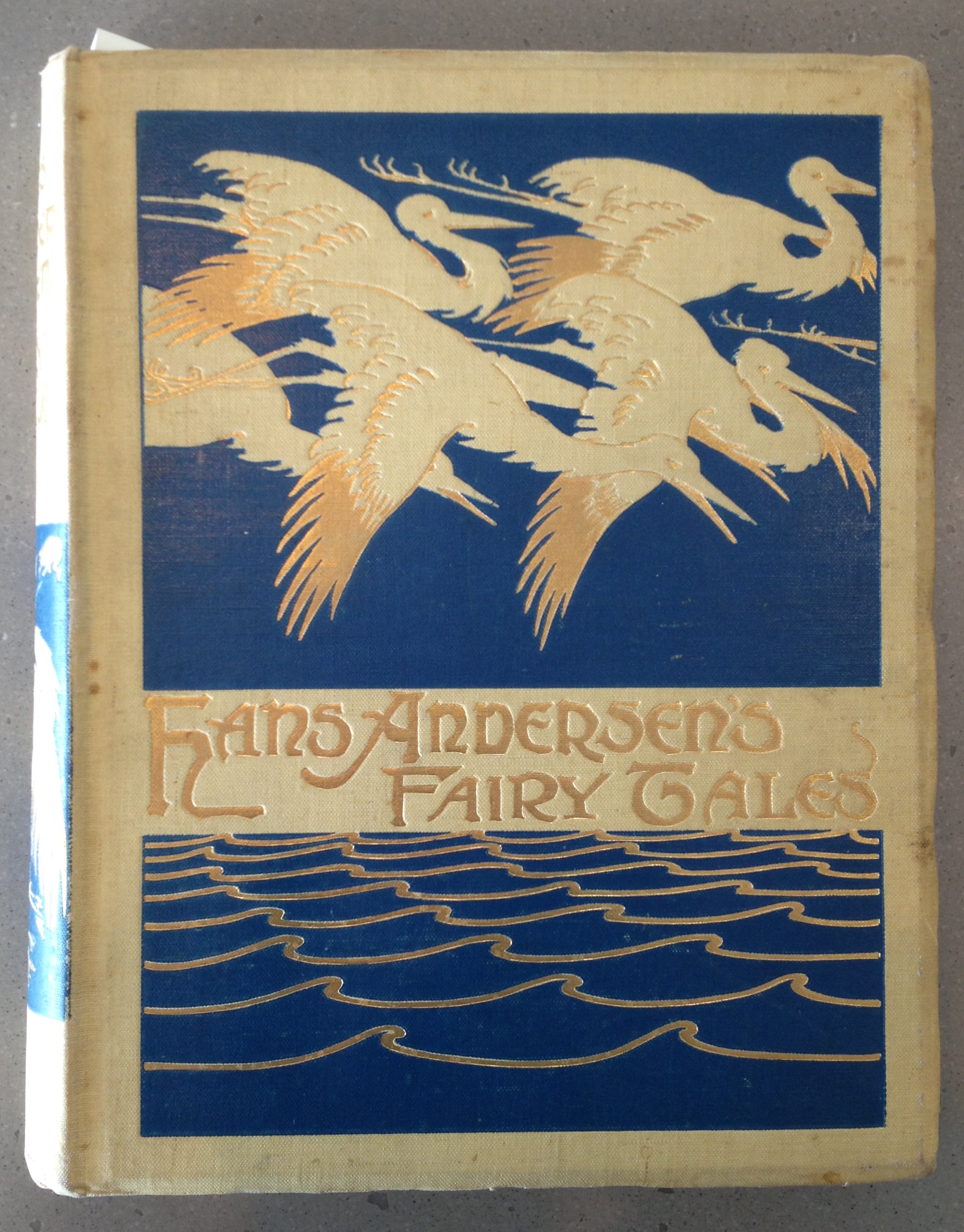
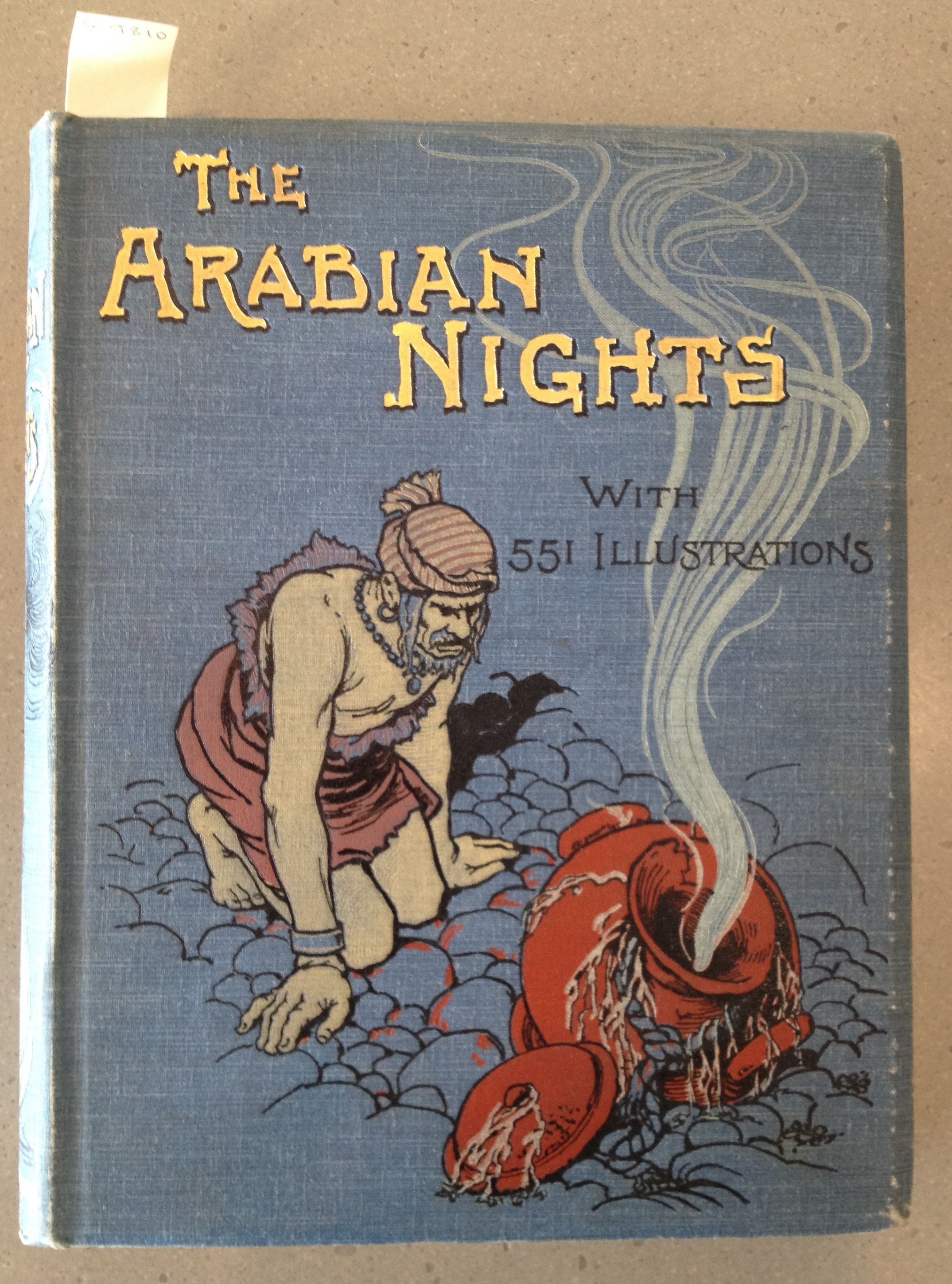
Both books were published in 1899 by George Newnes Ld. The Fairytales of Hans Christian Anderson (shelfmark SC9811) contains over 400 illustrations by Helen Stratton. The Arabian Nights (shelfmark SC9810) is illustrated by a group of artists: Helen Stratton, W. H. Robinson, A.D. McCormick, A.L. Davis and A.E. Norbury.
Very little information can be found about Helen Stratton (1867-1961). The internet yields wildly conflicting information, including one inconclusive suggestion that she studied in Glasgow. However, she was certainly a prolific artist who illustrated books typical of the Arts & Crafts Period, full of mystery and acts of heroism. Searching on the main library catalogue I came across another work featuring her illustrations:
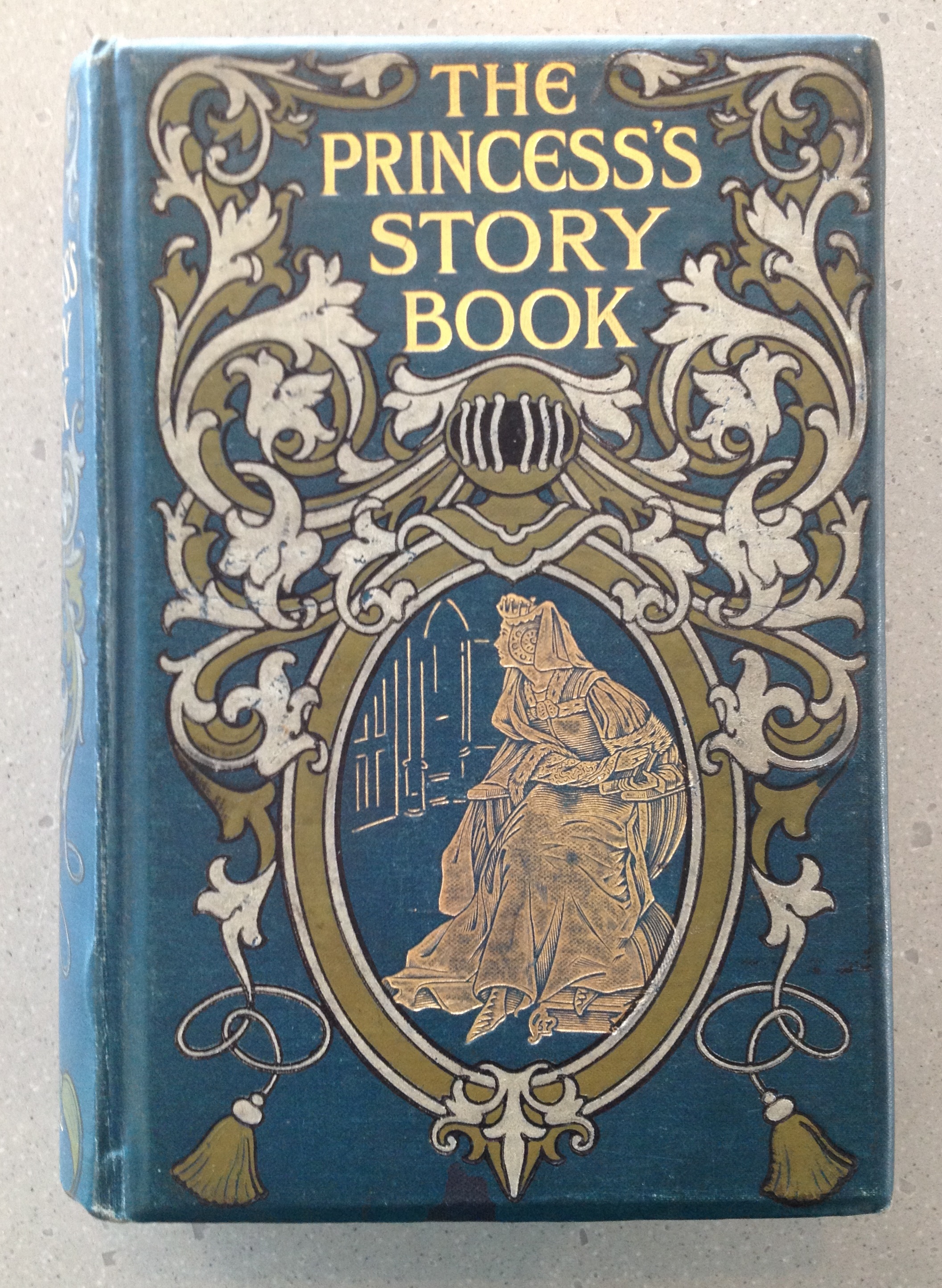
The Princess’s Story Book (shelfmark Corson A.17.GOM.1900) was published in 1900 by Archibald Constable & Co. The book is one of over 7,000 printed items in the Corson Collection of works by and about Sir Walter Scott, purchased by the University in 1975.
The Princess’s Story Book is a collection of short stories, with suitably melodramatic titles: ‘William I: Princesses in the Fighting Line’, ‘Richard I: In Camp and Tent’ and ‘Henry VIII: A Dishonoured Queen’. Even better are the list of illustrations, including: ‘Seating herself on the damp step while the rain descended in torrents upon her’ and ‘Gryme upheaved the silver cross and struck the Norman a blow’.
All of these items can be ordered to consult at the Centre for Research Collections – why not visit and transport yourself to another world of Knights and Bandits, Fairytales and Princesses.
Fran Baseby, Service Delivery Curator, CRC
Music Online – new content added

Music Online has been significantly updated this week with the addition of:
- 4.5 million independent popular music tracks
- 1.4 million world music tracks
- 510,000 American song tracks
- 440,000 classical music tracks
- 740,000 jazz tracks
Music Online Premium Service from Alexander Street Press, provides access to 13 music collections: African American Music Reference; American Song; Classical Music in Video; Classical Music Library; Classical Music Reference Library; Classical Scores Library: Volume I; Classical Scores Library: Volume II; Contemporary World Music; Dance in Video; The Garland Encyclopaedia of World Music Online; Jazz Music Library; Opera in Video; Smithsonian Global Sound(r) for Libraries. It can be accessed via our general A-Z list or our A-Z list for Music e-resources.
Unique World Christianity Collections coming home to New College, Edinburgh
Now we’re in the in the final stages of the Centre for the Studies of World Christianity Library (CSWC) Project, we’re receiving daily deliveries of books to New College Library from the Library Annexe.Nearly 7,500 items have already been reclassified with Library of Congress classmarks, with roughly 2,500 of these set be housed at classmark BV, Practical Theology & Missions. CSWC books can be identified on the library catalogue as “Andrew Walls Library Collection. From the Library of the Centre for the Study of World Christianity, University of Edinburgh. Presented by Professor Andrew Walls, OBE.” All of these items are unique within the University of Edinburgh Library, and I’ve found a number I’ve looked at to be unique in the UK.
I spent time this week looking through a selection of CSWC books that were published before 1900, and selected over 50 to be held in the Special Collections at New College Library. It’s fascinating to see how many titles are about women missionaries, or written by women, reflecting their engagement in the mission activity of this time. Many of these items have attractive pictorial Victorian publishers bindings, such as these books – A White Woman in Central Africa, Daughters of Syria and In Southern India.


Some items in the collection include signatures, such as the two Chinese-English dictionaries signed “Annie Buchan”, evidence that they were used by this missionary to China whose papers are in the care of the CSWC Archive. A number of volumes are signed by Robert Laws, Free Church of Scotland missionary to Livingstonia, Nyasaland (now Malawi), whose diaries are held in New College Library’s Special Collections at MSS LAW.

Christine Love-Rodgers, Academic Support Librarian – Divinity
The Staff Portrait V’s the Selfie
Over the years the Digital Imaging Unit have grown into the role of photographing official Library staff portraits. These images are used by the Library online to identify teams and in publications like the Piper when there is a focus on a department. In general terms the prospect of a staged portrait sends most staff fleeing for the Pentland hills. Some staff point blank refuse using colorful metaphors to explain why they will not do it and certainly most staff are guaranteed to be unhappy with the resulting image. It is without a doubt the least popular aspect of the the work we do in DIU. However most staff accept the formal portrait as a necessary evil a bit like going to the dentist. There are also a minority who are comfortable with the concept. What I have come to realise in this role is that I almost always only have about three shots right at the beginning of the session to capture a reasonable portrait. After those first three clicks the sitters brain goes of to an unusual place and we end up with overly self conscious faces that are beginning to do weird things with their facial muscles resulting in contorted bizarre expressions ending with an uncomfortable grimace. In this dominant age of the selfie I feel there is still a role for an official staged portrait and we don’t need to look any farther than the University of Edinburgh’s historic collection of staff portraits to see why they are an important record of individuals at work. Maybe the staff selfie should replace the staff portrait? Lets discuss………..
Malcolm Brown, Deputy Photographer.
Sport and social sciences: A Commonwealth Games inspired reading list
The 2014 Commonwealth Games start today and we’ve had a look through the wealth of e-books currently available to University staff and students at the Library, to pull together just a small number of titles that look at different aspects of sport related to social and political science.
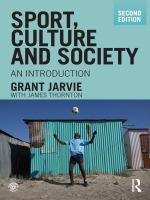 Sport, culture and society: an introduction by Grant Jarvie with James Thornton looks at the place of sport in contemporary society and culture. It argues that sport is part of our social and cultural fabric, possessing a social and commercial power that makes it a potent force in the world, for good and for bad. It looks at how sport has helped to start wars and promote international reconciliation, while every government around the world commits public resources to sport because of its perceived benefits. Read More
Interior Challenge

In the last couple of weeks I have been out to visit both the Reid Musical Instrument Museum and St. Cecilia’s Music Hall to document the buildings prior to a makeover.
The Reid is a particularly challenging location for a photographer: tight spaces with mixed lighting and tall glass cabinets lining the walls and centre of the room. Reflections everywhere. It turns out that this was not a good day to wear my new white top! Read More
Collections
 Hill and Adamson Collection: an insight into Edinburgh’s past
My name is Phoebe Kirkland, I am an MSc East Asian Studies student, and for...
Cataloguing the private papers of Archibald Hunter Campbell: A Journey Through Correspondence
My name is Pauline Vincent, I am a student in my last year of a...
Hill and Adamson Collection: an insight into Edinburgh’s past
My name is Phoebe Kirkland, I am an MSc East Asian Studies student, and for...
Cataloguing the private papers of Archibald Hunter Campbell: A Journey Through Correspondence
My name is Pauline Vincent, I am a student in my last year of a...
Projects
Cataloguing the private papers of Archibald Hunter Campbell: A Journey Through Correspondence
My name is Pauline Vincent, I am a student in my last year of a...
Archival Provenance Research Project: Lishan’s Experience
Presentation My name is Lishan Zou, I am a fourth year History and Politics student....