Home University of Edinburgh Library Essentials
April 5, 2026
Travel back 500 years with rare Hebrew book from New College Library
![Perush ha-Torah / leha-Rav rabenu Mosheh bar Nahman ... [1514]](https://libraryblogs.is.ed.ac.uk/newcollegelibrarian/files/2014/08/Dal-Chr-15ar.jpg)
Perush ha-Torah / leha-Rav rabenu Mosheh bar Nahman … [1514] פירוש התורה / להרב רבינו משה ב״ר נחמן.
This early commentary on the Pentateuch, published in 1514 has travelled all the way to Latvia to be part of the exhibition “1514. The Book. 2014“. On display until April 2015 at the National Library of Latvia, the exhibition includes 80 books published in 1514. Why 1514? The exhibition creators identified 1514 as a year of great change, 60 years after Gutenberg and on the cusp of the Reformation in Europe. The exhibition is “an opportunity to view the European cultural space in terms of a single year”.
The author, of this work, Perush-ha Torah, was Rabbi Moses Ben Nahman or Nahmanides (1195-1270). He was a Spanish rabbi and leading scholar of Talmudic literature in the mediaeval period. This book is just one of the early works of Jewish scholarship in the Dalman-Christie collection of Hebrew books, which was recently catalogued as part of the Funk Cataloguing Projects at New College Library. The Dalman-Christie Collection was transferred to New College Library in 1946 from the Church of Scotland Hospice in Jerusalem.
Christine Love-Rodgers, Academic Support Librarian – Divinity

Ecoinvent – new database
Ecoinvent has been added to our A-Z list of databases and catalogue. Ecoinvent database version 3.1 offers science-based, industrial, international life cycle assessment (LCA) and life cycle management (LCM) data and services. 
Access to this database is via specific user name and password.
Further information about our databases can be found at http://www.ed.ac.uk/schools-departments/information-services/library-museum-gallery/finding-resources/library-databases
Pop up Library
We’re taking over and making over a currently empty area in the Main Library to create a space which gives teams from across Information Services the chance to engage with Library users to promote their services in a fun and informal way and to gather some feedback.
The Pop up Library will run 8th September- 7th November using the currently vacant Main Library 1st floor reception desk.
This is what it looks like at the moment:

We are planning to use the space to hold two Pop Up sessions per day: one morning (10-12pm) and one afternoon (2-4pm).
Sessions will focus on a wide range of topics from across the Library and Information services.
Keep an eye on the Pop Up Library blog to find out what’s happening. You don’t need to make an appointment – just pop over and see what’s happening and have a chat or ask a question.
To give you an idea, there will be sessions on existing services such as, Searcher, Learn and Pebblepad.
Other sessions will focus on Special Collections with the chance for library users to see rare objects up close. Others will give you the opportunity to ask about new services such as Resources Plus, which describes the various options available to users when they can’t find what they want in the Library.
Academic Support Librarians will offer specialised consultancy sessions and Library users will also get a chance to address questions and queries to senior management who will be making themselves available at various points throughout the trial period.

#librarypop
We’re using the Pop up Library blog and #librarypop to promote sessions and are encouraging Library users to tweet about sessions and to leave feedback on the feedback wall- which we’ll be putting up next to the desk- soon.
Angela Laurins, Library Learning Services Manager
Top five library resources for Politics
It’s one month to go until the Scottish Referendum and as Scotland is gearing up to decide its future and politics dominates the news we thought we’d give you a taster of political science resources available to students and staff here at University of Edinburgh Library.
1. Why not have a look at the House of Commons Parliamentary Papers for documents relating to the previous Scottish devolution referendums? The 18th, 19th, 20th and 21st Century House of Commons Parliamentary Papers contains bibliographic records and searchable full text for papers printed between 1688-2004. It also includes Hansard 1803-2005. The collection does not include the House of Commons Journal, or daily business papers, such as Order papers and Votes and Proceedings, nor does it include Acts. You can access this and other relevant databases at databases for Politics. Read More
New E-Book Collections – August
We have recently purchased 3 new e-book collections. The individual titles are in the process of being added to our catalogue but links to the collections are available from the e-book A-Z list.
Access Engineering
Access Engineering provides access to over 200 engineering reference sources; 5,000 interactive graphs and downloadable tables and charts; personalization tools; instructional videos. Includes Perry’s Chemical Engineers Handbook, Marks Standard Handbook for Mechanical Engineers, Roark’s Formulas for Stress and Strain, Standard Handbook for Electrical Engineers.
Casalini e-books package
The Casalini full text platform (Torrossa) provides access to a selection of 1,867 scholarly e-books from Italian and Spanish academic publishers since 2000 for Edinburgh University  users. The collection consists of 1,188 titles on Italian studies and Italian literature and 679 titles on Spanish studies. The books are in Italian or Spanish and can be either downloaded or viewed online in PDF format (it is necessary to disable pop-up blockers on your web browser and also in your Google tool bar if applicable). The e-book collection is fully searchable, including by words in the full text. Click here to get a full list of the e-book titles.
Wageningen Academic Publishers
We now have access to the e-books published between 2002 and 2014 on the Wageningen Academic Publishers platform. Main subject areas include Animal & Veterinary Science, Environmental & Plant Science, Food Science and Social Science.
Further info
Further information about our e-books is available from http://www.ed.ac.uk/schools-departments/information-services/library-museum-gallery/finding-resources/resource-types/ebooks
Art Collections go hi-res!
The launch of the collections.ed.ac.uk public interface in May was a big success story in itself, but a bullet point below this was that it featured the first ever web delivered front-end for the University’s rich and diverse Art Collections. We’ve since gone one better; using the LUNA imaging platform, we can now present the best of the Art Collections in high resolution.
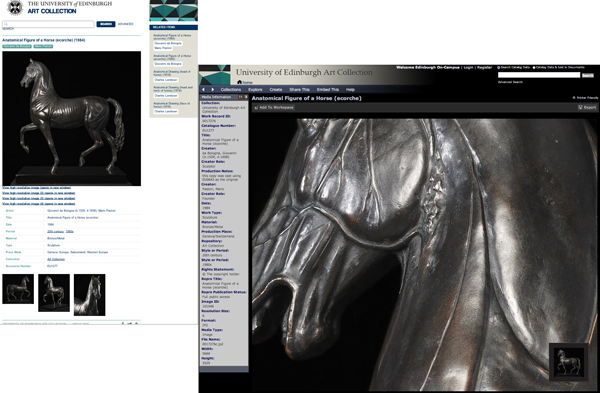
We’ve been able to harness photography from the Public Catalogue Foundation for both the University and the ECA, as well as a number of items from our own DIU, to surface 742 quality, zoomable images. The collection is browsable here, but importantly, the items are also linked back to their item records on collections.ed.ac.uk (simply click wherever you see “View high resolution image”- for example here). It’s important to us that the two systems complement and communicate with one another, and we have decided to use this functionality for the Calendars, and upcoming Exhibitions, collections also. I should mention, too, that we did consider the possibility of embedding the LUNA image directly into the collections.ed.ac.uk page, but after some deliberation, we decided that this solution was cleaner.
The other piece of good news about the Art Collections’ discoverability is that we have enriched the collections.ed.ac.uk set with a further 300 items, and 800 images (a lot of these are jpegs, which are generally not considered of sufficient quality for LUNA), to take us to over 3000 items and 1400 images. You can find them all at our site, and we look forward to taking advantage of further accessions and photography to make the collections ever more fascinating and inspiring online.
Thanks to the collections’ custodians (Neil Lebeter, Jill Forrest and Anna Hawkins) for all of their contributions to this piece of work.
Scott Renton, Digital Development
Edinburgh supports trial data publication
I recently read in a Sense about Science tweet that a lone student asked the Principal of the University of Edinburgh if it would join the AllTrials Campaign and it became the first Scottish University to do so. Here’s his story – [Editor]
As a Nurse I frequently talk with patients about the treatments and medications they receive. These are often difficult conversations as it relies on the clinician having a library of background knowledge coupled with the most up-to-date data. Despite the wealth of knowledge that exists within the medical community there is an increasing body of research that highlights the large amount of clinical trial data that has gone unshared for many decades. This is the origin of the AllTrials campaign.

The best estimate is that around half of clinical trials have never been published. Recognising the need for change a group of academics founded AllTrials. AllTrials is an initiative headed by leading academic bodies such as the British Medical Journal, the Oxford Centre for Evidence-based Medicine and the Cochrane Collaboration. AllTrials calls for all past and present clinical trials to be registered and their full methods and summary results reported.
As a Nursing graduate of The University of Edinburgh and a current masters student within the Nursing department I felt I should engage with my University about the issue of clinical trial data sharing and about the AllTrials campaign. I wrote to Professor Sir Timothy O’Shea, the Principal of the University, who gave his support for AllTrials. As of July 2014 The University of Edinburgh became the first Scottish University to register its support for AllTrials. This move is inherently positive for Edinburgh, both as a global leader in health care and as an institution with a longstanding Edinburgh Data Library history. The campaign has had nearly 80,000 people sign its petition as well as just under 500 organisations register support.
This is an issue important issue for all of us. Show your support by signing the AllTrials petition.
Adam Lloyd
Nurse
Masters of Nursing in Clinical Research student
The University of Edinburgh
The views expressed are my own and do not reflect the views of The University of Edinburgh, the AllTrials campaign or any of its affiliates.
2015 Calendar: Images from the David Laing Collection
The new Library and University Collections Calendar, 2015: Images from the David Laing Collection, is now available to buy online and from a number of locations across the University.
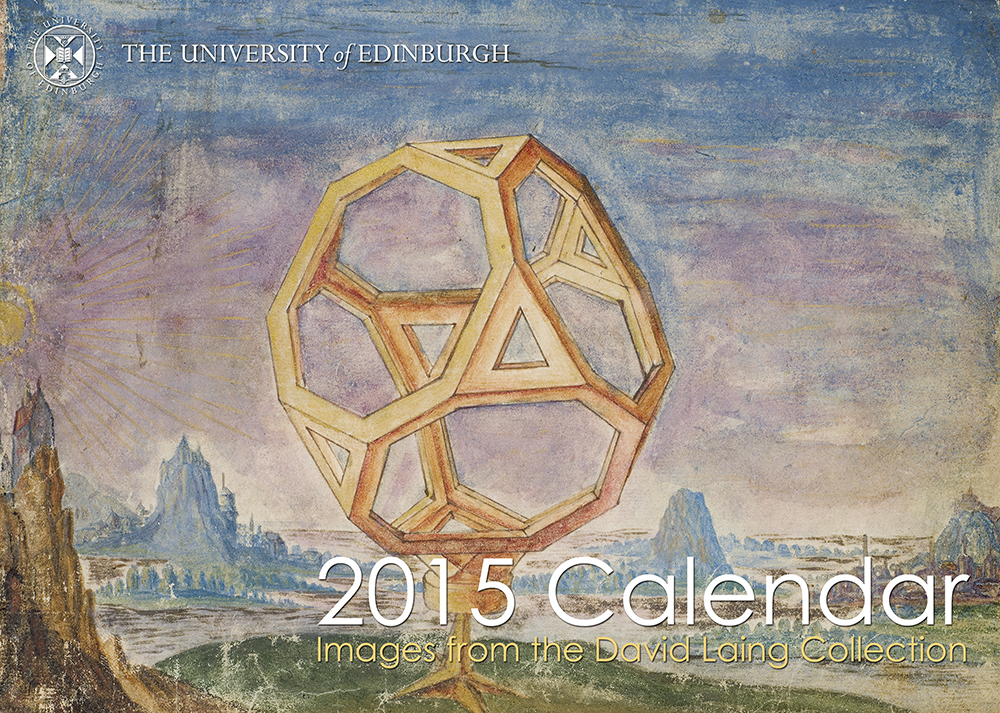
Featuring newly-surfaced images from the David Laing Collection, including a 16th century petition to the Pope, a burgess ticket from the town of Rutherglen and a stunning gold leaf manuscript fragment from the Darien scheme’s first expedition in 1698, the calendar showcases why the collection is considered one of the jewels in the Library’s crown. To view the images online, visit www.collections.ed.ac.uk/calendars.
Priced £8 and spanning a fifteen month period from October 2014 to December 2015, the calendar can be purchased online at http://www.giftshop.ed.ac.uk/2015-Calendar.html and in person from the Visitor Centre, the Centre for Research Collections and the Main Library helpdesk.
This small collection of images is only the tip of the iceberg: the David Laing Collection includes approximately half a million individual documents and, because of its size, much of the content remains uncatalogued and therefore largely undiscovered. The Library is seeking funds in order to apply modern archival and preservation methods to make the papers available to a worldwide audience: if you are interested in supporting our work to conserve and preserve the entire collection, please email laingcollection@ed.ac.uk.
Policies, Postcards and Prophylactics: Conserving Lothian Health Services Archive’s UNESCO-awarded HIV/AIDS Collections (1983-2010)
My name is Emily and I am Project Conservator at Lothian Health Services Archive. LHSA is based at the Centre for Research Collections, where we share a conservation studio with Emma Davey, Conservation Officer for the CRC, and two private conservators.
Lothian Health Services Archive holds the historically important local records of NHS hospitals and other health-related material. I am currently working on a 12-month Wellcome Trust-funded project to conserve LHSA’s HIV/AIDS collections. This material documents the social and medical response to the HIV/AIDS epidemic in Edinburgh and the Lothians from 1983 to 2010. The first suspected case of HIV/AIDS in Scotland was discovered in Edinburgh in 1983. The infection rate in the city steadily grew and by 1989 it was seven times higher than the national average, which led to Edinburgh being dubbed the “AIDS capital of Europe” in the national press. This is material of vital importance which comprehensively documents an important part of medical history. In 2011 the collections were inscribed to the UNESCO UK Memory of the World Register which emphasises its importance to national documentary heritage.
The collections are made up of a variety of media, mostly loose paper documents, leaflets and postcards but also badges, stickers, photographs, 35mm slides and canvas and plastic bags, as well as rubber and latex items such as condoms and balloons.

An example of the diverse range of materials found in the HIV/AIDS collections.
Many people assume that modern collections such as this do not require conservation, however this is not the case, and there are already items in this collection that are severely damaged. For example, previous storage has led to planar distortion, creasing, tearing and the accumulation of surface dirt on paper documents. Low quality materials used in paper making has also resulted in deterioration of paper sheets.

Paper documents in the HIV/AIDS collections. Plastic paper clips causing planar distortion of the sheets.
Damage to other items is often due to the inherent nature of the object. For example, rubber items such as the balloons have become brittle due to loss of plasticiser and objects have become stuck together due to the migration of adhesives.

A balloon from the HIV/AIDS collections. Loss of plasticiser has caused the balloon to become very brittle.
There is also a collection of digital media such as 3.5” floppy disks, VHS, audio cassette tapes and film reels which have been transferred to modern storage facilities to avoid loss of information due to obsolescence of the viewing equipment.

A screen shot from a video in the HIV/AIDS collection. Shows loss of image quality.
In this project, conservation of paper materials mainly involves the re-housing of paper items in acid-free folders and boxes and carrying out basic conservation treatment such as surface cleaning, tear repair and flattening if needed. Conservation of non-paper materials mainly focuses on re-housing the objects in appropriate archival storage, rather than on interventive treatment.
I really enjoy working with this diverse range of material in this collection. When I graduated last year specialising in paper conservation, I never thought I would be working with such modern materials. So since starting here, I’ve had to research plastic conservation and digitisation methods and develop new ways of storing modern objects with paper collections, which I’ve found challenging and fun! With more and more modern materials becoming deposited in archives, I believe skills gained in this project will be really useful in the future, and I’m glad I’ve had the opportunity to work with such a varied and interesting collection.
If you’d like to find out more about this project and the conservation of modern materials, please visit our blog.
Emily Hick Project Conservator Lothian Health Services Archive Emily.Hick@ed.ac.uk
SAE Technical Papers – new e-resource
The Library now subscribes to the full collection of SAE Technical Papers available within the SAE Digital Library. This provides access to over 90,000 technical papers from the Society of Automotive Engineers, ranging from 1906 to the present day. Papers are available in the fields of design engineering, aerospace  engineering, advanced materials, power and propulsion, transportation, tests and testing, fuels, energy sources, safety etc.
A full list of our databases is available at http://www.ed.ac.uk/schools-departments/information-services/library-museum-gallery/finding-resources/library-databases/databases-a-z
Collections
 Hill and Adamson Collection: an insight into Edinburgh’s past
My name is Phoebe Kirkland, I am an MSc East Asian Studies student, and for...
Cataloguing the private papers of Archibald Hunter Campbell: A Journey Through Correspondence
My name is Pauline Vincent, I am a student in my last year of a...
Hill and Adamson Collection: an insight into Edinburgh’s past
My name is Phoebe Kirkland, I am an MSc East Asian Studies student, and for...
Cataloguing the private papers of Archibald Hunter Campbell: A Journey Through Correspondence
My name is Pauline Vincent, I am a student in my last year of a...
Projects
Cataloguing the private papers of Archibald Hunter Campbell: A Journey Through Correspondence
My name is Pauline Vincent, I am a student in my last year of a...
Archival Provenance Research Project: Lishan’s Experience
Presentation My name is Lishan Zou, I am a fourth year History and Politics student....