Home University of Edinburgh Library Essentials
April 5, 2026
Metadata Fun and Games

Earlier this week we ran a 1980s-inspired crowdsourcing ‘Metadata Game’ to enhance the description of items within our online image collection http://images.is.ed.ac.uk. The good folk of Library and University Collections rallied to the cause and ten hardy volunteers surrendered their lunch breaks to take part in the session, sustained only by coffee, biscuits and a will to succeed.
Each participant was provided with a series of random images and received one ‘crowdsourcing point’ for every person, object or location they tagged. Can you spot a familiar face in one of the randomly-generated images below?

Once the tagging was complete, the group then moderated the submitted terms and further points were awarded for approved tags. In the course of the session, 264 images were tagged a total of 631 times and, although time ran out during the moderation phase because of issues with load on the software, we learned a lot about the programme and received useful feedback for future sessions.
Norman Rodger from the Projects & Innovations team ran out the clear winner on this occasion, with 221 points, but he was pushed all the way by Sandi Phillips and Clare Button, who finished second and third with 155 and 146 points respectively.
We’ll be setting up the game again at the Pop Up Library during Freshers’ Week so come along and find us if you’re interested in having a go for yourself! Or if you’re anxious to have a shot now, please email gavin.willshaw@ed.ac.uk or scott.renton@ed.ac.uk and we’d be happy to send you the link. Maybe you can even set a new high score…
Anatomy & Physiology Online – new e-resource

Anatomy & Physiology Online (Primal Pictures) has now been added to our A-Z list and will appear on our catalogue soon. Anatomy & Physiology Online provides 20 interactive modules on human anatomy and physiology, with 3D images, animations, audio, text articles, case studies and quizzes.
Past Politics : Pamphlets from an independent Scotland
New College Library’s Pamphlets Collection of over 30,000 items captures the issues and debates from the seventeenth century onwards. Now on display in the New College Library entrance are just a few of the pamphlets that take up the debate over the Treaty of Union that was agreed between the two separate countries on 22 July 1706. This led to the Union with England Act, passed in 1 May 1707, by the Parliament of Scotland.
All these items were catalogued as part of the Funk Donation Projects, supported by the generous donation of Rev. Dr Robert Funk. 
Hodges, James
The rights and interests of the two British monarchies inquir’d into and clear’d : with a special respect to an united or separate state. Treatise I. Shewing the different nature of an incorporating and federal union ; the reasons why all designs of union have hitherto prov’d unsuccessful ; and the inconsistency of an union by incorporation with the rights, liberties, national interests, and publick good of both kingdoms. Edinburgh : Re-printed by John Reid for James Donaldson, and are to be sold at the Caledonia Coffee-House, 1703.
New College Library W.d. 1/7

Defoe, Daniel
An essay at removing national prejudices against a union with Scotland : to be continued. Part I. Edinburgh : [s.n.], 1706. Published anonymously by Daniel Defoe.
New College Library W.d 1/4

Anon
The smoaking flax unquenchable : where the union betwixt the two kingdoms is dissecated, anatomized, confuted and anuuled. Also that good form and fabrick of civil gobernment, intended and espoused by the true subjects of the land, is illustrated and held out.
[Edinburgh : s.n.], Printed in the year 1706.
New College Library W.d. 1/15
Christine Love-Rodgers, Academic Support Librarian – Divinity
How I learned to Stop Worrying and Love the Archive
By Vanessa Johnson, conservation trainee and armchair physicist
Well, it’s been six weeks and I’ve survived! Although if archives could kill, the repository of world knowledge would go untapped and we’d be living lives of stone-age simplicity and struggle. Fortunately, archives are relatively harmless and very interesting! They’ve been especially so given their almost unlimited capacity for dirt and equally terrible capacity for retaining said dirt when faced with a tool as effective as a chemical sponge. Upon arriving at the University of Edinburgh’s conservation department for my 6-week placement, I was assigned the task of cleaning and rehousing correspondence from the archives dating from the 1930’s and 1940’s. The task was large but I was up to it! Using the previously mentioned chemical sponges, I wiped away surface dirt and placed the letters in new folders and boxes that were acid-free and sure to preserve them for future use. The old boxes had been rather ill-suited to the task and were glad to be relieved of the burden of keeping so many letters safe.

Library correspondence was originally housed in these beauties. Observe the sooty border along the bottom edge of the orange sheet. The clean area was protected by library correspondence.

Letters were cleaned and rehoused in nice grey, acid-free folders and then in archival boxes. I think they will be much happier there.
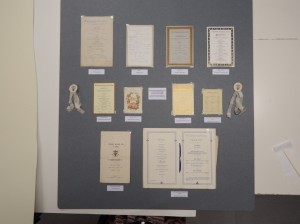
- The display of menus for the Holyrood event, most sufficient I’m told!

My duties extended beyond rehousing archival materials, though. In the second week, a University Club of London event was hosted at Holyrood Palace and a display of past menus was requested. These menus were from their archive held by The University of Edinburgh, retained from such distant times as 1878 and 1913, years whose existence can be verified largely through such archival relics. I mounted the menus on a board with labels and sent it off to Holyrood to be admired by the guests. I assume this is exactly what happened as I was not informed of any serious disappointment on anyone’s part regarding my attempts. Whew!
While I plugged away at my correspondence rehousing, a huge box arrived full of damaged architectural plans! My favourite! I do have a soft spot for repairing maps and architectural plans, as they are often very well-made and beautiful. The first step was to create condition reports and treatment proposals for all 56 plans. I had learned to write these in my course at Northumbria University, though they were often 10+ pages and full of information gathered by photographing pieces in the dark with only UV lights on. This was highly impractical for the current project, so I created a spreadsheet with every piece listed, a lettering system for conditions (A – pretty good!, B – Some tears, not too bad, C – Emergency intervention needed! Something to that effect…) and included treatment recommendations in my lettering system. This meant that it took MUCH less time to plan my attack.
Once this was done, it was time to bring these plans back to life! I started with a C, something that was extremely dirty and had a tear going almost all the way across. Though it took ages, I finished the repair in the few days. I soon developed a system of overlapping tasks, repairing tears while simultaneously surface cleaning a piece. There’s a lot of waiting when repairing tears, so this worked out well. In a little over a week, I was able to complete 5 plans.

Plan before any treatment. The giant rip made the plan a bit difficult to handle, as did the profusion of surface dirt.
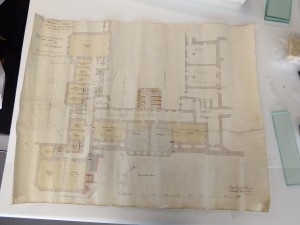
Plan after treatment. What was once torn asunder is made whole again!
So many plans with so many problems! Some were in pieces, some had large, degraded holes in them, while others were just extremely dirty. Regardless! They were all treated and brought up to a level of stability and usability. After treating them, I rolled them together with interleaving sheets of acid-free tissue and stored them in an archival box. A label was placed on the outside of the box and the treatment was complete!
I was back to my correspondence and plugging along when what should happen but a textile rehousing workshop! While I’m primarily a paper conservator, I have every interest in rounding out my skills and learning whatever I can about all aspects of conservation. Plus, this workshop seemed to deal with folder making, which, as a paper conservator, I felt particularly able to do. Little did I know that these folders were very time consuming to make! Tuula Pardoe, a textile conservator from the Scottish Conservation Studio at Hopetoun House, wowed us by showing us these beautiful, elegant folders with padded cloth interiors which would hold onto and protect any textiles in the folder. They were gorgeous and I needed to make one! The rest of the day was spent cutting board, ironing fabric and padding the interior of my custom-made folder which would house a textile from the library’s collection. It was tough but the results were worth it and Tuula was a great teacher.
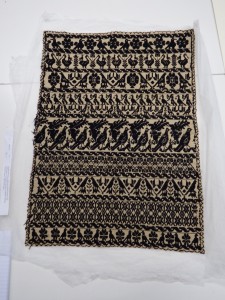
The textile! I chose this one because of its gorgeous, rectangular shape. It seemed well-suited to a folder.

After a day spent slaving away, my folder is nearly done! After that central linen tape dries, I can consider my rehousing project complete!
After folder making, I realized the clock was ticking. I had lots and lots of writing to do and not much time left to do it! In addition to an environmental monitoring report I had been requested to write, I had a blog post to write, a science fair booth to plan, a power point to prepare and photos to sort out! Gah! The environmental monitoring report was almost done, thankfully, and involved analysing data from an exhibit space. Certain materials have a tendency to leave the physical plane when exposed to conditions which are not within an acceptable range, so it was vitally important that the space did not fall outside of that range. We don’t want to lose archival materials to the environment! Nature is truly a harsh mistress.

Conservation is hilarious! But serious. Laughter is the best medicine for accidentally tearing your mock-up, and then repairing it like a pro.
In the midst of this writing bonanza, a teaching opportunity came out of nowhere and set itself up right in the conservation studio! Well, I suppose I’d known about it for some time, but in the hectic last week of work, it did come at a very busy time. Like all things potentially stressful, this day, which was a conservation taster day, proved to be fun instead! Emma, Emily and I taught some eager volunteers about the joys and pitfalls of the world of conservation. They were introduced to ethical issues, conservation techniques, and had questions answered such as ‘Why do conservators work so hard to prevent nature from getting closer to paper?’ Bugs, that’s why. The studio was a mess and we all had a good time repairing mock-ups that were surprisingly difficult to clean (sorry, volunteers) and very easy to tear (sorry, volunteers). They made a great job of it anyway and hopefully left feeling like they understood this strange world of paper conservation.
Finally, after all is done, it’s time to plan for the Midlothian Science Fair, a lovely place where families learn how science fits snugly into many, many professions. I was gifted the task of preparing a booth that was clear and relatable yet not so technical that it would alienate people. Well….this was tough. I LOOOVE getting real in-depth in my science explorations so I had to come up with something that a non-nerd would really enjoy. If Bill Nye is any indication, that sort of fun-for-the-family, completely relatable science is practically everywhere and I found just such a science concept in the technical examination of paper. That sounds horrible, I know, but stick with me!

Watercolour pigments fluorescing in UV light. From my personal photos.
If you’ve ever been around an ultraviolet light, you know that sometimes your white t-shirt glows or your Day-Glo nail polish. Well, conservators, in our wisdom, will sometimes place pieces of art with unknown pigments in just such a light to see what glows and what does not. Depending on what we see, we can usually come to a conclusion about what a pigment is made of (or at least narrow down the possibilities a bit). This gave me the idea for my science fair booth! Kids could make art, look at it in UV (with protective goggles! I ain’t no slouch about the ol’ H&S) and learn a little about chemistry and physics! Hurrah!
So! Idea is in hand, planning plugging along, all is well! I must say, the past 6 weeks have been busy! After everything though, I’m left feeling happy to have had such a wide range of experiences and a bit sad that I can’t finish rehousing all that correspondence. There really is a lot! Hopefully a future conservator can pick up where I left off and learn to love the archive too.
University of Edinburgh’s Yr 1 RCUK Compliance Report Complete
The Scholarly Communications Team at Edinburgh University Library have just submitted their end-of-year-one report to RCUK. This details how “compliant” we think we are with RCUK’s Open Access policy. We know that we have far to go, and that there is still much to do, but our current Open Access rates for RCUK-funded journal articles and conference proceedings is running at 64%. There *are* a number of caveats to that figure, but having looked at a range of data samples and reports we feel that it is a representative figure that we are happy to stand by.
So, that puts us ahead of the year 1 target of a minimum of 45% compliance, but there is much more to do over the course of year 2! Firstly, we need to see this rate increase further, and we need to ensure that all the details of the policy are being adhered to in every single case – (compliance with data requirements, correct acknowledgement of funder, correct CC-BY licence etc). Perhaps our biggest challenge over the next year is learning from our relative success here and stepping it up to cover ALL journal articles and conference proceedings in anticipation of the new requirements for REF. This is going to be a major challenge, but one we are ready to get stuck in to!
Well done to the Scholarly Communications Team and all the Publications Assistants who have helped contribute to this success. Our full report is available at https://www.era.lib.ed.ac.uk/handle/1842/9386.
Dominic Tate, University of Edinburgh
SAGE Research Methods – new e-resource

We now subscribe to SAGE Research Methods. This provides access to 700+ e-books, encyclopaedias, videos and journal articles. SAGE Research Methods supports beginning and advanced researchers in every step of a research project, from writing a research question, choosing a method, gathering and analyzing data, to writing up and publishing the findings. With information on the full range of qualitative, quantitative, and mixed methods for the social and behavioral sciences, as well as many methods commonly used in the hard sciences, the book, reference, and journal content in SAGE Research Methods help researchers of all levels conduct their research.
A list of the individual e-books, reference works and videos can be accessed here and are in the process of being added to our catalogue.
SAGE Research Methods has been added to both our database A-Z list and e-books A-Z list.
Upcoming Dealing with Data Conference and RDM Service Launch
The Edinburgh RDM team is a-buzz this week with preparations for the launch of our services, which will be carried out by the University’s Principal, Sir Timothy O’Shea in the Library next Tuesday morning, 26th August, 2014 with 120 stakeholders in attendance.
 Although the RDM Policy was passed by the University Court in May, 2011, and our RDM Roadmap work began in earnest in August 2012, it has taken until now to be sure our core services are ready for a formal launch. See this post by the RDM Services Coordinator for a recent snapshot of Roadmap progress.
The launch will be short and sweet–lasting no more than half an hour. But the event is enhanced by a mini-conference, featuring researchers discussing Dealing with Data from across the disciplinary spectrum. If they mention any of our services that will be a bonus for us! The programme is available now, and a summary will be posted after the event.
For those who want to follow live tweets, the hashtag will be #DWD2014. For those who attend, be sure and fill out the feedback form at https://www.survey.ed.ac.uk/dealing_data-feedback!
Robin Rice on behalf of Cuna Ekmekcioglu (RDM team)
Emerald Insight – platform upgrade

Emerald Insight have completed their platform upgrade work this week. Prompted by customer feedback, this has resulted in:
- Increased discoverability – thanks to enriched metadata and search engine optimization
- Improved usability – due to simplification of the administration area and alignment with other academic publisher platforms
- Enhanced search – as a result of advanced filter capabilities
- Industry standard categorization – because of redefined subject taxonomies
- Heightened security – owing to the implementation of latest access and security protocols
- Plus an extended range of author and editor services, including downloads of published research and access to historic publication events such as citations in other publications
We have access to over 190 e-journals on the Emerald Insight platform, the titles are listed in our e-journal A-Z list and in the library catalogue.
Scottish Government Yearbooks now available online
 The Scottish Government Yearbooks, which were published by the University of Edinburgh’s ‘Unit for the Study of Government in Scotland’ between 1976 and 1992, are now freely available online for the first time in a digital archive. With the Scottish Referendum fast approaching this archive offers a fascinating insight into a key period in Scotland’s social and political development.
You can access the Scottish Government Yearbooks at http://www.scottishgovernmentyearbooks.ed.ac.uk/ The archive was constructed by the Institute of Governance, successor to the Unit for the Study of Government in Scotland, and was developed by the University of Edinburgh’s Library Digital Development Team. The Archive was supported by funds from the University of Edinburgh’s School of Social & Political Science, and by the assistance of the University’s Library and University Collections.
Caroline Stirling – Academic Support Librarian for Social and Political Science.
Peace Research Abstracts – new database
Peace Research Abstracts has recently been added to our database A-Z list and catalogue. See the SPS Librarian blog for full details of this new database.
Collections
 Hill and Adamson Collection: an insight into Edinburgh’s past
My name is Phoebe Kirkland, I am an MSc East Asian Studies student, and for...
Cataloguing the private papers of Archibald Hunter Campbell: A Journey Through Correspondence
My name is Pauline Vincent, I am a student in my last year of a...
Hill and Adamson Collection: an insight into Edinburgh’s past
My name is Phoebe Kirkland, I am an MSc East Asian Studies student, and for...
Cataloguing the private papers of Archibald Hunter Campbell: A Journey Through Correspondence
My name is Pauline Vincent, I am a student in my last year of a...
Projects
Cataloguing the private papers of Archibald Hunter Campbell: A Journey Through Correspondence
My name is Pauline Vincent, I am a student in my last year of a...
Archival Provenance Research Project: Lishan’s Experience
Presentation My name is Lishan Zou, I am a fourth year History and Politics student....