Home University of Edinburgh Library Essentials
April 4, 2026
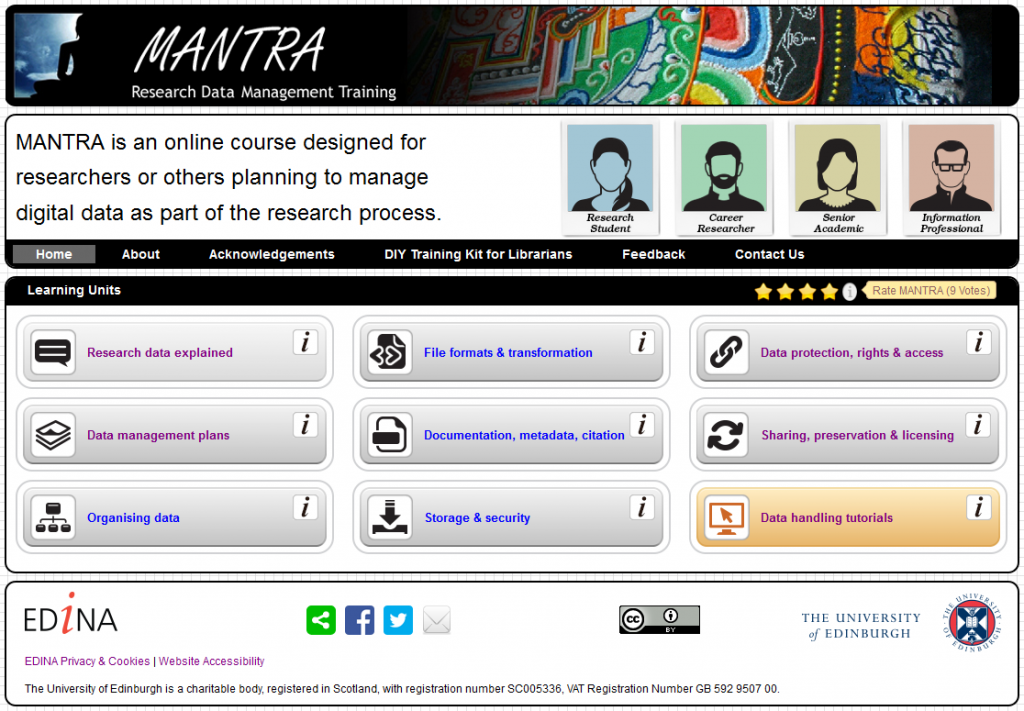
The Research Data MANTRA course is an open, online training course that provides instruction in good practice in research data management. There are nine interactive learning units on key topics such as data management planning, organising and formatting data, using shared data and licensing your own data, as well as four data handling tutorials with open datasets for use in R, SPSS, NVivo and ArcGIS.
This fourth release of MANTRA has been revised and systematically updated with new content, videos, reading lists, and interactive quizzes. Three of the data handling tutorials have been rewritten and tested for newer software versions too.
New content in the online learning modules with the September, 2014 release:
This release will also be more stable and more accessible due to back-end enhancements. The flow of the learning units and usability of quizzes have been improved based on testing and feedback. We have simplified our feedback form and added a four-star rating button to the home page. A YouTube playlist for each unit is available on the Data Library channel.
MANTRA was originally created with funding from Jisc and is maintained by EDINA and Data Library, a division of Information Services, University of Edinburgh. It is an integral part of the University’s Research Data Management Programme and is designed to be modular and self-paced for maximum convenience; it is a non-assessed training course targeted at postgraduate research students and early career researchers.
Data management skills enable researchers to better organise, document, store and share data, making research more reproducible and preserving it for future use. Researchers in 144 countries used MANTRA last year, which is available without registration from the website. Postgraduate training organisations in the UK, Canada, and Australia have used the Creative Commons licensed material in the Jorum repository to create their own training. The website also hosts a ‘training kit’ for librarians wishing to increase their skills in supporting Research Data Management.
Visit MANTRA and consider recommending it to your colleagues and research students this term! http://datalib.edina.ac.uk/mantra/
According to Google Analytics, the following organisation’s websites were the top ten referrers to the MANTRA website for the academic year 2013-2014 (discounting Data Library, EDINA and Information Services):
Social media sites Facebook, Twitter and Slideshare provided a large number of referrals; several more came from other UK institutions, and HEIs in Australia, the rest of Europe, and North America—University Library pages especially. Forty percent of sessions came from a referring website.
Visitors to MANTRA over the year came from 144 countries. Google searches accounted for 4,000 sessions, 25% of the total. Nearly ten thousand visits were from new users (based on IP addresses) over the year from 22nd August, 2013 – 23rd August, 2014. Here is a link to a Google Analytics summary spreadsheet extracted from our account.
We expect to have more detailed usage statistics over the forthcoming year due to moving the learning units out of the authoring software (Xerte Online Toolkits) onto the main MANTRA website.
Postscript, 15 Sept: See my Storify story, “Research Data MANTRA Buzz” to find out who’s been talking about MANTRA on twitter!
Robin Rice
Data Librarian
We have purchased the Congressional Record database from ProQuest.
ProQuest Congressional is a comprehensive online collection of primary source congressional publications and legislative research materials covering all topics, including government, current events, politics, economics, business, science and technology, international relations, social issues, finance, insurance, and medicine. Finding aid for congressional hearings, committee prints, committee reports and documents from 1970-present, and the daily Congressional Record from 1985-present. Compiled legislative histories from 1969-present.
The database has been added to our A-Z list and our History A-Z list and will appear on the catalogue soon.
Further information about our databases is available from http://www.ed.ac.uk/schools-departments/information-services/library-museum-gallery/finding-resources/library-databases.

We have trial access to 3 e-books on the Oxford Medicine Online platform ending on 2nd October:
We are interested to know what you think of these e-books or using this platform as your comments influence purchase decisions so please do fill out our feedback form.
A list of all trials currently available to University of Edinburgh staff and students can be found on our trials webpage.
We have increased the coverage available in our Compendex and Inspec databases which are hosted on the Engineering Village platform.
Previously we only had access to the archive content of the databases, now our access is to all available records.
Further information about our databases is available from http://www.ed.ac.uk/schools-departments/information-services/library-museum-gallery/finding-resources/library-databases.
Last week I was privileged to attend the CILIP Rare Books and Special Collections conference at the Sir Duncan Rice Library at Aberdeen University. I was able to take a poster about the Funk Donation Projects at New College Library, which fitted well with the theme of buildings and refurbishment projects for Special Collections.
I began the conference with a visit I’d arranged to Christ’s College Library, Aberdeen, thanks to the College Administrator, a New College alumnus. In the course of the Centre for World Christianity Library project that I’ve been working on over the summer, I’ve come across a number of books marked Christ’s College Library Aberdeen, so I was keen to see this Divinity library. The last remaining departmental Library at the University of Aberdeen, it’s supported by the Church of Scotland to provide books for undergraduate students of Divinity. The beautiful nineteenth century library environment also provides a setting for seminars and events for Christ’s College, which has a historic role overseeing the preparation and support of candidates for the ministry of the Church of Scotland. Recently it has developed a new Centre for Ministry Studies. I took the opportunity to visit Kings College Chapel, where I realized that the war memorial stained glass window was designed by Sir Douglas Strachan, who designed the windows in the Free High Kirk building which is now New College Library.
The conference included a visit to the University of Aberdeen’s Special Collections, where we were treated to a fabulous display of treasures, including an illuminated Dutch Book of Hours from the early 15th century that I could have looked at all afternoon. The background to the donors of many of the items on display and the complex library history of the two colleges, Kings and Marischal had been aptly descibed that morning by Dr Iain Beavan. I was fascinated to hear from after Conference Dinner speaker Prof Peter Davidson that another of the treasures on display, the Aberdeen Bestiary, was once posted out to M.R.James as part of his work cataloguing the Aberdeen University manuscripts. Other days, other ways …
I had learned before coming to the University of Aberdeen about their Pamphlets collection, which has a relationship with the newly catalogued Pamphlets Collection at New College, Edinburgh. Following the Union of the United Presbyterian Church with the Free Church of Scotland in 1900, the United Presbyterian College Library was dispersed among the three Free Church Colleges (including New College), and the pamphlet volumes were part of the collection that came to the Free Church College in Aberdeen (now Christ’s College). The older part of Christ’s College Library was deposited in Aberdeen University Library in 1986.
A tour of the newly built Sir Duncan Rice Library showed the importance of donor support for the Library project, with every area and room of the library named after a donor or supporter. I met Mrs Janet MacKay, Information Consultant for Divinity, History and Philosophy in the Elsevier Information Consultants Room for a helpful chat about the similarities and differences in our roles. I’d been struck by the Subject Information point desks on each floor of the Sir Duncan Rice Library, and also by the balance of bookstock vs study spaces / PCs in this library. Shared themes were supporting PhD students and the continued importance of the printed book to Divinity.
Christine Love-Rodgers, Academic Support Librarian – Divinity
The Library has recently subscribed to the Media Education Foundation (MEF) digital films service via the Kanopy streaming service. MEF produce and provide documentary films and other educational resources to inspire critical thinking about the social, political, and cultural impact of American mass media.
Read More
A notice from 1827 reveals certain privileges that were available if:
These seem to be the only criteria on offer in terms of access to bursaries. Cash-strapped students could also, with favourable recommendation from their parish Minister, be awarded Gratis Tickets.
Andrew Brown (1763-1834), who issued this notice and was Dean of Faculty, was born at Biggar, in 1763. He was educated at Glasgow University then he entered the Church and was ordained minister of the Scottish Church in Halifax, Nova Scotia, in 1787. Brown returned to Scotland in 1795 and held charges in Lochmaben and at New Greyfriars and Old St. Giles’ in Edinburgh.
In 1801 he became Regius Professor of Rhetoric and Belles-Lettres at Edinburgh University, a post first offered to Sir Walter Scott who turned it down. His appointment proved to be a disaster however, for he was more interested in North American history than in literature and during his term of office the subject he was appointed to teach declined. He made no literary contribution and as a lecturer he was uninspired. He died in 1834.
I am now coming to the end of my internship here in the Digital Imaging Unit. Over the past twelve weeks I have been responsible for digitising a large number of documents as part of the Godfrey Thomson Project. Collecting the project documents from Neasa, the Godfrey Thomson Archives Intern, I would then be required to capture every document individually using the Bookeye 4 Scanner (a machine that I have got to know very well lately, and one that behaves rather well, all told!).
We have increased our e-book holdings with the following providers.
DawsoneraWe have added a further 44 titles to the Dawsonera platform. A list of the new titles is available here and these have all been added to our catalogue.
We have added a further 72 titles to the EBL platform. A list of the new titles is available here and these have all been added to our catalogue.


A further 55 e-books have been added to the Ebsco and MyILibrary platforms over the last couple of months. A list of the new titles is here and these have been added to our catalogue.

A further 426 e-books in a variety of subject areas are now available on the Palgrave Connect website. The individual titles have been added to our catalogue and the list of new titles can be browsed here.
A further 695 e-books in a variety of subject areas are now available from Wiley Online Library. The individual titles have been added to our catalogue and the list of new titles can be browsed here.
Further information about our e-books is available from http://www.ed.ac.uk/schools-departments/information-services/library-museum-gallery/finding-resources/resource-types/ebooks
Information Services (IS) held a half-day conference in the Main Library on the subject of ‘Dealing with Data’ to coincide with the launch of the University of Edinburgh’s Research Data Management support services on 26 August.
University researchers presented to over 120 delegates from across the disciplinary and support spectrum on many aspects of working with data, particularly research with novel methods of creating, using, storing, or sharing data. Subjects included Big Data for disease control, managing West Nilotic language sound files, sharing brain images, geospatial metadata services, visualising qualitative data via carpets!
The RDM Programme team are currently collecting feedback and will report on this and the conference in more detail via this blog.
‘Dealing with Data Conference’ delegates then gathered in the Main Library foyer to hear brief talks by Professor Jeff Haywood, Professor Peter Clarke and Dr John Scally followed by the formal launch of the RDM Services by the University’s Principal, Sir Timothy O’Shea who underlined the successful collaboration between research and support service communities in establishing research support services worthy of a leading UK research-intensive university.
A ‘storify’ story of tweets collected during the launch and the conference is available, with pictures and perspectives from various attendees.
The launch of the IS-led RDM Services is the culmination of work detailed in the RDM Roadmap which began in earnest in August 2012 following approval of the RDM Policy by the University Court in May 2011.
Details of available and planned RDM Services for University of Edinburgh researchers were reported on in the blogpost: RDM Roadmap: Completion of Phase 1
Conference presentations can be downloaded from Edinburgh Research Archive (ERA) at: https://www.era.lib.ed.ac.uk/handle/1842/9389
Stuart Macdonald
RDM Service Coordinator
stuart.macdonald@ed.ac.uk
Hill and Adamson Collection: an insight into Edinburgh’s past
My name is Phoebe Kirkland, I am an MSc East Asian Studies student, and for...
Cataloguing the private papers of Archibald Hunter Campbell: A Journey Through Correspondence
My name is Pauline Vincent, I am a student in my last year of a...
Cataloguing the private papers of Archibald Hunter Campbell: A Journey Through Correspondence
My name is Pauline Vincent, I am a student in my last year of a...
Archival Provenance Research Project: Lishan’s Experience
Presentation My name is Lishan Zou, I am a fourth year History and Politics student....