Home University of Edinburgh Library Essentials
June 17, 2026
Trial – English Historical Documents
We have trial access to English Historical Documents until 1st December. 
English Historical Documents Online contains over 5,500 expertly indexed and fully searchable primary documents from 500-1914.
Feedback and further info
We are interested to know what you think of this e-resource as your comments influence purchase decisions so please do fill out our feedback form.
A list of all trials currently available to University of Edinburgh staff and students can be found on our trials webpage.
Trial – Classic Arabic Texts Online
We have trial access to Classic Arabic Texts Online until 27th November. 
Classic Arabic Texts Online (CATO) offers approx. 19,000 pages of classic Brill editions of Arabic texts in a full-text searchable format. The first part of CATO includes the following titles:
1) Bibliotheca Geographorum Arabicorum (with indices and glossaries!) edited by M.J. de Goeje and J.H. Kramers;
2) De Goeje’s edition of al-Ṭabarī’s Taʾrīkh al-rusul wa l-mulūk;
3) De Goeje’s edition of al-Balādhūrī’s Kitāb Futūḥ al-buldān; 4) Origins of the Islamic State by Murgotten and Hitti, the English translation of al-Balādhūrī’s Kitāb Futūḥ al-buldān.
Feedback and further info
We are interested to know what you think of this e-resource as your comments influence purchase decisions so please do fill out our feedback form.
A list of all trials currently available to University of Edinburgh staff and students can be found on our trials webpage.
Annexehalloween 2014

Viki took her creativity to new heights with this creation. We’re not sure what it is but it is certainly scary!
Previous pumpkin carving competitions at the Library Annexe have proved popular and we always enjoy the opportunity to flex our creative muscles during our lunch breaks. As such, the annual Annexe pumpkin carving competition was entered with much enthusiasm once again. And here are this year’s results!

Jack Skellington looks fantastic next to his more ambiguous friend.
Our part-time Annexe Assistant, Iraklis, was not at work on Halloween itself, but was sport enough to send us his own contribution, which he lovingly crafted in the comfort of his own home.

For those who can’t quite see it, it’s Sandra Bullock from the film Gravity.
Carl Jones, Library Annexe Supervisor
What’s on in our last week: 3rd – 7th November
#LibraryPop
Drop in sessions -1st Floor Main Library
3rd November – 7th November

| AM | PM | |
| Monday | Digital Footprint – managing your digital footprint | Edinburgh College of Art (ECA) Artists’ Books collection |
| Tuesday | Data Library | Community Fundraising – Development & Alumni |
| Wednesday | Collaborate | IS Skills |
| Thursday | Edinburgh College of Art (ECA) Library resources – how to find and use | MyEd Mobile |
| Friday | Finding and using Chinese related Library resources | Exam Papers Online |
Get the Best from the Library for … Mathematics and Physics
 Want to get the best from the Library for Mathematics and Physics? A key starting point is the Subject Guides at www.ed.ac.uk/is/subject-guides-maths and www.ed.ac.uk/is/subject-guides-physics. Start here to explore print and electronic collections, library facilities and library news. Any questions? Your Academic Support Librarian is Rowena Stewart.
*New* purchases in 2014

- Lecture Notes in Control and Information Sciences Online
- High Energy Nuclear Physics and Astronomy journal backfiles from Elsevier. Includes Nuclear Physics back to 1956 and Physics Letters back to 1962
Featured Library Resources for Mathematics and Physics in 2014-15 include:
MathSciNet
American Mathematical Society’s database. Bibliographic records with abstracts (or reviews) of mathematics, statistics, computer science articles published in more than 2,700 journals, book series and conference proceedings. Updated daily.
SIAM E-books
Full-text of approximately 400 monograph publications from the Society for Industrial and Applied Mathematics.
INSPEC (Engineering Village)
INSPEC, part of Engineering Village, is a major database covering literature in computer science, electrical engineering, electronics and physics from 1896.
Access from www.ed.ac.uk/is/databases-subjects.
Rowena Stewart, Academic Support Librarian – Chemistry
Get the Best from the Library for … Chemistry
 Want to get the best from the Library for Chemistry? A key starting point is the Chemistry Subject Guide at http://www.ed.ac.uk/is/subject-guides-chemistry. Start here to explore print and electronic collections, library facilities and library news. Any questions? Your Academic Support Librarian is Rowena Stewart.
Featured Library Resources for Chemistry in 2014-15 include:
Knovel E-books
Full-text online of over 400 books in Chemistry & Chemical Engineering. Use Data Search. Includes DOSE (2005), Yaws’ Critical Property Data for Chemical Engineers and Chemists, International Critical Tables of Numerical Data, Physics, Chemistry and Technology, Yaws’ Handbook of Physical Properties for Hydrocarbons and Chemicals (2008).
Maerck Index Online
Searchable full text database for information on chemicals, drugs and biologicals. Over 11,500 monographs – including historic records not available in the print edition. Updated regularly. Access from RSC via the Library catalogue: search for Merck Index, sort by publication date descending.
REAXYS
Chemical reaction, structure and property data for organic and inorganic compounds. Also bibliographic data. Search by chemical structures and reactions as well as text.Contains the information from Gmelin and Beilstein.
SciFinder
Academic literature information from more than 10,000 chemistry-related journals. Covers chemistry (all aspects), chemical structures and patents, chemical engineering, biochemistry, biotechnology, genetics.
Rowena Stewart, Academic Support Librarian – Chemistry
Get the Best from the Library for … GeoSciences
 Want to get the best from the Library for GeoSciences? A key starting point is the GeoSciences Subject Guide at http://www.ed.ac.uk/is/subject-guides Start here to explore print and electronic collections, library facilities and library news. Any questions? Your Academic Support Librarian is Angela Nicholson.
Featured Recent Purchases for GeoSciences in 2014-15 include:
GeoScience World
Provides a comprehensive resource for research across the geosciences, built on a database of peer-reviewed journals and integrated with GeoRef.
International Encyclopedia of Human Geography
An authoritative and comprehensive online source of information on human geography and related areas. It contains over 1,000 detailed entries on philosophy and theory, key concepts, methods and practices.
New journal titles include:
- Geography Compass
- Greenhouse Gas Measurement and Management
- Reviews in Mineralogy and Geochemistry
- International Journal of Logistics Management
- Wiley interdisciplinary reviews: Climate Change
Angela Nicholson – Academic Support Librarian – GeoSciences
A few words on witchcraft from New College Library

Lee, F.G. More glimpses of the world unseen. London 1878. New College Library BF 1251 Lee.
There’s a new display in the New College Library entrance of some of our historic publications that explore the world of witchcraft. These include:
Scot, Reginald. The discovery of witchcraft : proving that the compacts and contracts of witches with devils and all infernal spirits or familiars are but erroneous novelties and imaginary conceptions. London, 1665. New College Library tOD73 SCO
An account of the trial, confession & condemnation of six witches at Maidstone, in the county of Kent. London, 1837. New College Library Y.e.8/11
Halloween Zombie Apocalypse (or how to access Library resources off campus)
 Halloween! Zombies! Candy!
The Zombie Apocalypse is here and the real question is how do you survive both the zombies and your studies at the same time?
Stay calm … arm yourself with this list: Zombie Apocalypse Guide – How to access resources during a zombie outbreak (or any other event that may affect access to University services).
This guide created by the Library Learning Services team using Resource Lists @ Edinburgh provides handy tips on how library services can be accessed remotely and off campus. It also provides information on h
ow to get the most use from Resource Lists and provides direction towards self-study in the areas of zombie outbreak and survival.
Library Learning Services will be up on the first floor of the Main Libraryfrom 10am-12noon this Halloween (31st October) to answer all your off-campus and Zombie Apocalypse questions.
Attractions may include: pumpkins, zombies, games, chocolates, lollipops, assorted candy.
Note: if you are not already, you will be prompted to log in to EASE to access subscription content.
//
Stephanie Farley
Library Learning Services Assistant
Science From The Tomb…
Coll-1364/1/6: Papers of R.A. Beatty
It’s nearly Hallowe’en, when spooky subjects are foremost in our minds. An ideal time, then, to look at some rather unusual correspondence from the Richard Alan Beatty archive about Egyptian mummies! At first glance, this might seem an unlikely research subject for a reproductive physiologist, but Beatty had his reasons. Writing from the Institute of Animal Genetics to the Department of Egyptian Antiquities at the British Museum in July 1977, Beatty asks whether he may have a sample of ‘a testis of an Egyptian mummy’ to enable him to assess whether ‘ certain aspects of chromosome structure and spermatozoan morphology are stable’. In his letter, Beatty realises his request may be a ‘long shot’, but if it worked, ‘it could make an entertaining letter to Nature.’
Beatty was to be disappointed at first. He received a reply three days later from the Keeper of Egyptian Antiquities at the British Museum regretting that, as all their mummies were still in their wrapped state, the Museum could not allow any ‘surgical operation’ to take place. In reply, Beatty understands this restriction, but wonders if he could obtain any mummified cats instead, as ‘there would be merit in looking first at a mummy of some mammal other than man.’ He adds: ‘I read that 100,000 mummified cats were sold for fertiliser in the last century, and this made me hope that cats are in plentiful supply!’ However, he learned that those mummified animals in the Department’s collection were wrapped as well, and so also unavailable for study.
However, Beatty was directed to the Museum’s Department of Zoology, where he had better luck. This Department boasted a collection of mummified ‘monkeys, cats, dogs, and mongooses’, and were happy to let Beatty take a testis sample from an adult male dog from the W.M. Flinders Petrie collection, which was in an unwrapped state. He would also be permitted a sample from a human mummy in the Department of Palaeontology. Beatty visited the Museum on 16 December 1977 to take his samples, having been advised that ‘a strong sharp scalpel’ would be needed, the consistency of the mummified tissue being like ‘very hard leather’. Ever prepared, Beatty tested out his scalpel on ‘an old leather boot’ beforehand!
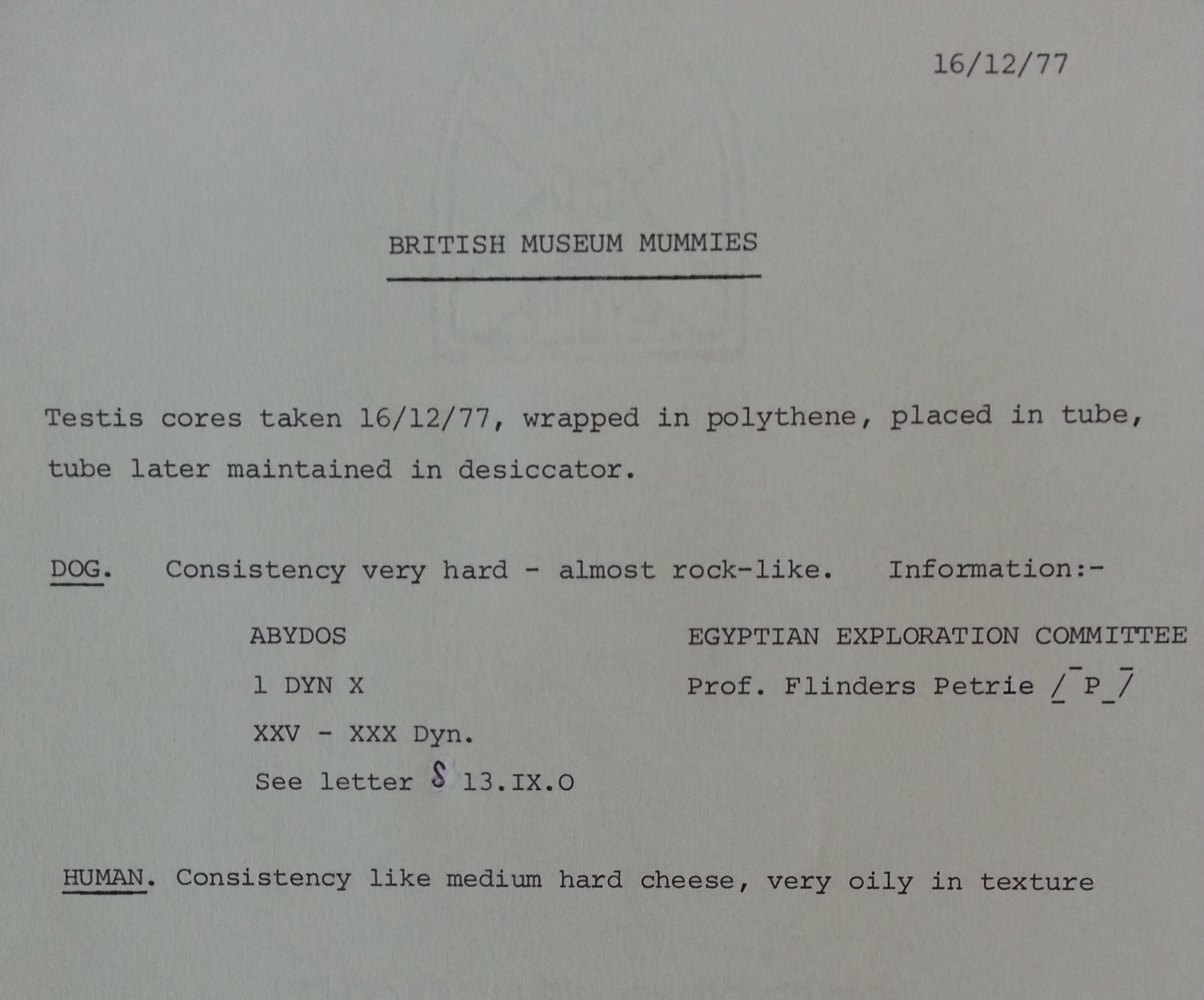
From a report amidst the correspondence, it appears Beatty was eventually successful in getting his samples from the dog and human mummies:
Testis cores taken 16/12/77, wrapped in polythene, placed in tube, tube later maintained in dessicator.
Dog: Consistency very hard – almost rock-like…
Human: Consistency like medium hard cheese, very oily in texture.
It is not clear from Beatty’s archive exactly what resulted from his research on the Egyptian mummies – so we’d be delighted to hear from anyone who may know more about it! In the meantime, you can read more about the strange story, mentioned by Beatty, of the 180,000 mummified cats brought over to England from Egypt in the nineteenth century to be used as fertiliser here:
http://www.strangehistory.net/2013/12/18/tens-of-thousands-of-egyptian-mummies-in-english-soil/
Happy Hallowe’en everyone!
Clare Button
Project Archivist
Collections
 Hill and Adamson Collection: an insight into Edinburgh’s past
My name is Phoebe Kirkland, I am an MSc East Asian Studies student, and for...
Cataloguing the private papers of Archibald Hunter Campbell: A Journey Through Correspondence
My name is Pauline Vincent, I am a student in my last year of a...
Hill and Adamson Collection: an insight into Edinburgh’s past
My name is Phoebe Kirkland, I am an MSc East Asian Studies student, and for...
Cataloguing the private papers of Archibald Hunter Campbell: A Journey Through Correspondence
My name is Pauline Vincent, I am a student in my last year of a...
Projects
Cataloguing the private papers of Archibald Hunter Campbell: A Journey Through Correspondence
My name is Pauline Vincent, I am a student in my last year of a...
Archival Provenance Research Project: Lishan’s Experience
Presentation My name is Lishan Zou, I am a fourth year History and Politics student....