Home University of Edinburgh Library Essentials
June 17, 2026
Photographing the Josephine Baker Bronze by Eduardo Paolozzi
An exciting new exhibition on the 6th floor of the main library in the Centre for Research Collections opens on the 13th November 2014 and runs until 27th of February 2015. The exhibition will include a selection of Edinburgh Universities collection of Paolozzi plaster maquettes which are wonderful three dimensional drawings of his ideas. The Digital Imaging Unit was tasked to photograph the Josephine Baker Bronze to coincide with this exhibition. We have produced a short day in the life film of the Digital Imaging Unit at work on the Paolozzi Bronze which you can see below. A larger better quality version is available by clicking the vimeo link below the film.
I first became aware of Paolozzi through an exhibition held at the Royal Scottish Academy for the Edinburgh 1984 International Festival called "Recurring Themes” , I still own the catalogue. His work and life made a lasting impression on me as a young man. The early collage work blew my mind and the way he fed pop culture back to ourselves dismantled and rearranged raising questions about pop culture itself was remarkable. Read More
Trial – World Newspaper Archive
 We have trial access to the World Newspaper Archive until the 12th December.
Please see the SPS Librarian blog post for full details.
So long, farewell, auf wiedersehen, goodbye (for now)
 Pop-up Library has now packed up and there will be no more sessions this semester. After 9 weeks and 90 sessions we wanted to say a big thanks to all the students and staff who popped-up to these sessions and hope that you enjoyed finding out more about the Library and Museum collections, services and resources.
Staff at the Pop-up Library sessions spoke to over 2200 people, mostly students, within this 9 week period and enjoyed this unique opportunity to meet you and show off what they do. We were even happy to tell you where the toilets on the first floor are (for future reference when facing the two lifts go through the doors on the right-hand side and then follow the signs!)
Watch this space:
For further Pop-up Library events that we are hoping to hold next semester (popping up in a space near you?)
For your feedback. During the trial, particularly in the Be in charge of the library for the day sessions, you were asked to complete feedback cards on what you love or don’t love so much about the Library and suggestions you may have for improvements. We’ll post a summary of your feedback in the near future.
Good luck to you all with your exams!
Trial access to World Newspapers Archive now available
*The Library has now purchased access to African Newspapers, Series 1. See New! African Newspapers, Series 1 1800-1922*
The Library has set up trial access to World Newspapers Archive (Readex) which gives us access to the African Newspapers, South Asian Newspapers and Latin American Newspapers collections. You can access World Newspapers Archive via the Databases trials page at www.ed.ac.uk/is/databases-trials Read More
Music Industry Data
 ACO Music Data Analysis (Academic Charts Online) has changed it’s name to Music Industry Data.
Please update any bookmarks you may have used.
Our music databases can be found at http://www.ed.ac.uk/schools-departments/information-services/library-museum-gallery/finding-resources/library-databases/databases-subject-a-z/database-music
‘Emma Gillies: Rediscovered’ – Ceramics Exhibition at the Main Library
Emma Smith, Exhibitions Officer, writes about the 2014 winter exhibition at the University of Edinburgh Main Library
Over the last two years, significant research has been carried out into the Edinburgh College of Art Collection. The project has resulted in the discovery of a number of highly significant works that add further colour to the history of Scottish art. One of the many extraordinary finds has been a collection of ceramics stored in a cupboard nearby the Head of Painting’s office at ECA. It became apparent early on that this collection was linked to Sir William Gillies in some way. Pieces from the collection appear in many of Gillies’ still life paintings – some of which will be featured in the exhibition. Furthermore, this was an active ceramics collection – it was used for its original purpose as well as for the inspiration for art and, most importantly, they are fine works on their own merit.
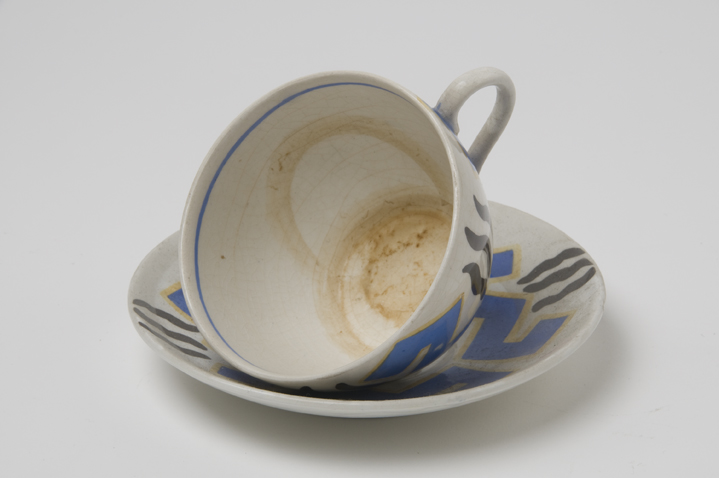
Fancy a cuppa? The artists enjoyed their wares – as you can see for yourself at the exhibition.
As research continued into the collection, it became clear that the ceramics were created mainly by Emma Gillies, sister of Sir William Gillies. Emma sadly died in her 30s and, particularly in light of the illustrious reputation of her older brother, is a peripheral figure in our understanding of 20th century art in Edinburgh. She is more often remembered as a tragic figure, or the sister of Sir William Gillies, than a skilled artist in her own right. This exhibition seeks to revisit the art of Emma Gillies.
We hope you can make it along to visit.
The exhibition is free and open to the public from 5 December 2014, Monday to Saturday, 10am to 5pm.
Exhibition Opening: 5 December 2014 | Where: Exhibition Gallery, Main Library, George Square | Closing: 07 March 2015 |
Blog posted by:
Emma Smith and Steven Skeldon, Centre for Research Collections.
1914 voices from the New College Archives
On 11 November, there will be a short Act of Remembrance in New College, starting at 10.50am and gathering at the war memorial in the Assembly Hall. Come into New College Library this week, and you can see the voices of New College staff, students and alumni remembered in a display from the New College Archives.
 New College War Memorial Album 1914-18. New College Library AA.1.14.1.
This is an official record of the New College students who fought in the First World War, including those who lost their lives.
New College Senate Minute Book, 1914-34 New College Library AA.1.1.4
This entry for 1914 records that, following appeals for chaplains to enter the Scottish Command, ten New College students have volunteered their service.

Faith on the frontier : a life of J.H. Oldham / K.W. Clements. New College Library BX6.8.O54 Cle.
Oldham, J.H. Letter to John R Mott, 4 Dec 1914. Oldham Papers. New College Library MSS Old 1/9
Joseph H. Oldham (1874-1969) was a missionary and pioneer of ecumenism. A theology student at New College, Edinburgh, he went on to become the organising secretary for the 1910 World Missionary Conference in Edinburgh, regarded by many as the starting point of the modern ecumenical movement. During the Second World War the meetings of his ‘Moot’ group initiated new thinking about Christian responsibility in modern society. This letter written in 1914 shows the tensions that the outbreak of war had created in the Church, both at home and overseas.
Christine Love-Rodgers, Academic Support Librarian – Divinity
We want more corpses
 In 1828 the University of Edinburgh’s medical students were desperate to get their hands on cadavers – so they could study Anatomy from real subjects. This amazing document, measuring 190 x 60 cm, is a petition signed by the students to ask the authorities to provide more bodies. At exactly the same time, Burke and Hare were responding to this shortage by resorting to murder. This manuscript, which has arrived today as a potential purchase, shows very clearly how the success of Anatomy at Edinburgh created unexpected pressures on society. Joe Marshall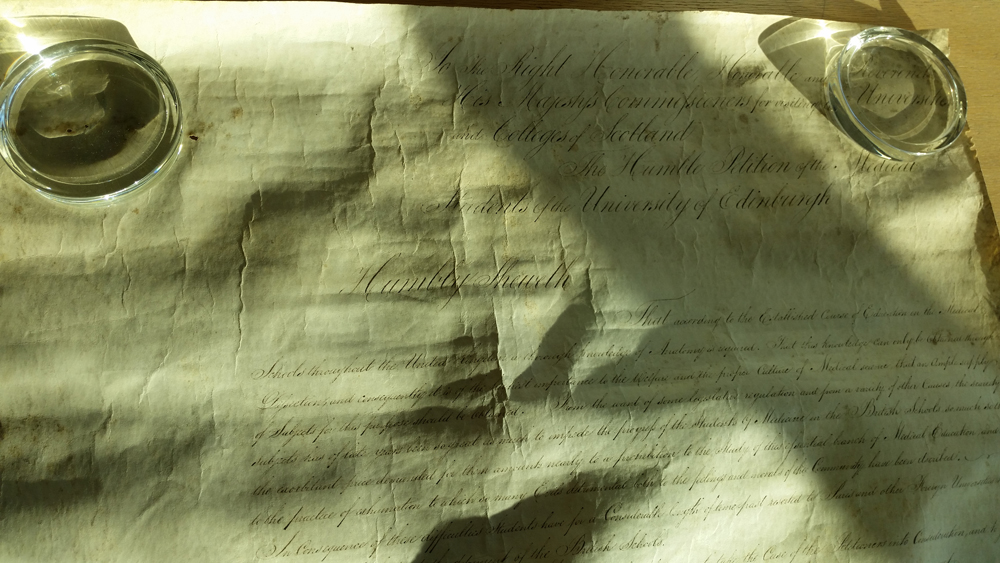
Explore your Archives!
Next week is Explore your Archives Week, join us in celebrating our archives at the Centre For Research Collections!

UKSG October webinar: The University Library as publisher. Can you? Should you?
 This webinar was held on Wednesday 29 October 2014 and was jointly presented by colleagues from the Universities of St Andrews and Edinburgh. The idea of the webinar was to understand how open access publishing initiatives can be delivered for academic staff and for students and to give some practical advice on how institutions might want to consider setting up a service. Janet Aucock of St Andrews opened the webinar and introduced some of the main themes. Jackie Proven of St Andrews and Angela Laurins of Edinburgh gave in depth case studies of their journal hosting services and covered all aspects of setup, staffing, costing and sustainability. Both institutions have extensive experience in using OJS (Open Journals System) for journal publishing and this was the main topic for the session. It was clear from the questions that came in before the webinar that participants were also very interested in open access publishing for other material, especially monographs. So this looks like a topic for further discussion and exploration.
Further key themes were trying to decide who is the publisher. Is it the journal editors, the academic department or is it the Library? Both Edinburgh and St Andrews offer journal hosting services and do not “publish” but it was felt that distinctions about publishing roles are becoming blurred anyway and that this sort of publishing is often a collaboration of people. Another major theme was how a journal hosting service can give great opportunities for journal editors to learn about the publication process and gain valuable experience. Services are not so much about supplanting existing established journals but giving new journals and their creators the opportunity to get involved with ways of exchanging their ideas and learning new skills. Journal hosting services also work well when they are part of wider open access services because they can demonstrate open access in action.
The webinar also picked up on themes first posted to the LOCH blog in August 2014 when the “University Library as publisher” was a themed workshop at this year’s Repository Fringe. We were particularly pleased to be able to deliver this webinar knowing that both St Andrews and Edinburgh are part of the Pathfinder projects and are collaborating together on the LOCH project with Heriot Watt. Collaboration and best practice are important themes in the LOCH project “which seeks to provide case studies of evidence of best practice in relation to OA workflows”. Models for good practice for open access compliance are built on author awareness about open access issues. Both St Andrews and Edinburgh can see real value in their Journal Hosting Services from the perspective of developing open access awareness among their journal editors and submitting authors. This theme came through very strongly in the webinar and we believe that our services will continue to develop these skills among our users, especially undergraduates and postgraduates who will become the next generation of academic authors and who will be much more familiar with open access publishing.
Slides from the presentations are at:
http://www.uksg.org/libraryaspublisher
and also archived at:
http://hdl.handle.net/10023/5617
Edinburgh’s Journal Hosting service is at:
http://journals.ed.ac.uk/
St Andrews Journal Hosting service is at:
https://www.st-andrews.ac.uk/library/services/researchsupport/journalhosting/
Blog post written by Janet Aucock, Jackie Proven and Angela Laurins
Collections
 Hill and Adamson Collection: an insight into Edinburgh’s past
My name is Phoebe Kirkland, I am an MSc East Asian Studies student, and for...
Cataloguing the private papers of Archibald Hunter Campbell: A Journey Through Correspondence
My name is Pauline Vincent, I am a student in my last year of a...
Hill and Adamson Collection: an insight into Edinburgh’s past
My name is Phoebe Kirkland, I am an MSc East Asian Studies student, and for...
Cataloguing the private papers of Archibald Hunter Campbell: A Journey Through Correspondence
My name is Pauline Vincent, I am a student in my last year of a...
Projects
Cataloguing the private papers of Archibald Hunter Campbell: A Journey Through Correspondence
My name is Pauline Vincent, I am a student in my last year of a...
Archival Provenance Research Project: Lishan’s Experience
Presentation My name is Lishan Zou, I am a fourth year History and Politics student....