Home University of Edinburgh Library Essentials
December 16, 2025
Westlaw update: unused accounts removed
Westlaw have recently let us know that they are engaging in some housekeeping activities to ensure the University’s records are being kept up-to-date. What this means is that any University of Edinburgh users who have not accessed their accounts for more than 15 months will have their account closed. The benefits to this are that we can keep an accurate log of how many users are actively using the database and that we do not exceed the student numbers we’ve quoted to the provider.
If this happens to your account and you are still a current student or staff member who needs access, you can simply re-register your university email address on Westlaw and continue to use the platform as before. However, your preferences and saved documents or favourites will no longer be stored, so you will need to add them back into your bookmarks when you log in. To avoid losing this data simply ensure you log in to Westlaw using your account at least once per semester.
We don’t anticipate this causing any major issues for our staff or students but if you do encounter problems with Westlaw or any of our other databases, please do let us know by email.
New College Library Reopens at Mound Place
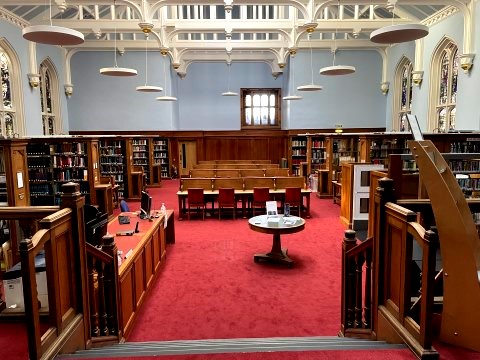
Photo of New College Library Hall, New College, Mound Place
We’re delighted to be able to tell you that New College Library re-opened on Monday 11 September at Mound Place, with access to Library Hall collections (including Reserve collections), study spaces and a range of Library and EdHelp services.
New College Library’s collections were relocated in 2020, as part of a New College site wide Fire Asset Protection project. Approximately 4 km of General Collections were moved to 40 George Square and about 3 km of Heritage Collections were moved to multiple locations, including deep storage. In August this year, library moves began to return the General Collections to their original home in Mound Place. The first students to enter the reopened library on September 11 simply said:
It’s beautiful …
While unanticipated buildings issues have delayed some collections moves, we expect that the collections in Stacks I and II will be fully available by early October. As throughout the move period, we will provide additional interlibrary loans to support access to any collection items which are inaccessible because of this delay. The move of New College Library’s Heritage Collections, originally scheduled for July 2023, has been paused while we ensure we have appropriate environmental conditions in all relevant storage spaces. We are looking forward to the return of Heritage Collections to New College later this academic year.
Further library information and opening hours at : http://www.ed.ac.uk/is/new-college- library.
This article has been cross posted from the October Library Updates newsletter. For more information on what’s new in the library this month you can read all articles here.
Trial access: ProQuest Black Studies
As part of Black History Month at the Library, we have trial access to ProQuest Black Studies. Developed with faculty, scholars and librarians, ProQuest Black Studies brings together award-winning content into one destination that can be used for research, teaching, and learning.

You can access ProQuest Black Studies via the E-resources trials page.
Trial access ends 15th November 2023.
ProQuest Black Studies combines primary and secondary sources, including leading historical Black newspapers, archival documents and collections, key government materials, videos, writings by major Black intellectuals and leaders, scholarly journals, and essays by top scholars in Black Studies. Read More
Working with Charles Lyell – a call for papers
Two-day workshop, 8-9 February 2024, University of Edinburgh
CALL FOR PAPERS
Contributions are invited to a two-day workshop on the life and work of the leading geologist and natural scientist Charles Lyell, to be held in the University of Edinburgh.
Building on the acquisition for the nation of the notebooks and archival papers of distinguished geologist and earth scientist Charles Lyell (1797-1875), our work towards the ‘Time Traveller’ exhibition and a soon to be launched Lyell dedicated website, we now invite papers for a 2 day workshop in Edinburgh.
The Workshop: Aims to provide a platform for persons interested in the life, work, and collections of Charles Lyell, and science in the nineteenth century, to come together to learn more of the Lyell materials held in Edinburgh, to explore how best to connect the disparate holdings of Lyell’s specimens and texts, and to consider future research possibilities on Lyell’s work and world.
Contributions in the form of a paper to be delivered at the Workshop are invited from persons working on any aspect of Lyell’s work and life, on the history of geology, or on related topics bearing upon Lyell’s writings and achievements. Contributions are also welcomed from curatorial or archival staff in institutions holding Lyell material or significant related material for an intended panel session on linking archival holdings and object collections across institutions. The Workshop will include an opportunity to see some of the Lyell materials held by Heritage Collections, and the Cockburn Geological Museum at the University of Edinburgh, and to visit the Exhibition.
Paper contributions: Papers should be 15 minutes in length (paper sessions are planned for 15-minute papers, 5 minutes discussion per paper). Please provide a title, an abstract (100 words), your title and institutional affiliation (if any), and an email address. In selecting papers for the Workshop, preference will be given to PhD or other research students and to Early Career Researchers.
Panel session contributions: Please be prepared to speak for 5-6 minutes on the Lyell material in your institution’s holdings and the opportunities it presents for further research.
To Contribute: Please send in your proposed contribution to Professor Emeritus Charlie Withers via email to: c.w.j.withers@ed.ac.uk by Friday 10 November 2023. It is hoped that the Workshop Programme Committee will reply within two weeks of this date to confirm your involvement or not.
A confirmed Workshop Programme will be available soon after this in which further details will be given on location, timings, and costs of delegate attendance at the Workshop.
We look forward to hearing from you!
Time Traveller: Charles Lyell at Work
Free exhibition in the Main Library Exhibition Gallery (ground floor),
Open from 27th October 2023 – 30th March 2024, Monday to Saturday, 10am to 6pm
Over the last few months, our efforts have been focussed on pulling together all the work to date associated with the Charles Lyell Project, into an exhibition. It has taken a small army of experts, staff, interns, and volunteers to get us to this stage – and we are nearly there. Here is a look behind the scenes…
Getting down to writing – what will be in effect – the first major exhibition on Sir Charles Lyell was a fairly daunting task. The science Lyell is writing about was new; today it can be recognised as ecology, climate and Earth studies, but in Lyell’s time it encompassed several different disciplines – geology, archaeology, geography, conchology, botany, zoology and palaeontology. The terminology is crucial, and, still under significant debate. Working in an era of imperial exploration and expansion Lyell’s travel through the slave plantations of the American South was controversial and remains disturbing. Despite his life’s work to gather, share and advocate for precise and authentic evidence in science, Lyell struggled to accept his friend Charles Darwin’s work on evolutionary theory. This exhibition explores these themes providing an unprecedented insight into how Lyell worked to establish a science that abridged deep divides of religion, race, culture, and politics.
Given these complexities, getting the right people on the exhibition team was vital, and it has been an absolute pleasure to work with Jim Secord, Director of the recently completed Darwin Correspondence Project. As Jim says, the reality is,
“getting into the 1830s is relatively easy, it’s the getting out that’s the problem”.
Jim has contributed a wealth of knowledge and experience , selecting rare books held by the University that add context to Lyell’s life and career, including motivators, Isaac Newton and James Hutton, and contemporaries such as Frederick Douglass. It has been fascinating to see how books held within the Library collections connect to Lyell’s work.
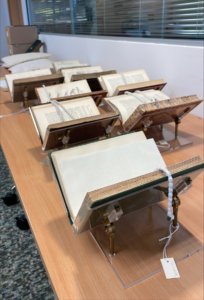
University Library books, that have been used by students over the years, contribute context to Lyell’s work.
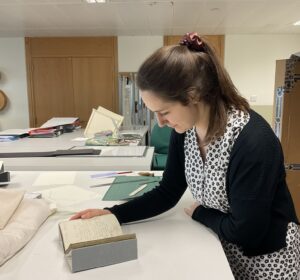
Robyn studies her successful trial to create a bespoke stand for the notebooks; re-useable and recyclable.
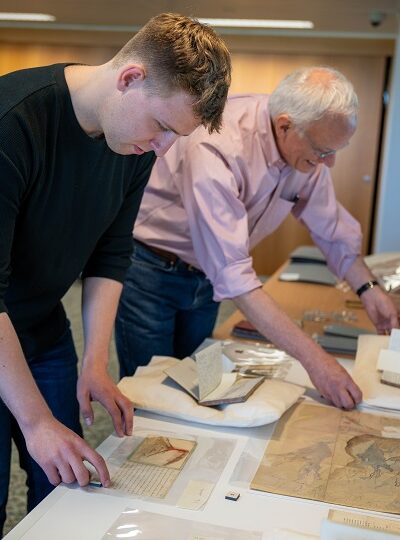
Jim and Will during ‘object selection’ day, working on choosing what items to feature.
Having completed his dissertation on Lyell’s contribution to prehistoric archaeological study, Will Adams has also been our Lyell Research Intern, tasked with curating a series of case studies, demonstrating how Lyell researched and gathered evidence to support his theories. Five display cases later, look out for Lyell as a ‘Principle Investigator’ (play on words intentional!) as he searches for evidence to support his theories on Volcanoes, Niagara, and Sea Serpents.
Will’s work has been supported by that of Lyell Summer Intern, Harriet Mack, and a crew of remote volunteers – Drew, Beverly, Bob and Ella – are are currently working to away using the digital images to transcribe notebook indexes. In the course of trying to understand them, we’ve googled, mapped, fact checked, and reached out to local people, familiar with where Lyell was working.
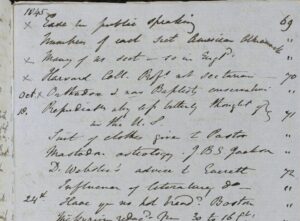
Notebooks are used in the exhibition to show how Lyell worked to gather evidence to support his theories.
The volunteer’s work has really opened up that section of the archive, producing rich descriptions that have highlighted previously unseen sections in the notebooks that will feature in the exhibition. We have worked to include their reflection on this experience, enabling us to shine a contemporary light onto the notebooks, and all the different hands that appear within their pages.
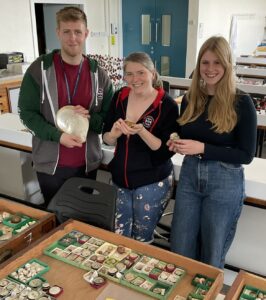
Team ‘Lyell Finds’ -Will, Dr. Gillian McCay, & Hattie at the Cockburn Geological Museum.
Lyell’s specimens were a key tool for him, and Dr. Gillian McCay of the Cockburn Geological Museum has been an integral part of our progress to understand how they connect to the archive. From the outset, everyone has been on the lookout for references to collection items (fed into and logged in a very lively teams chat ‘Lyell Finds’) and Will, through his dissertation, has been able to re-establish the events that link notebooks and specimens to Lyell’s work on the antiquity of man. There is much more work to be done in this area – and we hope the exhibition will encourage this.
Today Lyell’s questions are still relevant, and the ways in which he worked (not always successfully) to answer them can add to our own understanding. Travelling relentlessly, and often accompanied by his wife, Mary, Lyell spent his life putting time to work, chasing volcanoes, visiting coastal, industrial and heritage sites, exploring strata, caves, waterfalls, quarries, and mines. The resultant rich data contained in his archive transports us through time.
In working together on the project to open up Charles Lyell’s comprehensive archive, and in preparing this exhibition, we find we have walked in his footsteps – creating a network of experts and local people, and using different tools to consolidate our understanding.
Pamela McIntyre, Strategic Projects Archivist, Heritage Collections, University of Edinburgh
It’s Friday the 13th!
It’s that time of the year when the leaves start changing, the air gets cooler, and I get creeped out by works in the collection…
As the Art Collection is an ever-moving beast, on display across the University of Edinburgh’s entire campus and beyond, I am responsible for overseeing the transport of artwork in and out of storage and ensuring locations are kept up to date. However, occasionally I can get spooked out by works that I swear that I’ve never seen before – a fitting topic for today’s Friday the 13th blog!
Meeting the challenges facing ecclesiastical libraries
BETH are a European group of national organisations representing librarians working in theological college, seminary, Church and monastic libraries. Solo librarians or librarians working in small teams are characteristic of their membership, although there is also representation from University libraries. I attended their conference on the theme of Challenges facing ecclesiastical libraries in Cordoba, Spain on 30/9/23-4/10/23, to share a paper about partnership working between Church and University in New College Library.
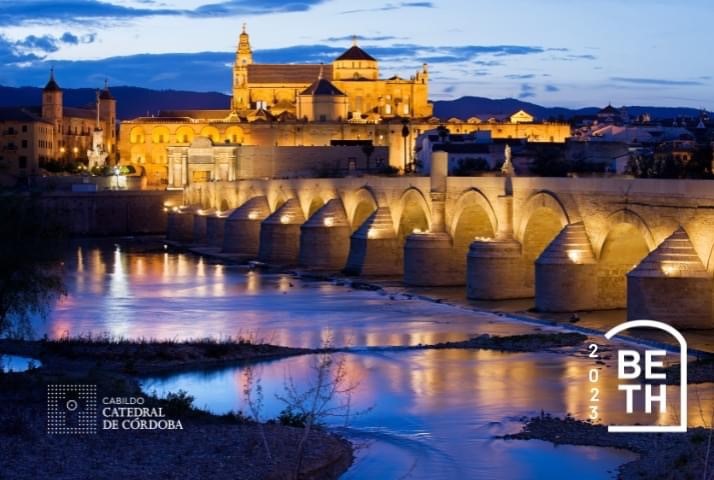
BETH Conference 2023
What are the challenges for ecclesiastical libraries?
A number of recurring challenges were underlying themes for the conference.
- The decline in religious vocations and in church membership and attendance, which is also linked to a decline in available funding for church libraries, as funding must come from a diminishing church populace.
- The effects of war, military action and other political and social conflicts.
- Delivering professional management of historic collections under both of these circumstances with the particular needs and financial demands of historic and rare collections.
How can ecclesiastical libraries be successful in avoiding crisis and collapse? Read More
How to find your way around the vast portfolio of Digital Research Resources
Guest blog post by Dr André de Araújo Vieira, Research Facilitator – Digital Research Services – University of Edinburgh
The Digital Research Services website helps researchers find resources including components of the Research Data Service.
The new Digital Research Services website will point you to the most suited tools tailored to your research project
Digital Research Services (DRS) has just released new features on their website to assist researchers who are still unsure about which digital resources would be most appropriate for them. The new interactive tool – Resource Finder – highlights the most suitable service(s) for each project. All the users need to do is answer a series of questions. The main purposes of this new functionality are:
- To empower the user to build their own personalized toolkit;
- To give autonomy to the user in finding their way around the large portfolio of digital resources provided by the University;
- To allow the user to understand the breadth and depth of data services available to them.
Beyond helping the navigation of digital research services, DRS also intends to emphasize the importance of adopting best practices throughout the research lifecycle. Getting to know the broad range of available resources, developed with an emphasis on research excellence, is key for making informed decisions, identify the most appropriate tools and by extension have higher chances of meeting funder requirements and maximise research outputs and impact.
The new Resource Finder was released as part of a full DRS Website redevelopment, overall enhancing findability and visibility of digital tools. After an assessment in 2022, DRS intensified efforts to raise awareness of data and computing services across the University, facilitate efficient use of digital resources and to enhance the existing training materials on digital tools. One of the steps taken towards this objective was reviewing the DRS website content, design, and functionalities which led to the Resource Finder.
How does it work?
Once you enter the Resource Finder page, you will find a description of the tool, further user guidance (available under the +More info button) and the DRS research lifecycle. A You will see a list with the name of each phase of the research life cycle and associated questions, as well as guidance text showing where you can interact with the tool. Among the information provided, you will also find an explanatory video on how to use the Resource Finder. There are different ways to navigate the Resource Finder. You can use it by interacting with the colourful wheel or with the drop-down list of phases. When you start answering the questions you will see that tailored resources will appear on your right side, depending on the answers you give. 
 You can reset each phase or the full questionnaire at any point. You can also see a summary of the resources that appeared in each phase on “+Related Resources”. If you are sure that one of the services presented will not be relevant to you, you can hide it. Above all the resources, you will be able to select how you want it to be displayed. Finally, above the display options, you will find a button that allows you to copy all the outcomes of your answers, in case you want to send the link to someone.
Give it a try
The Resource Finder is now available to members of the University of Edinburgh community and beyond. Give it a try and let us know your thoughts via the feedback button on the right side. We will always love to hear suggestions for improvement – whether it is for the Resource Finder or any other functionality of the website.
Other new DRS Website features
It is worth to mention that the new DRS website features and functionalities extend beyond the Resource Finder:
-
-
- Enhanced site-wide search and filtering functionality for colleges/schools;
- New pages and updated menu including the addition of News and Updates and About us pages;
- Additional options for the display or resources;
- New grouping of resources based on the type of service (tool or advice);
- Schedule an online meeting functionality.
-
The University of Edinburgh Art Collection: Irene G. Thomson, Anne Marie Gilmore and Gwen Hardie
Ash Mowat is one of our volunteers in the Civic Engagement Team. Inspired by Katy Hessel’s ‘The Story of Art’, Ash has been looking into the work of three female artists whose work belongs to the University of Edinburgh’s Art Collection. Find out more about these artists below as well as how to search our online art collections database or how to view artworks in our reading room. [Content note: pictures included contain nudity]
Introduction
The University of Edinburgh’s Art Collection contains almost 8,000 individual pieces of art which represent the combined historic University of Edinburgh Fine Art Collection, with Edinburgh College of Art holdings. In this blog, I will look at the work of three different artists from the collection. Whilst doing so, I will endeavour to give an insight into how to search and view art works in the University’s Art Collection using the online catalogue and the reading room. I will comment on the experience of searching for and viewing items on the website, and also viewing some of the works in person at the University of Edinburgh to help anyone else who might wish to do so in future.
I should make it clear that whilst I dabble in art myself, it is largely for the pleasure and therapeutic benefits as I’m certainly no professional artist. Neither do I possess any academic expertise in the visual arts, so my notes here are those of an interested and enthusiastic observer, rather than that of any kind of expert.
In selecting items to view, I focused on contemporary artists who studied at the Edinburgh College of Art from 1960s to 1980s. This was partially as this era can be viewed as an early period of greater accessibility to study at degree level, given that it predated tuition fees and included wider support services such as non-repayable living maintenance grants and Housing Benefit etc., available to those from lower income families.
As someone who is currently enjoying reading The Story of Art (without men) by Katy Hessel,[1] I chose to include women artists only, given the historical tendency for visual arts to focus on male artists. Furthermore, the artists I’m featuring are largely not famous or well-known individuals, as I find it is exciting to explore some works and their creators that may not get so much attention elsewhere.
Searching the Collections
The online catalogue of the University of Edinburgh’s Art Collection can be found at: University of Edinburgh Art Collection. A simple search of artists by name will bring up details of any of their works held. In some instances, the dimensions of the artworks are included. The media used to create individual items is sometimes noted (e.g. oil paint). There isn’t any detailed biography of the artists featured. Some of the items in the collection have been digitised and their entries contain an accompanying photograph.
Other than searching by artist name (correct spelling required), you can enter a specific year date or era such as 1980 or 1980s to narrow your focus. This function is not always precise, however. For example if searching for 1980 you will be shown works that date from that exact year, but it will also capture works from other years in the same decade. Equally, if searching for 1980s it will generate work from that decade but also select items from 1880s or earlier centuries.
The artist Irene G Thomson
There are three works by this artist included in the collections. One of the works pictured below (‘Portrait of a man with a book’) has been digitised and is listed as being a composition crafted using oil paints. I like how its thickly applied and dramatic brush strokes still serve to brilliantly capture the features and expressions of the sitter. The subject is holding but not reading a book, and is gazing perhaps wistfully to one side, as if quietly reflecting on something. I enjoyed the composition, character of the sitter and the textures and contrasting areas of light and dark that we encounter. (For clarity I should note that my reflections on this work as based on viewing the digitised image only on the University’s collection website, not having seen the painting in person).
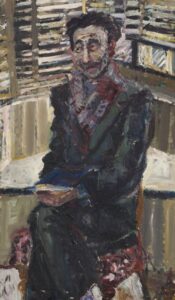
Irene G Thomson
Portrait of a man with a book (c.1950s-60s)
Oil paint
EU3210
© the artist[2]
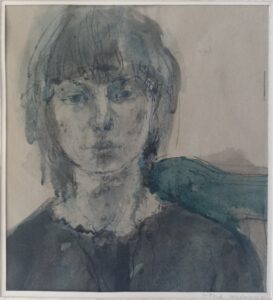
Irene G Thomson
Untitled: Portrait of a female with fringe (1963-64))
Portrait in pen and ink wash
EU4184
© the artist[3]
I was able to view the portrait above at the Centre for Research Collections (CRC) located in the University of Edinburgh Main Library. The portrait itself is sized 18 x 16 cm composed onto paper and mounted but unframed. In terms of colours, it is chiefly in monochrome in varying shades from black to grey, with accents of aquamarine around the eyes, skin tone and background. The sitter’s features are well executed despite the fluid challenges of the media, with a thoughtful gaze expressively rendered.
I like the contrast between areas of finer detail such as the eyes and looser work on the clothing. The grey green hues and dripping lines on the hair give the impression somehow of an image caught in reflection against either water or glass.
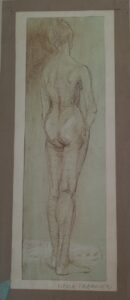
Irene G Thomson
Untitled: Standing nude female (1963-64))
Figure drawing in conte, graphite and white chalk
EU4183
© the artist[4]
I was also able to view the above drawing by the same artist, sized at approximately 35 x 10 cm. In what was probably a piece created during a short single viewing of the model, this sketched standing nude figure is very well captured. The varying tones from the use of graphite and then white chalk help create and establish detailed anatomical features, and muscle and skin surfaces and densities. Viewed from the back, we do not see the model’s face as instead the focus and detail is in on the limbs, head and neck, delivering a fine depiction of an elegant, relaxed and poised figure.
I was not able to access a wider biography of the artist, only dates provided that the obtained their degree at the Edinburgh College of Art in 1963, with a postgraduate completed the following year.
Ann Marie Gilmore
Ann Marie Gilmore (1948-2006)[5] was a Canadian artist who studied at the Edinburgh College of Art in the late 1960s and early 1970s. She worked using a variety of media but from the late 1970s focused on the use of watercolours to create her art. She became a friend of fellow artist Richard Demarco[6] who described her flower paintings as having “a particular gift of expressing her delight in nature through a joyous use of colour”.
She travelled extensively and taught at for a period back in her native Canada before dedicating her time as a full time artist, with her vibrant watercolours using a combination of abstract and figurative styles to great effect, capturing landscapes, flowers, portraits and architectural observations.
Sadly she died all too young whilst only in her fifties, with the two pieces held by the University of Edinburgh kindly provided by her family.[7] Her brother Professor Bill Gilmore remarked:
“Ann Marie studied at the Edinburgh College of Art in the late 1960s and early 1970s. Though then an independent institution, dating back to 1760, it has recently merged with the University of Edinburgh. Her works now join an impressive and extensive collection which includes pieces by some of those who taught her and others with whom she studied”.
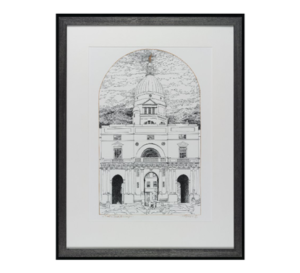
Ann Marie Gilmore
The Old Quad, Edinburgh (1985)
Ink/Coating 49 x 64 cm
EU5144
© the artist[8]
I was able to view on request this piece in the University of Edinburgh library. Its subject is an impressive and historic structure at the heart of the campus of the University.[9]It clearly made an impression on this artist, as it would likely impact upon many students coming to make their home in Edinburgh.
This is a highly intricate and finely detailed work executed in ink, brilliantly capturing the many refined architectural features, stonework and archways encountered at the main entrance into the quadrangle. Surprising to discover that at the time of this art being composed that the elegant lawns now present were once used as a car park. Mercifully the aesthetics of the feature have been restored to remedy this.
The exquisite detailing is further enhanced by outstanding use of the sharply contrasting areas of bright light set against the deep, dark archways and windows, creating a three dimensional effect. The loosely rendered figures in the courtyard and background make way for the star of the piece, the Old Quad building itself.
The artwork is complemented by a matching arched mount, mirroring the towering dome at the centre of the composition. The work is finished by a fine border of gold, and also gilded is the statue of Golden Boy at the crown of the piece.
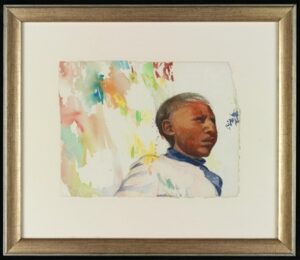
Ann Marie Gilmore
Andean Boy, Edinburgh (circa 1983)
Watercolour 26 x 19 cm
EU5143
© the artist[10]
I was not able to view this work in person so am using the image provided on the University of Edinburgh Art Collection online catalogue. This small piece is only 10x 8 inches in diameter unlike the larger pieces that the artist was to later favour, although it is in watercolour, which remained her favoured media throughout her artistic career.
Presumably painted during her years of travel, the portrait places all focus on the child’s face which is well defined, given the media used, with a looser accent of bright colours for a background. Seemingly peering into the sun his eyes are narrowed, and the white expanses of the piece and skin tones brilliantly represent the impact of the blazing sunlight in the Andes. The artist also manages to convey the child’s serene expression.
Gwen Hardie
Born in Fife Scotland in 1962, Gwen Hardie[11] completed a first class honours degree at the Edinburgh College of Art in 1983, followed by a postgraduate diploma with distinction the next year. She has lived and worked as an artist in Berlin, London and across America, having been based in New York since 2020.
Whilst only aged in her early twenties, in 1994 she became the youngest living artist to have been granted a solo exhibition at the Scottish National Gallery of Modern Art in Edinburgh.
The artist has demonstrated a flair and expertise in a wide variety of styles,[12] moving from her earlier precise and figurative portraits and draughtsmanship into her current non-figurative work, such as her “Squares” series.
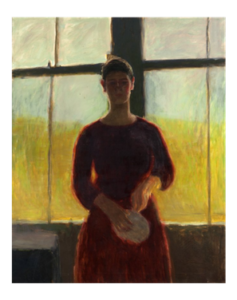
Gwen Hardie
Self Portrait against Window 9circa 1983)
Oil on Canvas 152 x 122 cm
EU3148
© the artist[13]
I wasn’t able to view this work in person due to difficulties in arranging these for larger pieces. Completed during her period studying art as an undergraduate, it may well have been undertaken in the Edinburgh College of Art building, as it features as a backdrop their recognisable impressively large windows that allow light to flood the studios. There is a clever mirroring and intertextuality here as she is holding a palette in the piece, reflecting both the subject and creator as artists.
She has elected to keep the face in a lot of shadow accounting for the background light source, but up close we do get an impression and expression of her features, and the highlighted edges around her head and face help deliver a strongly developed portrait. The colours are lovely warm hues that shift and blend creating textures and features.
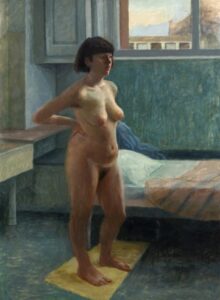
Gwen Hardie
Nude in Sunlight 1983
Oil on Canvas 167 x 122 cm
EU3148
© the artist[14]
Once again I had to rely on kindly consented use of a digital image to view the painting given its scale. In this work we have an oil on canvas portrait of a standing nude woman. The model’s skin tones are brilliantly finished, a highly crafted and refined study of the human form, but equally non-photographic in its use of blurring and intermingling colours to create depth, perspective and areas of light and shadow. The model’s confident stance possibly suggests the artist’s use of the female gaze, and gives the subject a powerful and dignified presence.
Whilst the artist’s current works referred to earlier as non-figurative paintings, one aspect that she has continued to demonstrate is as love for colour. Her recent works, such as the squares series, whilst abstract, are not blocks of uniform colour: but instead they appear to pulse, shimmer and breathe, and are mesmerising to view.
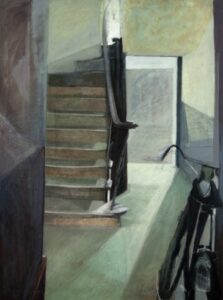
Jean B.M. Lothian
Stairway (circa 1979)
Oil on Canvas 137 x 183 cm
EU3191
© the artist[15]
Finally to finish with a painting from an artist that I’ve not been unable to source any biography for.
I therefore do not know if the artist continued to work in the field or not, but I thought it was fitting to end with a lesser known artist. Its subject is unspectacular, almost quotidian in nature, but acts as a slice of life for the then and now: the almost ubiquitous dwelling for many students, the Edinburgh tenement stairwell replete with bicycle.
It has muted but not monochrome tones, utilising the chiaroscuro: the sharply varying areas of light and dark in the composition. The different material of stone, wood and steel in the piece are accented differently to give texture and reflected light.
In conclusion I would urge anyone with an interest in the arts to explore the University of Edinburgh Arts Collection. If doing so please do not publish any images without prior consent, and if granted ensure to correctly attribute the source of images.
I should like to thank University of Edinburgh staff for allowing access to view works and use images from the collection. I should particularly like to thank Liv Laumenech for their generous time with guidance and corrections, and also to Laura Beattie, my Engagement Officer (Communities) supervisor at the University of Edinburgh.
[2] “Portrait of a Man with a Book” (ed.ac.uk)
[3] https://collections.ed.ac.uk/art/record/99420?highlight=irene+g+thomson
[4] https://collections.ed.ac.uk/art/record/99419?highlight=irene+g+thomson
[5] Ann Marie Gilmore Fine Art – Home (amgilmorefineart.com)
[6] https://en.wikipedia.org/wiki/Richard_Demarco
[7] Ann Marie Gilmore’s Art Enters Edinburgh University’s Permanent Collection – Ann Marie Gilmore Fine Art (amgilmorefineart.com)
[8] https://collections.ed.ac.uk/art/record/99917?highlight=anne+marie+gilmore
[9] https://en.wikipedia.org/wiki/Old_College,_University_of_Edinburgh
[10] https://collections.ed.ac.uk/art/record/99916?highlight=anne+marie+gilmore
[13] “Self Portrait against Window” (ed.ac.uk)
Research Data Support team and DCC to host Skills4EOSC Fellow
University of Edinburgh has been chosen as one of 12 European institutions to host sponsored short secondments for data professionals in Open Science, as part of the Skills4EOSC Horizon Europe project. Whilst the Digital Curation Centre is a partner in the Skills4EOSC project (EOSC is the European Open Science Cloud), the Research Data Support team has been asked to be the primary host for the secondment, so the ‘fellow’ can participate and engage in the team’s day-to-day activities in supporting and training researchers in an academic setting.

The project aims to develop common methodologies, activities and training resources to unify the current training landscape into a collaborative and reliable ecosystem and to provide dedicated community-specific support to leverage the potential of EOSC for open and data-intensive research. A number of enquiries have already been received and plans are currently underway with Library Research Support and the Digital Curation Centre (DCC) to support the application of a European candidate to work with the team for a month in either April or July, 2024, with a deadline for the application of 31 October. More information is at https://www.skills4eosc.eu/participate/fellowship-programme.
Collections
 Hill and Adamson Collection: an insight into Edinburgh’s past
My name is Phoebe Kirkland, I am an MSc East Asian Studies student, and for...
Cataloguing the private papers of Archibald Hunter Campbell: A Journey Through Correspondence
My name is Pauline Vincent, I am a student in my last year of a...
Hill and Adamson Collection: an insight into Edinburgh’s past
My name is Phoebe Kirkland, I am an MSc East Asian Studies student, and for...
Cataloguing the private papers of Archibald Hunter Campbell: A Journey Through Correspondence
My name is Pauline Vincent, I am a student in my last year of a...
Projects
Cataloguing the private papers of Archibald Hunter Campbell: A Journey Through Correspondence
My name is Pauline Vincent, I am a student in my last year of a...
Archival Provenance Research Project: Lishan’s Experience
Presentation My name is Lishan Zou, I am a fourth year History and Politics student....