Home University of Edinburgh Library Essentials
April 6, 2026

Graveyards and ghosts in web archiving
October 1969 was a busy month. Monty Python’s Flying Circus aired for the first time; Steve McQueen, Trey Parker and PJ Harvey were born; and on a dark, dark night (or about 10.30pm on the 29th), a 21-year-old UCLA student called Charley Kline started to transmit a message to the Stanford Research Institute using the Advanced Research Projects Agency Network. He meant to send the word ‘LOGIN’ – but the receiving system crashed at ‘LO’. And thus, the internet was born.
On trial: East India Company
Thanks to a request from a member of staff in HCA the Library currently has trial access to East India Company: India Office Records from the British Library, 1599-1947 from AM Digital. This digital resource allows students and researchers to access the vast and remarkable collection of primary source documents from the India Office Records, the single most important archive for the study of the East India Company.
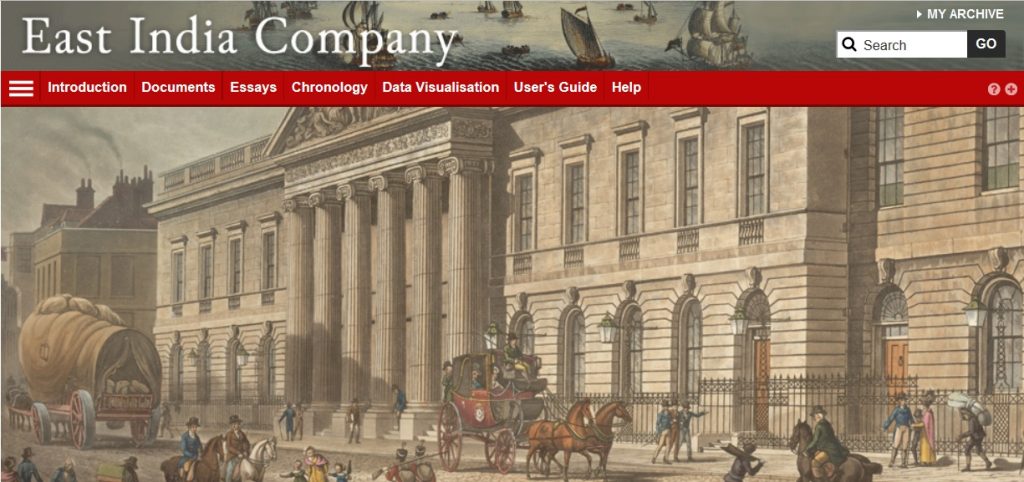
You can access East India Company via the E-resources trials page.
Trial access ends 1st December 2023. Read More
Witches and Animals in the School of Scottish Studies Sound Archives
Nicole Deacon is a volunteer in the Civic Engagement Team. As someone who has always been interested in all things witches, witch trials and witchcraft since she was very young, this was a topic that she was drawn to when she was first started volunteering with us and researching stories in the university’s archives at the age of sixteen. Nicole wanted to educate people about the role witches and folklore played in our history. We thought today being Hallowe’en would be a good day to share some of the results of that research with you.
When I first started looking into ideas about witches in the archives, I found that there are two main sources with a lot of information: the Tobar an Dualchais website which contains many sound recordings from the School of Scottish Studies Archives (as well as The Canna Collection and BBC Radio Gàidheal) and the Carmicheal Watson Collection. Both of these sources give us a great insight into Scotland’s rich history of folklore.
One thing that I noticed about many of the stories I came across was the connection between witches or witchcraft and animals. In this blog post, I’d like to share some examples of stories which feature this this connection by telling us about witches who change shape into animals or beings who can shapeshift between animal and human such as Selkies and Kelpies.
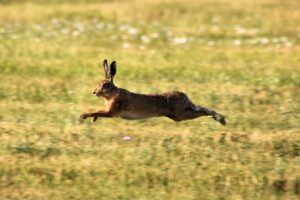
Story about a witch transforming herself into a hare, Nan Marshall (Contributor), Dr Emily Lyle (Fieldworker), ref. SA1974.171.B9, School of Scottish Studies Archives, University of Edinburgh
An Eighteenth Century Witch Trial Following a Plague of Cats, Donald Grant (Contributor), Prof. Tadaaki Miyake (Fieldworker), ref. SA1972.240.B5 , School of Scottish Studies Archives, University of Edinburgh
A Shape Shifting Witch Met her End, Donald Grant (Contributor), Prof. Tadaaki Miyake (Fieldworker), ref. SA1972.241.B6, School of Scottish Studies Archive, University of Edinburgh
Selkies
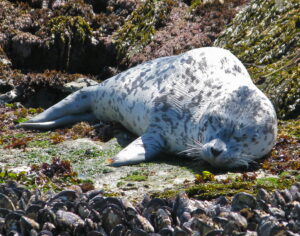
Image taken from: Baby Harbor Seal | Openverse
In Northern Scotland, you may hear stories about a water creature called the selkie. Selkies are often, although not exclusively, women reflected in the fact that in Gaelic stories, the word for mermaids and for selkies is the same: maighdeannn-mhara or ‘the maiden of the sea’.[3]
When they are in the sea, selkies live as a seals but on land they transform into women by taking their seal skin off. To go back to their true form, they must put their seal skin back on. Often selkies are trapped by men who steal their seal skins, forcing them to live on land as a human women. Selkies are said to be good wives but very sad. Sometimes in the stories, they give birth to children but if they recovers their skin, they will leave them to return to the ocean. According to the tales, male selkies are very handsome in human form and women find them very seductive. Male selkies will seek out unhappy wives of fishermen who wait for their husband to return.
There are several stories about selkies in the School of Scottish Studies sound archives. One story that takes place on Hallowe’en features a young man who travels to an island where he had heard there were many selkies congregating in a cave. He watches them as they strip off their skins and turn into men and women. They hid their skins while they dance and sing and the young man takes the opportunity to steal the skin of a seal girl he is attracted to. As a result, she is left behind after the dance and marries the man who stole her skin. Many years later her son finds the skin and gives it back to her. She returns to the sea and after that her children would often spot a particularly pretty seal in the waves who would wave to them.
A young man watched the selkies dance, Brucie Henderson (Contributor), Alan Bruford (Fieldworker), ref. SA1970.243, School of Scottish Studies Archive, University of Edinburgh
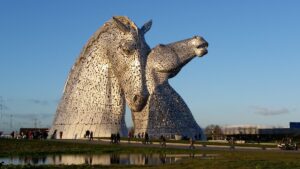
A Traveller who was pearl-fishing was nearly caught by a kelpie., Stanley Robertson (Contributor), Barbara McDermitt (Fieldworker), ref. SA1981.23.3, School of Scottish Studies Archive, University of Edinburgh.
These are only some of the examples that I came across. Listening to, and reading, these stories gives us an insight into these women and creature’s lives. Was their shapeshifting a way for them to escape blame, to avoid danger or was it for others to cast them as scapegoats?Although many people may not believe in witches or the kelpies, I believe there’s got to be some truth in the stories and legends that are all over the world.
If you want to read more about the different Hallowe’en customs recorded in the School of Scottish Studies Archives, you can read this blog post here which talks about many different customs from burning hazelnuts to reading eggs.
[4] Scottish Mythical Creatures – Kelpies, Selkies, and More (twinkl.co.uk)
[5] Why Are Kelpies So Feared and Distrusted in Scottish Folklore? (icysedgwick.com)
2023 ISG Staff Recognition Awards : Scholarly Communications Team announced as the Outstanding Team of the Year
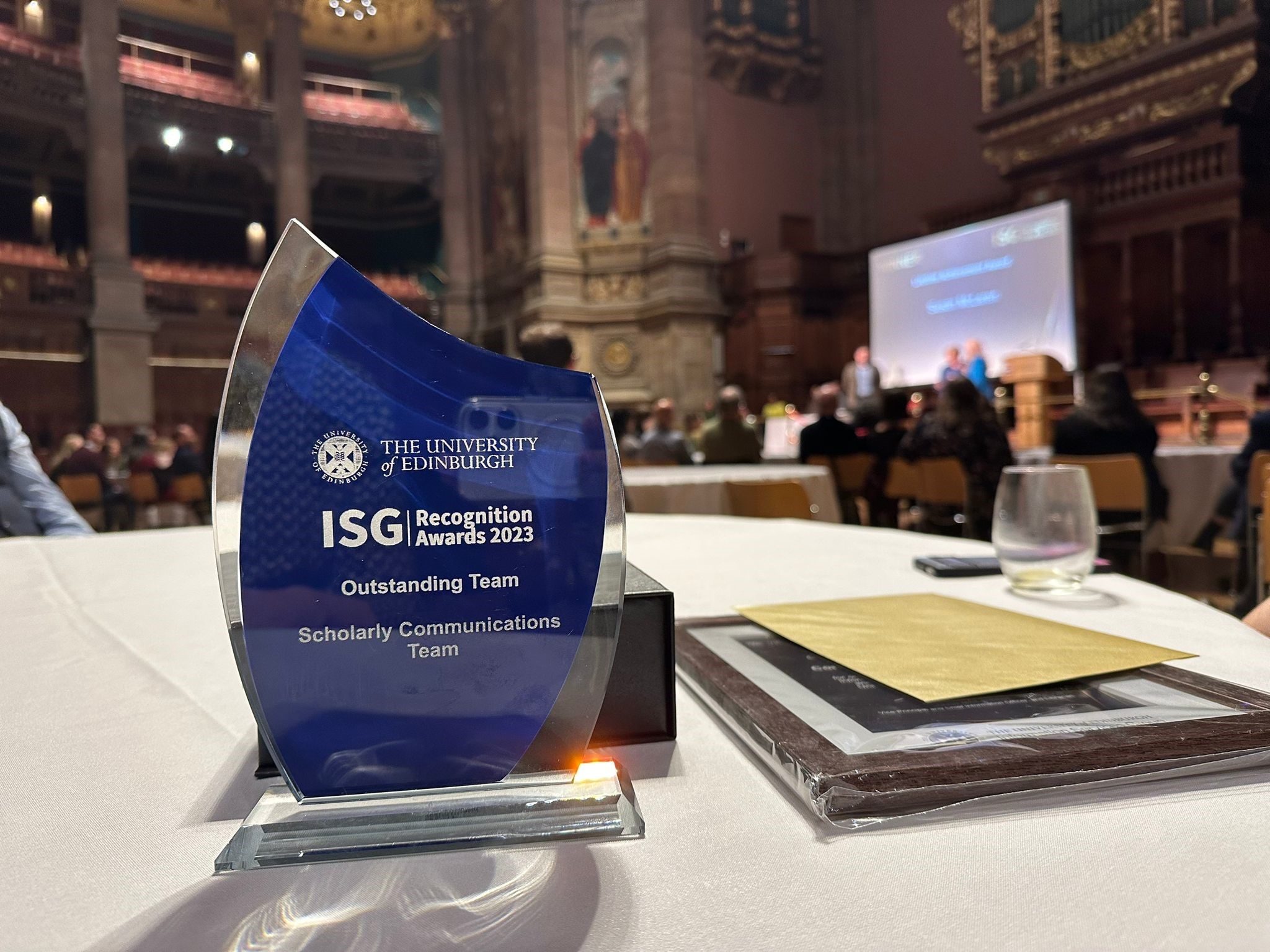
On Tuesday 24th October the second annual ISG Recognition Awards ceremony was held at the spectacular McEwan Hall. The ISG Recognition Awards are intended to celebrate the achievements of the 800 staff that work in the Information Services Group. The awards are peer–led with staff volunteering their time to be judges.
With over 200 nominations received the Library’s Scholarly Communications Team were lucky enough to be selected for the shortlist. At the in person event attended by over 100 staff we were humbled to find out that we actually won the Outstanding Team prize.
Catalyst for change
The nomination was submitted in recognition of the team’s internationally recognised leading work in championing rights retention for the University’s academic staff. The Scholarly Communications Team were the architects behind the ground-breaking Copyright and Research Publications policy, which was formally accepted by the University Executive and introduced on 1 January 2022. The University of Edinburgh was the first UK university to adopt an institutional rights retention policy, and since then over 30 other institutions have followed suit, including the University of Cambridge and the University of Oxford, and in Scotland the Universities of St. Andrews and Glasgow, with lots more actively planning a similar approach.
A positive and immediate impact
Traditionally the copyright to research outputs, like journal articles, is signed away to commercial publishers by authors. This copyright assignation is normally a requirement to publication, and often goes against the authors (and research funders) wishes. Where publishers do not offer open access options the authors research is then locked away behind journal subscription paywalls. The Copyright and Research Publications policy allows the author and institutions to retain and assert the rights to their own work. Authors are able to use and re-use their work as they choose, granting them the freedom to share their research as they wish. This is increasingly important as major research funders – like UKRI and Wellcome Trust – now require immediate open access to research publications that acknowledge their support.
Our policy is an affirmation that the University of Edinburgh fully supports authors in their open access practices.
New trial: Jus Mundi Academic Research
Recently we have arranged access to the Jus Mundi Academic Research database, which we have until 17th November.
Jus Mundi Academic Research is a comprehensive, multilingual, user-friendly and intelligent search engine for international law and arbitration. It covers over 72,000 international law and arbitration documents, including investment arbitration, commercial arbitration, public international law, law of the sea, and international trade-law. Jus Mundi has international cases from more than 100 institutions globally, namely, WTO, ICSID, ICC, ICJ, CAS, PCA, ICDR, IUSCT, ITLOS, SCC, LCIA, ICAC, RAC, SIAC, HKIAC, Mixed Claims Commissions, and ad hoc arbitration tribunals established under the UNCITRAL rules. Commercial arbitration documents including arbitral awards are made available through Jus Mundi thanks to their partnerships with the IBA, ICC, RAC, VIAC, CEA, UAA, ICDR, CBMA, HKIAC, SHIAC, SCCA, THAC and more.
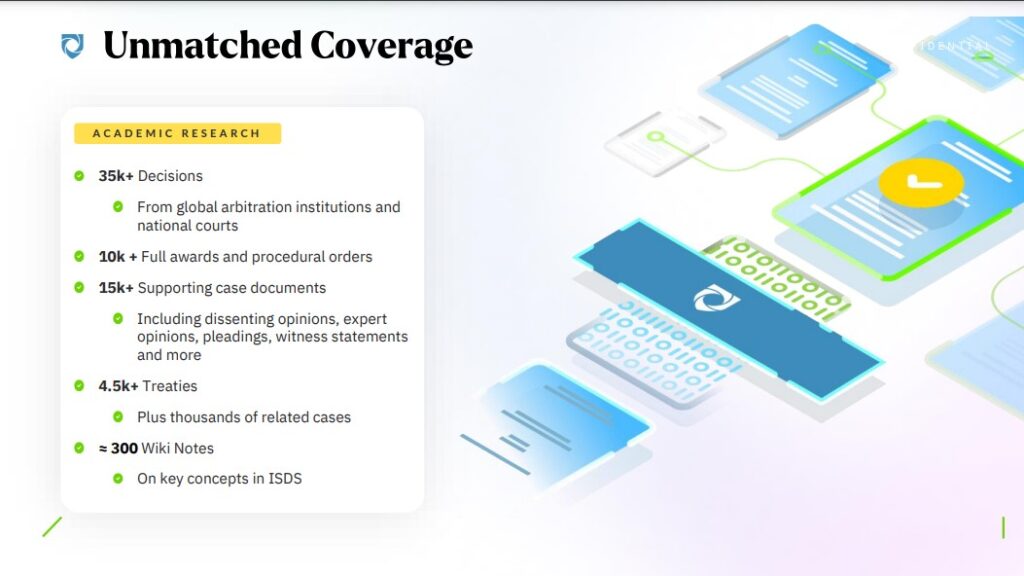
Jus Mundi is a provider who also hosts the ICC Dispute Resolution Channel, so you may already be familiar with their platform. This means we now have access not only to ICC DRL but also to Jus Mundi’s search engine + Documents on Treaties, Cases and Rules of Arbitration, and Wiki notes.
Students and staff may be interested to know there is a dedicated help center for useful information:
- FAQ on the search engine and tools
- FAQ on Wikinotes
- Tutorial videos on all products included in Academic Research Subscription.
To access Jus Mundi please visit the EResources trials page for links and usernames. Don’t forget to complete the feedback form so we know what you think!
Westlaw update: unused accounts removed
Westlaw have recently let us know that they are engaging in some housekeeping activities to ensure the University’s records are being kept up-to-date. What this means is that any University of Edinburgh users who have not accessed their accounts for more than 15 months will have their account closed. The benefits to this are that we can keep an accurate log of how many users are actively using the database and that we do not exceed the student numbers we’ve quoted to the provider.
If this happens to your account and you are still a current student or staff member who needs access, you can simply re-register your university email address on Westlaw and continue to use the platform as before. However, your preferences and saved documents or favourites will no longer be stored, so you will need to add them back into your bookmarks when you log in. To avoid losing this data simply ensure you log in to Westlaw using your account at least once per semester.
We don’t anticipate this causing any major issues for our staff or students but if you do encounter problems with Westlaw or any of our other databases, please do let us know by email.
New College Library Reopens at Mound Place
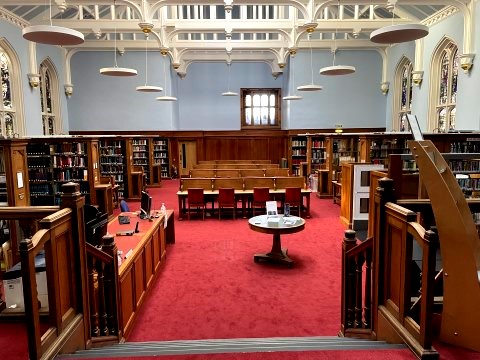
Photo of New College Library Hall, New College, Mound Place
We’re delighted to be able to tell you that New College Library re-opened on Monday 11 September at Mound Place, with access to Library Hall collections (including Reserve collections), study spaces and a range of Library and EdHelp services.
New College Library’s collections were relocated in 2020, as part of a New College site wide Fire Asset Protection project. Approximately 4 km of General Collections were moved to 40 George Square and about 3 km of Heritage Collections were moved to multiple locations, including deep storage. In August this year, library moves began to return the General Collections to their original home in Mound Place. The first students to enter the reopened library on September 11 simply said:
It’s beautiful …
While unanticipated buildings issues have delayed some collections moves, we expect that the collections in Stacks I and II will be fully available by early October. As throughout the move period, we will provide additional interlibrary loans to support access to any collection items which are inaccessible because of this delay. The move of New College Library’s Heritage Collections, originally scheduled for July 2023, has been paused while we ensure we have appropriate environmental conditions in all relevant storage spaces. We are looking forward to the return of Heritage Collections to New College later this academic year.
Further library information and opening hours at : http://www.ed.ac.uk/is/new-college- library.
This article has been cross posted from the October Library Updates newsletter. For more information on what’s new in the library this month you can read all articles here.
Trial access: ProQuest Black Studies
As part of Black History Month at the Library, we have trial access to ProQuest Black Studies. Developed with faculty, scholars and librarians, ProQuest Black Studies brings together award-winning content into one destination that can be used for research, teaching, and learning.
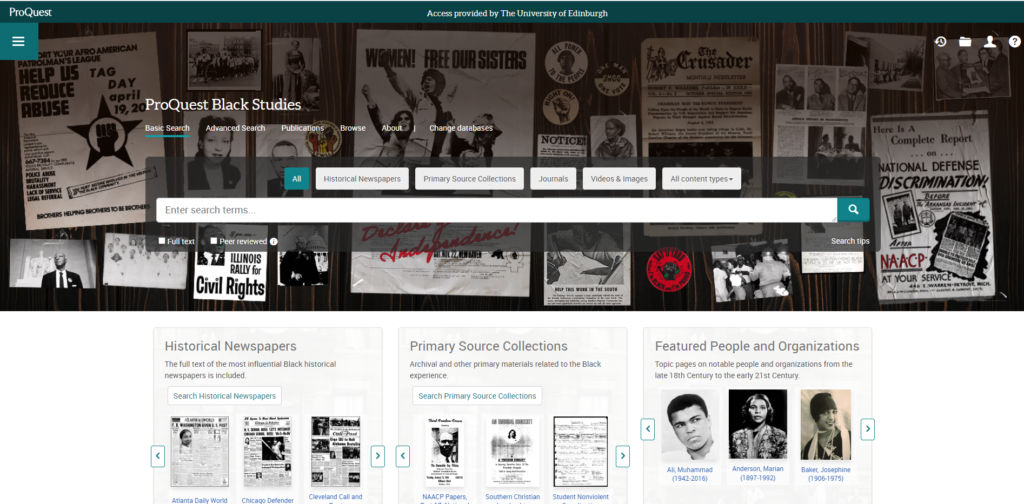
You can access ProQuest Black Studies via the E-resources trials page.
Trial access ends 15th November 2023.
ProQuest Black Studies combines primary and secondary sources, including leading historical Black newspapers, archival documents and collections, key government materials, videos, writings by major Black intellectuals and leaders, scholarly journals, and essays by top scholars in Black Studies. Read More
Working with Charles Lyell – a call for papers
Two-day workshop, 8-9 February 2024, University of Edinburgh
CALL FOR PAPERS
Contributions are invited to a two-day workshop on the life and work of the leading geologist and natural scientist Charles Lyell, to be held in the University of Edinburgh.
Building on the acquisition for the nation of the notebooks and archival papers of distinguished geologist and earth scientist Charles Lyell (1797-1875), our work towards the ‘Time Traveller’ exhibition and a soon to be launched Lyell dedicated website, we now invite papers for a 2 day workshop in Edinburgh.
The Workshop: Aims to provide a platform for persons interested in the life, work, and collections of Charles Lyell, and science in the nineteenth century, to come together to learn more of the Lyell materials held in Edinburgh, to explore how best to connect the disparate holdings of Lyell’s specimens and texts, and to consider future research possibilities on Lyell’s work and world.
Contributions in the form of a paper to be delivered at the Workshop are invited from persons working on any aspect of Lyell’s work and life, on the history of geology, or on related topics bearing upon Lyell’s writings and achievements. Contributions are also welcomed from curatorial or archival staff in institutions holding Lyell material or significant related material for an intended panel session on linking archival holdings and object collections across institutions. The Workshop will include an opportunity to see some of the Lyell materials held by Heritage Collections, and the Cockburn Geological Museum at the University of Edinburgh, and to visit the Exhibition.
Paper contributions: Papers should be 15 minutes in length (paper sessions are planned for 15-minute papers, 5 minutes discussion per paper). Please provide a title, an abstract (100 words), your title and institutional affiliation (if any), and an email address. In selecting papers for the Workshop, preference will be given to PhD or other research students and to Early Career Researchers.
Panel session contributions: Please be prepared to speak for 5-6 minutes on the Lyell material in your institution’s holdings and the opportunities it presents for further research.
To Contribute: Please send in your proposed contribution to Professor Emeritus Charlie Withers via email to: c.w.j.withers@ed.ac.uk by Friday 10 November 2023. It is hoped that the Workshop Programme Committee will reply within two weeks of this date to confirm your involvement or not.
A confirmed Workshop Programme will be available soon after this in which further details will be given on location, timings, and costs of delegate attendance at the Workshop.
We look forward to hearing from you!
Time Traveller: Charles Lyell at Work
Free exhibition in the Main Library Exhibition Gallery (ground floor),
Open from 27th October 2023 – 30th March 2024, Monday to Saturday, 10am to 6pm
Over the last few months, our efforts have been focussed on pulling together all the work to date associated with the Charles Lyell Project, into an exhibition. It has taken a small army of experts, staff, interns, and volunteers to get us to this stage – and we are nearly there. Here is a look behind the scenes…
Getting down to writing – what will be in effect – the first major exhibition on Sir Charles Lyell was a fairly daunting task. The science Lyell is writing about was new; today it can be recognised as ecology, climate and Earth studies, but in Lyell’s time it encompassed several different disciplines – geology, archaeology, geography, conchology, botany, zoology and palaeontology. The terminology is crucial, and, still under significant debate. Working in an era of imperial exploration and expansion Lyell’s travel through the slave plantations of the American South was controversial and remains disturbing. Despite his life’s work to gather, share and advocate for precise and authentic evidence in science, Lyell struggled to accept his friend Charles Darwin’s work on evolutionary theory. This exhibition explores these themes providing an unprecedented insight into how Lyell worked to establish a science that abridged deep divides of religion, race, culture, and politics.
Given these complexities, getting the right people on the exhibition team was vital, and it has been an absolute pleasure to work with Jim Secord, Director of the recently completed Darwin Correspondence Project. As Jim says, the reality is,
“getting into the 1830s is relatively easy, it’s the getting out that’s the problem”.
Jim has contributed a wealth of knowledge and experience , selecting rare books held by the University that add context to Lyell’s life and career, including motivators, Isaac Newton and James Hutton, and contemporaries such as Frederick Douglass. It has been fascinating to see how books held within the Library collections connect to Lyell’s work.
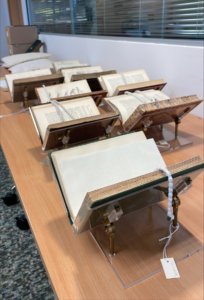
University Library books, that have been used by students over the years, contribute context to Lyell’s work.
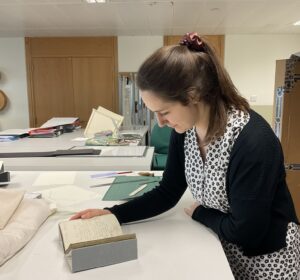
Robyn studies her successful trial to create a bespoke stand for the notebooks; re-useable and recyclable.
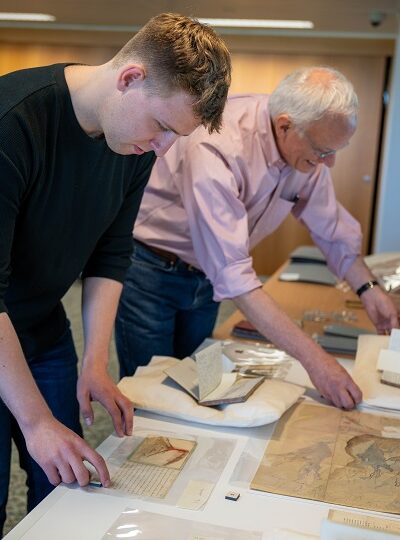
Jim and Will during ‘object selection’ day, working on choosing what items to feature.
Having completed his dissertation on Lyell’s contribution to prehistoric archaeological study, Will Adams has also been our Lyell Research Intern, tasked with curating a series of case studies, demonstrating how Lyell researched and gathered evidence to support his theories. Five display cases later, look out for Lyell as a ‘Principle Investigator’ (play on words intentional!) as he searches for evidence to support his theories on Volcanoes, Niagara, and Sea Serpents.
Will’s work has been supported by that of Lyell Summer Intern, Harriet Mack, and a crew of remote volunteers – Drew, Beverly, Bob and Ella – are are currently working to away using the digital images to transcribe notebook indexes. In the course of trying to understand them, we’ve googled, mapped, fact checked, and reached out to local people, familiar with where Lyell was working.
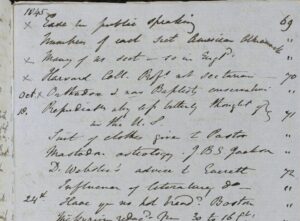
Notebooks are used in the exhibition to show how Lyell worked to gather evidence to support his theories.
The volunteer’s work has really opened up that section of the archive, producing rich descriptions that have highlighted previously unseen sections in the notebooks that will feature in the exhibition. We have worked to include their reflection on this experience, enabling us to shine a contemporary light onto the notebooks, and all the different hands that appear within their pages.
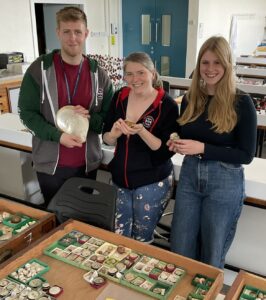
Team ‘Lyell Finds’ -Will, Dr. Gillian McCay, & Hattie at the Cockburn Geological Museum.
Lyell’s specimens were a key tool for him, and Dr. Gillian McCay of the Cockburn Geological Museum has been an integral part of our progress to understand how they connect to the archive. From the outset, everyone has been on the lookout for references to collection items (fed into and logged in a very lively teams chat ‘Lyell Finds’) and Will, through his dissertation, has been able to re-establish the events that link notebooks and specimens to Lyell’s work on the antiquity of man. There is much more work to be done in this area – and we hope the exhibition will encourage this.
Today Lyell’s questions are still relevant, and the ways in which he worked (not always successfully) to answer them can add to our own understanding. Travelling relentlessly, and often accompanied by his wife, Mary, Lyell spent his life putting time to work, chasing volcanoes, visiting coastal, industrial and heritage sites, exploring strata, caves, waterfalls, quarries, and mines. The resultant rich data contained in his archive transports us through time.
In working together on the project to open up Charles Lyell’s comprehensive archive, and in preparing this exhibition, we find we have walked in his footsteps – creating a network of experts and local people, and using different tools to consolidate our understanding.
Pamela McIntyre, Strategic Projects Archivist, Heritage Collections, University of Edinburgh
Collections
 Hill and Adamson Collection: an insight into Edinburgh’s past
My name is Phoebe Kirkland, I am an MSc East Asian Studies student, and for...
Cataloguing the private papers of Archibald Hunter Campbell: A Journey Through Correspondence
My name is Pauline Vincent, I am a student in my last year of a...
Hill and Adamson Collection: an insight into Edinburgh’s past
My name is Phoebe Kirkland, I am an MSc East Asian Studies student, and for...
Cataloguing the private papers of Archibald Hunter Campbell: A Journey Through Correspondence
My name is Pauline Vincent, I am a student in my last year of a...

Projects
Cataloguing the private papers of Archibald Hunter Campbell: A Journey Through Correspondence
My name is Pauline Vincent, I am a student in my last year of a...
Archival Provenance Research Project: Lishan’s Experience
Presentation My name is Lishan Zou, I am a fourth year History and Politics student....