Home University of Edinburgh Library Essentials
April 9, 2026
Google Cultural Institute
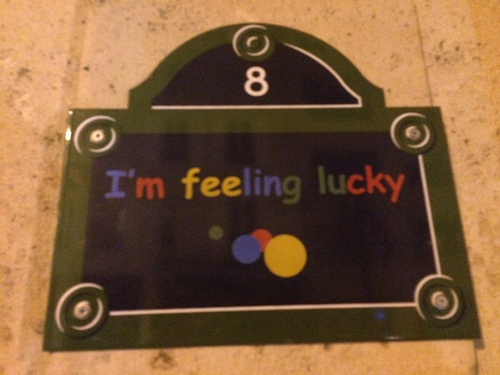
I was lucky enough to attend the Europeana loCloud Hackathon at the Google Cultural Institute in Paris, on February 11th. While I was too late to actually do any hacking with Europeana data, I did get to witness some of the interesting tools being developed using the loCloud API, and got a tour of the building.
The Google Cultural Institute has emerged from the Google Art Project, which has now digitised over 6 million artworks, and is effectively an umbrella for a number of digitisation projects in the cultural heritage sector. We were shown the AV suite, which really puts any other such room that I’ve been in to shame, with its high resolution imaging technology, developed for the Art Project. We were able to see, for example, tiny cracks in paint in Van Gogh oils, giving an insight into how he worked (apparently these cracks were caused by the lead he put in his white paint).

We were also given a souvenir to take away- a Google Cardboard Virtual Reality viewer. While still in its infancy, this is their solution to the prohibitive costs of such tools; put your android (or iOS, but this is Google, so don’t expect the branded apps on iOS!) smartphone into the cardboard, and tailored apps will allow virtual reality heritage viewing, YouTube videos, games and more. Damien Henry, star of the above video, was at work as we toured: his office is almost completely furnished in… cardboard.
Scott Renton- Library Digital Development
Reflections on IDCC 2015: How the 80/20 rule applies to Research Data Management tools
RDM Tools need to be usable by a defined and significant set of researchers
A key question for universities considering which RDM tools to adopt is how broadly useful each tool is and how widely it will be taken up by researchers across the institution. I was reminded of this when Robin Rice posed the question to Ian MacArdle and Torsten Reimer of Imperial College after listening to their presentation, ‘Green Shoots: RDM Pilot at Imperial College London’.
This is equally an issue for builders of tools. Some tools are designed to be used primarily by the people who designed them, to add value to their own research. Most of the six projects described in the Green Shoots presentation fall into that category. Other tools are designed to be used by a broader but still limited community, e.g. tools for researchers in a particular discipline. RDM tools, in contrast, need to be applicable to an even broader range of researchers, certainly across more than one discipline. I think the 80/20 rule is a good benchmark. For an RDM tool to be of interest at the institutional level it needs to be relevant to the needs of at least 80% of a defined and significant set of researchers at the institution.
Electronic lab notebook example
To illustrate this point let’s take the example of electronic lab notebooks. The target user group here includes biologists, chemists, biomedical researchers, and researchers in associated disciplines such as veterinary medicine, plant science, and food science. In a word, disciplines where the paper lab notebook is widely used. This is clearly a defined and significant set of researchers at major research institutions, so the target user group meets the minimum viable community definition.
What does an electronic lab notebook need to have and to do in order to meet the requirement of 80% of the users in this defined target group? One way of approaching this issue is to look at the reactions of ‘outliers’, i.e. researchers whose focus is so specific that a ‘generic’ offering, even one tailored to this particular set of researchers, may not be attractive. A large set of potential outliers is chemists. If there is no support for chemistry in an ELN chemists are likely to find it unsuitable for their needs. So one challenge is to build in sufficient support for chemists without having the ELN become so chemistry-focussed that other segments of the target user group find it unworkable. When this is done in most cases the majority of chemists go from being potential outliers to proponents of adoption.
A second set of outliers are bioinformaticians, who overlap with another set of outliers, researchers who build their own software as part of their research. Both of these groups tend to prefer ‘home-built’ solutions, and for this reason may not be inclined to adopt ELNs that in fact work well for” the 80%”. One way of increasing the likelihood that some members of these groups will make use of the ELN and hence become proponents is to build a good API. This enables these groups to integrate the ELN with the software and solutions they are developing, in which case they are more likely to (a) appreciate the ELN’s benefits, and (b) find that it adds value to their workflow.
A third set of outliers are those who are reluctant to adopt an ELN because for whatever reason they do not see it fitting into their workflow. In many cases this is a temporary barrier which can be overcome as the doubters come to understand the benefits of using an ELN. In other cases there is a specific issue relating to the use of a paper notebook. For example, some researchers work in labs where chemical spillage is likely. They are reluctant to bring their own tablet computer into the controlled area because they are afraid it will be damaged — they will only adopt the ELN, for use on a tablet, if the lab provides a dedicated tablet for them to use in the lab.
Applying the 80/20 rule
Sometimes the doubts raised by outliers like the ones identified above take on a higher profile than the views of the silent majority of researchers who may be willing or even keen to try out and eventually adopt an ELN, but lack effective or well-connected advocates. In this case the 80/20 rule may come in handy for those involved in RDM – take some soundings from the ‘average’ labs which don’t fall into any of the three categories of outliers noted above. If there is significant interest among this group, that could be an indication that a product trial is justified, and that, notwithstanding doubts expressed from some quarters, the 80/20 rule is in fact in operation.
Making the right RDM tools available is a joint responsibility
Reflecting on the above, it’s clear that neither developers of RDM tools or those involved in RDM management can, working in isolation, provide the RDM tools that researchers need. It’s up to tool providers to, first, design tools for the 80%, and then to be sensitive to those with specialist needs and attempt to build in capabilities that will make the tool useful to as many as possible of them, too. And it’s up to those involved in RDM management to be attentive to the needs of the ‘silent majority’ of researchers and to work with them, and with interested tools providers, to offer researchers tools that meet their needs, even when those needs may not initially be systematically or even very coherently expressed.
Explore the Geology with LUNA
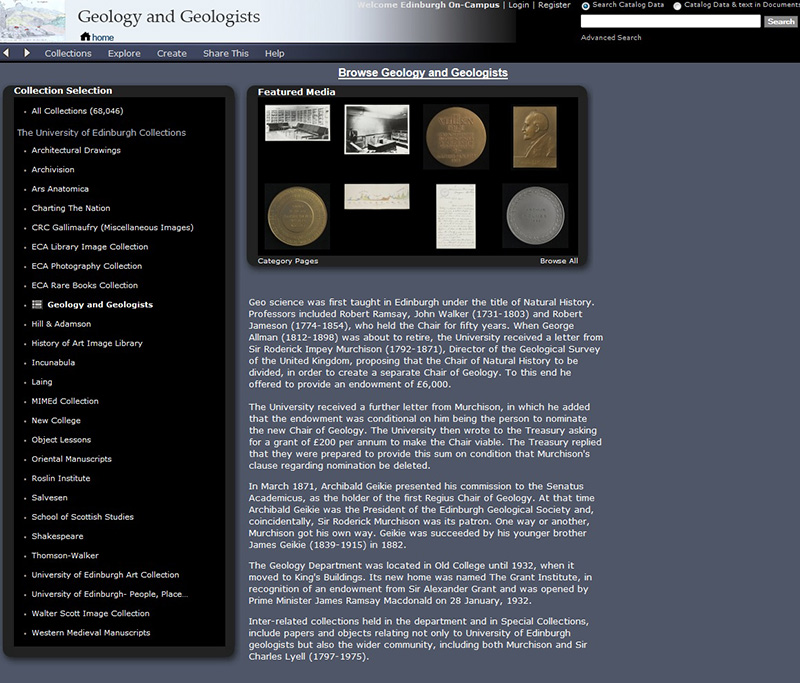
Last week we were very excited to see a new LUNA collection go live- ‘Geology & Geologists’. This brings together images from the CRC’s Lyell collection (a wonderful mixture of correspondence and drawings), Arthur Holmes Geology medals, as well as recent images from The Cockburn Museum, School of GeoSciences. The Cockburn collection contains photographs of past Professors, and historic photos of the department as well as plates of fossilised fish.
Recent acquisition – Small archive relating to ‘The Jabberwock’

Artwork from a poster advertising a 1958 issue of ‘The Jabberwock’. Coll-1611.
Assisted by the College, a small but interesting archive of material relating to the Edinburgh University literary review, The Jabberwock, has been acquired by the Centre for Research Collections (Special Collections) for Edinburgh University Library.

Letter-heading from correspondence of the Editorial office of ‘The Jabberwock’. Coll-1611.
The Jabberwock was an Edinburgh University literary journal, or review, starting in the 1940s and running to the late-1950s, and its editors have included Iain Ferguson, Ian F. Holroyd, Douglas Henderson, Barbara Macintosh and Alex Neish.

Cartoon describing the arrival of ‘The Jabberwock’, Edinburgh University. Coll-1611.
The archive contains manuscript and typescript work – literary and political – submitted to the title in the 1950s under the editorship of Ian Holroyd by Scottish literary figures such as: C. M. Grieve, or Hugh MacDiarmid; Robert Garioch; Martin Gray; Sydney Goodsir Smith; Bruce Etherington; Alan Riddell; Jonathan Mills; and, other contributors.

Note to the Editor of ‘The Jabberwock’ from Martin Gray telling about his submissions to the review. Coll-1611.
Also in the archive, there is correspondence to and from Ian F. Holroyd, posters for various editions of The Jabberwock and other printed ephemera, journal off-prints that would have assisted in the editing of some articles, scribbled accounts and sales figures, art-work, and some Jabberwock Committee Meeting minutes. Some typed lists of Jabberwock shop sales prompt recall of Edinburgh booksellers no longer with us – Thin’s, Baxendine’s, and Bauermeister’s.

Poster advertising the Volume 5. 1958 issue of ‘The Jabberwock’. Coll-1611.
Holroyd’s correspondents include, among others: Compton Mackenzie; Sean O’Casey; C. M. Grieve or Hugh MacDiarmid; Edwin Muir; Edith Sitwell; Jonathan Mills; Neil Gunn; and, Martin Gray.

Poster for an edition of ‘The Jabberwock’ featuring contributions by Compton Mackenzie and Helen Cruickshank. Coll-1611.
Submissions to The Jabberwock by Hugh MacDiarmid include autograph manuscripts: The Scottish Renaissance: the next step; R.B.Cunninghame Graham; and, The significance of Sydney Goodsir Smith. The archive holds a typescript piece by Compton Mackenzie, at the time aged 70 (so probably from 1953), in which he lauds twenty-somethings, writing ‘that the University magazine of today is a much more interesting production than it was half a century ago […] I find a magazine like Jabberwock much more lively than The Oxford Point of View. I can read it through from cover to cover with pleasure […] I am quite unable to grasp what inspires all this pessimism over modern youth’.

Letter dated 14 April 1952 to Ian Holroyd, Editor of ‘The Jabberwock’ from Compton Mackenzie promising a contribution. Coll-1611.

Letter dated 3 June 1952 to Ian Holroyd, Editor of ‘The Jabberwock’ from Compton Mackenzie again promising a contribution. Coll-1611.

Signature of Hugh MacDiarmid (C.M.Grieve) on a letter dated 23 November 1950 to Ian Holroyd, Editor of ‘The Jabberwock’. Coll-1611.

Signature of Edith Sitwell on a letter dated 23 October 1951 to Ian Holroyd, Editor of ‘The Jabberwock’. Coll-1611.

Signature of Sean O’Casey on a letter dated 24 April 1958 to Ian Holroyd, Editor of ‘The Jabberwock’. Coll-1611.

Signature of Neil Gunn on a letter dated 24 April 1958 to Ian Holroyd, Editor of ‘The Jabberwock’. Coll-1611.
Dr. Graeme D. Eddie, Assistant Librarian Archives & Manuscripts, Centre for Research Collections
Access alert – e-journals unavailable
Our e-journals are currently unavailable via A-Z library links, Searcher and the catalogue. This is being investigated by our IT staff.
In the meantime, please access the journals directly on campus or off campus via the VPN or by adding http://ezproxy.is.ed.ac.uk/login?url= to the front of a url eg for nature journal, the link is http://www.nature.com and then add http://ezproxy.is.ed.ac.uk/login?url= to make it http://ezproxy.is.ed.ac.uk/login?url=http://www.nature.com which will then work off campus. There is also the option to log in off campus via UKFederation/Shibboleth if offered by the publisher.
We will add an update to this post once access is restored. Access has been restored.
Win £50 book token!
This summer the Library is launching a new Discovery service which will combine the functionality of the Library Catalogue and Searcher into one single search tool that will help you to easily discover the resources you need for your study and research.
The Library will be using Primo for the new discovery service but “Primo” is just the product name. We would like you to help name the service for our Library. If your suggested name is chosen then you will win £50 worth of book tokens. The competition is open to all staff and students of the University. Entries must be received by 5pm (GMT) on Friday 20th February 2015.
For more information on the competition and how to enter see:
What’s in a name? Help us decide. Read More
Getting to the Heart of the Matter
This blog post starts where I left off last time (with another pun!) and details my efforts on the Thomson-Walker medical print collection thus far, describing the first phase of the project.
After I had spent a few days surveying the boxes of prints I began to get a better idea of how to best approach treating the entire collection and started to investigate various rehousing ideas, as well as experimenting with numerous adhesive removal techniques. The main requirement for the adhesive removal was to be able to lift a range of adhesives, at various stages of degradation on differing primary supports allowing for the safe and quick removal of carrier and adhesive for the majority of the 2500 prints. It was decided quite early on during the survey that a poultice would work best for such a task. A poultice is a swelling agent commonly made with a viscous substance used to slowly and controllably release moisture. This would permit a number of objects to be treated simultaneously and, if the correct poultice method was adopted, to remove an adhesive easily and equally – such a technique would not only be beneficial for the wellbeing of the prints, but would also be time and cost effective.
I began my experimentation with the Albertina poultice, a ready for use amylase poultice that removes un-swellable starch pastes. I was sent a sample kit, which comprised of two interleaving silk tissue papers, an amylase poultice, and a small piece of blotter. I experimented with this system on a variety of prints from the collection, however whilst the poultice worked wonderfully on some adhesives and carriers (presumably starch based) the poultice failed on others. Because of this I believed that despite the Albertina poultice working well on certain adhesives, and with the added benefit of reusability (the Albertina poultice can be stored and reused for at least 12 months) it was not a suitable option considering the varied adhesives present within the collection.
Next, I experimented with high viscosity carboxymethyl cellulose sodium salt poultice strips, a method devised at the Book and Paper Conservation Studio at the University of Dundee. To be efficient and economical the CMC is wrapped in Japanese tissue to create individual poultice strips that are then placed directly onto the carrier of the adhesive and left to take action. I discovered that to easily remove the adhesive and carrier the poultice strip only needed to be in place for about 20 minutes and thereafter the adhesive/carrier could be gently lifted and removed. This particular poultice worked on a variety of tape and adhesives and the reusable strips were easy to handle and manipulate according to shape and size of the adhesive layer. So far the poultice has been successful on a range of tapes and adhesives including starch based adhesives, animal glue, and masking and glassine tape.
And so, there you have it, the Carboxymethyl Cellulose strips created perfect and painless poulticing – a swift operation, if I do say so myself…
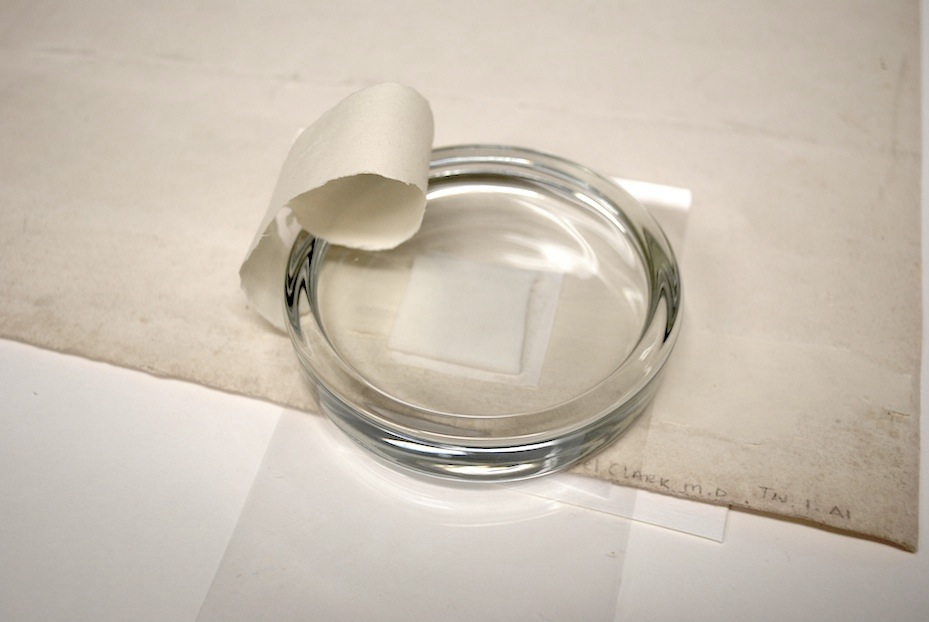
Albertina Poultice sample at work
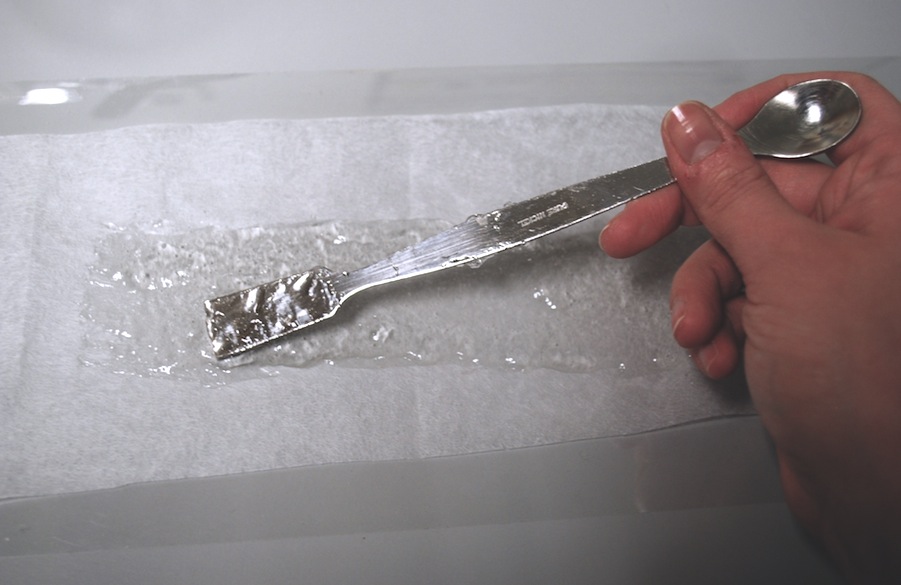
Making CMC poultice

CMC poultice at work

Adhesive and carrier removal after using the CMC poultice
Post by Samantha Cawson, Conservation Intern
Trial – ACLS Humanities E-Book package
 We have trial access to ACLS Humanities E-Book package until the 5th April.
This electronic resource includes 4,315 full-text, cross-searchable books in the humanities selected by scholars for their continuing importance for research and teaching. Lists of titles can be found online at: http://www.humanitiesebook.org/titlelist.html.
The project includes both in-print and out-of-print books and many prize-winning works. It is a ongoing collaboration of the American Council of Learned Societies, various constituent member learned societies of the ACLS (http://www.humanitiesebook.org/societies.html), and over 100 publishers. 300-500 titles are added every year.
To access HEB, please go to http://www.humanitiesebook.org.
–> Select Browse from top toolbar.
–> Click on any title. This will bring you to a screen with information about the book.
–>To view the full text of a chapter, click on the chapter title in the table of contents. You can select Search from the top toolbar to look for specific titles. To browse through HEB’s special series, select The Collection from the top toolbar and click on the links for series such as the College Art Association Monographs: http://www.humanitiesebook.org/the-collection/series_CAA.html and the Cambridge University Press series: http://www.humanitiesebook.org/the-collection/series_CamUP.html, the Society of Biblical Literature series: http://www.humanitiesebook.org/the-collection/series_SBL.html, and the Records of Civilization series: http://www.humanitiesebook.org/the-collection/series_ROC.html.
HEB Titles Online as of Dec. 2014
To download the spreadsheet, please visit:
http://www.humanitiesebook.org/the-collection/default.html
This spreadsheet, with 4,315 titles in all, represents the total number of books on the HEB site as of Dec. 2014. This list is formatted as a downloadable Excel spreadsheet and includes author, title, publication information, ISBN, LC catalog number, subject area, direct URL, and date live on HEB.
Fields currently covered include Area and Historical Studies in the following: African, American, Asian, Australasian/Oceanian, Byzantine, Canadian, Caribbean, Central European, Comparative/World, Eastern European/Russian, Economic, Environmental, European, Jewish Studies, Latin American, Law, LGBT/Queer Studies, Medicine, Methods/Theory, Middle East, Native Peoples of the Americas, Science/Technology, Women’s Studies. HEB also encompasses the fields of Archaeology, Art and Architectural History, Biblical Studies, Bibliographic Studies, Film and Media Studies, Folklore, Linguistics, Literature, Literary Criticism, Musicology, Performance Studies (theater, music, dance), Philosophy, Political Science, Religion, and Sociology.
Feedback and further info
We are interested to know what you think of this e-book package and platform as your comments influence purchase decisions so please do fill out our feedback form.
A list of all trials currently available to University of Edinburgh staff and students can be found on our trials webpage.
Leading a Digital Curation ‘Lifestyle’: First day reflections on IDCC15
[First published on the DCC Blog, republished here with permission.]
Okay that title is a joke, but an apt one to name a brief reflection of this year’s International Digital Curation Conference in London this week, with the theme of looking ten years back and ten years forward since the UK Digital Curation Centre was founded.
The joke references an alleged written or spoken mistake someone made in referring to the Digital Curation lifecycle model, gleefully repeated on the conference tweetstream (#idcc15). The model itself, as with all great reference works, both builds on prior work and was a product of its time – helping to add to the DCC’s authority within and beyond the UK where people were casting about for common language and understanding in this new terrain of digital preservation, data curation, and – a perplexing combination of terms which perhaps still hasn’t quite taken off, ‘digital curation’ (at least not to the same extent as ‘research data management’). I still have my mouse-mat of the model and live with regrets it was never made into a frisbee.
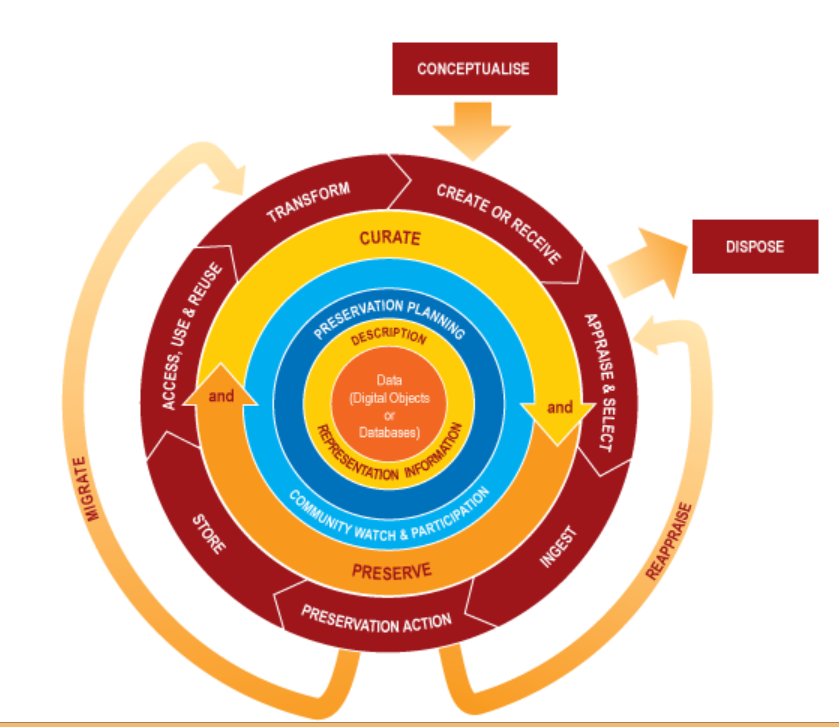
The Digital Curation Lifecycle Model, Sarah Higgins & DCC, 2008
They say about Woodstock that ‘if you remember it you weren’t really there’, so I don’t feel too bad that it took Tony Hey’s coherent opening plenary talk to remind me of where we started way back in 2004 when a small band under the directorship of Peter Burnhill (services) and Peter Buneman (research) set up the DCC with generous funding from Jisc and EPSRC. Former director Chris Rusbridge likes to talk about ‘standing on the shoulders of giants’ when describing long-term preservation, and Tony reminded us of the important, immediate predecessors of the UK e-Science Programme and the ground-breaking government investment in the Australian National Data Service (ANDS) that was already changing a lot of people’s lifestyles, behaviours and outlooks.
Traditionally the conference has a unique format that focuses on invited panels and talks on the first day, with peer-reviewed research and practice papers on the second, interspersed with demos and posters of cutting edge projects, followed by workshops in the same week. So whilst I always welcome the erudite words of the first day’s contributors, at times there can be a sense of, ‘Wait – haven’t things moved on from there already?’ So it was with the protracted focus on academic libraries and the rallying cries of the need for them to rise to the ‘new’ challenges during the first panel session chaired by Edinburgh’s Geoffrey Boulton, focused ostensibly on international comparisons. Librarians – making up only part of the diverse audience – were asking each other during the break and on twitter, isn’t that exactly what they have been doing in recent years, since for example, the NSF requirements in the States and the RCUK and especially EPSRC rules in the UK, for data management planning and data sharing? Certainly the education and skills of data curators as taught in iSchools (formerly Library Schools) has been a mainstay of IDCC topics in recent years, this one being no exception.
But has anything really changed significantly, either in libraries or more importantly across academia since digital curation entered the namespace a decade ago? This was the focus of a panel led by the proudly impatient Carly Strasser, who has no time for ‘slow’ culture change, and provocatively assumes ‘we’ must be doing something wrong. She may be right, but the panel was divided. Tim DiLauro observed that some disciplines are going fast and some are going slow – depending on whether technology is helping them get the business of research done. And even within disciplines there are vast differences –-perhaps proving the adage that ‘the future is here, it’s just not distributed yet’.
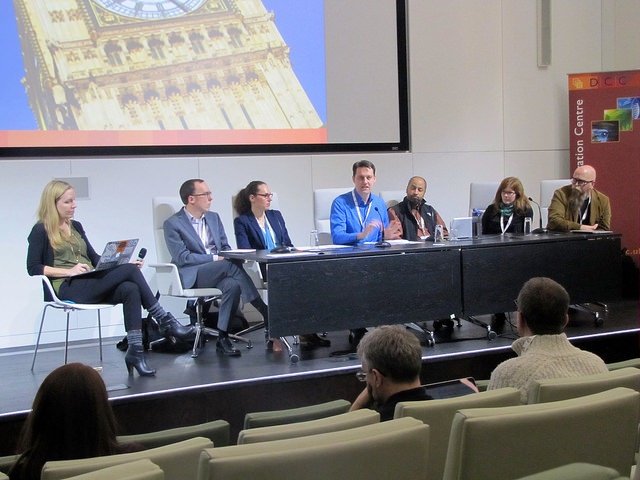
Carly Strasser’s Panel Session, IDCC15
Geoffrey Bilder spoke of tipping points by looking at how recently DOIs (Digital Object Identifiers, used in journal publishing) meant nothing to researchers and how they have since caught on like wildfire. He also pointed blame at the funding system which focuses on short-term projects and forces researchers to disguise their research bids as infrastructure bids – something they rightly don’t care that much about in itself. My own view is that we’re lacking a killer app, probably because it’s not easy to make sustainable and robust digital curation activity affordable and time-rewarding, never mind profitable. (Tim almost said this with his comparison of smartphone adoption). Only time will tell if one of the conference sponsors proves me wrong with its preservation product for institutions, Rosetta.
It took long-time friend of the DCC Clifford Lynch to remind us in the closing summary (day 1) of exactly where it was we wanted to get to, a world of useful, accessible and reproducible research that is efficiently solving humanity’s problems (not his words). Echoing Carly’s question, he admitted bafflement that big changes in scholarly communication always seem to be another five years away, deducing that perhaps the changes won’t be coming from the publishers after all. As ever, he shone a light on sticking points, such as the orthogonal push for human subject data protection, calling for ‘nuanced conversations at scale’ to resolve issues of data availability and access to such datasets.
Perhaps the UK and Scotland in particular are ahead in driving such conversations forward; researchers at the University of Edinburgh co-authored a report two years ago for the government on “Public Acceptability of Data Sharing Between the Public, Private and Third Sectors for Research Purposes,” as a pre-cursor to innovations in providing researchers with secure access to individual National Health Service records linked to other forms of administrative data when informed consent is not possible to achieve.
Given the weight of this societal and moral barrier to data sharing, and the spread of topics over the last 10 years of conferences, I quite agree with Laurence Horton, one of the panelists, who said that the DCC should give a particular focus to the Social Sciences at next year’s conference.
Robin Rice
Data Librarian (and former Project Coordinator, DCC)
University of Edinburgh
Trial – Film Industry Data
 We have trial access to Film Industry Data from Academic Rights Press until the 9th March.
Film Industry Data enables the gathering of information about film trends and research into the impact of film across countries and cultures. Films tell us about global culture, politics and society. Now you can get the facts behind the film industry with the exclusive Nielsen backed Film Industry Data collection. This database synthesises movie industry data to help you make new connections, gain valuable insights and tell new stories
Feedback and further info
We are interested to know what you think of this database as your comments influence purchase decisions so please do fill out our feedback form.
A list of all trials currently available to University of Edinburgh staff and students can be found on our trials webpage.
Collections
 Hill and Adamson Collection: an insight into Edinburgh’s past
My name is Phoebe Kirkland, I am an MSc East Asian Studies student, and for...
Cataloguing the private papers of Archibald Hunter Campbell: A Journey Through Correspondence
My name is Pauline Vincent, I am a student in my last year of a...
Hill and Adamson Collection: an insight into Edinburgh’s past
My name is Phoebe Kirkland, I am an MSc East Asian Studies student, and for...
Cataloguing the private papers of Archibald Hunter Campbell: A Journey Through Correspondence
My name is Pauline Vincent, I am a student in my last year of a...

Projects
Cataloguing the private papers of Archibald Hunter Campbell: A Journey Through Correspondence
My name is Pauline Vincent, I am a student in my last year of a...
Archival Provenance Research Project: Lishan’s Experience
Presentation My name is Lishan Zou, I am a fourth year History and Politics student....