Home University of Edinburgh Library Essentials
April 9, 2026
Library Play Day
 Last Friday, Gavin, Caroline, Matthew and I attended a Library Gamification day organised by the Scottish Academic Libraries Cooperative Training Group. Andrew Walsh, from the University of Huddersfield gave us an introduction to gamification and then gave us all a pack of Lego with the challenge to build our ideal librarian.
We then play ed different games to discover the different game mechanics we could use when building our own library games later in the day. The Lego was again utilised to form groups for the rest of the day based on common issues we wanted to address. Here’s my Lego model of a problem we face here at the University of Edinburgh, the Lego wall represents the Main Library, with the pink and red blocks being the floors most undergraduates visit and the grey floors the Lower Ground Floor, fifth and sixth floors containing the rare and unique collections that are unknown to many of our students.
We then created board and card games based on the common issues we face in our libraries.
The group I was in created a ca rd game called ‘Library Soup’, where each player was given a ‘recipe card’, representing an assignment that they had to complete with five visits to the Library (five turns). The player with the highest points at the end was the winner. The aim of the game was to teach the players that not all library resources are equal. As the assignment could be completed with resources with low points, e.g. a magazine article or high points e.g. a peer-reviewed article.
 Gavin and Matthew’s team created a board game called ‘Find-It‘ to encourage users to discover resources in their University Library. Players started off at the library entrance, drew cards to see what items / resources they had to locate and then searched for these in the physical and digital library space. The game aimed to raise awareness of the diversity of library resources available while orientating students around the library building.
In Caroline’s teams game ‘Database Ace‘  players worked their way up the board picking up reward, risk and chance cards. The cards taught users about the use of online database in their assignments.
Andrew, also gave us an overview of ‘Lemon Tree‘ a rewards based application developed in partnership with University of Huddersfield Library, which gives users points and badges for library activities.
Videos of all the games designed on the day are available on Andrew’s Blog .
Claire Knowles, Gavin Willshaw, Caroline Stirling and Matthew Pang
Charles Sarolea and his relief effort for Belgium during the War
RELIEF FOR BELGIUM… OFFERS OF AID FROM ALL OVER SCOTLAND

If we are to let our collections talk about the First World War, then surely the story of Charles Sarolea (1870-1953) and his efforts to aid the people of war-ruined Belgium has to be told. His wartime story emerges from the files, folders and boxes of the very large Sarolea Collection of writings and correspondence (Coll-15, Centre for Research Collections). Sarolea’s aid effort continued from the opening days of the assault on Belgium until the last months and days of the War.

Wartime propaganda… National personification of Belgium… Mother Belgium or ‘Belgica’… ‘La Belgique’… ‘La Belge’… on a Scottish booklet published by the Belgian Relief Fund. From file entitled ‘Everyman Belgian Relief Fund 1914-1916′, in Sarolea Collection 76, Coll-15
Who was Charles Sarolea? Charles Sarolea was born on 25 October 1870 in Tongeren (Tongres) in the Belgian province of Limburg. He was educated at the Royal Atheneum in nearby Hasselt before going on to the University of Liege where he was awarded first class honours in Classics and Philosophy. In 1892 he was given a Belgian Government travelling scholarship, and between 1892 and 1894 he studied in Paris, Palermo and Naples. Still in his early 20s he became private secretary and literary adviser to Hubert Joseph Walthère Frère-Orban (1812-1896) who had been Prime Minister of Belgium (Liberal Party) between 1878 and 1884. This task brought Sarolea early initiation into wide circles of international affairs, both political and cultural. Indeed later, the Belgian Royal Family would be counted among his circle.

In 1894, at the age of 24, Charles Sarolea became the first holder of the newly-founded Lectureship in French Language and Literature and Romance Philology at Edinburgh University, and in 1918 he would become the first Professor of French when that Chair was established at the University. He held a post and Chair at the University for some 37-years, 1894-1931. From 1901, Sarolea was also the Belgian Consul in Edinburgh.

Photograph in Dr. Charles Sarolea author, lecturer, cosmopolitan in the file entitled ‘Biographical and bibliographical material relating to C. Sarolea’, in Sarolea Collection 223, Coll-15.
From 1891 until the outbreak of War in August 1914, Sarolea had written books on a wide range of international affairs and topics, including: Henrik Ibsen (1891); Essais de philosophie et de literature (1898); Les belges au Congo (1899); A Short History of the Anti-Congo Campaign (1905); The French Revolution and the Russian Revolution (1906); Newman’s Theology (1908); The Anglo-German Problem (1912); and, Count L.N. Tolstoy. His life and work (1912). From 1912 until 1917, he was also Editor of the Everyman magazine published by J. M. Dent – the magazine which features prominently in our story about Belgium.

Everyman, edited by Charles Sarolea 1912-1917.
Many other resources elsewhere can tell the in-depth military and strategic story of Belgium’s stubborn resistance during the early days of the War, but a brief foray into the Belgian experience can do no harm here in a phrase or two. Basically… the Belgian army – around a tenth the size of the German army – managed to frustrate the infamous Schlieffen Plan to capture Paris, and held up the German offensive for nearly a month giving the French and British forces time to prepare for a counter-offensive on the Marne.

The Special Belgium issue of Everyman, November 1914, contained pictures of the war-spoiled country. From a file entitled ‘Everyman Belgian Relief Fund 1914-1916′, in Sarolea Collection 77, Coll-15.

The Special Belgium issue of Everyman, November 1914, contained pictures of the war-spoiled country. From a file entitled ‘Everyman Belgian Relief Fund 1914-1916′, in Sarolea Collection 77, Coll-15.
In this opening phase of the War, many hundreds of civilian Belgians were killed, many thousands of homes were destroyed, and nearly 20% of the population escaped from the invading German army.

Destroyed house in Malines (Mechelen) in the Province of Antwerp, Belgium. From an envelope of ‘Miss Findlay’s photographs’, in the file entitled ‘Everyman Belgian Relief Fund, 1914-1916′, Sarolea Collection 76, Coll-15.
Goodwill towards Belgian refugees and those Belgians remaining in the country was shown right across the UK, not least in the form of the Belgium Relief Fund launched by The Times, the National Committee for Relief in Belgium, and the Belgian Orphan Fund.

Circular advertising the ‘Everyman Belgian Relief and Reconstruction Fund’. From a file entitled ‘Everyman Belgian Relief Fund 1914-1916′, in Sarolea Collection 77, Coll-15.
Also, from the very outset of War in August 1914, the Everyman magazine had established its own Belgian Relief and Reconstruction Fund and this was administered by the Charles Sarolea, the Belgian Consul, in Edinburgh, assisted by a Committee.

Collection envelopes issued by the National Committee for Relief in Belgium. The design showing a mother and child was by Louis Raemaekers. From a file entitled ‘Belgian Consular Correspondence, 1915-1919’, in Sarolea Collection 73, Coll-15.
Goodwill was also registered across Scotland where a National Appeal for Belgium was opened, as this item from the Sarolea Collection shows (from file entitled ‘Everyman Belgian Relief Fund 1914-1916′, in Sarolea Collection 76, Coll-15). The pamphlet issued by the National Appeal provided a summary of the work undertaken in Scotland where the number of Belgian refugees registered in the country in December 1915 was 13,307.


The fact that the Editor of Everyman was of Belgian origin and that he was the Belgian Consul in the capital of Scotland enabled him to be in close touch with events as they unfolded in Belgium and with the conditions of the civilian population. On 13 October 1914, as the British and French troops tried to outflank the German army – and thus establish the general shape of the Front from the Channel coast to the border with Switzerland for the next four years – Sarolea was informed by the Consul General in London (Edouard Pollet) that the legitimate Belgian government had left Ostend in Belgium for the safety of Le Havre, France.

Letter from the Belgian Embassy in London to Sarolea at the Belgian Consulate in Edinburgh indicating the removal of the Belgian government to Le Havre, France. From a file entitled ‘Belgian Consular Correspondence, 1915-1919’, in Sarolea Collection 73, Coll-15.
As for Belgian Relief… Sarolea and the Belgian Consulate in Edinburgh received money and requests for collecting boxes and other means of formalising the collection of funds. From all across Scotland, the Consulate also received offers of hospitality and requests for cooks, kitchen-maids, laundry-workers, nursery-maids, tutors, knitter-mechanics, sewing-maids, gardeners, grooms, house-maids and other domestic servants, and ploughmen and other agricultural workers – jobs for Belgian refugees.
A list of ‘Offers of Hospitality received at the Belgian Consulate, Edinburgh’ in the file entitled ‘Everyman Belgian Relief Fund 1914-1916′, in Sarolea Collection 76, notified the following generous offers…: From Eyemouth came the offer for a ‘Lad as boots in hotel, permanent’, with ‘Food, travelling clothes, all offered, and 2/6 a week and all tips, say 7/6 per week’ (2/6 was one-eighth of £1 in the old currency). From North Berwick came the offer of a post as ‘Domestic servant £18, with child £12’, and from Dunblane ‘two bed-rooms, each with double beds, for superior refugees, to live with family’, and the same household would also take ‘two Belgian servants to do work and receive wages’.

Offer of help received by Sarolea at the Belgian Consulate, Edinburgh. From a file entitled ‘Everyman Belgian Relief Fund 1914-1916′, in Sarolea Collection 76, Coll-15.

Offer of help received by Sarolea at the Belgian Consulate, Edinburgh. From a file entitled ‘Everyman Belgian Relief Fund 1914-1916′, in Sarolea Collection 76, Coll-15.
A household in Fife offered a placement for a ‘Mother and daughter (past school age) or two sisters as servants’, and the offer extended to ‘£24 for the two and help with their wardrobe’. From Peterhead came the offer to take ‘One little girl for an indefinite period’ and the girl could be taken ‘at once’. And, from the Kinnordy Estate, Kirriemuir came the offer of ‘Two houses’ for up to 44 ‘Cultivated and scientific people’ and this could include work.

Letter with contribution to the Fund from someone who ‘deeply feels for brave little Belgium’ and who had visited Dinant a few years earlier. Dinant had been severely damaged in the first months of the war. From a file entitled ‘Everyman Belgian Relief Fund 1914-1916′, in Sarolea Collection 77, Coll-15.
Many letters from children were received with money raised in various ways – such as selling flowers from the garden or making pictures made from postage stamps – as these letters show here:

Letter from children in Balerno, 1914. In packet/envelope ‘Letters from children for possible publication’ in the file ‘Everyman Belgian Relief Fund, 1914-1916′. Sarolea Collection 77, Coll-15.

Second page of the letter. In packet/envelope ‘Letters from children for possible publication’ in the file ‘Everyman Belgian Relief Fund, 1914-1916′. Sarolea Collection 77, Coll-15.

Picture of ‘La Belge’ by a 14-year old girl from Edinburgh, and made from postage stamps, 1914. In the file ‘Letters from children for possible publication’ in the file ‘Everyman Belgian Relief Fund, 1914-1916′. Sarolea Collection 77, Coll-15.
Soldiers too benefited from the charitable-giving fostered by the relief effort centred on the Belgian Consulate in Edinburgh. In 1917 an appeal was raised on behalf of Belgian soldiers ‘spending their hard-earned leave in the Edinburgh district’. In a letter from the ‘Edinburgh Consular Belgian Relief Fund’ to the Editor of the Scotsman in October 1917, it was pointed out that the pay of a Belgian soldier was only just over 2d per day (around 50p at today’s levels) and that a soldier could not afford maintenance expenses while in Edinburgh. The Fund made an appeal asking for help from ‘citizens of Edinburgh who would be willing to give those soldiers hospitality or to pay for their maintenance whilst on leave’. The Fund was sure that Edinburgh’s people would help ‘those brave Belgian lads’.

Draft letter to the ‘Scotsman’, 3 October 1917, requesting help from the people of Edinburgh for Belgian soldiers on leave in the city. From the file ‘Edinburgh Consular Relief Fund 1916-1918. Correspondence’, in the wider file ‘Everyman & Edinburgh Consular Belgian Relief Funds. Correspondence & figures, 1914-1918′. Sarolea Collection 78, Coll-15.
In November 1914, Sarolea issued a Special Belgium number of the magazine, Everyman. Illustrated with Albert I, King of the Belgians, on the front cover, the issue was seen as a ‘means of making a wider appeal to the sympathy and generosity’ of readers. Sarolea claimed that from the start of the assault on Belgium in August 1914 until the Special Belgium issue, the magazine’s ‘efforts have resulted in the raising for the relief of Belgian distress and the reconstruction of Belgian prosperity the substantial sum of thirty-one thousand pounds (£31,000)’ – a colossal sum 100 years ago, the equivalent of £3-million today. Until the Everyman effort, no weekly magazine ‘has ever raised anything like so large a sum for the public cause’.

Front cover of Everyman, November 1914. From a file entitled ‘Everyman Belgian Relief Fund 1914-1916, in Sarolea Collection 77, Coll-15.
The Special Belgium issue was filled with articles and photographs, with many of these describing and illustrating the destruction and suffering experienced by Belgians.

Like many contemporary journals, the Everyman Special Belgium issue contained patriotic advertisements for household shopping – drinks and sweets.


In addition to papers and correspondence specifically concerning the ‘Everyman Belgian Relief and Reconstruction Fund’ within the expansive Sarolea Collection, the files also contain ephemera produced by other charitable efforts. One piece is a copy of a drawing produced by Louis Raemaekers (1869-1956) the Dutch painter and editorial cartoonist for De Telegraaf, the Amsterdam daily newspaper. His drawing was used by the Belgian Orphan Fund which encouraged the contribution of sixpence to ‘Save that Child!’

Drawing by Louis Raemaekers and used by the Belgian Orphan Fund. From a file entitled ‘Belgian Consular Correspondence, 1915-1919’, in Sarolea Collection 73, Coll-15.
Even in November 1914, those behind the Special Belgium issue of Everyman were looking ahead to the end of the War which many believed would be of short duration. A piece by the Belgian-British Reconstruction League talked of the ‘tremendous task’ ahead. ‘A whole country will have to be reclaimed from devastation. A whole people will have to be repatriated and resettled’. As the War ground on though, Sarolea travelled extensively during 1914 and 1916 – across France and to Switzerland and Italy – as his passport shows.

Passport issued in December 1914 to Charles Sarolea, naturalised British subject of Belgian origin, travelling to France… but not valid for travel in Army zones. In the file entitled ‘C.S. personal documents, Passport etc’. Sarolea Collection 222, Coll-15.
The ‘Everyman Belgian Relief and Reconstruction Fund’ was wound up towards the end of 1917, and real reconstruction across Belgium would be well underway by the early 1920s. By the end of the war, some 200,000 Belgians had sought refuge across the UK – 17,000 in the Glasgow area alone – and around £6-million to £7-million had been contributed to all of the Belgian charities (circa £400-million today), and these figures were used by Sarolea in his defensive ‘open letter’ to an English correspondent who had criticised the effort.

Sarolea defended charitable giving to Belgians in this ‘open letter’ written in May 1917. From the file ‘Belgian Consular Correspondence, 1915-1919’. Sarolea Collection 73, Coll-15.
Immediately after the War, in March 1919, in Edinburgh, Charles Sarolea was presented with an illuminated scroll by grateful Belgians honouring his wartime work for aid to Belgium. Heading the signatures on the scroll was that of the Rev. O. M. Couttenier a Belgian priest in Edinburgh.

Scroll presented to Charles Sarolea by grateful Belgians. Sarolea Collection 222, Coll-15.
Professor Charles Sarolea resigned his Chair in 1931 but continued to reside in Edinburgh and remained as Belgian Consul in the city until his death in 1953. In 1954, his papers and correspondence were purchased for Edinburgh University Library.

Detail from the front cover of Everyman, November 1914. In a file entitled ‘Everyman Belgian Relief Fund 1914-1916′, in Sarolea Collection 77, Coll-15.
Dr. Graeme D. Eddie, Assistant Librarian Archives & Manuscripts, Centre for Research Collections
Thomas Nelson Exhibition: Covers in Colour
The new exhibition in the CRC showcases a number of items from the Thomas Nelson Archive, which has been written about on this blog more than once in the past. It really is an interesting collection and it’s great to see some of the books making it into the public eye.
Fiona Mowat and Beth Dumas, who began organising and cataloguing the collection of over 10,000 books, have worked with Emma Smith to make this exhibition possible. In it you can see a range of books from throughout the 20th century including stylish art deco designs and pulpy dust-jackets from the ‘40s and ‘50s. There is plenty of sci-fi and and romance present for genre fans!
The exhibition can be seen at the Binks Trust Display Wall at the Centre for Research Collections on the 6th floor of the Main Library from 3 March until 21 May 2015.
More information can be found here:
Read more about the Thomas Nelson Archive at the Library Annexe here:
[Blog] Fiona an Beth blog about their work on the Thomas Nelson collection
[Blog] The AnneXe Factor: Full Nelson Archive
Carl Jones, Library Annexe Supervisor
EPSRC Expectations Awareness Survey
As many of you will already know EPSRC set out its research data management (RDM) expectations for institutions in receipt of EPSRC grant funding in May 2011, this included the development of an institutional ‘Roadmap’. EPSRC assessment of compliance with these expectations will begin on 1 May 2015 for research outputs published on or after that date.
In order to comply with EPSRC expectations and to implement the University’s RDM Policy, the University of Edinburgh has invested significantly in RDM services, infrastructure (incl. storage and security) and support as detailed in the University of Edinburgh’s RDM Roadmap.
In an effort to gauge the University of Edinburgh’s ‘readiness’ in relation to EPSRC’s RDM expectations, we are conducting a short survey of EPSRC grant holders.
The survey aims to find out more about researcher awareness of those expectations concerning the management and provision of access to EPSRC-funded research data as detailed in the EPSRC Policy Framework on Research Data.
We aim to conduct follow-up interviews with EPSRC grant holders who are willing to talk through these issues in a bit more detail to help shape the development of the RDM services at the University of Edinburgh.
We will endeavour to make available some of our findings shortly. In the meantime, if you want to use or refer to our survey we have posted a ‘demo’version below:
https://edinburgh.onlinesurveys.ac.uk/epsrc-expectations-awareness-demo
Should you decide to make use of our survey, let us know, as we can potentially share our data with each other to benchmark our progress.
(As an aside Oxford University have crafted a useful data decision tree for EPSRC-funded researchers at Oxford)
Regards
Stuart Macdonald
RDM Services Coordinator
stuart.macdonald@ed.ac.uk
Upadate: A link to the findings can be found at: https://libraryblogs.is.ed.ac.uk/datablog/wp-content/uploads/2016/07/EPSRC-RDM-Expectations-Awareness-Survey-Findings.pdf
Science on a Plate: an evolution
I have been based in the Digital Imaging Unit, digitising the Roslin Glass Plate Slide Collection, since October last year as part of the ‘Science on a Plate’ project, funded by the Wellcome Trust’s Research Resources scheme. Recently, I became intrigued by the history of the glass plate slide itself so I decided to carry out a little research of my own.
Curious to discover where glass plate slides are positioned on the timeline of photography; what chemistry and techniques were involved in their making; and the role they played, I began with searching online and delving into some books on the history of photography.
The slides in the Roslin Collection date, loosely, between the late nineteenth century and the early twentieth century. This leads me to think that the majority of the slides are dry plate, gelatin-coated, slides as this was the most popular process used during that time period. Other processes, however, may have also crept in to the collection because different techniques and methods may have overlapped.
The slides are all positive, transparent images, with the nature of the images spanning; documentary photography, maps, statistics, instructions, illustrations, portraits, images taken from publications… the list goes on. Physically, the slides are all 3×3 inches in width and diameter, with a depth of roughly 3-6 millimetres. There are 3465 of them!
To give a little context, these slides might also be referred to as lantern slides. This is a term that relates to the fact that, early on, magic lanterns would be used to project similar looking slides. Magic Lantern (and Sciopticon) projectors had been used long before the invention of photography to project images painted on glass.
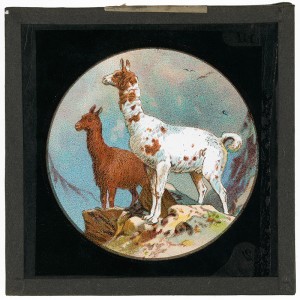
Roslin glass slide (or lantern slide). Illustration of two llamas standing on a rocky ledge.
It was not until 1840 that the inventors of the daguerreotype began using magic lantern projectors in an attempt to project their photographic images for better viewing. The dull and foggy nature of the daguerreotype, however, did not lend itself well to the projection of light.
Next came the creation of the wet plate negative in 1851 by the Englishman, Frederick Scott Archer. This process involved coating glass plates with a collodian chemical and exposing light onto the glass while the chemical was still wet. This allowed for shorter exposure times when taking photographs. Previously, daguerreotypes (1839-1850’s) and calotypes (1841-1850’s) would require long exposures, often over one minute, forcing those being photographed to remain still in order to avoid blurring within the image. This is why daguerreotypes and calotypes often look posed and overly considered as compositions.
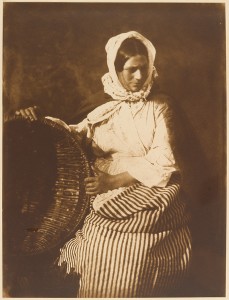
Calotype by Hill and Adamson, 1840’s
Accordingly, the colllodian wet plates gave a bit more flexibility when composing photographs. If, however, using the wet glass plate outwith the studio, photographers would have been required to carry processing chemicals and a portable darkroom as the wet plates would need developing immediately after exposure.
Photography remained a rather laborious procedure until the invention of the dry plate slide. In 1871, Richard Leach Maddox discovered that coating glass with silver bromide within a layer of gelatin would give more efficient photographic results; speedier and with a longer shelf life. The burden of hauling around chemicals and a darkroom was removed because the developing could be done at a later date by a specialist. In light of this photography became more accessible, opening up the practice to amateur photographers. Only the camera (camera models were becoming smaller and more portable over time) and the dry plates themselves were needed. Dry glass plates could be produced on mass, ready to use on the job. The act of taking a photograph therefore became less time-consuming, causing a change in the style of photographs being produced. This can be seen in the Roslin Glass Plate Slide Collection. On viewing many of the slides the camera seems to be there as a spectator, very much in the moment, giving the viewer a sense of what it mean to ‘be there’ – a relatively new phenomenon.
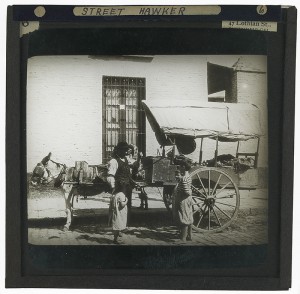
Roslin glass slide. A street hawker with his horse drawn cart standing next to a couple of children in Buenos Aires, Argentina in the late 19th or early 20th century.
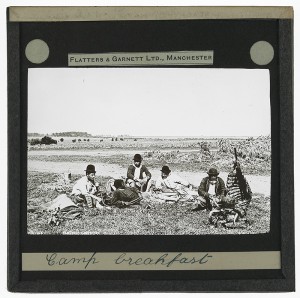
Roslin glass slide. A group of men eating breakfast in their camp on the plains in [Argentina or Uruguay] in the early 20th century.
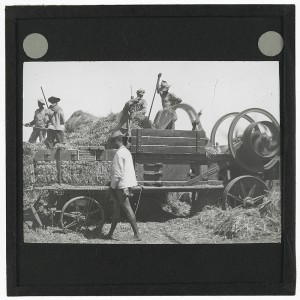
Roslin glass slide. Men using a machine to press hay in [South Africa] in the early 20th century.
Of all the various glass plate processes, the dry, gelatin-based plate had the longest run of success. It was not until the 1930’s when it was reduced to history with the introduction of nitrate film negatives and, namely the 35mm Kodachrome.
These slides were catalogued as part of the ‘Towards Dolly’ project and the Roslin Slide Collection can be viewed here.
Some useful reading:
Frizot, Michel, The New History of Photography (1994), Chapter 5
http://memory.loc.gov/ammem/collections/landscape/lanternhistory.html
http://archives.syr.edu/exhibits/glassplate_about.html
http://www.nfsa.gov.au/research/papers/2012/05/10/preserving-20th-century-glass-cinema-slides/
John
Project Photographer: Science on a Plate.
New Open Access Journal of Undergraduate Research

The first issue of a new open access journal dedicated to undergraduate research in the area of sociolinguistic variation has been published on the library-supported journal hosting service.
The journal, Lifespans & Styles: Undergraduate Working Papers on Intraspeaker Variation includes research designed, implemented, and written by advanced undergraduate students. These peer-reviewed papers are the result of dissertations, project-based seminars, and other research-led learning.
Although focused on the rather narrow subfield of within-speaker linguistic variation, the papers in this first issue span topics as diverse as gay identity, Received Pronunciation, vocal fry, and dog-directed speech.
For further information about Lifespans & Styles please contact:lifespans.styles@ed.ac.uk
Follow the journal on Twitter @lifespansstyles
To find out more about how the Library can help you to publish an open access journal, please contact: library.learning@ed.ac.uk
Angela Laurins, Library Learning Services Manager
Canterbury Dictionary of Hymnology now on trial

New on trial for University of Edinburgh users from 3 March to 31 March is the Canterbury Dictionary of Hymnology.
The Canterbury Dictionary of Hymnology is the replacement for the Dictionary of Hymnology produced by John Julian in 1892, with a supplement in 1907.
It is an essential reference resource for scholars of global hymnody, with information on the hymns of many countries and languages, and a strong emphasis on the historical as well as the contemporary. It includes articles on individual hymns, authors from many countries, hymnals, organisations, and themes, as well as information on hymn tunes and their composers. Covering a multitude of hymn traditions from around the world, it is ecumenical and international.
You can access the trial via the link at : http://www.ed.ac.uk/is/databases-trials. Please give us your feedback as this is a key part of making a case to subscribe to resources like this.
Christine Love-Rodgers, Academic Support Librarian – School of Divinity
International Women’s Day 2015: Make it Happen
 On Sunday 8th March 2015 International Women’s Day (IWD) will be celebrated worldwide. IWD has been observed since the early 1900s and has been sponsored by the United Nations (UN) since 1975. It is an important occasion for promoting women’s issues and rights, especially in developing countries.
This year’s theme is Make it Happen and there are many events happening at the University this year to mark IWD 2015.
The University’s annual International Women’s Day Lecture takes place on Friday 6th March and this year welcomes guest speaker Professor Anneila Sargent. Make it Happen – Women into Science will draw from Professor Sargent’s own experiences to discuss the challenges many women may face when entering a career in science. More information and how to book can be found at http://www.ed.ac.uk/news/2015/anneilia-sargent-170215 Read More
New books for Social and Political Science: February 2015
Thanks to recommendations from members of staff and requests via RAB from students the Library is continually adding new books to its collections both online and in print. Here are just a small number of the books that have been added to the Library’s collections in February 2015 for Social and Political Science.
 Industrializing organisms : introducing evolutionary history edited by Susan R. Schrepfer and Philip Scranton (shelfmark: S494.5.B563 Ind.)
Mind Change : how digital technologies are leaving their mark on our brains by Susan Greenfield (shelfmark: BF311 Gre.) Read More
Trials – New E-Resources on Trial
These new trials are now available…
 Access Latin America from Newsbank is on trial until 27th March. Access Latin America provides indepth coverage of local and regional issues and events via news sources from South America, Mexico, Central America, the Caribbean and U.S. territories. These daily and weekly newspapers, wire services and broadcast transcripts chronicle local issues and events at their source and provide revealing local perspectives on national and international issues.
 Annual Review of Linguistics – this new e-journal is on trial for the whole of 2015. It will cover significant developments in the field of linguistics, including phonetics, phonology, morphology, syntax, semantics, pragmatics, and their interfaces. Reviews will synthesize advances in linguistic theory, sociolinguistics, psycholinguistics, neurolinguistics, language change, biology and evolution of language, typology, as well as applications of linguistics in many domains.
 Asia and the West: Diplomacy and Cultural Exchange from Gale Cengage is on trial until 25th March. It features primary source collections related to international relations between Asian countries and the West during the 19th century. These invaluable documents—many never before available—include government reports, diplomatic correspondences, periodicals, newspapers, treaties, trade agreements, NGO papers, and more. Documents are sourced from The National Archives, Kew; The National Archives, United States; and other collections.
 British Theatre, Music and the Arts from Gale Cengage is on trial until 25th March. It features a wide range of primary sources related to the arts in the nineteenth century, from playbills and scripts to operas and complete scores. These rare documents, many of them never before available, are sourced from the British Library and other institutions. Curation is by experts in British arts history. Covering more than a century, and encompassing both the Georgian and Victorian theatre.
 Caribbean Newspapers, Series 1, 1718-1876 from the American Antiquarian Society and Readex is on trial until 27th March. Caribbean Newspapers, 1718-1876—the largest online collection of 18th- and 19th-century newspapers published in this region—will provide a comprehensive primary resource for studying the development of Western society and international relations within this important group of islands. This unique resource will prove essential for researching colonial history, the Atlantic slave trade, international commerce, New World slavery and U.S. relations with the region as far back as the early 18th century
 The Encyclopedia of Political Thought is on trial until 25th March- see full information about this e-resource over at the SPS Blog.
 Foreign Broadcast Information Services (FBIS) Daily Reports: Latin America, 1974-1996 from Readex is on trial until 27th March. As the United States’ principal historical record of political open source intelligence for more than half a century, the Foreign Broadcast Information Service (FBIS) Daily Report is an indispensable source for insights into decades of turbulent world history. The original mission of the FBIS was to monitor, record, transcribe and translate intercepted radio broadcasts from foreign governments, official news services, and clandestine broadcasts from occupied territories. Accordingly, it provides a wealth of information from all countries outside of the U.S.—from Afghanistan to Zimbabwe – only the Latin American module is available for this trial but we already have access to other modules.
 Latin American Newspapers, Series 1 and 2, 1805-1922 from Readex is on trial until 27th March. This newspaper package offers unprecedented coverage of the people, issues and events that shaped this vital region during the 19th and early 20th centuries. Featuring titles from Argentina, Brazil, Chile, Cuba, Guatemala, Mexico, Peru, Venezuela and a dozen other countries, these resources provide a wide range of viewpoints from diverse Latin American cultures. Together, both series of Latin American Newspapers chronicles the evolution of Latin America over two centuries through eyewitness reporting, editorials, legislative information, letters, poetry, advertisements, obituaries and other items.
 Photography: The World Through the Lens from Gale Cengage is on trial until 25th March. Including images from Britain, Europe, Asia, Africa, and the Americas, Photography: The World through the Lens assembles collections of photographs, photograph albums, photographically illustrated books and texts on the early history of photography from libraries and archives from across the globe.
Feedback and further info
We are interested to know what you think of these e-resources as your comments influence purchase decisions so please fill out our feedback form.
A list of all trials currently available to University of Edinburgh staff and students can be found on our trials webpage.
Collections
 Hill and Adamson Collection: an insight into Edinburgh’s past
My name is Phoebe Kirkland, I am an MSc East Asian Studies student, and for...
Cataloguing the private papers of Archibald Hunter Campbell: A Journey Through Correspondence
My name is Pauline Vincent, I am a student in my last year of a...
Hill and Adamson Collection: an insight into Edinburgh’s past
My name is Phoebe Kirkland, I am an MSc East Asian Studies student, and for...
Cataloguing the private papers of Archibald Hunter Campbell: A Journey Through Correspondence
My name is Pauline Vincent, I am a student in my last year of a...
Projects
Cataloguing the private papers of Archibald Hunter Campbell: A Journey Through Correspondence
My name is Pauline Vincent, I am a student in my last year of a...
Archival Provenance Research Project: Lishan’s Experience
Presentation My name is Lishan Zou, I am a fourth year History and Politics student....