Home University of Edinburgh Library Essentials
December 17, 2025

Olive Schreiner Letters Online
 Olive Schreiner was an author, feminist and social theorist. Although she received no formal education Schreiner would become one of the most important social commentators of her day.
 Her writings include allegories, social theory and novels. One of her most famous novels, The Story of an African Farmer (1883, originally published under the pseudonym Ralph Iron), “secured her reputation as an evocative storyteller, a daring and perceptive freethinker, and feminist” (from Oxford Dictionary of National Biography Online).
The Olive Schreiner Letters Online provides you with access to transcriptions of Schreiner’s more than 4800 extant letters located in archives across Europe, the US and South Africa, with detailed editorial notes and background information, thanks to the Olive Schreiner Letters Project. The transcripts include insertions and deletions, omissions and spelling mistakes – so just as Schreiner wrote them. The letters are fully searchable and guides to the archival locations of all her letters are also available.
If you are interested in political history, socialism, feminism, women’s or gender studies, colonialism, imperialism in southern Africa, political and economic change in South Africa after the First World War and much, much more then this is a fascinating resource.
The Olive Schreiner Letters Online (http://www.oliveschreiner.org/) is a freely available resource. It can also be accessed via the Databases pages on the Library website.
The Library holds a number of Schreiner’s books in its collections – Olive Schreiner works in Library (e-books are only available to students and staff at University of Edinburgh).
Caroline Stirling – Academic Support Librarian for Social and Political Science
‘Develop a Data Vault’ project funded!
The ‘Develop a Data Vault‘ proposal submitted to the Jisc #DataSpring funding call has been funded! Jointly submitted by the Universities of Edinburgh and Manchester, the project aims to develop a Data Vault system that can be used to allow the description and long term storage of important research data.
Further details of the funding programme can be found at http://www.jisc.ac.uk/rd/projects/research-data-spring
Watch out for further blog posts as the project progresses!
New books for Social and Political Science: March 2015
Thanks to recommendations from members of staff and requests via RAB from students the Library is continually adding new books to its collections both online and in print. Here are just a small number of the books that have been added to the Library’s collections in March 2015 for Social and Political Science.
 Polarization and Transformation in Zimbabwe : social movements, strategy dilemmas and change by Erin McCandless (e-book)
Unexpected Alliances : independent filmmakers, the state, and the film industry in postauthoritarian South Korea by Young-a Park (shelfmark: PN1993.5.K6 Par.)
The neoliberal regime in the agri-food sector : crisis, resilience, and restructuring edited by Steven A. Wolf and Alessandro Bonanno (shelfmark: HD9000.6 Neo. Also available as e-book.)
The great humanists : an introduction by Jonathan Arnold (e-book) Read More
A knot better!
I am writing this on the very last day of my work placement here at the University of Edinburgh. I have had an amazing six weeks learning about caring for the historic musical instrument collection. Many of the things I have learnt can be applied to other kinds of collection material but some things are very instrument-specific. So I thought I’d talk about some of those.
For example, I have learnt how to make frets from gut (the same material used for early strings) for 17th century string instruments. This involves using a special knot to tie the gut round the fingerboard, making it as tight as possible and sliding it to the right position, then burning the ends so it won’t unravel (and so it looks really neat). Fire is something I never thought I would use in conservation, so this was awesome!

New frets on a archlute – the knots are on the back of the fingerboard, at the top, where they would be least disruptive to the player
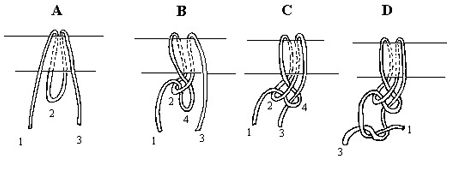
How to tie the fret knot. Image from Gamut Music Inc.
There is a mathematical equation for positioning the frets on the fingerboard in order to achieve perfect semi-tones. However, these instruments are not in playing condition, so it doesn’t matter too much about the precise positioning of the frets. You may ask, why put them on in the first place, if they are not needed for playing? For the same reason you’d take plastic strings off a baroque instrument and replace them with new gut strings: the instrument should be made to look complete and correct so the viewer understands how it works, and how it should look. It should look as if it could be played, and if it were played it would sound authentic. But let’s not get started on authenticity of sound…
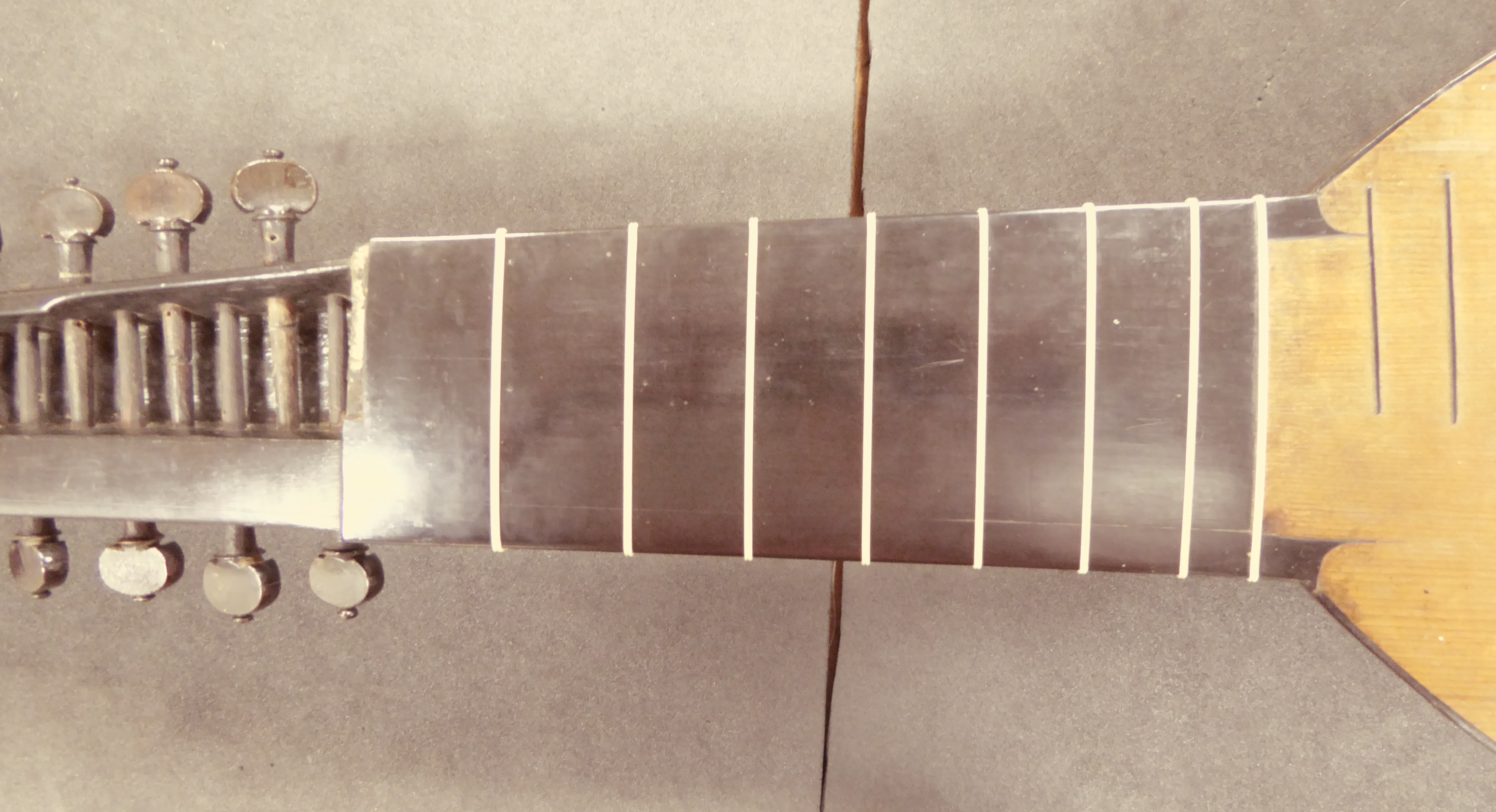
New frets on an archlute – front view
Many of these instruments did have frets, and most people wouldn’t know (I didn’t) but it makes a lot of difference to the sounds they would have made. Also they did not have nylon in the 17th century!
However, it’s not just about using the correct materials, but using them properly and wasting as little as possible. So when I put strings on a baroque guitar, the strings which have been made (by Gamut, an early music string maker) have a few extra inches that are not needed. These few inches can then be used to make frets, for example. The knots at the bridge of a guitar or lute can be tied in many different ways, but the way we do it here is so that all the ends point downwards (when the instrument is held as if for playing) and are tucked away behind the bridge. Beautiful!
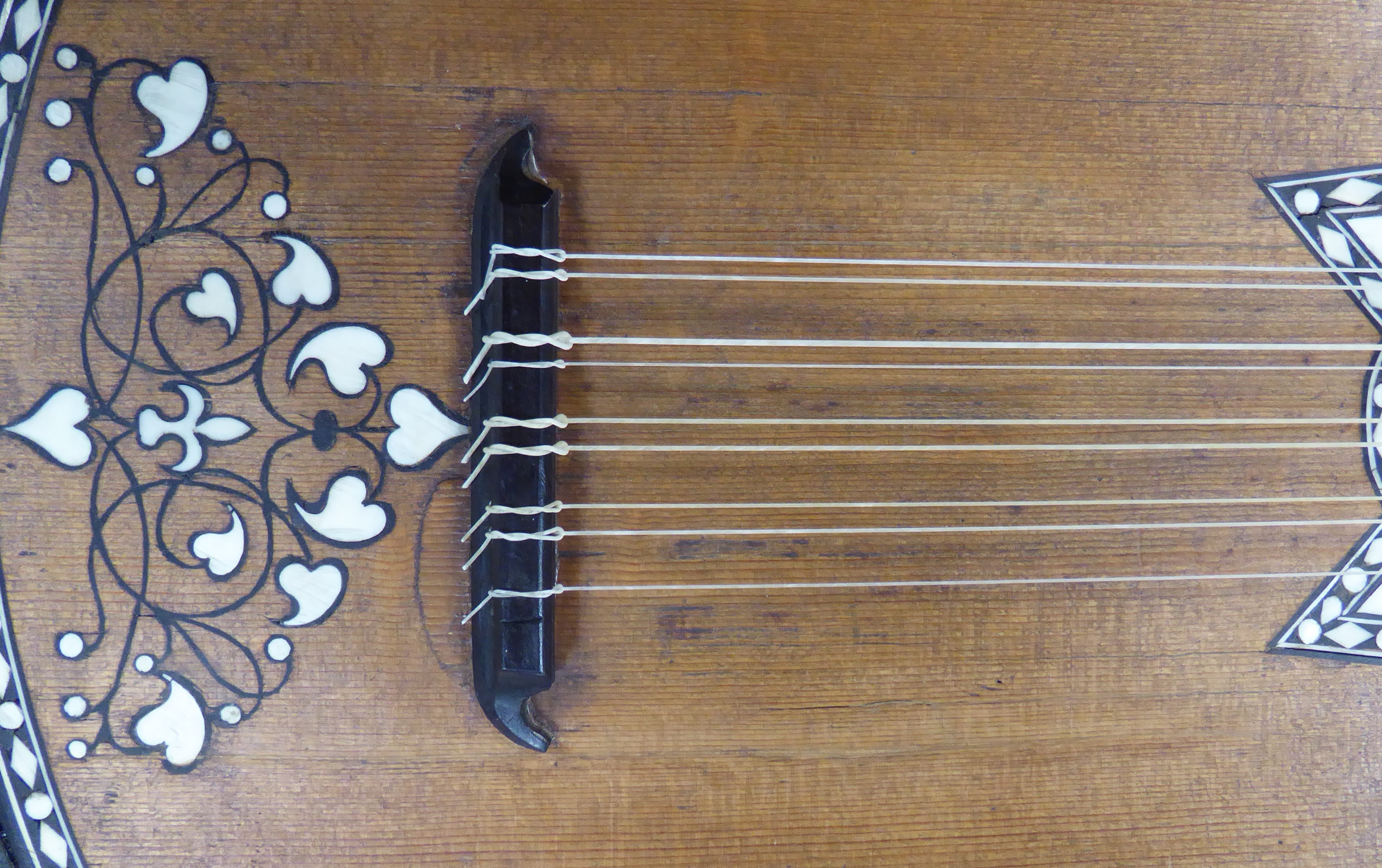
Baroque guitar with new gut strings, detail of bridge. Check out that inlay!
Last week I did a short presentation to show the CRC staff what I have been doing during this placement, which I rounded off with before and after images of the head of an instrument called a viola da gamba – the first string instrument I had the pleasure of working with. And the loveliest, I think. In Southampton I volunteer at the SeaCity Museum, working with their objects conservator who likes to personify things in the collection, describing a piece of newly consolidated Murano glass as ‘a lot happier’, or a rusty medieval sword as ‘not very well’. I think this can be applied nicely to the viola da gamba. She looks great for a 319 year-old, and genuinely seems happier with her new strings.
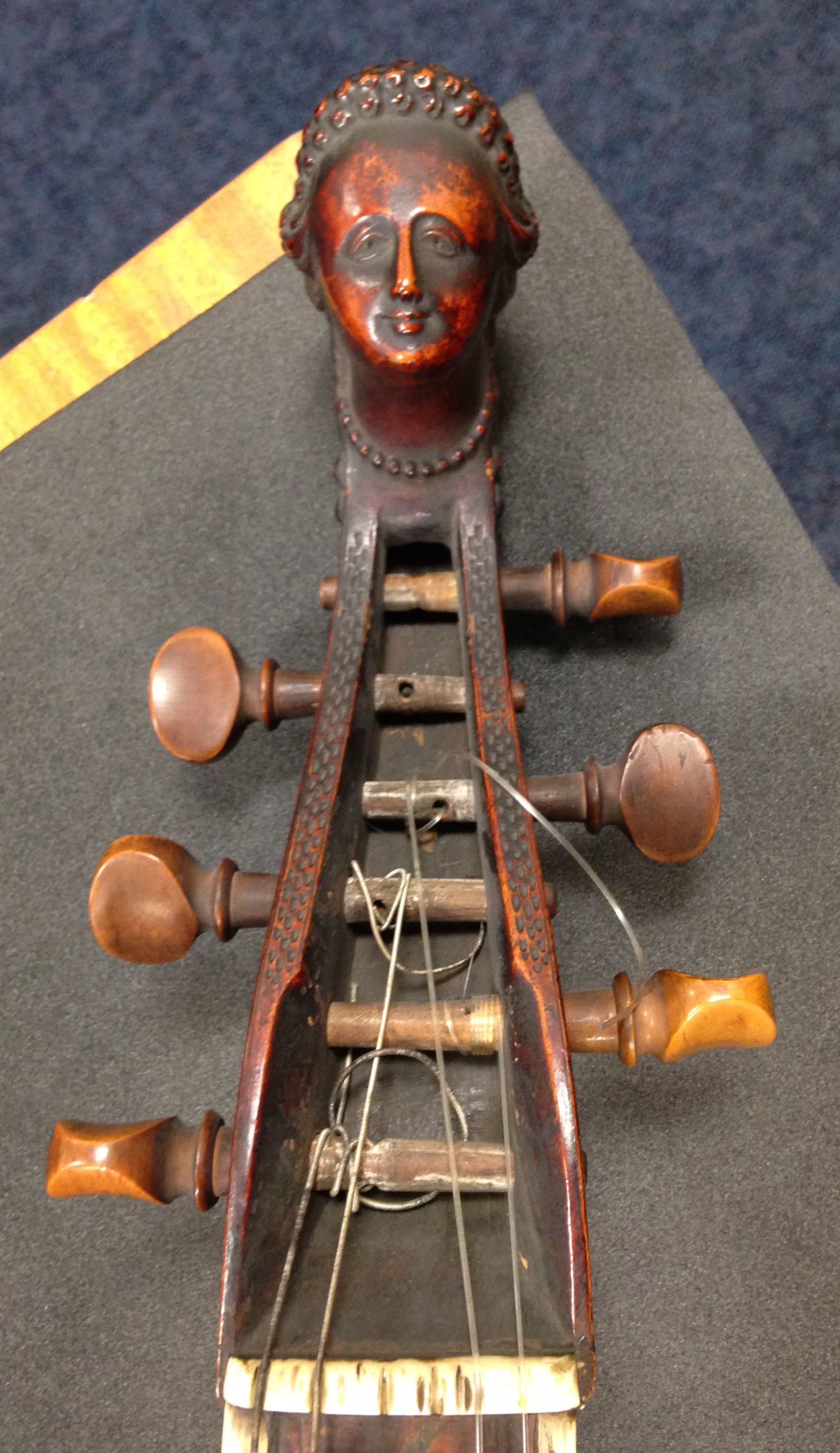
Viola da gamba before cleaning and re-stringing
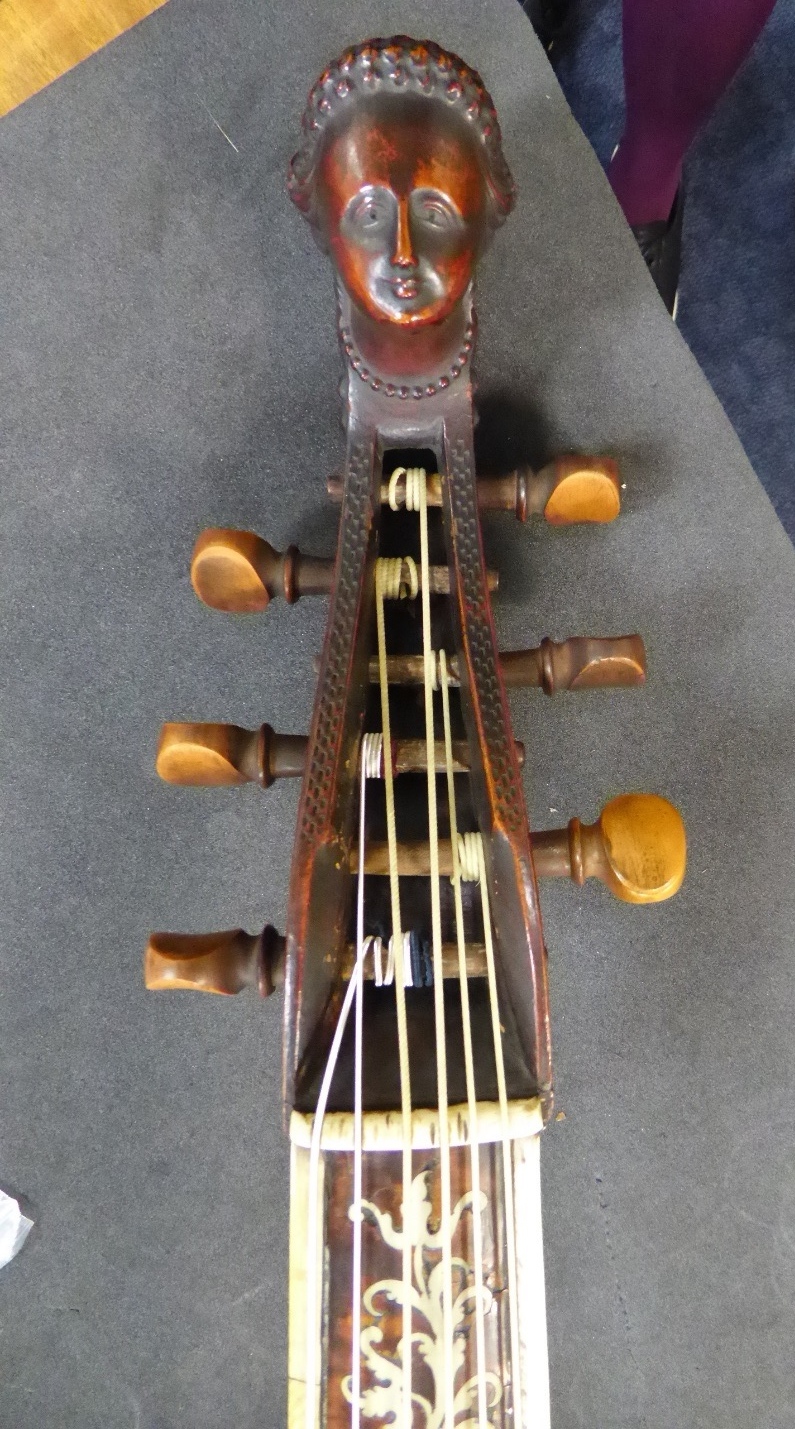
Viola da gamba after cleaning and re-stringing
Post by Harriet Braine, Preventive Conservator Student Placement
Risk Registers
Today, I added a number of risks related to Open Access to the University’s Information Services Group Risk Register. The risks were around loss/reduction of funding for Open Access and non-compliance with RCUK and REF Open Access policies.
The purpose of this exercise was to make sure that risks are formally documented to library management, and also to show that we have thought about mitigation, and identified individuals responsible for these risks. As mentioned in earlier posts, we have included more detailed risk registers on School implementation plans. We are now thinking about whether it would be appropriate to encourage Schools and Colleges to include similar items in their organisational documentation.
We’d be interested to hear if other Universities have taken a similar approach, and if this has had any impact in raising awareness or on planning for OA implementation. Please get in touch if you’d like to discuss this more, or have anything to feed back.
New data analysis and visualisation service
Statistical Analysis without Statistical Software
The Data Library now has an SDA server (Survey Documentation and Analysis), and is ready to load numeric data files for access by either University of Edinburgh users only, or ‘the world’. The University of Edinburgh SDA server is available at: http://stats.datalib.edina.ac.uk/sda/
SDA provides an interactive interface, allowing extensive data analysis with significance tests. It also offers the ability to download user-defined subsets with syntax files for further analysis on your platform of choice.
SDA can be used to teach statistics, in the classroom or via distance-learning, without having to teach syntax. It will support most statistical techniques taught in the first year or two of applied statistics. There is no need for expensive statistical packages, or long learning curves. SDA has been awarded the American Political Science Association Best Instructional Software.
For data producers concerned about disclosure control, SDA provides the capability of defining usage restrictions on a variable-by-variable basis. For example, restrictions on minimum cell sizes (weighted or unweighted), use of particular variables without being collapsed (recoded), or restrictions on particular bi- or multivariate combinations.
For data managers and those concerned about data preservation, SDA can be used to store data files in a generic, non-software dependant format (fixed-field format ASCII), and includes capability of producing the accompanying metadata in the emerging DDI-standard XML format.
Data Library staff can mount data files very quickly if they are well documented with appropriate metadata formats (eg SAS or SPSS), depending on access restrictions appertaining to the datafile. To request a datafile be made available in SDA, contact datalib@ed.ac.uk.
Laine Ruus
EDINA and Data Library
Fairbairn Archive Mystery Item of the Month
One of the elements of archival work I have always enjoyed is the opportunity to get to know a collection really intimately. In order to generate intelligible finding aids for researchers, it is important to get a good overview of a collection: to understand how records relate to each other and to learn all that you can about the format, creator, use and date of an item. Luckily, this is often pretty easy but sometimes an item comes along which presents a bit more of a challenge.
Challenging items bring out an archivist’s inner Sherlock Holmes. Minute clues are forensically examined in the hope of cracking the mystery. However, some challenges are easier than others and today I would like to ask for your help with a mystery I have been unable to solve so far.
The item in question is a six-line, rhyming poem on a suitably psychoanalytical theme.

My familiarity with Ronald Fairbairn’s papers means that I know this item is in his handwriting*. However, I have no real idea as to the author of this poem. Is this an original Fairbairn composition or is it something he merely transcribed?
Knowing the answer to this mystery will be invaluable as it will help to ensure Fairbairn’s papers are catalogued to the highest possible standard. So, can anyone out there help?
*By now, I can read Fairbairn’s hand pretty easily, but just in case it proves a little tricky, here’s a transcription of the poem:
Remember well what Freud hath said-
We want to take our mums to bed.
And, since they always utter “no”,
We feel we’ve nowhere else to go.
Hysteria doth thus emerge
Through failure of the sexual urge.
A Traquair Treat
 As there were several separate requests recently for images from the splendid ‘Song School St Mary’ manuscript by Phoebe Anna Traquair, we decided the time was right to digitise the book from cover to cover, replacing some fairly mixed quality old digital images and preparing it for the LUNA Book Reader http://images.is.ed.ac.uk/luna/servlet/s/109unz . This item is one of my favourites (yes, I know I have many…), and it is a beautifully illuminated, vibrantly coloured, jewel-like treasure. Although made in 1897, Traquair created this on vellum, which adds to the impression of exquisite quality. Read More
Unwrapping the Martin Hall Collection
This January we began cataloguing work on the MR Collection from New College Library’s Special Collections. This sequence contains much early and rare material, and carries the shelfmark MR because at one time these books were housed in the Martin Hall in New College.

Image courtesy of Paul Nicholas
We were really excited to find this lovely item, Historia apostolica illustrata : ex actis apostolorum et epistolis Paulinis. Published in seventeenth century Geneva, the author Louise Cappel writes about the works of the apostles, and Paul in particular. What’s immediately striking about it is that it is covered with a vellum wrapper (waste parchment) with beautiful manuscript lettering.

Image courtesy of Paul Nicholas
While further research is required on the wrapper, it appears to be a medieval liturgical text. The back cover (pictured) is in honour of St. Nicholas, with his name appearing in the line with the musical notation.
Christine Love-Rodgers – Academic Support Librarian, Divinity
Paul Nicholas – Funk Cataloguer
Elizabeth Lawrence – Rare Books Librarian
March Update from LOCH
I realise we’ve been a bit quiet recently, so it is high time we posted an update to let you know what we have been doing over the last few months! The good news is that we now have a case study and a number of related documents which we are pleased to be able to share with you. We hope that these documents will provide some inspiration and assistance in planning and gearing up for Open Access in the next REF.
ARMA Good Practice Event
Last week Janet Aucock and I attended ARMA’s Good Practice Exchange event, at which we presented St Andrews and Edinburgh Universities’ approaches to preparing for OA in the next REF. St Andrews are adopting a more central approach with the library taking ownership for all the administration, whilst here at Edinburgh, we are adopting a more decentralized approach, with more work being carried out in Schools and Colleges. We’ve made St Andrews and Edinburgh’s slides available, as well as our planning checklists.
Open Access Implementation Case Study – College of Medicine and Veterinary Medicine
Anna Krzak, Edinburgh’s Open Access Administrator in CMVM has kindly put together a case study looking at the specifics of implementing the REF OA requirements in the context of medical sciences. Hopefully this will be of use to other Universities. If you have any comments about this then please contact either anna.krzak@ed.ac.uk or dominic.tate@ed.ac.uk and we would gladly discuss this work further.
Communications Best Practice – Example Emails
Here at Edinburgh, we are starting to contact academics about the new requirements, and you might be interested to this exemplar draft email, which is intended to be sent to all staff in the College of Medicine. This second example email was sent to all staff in the School of Mathematics.
School Implementation Plans & Job Descriptions – Humanties & Social Sciences
The University of Edinburgh is in the process of agreeing implementation plans within many of its Schools to agree locally how the new OA requirements will apply, and to details the processes needed to make this happen. We’re delighted to include here an example School Implementation Plan, drafted by Jacq McMahon (Research Officer in the College of Humanities & Social Sciences). This College is also starting to think about what resources will need to be put in place to manage any additional workload. At present the College is considering employing new Open Access Facilitators to work in Schools and in co-ordination with the Library’s Scholarly Communications Team. A (draft) job description is also available.
Resource List:
ARMA Good Practice Event:
University of Edinburgh Slides: https://www.era.lib.ed.ac.uk/handle/1842/10009
St Andrews University Slides: https://www.era.lib.ed.ac.uk/handle/1842/10015
Discussion Points and Planning Checklist: https://www.era.lib.ed.ac.uk/handle/1842/10014
College of Medicine and Veterinary Medicine Open Access Implementation Case Study:
https://www.era.lib.ed.ac.uk/handle/1842/10010
Exemplar Emails:
College of Medicine: https://www.era.lib.ed.ac.uk/handle/1842/10012
School of Mathematics: https://www.era.lib.ed.ac.uk/handle/1842/10011
Example School OA Plan and Risk Register (Humanities & Social Sciences): https://www.era.lib.ed.ac.uk/handle/1842/10013
OA Facilitator Job Description: https://www.era.lib.ed.ac.uk/handle/1842/10016
Collections
 Hill and Adamson Collection: an insight into Edinburgh’s past
My name is Phoebe Kirkland, I am an MSc East Asian Studies student, and for...
Cataloguing the private papers of Archibald Hunter Campbell: A Journey Through Correspondence
My name is Pauline Vincent, I am a student in my last year of a...
Hill and Adamson Collection: an insight into Edinburgh’s past
My name is Phoebe Kirkland, I am an MSc East Asian Studies student, and for...
Cataloguing the private papers of Archibald Hunter Campbell: A Journey Through Correspondence
My name is Pauline Vincent, I am a student in my last year of a...

Projects
Cataloguing the private papers of Archibald Hunter Campbell: A Journey Through Correspondence
My name is Pauline Vincent, I am a student in my last year of a...
Archival Provenance Research Project: Lishan’s Experience
Presentation My name is Lishan Zou, I am a fourth year History and Politics student....