Home University of Edinburgh Library Essentials
April 9, 2026
Trial access to SIPRI Yearbook Online
The Library has set up trial access to SIPRI Yearbook Online. You can access this via the E-resources trials page at www.ed.ac.uk/is/databases-trials.
 The SIPRI Yearbook, written by authors who are experts in their field, is known worldwide as an essential and independent source for issues on armaments and arms control, conflicts and resolutions, security arrangements and disarmament, as well as longer-term trends in international security. SIPRI Yearbook Online offers access to the SIPRI Yearbooks published from 2010 and onwards, all available on one, easy-to-use and fully cross-searchable resource.
SIPRI (Stockholm International Peace Research Institute) is an independent international institute dedicated to research into conflict, armaments, arms control and disarmament. Established in 1966, SIPRI provides data, analysis and recommendations, based on open sources, to policymakers, researchers, media and the interested public.Find out more at http://www.sipri.org/
Trial access is available until 30th April 2015. We would welcome feedback on this database as this helps with making the decision on whether the resource should be considered for subscription or not.
Caroline Stirling – Academic Support Librarian for Social and Political Science
Divinity student book recommendations now available
All these books (and more) were recommended by Divinity students and are now available to University of Edinburgh Library users – more details on the library catalogue.
100+ book recommendations from Divinity students have been received over since August 2014, via the student recommendation form on the Library website.
Trial access to Political Science Complete

The Library has set up trial access to Political Science Complete. You can access this via the E-resources trials page at www.ed.ac.uk/is/databases-trials.
This major database from EBSCO provides extensive coverage of global political topics with a worldwide focus, reflecting the globalisation of contemporary political discourse. Covering top-ranked scholarly journals, many of which are unique to the product, Political Science Complete is a must-have for researchers in the field. The database offers full-text access to a huge range of material including nearly 340 full-text reference books and monographs and more than 44,000 full-text conference papers, which includes those from the International Political Science Association. Subject coverage includes comparative politics, humanitarian issues, international relations, law and legislation, non-governmental organisations and political theory.
For a full list of publications covered by this database see the Coverage List (pdf).
Trial access is available until 24th April 2015. We would welcome feedback on this database as this helps with making the decision on whether the resource should be considered for subscription or not.
Caroline Stirling – Academic Support Librarian for Social and Political Science
A year in the life of Open Access support: continuous improvement at University of St Andrews
The LOCH Project is pleased to announce the publication of its latest case study: A year in the life of Open Access support: continuous improvement at University of St Andrews.
This case study explains the “Lean Exercise” that the Open Access and Research Publications Support Team took part in during May 2014, as well as the follow-up to this exercise and the impact it has had on the team’s day-to-day activities.
The case study provides plenty of detail of the Lean method, details of process improvements undertaken at St Andrews and example documentation which is available for re-use.
Case Study: http://hdl.handle.net/10023/6430
St Andrews Lean Office: https://www.st-andrews.ac.uk/lean/
Dominic Tate, on behalf of St Andrews University
Easter Greetings from New College Library
New College Library is open as usual for semester time over the Easter period, see Library Opening hours for more detail. When visiting, take a moment to look at our Special Collections display, which currently features a 1637 Book of Common Prayer written for the use of the Church of Scotland, edited by Archbishop William Laud, open at the readings for Easter Day. We also have on display a 1602 New Testament, open to show a map of the Holy Land and the beginning of St Matthew’s Gospel.
In the Funk Reading Room display case, you can see a selection of more modern titles relating to Easter.
Olive Schreiner Letters Online
 Olive Schreiner was an author, feminist and social theorist. Although she received no formal education Schreiner would become one of the most important social commentators of her day.
 Her writings include allegories, social theory and novels. One of her most famous novels, The Story of an African Farmer (1883, originally published under the pseudonym Ralph Iron), “secured her reputation as an evocative storyteller, a daring and perceptive freethinker, and feminist” (from Oxford Dictionary of National Biography Online).
The Olive Schreiner Letters Online provides you with access to transcriptions of Schreiner’s more than 4800 extant letters located in archives across Europe, the US and South Africa, with detailed editorial notes and background information, thanks to the Olive Schreiner Letters Project. The transcripts include insertions and deletions, omissions and spelling mistakes – so just as Schreiner wrote them. The letters are fully searchable and guides to the archival locations of all her letters are also available.
If you are interested in political history, socialism, feminism, women’s or gender studies, colonialism, imperialism in southern Africa, political and economic change in South Africa after the First World War and much, much more then this is a fascinating resource.
The Olive Schreiner Letters Online (http://www.oliveschreiner.org/) is a freely available resource. It can also be accessed via the Databases pages on the Library website.
The Library holds a number of Schreiner’s books in its collections – Olive Schreiner works in Library (e-books are only available to students and staff at University of Edinburgh).
Caroline Stirling – Academic Support Librarian for Social and Political Science
‘Develop a Data Vault’ project funded!
The ‘Develop a Data Vault‘ proposal submitted to the Jisc #DataSpring funding call has been funded! Jointly submitted by the Universities of Edinburgh and Manchester, the project aims to develop a Data Vault system that can be used to allow the description and long term storage of important research data.
Further details of the funding programme can be found at http://www.jisc.ac.uk/rd/projects/research-data-spring
Watch out for further blog posts as the project progresses!
New books for Social and Political Science: March 2015
Thanks to recommendations from members of staff and requests via RAB from students the Library is continually adding new books to its collections both online and in print. Here are just a small number of the books that have been added to the Library’s collections in March 2015 for Social and Political Science.
 Polarization and Transformation in Zimbabwe : social movements, strategy dilemmas and change by Erin McCandless (e-book)
Unexpected Alliances : independent filmmakers, the state, and the film industry in postauthoritarian South Korea by Young-a Park (shelfmark: PN1993.5.K6 Par.)
The neoliberal regime in the agri-food sector : crisis, resilience, and restructuring edited by Steven A. Wolf and Alessandro Bonanno (shelfmark: HD9000.6 Neo. Also available as e-book.)
The great humanists : an introduction by Jonathan Arnold (e-book) Read More
A knot better!
I am writing this on the very last day of my work placement here at the University of Edinburgh. I have had an amazing six weeks learning about caring for the historic musical instrument collection. Many of the things I have learnt can be applied to other kinds of collection material but some things are very instrument-specific. So I thought I’d talk about some of those.
For example, I have learnt how to make frets from gut (the same material used for early strings) for 17th century string instruments. This involves using a special knot to tie the gut round the fingerboard, making it as tight as possible and sliding it to the right position, then burning the ends so it won’t unravel (and so it looks really neat). Fire is something I never thought I would use in conservation, so this was awesome!

New frets on a archlute – the knots are on the back of the fingerboard, at the top, where they would be least disruptive to the player
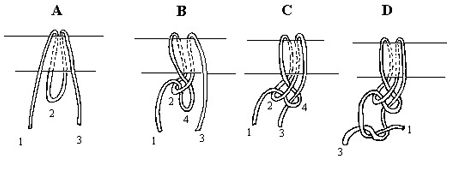
How to tie the fret knot. Image from Gamut Music Inc.
There is a mathematical equation for positioning the frets on the fingerboard in order to achieve perfect semi-tones. However, these instruments are not in playing condition, so it doesn’t matter too much about the precise positioning of the frets. You may ask, why put them on in the first place, if they are not needed for playing? For the same reason you’d take plastic strings off a baroque instrument and replace them with new gut strings: the instrument should be made to look complete and correct so the viewer understands how it works, and how it should look. It should look as if it could be played, and if it were played it would sound authentic. But let’s not get started on authenticity of sound…
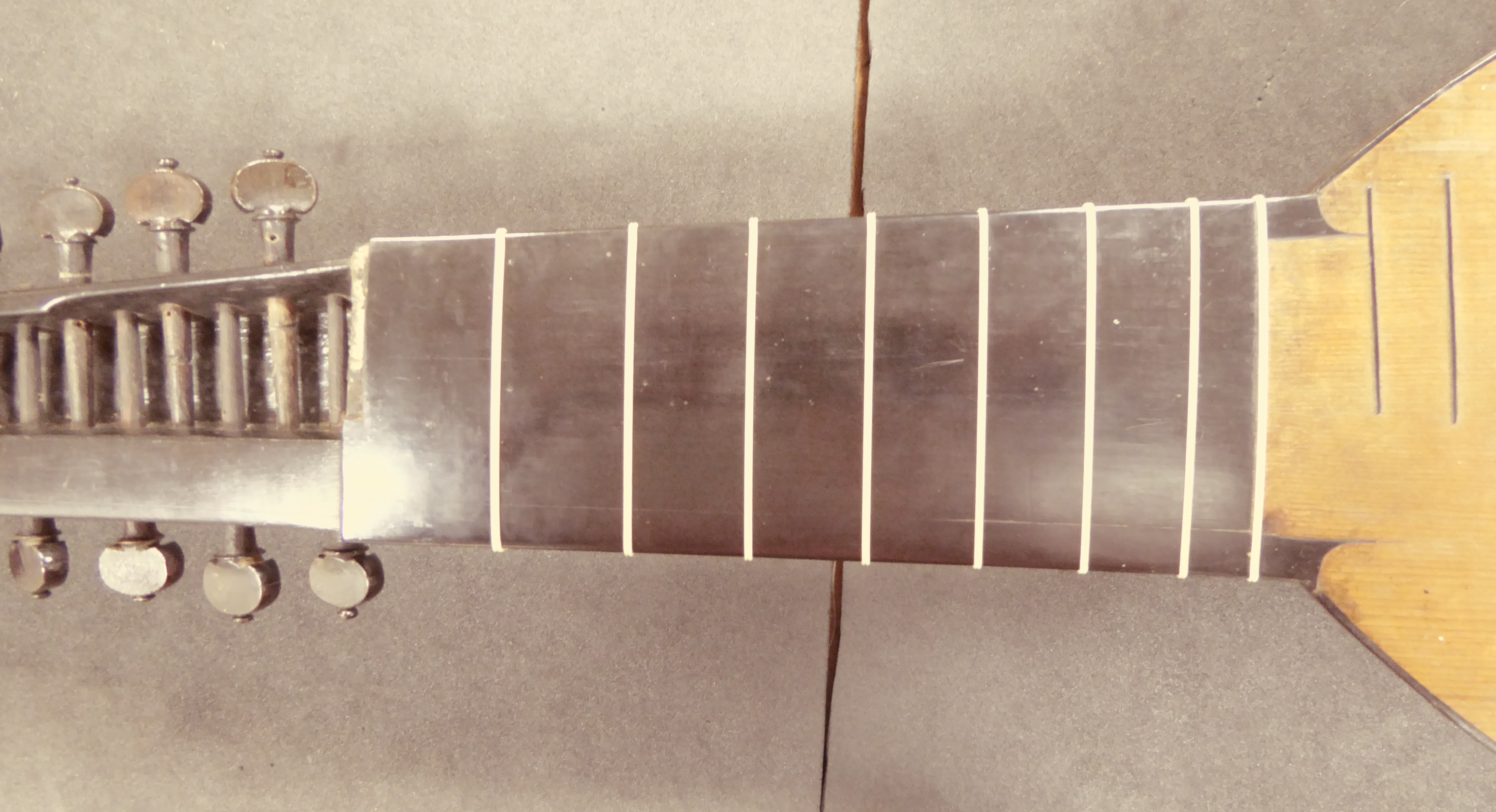
New frets on an archlute – front view
Many of these instruments did have frets, and most people wouldn’t know (I didn’t) but it makes a lot of difference to the sounds they would have made. Also they did not have nylon in the 17th century!
However, it’s not just about using the correct materials, but using them properly and wasting as little as possible. So when I put strings on a baroque guitar, the strings which have been made (by Gamut, an early music string maker) have a few extra inches that are not needed. These few inches can then be used to make frets, for example. The knots at the bridge of a guitar or lute can be tied in many different ways, but the way we do it here is so that all the ends point downwards (when the instrument is held as if for playing) and are tucked away behind the bridge. Beautiful!
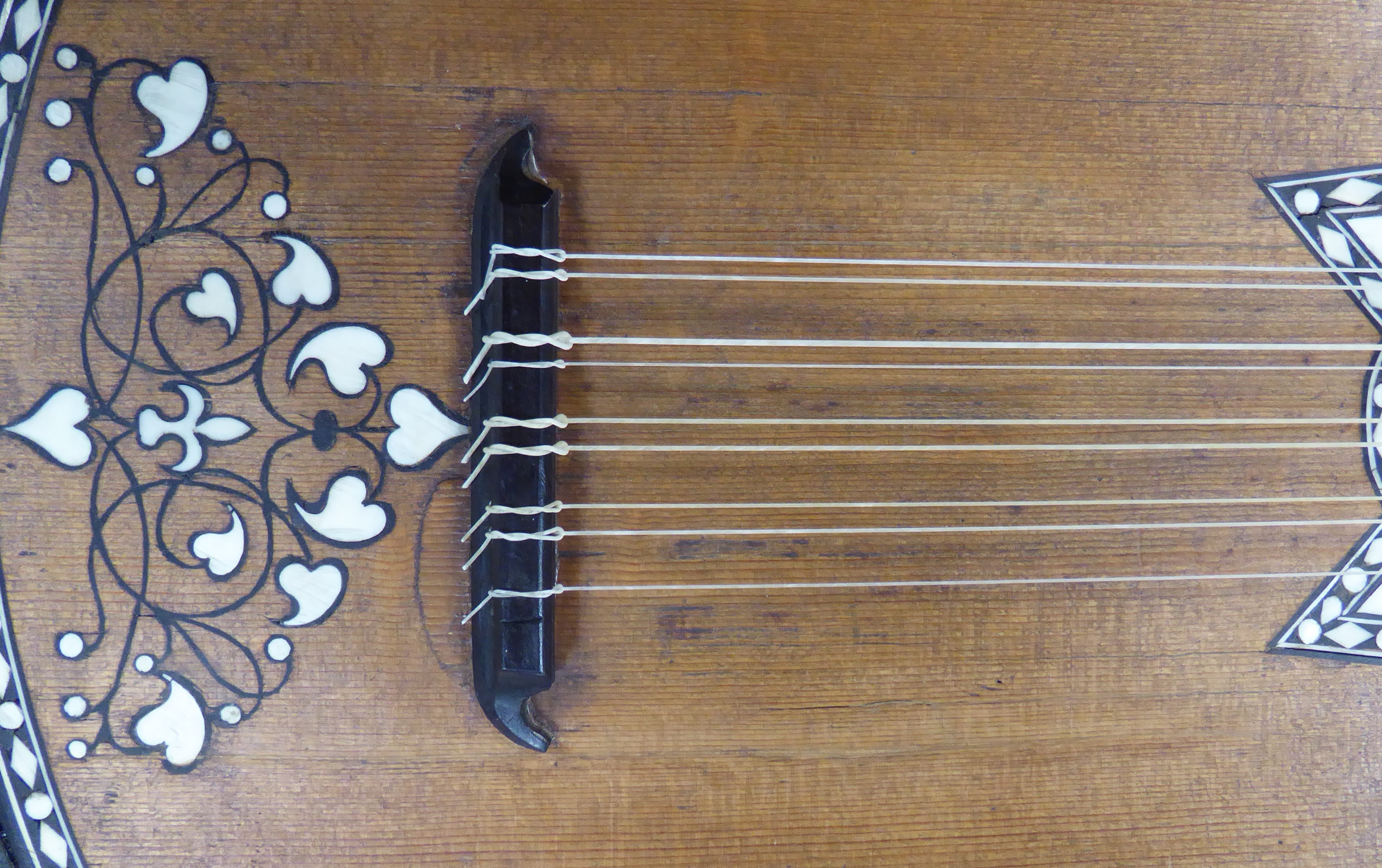
Baroque guitar with new gut strings, detail of bridge. Check out that inlay!
Last week I did a short presentation to show the CRC staff what I have been doing during this placement, which I rounded off with before and after images of the head of an instrument called a viola da gamba – the first string instrument I had the pleasure of working with. And the loveliest, I think. In Southampton I volunteer at the SeaCity Museum, working with their objects conservator who likes to personify things in the collection, describing a piece of newly consolidated Murano glass as ‘a lot happier’, or a rusty medieval sword as ‘not very well’. I think this can be applied nicely to the viola da gamba. She looks great for a 319 year-old, and genuinely seems happier with her new strings.
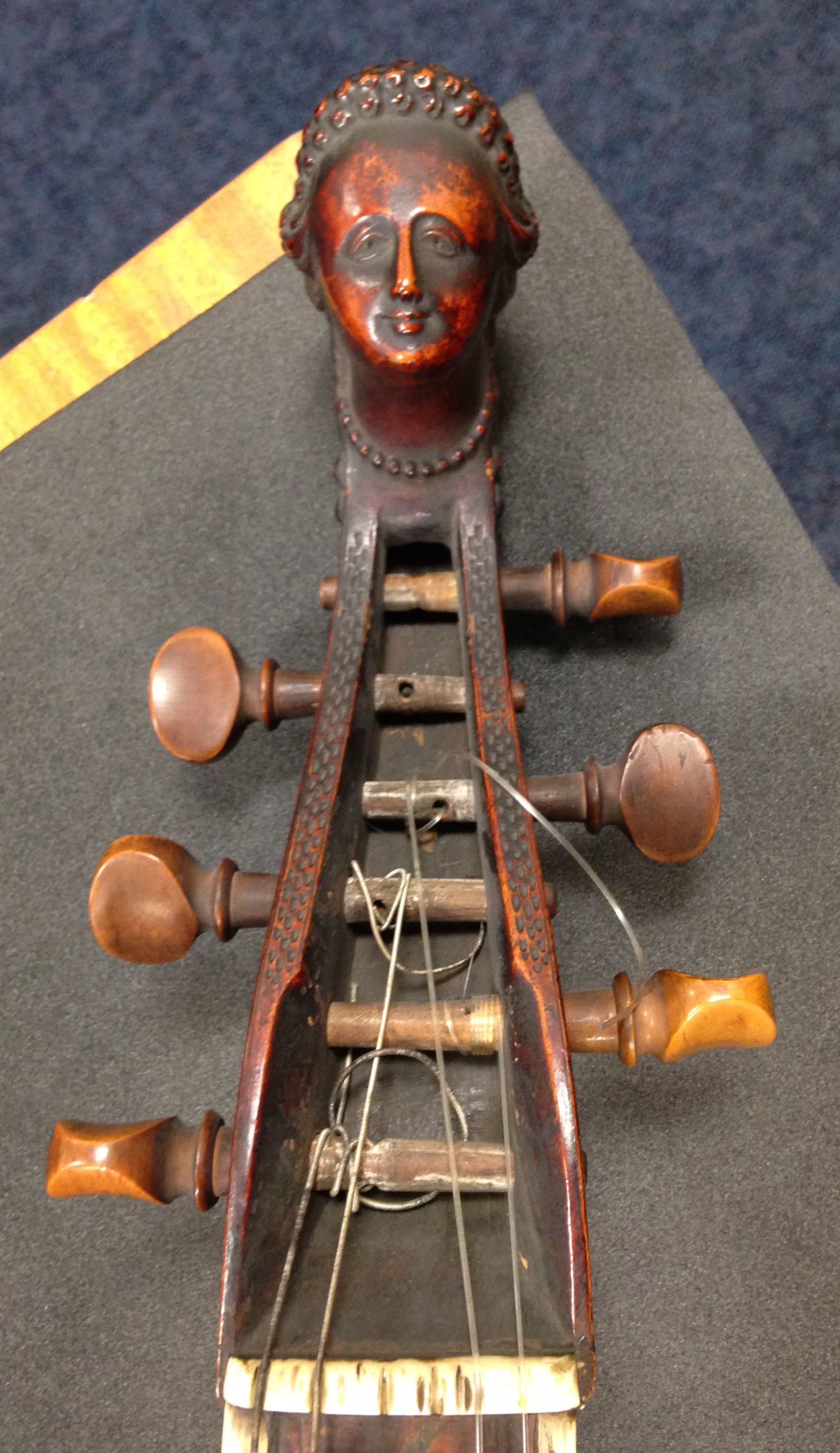
Viola da gamba before cleaning and re-stringing
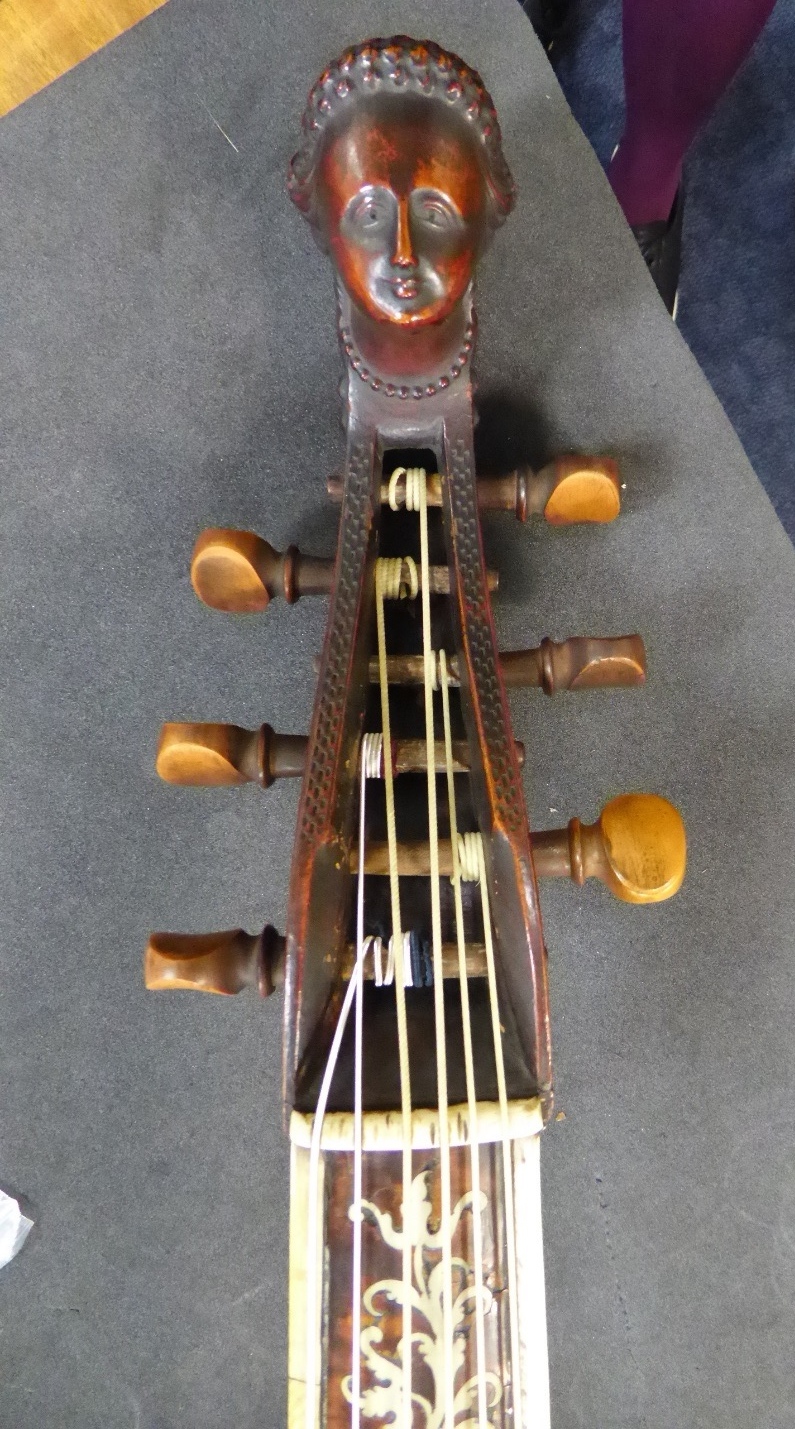
Viola da gamba after cleaning and re-stringing
Post by Harriet Braine, Preventive Conservator Student Placement
Risk Registers
Today, I added a number of risks related to Open Access to the University’s Information Services Group Risk Register. The risks were around loss/reduction of funding for Open Access and non-compliance with RCUK and REF Open Access policies.
The purpose of this exercise was to make sure that risks are formally documented to library management, and also to show that we have thought about mitigation, and identified individuals responsible for these risks. As mentioned in earlier posts, we have included more detailed risk registers on School implementation plans. We are now thinking about whether it would be appropriate to encourage Schools and Colleges to include similar items in their organisational documentation.
We’d be interested to hear if other Universities have taken a similar approach, and if this has had any impact in raising awareness or on planning for OA implementation. Please get in touch if you’d like to discuss this more, or have anything to feed back.
Collections
 Hill and Adamson Collection: an insight into Edinburgh’s past
My name is Phoebe Kirkland, I am an MSc East Asian Studies student, and for...
Cataloguing the private papers of Archibald Hunter Campbell: A Journey Through Correspondence
My name is Pauline Vincent, I am a student in my last year of a...
Hill and Adamson Collection: an insight into Edinburgh’s past
My name is Phoebe Kirkland, I am an MSc East Asian Studies student, and for...
Cataloguing the private papers of Archibald Hunter Campbell: A Journey Through Correspondence
My name is Pauline Vincent, I am a student in my last year of a...
Projects
Cataloguing the private papers of Archibald Hunter Campbell: A Journey Through Correspondence
My name is Pauline Vincent, I am a student in my last year of a...
Archival Provenance Research Project: Lishan’s Experience
Presentation My name is Lishan Zou, I am a fourth year History and Politics student....