Home University of Edinburgh Library Essentials
May 9, 2026
Where Did Fairbairn get his books?
It has often been commented that Fairbairn, in Edinburgh, was working a long way from the main centres of development in psychoanalysis. This must have made keeping abreast of the literature of his subject more difficult, as libraries and bookshops were unlikely to stock much of such a specialised subject. While cataloguing the books we have found some fascinating clues as to where some of them came from.
Of course it was possible to order through local bookshops, as an invoice from the Edinburgh bookseller James Thin, found between the pages of a 1940s issue of The Yearbook of Psychoanalysis, shows Fairbairn sometimes did.

Our attention was caught by a bookseller’s ticket on the inside of the binding of a dozen or so of the books in the collection “H.K. Lewis & Co. Ltd., 136 Gower Street, London, W.c.1”. Lewis’s turn out to have been a specialist medical and scientific booksellers, publishers and commercial circulating library, who operated a huge, international mail-order business. Their catalogues contained exactly the books Fairbairn needed to know about.
It would be fascinating to know whether Fairbairn also used Lewis’s library. This part of the business was founded in 1852, and was still functioning in the 1940s. There were reading rooms in the company’s premises in Gower Street, for students and professionals living in or visiting London, but there was also a postal service, designed originally to meet the needs of provincial doctors, working without other access to a library of professional literature. By the 1940s the catalogue, sent out to subscribers, was 900 pages long, and covered every medical speciality.
One of the consequences of professional eminence is being asked to write book reviews. There are a number of volumes in the collection stamped ‘Review Copy’, or, as with Clifford Allen’s Modern discoveries in medical psychology, 1936, with the publisher’s slip requesting a review and Fairbairn’s notes for the review still inside it. Fairbairn’s papers at the National Library include his reviews for many other titles which are in the collection, although his copies have nothing in them to show this.

There are presentation inscriptions inside a few of the books, not usually from their authors, but instead marking professional collaborations or visits. One of these has proved tantalising: Lewis Brown Hill’s Psychotherapeutic Intervention in Schizophrenia, 1955, is inscribed to Fairbairn by someone with a totally illegible name. If anyone can identify them we would be very grateful to know.

Elizabeth Quarmby Lawrence
Edinburgh University Library
Month 2 project meeting
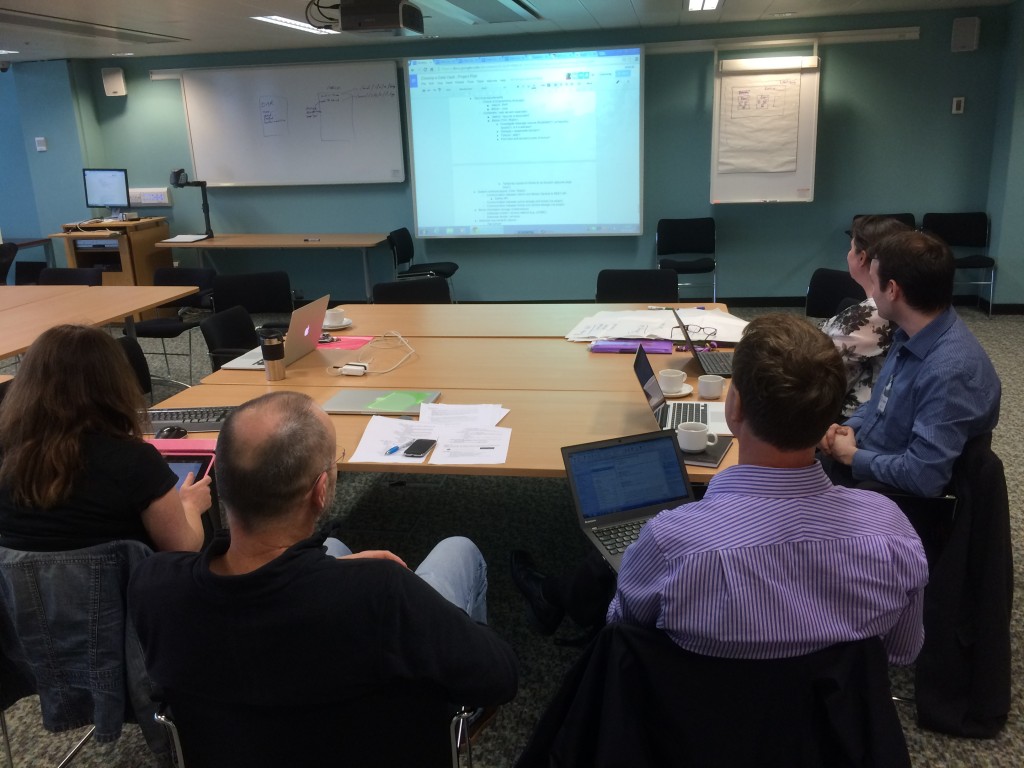
The Data Vault project is three months long, and is a collaboration between the universities of Edinburgh and Manchester. Due to the short nature of the project, we have decided to hold monthly meetings. The first of these was held in Manchester University Library in April.
We held the second project meeting on Tuesday 5th May in Edinburgh University Library. One of the main focus points of the meeting was on storage and architecture. We were therefore luck that experts in these areas attended from both universities.
The agenda for the meeting was:
- Overview and introductions for architecture/infrastructure attendees
- Review of the last month
- User cases and workflows
- Filesystem / transfer security (user credentials) – not in POC
- Dealing with large files / large archives (split bags?) configurable per backend
- Relationship with PURE (metadata harvesting) – not in POC
- Prototype planning
- Plans for the next month
Agreed actions from the meeting were:
- Define the requirements of the data vault to a level that can be implemented:
- Define ‘broker’, ‘storage’, and ‘archive’ APIs;
- Define database structure for metadata / search index;
- Define security requirements (Shibboleth / CAS / CoSign)
- Select technologies for web user interface and broker;
- Setup test infrastructure for month 3;
- Architecture diagrams;
- Test cases for the APIs / test data sets;
- User interface wireframes (associated with use cases);
- Consult in local institutions, and wider via project blog, to ensure the use cases are valid;
Visualising the Scott Monument
In Semester 2 this year, we had a number of first-year architecture students visiting the CRC to research historic Edinburgh buildings. There have been enquiries about Old College, New College, and the National Museum of Scotland, but the most popular building by far has been the Scott Monument. Designed by local (and self-taught) architect George Meikle Kemp (1795-1844) and constructed between 1840 and 1846, the monument is a defining feature of Edinburgh’s New Town.
The CRC’s Corson collection of books by and about Sir Walter Scott contains plenty of books about the Scott Monument, including Thomas Bonnar’s Biographical Sketch of George Meikle Kemp (1892), as well a few oddities (a Scott-themed thermometer and even a bar of soap!). Further information about the Corson collection is available online. 
 One of the most distinctive images of the Scott Monument in our collection is an early calotype, circa 1845, taken by Edinburgh photographers D.O. Hill and R. Adamson.
  The calotype process, developed by Henry Fox Talbot in 1841, used silver iodide to produce paper negatives; these were then printed onto silver chloride, or “salted paper”. The original prints are extremely sensitive to light but we have digitized our entire collection of about 700 Hill and Adamson calotypes. You can view them online here: http://images.is.ed.ac.uk/luna/servlet/UoEcar~4~4
Anne Peale, CRC Evening Assistant
Researching the Church of Scotland at New College Library
 The General Assembly of the Church of Scotland 2015 will take place between 16 and 23 May 2015. Staff and students continue to have access to New College and New College Library as normal, but as there may be an additional security presence at the entrance to New College we advise carrying your UoE staff/student card with you at all times.
At this time of year we expect to welcome visiting ministers and members of the Church of Scotland community to New College Library, often to research and reflect on the topics of business at the General Assembly.
For research into current issues in the Kirk, the Reports of the General Assembly are held in Stack II at sLX 50 B, side by side with the Principal Acts of the General Assembly at sLX50 AB. Documentation from the last five years of the Church of Scotland’s General Assembly is also available free to download from their website at http://www.churchofscotland.org.uk/about_us/general_assembly – recent membership and documentation for Church of Scotland Councils, committees and departments is also available from their website.We continue to collect the daily papers and proceedings of current General Assemblies of the Church of Scotland. The Church of Scotland Yearbook is also available, in Stack I at BX9076 Chu. The Church of Scotland magazine, Life and Work, has current issues on display in the current periodicals section in the Library Hall, with older bound volumes held downstairs in Stack II at Per L. When tracking down information about ministers, the Fasti ecclesiae Scoticanae remains a key tool, available at Ref. BX9099 Sco. in New College Library Hall.
For researchers interested in the historic Kirk, the Acts of the General Assembly are available from the seventeenth century onwards in Special and General Collections copies. New College Library’s print collections includes the collections of the former General Assembly Library, and also the Edinburgh Theological Library. This means that New College Library holds Church of Scotland accounts, orders of service, aids to devotion, Books of Discipline, Books of Common Prayer, publications of individual committees such as the Church and Nation Committee, and publications by groups such as Panel on Doctrine, Science, Religion & Technology. For those more interested in the Church of Scotland abroad rather than at home, we hold appeals, annual reports and archives relating to Church of Scotland missions.
University of Edinburgh users can access Acts and Proceedings of the General Assemblies of the Kirk of Scotland, 1560-1618 and Acts of the General Assembly of the Church of Scotland 1638-1842 online via British History Online. Seven volumes of Hew Scott’s original Fasti ecclesiae Scoticanae are also available digitally to UofE users. Finally, Gale Newsvault provides University users with access to The Home and Foreign Record of the Church of Scotland.
Christine Love-Rodgers – Academic Support Librarian – Divinity
New CRC Reading Room self-service scanner
Book Eye Scanner Instructional Video from DIU MOVING IMAGE on Vimeo.
Readers in the CRC are now able to capture high quality images from our collections using the new self-service Book Eye scanner. The machine is easy to use and well-suited for use with a wide range of materials including books, manuscripts, maps, poetry and newspapers. This service is completely free and all that is required of users is that they complete a form agreeing to the terms and conditions of use and watch a short demonstration from a member of staff the first time they use the scanner. The short video above outlines the key steps involved in the scanning process:
- Read and accept the terms and conditions
- Adjust cradle to suit item
- Place item on the cradle
- Push the scan button
- Insert USB
- Export scan to USB
- Remove USB
Unfortunately the scanner is not currently linked to a printer or wifi network, so anyone wishing to save their scans will have to use a USB stick (available to buy from the CRC reception).
The Book Eye is designed to be as intuitive as possible and features a touch panel on the front where the user can manage the scanning process. It has an adjustable cradle which can be used for scanning items of various shapes and sizes, up to a maximum of approximately A2. It can capture images up to 600 dpi, and these can be reviewed on the built-in 19 inch preview monitor above the book cradle and then exported as either JPEG or PDF files.
While the scanner is well suited to anyone who wishes to scan a few pages from a book or manuscript, we would be particularly interested to hear from anyone who would like to use it for a larger digitisation project.
Please contact is-crc@ed.ac.uk for more information.
St Cecilia’s captures donor’s imagination
The project to renovate Scotland’s oldest concert hall has received a generous donation from a University alumnus.
The bequest of £5,000 was donated by Robert McCracken, LLB who graduated in 1979.
Mr McCracken said: “I donated to the St Cecilia’s Hall project because it captured my interest and imagination in a number of different ways that were important to me.
“Firstly, it has strong historic significance for the City of Edinburgh, where I attended school and university, and to which I still have strong links. Secondly, it appealed to my interest in music, both for its beauty and potential as a venue for baroque music, and as a home for a wonderful period collection of harpsichords and other similar instruments.
“After very kindly being given a guided tour of the instruments, including a fascinating chat with the curator, I was hooked!”
The donation is a further boost to the project, which received a £100,000 award from Edinburgh World Heritage earlier this year, and £825,500 from the Heritage Lottery Fund in March 2014.
If you would like to find out more about supporting the St Cecilia’s Hall project, please email Leisa.Thomas@ed.ac.uk.
General Election 2015: recommended resources
It’s hard to miss that today, Thursday 7th May 2015, the UK is going to the polls to vote in the General Election. Have you voted yet?
We’ve pulled together just a small selection of Library resources and external sources that you may find useful if you are interested in elections and the election process in general or specifically in the UK General Election 2015.
What do the papers say?
 Although traditional news outlets are seen as less influential these days they still matter and have been extensively covering the General Election.
Factiva (off-campus access requires VPN) and NexisUK (click “Academic sign-in” and choose “UK federation”) allow you to search and access the full text of a large number of UK and international newspapers to find out how they have been covering the General Election. Read full text articles, compare how different newspapers are covering the same issues and stories, track the coverage of the General Election from the beginning and more. You can also use Lexis Library to specifically look at UK newspapers.
Edinburgh University Union Committee, 1899
 We recently acquired this photograph. It shows the committee which had responsibility for running the University Union, one comprised of both staff and students. We have researched each of the names and found out something further about most of them.
At this time and for some time to come, the Union was an all male affair. The date also means that many of the students depicted would also see service during the First World War – where known, this is noted.
Leonard Crossley
Medical graduate: MBChB 1900, MD 1903.
Frederick Nelson Menzies
Medical graduate: MBChB 1899, MD 1903.
James Myles Hogge (1873-1928)
Arts graduate: MA 1898. Later Member of Parliament.
Andrew Binny Flett (1875-1961)
Medical graduate: MBChB 1902.
Robert Dundonald Melville (1872-1927)
Arts and Law graduate: MA 1894, LLB 1896.
David Barty King (1873-1956)
MA from University of St. Andrews. Medical graduate: MBChB 1899, MD 1902. Served as Major in the Royal Army Medical Corps.
Francis Mitchell Caird (1853-1926)
Later Professor of Clinical Medicine.
Dr Richard J A Berry
Lecturer in Anatomy. Medical graduate: MBChB 1891, MD 1894.
John Rankine (1846-1922)
Professor of Scots Law.
Hugh Nethersole Fletcher (1877-1962)
Medical graduate: MBChB 1903, MD 1909. Served as Captain in the Royal Army Medical Corps (Territorial).
Hugh Crichton Miller (1877-1959)
Psychotherapist and founder of the Tavistock Clinic. Arts and Medical graduate: MA 1899, MBChB 1900, MD 1902. Served as Lieutenant, then Major, Royal Army Medical Corps.
Harry Malcolm Mackenzie (c1872-1947)
Medical graduate: MBChB 1899. Served as Lieutenant, then Major, then Lieutenant Colonel, Indian Medical Service.
James Walker ( -1922)
Chartered Accountant. Honorary Treasurer to the University Union
Samuel Butcher (1850-1910)
Professor of Greek.
Dr Francis William Nicol Haultain (1861-1921)
Obstetrician and Gynaecologist. Medical graduate: MB CM 1882.
Collections
 Hill and Adamson Collection: an insight into Edinburgh’s past
My name is Phoebe Kirkland, I am an MSc East Asian Studies student, and for...
Cataloguing the private papers of Archibald Hunter Campbell: A Journey Through Correspondence
My name is Pauline Vincent, I am a student in my last year of a...
Hill and Adamson Collection: an insight into Edinburgh’s past
My name is Phoebe Kirkland, I am an MSc East Asian Studies student, and for...
Cataloguing the private papers of Archibald Hunter Campbell: A Journey Through Correspondence
My name is Pauline Vincent, I am a student in my last year of a...
Projects
Cataloguing the private papers of Archibald Hunter Campbell: A Journey Through Correspondence
My name is Pauline Vincent, I am a student in my last year of a...
Archival Provenance Research Project: Lishan’s Experience
Presentation My name is Lishan Zou, I am a fourth year History and Politics student....