Home University of Edinburgh Library Essentials
May 9, 2026
Digitisation of the Roslin Glass Slide Collection; complete!
That’s me signing out, 3460 glass plate slides later. It is hard to know where to start. Lots of images of cows, pigs, horses and sheep! I now have the satisfaction of viewing the entire collection on our online digital collections platform – Roslin Slides. Furthermore, I was glad to find out that a selection of the slides will be shown at the Towards Dolly exhibition, here on the ground floor of the main library, in July 2015. With so many rich and diverse images, the best place for them is out in the open, easily accessible to academics and members of the public. This one of the many benefits of digital collections. The images are there to be enjoyed and engaged with; an activity that is not so easy when slides are neatly stacked away on shelves in a strong room! With the latter in mind, here are just a few more of my favourite slides from the collection.
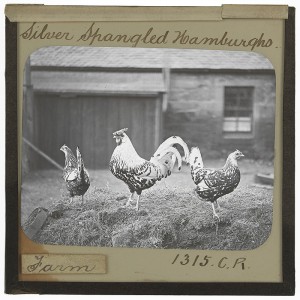
Silver Spangled Hamburghs
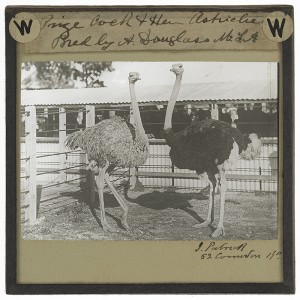
Prize Cock and Hen Ostriches, South Africa
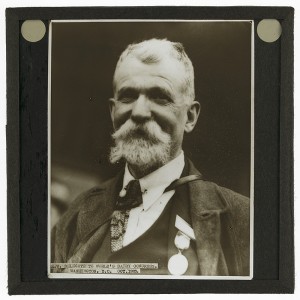
Professor Robert Wallace
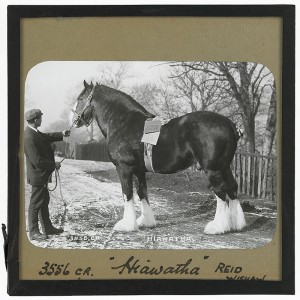
‘Hiawatha’, Clydesdale horse
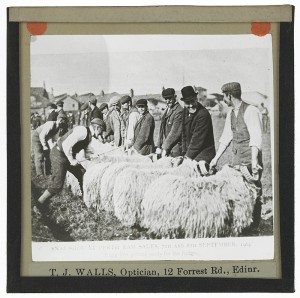
Perth Ram Sales
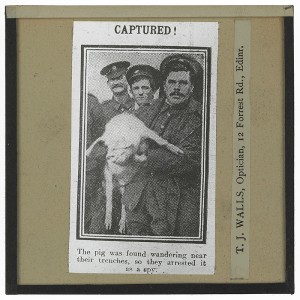
Spy Pig
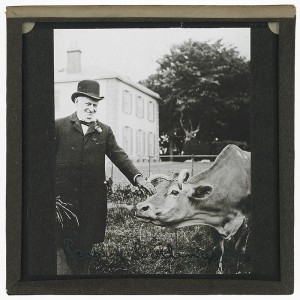
Jersey Collings Cow
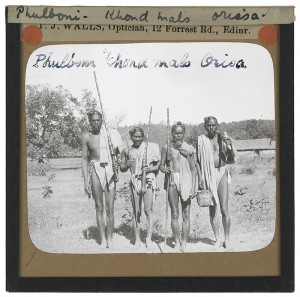
Khonds in Phulbani, Khandmal, Orissa, India
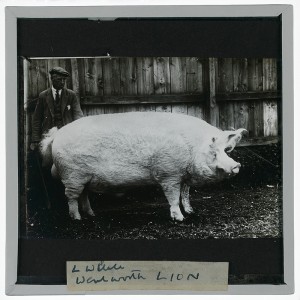
The ‘Wandsworth Lion’
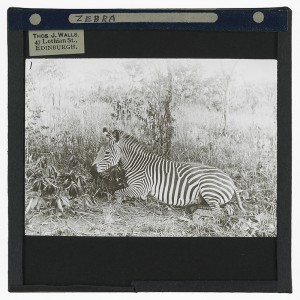
Zebra
John
Project Photographer
‘Science on a Plate’
‘Innovation’: the Emperor’s new clothes?
Scott and I travelled down to Cambridge last week to speak at the Museum Computer Group’s Spring Meeting, ‘Innovation’: the Emperor’s new clothes? It was a very informative day that began with Peter Pavement, SurfaceImpression, giving us a history of digital innovation in museums. Including the first audio guides and the Senster, which was the first robotic sculpture to be controlled by a computer.
First Museum Audio Guides from Loic Tallon Flickr

Peter discussing the Hype Cycle, where would you place new technological innovations?

Sejul Malde, Culture 24, followed on from Peter. He discussed using existing assets and content, as well as small ‘process focused’ innovation rather than innovation through giant leaps. His emphasis on creating a rhythm for change made me reflect on how short sprints enabled us to get Collections.ed online. (Looking at our Github commit history highlights sprint deadlines.)
Scott and I then discussed the work we have being doing at Edinburgh to get our collections online through Collections.ed, which has been an iterative process starting off with four online collections launched May 2014, we now have eight collections online following the recent launch of our Iconics collection. We have also recently made a first import into Collections.ed of 776 unique crowdsourced tags we have obtained through Library Labs Metadata Games and those entered into Tiltfactor‘s metadata games.
The tags can been seen online in these two examples:
Charles Darwin’s Class Card
Bond M., White House in Warm Perthshire Valley
The slides from our presentation are available on ERA http://hdl.handle.net/1842/10415 and have a film theme running through them.
The new Iconics home page (I think it is my favourite so far):
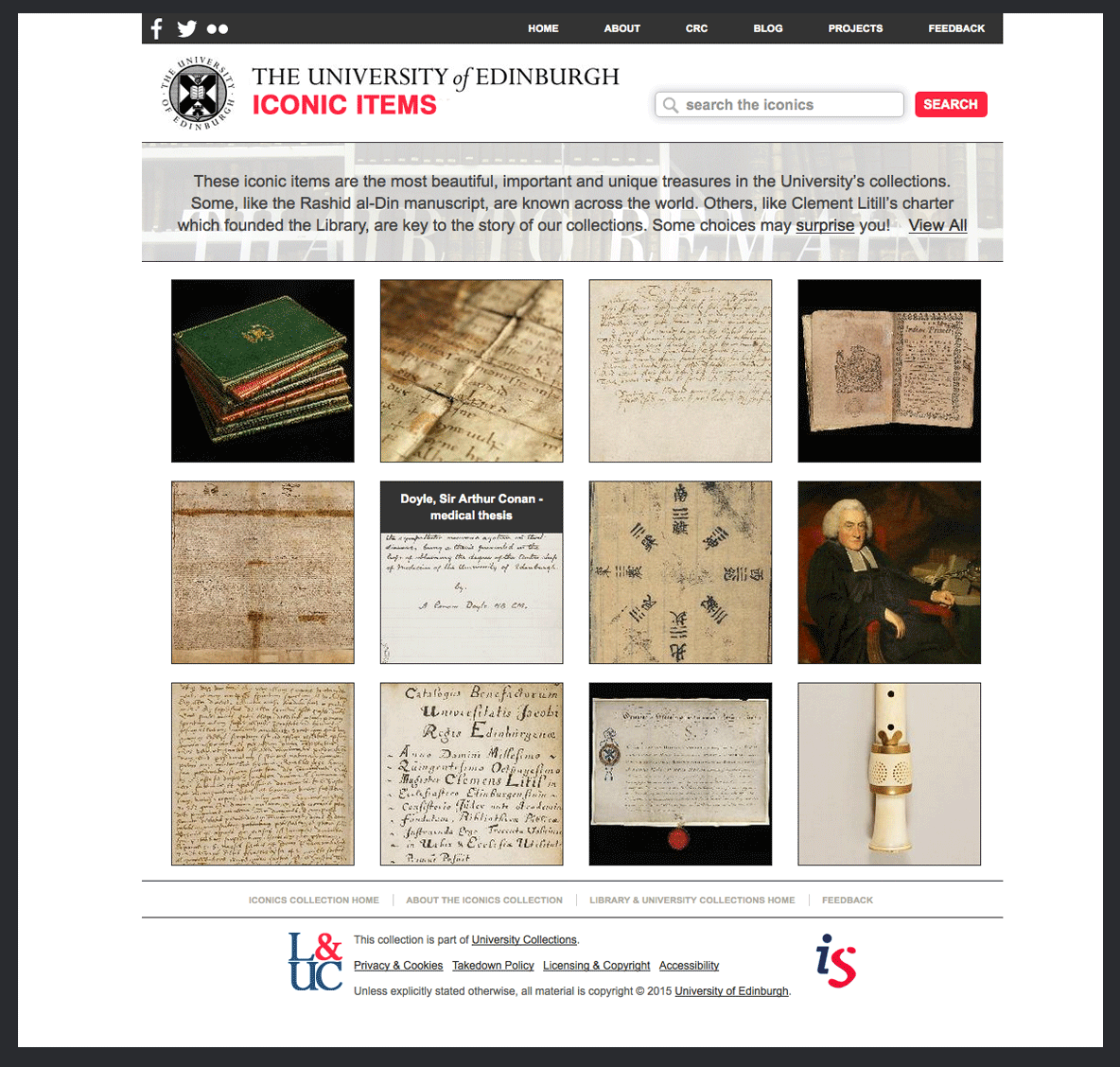
In the afternoon Lizzie Edwards, Samsung Digital Discovery Centre, British Museum, lead a practical session where we had to think about how we could use new technologies in Museums. Jessica Suess, Oxford University Museums, spoke about their ‘Innovation Fund’ programme and how it had led to new ways of working and new collaborations with colleagues. She mentioned one project using Ipads as Art Sketchbooks http://www.ashmolean.org/education/dsketchbooks/ which was also showcased in a lightning talk.
Lightning talks and a Q&A session with HLF and Nesta finished off the day, you can find out more from Liz Hide’s storify of the day: https://storify.com/TheMuseumOfLiz/the-emperor-s-new-clothes
Claire Knowles and Scott Renton, Library Digital Development Team
William Hunter (1861-1937) & the Order of St. Sava
EDINBURGH UNIVERSITY ALUMNUS SERVED IN SERBIA IN CHARGE OF A MEDICAL MISSION AND EARNED THE ORDER OF ST. SAVA, ONE OF SERBIA’S HIGHEST HONOURS
 During the First World War, and just shy of 100-years ago in June 1915, Colonel Sir William Hunter, an Edinburgh University alumnus, was appointed as a Grand Officer of the Serbian Order of St. Sava.

The Serbian Order of St. Sava – Medallion/badge with ribbon. Coll-1146 – Medals, awards and decorations of William Hunter
Hunter had been serving in Serbia with the British Military Sanitary Mission and there he developed de-lousing techniques to control typhus. In Serbia he was associated with the use of the ‘Serbian barrel’ for disinfection and the eradication of lice.

The Serbian Order of St. Sava – Detail. Coll-1146 – Medals, awards and decorations of William Hunter
William Hunter was born on 1 June 1861 in Ballantrae on the Ayrshire coast. He was educated at Ayr Academy, and then studied Medicine at Edinburgh University, graduating in 1883 with M.B., C.M. (1st Class) 1883, and M.D. (Gold Medal) 1886. He served as a house physician at the Royal Infirmary, Edinburgh, and as a Physican to the Western Dispensary, Edinburgh. He had also studied overseas at Leipzig in 1884 with a grant from the British Medical Association, and during the period 1887-1890 he visited Vienna and Strasbourg.

The Serbian Order of St. Sava – Breast Star. Coll-1146 – Medals, awards and decorations of William Hunter
Also during 1887-1890 Hunter worked full time on laboratory research at Cambridge, devoting himself to pernicious anaemia. He was the first person to note that the alimentary and the nervous system were often affected in this disorder. From 1895, Hunter was affiliated with the Charing Cross Hospital and the London Fever Hospital. Earlier, in 1894, he married Beatrice Fielden, daughter of Joshua Fielden MP.
Along with Julius Otto Ludwig Moeller (1819-1887), a German Professor of Medicine and Surgery from Königsberg (now Kaliningrad), he is associated with ‘Hunter’s glossitis’ caused by B12 or folic acid deficiency (‘Moeller-Hunter glossitis’).

The Serbian Order of St. Sava – Detail, with wording in older cyrillic letters ‘One’s own work achieves all’. Coll-1146 – Medals, awards and decorations of William Hunter
In addition to the honour of his appointment as a Grand Officer of the Serbian Order of St. Sava for medical services to Serbia, in January 1916 Hunter was mentioned in Dispatches (Dardanelles) and was awarded the Companion Order of the Bath (CB). He went on to become President of the Advisory Committee, Prevention of Disease, in the Eastern Mediterranean and Mesopotamia (Gallipoli, Egypt, Salonika, Malta and Palestine), and he served with the Eastern Command, 1917-1919, as Consulting Physician. He continued to hold the rank of Colonel.
The Serbian Order of St. Sava – Detail, oval enamelled portrait of the Prince Bishop St. Sava (Rastko Nemanjić). Coll-1146 – Medals, awards and decorations of William Hunter
St. Sava is most important saint of the Serbian Orthodox Church and the patron saint of Serbia. The Order of St. Sava was a decoration instituted by the Serbian King, Milan I (1854-1901), in 1883. The Order was established to recognize civilians for meritorious achievements to the Church, to arts and sciences, the royal house and the state. In 1914 a change was made permitting military personnel to receive the honour for military merit. After the ending of the First World War, the Order of St Sava was awarded by the king of then-Yugoslavia until the abolishment of the monarchy in 1945 (Serbia had been a part of the Kingdom then Republic of Yugoslavia between 1918 and the early 1990s).

The Serbian Order of St. Sava – Detail, Serbian Eagle and Cross. Coll-1146 – Medals, awards and decorations of William Hunter
Five grades of the Order of St. Sava were awarded: Grand Cross, Grand Officer, Commander, Officer and Knight. Other very varied recipients of the Order were Nikola Tesla (electrical engineer, physicist 1856-1943), Peter Norman Nissen (mining engineer, developer of pre-fab’ shelter 1871-1930) and Helen Keller (author, political activist, lecturer 1880-1968).
Hunter’s published work includes: Oral sepsis as a cause of ‘Septic gastritis’, ‘Toxic neuritis’ and other septic conditions (1901); Pernicious anaemia: its pathology, septic origin, symptoms, diagnosis, and treatment. Based upon original investigations (1901); A research into epidemic and epizootic plague (1904); Severest anaemias. Their infective nature, diagnosis and treatment (1909); Historical account of Charing Cross hospital and medical school (University of London): original plan and statutes, rise and progress (1914); and, The Serbian epidemics of typhus and relapsing fever in 1915: Their Origin, Course, and Preventive Measures employed for their Arrest (1920).

The Serbian Order of St. Sava – Medallion/badge with ribbon. Coll-1146 – Medals, awards and decorations of William Hunter
William Hunter was a Fellow of the Royal College of Physicians (FRCP London 1896) and a Fellow of the Royal Society of Edinburgh (FRSE).

Letter from William Hunter acknowledging the award of Hon. LLD. to be conferred on him by Edinburgh University. EUA INI/ADS/STA/15 1914-1930. Acceptances of Honorary Degrees
In 1927 he was awarded an Honorary LL.D. by Edinburgh University, and acknowledging the notification of award in a letter dated 8 June 1927, Hunter offers his ‘most grateful appreciation […] of the great honour’ his alma mater has conferred on him.

Letter from William Hunter acknowledging the award of Hon. LLD. to be conferred on him by Edinburgh University. EUA INI/ADS/STA/15 1914-1930. Acceptances of Honorary Degrees
The letter goes on: ‘It will be a great pleasure to me to be at the Graduation on July 20th’.
Colonel Sir William Hunter died on 13 January 1937.
Dr. Graeme D. Eddie, Assistant Librarian Archives & Manuscripts, Centre for Research Collections
Sources used included online medal sites, and: (1) University of Edinburgh. Roll of Honour 1914-1919. p.383, Edinburgh: Oliver & Boyd, 1921 (2) Serbia under typhus in 1915. p.219. The British Journal of Nursing. 10 April 1920 (3) Bosiljka M. Lalević-Vasić. History of dermatology and venereology in Serbia – part III/2 ; Dermatovenereology in Serbia from 1881-1918. p.162. Serbian Journal of Dermatology and Venereology 2009 (4), pp.159-165
Here comes the summer!
The weather may not be able to quite make up its mind whether (!) we are heading into summer or skipping it entirely and going straight to autumn but this Friday, 22 May, is the end of semester 2 and the beginning of the summer vacation period at the University.
Whether you will be staying in Edinburgh and continuing your studies over the summer period or if you will be away from Edinburgh for the summer here are a few things to bear in mind:
1) This summer both the Library Catalogue and Searcher will be replaced by DiscoverEd.

John Knox and the Scottish Reformed Kirk
At 4pm today, Tuesday 19 May, in the Assembly Hall, Prof Jane Dawson will address the General Assembly on the topic of John Knox, following publication of her recent biography. Prof. Dawson’s new book is on display in the Funk Reading Room and in the main display case we have early printed books from the time of John Knox selected by Prof. Dawson to illustrate key themes about his ministry and the development of the Scottish Reformed Kirk from 1560 onwards.

Knox, John. Sermon on Isaiah. London, 1566. New College Library LR1/7
This sermon by Knox was preached on 19 August 1565, in St Giles’ Kirk where Knox was minister and is the only full text of one of Knox’s sermons to have come down to us. It was printed because Knox had been given a temporary preaching ban having offended King Henry [Lord Darnley and husband of Mary, Queen of Scots] by Knox’s pointed use of the Old Testament story of Ahab and Jezebel.

Psalmes of David [Henry Charteris ] 1596 New College Library tUR 1596

Knox, John. An Answer Geneva, 1560. LR1/7
Knox’s ‘Answer’. This was Knox’s longest book and dealt with the doctrine of predestination. It was published in Geneva in 1560 after Knox had returned to Scotland. Following the lead of John Calvin on predestination, Knox refuted an anonymous author who had championed free will. As was common practice, Knox challenged each of his opponent’s arguments in turn – this makes the book long and not an easy read!
*With thanks to Prof Jane Dawson for this blog post text*
Christine Love-Rodgers – Academic Support Librarian – Divinity
‘The County Surveys 1793 – 1817: Exploring Considered Digitisation’
Those familiar with the Statistical Accounts of Scotland will be aware that they belong to a greater body of works initiated and supervised by Sir John Sinclair, forming the base of what he envisaged as a grand ‘pyramid of agricultural enquiries’. An extensive and ambitious survey of ‘the existing agricultural state of England and Scotland respectively, and the means by which each might be improved’, the pyramid comprised four levels. Scotland’s parishes were the focus of the Statistical Accounts, while the ‘General View…’ series covered a much broader geographical area by focusing on the counties of Scotland, England and Wales. Then came The General Report of the Agricultural State, and Political Circumstances of Scotland, published in 5 volumes in 1814 and, at the pinnacle of the pyramid, Sinclair’s Code of Agriculture, published in one volume in 1817. This, as historian Heather Holmes explains, “combined all the enquiries into one code ‘for the purpose of rendering, a general knowledge of the principles of husbandry, more easily accessible’.”
The Statistical Accounts of Scotland service makes the full text of the accounts available through searchable digitised copies which provide important reference sources for researchers across numerous disciplines and fields of study. Over the years, we have also built up a fantastic collection of related resources including maps and illustrations, correspondence, manuscripts and information about Sinclair’s other works.
We are therefore delighted to report that EDINA is currently undertaking a project to assess the potential of a similar virtual collection of the County Surveys, the second layer of Sinclair’s pyramid.
The County Surveys recorded comprehensive information on the agriculture, rural economy and political economy of each county in Great Britain between 1793 and 1817. They provide a unique insight into the innovation and agricultural improvement during a significant period in the making of Britain as the first industrial nation. Despite its remarkable historical interest, this resource is currently under-used because very few surveys are available in digital format, and printed copies are difficult to locate and access.
‘The County Surveys 1793 – 1817: Exploring Considered Digitisation’ aims to explore how the creation of a virtual collection can unleash the potential of the County Surveys for discovery. The project is funded by EDINA, University of Edinburgh and scheduled for completion in July 2015.
Our approach of “considered digitisation” involves:
- Reviewing extant digital fragments of the County Surveys to assess their availability for public access, the quality of their digital image, OCR text and metadata, and their suitability for computer automated text analysis, search and retrieval
- Supporting re-digitisation when appropriate to offer public domain content of sufficient quality
- Identifying sources of printed copies for the County Survey and encouraging digitisation
- Engaging with organisations holding copies of the County Surveys to encourage and support digitisation and re-digitisation efforts, and sharing openly our experience of “considered digitisation”.
Find out more about the project and its progress here.
Trial – Early Modern Pamphlets Online
 We have trial access to Early Modern Pamphlets Online until 13th June. We are trialling all 3 collections within Early Modern Pamplets Online:
Dutch Pamphlets 1486-1853: The Knuttel Collection
The Knuttel Collection at the Koninklijke Bibliotheek, the National Library of the Netherlands, is the most extensive pamphlet collection in the Netherlands. It consist of roughly 34,000 pamphlets ranging from political apologies and manifestos to tracts for and against predestination in theology. Further info about this collection is available at http://tempo.idcpublishers.info/protected/content/coll_pamphlets.php
Dutch Pamphlets, 1542-1853: The Van Alphen Collection
The Van Alphen collection supplements the Knuttel collection. It comprises some 2,800 pamphlets from Groningen University Library not included in the Knuttel collection. The pamphlets date from 1542 to 1853 and deal with similar topics as those described by Knuttel. See http://tempo.idcpublishers.info/protected/content/coll_vanalphen.php for further information.
Flugschriften des 16. Jahrhunderts
The Flugschriften series contains some 11,000 German and Latin pamphlets printed in the Holy Roman Empire. The collection is supplemented on an annual basis. The pamphlets from 1501-1530 are primarily concerned with the early Reformation movement and its propaganda, the Peasants’ War, the threat presented by the Turks, and the various conflicts among the Western European countries. The pamphlets from 1531-1600 deal with a broad spectrum of themes, such as the Turkish wars, the revolt of the Netherlands, the persecution of French protestants, the status of Calvinists and Zwinglians in the Holy Roman Empire, the Council of Trent, the Anabaptist Kingdom of Münster, the Schmalkaldic War and the Interim, propaganda against the papacy and the Jesuits, intra-Protestant theological quarrels, the building of confessional networks, witch-hunting, and anti-Jewish polemics.
Feedback and further info
We are interested to know what you think of these collections as your comments influence purchase decisions so please fill out our feedback form.
A list of all trials currently available to University of Edinburgh staff and students can be found on our trials webpage.
JSTOR – additional content now available

We now subscribe to JSTOR Arts & Sciences XIII and Arts & Sciences XIV packages.
The Arts & Sciences XIII Collection adds an increasingly international set of journals in disciplines including Language & Literature, Art & Art History, Philosophy, and Religion. Represented subdisciplines include European church history and the literature of the American West. The collection offers a global scope. European countries including Germany, Italy, and the Netherlands each contribute several titles, with an additional title published in South Korea, the Journal of Korean Religions. The collection will contain at least 125 titles by completion.
The Arts & Sciences XIV Collection brings together more than 125 journals devoted to the study of culture and communication, from civilization’s earliest traces to the growth and governance of peoples. All titles are new to the JSTOR platform at the time of launch. Journals in the collection span 17 countries, 23 disciplines, and date back to 1839. They are drawn primarily from the fields of Archaeology, Language & Literature, Communications Studies, Asian Studies, and Political Science. As this collection was only released last month, not all titles are online yet – these will be added to our catalogue/A-Z list as they become available.
See http://www.jstor.org/action/collectionsAvailable for title lists. We have added the individual e-journals currently available to our e-journal A-Z list and they will be added to our catalogue/searcher soon.
Oldest thesis record in the British Library’s e-thesis online service (EThOS)
Over the last few weeks and months we’ve been adding a lot of digitised material from our historical collections to the Edinburgh Research Archive. One of the collections that has been scanned is a series of M.D theses written in Latin and published in the period from late 1700s to early 1800s. We now can claim to have the oldest thesis record in the British Library’s e-thesis online service (EThOS) – a dissertation written by Thomas Charles Hope and published in 1787. The challenge is on for other institutions to beat this.

Thomas Charles Hope was one of the University of Edinburgh’s more interesting alumnus who discovered the chemical element Strontium, and also taught a young Charles Darwin who viewed his chemistry lectures as highlights in his otherwise largely dull education at Edinburgh University (we’ve come along way since!).
Thomas Charles Hope’s M.D thesis can be accessed online for free in the Edinburgh Research Archive.
‘Edinburgh’s Guilty Avenues’ : horrible histories from the New College Library Archives
A guest post from Eleanor Rideout, New College Library Helpdesk Assistant
The grisly find of a letter written in William Burke’s blood, on show as part of this weekend’s Festival of Museums, reminded me of one of my favourite items in the New College Library manuscript collections.

Letter from George Charles Smith to Thomas Chalmers, 19 August 1835 New College Library CHA 4.243.5
CHA 4.243.5 is a letter dated 19 August 1835 containing a contemporary use of the verb ‘burking’ and lurid descriptions of the most deprived areas of Edinburgh:
“Only to look down many of your closes and courts and alleys, is enough to satisfy anyone that more suitable places, for robbery, uncleanness, murder, or Burkings of any kind, cannot be found in the world”.

Rev. Dr Thomas Chalmers, [1843?]. Calotypes Collection, University of Edinburgh.
The letter is titled ‘Edinburgh’s Guilty Avenues’ and was sent to Thomas Chalmers, the first Principal of New College. His papers are one of the most significant collections held by New College Library. Chalmers had a wide range of interests and a considerable number of correspondents but as a public figure he also attracted much unsolicited mail from those seeking support for their own ideas. The sender, George Charles Smith, was not a regular correspondent, but was clearly a very zealous evangelist. According to his DNB entry, he was known as Boatswain Smith due to his involvement with maritime missions and he was also passionate about improving the morals of port cities.
Interestingly, the DNB does not mention his time in Edinburgh but this letter shows he spent some time here.He writes to Chalmers to:
“entreat that you will kindly devote your attention to the state of the poorest, the meanest, and vilest of the population of Edinburgh…I have considered that their Habitations are disgusting, unhealthy, and horrible. Your national custom of so many Families occupying one House cut up into Floors or “Flats”, as you term them, is to an Englishman surpassing strange.”
Sadly no response is recorded. Given Chalmers’ evangelical beliefs and published schemes for poor relief, perhaps he would not have been pleased to have it suggested that he had not gone nearly far enough. However, in his last years he did establish a campaign for social reform and religious instruction in the West Port area of Edinburgh. Hopefully Smith was pleased to hear of it.
Eleanor Rideout, New College Library Helpdesk Assistant
Collections
 Hill and Adamson Collection: an insight into Edinburgh’s past
My name is Phoebe Kirkland, I am an MSc East Asian Studies student, and for...
Cataloguing the private papers of Archibald Hunter Campbell: A Journey Through Correspondence
My name is Pauline Vincent, I am a student in my last year of a...
Hill and Adamson Collection: an insight into Edinburgh’s past
My name is Phoebe Kirkland, I am an MSc East Asian Studies student, and for...
Cataloguing the private papers of Archibald Hunter Campbell: A Journey Through Correspondence
My name is Pauline Vincent, I am a student in my last year of a...
Projects
Cataloguing the private papers of Archibald Hunter Campbell: A Journey Through Correspondence
My name is Pauline Vincent, I am a student in my last year of a...
Archival Provenance Research Project: Lishan’s Experience
Presentation My name is Lishan Zou, I am a fourth year History and Politics student....