Home University of Edinburgh Library Essentials
December 17, 2025
‘The County Surveys 1793 – 1817: Exploring Considered Digitisation’
Those familiar with the Statistical Accounts of Scotland will be aware that they belong to a greater body of works initiated and supervised by Sir John Sinclair, forming the base of what he envisaged as a grand ‘pyramid of agricultural enquiries’. An extensive and ambitious survey of ‘the existing agricultural state of England and Scotland respectively, and the means by which each might be improved’, the pyramid comprised four levels. Scotland’s parishes were the focus of the Statistical Accounts, while the ‘General View…’ series covered a much broader geographical area by focusing on the counties of Scotland, England and Wales. Then came The General Report of the Agricultural State, and Political Circumstances of Scotland, published in 5 volumes in 1814 and, at the pinnacle of the pyramid, Sinclair’s Code of Agriculture, published in one volume in 1817. This, as historian Heather Holmes explains, “combined all the enquiries into one code ‘for the purpose of rendering, a general knowledge of the principles of husbandry, more easily accessible’.”
The Statistical Accounts of Scotland service makes the full text of the accounts available through searchable digitised copies which provide important reference sources for researchers across numerous disciplines and fields of study. Over the years, we have also built up a fantastic collection of related resources including maps and illustrations, correspondence, manuscripts and information about Sinclair’s other works.
We are therefore delighted to report that EDINA is currently undertaking a project to assess the potential of a similar virtual collection of the County Surveys, the second layer of Sinclair’s pyramid.
The County Surveys recorded comprehensive information on the agriculture, rural economy and political economy of each county in Great Britain between 1793 and 1817. They provide a unique insight into the innovation and agricultural improvement during a significant period in the making of Britain as the first industrial nation. Despite its remarkable historical interest, this resource is currently under-used because very few surveys are available in digital format, and printed copies are difficult to locate and access.
‘The County Surveys 1793 – 1817: Exploring Considered Digitisation’ aims to explore how the creation of a virtual collection can unleash the potential of the County Surveys for discovery. The project is funded by EDINA, University of Edinburgh and scheduled for completion in July 2015.
Our approach of “considered digitisation” involves:
- Reviewing extant digital fragments of the County Surveys to assess their availability for public access, the quality of their digital image, OCR text and metadata, and their suitability for computer automated text analysis, search and retrieval
- Supporting re-digitisation when appropriate to offer public domain content of sufficient quality
- Identifying sources of printed copies for the County Survey and encouraging digitisation
- Engaging with organisations holding copies of the County Surveys to encourage and support digitisation and re-digitisation efforts, and sharing openly our experience of “considered digitisation”.
Find out more about the project and its progress here.
Trial – Early Modern Pamphlets Online
 We have trial access to Early Modern Pamphlets Online until 13th June. We are trialling all 3 collections within Early Modern Pamplets Online:
Dutch Pamphlets 1486-1853: The Knuttel Collection
The Knuttel Collection at the Koninklijke Bibliotheek, the National Library of the Netherlands, is the most extensive pamphlet collection in the Netherlands. It consist of roughly 34,000 pamphlets ranging from political apologies and manifestos to tracts for and against predestination in theology. Further info about this collection is available at http://tempo.idcpublishers.info/protected/content/coll_pamphlets.php
Dutch Pamphlets, 1542-1853: The Van Alphen Collection
The Van Alphen collection supplements the Knuttel collection. It comprises some 2,800 pamphlets from Groningen University Library not included in the Knuttel collection. The pamphlets date from 1542 to 1853 and deal with similar topics as those described by Knuttel. See http://tempo.idcpublishers.info/protected/content/coll_vanalphen.php for further information.
Flugschriften des 16. Jahrhunderts
The Flugschriften series contains some 11,000 German and Latin pamphlets printed in the Holy Roman Empire. The collection is supplemented on an annual basis. The pamphlets from 1501-1530 are primarily concerned with the early Reformation movement and its propaganda, the Peasants’ War, the threat presented by the Turks, and the various conflicts among the Western European countries. The pamphlets from 1531-1600 deal with a broad spectrum of themes, such as the Turkish wars, the revolt of the Netherlands, the persecution of French protestants, the status of Calvinists and Zwinglians in the Holy Roman Empire, the Council of Trent, the Anabaptist Kingdom of Münster, the Schmalkaldic War and the Interim, propaganda against the papacy and the Jesuits, intra-Protestant theological quarrels, the building of confessional networks, witch-hunting, and anti-Jewish polemics.
Feedback and further info
We are interested to know what you think of these collections as your comments influence purchase decisions so please fill out our feedback form.
A list of all trials currently available to University of Edinburgh staff and students can be found on our trials webpage.
JSTOR – additional content now available

We now subscribe to JSTOR Arts & Sciences XIII and Arts & Sciences XIV packages.
The Arts & Sciences XIII Collection adds an increasingly international set of journals in disciplines including Language & Literature, Art & Art History, Philosophy, and Religion. Represented subdisciplines include European church history and the literature of the American West. The collection offers a global scope. European countries including Germany, Italy, and the Netherlands each contribute several titles, with an additional title published in South Korea, the Journal of Korean Religions. The collection will contain at least 125 titles by completion.
The Arts & Sciences XIV Collection brings together more than 125 journals devoted to the study of culture and communication, from civilization’s earliest traces to the growth and governance of peoples. All titles are new to the JSTOR platform at the time of launch. Journals in the collection span 17 countries, 23 disciplines, and date back to 1839. They are drawn primarily from the fields of Archaeology, Language & Literature, Communications Studies, Asian Studies, and Political Science. As this collection was only released last month, not all titles are online yet – these will be added to our catalogue/A-Z list as they become available.
See http://www.jstor.org/action/collectionsAvailable for title lists. We have added the individual e-journals currently available to our e-journal A-Z list and they will be added to our catalogue/searcher soon.
Oldest thesis record in the British Library’s e-thesis online service (EThOS)
Over the last few weeks and months we’ve been adding a lot of digitised material from our historical collections to the Edinburgh Research Archive. One of the collections that has been scanned is a series of M.D theses written in Latin and published in the period from late 1700s to early 1800s. We now can claim to have the oldest thesis record in the British Library’s e-thesis online service (EThOS) – a dissertation written by Thomas Charles Hope and published in 1787. The challenge is on for other institutions to beat this.

Thomas Charles Hope was one of the University of Edinburgh’s more interesting alumnus who discovered the chemical element Strontium, and also taught a young Charles Darwin who viewed his chemistry lectures as highlights in his otherwise largely dull education at Edinburgh University (we’ve come along way since!).
Thomas Charles Hope’s M.D thesis can be accessed online for free in the Edinburgh Research Archive.
‘Edinburgh’s Guilty Avenues’ : horrible histories from the New College Library Archives
A guest post from Eleanor Rideout, New College Library Helpdesk Assistant
The grisly find of a letter written in William Burke’s blood, on show as part of this weekend’s Festival of Museums, reminded me of one of my favourite items in the New College Library manuscript collections.

Letter from George Charles Smith to Thomas Chalmers, 19 August 1835 New College Library CHA 4.243.5
CHA 4.243.5 is a letter dated 19 August 1835 containing a contemporary use of the verb ‘burking’ and lurid descriptions of the most deprived areas of Edinburgh:
“Only to look down many of your closes and courts and alleys, is enough to satisfy anyone that more suitable places, for robbery, uncleanness, murder, or Burkings of any kind, cannot be found in the world”.

Rev. Dr Thomas Chalmers, [1843?]. Calotypes Collection, University of Edinburgh.
The letter is titled ‘Edinburgh’s Guilty Avenues’ and was sent to Thomas Chalmers, the first Principal of New College. His papers are one of the most significant collections held by New College Library. Chalmers had a wide range of interests and a considerable number of correspondents but as a public figure he also attracted much unsolicited mail from those seeking support for their own ideas. The sender, George Charles Smith, was not a regular correspondent, but was clearly a very zealous evangelist. According to his DNB entry, he was known as Boatswain Smith due to his involvement with maritime missions and he was also passionate about improving the morals of port cities.
Interestingly, the DNB does not mention his time in Edinburgh but this letter shows he spent some time here.He writes to Chalmers to:
“entreat that you will kindly devote your attention to the state of the poorest, the meanest, and vilest of the population of Edinburgh…I have considered that their Habitations are disgusting, unhealthy, and horrible. Your national custom of so many Families occupying one House cut up into Floors or “Flats”, as you term them, is to an Englishman surpassing strange.”
Sadly no response is recorded. Given Chalmers’ evangelical beliefs and published schemes for poor relief, perhaps he would not have been pleased to have it suggested that he had not gone nearly far enough. However, in his last years he did establish a campaign for social reform and religious instruction in the West Port area of Edinburgh. Hopefully Smith was pleased to hear of it.
Eleanor Rideout, New College Library Helpdesk Assistant
Where Did Fairbairn get his books?
It has often been commented that Fairbairn, in Edinburgh, was working a long way from the main centres of development in psychoanalysis. This must have made keeping abreast of the literature of his subject more difficult, as libraries and bookshops were unlikely to stock much of such a specialised subject. While cataloguing the books we have found some fascinating clues as to where some of them came from.
Of course it was possible to order through local bookshops, as an invoice from the Edinburgh bookseller James Thin, found between the pages of a 1940s issue of The Yearbook of Psychoanalysis, shows Fairbairn sometimes did.

Our attention was caught by a bookseller’s ticket on the inside of the binding of a dozen or so of the books in the collection “H.K. Lewis & Co. Ltd., 136 Gower Street, London, W.c.1”. Lewis’s turn out to have been a specialist medical and scientific booksellers, publishers and commercial circulating library, who operated a huge, international mail-order business. Their catalogues contained exactly the books Fairbairn needed to know about.
It would be fascinating to know whether Fairbairn also used Lewis’s library. This part of the business was founded in 1852, and was still functioning in the 1940s. There were reading rooms in the company’s premises in Gower Street, for students and professionals living in or visiting London, but there was also a postal service, designed originally to meet the needs of provincial doctors, working without other access to a library of professional literature. By the 1940s the catalogue, sent out to subscribers, was 900 pages long, and covered every medical speciality.
One of the consequences of professional eminence is being asked to write book reviews. There are a number of volumes in the collection stamped ‘Review Copy’, or, as with Clifford Allen’s Modern discoveries in medical psychology, 1936, with the publisher’s slip requesting a review and Fairbairn’s notes for the review still inside it. Fairbairn’s papers at the National Library include his reviews for many other titles which are in the collection, although his copies have nothing in them to show this.

There are presentation inscriptions inside a few of the books, not usually from their authors, but instead marking professional collaborations or visits. One of these has proved tantalising: Lewis Brown Hill’s Psychotherapeutic Intervention in Schizophrenia, 1955, is inscribed to Fairbairn by someone with a totally illegible name. If anyone can identify them we would be very grateful to know.

Elizabeth Quarmby Lawrence
Edinburgh University Library
Month 2 project meeting
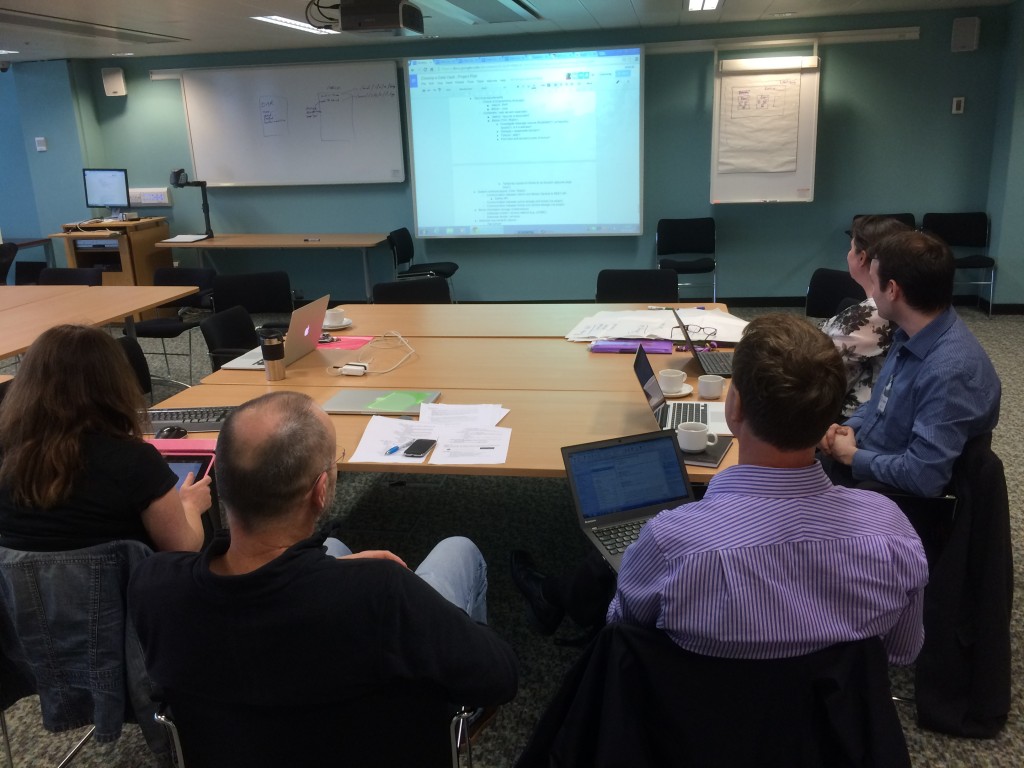
The Data Vault project is three months long, and is a collaboration between the universities of Edinburgh and Manchester. Due to the short nature of the project, we have decided to hold monthly meetings. The first of these was held in Manchester University Library in April.
We held the second project meeting on Tuesday 5th May in Edinburgh University Library. One of the main focus points of the meeting was on storage and architecture. We were therefore luck that experts in these areas attended from both universities.
The agenda for the meeting was:
- Overview and introductions for architecture/infrastructure attendees
- Review of the last month
- User cases and workflows
- Filesystem / transfer security (user credentials) – not in POC
- Dealing with large files / large archives (split bags?) configurable per backend
- Relationship with PURE (metadata harvesting) – not in POC
- Prototype planning
- Plans for the next month
Agreed actions from the meeting were:
- Define the requirements of the data vault to a level that can be implemented:
- Define ‘broker’, ‘storage’, and ‘archive’ APIs;
- Define database structure for metadata / search index;
- Define security requirements (Shibboleth / CAS / CoSign)
- Select technologies for web user interface and broker;
- Setup test infrastructure for month 3;
- Architecture diagrams;
- Test cases for the APIs / test data sets;
- User interface wireframes (associated with use cases);
- Consult in local institutions, and wider via project blog, to ensure the use cases are valid;
Visualising the Scott Monument
In Semester 2 this year, we had a number of first-year architecture students visiting the CRC to research historic Edinburgh buildings. There have been enquiries about Old College, New College, and the National Museum of Scotland, but the most popular building by far has been the Scott Monument. Designed by local (and self-taught) architect George Meikle Kemp (1795-1844) and constructed between 1840 and 1846, the monument is a defining feature of Edinburgh’s New Town.
The CRC’s Corson collection of books by and about Sir Walter Scott contains plenty of books about the Scott Monument, including Thomas Bonnar’s Biographical Sketch of George Meikle Kemp (1892), as well a few oddities (a Scott-themed thermometer and even a bar of soap!). Further information about the Corson collection is available online. 
 One of the most distinctive images of the Scott Monument in our collection is an early calotype, circa 1845, taken by Edinburgh photographers D.O. Hill and R. Adamson.
  The calotype process, developed by Henry Fox Talbot in 1841, used silver iodide to produce paper negatives; these were then printed onto silver chloride, or “salted paper”. The original prints are extremely sensitive to light but we have digitized our entire collection of about 700 Hill and Adamson calotypes. You can view them online here: http://images.is.ed.ac.uk/luna/servlet/UoEcar~4~4
Anne Peale, CRC Evening Assistant
Collections
 Hill and Adamson Collection: an insight into Edinburgh’s past
My name is Phoebe Kirkland, I am an MSc East Asian Studies student, and for...
Cataloguing the private papers of Archibald Hunter Campbell: A Journey Through Correspondence
My name is Pauline Vincent, I am a student in my last year of a...
Hill and Adamson Collection: an insight into Edinburgh’s past
My name is Phoebe Kirkland, I am an MSc East Asian Studies student, and for...
Cataloguing the private papers of Archibald Hunter Campbell: A Journey Through Correspondence
My name is Pauline Vincent, I am a student in my last year of a...
Projects
Cataloguing the private papers of Archibald Hunter Campbell: A Journey Through Correspondence
My name is Pauline Vincent, I am a student in my last year of a...
Archival Provenance Research Project: Lishan’s Experience
Presentation My name is Lishan Zou, I am a fourth year History and Politics student....