Home University of Edinburgh Library Essentials
May 9, 2026
Ministry and medicine
Today we’re welcoming a group from the EAHIL + ICAHIS + ICLC 2015 Workshop to New College Library. The Workshop is a collaboration between the European Association for Health Information and Libraries (EAHIL), the International Conference of Animal Health Information Specialists (ICAHIS) and the International Clinical Librarian Conference (ICLC). Along with a tour of the library we have brought out some Special Collections items on a medical theme to display.

Avicenna, 980-1037. Liber Avicenna. Venice : 1500. New College Library Inc. 22
This is a detail from Liber Avicenna, a work from the Incunabula Collection. Avicenna was a Persian scholar whose medical texts became standard works at medieval universities.

Piperno, Pietro. De effectibus magicis libri sex … Naples : 1647. New College Library TR.395
Part of the TR Collection currently being catalogued as part of the Funk Projects, De effectibus magicis libri sex is a seventeenth century work on medicine, magic and the occult.

Sibbald, Robert. Scotia illustrata, sive, Prodromus historiae naturalis … Edinburgh : 1684. New College Library DPL 9
Robert Sibbald was an Edinburgh physician and later the first professor of medicine at the University of Edinburgh. This work, Scotia illustrata, is a descriptive regional guide to Scotland’s natural history, with reference to the health of the inhabitants of each region. It once belonged to another doctor, Dr John Hutton, who was court physician at the court of William and Mary. He gifted his library to the Presbytery of Dumfries, from where it came to New College Library where it is now part of the Dumfries Presbytery Library.
Christine Love-Rodgers, Academic Support Librarian – Divinity
Christ or Confucius, Which?
Christ or Confucius, Which? is just one of the book titles now on display in New College Library, in honour of the conference being held on James Legge and Scottish Missions to China at New College on 11-13 June 2015.

Macgowan, John. Christ or Confucius, Which? Or, the story of the Amoy Mission. London : London Missionary Society, 1889. New College Library sMR 5 McG

Henry, B.C. The Cross and the Dragon ; or, Light in the Broad East. London: S.W. Partridge & Co, 1885. New College Library sMR 5 Hen
The authors of these works were contemporaries of James Legge (1815-1897), who was a missionary and scholar of Chinese. He became Principal of the Anglo-Chinese College in Malacca established in 1818 by the pioneering protestant missionary Robert Morrison (1782–1834). In 1842 he was put in charge of the London Missionary Society’s mission house in Hong Kong where he spent a third of his life. He became an accomplished translator of Chinese Classical texts. Returning home to Scotland in 1873, he then took up the newly endowed chair of Chinese at Oxford University. Many editions of his works are held in the University of Edinburgh Library, with several at New College Library.

Legge, James. The notions of the Chinese concerning God and spirits : with an examination of the defense of an essay, on the proper rendering of the words Elohim and Theos, into the Chinese language, by William J. Boone … / Hongkong : Printed at the “Hongkong Register” office, 1852. New College Library Z.1763

Legge, James. The sacred books of China : the texts of Confucianism / Part 1, The Shû King The religious portions of the Shih King The Hsiâo King.
Oxford : Clarendon, 1899. New College Library C2/a4
Christine Love-Rodgers, Academic Support Librarian – Divinity
ScienceDirect website down
The ScienceDirect website is currently unavailable due to an outage. Elsevier are aware of the issue and are urgently working to restore access to their website.
ACCESS RESTORED
E-Resources Access Alert – EZProxy downtime
Access to E-Resources using EZProxy will be unavailable on Tuesday 9th June between 8.30am and 9.30am followed by a further 1 hour at risk period. This is to allow our EZProxy service to be upgraded and improve off campus access to our e-resources.
Please see http://edin.ac/1bjVuCC for details of how to access E-Resources during this time. Further updates may also appear on the IS Alerts page http://reports.is.ed.ac.uk/alerts/.
We apologise for any inconvenience during this time.
Rare Mass for the Dead from the MH Collection
A guest post from Paul Nicholas, Funk Projects Cataloguer

Missae defunctorum, iuxta usum Ecclesiae Romanae, cum ordine et canone extensae. Tulli Leucorum : Ex officina Ioannis Laurentii, et Ioannis Francisci Laurentii, typographorum Regiorum & Episcopalium, MDCLXXI. New College Library MH.83.
We were delighted this week to discover a rare Mass for the Dead in the MH Collection at New College Library. This folio volume is a Roman Catholic priest’s ‘handbook’ published in 1671 and intended to be used during a ceremonial mass for the dead. The printed text in black would be spoken out loud, the text printed in red forms ceremonial instructions for the priest. The musical notation shows Gregorian chant, scripted in square notation.

At the time of writing, we have not identified another copy of this item in any of the bibliographic databases of the world’s library collections – so we are hoping it may be unique! This item was catalogued as part of the Funk Cataloguing Projects at New College Library.
 Paul Nicholas – Funk Projects Cataloguer
With thanks to Elizabeth Lawrence, Assistant Rare Books Librarian
A Visit from Dolly…
It has been a while since my last post, but rest assured, the ‘Towards Dolly’ project has not been idle! As you’ll have seen from the last couple of posts, John Bryden has done a brilliant job digitising the Roslin glass slide collection. We’ve also been conducting some fascinating oral history recordings which we’ll post more about soon. But mainly, we’re excited to announce our forthcoming exhibition in the University of Edinburgh Main Library’s Exhibition Gallery. Titled ‘Towards Dolly: a century of animal genetics in Edinburgh’, this multimedia exhibition will explore the enormous contribution the Edinburgh area has made to the science of genetics over the last century. We will be open from 31 July to 31 October 2015 and also appear as part of this year’s Edinburgh Festival Fringe Festival: https://tickets.edfringe.com/whats-on/towards-dolly-a-century-of-animal-genetics-in-edinburgh
Data Visualisation with D3 workshop
Last week I attended the 4th HSS Digital Day of Ideas 2015. Amongst networking and some interesting presentations on the use of digital technologies in humanities research (the two presentations I attended focused on analysis and visualisation of historical records), I attended the hands-on `Data Visualisation with D3′ workshop run by Uta Hinrichs, which I thoroughly enjoyed.
The workshop was a crash course to start visualising data combining d3.js and leaflet.js libraries, with HTML, SVG, and CSS. For this, we needed to have installed a text editor (e.g. Notepad++, TextWrangler) and a server environment for local development (e.g. WAMP, MAMP). With the software installed beforehand, I was ready to script as soon as I got there. We were recommended to use Chrome (or Safari), for it seems to work best for JavaScript, and the developer tools it offers are pretty good.
First, we started with the basics of how the d3.js library and other JavaScript libraries, such as jquery or leaflet, are incorporated into basic HTML pages. D3 is an open source library developed by Mike Bostocks. All the ‘visualisation magic’ happens in the browser, which takes the HTML file and processes the scripts as displayed in the console. The data used in the visualisation is pulled into the console, thus you cannot hide the data.
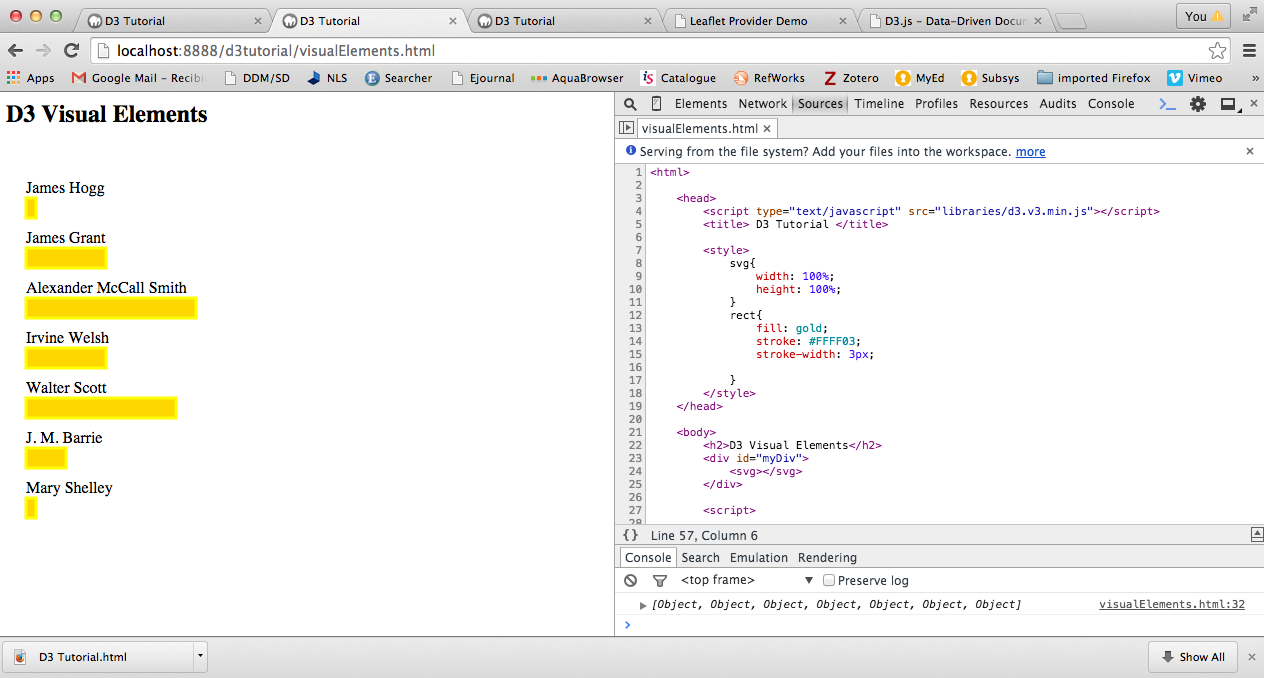
For this visualisation (D3 Visual Elements), the browser uses the content of the HTML file to call the d3.js library and the data into the console. In this example, the HTML contains a bit of CSS and SVG (Scalable Vector Graphics) element with a d3.js script which pulls data from a CSV file containing the details: author and number of books. The visualisation displays the authors’ names and bars representing the number of books each author has written. The bars change colour and display the number of books when you hover over.
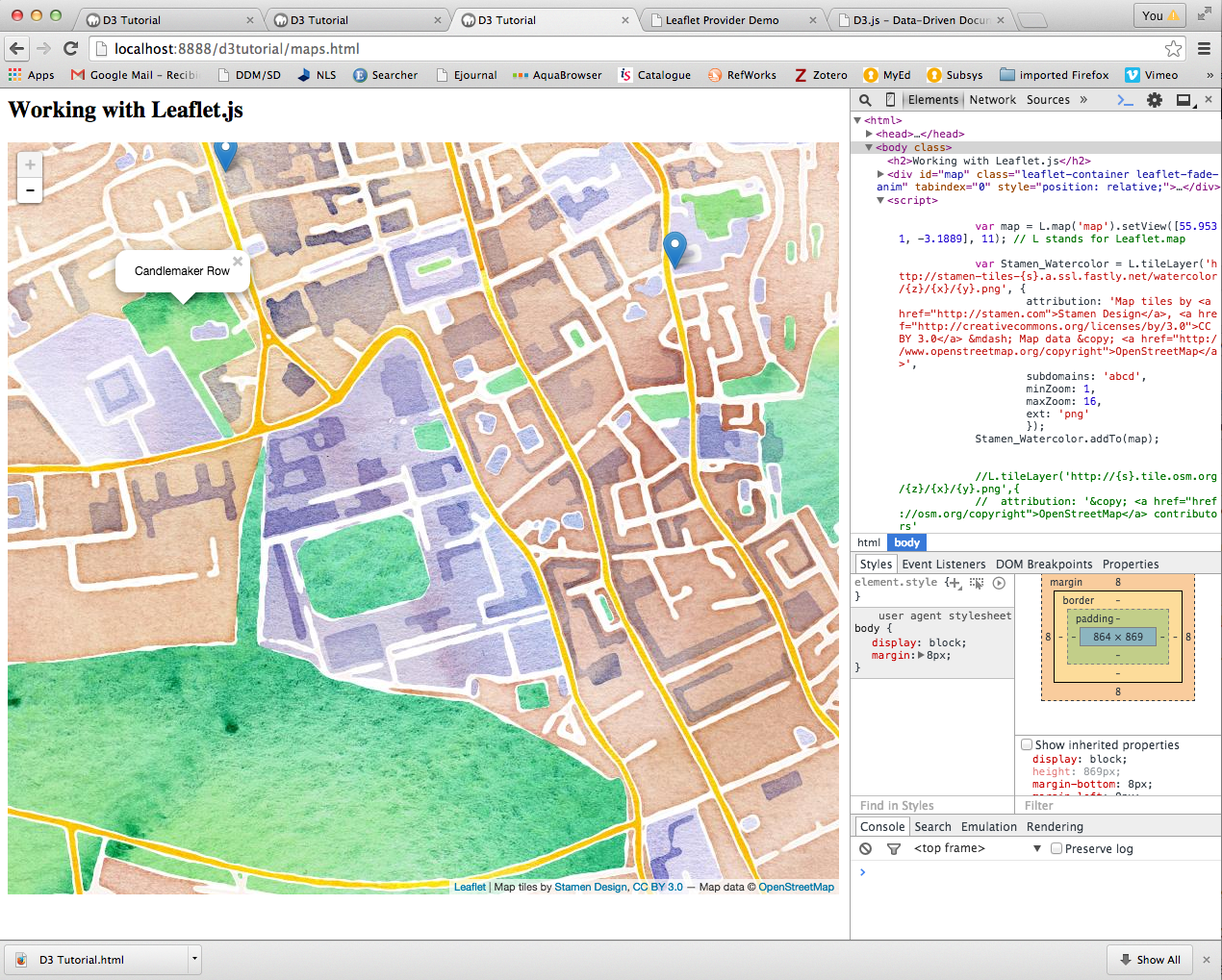
The second visualisation we worked on was the combination of geo-referenced data and leaflet.js library. Here, we combine the d3.js and leaflet.js libraries to display geographic data from a CSV file. First we ensured the OpenStreetMap loaded, then pulled the CSV data in and last customised the map using a different map tile. We also added data points to the map and pop-up tags.
In this 2-hour workshop, Uta Hinrichs managed to give a flavour of the possibilities that JavaScript libraries offer and how ‘relatively easy’ it is to visualise data online.
Workshop links:
- Visualising data with D3 workshop – http://www.digital.hss.ed.ac.uk/news/digital-day-of-ideas-2015/uta-hinrichs/
- Dr Uta Hinrichs (St Andrews University) – http://www.utahinrichs.de/
- D3 website (find out all about D3) – http://d3js.org/
- Leaflet website – http://leafletjs.com/
- Mike Bostocks’s website – http://bost.ocks.org/mike/
- Github D3 gallery – https://github.com/mbostock/d3/wiki/Gallery
Other links:
- Digital Scholarship website – http://www.digital.hss.ed.ac.uk/
- Lorna E. Campbell’s blog post about the event – https://lornamcampbell.wordpress.com/2015/05/29/day-of-digital-ideas-2015/
Rocio von Jungenfeld
EDINA and Data Library
Weekend e-resource disruption
 The MyILibrary e-books website will be shut down for maintenance on Saturday 30th May – 1pm – 7pm. Ingram Content Group apologise for any inconvenience that may be caused during this downtime.
 Thomson Reuters have advised that Web of Science and Endnote Online are “at risk” during their maintenance period on Sunday 31st May 2015 – 1:00pm – 16:00pm.
They expect minimal interruption to the service for users who are logged into Web of Science™ or EndNote® Online. Thomson Reuters apologise for any inconvenience.
A Hare Raising Tale
Over the last month, conservation has been playing host to two rather notorious and unsavoury characters, namely William Burke and William Hare. Thankfully for us not in person but rather in the form of a scrapbook containing original documents and cuttings from their capture and subsequent trail and execution.
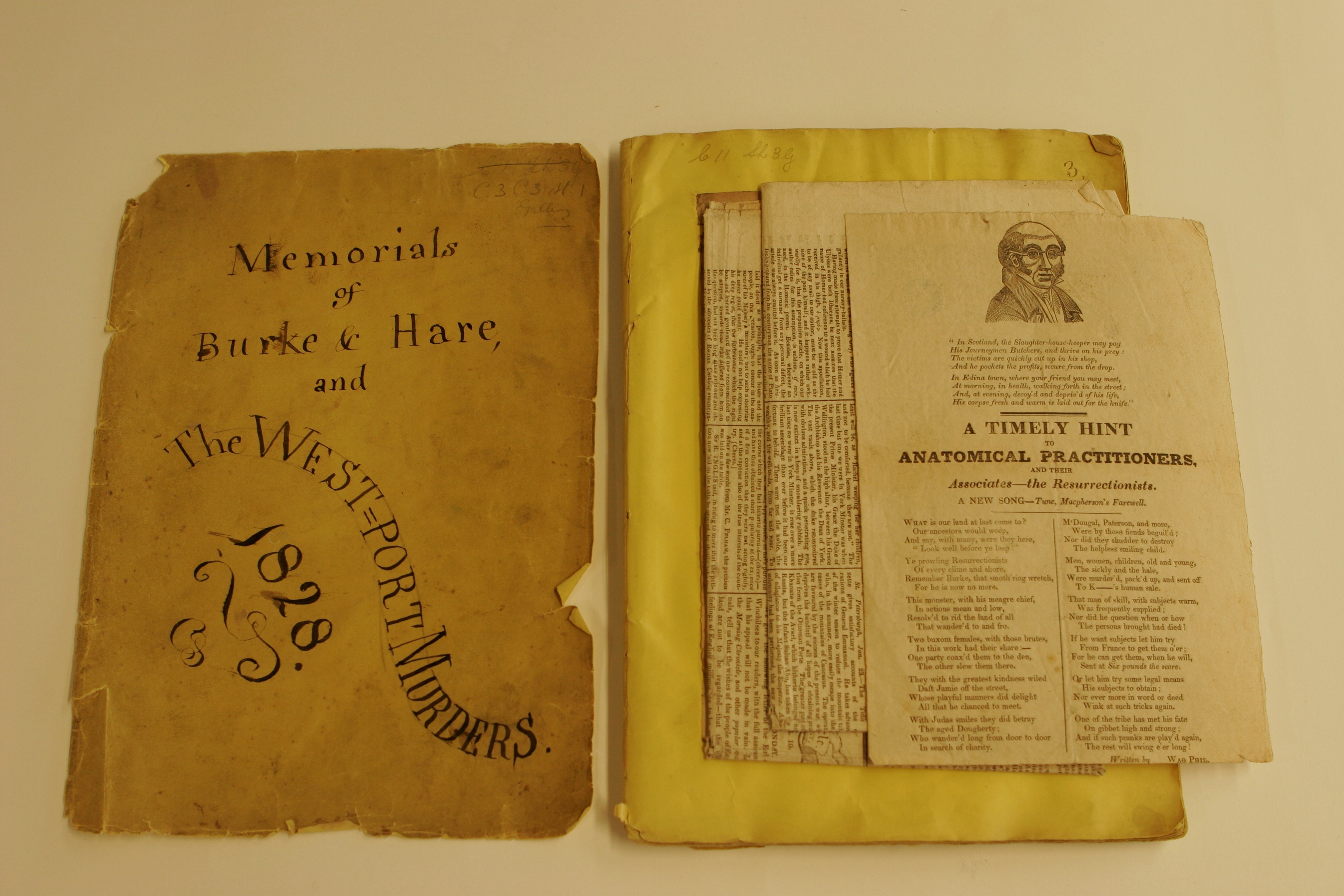
Burke and Hare Scrapbook before treatment
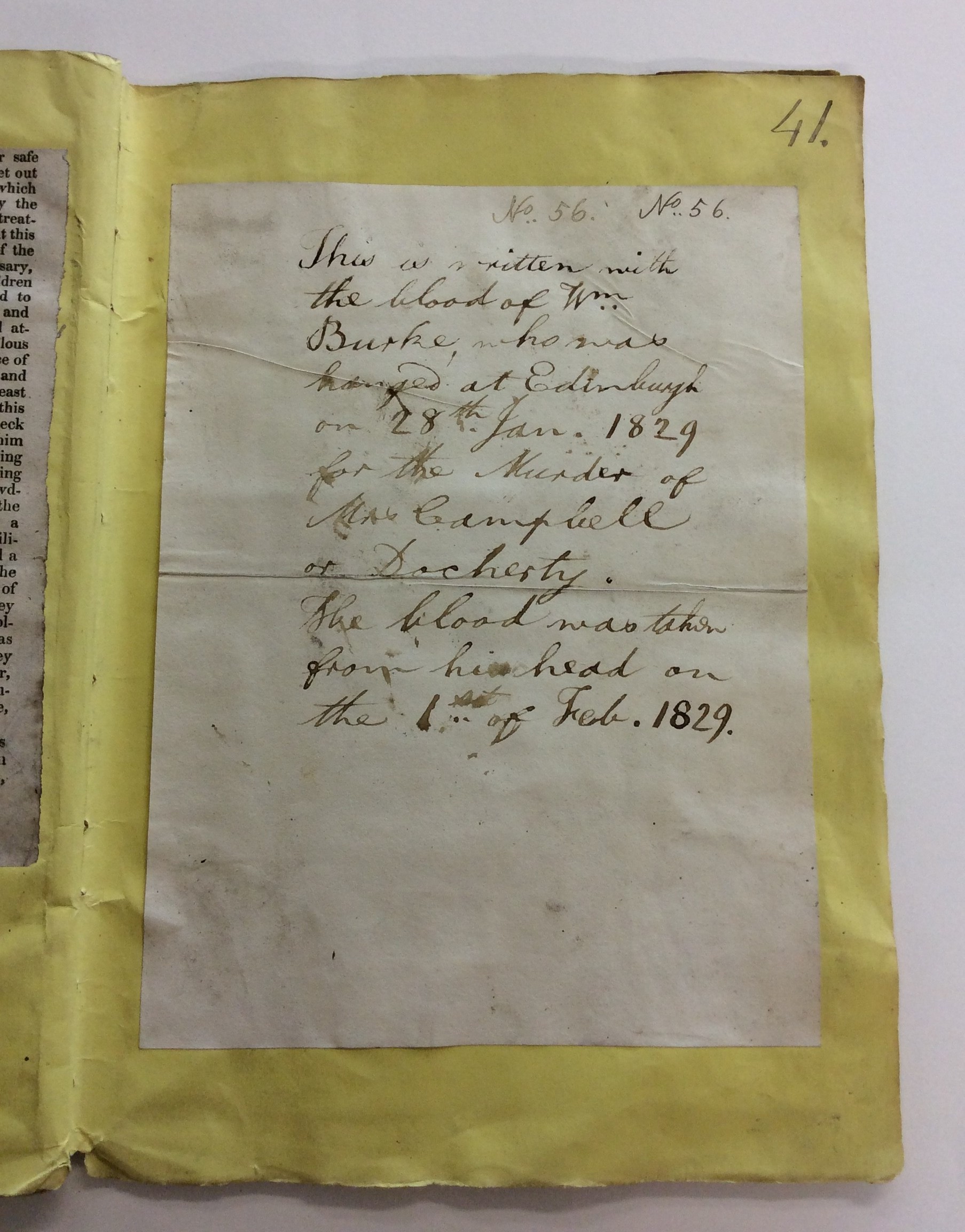
William Burke ‘blood’ Letter
The most interesting and macabre of all of these is a letter written in the blood of William Burke – as it (helpfully) states “This is a letter written with the blood of Wm. Burke, who was hanged at Edinburgh on 28th Jan. 1829 for the Murder of Mrs. Campbell or Docherty. The blood was taken for his head on the 1st of Feb. 1829.” Unsurprisingly, the scrapbook, and this letter in particular, has caused a lot of attention, and has recently appearing in a number of newspaper and websites. I have found myself in the rather unusual position of combining conservation with press calls – the conservation life is not always quite so glamorous!
The scrapbook has a pamphlet style of binding with the cuttings pasted into its pages, the larger of which have been folded in order to fit within the volume. Overall, the scrapbook was in a reasonable condition and it was decided therefore to take a minimal interventive conservation approach with treatment focused on surface cleaning, tear repair where necessary and rehousing. The aim was to stabilise the object allowing it to be stored and accessed with minimal risk, at the same time as maintaining its authenticity.
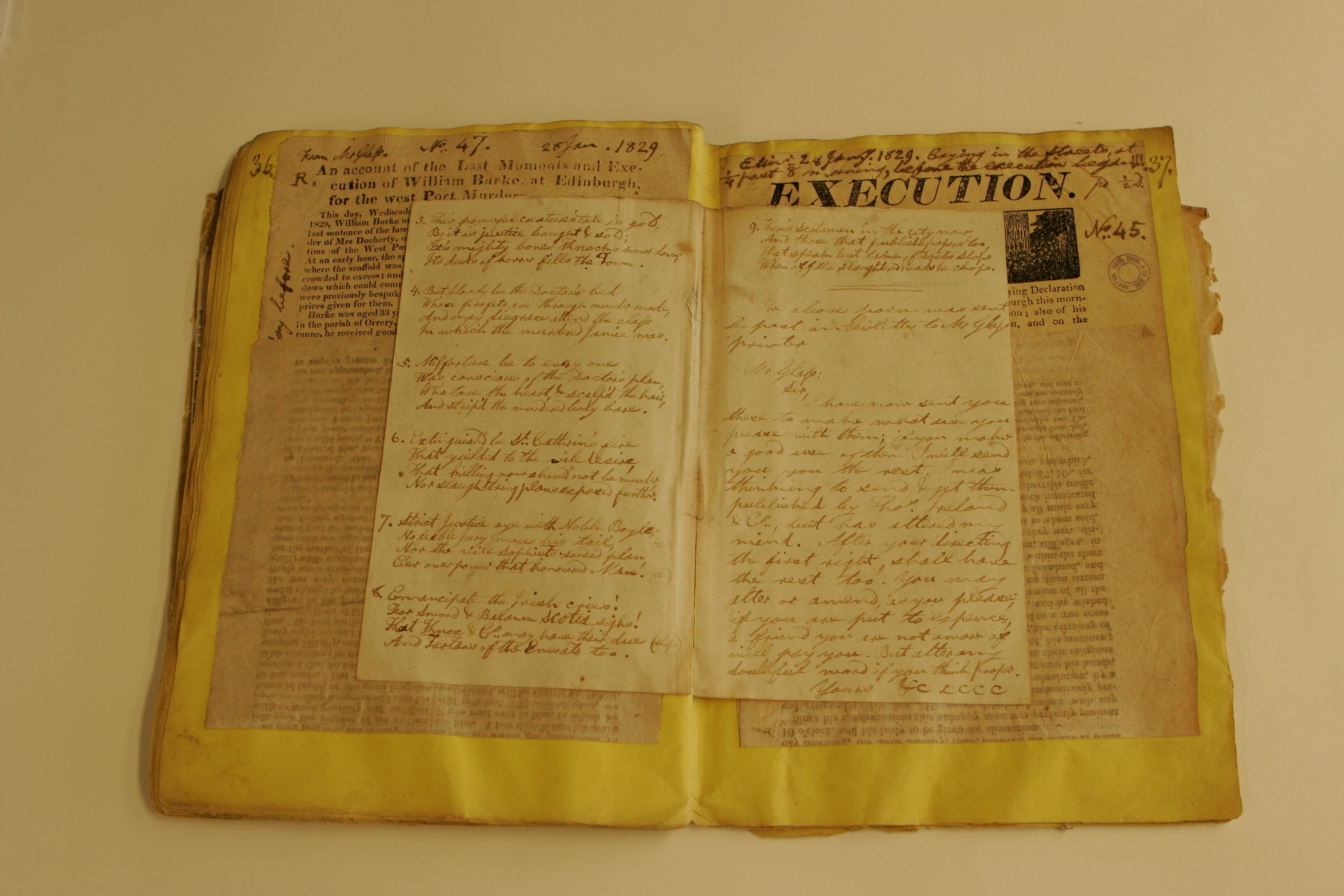
Scrapbook containing folded cutting and hand-written documents
The first stage of treatment was to surface clean the pages. This was done with “chemical sponge” – made of vulcanised rubber which (despite its name) contains no chemicals – which works by gently lifting off any surface dirt on the pages. This has not only aesthetic benefits but, more importantly, will remove any potentially damaging substrates. Surface dirt can contain acidic particulates, cause abrasions, attract moisture, and become a food source of mould, all of which can affect the long-term preservation of the object.
Secondly, I carried out tear repairs where necessary using Japanese tissue and wheat starch paste. The tears where primarily on the larger format cuttings that had been folded in position within the scrapbook and found in areas where the paper had become weak, especially along the folds or along edges where the cutting has projected beyond the edge of the scrapbook. Again, as with surface cleaning, repairing tears will not only improve the appearance of the pages, but will also provide structural stability making the paper easier to handle and reduce the risk of the tear getting caught and becoming worse.

Before tear repair
After tear repair
The last stage in treatment, and arguably the most important, was to address the housing needs of the scrapbook. As well as providing physical support to the item, choosing appropriate storage has the added benefits of giving an extra layer of protection from accidental damage, as well as acting as a buffer to atmospheric pollutants, dust and light, and any fluctuations in environmental conditions. It is important to know and understand what the materials you are using are made from as poor quality materials that are in close contact with collection items can cause severe damage. Acid from these materials can migrate to the object causing discolouration and embrittlement and hastening the its deterioration.
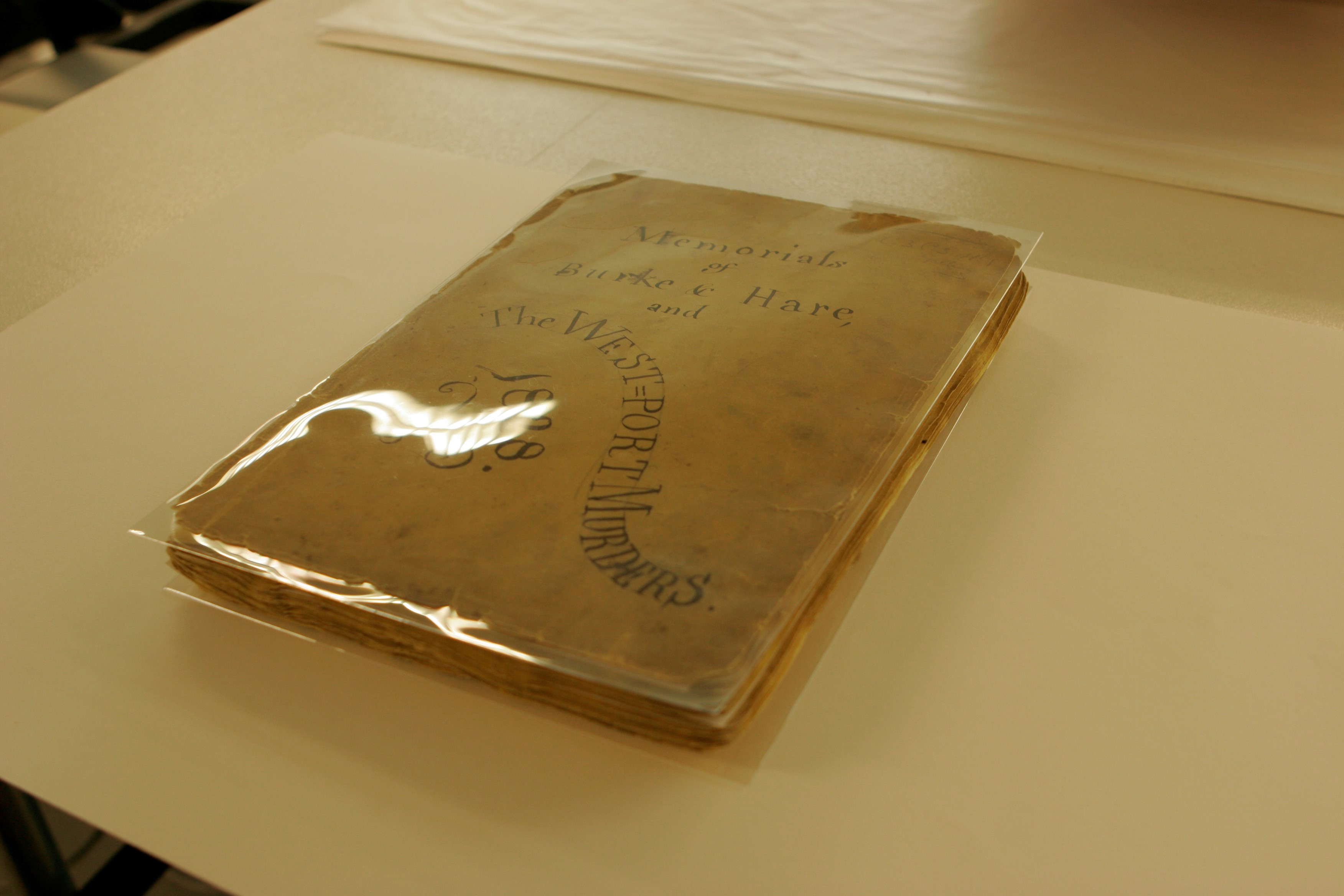
Scrapbook during treatment and rehousing
I decided, therefore, to house the detached, fragile and vulnerable front and back covers of the scrapbook in polyester sleeves allowing them to be easily consulted without being removed and so would drastically improve handling whilst minimising the risk of any tears getting worse. Because of the poor quality and acidic nature of the paper cuttings contained within the scrapbook, the individual pages were interleaved with a light-weight acid-free paper to reduce the transfer of any potential harmful elements within the sheets. The scrapbook itself – alongside some loose-sheet material contained within – were rehoused in acid-free paper folders which, in turn, were placed inside a four-flap enclosure made from acid-free card.
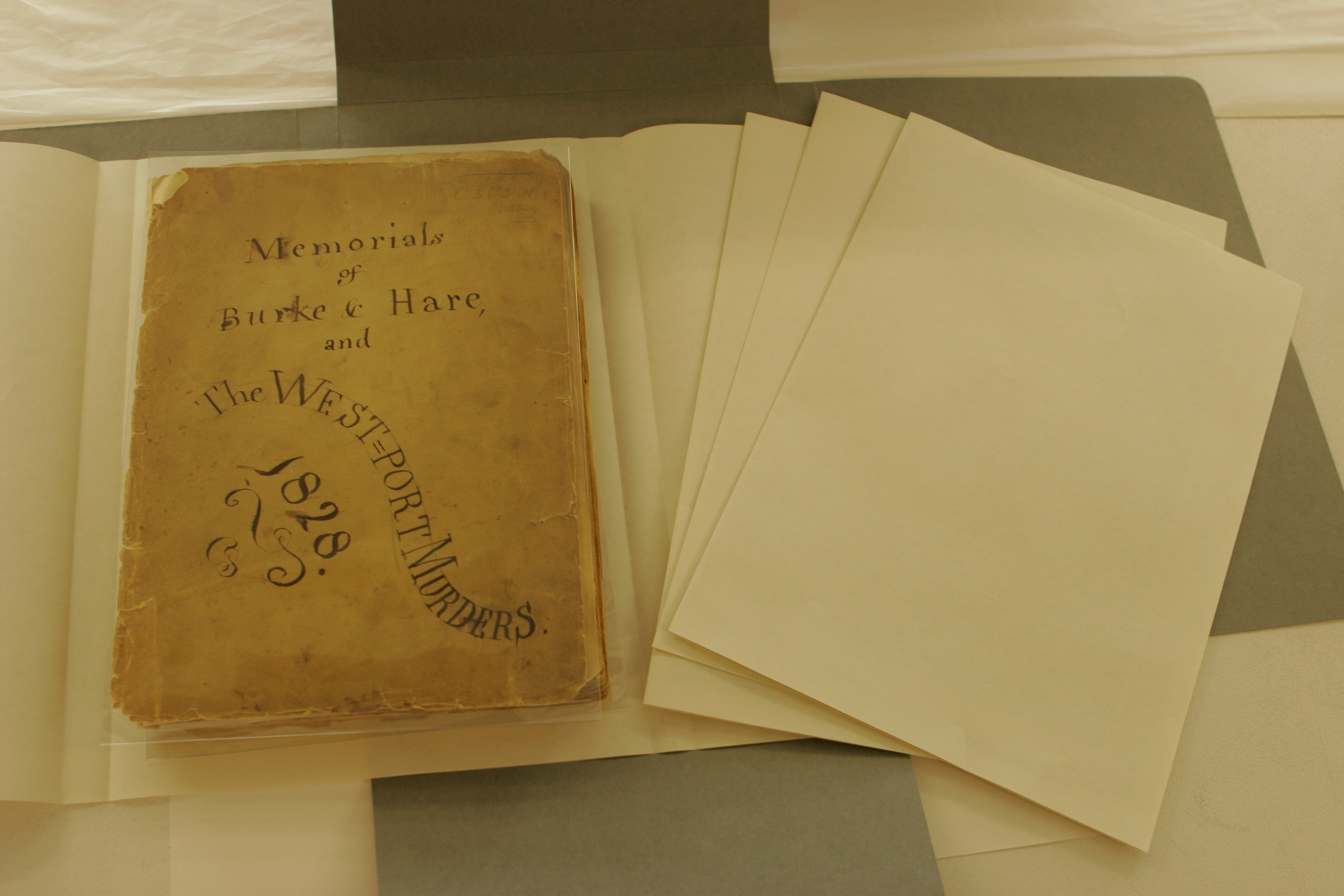
Rehousing of the scrapbook into acid-free paper enclosures
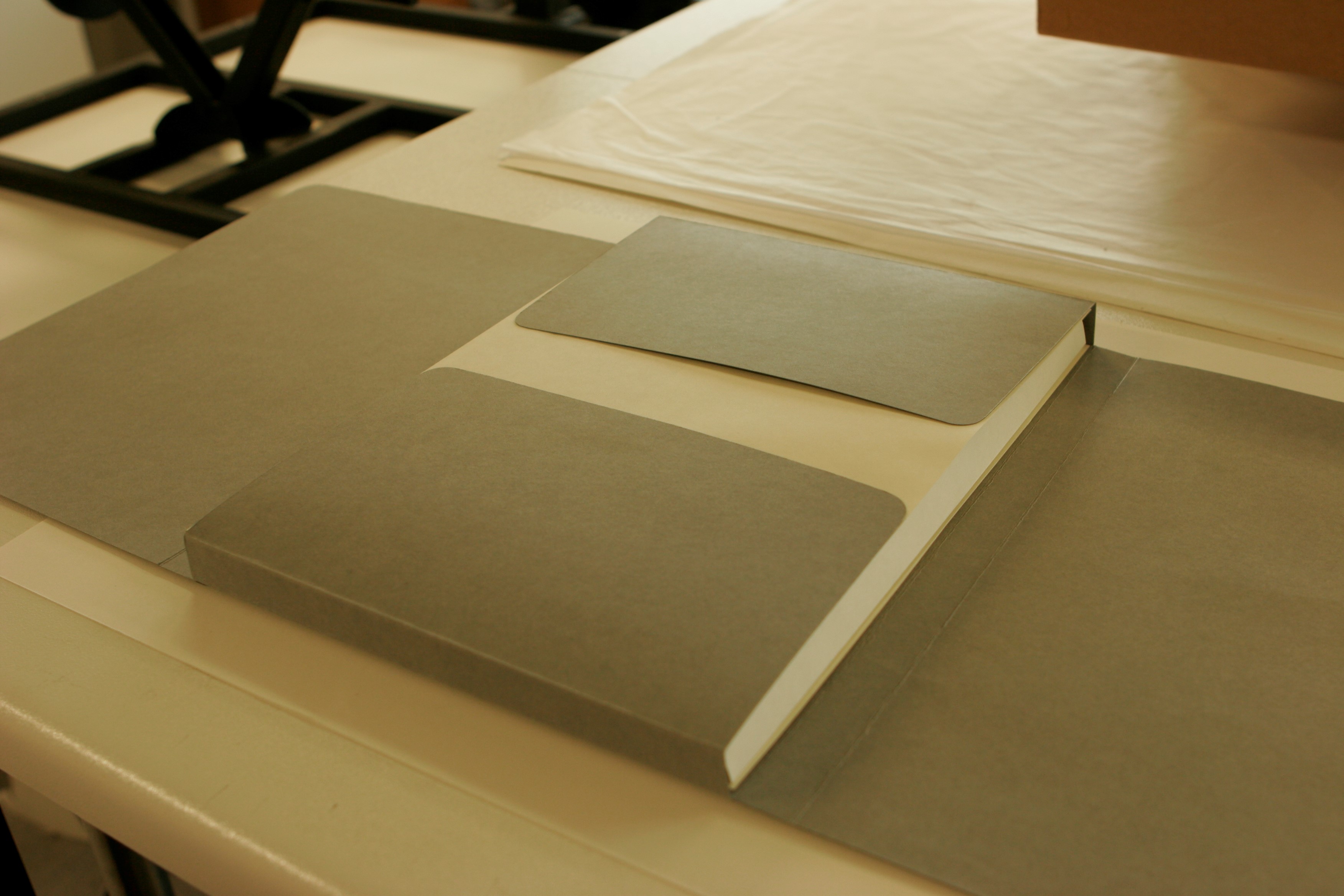
Rehousing of the scrapbook into four-flap enclosure
And the blood letter? Well, it is certainly not every day that I come across something so unusual, interesting and, quite frankly, a little unsettling. However, by applying general conservation principles of minimal treatment and the use high-quality and appropriate conservation and rehousing materials, I was able to treat the letter, and scrapbook as a whole, very much like other paper-based material. Perhaps with just a little more murder and intrigue this time…
Post by Emma Davey, Conservation Officer
Development model
The Data Vault project is a collaboration between the University of Edinburgh and the University of Manchester. The majority of the funding from the Data Spring programme has been allocated to paying for software development effort at both partners, along with a small proportion to pay for travel costs.
The intention of the three month project is create a proof of concept Data Vault system. Months one and two perfoemd the scoping, use case, requirements, and design phases. Month three will spent developing the software.
Three of us (Robin, Claire, Stuart) are due to travel to Manchester University next week to start writing the code with their project staff (Tom and Mary). We’re taking the approach of a ‘hackathon – all of us coding collaboratively together! This should allow rapid development as communication will be easy.
Collections
 Hill and Adamson Collection: an insight into Edinburgh’s past
My name is Phoebe Kirkland, I am an MSc East Asian Studies student, and for...
Cataloguing the private papers of Archibald Hunter Campbell: A Journey Through Correspondence
My name is Pauline Vincent, I am a student in my last year of a...
Hill and Adamson Collection: an insight into Edinburgh’s past
My name is Phoebe Kirkland, I am an MSc East Asian Studies student, and for...
Cataloguing the private papers of Archibald Hunter Campbell: A Journey Through Correspondence
My name is Pauline Vincent, I am a student in my last year of a...
Projects
Cataloguing the private papers of Archibald Hunter Campbell: A Journey Through Correspondence
My name is Pauline Vincent, I am a student in my last year of a...
Archival Provenance Research Project: Lishan’s Experience
Presentation My name is Lishan Zou, I am a fourth year History and Politics student....