Home University of Edinburgh Library Essentials
April 7, 2026
Highlights from the RDM Programme Progress Report: June – July 2015
May 2015 saw the end of the current Roadmap period and we are now into a period of consolidating work that has already been done and organising future work for the next phase of the RDM programme. The draft Roadmap 2.0 has been submitted to the steering group for approval and should be published soon.
The RDM services brochure is now almost complete and should be printed and distributed to Schools soon.
A meeting was held between the RDM team and the DCC to decide on the best approach for offering school level customisation of DMPonline. It was decided that customisation would be offered to all schools and undertaken as and when requests were made.
The Infrastructure upgrades have been procured and physically installed for the IGMM storage capacity expansion and the Research Computing Infrastructure DataStore integration servers.
Upgrades for backup/DR infrastructure have been procured and physically installed.
A 2 part workshop sponsored by EU FOSTER programme, “Good practice in data management & data sharing with social research” and “Overcoming obstacles to sharing data about human subjects” was delivered at the Scottish Graduate School of Political and Social Science Summer School.
A new series of awareness raising presentations and training courses for researchers, committees, and support staff in CHSS, CSE, and CMVM are currently being organised for 2015/16.
The RDM website has been successfully migrated to the new content management system, this included reviewing and revising all content, links, and images to fit with the new structure and layout. All schools in CHSS and CSE now have links on their own webpages to the RDM webpages, and CHSS will be placing a link from their new college pages when they go live.
An EAHIL workshop on ‘Managing research data’ was held on the 10th June and the report of the
Met with RDM staff from University of Lisbon who were visiting the University (via James Toon).
Met with Jennifer Warburton, University of Melbourne, as part of Library visit.
Met with French delegation (INIST-CNRS) as part of Library visit.
Kerry Miller
RDM Service Coordinator
Of Pibrochs and Preachers: Music and Folk Culture in the Old Statistical Accounts
Perhaps particularly in a post-Christian society it is stereotypes we live with, rather than the nuanced reality of religion. Listening to the thoughts of ministers by reading the Old Statistical Accounts has challenged one of these for me recently. We are all familiar with the notion of religion’s hostility to folk culture. The story of John MacDonald, born in 1779 and brought up in Reay, on the north coast, demonstrates this perfectly.
He early manifested an intense love for music, and even in his boyhood acquired considerable skill in subduing into melody for Celtic ears the wild sounds of the bagpipe. This was his favourite instrument; and on leaving home for college in 1797 [in Aberdeen] it was carefully packed in his trunk, and doubtless furnished many a pleasant interlude amidst the busy studies of the session.
However the young man, son of a Church of Scotland catechist, was becoming increasingly committed to his faith.
Poltalloch Harp, Courtesy of West Highland Museum
Before the following session higher matters began to occupy his attention, and the pipe was that year left purposely behind. His father, in order to try him, wrote to inquire what would be done with the pipe. “Just what you think right,” was his answer, well knowing what treatment his idol was likely to receive at his father’s hands. The old man no sooner received this license from his son than he went to fetch the pipe from its place, and laying it on the block, he plied with right good-will the axe on its chanters.

The fingers of all musicians will tighten a little on their mouse as they read that. Young John became an influential preacher, down in Ferintosh on the Black Isle, and beloved to many across the Highlands. But he didn’t feel that music and his brand of faith were compatible. It seems that as people became more religious, affected by the Evangelical movement in the late 1700s in Sutherland and Ross-shire, and in the early 1800s on the west coast, that they rejected their music and the telling of the old stories. The poet Derick Thomson likens Calvinism to a scarecrow; a ‘tall, thin black-haired man’ who ‘took the goodness out of the music’ replacing it with ‘a new song’ and ‘fragments of the philosophy of Geneva’. Thomson is ambivalent about this religious legacy, but is sure it was hostile to folk culture.
The ministers writing in the Statistical Accounts were not all John MacDonalds nor did they all usher in scarecrows. Many record local leisure activities neutrally, even positively. The minister of Islay noted that ‘dance and the song, with shinty and putting the stone, are their chief amusements. Numbers of them play well upon the violin and the bagpipe.’ In Coll and Tiree the people composed and sang songs, told Fingalian tales, and held ‘dancing assemblies at different farms in turn.’ The minister in Thurso fancied himself an expert on fiddle and pipe music. He found ‘the Highland reels are played particularly well … in Caithness; but the proper slow bagpipe tunes and marches, are not given in that perfection here, which seems almost peculiar to the West Highland pipers.’
A few used folk culture to lament changing times. On the south shores of the Dornoch Firth, the minister romanticised the people of Kincardine. They were apparently moral, hospitable, agile, inquisitive, ‘fond of information’ (which I suspect means gossipy!) and ‘extremely patient under hunger, cold, and other distresses, from which their southern neighbours would shrink with horror.’ However he felt all was not well and used the decline in ceilidh culture to emphasise this. ‘The tale, the song, and the dance, do not, as in the days of their fathers, gild the horrors of the winter night.’ He blames this on the rise of legal distilling. The minister of Strachur, Argyllshire, went further. He used a romanticised vision of the past and a perceived cultural decline in music and poetry to subtly criticise the landlord for introducing commercial sheepfarming.

David Allan ‘Highland Wedding at Blair Atholl’ featuring the famous fiddler Neil Gow (1780).
This positive clerical view is not the whole story. In Stromness the minister saw the connection between ‘sottish enjoyment of drinking’ and music and dancing. His neighbour in North Ronaldsay worried about fifty of his parishioners who gathered at some prehistoric cairns on New Year’s Day for ‘dancing with moon light, with no other music than their own singing.’ The connection of music, dancing and community get-togethers with drinking and with ancient spiritual beliefs gave many ministers cause for reflection.
My study is not meant to suggest that the church, particularly Evangelical Calvinism in the way it was absorbed and put into practice in Scotland, has nothing to repent of in its frequently invidious effect on local culture. But the more I look, the more Jackson Pollock-like becomes the picture. John MacDonald was not the only influential religious leader to throw out the musical baby with its bathwater. Yet ministers were not doctrinal automatons. For as many as saw moral dangers in the old stories and the new tunes, others were neutral, enthusiastic or even sentimental about folk culture.
Of course there may be another reason ministers living in draughty manses supported musicians. In Ronaldsay the music of the piper, it was said, was capable of banishing rats!
Dr Elizabeth Ritchie, Centre for History, University of the Highlands and Islands
We hope you have enjoyed this post: it is characteristic of the rich historical material available within the ‘Related Resources’ section of the Statistical Accounts of Scotland service. Featuring essays, maps, illustrations, correspondence, biographies of compliers, and information about Sir John Sinclair’s other works, the service provides extensive historical and bibliographical detail to supplement our full-text searchable collection of the ‘Old’ and ‘New’ Statistical Accounts.
Sources:
John Kennedy, The ‘Apostle of the North’: the Life and Labours of the Rev. Dr. M’Donald, (Toronto: J. Campbell, 1866)
Derick Thomson, ‘The Scarecrow’, quoted in Malcolm Chapman, The Gaelic Vision in Scottish Culture (Montreal: McGill-Queen’s University Press, 1978)
Old Statistical Account: parishes of Kilchoman, Tiree and Coll, Thurso, Strachur and Stralachan, Stromness, North Ronaldshay
Welcome to arriving students at New College Library!
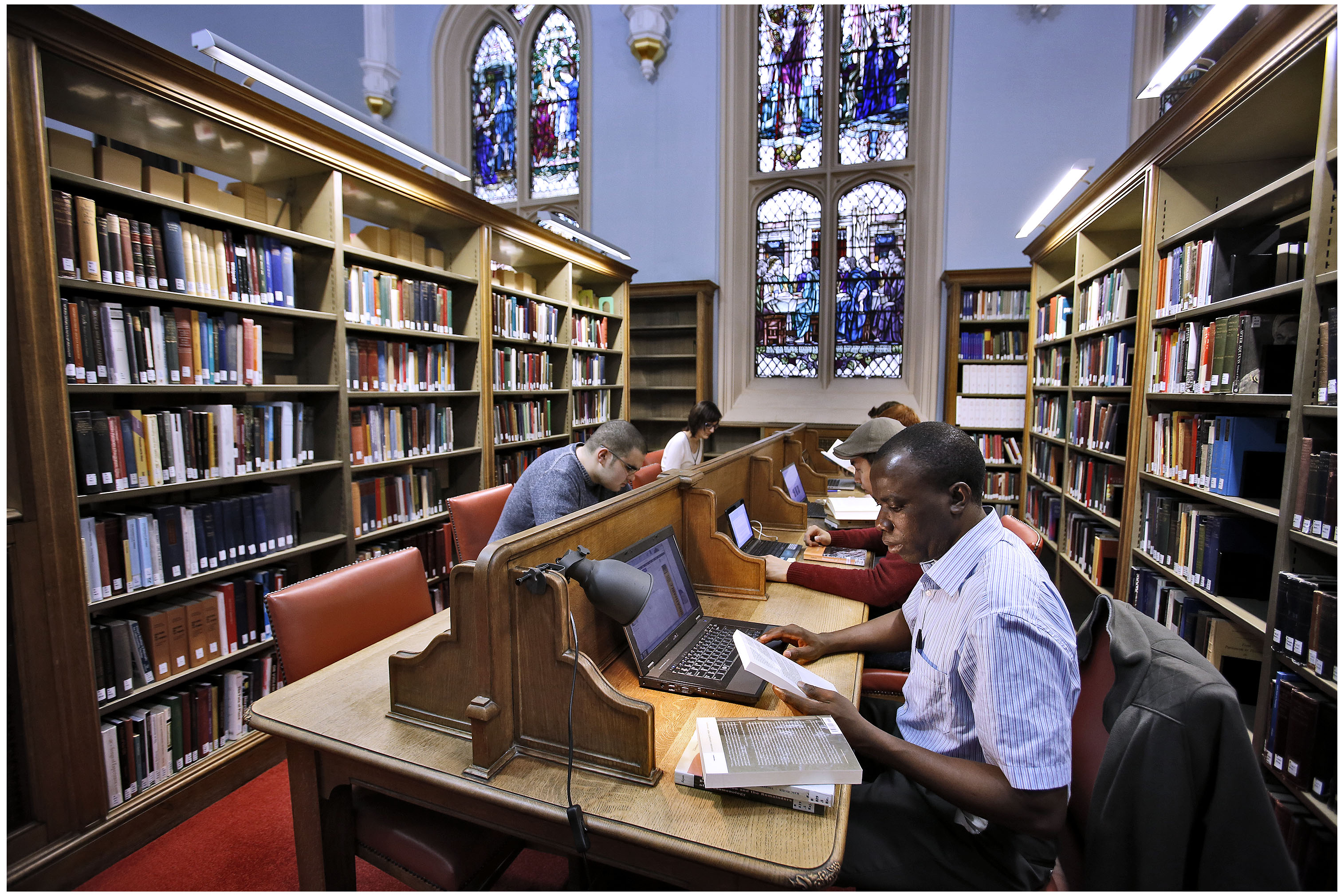
A big welcome to all our new students arriving today. New College Library holds over 250,000 volumes, including rich and unique Special Collections, making it one of the leading theological libraries in Britain. Read More
Data Vault Community Engagement Event
Over the next few months we will be hosting a series of workshops, with the aim of engaging with the community to refine the Data Vault platform solution developed so far.
The first workshop is being held in Manchester on 7th October 2015 – for further details and to register see:
Eventbrite Data Vault Community Event, Manchester
The second workshop is being held in Edinburgh on the 5th November 2015 – for further details and to register see:
LOCH Project at ELPUB 2015!


Last week I attended the 19th International Conference on Electronic Publishing (ELPUB 2015), which took place at the St James Cavalier Centre for Creativity in Valetta, Malta. The theme of this year’s conference was “Scale, Openness and Trust: New Avenues for Electronic Publishing in the Age of Infinite Collections and Citizen Science”.
The conference attracted over 70 delegates from all over Europe – most of whom were employed in scholarly communications roles in university libraries. The convenient size of the event, combined with the specialisms of the attendees made this a really useful event for me to attend – I was able to gain quite a lot of insight into publication trends in different countries and in particular, progress with the transition towards Open Access. I think Finland might be one to watch on this front – our Finnish colleagues have ambitious plans to become 100% Open Access in the next few years!
The conference featured a particularly interesting opening keynote from Gowan Dawson of the University of Leicester, who introduced the theme of citizen science by reviewing the history of this area with a particular focus on some interesting 19th century publications such as Hardwicke’s Science-Gossip.
Other notable presentations included Gail Feigenbaum’s keynote on the unintended consequences of electronic publication – (which even included salary disparities between editors working with print and electronic at one publishing house) and a fabulous talk from senior staff of the Times of Malta, who discussed the impact that disruptive technologies can have on media such as newspapers. They also talked about the pressures that the likes of Facebook and Google can exert on a small press such as this, and the limited recourse available to them.
My paper focused on the UK’s REF Open Access policies and how this is proving a real game-changer in the rate of adoption of OA in the UK. The full conference paper and my slides are available to download at https://www.era.lib.ed.ac.uk/handle/1842/10553 .
Dominic Tate – University of Edinburgh
British Newspapers Part III and IV – 1780-1950
 We have recently purchased British Newspapers Part 3 and 4 – 1780-1950.
British Newspapers Part III contains the Sheffield Daily Telegraph, Leeds Intelligencer, Yorkshire Gazette, Newcastle Guardian and Tyne Mercury.
British Newspapers Part IV contains the Evening Telegraph, Yorkshire Gazette, Nottingham Evening Post, Illustrated Times, Edinburgh Evening News, Chester Chronicle, Cheltenham Chronicle, Cambridge Independent Press, Belfast Morning News, Bath Chronicle and Weekly Gazette, and Aberdeen Journal.
See the factsheet for more details as well as related newspaper packages we have previously purchased.
There is an entry for “British Newspaper Archive” on our main AZ list as well as the subject AZ lists for History and Newspapers. Individual newspapers titles will be added to DiscoverEd soon.
The Music of Archives
For the past few years, we have had one of our volunteers, Fiona Donaldson, working with Deputy University Archivist, Grant Buttars, to develop a usable catalogue to our Tovey Collection, one of our larger collections of personal papers we hold. We are now able to offer an unfinished but usable ‘pre-release’ to allow researchers and other users get a better handle on what’s in the collection while work continues.
Donald Francis Tovey
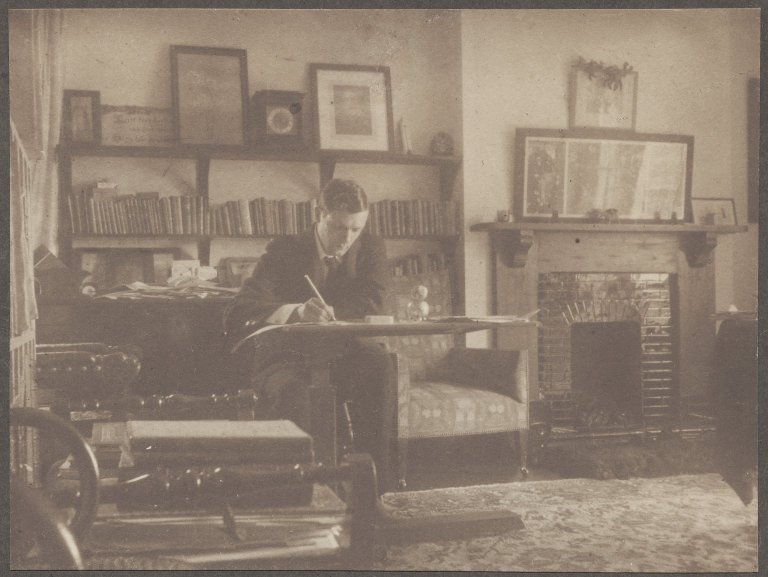
Donald Francis Tovey at work
Donald Francis Tovey was born at Eton on 17 July 1875. His father was an Assistant Master at Eton College. He was educated privately by the music and general teacher Miss Sophie Weisse (1851-1945) and later on studied under Sir Walter Parratt (1841-1924) and Sir C. H. Parry (1848-1918). Tovey then won a music scholarship to Balliol College, Oxford, graduating with a BA, Classical honours, in 1898. As a pianist, a series of chamber music concerts followed in London, Berlin and Vienna where he played with Halle, Joachim, Hausmann, Casals, and other artists. He also composed.
In 1914 he was appointed to the Reid Chair of Music at Edinburgh University in succession to Professor Niecks (1845-1924). As Professor he broadened the music curriculum by instituting classes in musical interpretation, orchestration, history and analysis, thorough-bass, score reading, and advanced counter-point and composition.
Tovey also established and conducted the Reid Orchestra and organised an annual series of concerts. His musical compositions were in many forms including chamber music, symphony, grand opera and concerto, and probably the most famous was his opera The bride of Dionysus produced in Edinburgh in 1929. His literary publications include the six volumes of Essays in musical analysis (1935-1939), and A musician talks (1941). Tovey was knighted in 1935. He died on 10 July 1940.
The Collection
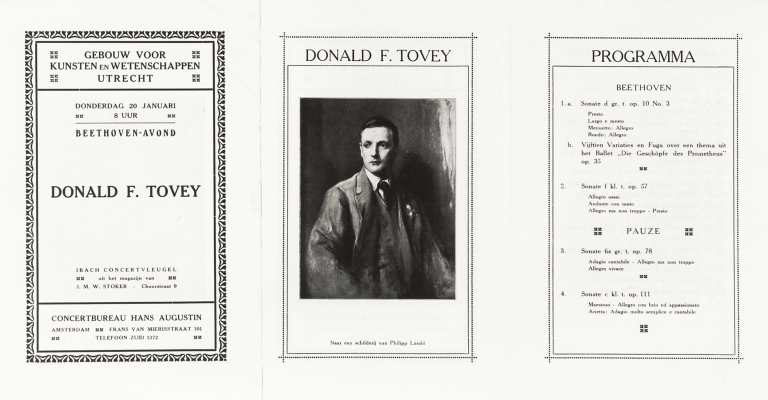
Concert programme
The largest part of the collection is the papers of Tovey himself. Following his death, the collection appears to have remained in what became the Tovey Memorial Rooms at 18 Buccleuch Place, from where they were taken to Alison House sometime after the Faculty of Music took up occupancy there in 1964. During its time in those locations it appears to have been augmented, with the addition of particularly correspondence and notes of Tovey’s biographer, Mary Gardner Grierson (1896-1964) and post-Tovey records relating to the Reid Orchestra and Choir. Tovey’s teacher and mentor, Sophie Weisse (1851-1945), is also well-represented. Perhaps the clear boundaries between what simply began as adjacently shelved material became indistinguishable; by the time the collection was transferred here from the Reid Music Library in 2001, it was all seen as one overall collection and it has not proved possible to fully disentangle it.
The work
We have concentrated on sorting out obvious disorder but with a light-touch approach, creating a meaningful arrangement and, as far as possible identifying what is clearly Tovey’s papers from what is not. Basic repackaging has been undertaken where needed.
The catalogue benefits from earlier cataloguing work that was undertaken when the collection was still in the Reid Music Library. It focussed on the correspondence (the largest single series within the collection) and the database created than has been converted and imported into the new catalogue.
Our volunteer Fiona is currently a PhD student but also a former administrator from within the former Faculty of Music. Drawing on this and other related collections here, she has been creating a database to Reid Orchestras as part of her PhD research.
Find out more
Mass Observation Parts III and IV now available
We have recently purchased two extra collections within Mass Observation – Mass Observation Parts III and IV. Access this resource via the database A-Z list and DiscoverEd.
Detailed information about the contents of Mass Observation can be found at http://www.amdigital.co.uk/m-collections/collection/mass-observation-online/detailed-information/ and a quick tour of the resource is shown in the YouTube clip below.
“You’ll never guess who I met today…”
At the beginning of August I took on the role of New College Collections Curator looking after the archives held at New College Library and in the Centre for Studies in World Christianity (CSWC). As the CSWC archives rooms were essentially out of action during the festival, the Rainy Hall being a Festival Fringe venue, I spent my first month concentrating on acquainting myself with the archives in New College Library (NCL).
As inevitably happens with archives, almost as soon as you are trying to establish the facts around your collections you find yourself with questions. So it was in my third week of work.

The Rev Thomas Chalmers (1780 – 1847) is a mighty figure in Presbyterian Church history and his collection of papers is no less substantial than the man himself. The first Principal of New College, his papers (ref GB238 CHA) contain correspondence with many individuals, including notable figures of the era; family papers dating back to the 18th century; sermons and lectures. There are also several boxes marked as an Appendix to the collection. Within one of these boxes are photocopies noted as having been taken from records belonging to a descendant of Thomas Chalmers. Intent on finding out who this descendant was and where the originals of these documents might be now, I set about searching the records of New College Library itself (ref. GB238 AA2) to see if there was any mention in minute books or correspondence about making and receiving these photocopies.
This proved to be a useful exercise in itself as I was able to get a sense of how the Library operated, key points in the history of the collections, and the sort of cataloguing work that had been done on the manuscripts during the twentieth century. Gleaning the names of different members of staff over the years – Mrs Margot Butt seems to have become the expert on Thomas Chalmers – I was quickly able to start scanning documents for them, which was why I gave a start when my own grandfather’s signature, as bold as the man himself, jumped out at me from some correspondence. The second surprise came when I realised that he had written to the Library on behalf of my father (ref. GB238 AA.2.1.108).


As the images above show, it transpired that in the late 1960s when my father was a missionary in Kenya, he had a colleague, called Simon, who used a particular book to help him while evangelising. He had noticed that the book was falling apart, pages were missing and the covers torn and so he wanted to get him a new copy but all he had to go on was part of the title page. He sent this fragment to my grandfather (incidentally a New College graduate) to see if he could find out what the full title was and if a new copy could be purchased. My grandfather duly wrote to the New College Librarian and the enquiry resulted in success with contacts in London being able to identify the book: The Treasury of Scripture Knowledge, by Samuel Bagster. From a note on the first letter it seems that the Librarian actually visited my grandfather but whether they were friends or he just happened to be in the vicinity I’ll never know. My father has no recollection of the matter although he does remember Simon. For me it was quite touching to encounter my late grandfather and be reminded of my own father’s characteristic thoughtfulness amidst a completely different quest altogether.
As for the Thomas Chalmers photocopies and originals, I eventually discovered records of the Thomas Chalmers Bicentenary Exhibition, which Margot Butt had prepared in 1980, along with the name of not one but twenty-one descendants and discussion on the disputed inheritance of his papers (ref. GB238 CHA Appendix 5). A blog for another day.
Kirsty M Stewart, New College Collections Curator
L.H.S.A. is A-OK!
Throughout 2015, I have been involved in many different projects within the CRC. However, I have mostly been working with collections from the Lothian Health Services Archive (LHSA). Overall I have spent 4 months carrying out conservation work on their main collection, and spent 1 month working on a public engagement project.
The majority of the work I have carried out has been on bound volumes. I have spent 25 days working on these items and have conserved 321 volumes. The conservation work aimed to stabilise the objects and prevent them from deteriorating further. Techniques carried out included surface cleaning, consolidation of red rot using Klucel G in IMS, inner joint repair to reattach loose or detached boards, and reattaching damaged spines to volumes using a hollow.
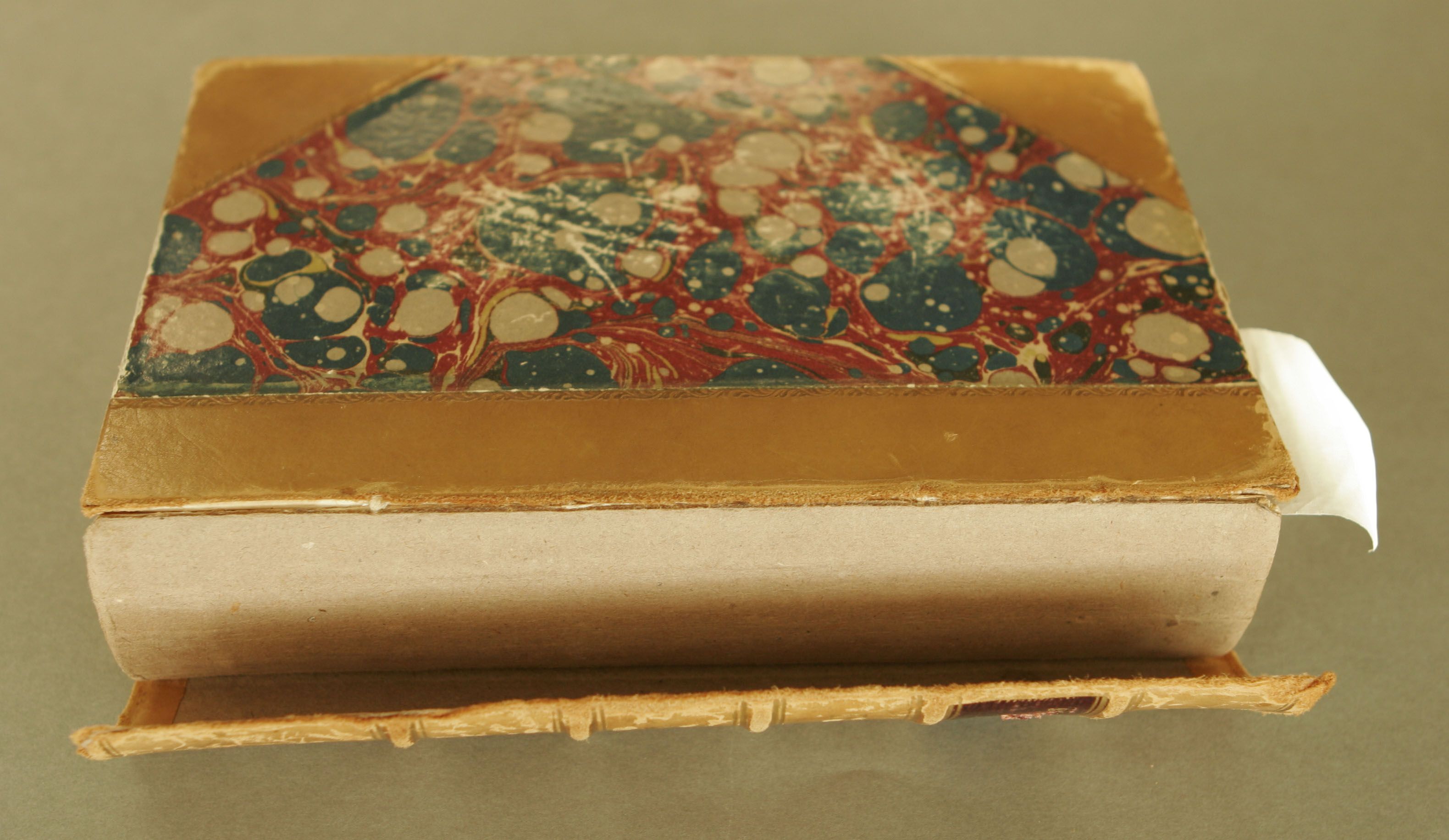
Bound volume before conservation. Spine has become detached
During this time, I have also worked on a few photo albums and scrapbooks. Often, the photographs had fallen out of the albums as the adhesive failed, so I reattached the photographs using hinges made from Japanese paper and wheat starch paste. Although the paper the album is made from is not ideal for the storage of photographs, I wanted to conserve the album as a whole, and keep the way it was originally intended to be viewed. I particularly enjoyed working with a scrapbook that belonged to Yvonne Fitzroy. The pages of the book had become cockled over time, which allowed for the ingress of surface dirt. I cleaned each page using a smoke sponge and was delighted to come across a note and doodle from H.G. Wells on one page of the book.
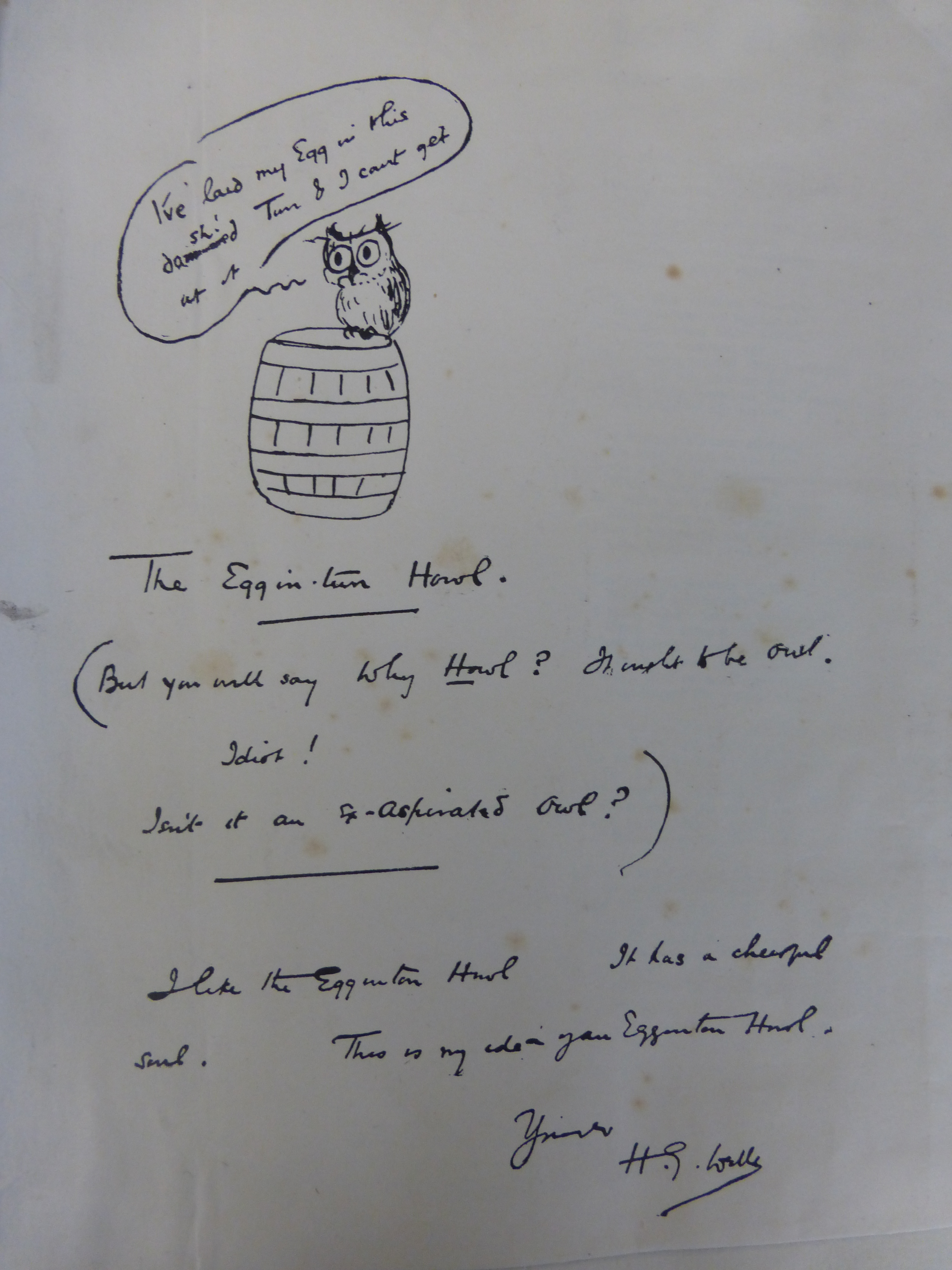
Note from H.G. Wells in Yvonne Fitzroy’s scrapbook
I have also rehoused 16 boxes of case notes, which had previously been stored in their original folders, loose on the shelf. I removed all the metal fasteners (paper clips, staples), realigned any creases and carried out tear repairs if necessary. I then rehoused the case notes in acid free single crease folders and placed them in an acid free box.
X-rays are another collection I have been working with. I have sorted through 15 boxes of X-rays in preparation for frozen storage. You can read more about the deterioration and storage of X-rays in the LHSA blog.
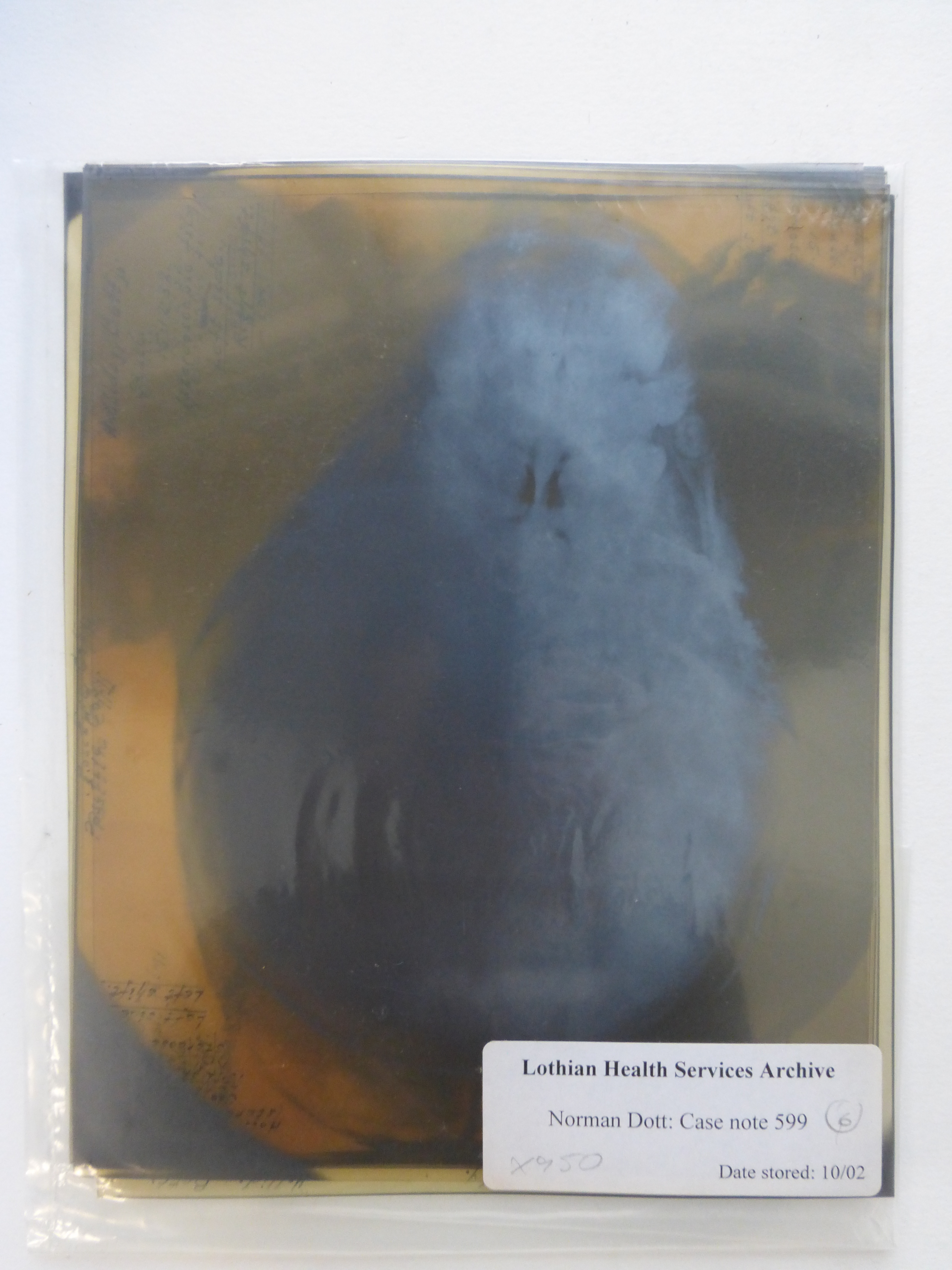
X-ray from LHSA’s collection
During this time, I have also been supervising conservation volunteer, Colette Bush, who has been working on a collection of architectural plans. She has surface cleaned each plan, repaired any tears and removed any paper accretions using a poultice. When this was complete, I humidified and flattened the plans and rehoused them in a polyester sleeve. Together we have conserved 16 plans in this way.
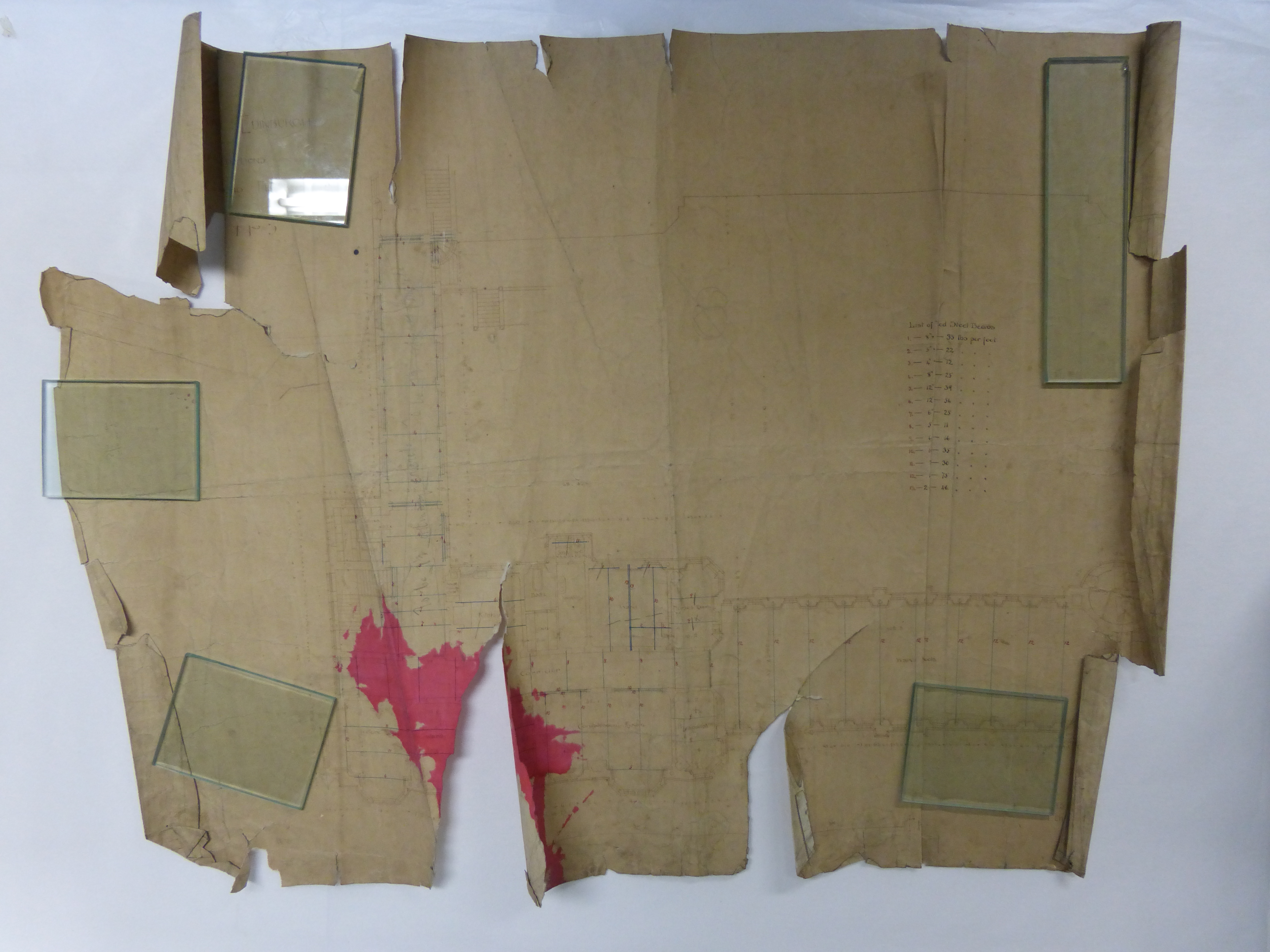
Architectural plan, before conservation

Architectural plan, after conservation
I’ve really enjoyed working with such a diverse collection and have learnt a lot on the way. I’m looking forward to seeing what new conservation challenges arise over the next year as I start working with new collections.
Collections
 Hill and Adamson Collection: an insight into Edinburgh’s past
My name is Phoebe Kirkland, I am an MSc East Asian Studies student, and for...
Cataloguing the private papers of Archibald Hunter Campbell: A Journey Through Correspondence
My name is Pauline Vincent, I am a student in my last year of a...
Hill and Adamson Collection: an insight into Edinburgh’s past
My name is Phoebe Kirkland, I am an MSc East Asian Studies student, and for...
Cataloguing the private papers of Archibald Hunter Campbell: A Journey Through Correspondence
My name is Pauline Vincent, I am a student in my last year of a...
Projects
Cataloguing the private papers of Archibald Hunter Campbell: A Journey Through Correspondence
My name is Pauline Vincent, I am a student in my last year of a...
Archival Provenance Research Project: Lishan’s Experience
Presentation My name is Lishan Zou, I am a fourth year History and Politics student....