Home University of Edinburgh Library Essentials
April 6, 2026
Foreign Office Files for China 1919-1948 & China: Culture and Society
The Library has arranged further database trials for Chinese Studies.To access these trials, please go to the Library’s e-resources trials page and scroll down to find these entries.
Foreign Office Files for China 1919-1948
 Foreign Office Files for China provides access to the digitised archive of British Foreign Office files dealing with China, Hong Kong and Taiwan between 1919 and 1980. The complete files consist of six parts. We have purchased full content for the three parts covering 1949-1956. Files between 1919 and 1948 are now under trial which cover the following parts: 1919-1929: Kuomintang, CCP and the Third International; 1930-1937: The Long March, civil war in China and the Manchurian Crisis; and 1938-1948: Open Door, Japanese war and the seeds of communist victory. The formerly restricted British government documents include diplomatic dispatches, letters, newspaper cuttings, maps, reports of court cases, biographies of leading personalities, summaries of events and other diverse materials.
Trial ends 16/12/2015
China: Culture and Society
 Spanning three centuries (c. 1750-1929), this resource makes available for the first time extremely rare pamphlets from Cornell University Library’s Charles W. Wason Collection on East Asia, one of the oldest and most distinctive collections of its kind and a very rich source for research on China for teachers and students from undergraduate-level to research-level and beyond. Digitised in its entirety and in full colour, the Wason collection of c. 1,200 pamphlets encompasses speeches, guides, reports, essays, catalogues, magazine articles and other material addressing Chinese history, culture, and everyday life. The resource is full-text searchable, allowing for the collection to be comprehensively explored and studied. The wide variety of research interests and themes covered by the pamphlets include education, emigration, the foreign presence, missionaries, wars, rebellion, reform, opium, healthcare and language. *Please note that PDF download options are not available during trials.
Trial ends 17/12/2015
It’s all Greek to me!
Hello, my name is Katharine – I’m the new Intern with the Conservation department at the Centre for Research Collections. Having spent the last four years working in collections care in historic houses, I was keen to branch out and experience a different working environment in conservation. I’m thrilled to have been given this opportunity to work with the research collections at Edinburgh University. It has been interesting to learn about the challenges of managing a working research collection and the conservation issues that come with it.
I’m working with Project Conservator, Emily Hick, for 10 weeks, to conserve and rehouse a collection of Greek books owned by John Stuart Blackie, Professor of Greek at Edinburgh University from 1852 to 1882. The collection was largely in poor condition; most of the books were very dusty and had suffered some degree physical damage from years of use and exposure. In this state, many of the books were unable to be used by researchers without suffering further damage. The aim of this project is to stabilise and protect the collection and thus making it accessible to researchers.
The first step of the project was to surface clean the collection. To save time only the edges of the text block and end papers of the books were cleaned, as these are typically the areas where most dust accumulates on books. I started by removing loose surface dirt using a vacuum cleaner with on low suction setting and a soft brush attachment. I then removed the ingrained surface dirt using smoke sponge.
 An example of a dusty book before surface cleaning
As I finished cleaning each shelf of books Emily started the interventive conservation treatments, which has included consolidation of red rot, and re-attaching loose boards and spines.
Once the books have received their treatment rehousing can begin. Each book is to be given its own made-to-measure enclosure made of acid-free box board. The book enclosures are a relatively simple design. The box board is cut to fit the book’s shape as closely as possible, folded together and fastened with cotton archival tape. By using this design we avoid using adhesives which release potentially harmful gases that may damage the books.
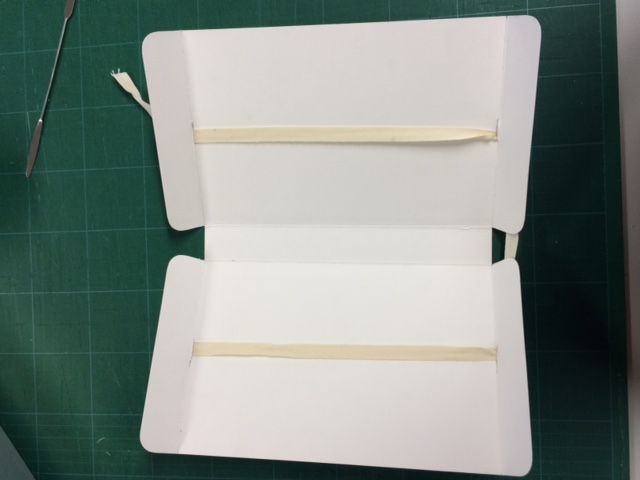
 Finished book enclosure
The enclosures will protect the books from physical damage caused be handling, and in addition will act as a barrier against dust and the environment while the books are in storage.
 Books looking happy in their new enclosures
Keep an eye out for future posts about this project over the next couple of months!
Look, there’s a libretto in the library!
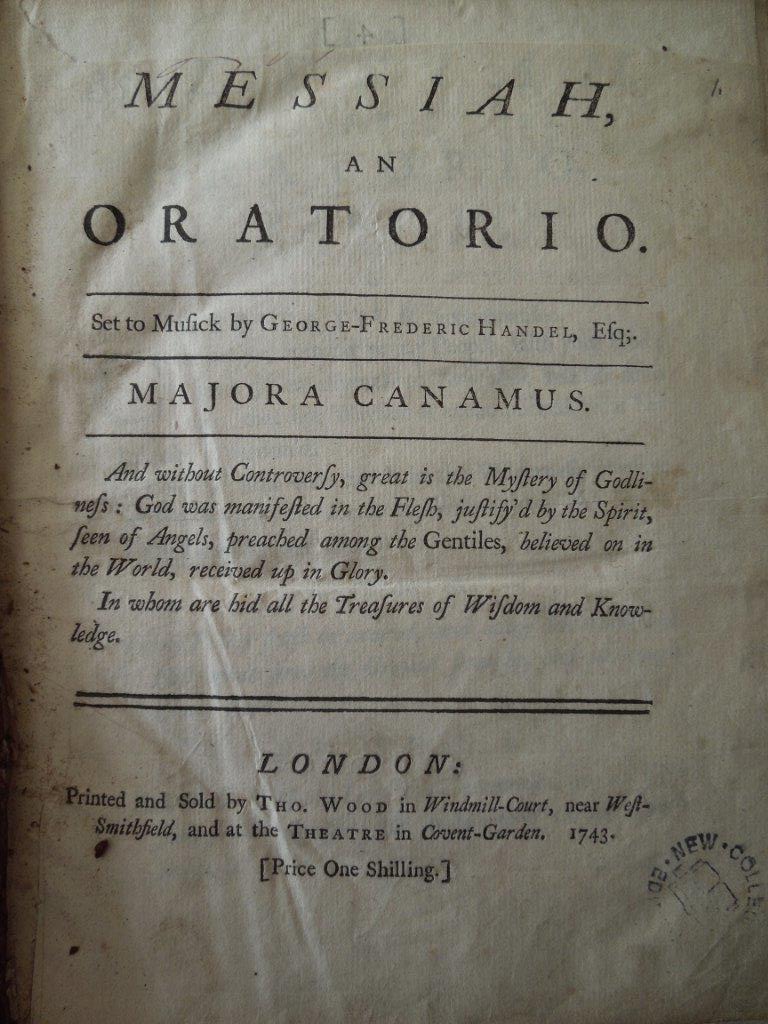
Handel, George. Messiah : an Oratorio.
New College Library O.b.2/1
It’s not every day that you find a rare edition of Handel’s Messiah in your library but I’m delighted to say that we have one at New College Library! This recently catalogued pamphlet from our Special Collections appears to be the first printing in England, and second edition overall of the libretto of Handel’s Messiah (The first edition was in Dublin.) It is also the first edition printed in England by six years. According to Elizabeth Lawrence, EUL Assistant Rare Books Librarian, “The oratorio was first performed in Dublin in 1742, and then again in London in March 1743. The publication we have, the libretto, known as the ‘word book’, was published to sell at the theatre, so the audience had half an idea what was going on. There are no copies of this edition currently on ESTC.”
Cambridge University Press E-Book Additions – November

A further 306 e-books published by Cambridge University Press have been added to DiscoverEd. Subject areas cover most disciplines. See the list here – tab 1 contains the monographs and tab 2 contains the course books.
Further info
Further information about our e-books is available from http://www.ed.ac.uk/information-services/library-museum-gallery/finding-resources/ebooks
If a book you require is not held by the library, please visit our Library Resources Plus webpage.
E-Resources Access Alert – EZProxy issues
There are currently intermittent access problems to e-resources via EZProxy links which are being investigated by our IT team.
Eg http://www.ezproxy.is.ed.ac.uk/login?url=http://www.oxfordscholarship.com/oso/public/ may not work but if you drop the “http://www.ezproxy.is.ed.ac.uk/login?url=” portion e.g. http://www.oxfordscholarship.com/oso/public the link will work.
Please see http://edin.ac/1bjVuCC for details of how to access E-Resources during this time, especially if off campus.
Further updates may also appear on the IS Alerts page http://reports.is.ed.ac.uk/alerts/.
We apologise for any inconvenience during this time.
Opening Doors with Bluetooth Beacons
Location-based intelligence is a growing area of importance in the academic library environment (as identified in the most recent NMC Horizon Report) and we’ve been exploring how Bluetooth beacons can be used to deliver information and content to users based on their location in the library space.
Earlier this year we used the technology with Google Glass to create an immersive visitor experience as part of the Something Blue exhibition: beacons were placed next to several exhibits in the gallery space and when users came within proximity, a video was activated on the Glass headset.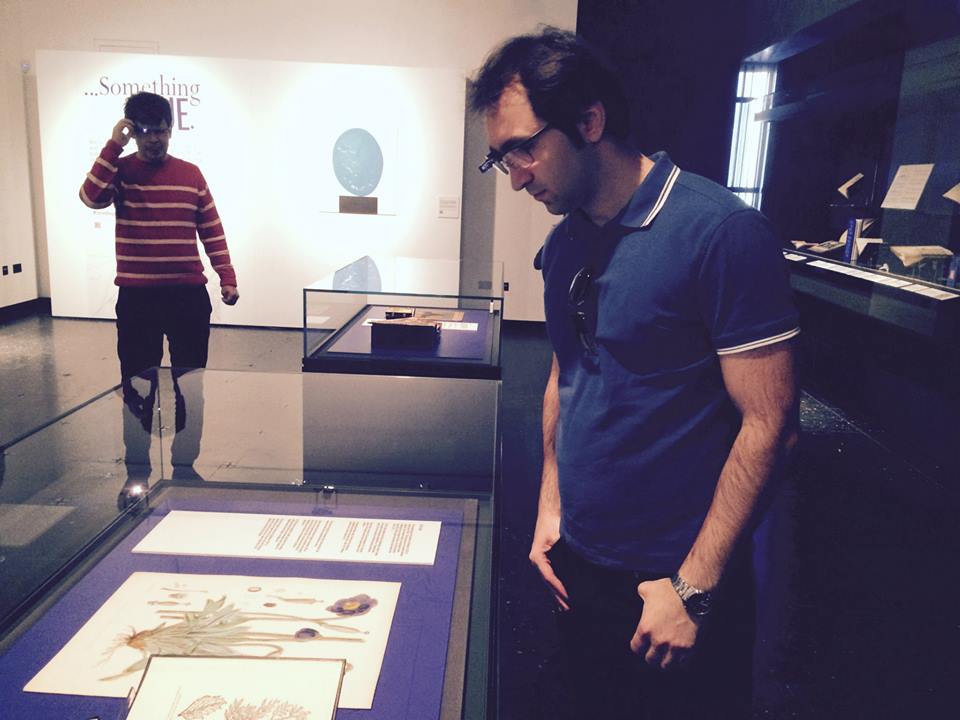
More recently, we’ve started to explore ways in which beacons can be used to provide tours of the library building itself. There are several potential use cases for this, such as a tour for new undergraduates showing them where key services are located, or a tour of the paintings on display in the main library for art enthusiasts, but we decided to create a tour of the building for the general public in order to tie in with Doors Open Day 2015. Our library was designed by the British architect Sir Basil Spence and A-listed in 2006: its history is of real interest to our visitors.
Working with colleagues from across Information Services, we developed a tour app (available from the Apple App Store and Google Play) which uses beacons to tell the story of the library building and service. Beacons were set up at seven locations and users who had installed the app on their phone were sent a notification whenever they came into proximity of one – tapping the notification provided the user with a short, 1-2 minute long, video about the area they were in, such as this general introduction to the building:
We had originally hoped to use beacons to create a form of ‘internal GPS’ to show the user their location in the library space (much like the blue ‘you are here’ dot on Google Maps) but we found that their inaccuracy over three metres made it impossible to trilaterate location accurately enough.
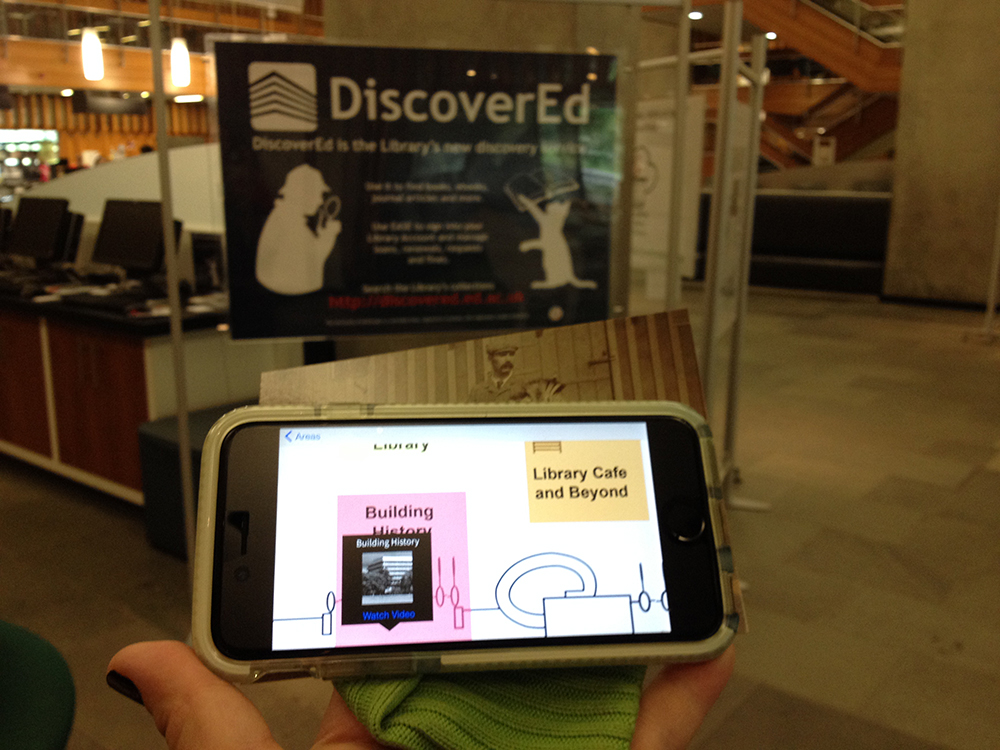
Around 45 people downloaded the tour over the weekend and the feedback was extremely positive. We learned some important lessons from this application, which will inform future uses of technology in this way.
- Have a backup content delivery mechanism: make sure the content can be accessed manually through the app if the beacons don’t work. This also allows visitors to access the videos once they have left the building.
- Have staff on hand to help people download the app: many visitors needed assistance to access the Wi-Fi network and download the app from the relevant online store.
- Make sure Wi-Fi is available: provide Wi-Fi so that visitors don’t need to use their data connection to download the app, particularly as apps can be quite large (our app was 50MB). We set up a Wi-Fi hotspot for people who didn’t have access to the network.
- Provide some basic signage in the physical space: let people know when they are in a beacon zone and provide QR codes linking to the app stores in order to assist with the download.
- Bluetooth: make sure users switch it on!
- The content is more important than the medium: we got good feedback for our experiment but, ultimately, a beacon is just a delivery mechanism and it was crucial that we provided high quality content. It took in the region of 50 staff hours to create seven two-minute videos.
- Having to download an app is a huge barrier: the need to download an app prevented many visitors from engaging with the tour.
We’re continuing to explore the use of beacons in the library space and recently secured funding to see how Google’s new Eddystone beacon can be used to provide information and updates to library users throughout the building. We are especially keen on exploring the potential for Eddystone to bypass the need to download an app and will blog more as the project progresses!
Gavin Willshaw (Library & University Collections) , Ben Butchart (Edina), Sandy Buchanan (Edina), Claire Knowles (Library & University Collections)
Trial access to IBIS World

We have trial access to IBISWorld until 4th December. Update : Subscription started January 2016.
IBISWorld is an online industry intelligence solution. Covering 432 UK industries at SIC L5, each of its industry reports provides the most detailed performance data and analysis on the market; supply chain information; forecasts; risk scores; operating strengths and weaknesses; analysis of external drivers; major player market strategies; and industry profit and costs benchmarks. Reports are updated three times per year on average ensuring the most up to date research possible.
In addition to coursework/assignments, these reports would be of use to students researching industries for placements, future careers (including start up research) and interview preparation.

Feedback and further info
We are interested to know what you think of this e-resource as your comments influence purchase decisions so please do fill out our feedback form.
A list of all trials currently available to University of Edinburgh staff and students can be found on our trials webpage.
10,000th open access item added to the Edinburgh Research Archive

Thanks to a major digitisation project being undertaken by Library & University Collections we are proud to announce our 10,000th open access item has recently been deposited in the Edinburgh Research Archive (ERA).
ERA is a digital repository of original research produced at The University of Edinburgh. The archive contains documents written by academic authors, based or affiliated with Edinburgh that have sufficient quality to be collected and preserved by the Library, but which are not controlled by any other organisations (for example commercial publishers). Holdings include full-text digital doctoral theses [6150], masters dissertations [950], project reports, briefing papers and out-of-print materials. Current research produced by the University is available from the research portal, which has 101,860 records, of which 28,220 have open access documents attached.
Since 2005 the majority of PhD theses issued by the University have been submitted in a digital format, and around 20 recently completed PhD theses are added each week. Our digitisation activities seek to make accessible older unique content which is only available onsite in the Special Collections reading rooms. The oldest University of Edinburgh thesis archived in ERA was originally published in 1819.
Theatre in Video
In 2013 we acquired Theatre in Video which contains more than 250 definitive performances of the world’s leading plays, together with more than 100 film documentaries, online in streaming video – more than 500 hours in all, representing hundreds of leading playwrights, actors and directors. This video resource can be accessed from the Database A-Z list or Databases by subject for English Literature.
Now, we have been offered a free trial of Volume II of Theatre in Video which includes new, international, and contemporary performances; ground-breaking documentaries; and critical instructional series. The trial will last until 30th Nov 2015. To access the trial, please go to the Library’s e-resources trial site. Feedback welcome. 
The publisher Alexander Street Press has given the following information about the content of Theatre in Video: Volume II:
PERFORMANCES: This release of Theatre in Video: Volume II includes almost forty hours of either live performance or cinematic productions of plays from classical playwrights such as William Shakespeare, Molière, Voltaire, and Anton Chekhov but also incorporates new, contemporary writers such as Philip Kan Gotanda, Alexander Buzo, and William Yang. Examples include:
- Sadness from the National Film and Sound Archive of Australia (1999): Award-winning photographer William Yang explores issues of grief, family and identity in this adaptation of his acclaimed stage performance. Through this poetic montage of storytelling, photography and stylized reenactment, Yang brings to life the stories of his family and friends.
- Sweeney Todd from Image Entertainment (2001): The San Francisco Symphony Orchestra’s 2001 concert production of Stephen Sondheim’s musical is superb and (even without scenery) theatrically effective. The performers are in costume and use a few essential props such as Todd’s razor, but more than these details the quality of their singing and acting makes this production stand out. Features Tony Award-winners Patti LuPone and Neil Patrick Harris.
- Candide from Image Entertainment (2004): Leonard Bernstein’s comic operetta comes to new life under the guidance of director Lonny Price (A Class Act). Based on the classic Voltaire tale of an innocent young man’s journey through a life filled with colorful characters and unexpected life lessons, this production features Tony Award-winners Patti LuPone and Kristin Chenoweth.
- Modern Moliere: Tartuffe from TMW Media Group (2007): This contemporary version of Moliere’s classical comedy, Tartuffe, is the timeless story of a religious impostor who tries to steal his wealthy benefactor’s wife, daughter and fortune. Set in modern-day Los Angeles and told all in rhyme, Tartuffe comes brilliantly alive on screen.
- Shakespeare: Twelfth Night (Globe)** from Opus Arte (2013): One of Shakespeare’s best-loved comedies, Twelfth Night was ‘blissfully reborn’ (Telegraph) for the 2012/13 season at London’s Globe Theatre, under the direction of Tim Carroll. The tale of misdirection and deception is performed here by an all-male cast, among whom we find Mark Rylance as Olivia and Roger Lloyd-Pack as Sir Anthony Aguecheek. The production also marks Stephen Fry‘s return to the stage as the pompous Malvolio, ridiculous in his yellow stockings.
- Sado Tempest from John Williams (2012): Arashi mixes Japanese rock, Noh Masks, and the weird volcanic landscapes of Sado Island in a radical reworking of Shakespeare’s The Tempest. In this Tempest the storm has gone badly wrong and ruined the island, Caliban is now in charge, Miranda has gone crazy, and Prospero is missing – presumed dead.
DOCUMENTARIES: With almost six hours of key documentary in this release, Theatre in Video: Volume II explores independent theatre scenes, the internationality of theatre, and the lives of acting giants. Examples include:
- Black Theater: The Making of a Movement from California Newsreel (1978): Black Theatre: The Making of a Movement documents the birth of a new theatre out of the Civil Rights activism of the 1950s, ’60s and ’70s.
- Amazing Scenes from the National Film and Sound Archive of Australia (1980): Spike Milligan takes a look at the Australian fringe theatre scene and finds a colourful, somewhat offbeat array of talent, including David Argue, Cappriccios, Circus Oz, Clowneroonies (featuring Geoffrey Rush), and many more.
- Pram Factory from the National Film and Sound Archive of Australia (1994): In the early 1970s Melbourne was home to the Australian Performing Group, a theatre collective that quickly became a focal point for the intellectual, artistic and political life of those turbulent times.
- Shakespeare, India and Me** from electric sky (2012): In Shakespeare, India & Me, Felicity Kendal, one of Britain’s best loved actors, tells the story of India’s long love affair with Shakespeare, from the first days of Empire to Bollywood and beyond.
- Elaine Stritch: Shoot Me** from Smart Broad Films (2013): In her final years, Broadway legend Elaine Stritch remained as ferociously funny as ever, moving from project to project with unparalleled zest and zeal. This bold, hilarious, and poignant documentary reveals the uncompromising Tony and Emmy Award-winner both on and off the stage.
INSTRUCTIONAL MATERIAL: Instructional material is key in any drama department. This release of Theatre in Video: Volume II brings customers 65 hours of content across a wide range of topics: from how to run the front of house to the difference between acting for the stage versus acting for a TV series. Examples include:
- Audition Series with Michael Shurtleff from First Light Video Publishing: Michael Shurtleff teaches an approach to acting that helps students learn to locate their own inner strengths and bring these strengths to bear with maximum energy and force in each role and each moment on the stage.
- Actor’s Notes** from Sound Venture: Following in the footsteps of our very successful series on ballet and classical music, this series examines the art of acting from the actor’s point-of-view. Hosted by veteran actor, Jennifer Dale, the series features interviews and performances by some of Canada’s greatest stars, working in a particular genre of acting: Feature Films, TV Series, Shakespeare, Musical Theatre, from Stage to Screen, and Comedy.
- Producing for the Theatre Series from TMW Media: This actually includes three sub-series, separated into different categories, covering all aspects of the business of theatre. The following playlists are available for each of these sub-series:
- Dreamers and the Builders: This sub-series examines the jobs of the creative people behind theater productions and considers their processes. It explores the various aspects of the work of actors, directors, playwrights, designers, and technicians and discusses the ways in which they work individually and collaborate.
- Forces Who Run the Theatre: This sub-series examines the roles and responsibilities of the people who control the venues, content, and talent in theatre and provide a wide panorama of what theatre is and who ‘makes it happen.’
- Business of the Theatre: This sub-series describes the business aspect of producing the play, how you raise the money to capitalize a play or musical, structuring budgets to account for pre-production and ‘running’ costs, and developing a marketing/publicity and advertising plan.
William Henry Playfair, architect
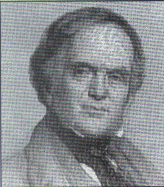
William Henry Playfair
On 2 Nov 2015, the CRC hosted a seminar which looked at the figure of William Henry Playfair (1790-1857), discussing his life and work and looking in some detail at a range of architectural drawings which had been selected from our collection.
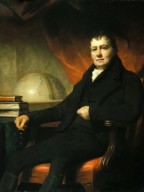
John Playfair
Playfair was born was born in Russell Square, London, July 1789. On the death of his father, architect James Playfair, he was sent to reside with his uncle in Edinburgh. Professor John Playfair, mathematician and geologist and a leading figure in the Edinburgh Enlightenment, took control of his nephew’s education. Following his father’s profession, the young Playfair studied under William Starke of Glasgow. Following Starke’s death in 1813, Playfair moved to London where he worked in the offices of James Wyatt and Robert Smirke, returning to Edinburgh in 1816.
He established himself professionally by winning the commission in 1817 to complete the unfinished University buildings (leaving the front as designed by Robert and James Adam). He also designed the city’s Royal Terrace and Regent Terrace on the Calton
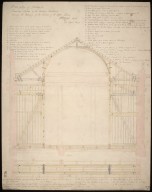
College of Edinburgh Transverse Section of the Southern Buildings
Hill estate; the unfinished National Monument on Calton Hill; and, the Royal Scottish Academy and the National Gallery on the Mound. While Playfair’s most important works in Edinburgh have been executed in the Greek revivalist or classical style – earning for Edinburgh the title of ‘Athens of the North’ – he was competent in other styles too. He designed New College for the ten newly established Free Church of Scotland, a jagged-lined rendering of the Gothic style. He also built country houses and mansions in the Italianate and Tudor styles.
The discussion in the seminar was not structured in any major way but flowed directly from looking at the drawings we had selected to view. Alongside the physical drawings, we also looked at digitised ones, using the complement of both to do things which one or other could not do alone.
With over 5000 to choose from, electing the drawings was never going to be an easy task. However we settled on one or more drawings relating to the following of Playfair’s projects:
- College of Edinburgh
- Royal Observatory
- Dollar Academy
- Blenheim Place
- Elm Row
- Royal Institution
- Royal Institution Additions
- National Monument
- Royal College of Surgeons
- Stewart Monument
- Donaldson’s Hospital
- New College Edinburgh
Links:
- All of the digitised drawings can be viewed in a dedicated online gallery
- View Playfair in the Archives Catalogue
Collections
 Hill and Adamson Collection: an insight into Edinburgh’s past
My name is Phoebe Kirkland, I am an MSc East Asian Studies student, and for...
Cataloguing the private papers of Archibald Hunter Campbell: A Journey Through Correspondence
My name is Pauline Vincent, I am a student in my last year of a...
Hill and Adamson Collection: an insight into Edinburgh’s past
My name is Phoebe Kirkland, I am an MSc East Asian Studies student, and for...
Cataloguing the private papers of Archibald Hunter Campbell: A Journey Through Correspondence
My name is Pauline Vincent, I am a student in my last year of a...

Projects
Cataloguing the private papers of Archibald Hunter Campbell: A Journey Through Correspondence
My name is Pauline Vincent, I am a student in my last year of a...
Archival Provenance Research Project: Lishan’s Experience
Presentation My name is Lishan Zou, I am a fourth year History and Politics student....