Home University of Edinburgh Library Essentials
May 6, 2026
Trial access to IndiaStat

We have on campus access to IndiaStat until 11th December. This resource has been added to the e-resources trials webpage.
 IndiaStat provides India-specific socio-economic statistical facts and figures from various secondary level authentic sources. Includes 19 sector specific information including industry, education, health, banks and financial institutions, companies, co-operatives, crime and law, population, foreign trade, labour and workforce, housing, media, power, transport, urban-rural. Provides socio-economic information on 31 Indian states and union territories. Provides comprehensive information on 6 main geographical regions of India. Data and statistics about India available on Indiastat.com can easily be downloaded in MS-Word/Excel/ HTML formats.
To access the site, click on the Login tab at the top banner of the site and select the IP Login option.
Feedback and further info
We are interested to know what you think of this e-resource as your comments influence purchase decisions so please do fill out our feedback form.
A list of all trials currently available to University of Edinburgh staff and students can be found on our trials webpage.
UPDATE: Subscription scheduled to start April 2016
Trial access to e-Duke Books Scholarly Collection
 We have trial access to all of the e-books published by Duke University Press hosted on the Highwire platform. This trial runs until 18th January.
The e-Duke Books Scholarly Collection consists of 2100 titles in humanities and social sciences. Key subject areas are Anthropology, Art History & Theory, Asian Studies, Cultural Studies, Ethnic Studies, Film & Television, Gender & Sexuality Studies, Latin American Studies, Political Theory and Science Studies. See the title list at https://www.dukeupress.edu/Assets/Downloads/dup_info_titles.xls (3rd tab).
Access the trial via our e-resources trial page. We have also added the individual e-books to DiscoverEd.
Feedback and further info
We are interested to know what you think of this e-book collection as your comments influence purchase decisions so please do fill out our feedback form.
A list of all trials currently available to University of Edinburgh staff and students can be found on our trials webpage.
Last chance to try out IBISWorld
 Our trial to IBISWorld ends on Friday. Please fill out a feedback form if you would like the Library to subscribe.
IBISWorld is an online industry intelligence solution. Covering 432 UK industries at SIC L5, each of its industry reports provides the most detailed performance data and analysis on the market; supply chain information; forecasts; risk scores; operating strengths and weaknesses; analysis of external drivers; major player market strategies; and industry profit and costs benchmarks. Reports are updated three times per year on average ensuring the most up to date research possible.
Further details at https://libraryblogs.is.ed.ac.uk/eresources/2015/11/10/trial-access-to-ibis-world/
A list of all trials currently available to University of Edinburgh staff and students can be found on our trials webpage.
Hugh MacDiarmid introduces Lewis Grassic Gibbon (John Leslie Mitchell 1901-1935), author of ‘Sunset Song’, to publisher Stanley Nott
FROM LETTERS IN THE HUGH MACDIARMID (C. M. GRIEVE) COLLECTIONS HERE AT EDINBURGH
 During this 80th anniversary of his early death, a new film adaptation of Sunset Song by Lewis Grassic Gibbon is to be released on 4 December 2015. Lewis Grassic Gibbon was the pseudonym of James Leslie Mitchell who was born in Auchterless in February 1901.
 Mitchell was raised in Arbuthnott, Kincardineshire, and in his teens he started work as a journalist with the Aberdeen Journal (which would later become the Press and Journal) and also for the Scottish Farmer. In 1919 he joined the Royal Army Service Corps (RASC) and then in 1920 he joined the Royal Air Force (RAF). In 1925 he married and settled in Welwyn Garden City. He wrote a number of works under both his real name and his pseudonym before dying in his 30s of peritonitis brought on by a perforated ulcer – in February 1935.
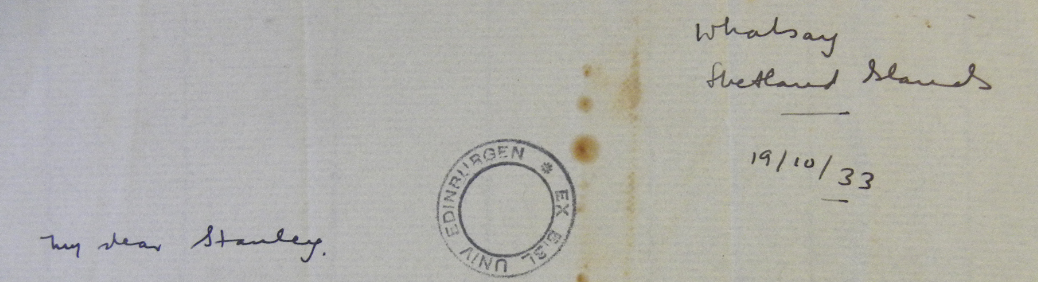
Letter from Grieve to Stanley Nott (Grieve Coll-18)
His earliest writing is described in a letter from Christopher M. Grieve (Hugh MacDiarmid) to Charles Stanley Nott (1887-1978) author, publisher and translator, in what reads almost like a letter of introduction. The letter is dated 19 October 1933, and was written from Whalsay, Shetland.
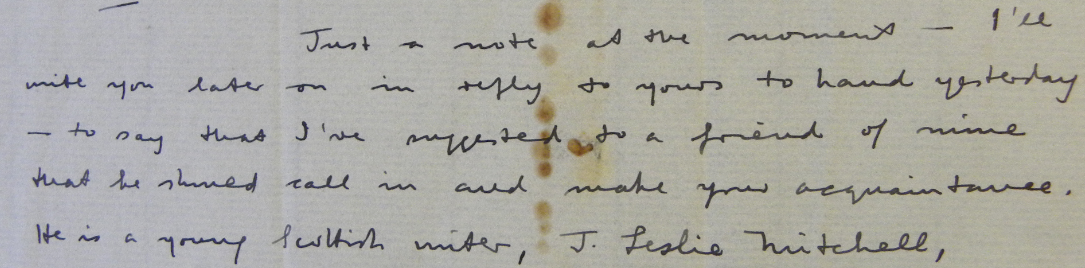
Letter from Grieve to Nott (Grieve, Coll-18)
Grieve writes to ‘My dear Stanley’:
I’ve suggested to a friend of mine that he should call in and make your acquaintance. He is a young Scottish Writer, J. Leslie Mitchell, who has published histories of Mexican antiquities etc but also novels and imaginative romances over his own name, the latest being an historical novel…
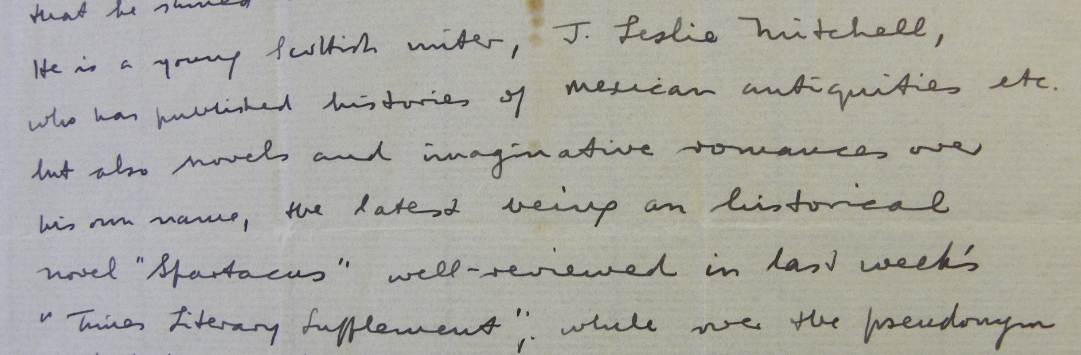
Letter from Grieve to Nott (Grieve, Coll-18)
When referring to ‘histories of Mexican antiquities’, Grieve may have been pointing towards The Conquest of the Maya (1934). The historical novel mentioned was Spartacus which had been ‘well reviewed’ in the Times Literary Supplement, and which had been written under his own name, J. Leslie Mitchell.

Letter from Grieve to Nott (Grieve, Coll-18)
Grieve goes on:
…over the name Lewis Grassic Gibbon he has lately scored a great success with ‘Sunset Song’ and ‘Cloud Howe’, the first two volumes of a trilogy of novels…

Letter from Grieve to Nott (Grieve, Coll-18)
At the time of this correspondence to Nott – October 1933 – Grieve tells us that Mitchell’s publishers ‘are Jarrold’s, and Faber and Faber for a biography of the explorer, Mungo Park’, and that Mitchell and he ‘are collaborating in a miscellany on Scotland’. The Mungo Park work in question was Niger: The Life of Mungo Park (1934), and the collaborative work by Grieve and Mitchell was Scottish scene (also 1934).
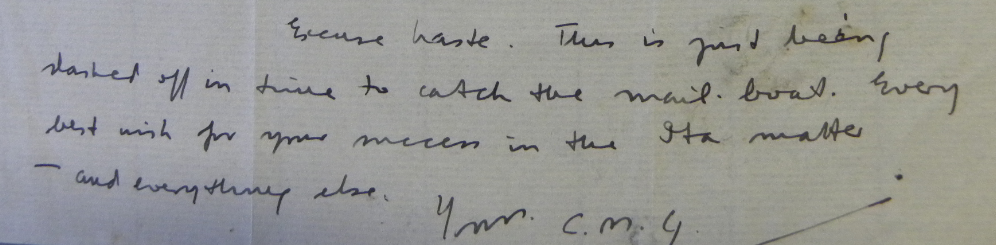
Letter from Grieve to Nott (Grieve, Coll-18)
During these Whalsay years – island life in east Shetland – Grieve then writes:
Excuse haste. This is just being dashed off in time to catch the mail-boat […] Yours C.M.G.
Dr. Graeme D. Eddie, Assistant Librarian Archives and Manuscripts, Centre for Research Collections (Special Collections)
Home Front – Theatrical group – ‘The Eves’, 1916-1917
AN ALBUM OF PHOTOGRAPHS AND EPHEMERA TELLS THEIR STORY
 For the war effort, various Home Front groups and organisations produced entertainments to raise funds for the Red Cross and other organisations. This happened all across the country. One such theatrical group – ‘The Eves’ – performed local entertainments in Perthshire. Rehearsals for ‘The Eves’ theatrical group were held at the home of Helen Wilson at Colquhalzie, or Kilcolquhalzie, in Perthshire.
Under the curation of the Centre for Research Collections, Edinburgh University Library, an album of photographs and ephemera, including concert programmes and news clippings, offers an insight into the performances of ‘The Eves’.

One of ‘The Eves’ – Helen Wilson, wife of Capt. James R. Wilson (Coll-1668).
Most of the cast of ‘The Eves’ were female and the name of their group was derived from the fact that their husbands, brothers, and fathers (their Adams) were serving in the forces. They offered sketches taken from London musical theatre productions, songs, recitations, choruses and dances. They were accompanied by piano or by the Auchterarder Ladies Orchestra.

Most of ‘The Eves’ performers were women (Coll-1668).
Mrs. Helen Wilson of Colquhalzie was the daughter-in-law of Sir John Wilson (1844-1918) of Airdrie House, businessman, Unionist politician, Chairman of the Wilsons and Clyde Coal Company, and MP for Falkirk Burghs from 1895 to 1906. Her husband, Captain James R. Wilson – Sir John’s son – served with the Lanarkshire Yeomenry in Gallipoli and Egypt.

Military uniforms and Sailor suits and caps – HMS ‘Victory’ (Coll-1668).
‘Eves’ performances took place at, for example, the local village hall in Muthill, August 1916, in aid of the National Work Party…

‘The Eves’ to perform at Muthill Hall, August 1916 (Coll-1668).
…and other performances were at Porteous Hall, Crieff, September 1916, in aid of the Scottish Red Cross, and at the Pavilion Hall, Glasgow, later in 1916.

Performance to be given at Crieff, September 1916 (Coll-1668).
In the album acquired by Edinburgh University Library, a photographic reproduction of a news clipping from The Strathearn Herald, 26 August 1916, describes the Variety Entertainment at Muthill Hall where ‘the seats were extensively booked throughout Muthill, Crieff and Auchterarder districts’. Indeed, ‘fully half-an-hour before the starting-time […] motor cars began to arrive with front-seat ticket-holders, as well as public vehicles which brought numbers more from populous centres’. The programme opened with Mrs Wilson and a Chorus offering a ‘fine rendering of Ivor Novello’s popular Keep the Homes Fires Burning.
The performance was ‘shown nicely under the special lighting arrangements regulated […] and worked from a dynamo driven by Mrs. Wilson’s private motor outside’.

Performance by ‘The Eves’ at the Pavilion Theatre Glasgow, November 1916 (Coll-1668).
A Special Matinee at the Pavilion Theatre on 7 November 1916 was held to raise funds to purchase Motor Ambulance Wagons for Glasgow and District. ‘The Eves’ Committee were indebted to the Pavilion Theatre Directors for giving the use of the Theatre, and to Mr. D. Y. Cameron A.R.A. for ‘so graciously having designed the cover’ of the Matinee Programme.

Special matinee programme cover, designed by D. Y. Cameron A.R.A. (Coll-1668).
David Young Cameron (1865-1945) – knighted in 1924 – had been a student of both the Glasgow School of Art and the Edinburgh School of Art.

Detail from Cameron’s programme for the Special Matinee performance of ‘The Eves’ in Glasgow (Coll-1668).
The Special Matinee at the Pavilion Theatre included performances by Mrs. Wilson and her son ‘little Jock Wilson’. With the Chorus she sang ‘Molly, the Marchioness’ from The Country Girl, ‘The girl with the brogue’ from The Arcadians, ‘The flower girl’, and ‘The lads who play the game’. Unaccompanied, and with Miss S. Bulloch Graham she sang ‘The girl with the brogue’ from The Arcadians, and ‘The Middy’ from ‘The Marriage Market’.
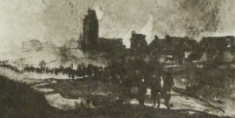
More detail from the Cameron work (Coll-1668).
Again, the album describes the Pavilion Theatre performances from news clippings. A feature of the charity event was the floral display – on the stage and in the Theatre – and the distribution of 3000 buttonholes. Apparently, one of the highlights ‘was the appearance of little Jock Wilson […] the little fellow presented a bouquet and ran off the stage with as little self-consciousness as if he had been in his nursery’.

Some of ‘The Eves’ at one of their performances (Coll-1668).
After their successful appearance in Glasgow, ‘The Eves’ gave a Grand Concert and Variety Entertainment at the Pavilion Theatre, Johnstone, a few weeks later on 7 February 1917.

Costumes of ‘The Eves’ (Coll-1668).
This was for a special appeal by the 38th Renfrew Voluntary Aid Detachment for the County of Renfrew Red Cross Fund.
Dr. Graeme D. Eddie, Assistant Librarian Archives & Manuscripts, Centre for Research Collections
New books for Social and Political Science
Thanks to recommendations from members of staff and requests via RAB from students the Library is continually adding new books to its collections both online and in print. Here are just a small number of the books that have been added to the Library’s collections this semester for the School of Social and Political Science and these demonstrate the wide range of subjects being taught, studied and researched within School.
 Sexting panic : rethinking criminalization, privacy, and consent by Amy Adele Hasinoff (e-book).
Russia and the new world disorder by Bobo Lo (shelfmark: JZ1616.A5 Lo. Also available as e-book.)
Why India votes? by Mukulika Banerjee and Jonathan Spencer (shelfmark: JQ292 Ban.)
Challenging child protection : new directions in safeguarding children by Lorraine Waterhouse and Janice McGhee (shelfmark: HV713 Cha.)
Becoming salmon : aquaculture and the domestication of a fish by Marianne E. Lien (shelfmark: SH167.S17 Lie. Also available as e-book.) Read More
E-Resource Trials – last chance to try out
The following e-resource trials end on Monday. These can all be accessed from the e-resources trial page where links to trial feedback forms can also be found.
 Voxgov – a distinctive resource that pulls together the vast amount of US Federal Government information, communications and publications and allows you to easily search, discover, compare and get full text access to this material. Content includes official releases, congressional documents, legislation, federal register and social media. Coverage is from 2005 onwards although older material is being added as it is digitised by the US Federal Government.
 Theatre in Video: Volume II brings together classic and contemporary plays and documentaries. With a greater focus on contemporary and international productions, Theater in Video: Volume II offers a simple way for libraries to acquire highly valued and often difficult-to-find performances. Users can view the works of widely studied playwrights and theatre artists from around the globe, including many new performances from Shakespeare’s Globe Theatre collection (Opus Arte), Theatre Arts Films, the BBC, and TMW Media Group
 The Cecil Papers – a collection of documents, principally from the reigns of Elizabethan I and James I/VI, privately held by the Gascoyne-Cecil family at Hatfield House in Hertfordshire. The Cecil Papers contain nearly 30,000 documents gathered by William Cecil (1521-98), Lord Burghley and his son Robert Cecil (1563-1612), First Earl of Salisbury. Occupying some of the highest offices of state in the land (both men were Secretary of State to Elizabeth I and Robert Cecil also served her successor, James), these two men were at the heart of events during one of the most dynamic periods in Western history.
 Colonial State Papers – This growing collection offers insight into the colonial history of North America and the West Indies. It includes the National Archives collection CO 1– papers that were presented to the Privy Council and the Board of Trade during 1574-1757. More than 7,000 hand-written documents and more than 45,000 bibliographic records give fascinating insight into British trade, history and overseas expansion between the 16th and 18th centuries.
 Nineteenth Century Collections Online (NCCO) – A ground-breaking resource for 19th century studies, NCCO is a multi-year global digitization and publishing program focused on primary source collections of the long nineteenth century. Collections for this program are sourced through partnerships with major world libraries as well as specialist libraries, and content includes monographs, newspapers, pamphlets, manuscripts, ephemera, maps, statistics, and more.
Cambridge Companions Online
 We have access to all Cambridge Companions Online as they are published. A further 20 new titles in the subject areas of literature and history of ideas have been added to DiscoverED. See the list of new titles here.
June Baker Trust – Emerging Conservator Grant
In this week’s blog post, we hear from Project Conservator, Emily Hick, who recently carried out a self-led continuing professional development project at the CRC, which was funded by the June Baker Trust Grants for Emerging Conservators….
The June Baker Trust was set up in 1990 to promote and encourage the development and study of the conservation of either historical or artistic artefacts in Scotland. Since that time the scheme has awarded more than £25,000 in grants to Scottish conservators for continuous professional development.
The success of these awards led the trustees to develop a new strand of funding for emerging conservators, which has been made possible this year thanks to the generosity of the Gordon Fraser Charitable Trust.
In May 2015, three newly qualified conservators based in Scotland, received awards of up to £1000 each from the June Baker Trust to carry out a project of their own design, and I was lucky enough to be one of them.
My project focused on developing my skills of carrying out surveys for conservation work. I chose to focus on this area after analysing my CV and finding that this was an area of weakness. It is difficult to gain these types of skills as an emerging conservator as often a project has been scoped out before a position starts. If mistakes are made while surveying a collection, and incorrect time and material estimates are given, it can result in going over budget and over time. So these are vital skills to develop.
The project lasted four weeks in total, and I began by spending a day at Royal Commission of Historic and Ancient Monuments in Scotland (RCHAMS). During this time they were carrying out a survey of their whole collection prior to a merger with Historic Scotland. Due to the limited time available, they had developed a very basic survey to gain condition and current housing data. I helped carry out this survey and was also shown a previous, more detailed survey of the whole collection that had been carried out 5 years beforehand, as well as several other types of surveys they had done in the past.
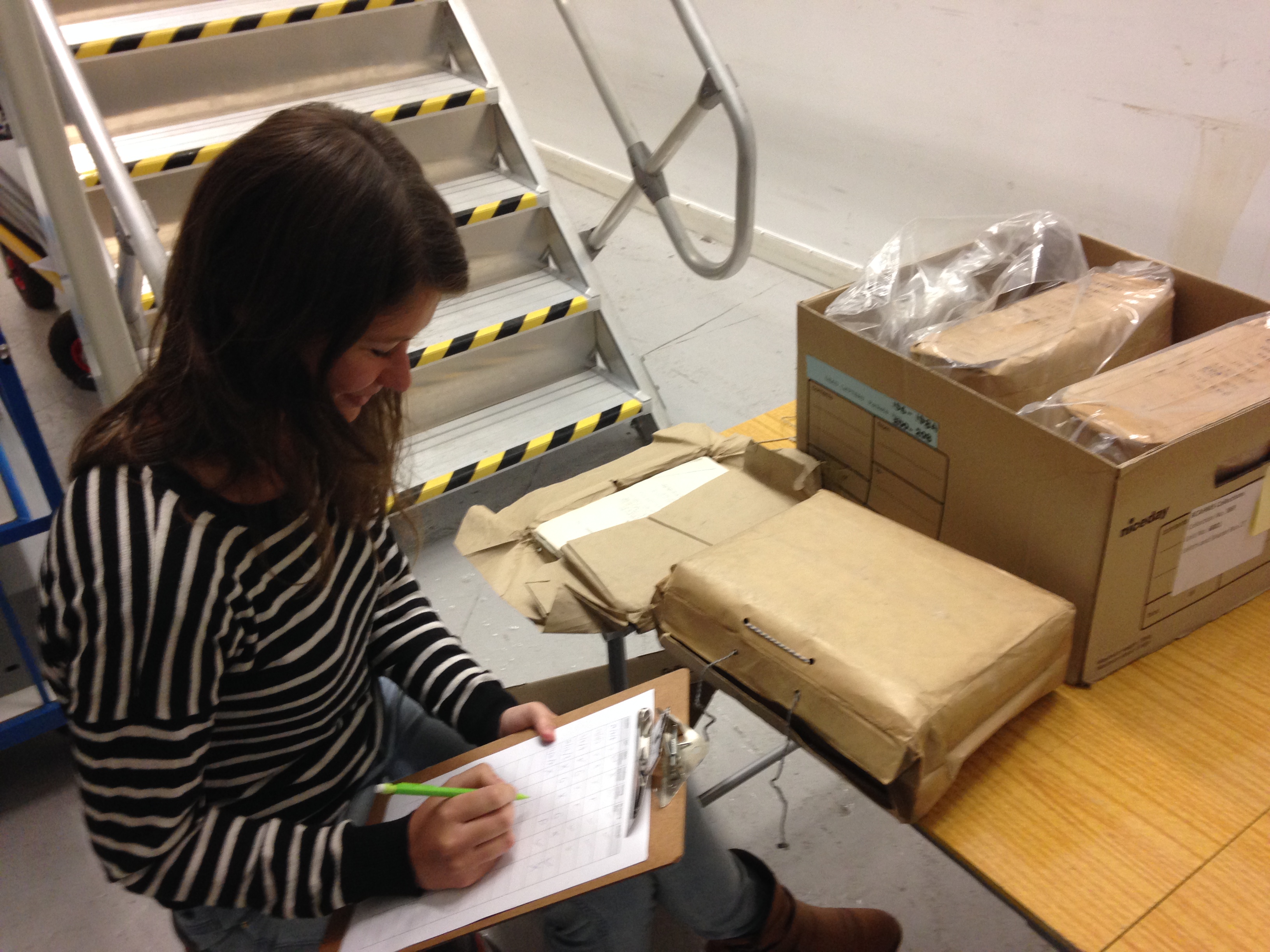
Surveying the Collections at RCAHMS
I also spent two days at the National Library of Scotland (NLS). Here I was shown several surveys in a range of styles; A Preservation Assessment Survey (PAS) of the whole collection using a random sampling method, an item by item survey of the photographic collection, and a basic survey of bound volumes prior to digitisation. The conservators talked about how they change the criteria of the survey depending on how the results would be used, rather than having a ‘one size fits all’ approach, and gave useful tips about what types of questions to include. I also helped to carry out a survey of a collection of printed ballads. I was also shown how to create a Microsoft Access Database to make my own survey form.
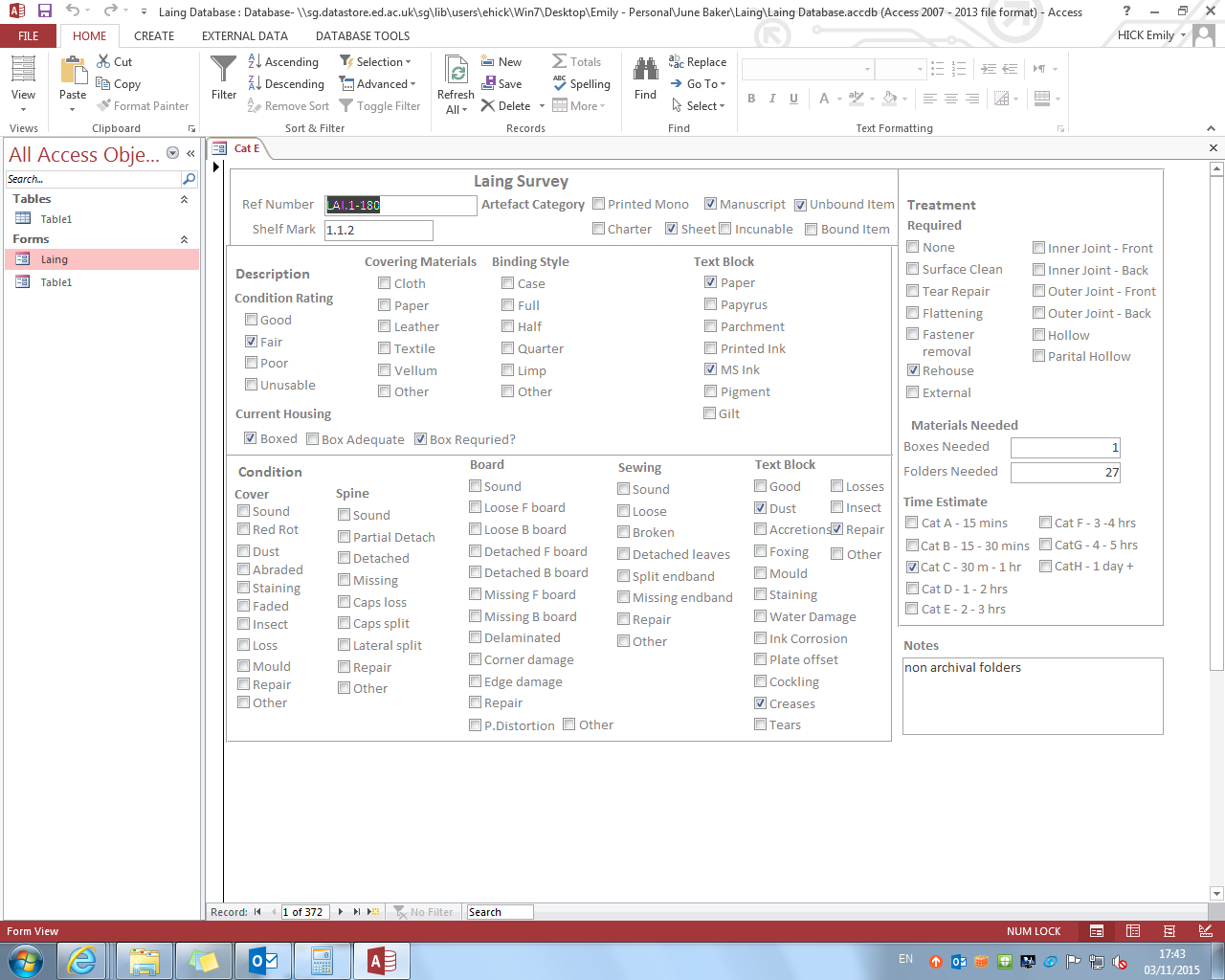
Screenshot of Microsoft Access Database
Following this, I then spent two days carrying out research on survey methods, spending time at Edinburgh University Library and at the National Library Scotland. I also took a day to create two surveys databases on Microsoft Access Database for use in carrying out two collection reviews at the CRC.
At the CRC, I carried out three surveys in total; an item by item survey of the Oriental Manuscripts collection (5 days), and a random sample survey of the Laing collection (5 days). Following this, I spent two days writing up reports which included information on the condition of the collections, recommendations for future work, materials needed and time estimates. I also spent two days carrying out a brief survey on the use of space in the store rooms, suggesting how items could be repackaged to make more efficient use of the shelving.
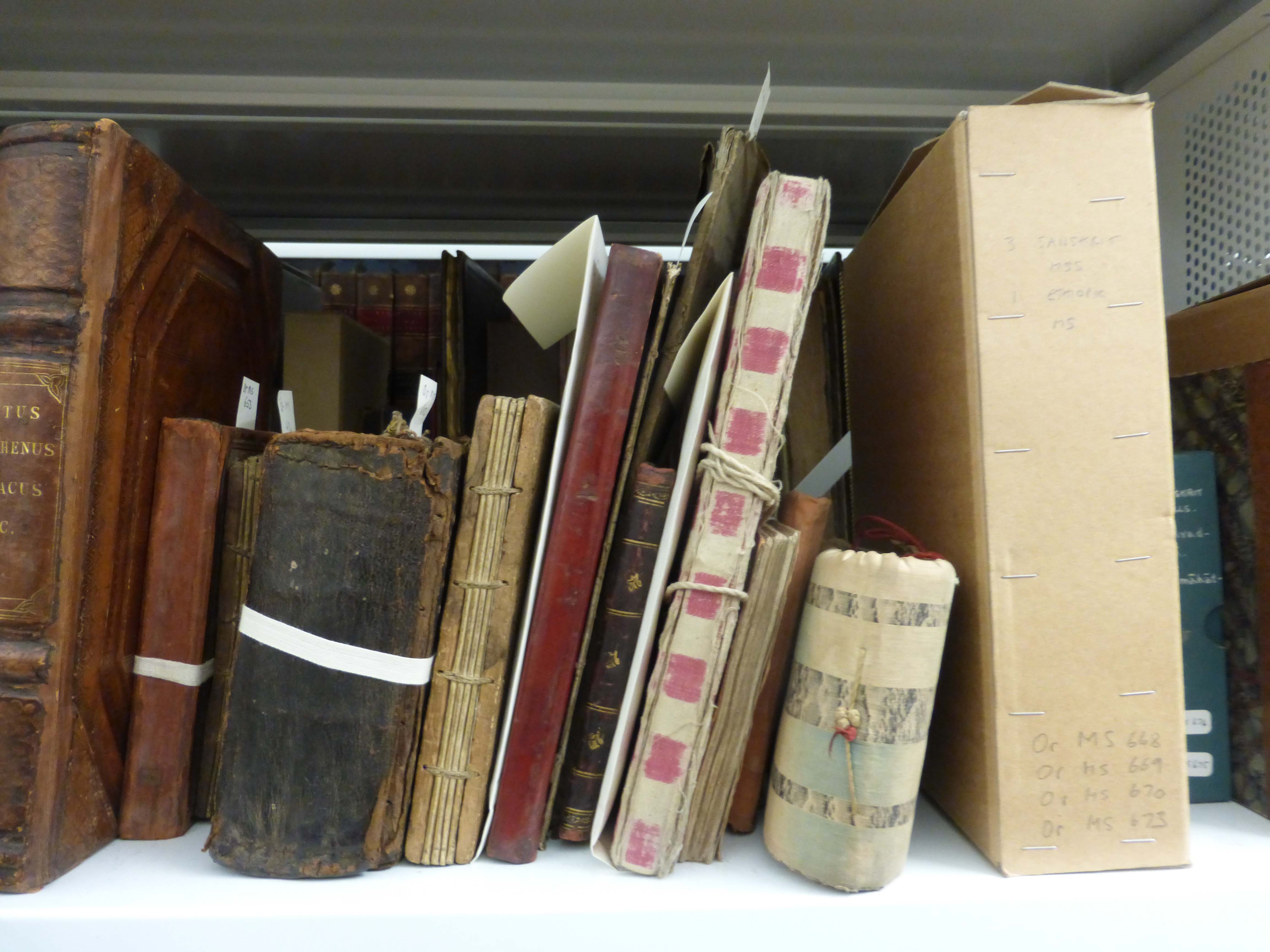
Oriental Manuscript Collection on the Shelves at the CRC
This project has been hugely beneficial to me and helped me gain surveying skills which are frequently asked for in more senior conservation job descriptions. I hope that the reports will also be useful to the CRC and inform future funding bids.
Emily Hick, Project Conservator
Institutionally Authored Books
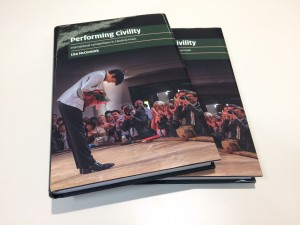 The Scholarly Communications Team estimates that staff at the University of Edinburgh write, edit or contribute to over 500 books annually and the Library aspires to hold two copies of each of these books (one for general loan, one for preservation). In light of this aspiration, Edinburgh University Library has developed a policy relating to the acquisition of institutionally authored books, which encourages staff to donate two copies to the library, wherever this is possible.
Today we received our first donations under this policy, Performing Civility by Dr Lisa McCormick. Lisa generously sent two copies to the Scholarly Communications Team, which has checked that there is a record of the research output on PURE. The print copies have now been sent for cataloguing and should be available very shortly.
Congratulations to Lisa, firstly on her publication and secondly for being the first to donate copies of books under this new policy!
Dominic Tate, Scholarly Communications Manager.
Collections
 Hill and Adamson Collection: an insight into Edinburgh’s past
My name is Phoebe Kirkland, I am an MSc East Asian Studies student, and for...
Cataloguing the private papers of Archibald Hunter Campbell: A Journey Through Correspondence
My name is Pauline Vincent, I am a student in my last year of a...
Hill and Adamson Collection: an insight into Edinburgh’s past
My name is Phoebe Kirkland, I am an MSc East Asian Studies student, and for...
Cataloguing the private papers of Archibald Hunter Campbell: A Journey Through Correspondence
My name is Pauline Vincent, I am a student in my last year of a...
Projects
Cataloguing the private papers of Archibald Hunter Campbell: A Journey Through Correspondence
My name is Pauline Vincent, I am a student in my last year of a...
Archival Provenance Research Project: Lishan’s Experience
Presentation My name is Lishan Zou, I am a fourth year History and Politics student....